An artists journey

Category: Craft

  • The Histogram is Just Data

    The Histogram is Just Data

    I don’t mean to be insulting, but I cannot understand when people look at histograms as some magical, mysterious, and intimidating technical artifact. It is not. It is just data about what our sensor is seeing. The histogram is just data, and it is useful. Use it. Do not be afraid of it.

    Trigger

    A newsletter I received today triggered this semi-rant. But looking back, I see it has been over 3 years since I wrote about histograms, so it is probably time to revisit the subject. This actually is a subject I feel some passion for and believe it needs to be better understood by photographers.

    The newsletter author declared that our histograms lie. I realize that click-bait is commonly used to try to get people to read articles, but I still feel it is being somewhat underhanded. Now, in fairness, the newsletter author made some valid points – except for the part about histograms lying.

    What is a histogram?

    We see this graph of some data and maybe it does look complex and mysterious if you are not used to working with data and don’t know where the data comes from. Let’s get over that by understanding how simple but effective it is.

    By convention we play like our cameras measure light in a range of 0 to 255. There are no units: 0 represents black and 255 is pure white. The convention came from the history of early digital cameras. It is obsolete today, but still used. That is a topic for another day.

    So there are 256 possible values of brightness (0-255). If we go through and count the number of pixels of each value – the number of pixels in the image that have value 0, the number of pixels in the image that have value 1, etc. – and put them on a graph, we have a histogram.

    Here is a simple example:

    Again, black is on the left going to white on the right. Even without me showing the actual image, we can see that there is a “bump” of dark values on the left and a larger hill of bright values on the right. In between is a relatively low and even count.

    What can we learn from this? It is a black & white image, because there is no separate data for red, green and blue. There is high contrast because of the hills at the dark and bright ends. It is bright but not overexposed. There are deep blacks, but not enough to have lost important information. So, even without seeing the image, we can tell a lot about it. Is the image exposed “correctly”? Ah, that is the question my rant is based on.

    This is why histograms are useful. They are useful data about our image. It gives simple information to help us understand our exposure better.

    Benefit

    Today’s mirrorless cameras bring us the amazing benefit of real-time histograms. We can select to see the histogram live in our viewfinder or on the display on the back.

    What is the benefit? We see an immediate graphical view of the exposure the camera is determining. In the example above, we can see that the light tones are very bright, but not overexposed.

    I routinely use it to watch for “clipping” of brights or darks. If there is a large hump of data jammed up against the left or right edge, that is probably a problem. I will often choose to override the camera’s exposure determination to avoid these peaks.

    Again using the example above and knowing that my camera was in aperture priority mode, we see that it chose 1/750 second as the shutter speed. That works OK in this case, but if I did not agree, I would have easily used the exposure compensation dial to adjust the exposure. I do this a lot.

    So the histogram is a quick and easy to get a feeling for the “shape” of the exposure.

    They don’t lie

    Now coming to the basis of my rant: histograms do not lie (actually, they do; I will say how later and why it doesn’t matter).

    The newsletter author gave the example of a picture of some fruit on a dark table with a black background. She said the histogram lied because the camera did not give the exposure she wanted. It tried to make the whole image evenly exposed.

    No, the histogram is just a straightforward measurement of the data. If you take your temperature but don’t like the reading you get, it is silly to say the thermometer lied.

    What the author was describing was that she wanted to expose to have the same look as the scene she saw. This was a case of disagreeing with the camera’s matrix metering calculation. It was doing it’s job of trying to capture all the data that was there and preventing blown out blacks. But she decided to use exposure compensation to force the camera to expose the scene the way she wanted.

    The histogram did not lie. As a matter of fact, she relied on it to do her exposure compensation values. She used the histogram to determine how to override the camera exposure calculation.

    Actually, I would have used the camera’s original exposure determination. I like to have all the data available to work with. This is called exposing to the right. Bringing the brightness down in post processing to the level she wanted is simple, non-destructive, and does not add noise. Capturing the compensated image the way she wanted irreversibly crunches the blacks.

    They lie

    I said they don’t lie, but they do a little. For speed and efficiency the histogram is derived from the jpg preview of the image. Same as the preview shown in the viewfinder or camera back. If you study jpg processing you will see that it alters and discards a lot of information to give a good perceptual result.

    So the histogram is not actually looking directly at the literal RAW data from the sensor. But there is little observable discrepancy. On my camera, I find that it exaggerates the highlight values very slightly. Still, I typically back the exposure off to avoid highlight clipping, so it adds a little conservatism into the process.

    Trust the data you see. It is good enough.

    They’re not the photographer

    The histogram gives you data. It does not determine exposure. People talk about “good” or “bad” histograms. This is a misunderstanding. There are no absolute good or bad ones. What counts is did you get the exposure you wanted.

    There are valid artistic reasons for shooting what some people would consider bad histograms. If it is what the artist wants, it is correct.

    Histograms give us a reading of the exposure. They do not determine what is right. It gives some insight on what the automatic exposure calculation in the camera is trying to do.

    Use it

    The histogram is a brilliantly simple and wonderfully useful tool. We are lucky to have real-time histograms available to us now. It is a game changer. But it is just data. Do not be afraid of it.

    The histogram does not lie. But it does not automatically ensure that the exposure is exactly what you want. You have to sometimes take change and override the camera settings. When you do, the histogram is there showing you the result of your decisions.

    It is not magical or mysterious. It is a great tool. Use it. A craftsman know how to use his tools.

  • Buy My Presets, Make Work Just Like Me!

    Buy My Presets, Make Work Just Like Me!

    Maybe I’ve just gotten on some bad mailing lists, but it seems I am being bombarded by offers to get the “secret sauce” of many photographers. Promises that if I will just take and use their presets I will now have all I need to be just like them. No sweat; no learning, just buy my presets, make work just like me.

    Plugins and presets can be good

    I use plugins, presets, profiles, Photoshop actions, and whatever else I can use productively. There is nothing inherently wrong with any of them. They can be great productivity tools and they are getting more capable all the time.

    Lightroom Classic’s latest technology allowing us to include “AI” masks in a preset – adaptive presets – that can be a great help. This is one reason a larger preset market is appearing. Including the automatic masks makes the presets more general.

    Adobe includes quite a few presets and profiles in Lightroom Classic. Many of them are useful. If you include all of them in your lists you will be wading through hundreds of choices. That’s before buying sets of them from other photographers.

    Maybe it’s just me, but I find too many choices overwhelming. If you are exploring a look for an image, are you really going to try out hundreds of options? Maybe once every few months just to stimulate ideas. But routinely doing that would waste lots of time.

    That is why I carefully curate a small set of presets and profiles that are important to me and that I may actually use. This gets into the next topic.

    If you didn’t make it, you probably won’t know when to use it

    I have tried downloading a couple of sets of presets from well known photographers. What I find is that the presets represent their thinking and choice sets. They had dozens or hundreds of minor variations of some basic edits. E.g. make the sky a little more blue, make the sky even more blue, make it real blue, make the foreground a little warmer, make the foreground even more warm, etc.

    But there was little there I could not do as well and faster by myself, since i know how to edit in Lightroom Classic. If I want to make the sky more blue, that is some simple, almost automatic edits that I can do in a few seconds with little thought. Doing it myself is much faster than searching through hundreds of presets someone else made and that have confusing names.

    I removed all the ones I downloaded.

    What I find is that if I want to repeat something fairly consistently, I make a custom preset for it. Then I can find it easily, because it is in my User Preset list and I know what I called it and why I made it. Even though it is probably duplicating what many others offer in their preset sets, I will never find theirs and I would not recognize the strange name they called it.

    But if I make it, I know what it does and where to find it. Besides, the adjustments reflect my vision, not someone else’s.

    Profiles

    Profiles are another rich area in Lightroom Classic. They have gotten very powerful in recent releases. If I am doing a B&W conversion in Lightroom, I will usually run through a short list of my favorite B&W profiles to get a starting point.

    In some ways profiles are more powerful than presets, but also more mysterious. Presets do their work by changing the normal settings we can see. It is easy to apply a preset then go look at the settings and modify them to our preferences. A profile’s work is hidden in the internals of Lightroom. You can’t really see how it did what it did.

    This is a problem for me. Maybe I am too much of a control freak, but I take the responsibility for knowing how to create the image I produce. Besides, vintage photography looks and “modern” color styles are not very appealing to me. That seems to be the main application of many profiles.

    Craftsmanship

    I would never say we have to suffer for our art, but I do believe we have to be a good enough craftsman to be able to realize our vision. That is an argument for doing the work ourselves. This is one of the arguments against AI generated “art”. For me, there is a serious question of authorship if we are unable to create the work entirely our self.

    I will capture my own image, not download something someone else shot. My image curating will be done by me. I feel I need to be able to edit and craft my work to the point of being a final image. I will also print it, to the limits of my small printer. That whole cycle is important to me. I feel it defines a lot of me as an artist.

    If it actually did it, why would I want it?

    But this is just looking at mechanisms and process. What is going on behind the scenes in the editor. The overarching question for me is why would I use these artist-specific presets?

    Sorry, but I don’t want my work to look like yours. Perhaps I will analyze what appeals to me about some feature of your work and find out how to do some of that on my own. But I do not want a preset that says “make this image look like <_______> did it”.

    How much different is using a “make it look like x did it” preset from telling ChatGPT (or one of it’s cousins) to “create a landscape image of the Grand Tetons in the style of Ansel Adams”?They are not quite the same, but too close for my comfort. I am deadly serious about wanting to follow my personal vision and do work that creatively expresses what I feel.

    No, I will stumble along in my own way, taking my own path, missing out on the ease of being able to simulate various other artists. The risk is not worth the reward for me. I would feel like a fake.

    Thank you for your offer to buy your presets and easily make work that looks just like yours. I will pass.

    Today’s image

    This is taken in a rail yard near my studio. Nothing very special (although if you look at those rails you can wonder, like I do, how a train stays on the track). Maybe it is not a very good image. But it is all mine. I am responsible for every pixel. The original image is mine and no presets or profiles or plugins were used. No attempts to imitate any other photographer’s style. Just like I want it to be.

    Do you use other photographer’s presets or profiles? Let me know. I am curious. No criticism if you do, I just welcome your experience and thought process.

  • Color Perfection

    Color Perfection

    At the risk of sabotaging potential sponsorships from the color matching industry, I suggest some of us obsess too much about color. There is a difference between color perfection and color correction and color as an artistic decision and color as one of the processes we deal with. Know why you are doing it.

    Obsession

    Photographers seem to be obsessive about a lot of things. Color is only one of them. But we have color equipment manufacturers (arms merchants?) and blogs and videos constantly preaching to us that we must have a perfect color matched system from our camera to the final print or our work is amateur.

    This all sounds logical and authoritative, so we buy into it. And it can get expensive.

    So we buy colorimeters and special color corrected monitors. We make sure we have proper profiles for the printer and paper combinations we use. We even buy special systems to color profile our cameras.

    Now we can be confident that our wildflower picture exactly matches the colors of the flowers in the wild.

    Why?

    Why are we going to all this trouble? Does it really matter so much?

    Maybe, maybe not. It depends on your needs and values.

    All the steps to color correct your workflow are generally good. But unless you are doing product photography, it may not matter as much as you have been told. A corporation cares very much that the company logo exactly matches it’s color standards and that their official color pallet is correctly used.

    But if you are shooting landscapes, is it critical that the color of that leaf is the exact match of the leaf you shot? Or is it more important to match your memory and your preferences?

    My attitude

    I am not a purist about this. Actually, I am less and less a purist about anything as I evolve in my style. Any work I do is an artistic interpretation. I have no problem with changing colors if it gives me a more pleasing image. More pleasing means I like it. It has nothing to do with the match to the original scene.

    But I do it deliberately and intelligently. To do that, it is necessary to have control over your color process. And without a controlled color process your results are not repeatable. What comes out of your printer is likely to be wildly different from what you see on your monitor and different from session to session.

    That is chaos. You cannot reliably create your art. It is unprofessional and unsatisfying.

    But you need to have a color managed work flow

    It is important to color manage your workflow. That is not the same thing as obsessing about color perfection.

    Every month I calibrate my monitor with my trusty old obsolete i1 Display Pro colorimeter. And I print using proper profiles for my paper and printer. This gives me pretty repeatable colors. The biggest problem is keeping my monitor brightness low enough to match the prints.

    So far I do not find it necessary to profile my camera. Since I only shoot RAW, I can “re-profile” the images at will. And Lightroom Classic’s Camera Landscape profile is usually a good start for most of my work. Now days there are lots of profiles to try out to get a color starting pointl

    Overall, the biggest problem I have is dealing with printer gamut issues. Some of my work is highly saturated. It is disappointing when these images do not look as good as what I see on my monitor.

    Black & white

    The outlier in many parts of photography is black & white. Is it important to color manage black & white images? It seems wrong, but I would say yes, it is. It may be more important than in images that will stay in color.

    In color images, we look at the color, obviously. We tend to be pretty tolerant in what we accept as reasonable. But in black & white we only see the color indirectly through the tone relationships of the print.

    The colors are mapped to monochrome tones and shades. This makes it important to precisely control the color relationships to give separation of the tones. We may need to distinguish between fine shades of green, for instance, to give body to the b&w print. More than if the print were in color.

    What I do to the color may look strange if you saw it in color, but the important thing is the precise control required. This makes me believe color precision is more important in b&w than in much color work.

    Conclusion

    Have I confused you? I seem to have said color perfections is not important but you have to have a good color balanced workflow. Yes, that is right. Learn to live with ambiguity. πŸ™‚

    My work is art. Everything is an interpretation of what I saw or felt. I usually do not care if the colors are “true”. They often intentionally are not.

    But it is very important to me to control and repeatably achieve the results I want in the final print. This requires understanding how to color balance my process and how to use it to achieve my vision.

    For me, color control is part of a repeatable process, not a commitment to absolutely match a scene.

    Today’s image

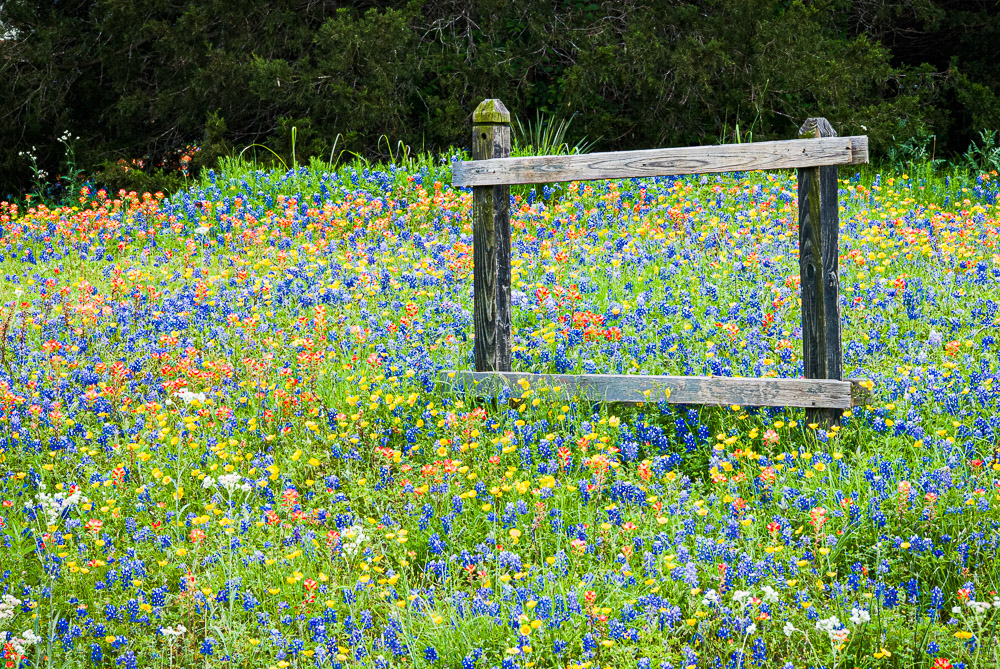
    This is Texas wildflowers in the spring. They really are like this, and in great bands over much of the state. Go there in the spring sometime. Spring in Texas wildflower country is about mid March through mid April.

    This is an accurate representation of what you will remember when you are there and see them. Is it totally accurate color? Probably not. Don’t know; don’t care. If you’ve been there, you will say “Yes! That’s what they look like!”.

  • To Be, or Not to Be.

    To Be, or Not to Be.

    I’m not discussing Hamlet’s famous existential crisis. I want to continue an ongoing theme of mindfulness. To be or not to be refers to our state of mindfulness when we go out shooting.

    Backwards

    John Barclay is an excellent photographer and workshop leader. I read an interesting article where he talked about a student in a workshop who changed John’s approach to photography. The student was a new photographer, but a Zen priest. His work was noticeably better than the rest of the student, even maybe John’s. John said “I had been approaching photography backwards and I believe this to be true for most people. Flint arrived at photography because he had learnt how to become mindful and present in the world, so when he picked up a camera, he’d already done all the hard work.”

    What an interesting idea. And I see it playing out constantly. Photography instructors spend massive amounts of time teaching the technical process of taking pictures. Apertures and shutter speeds and depth of field and rules of third and all the other trivia we think is important to taking a good picture.

    But this student, Flint, had already figured out how to see what was interesting. Now he just needed to learn the technical process for recording it. Amazing. He starts out at the level most of us strive over years to attain then just has to learn to use a camera.

    Mindfulness

    John’s takeaway was a change of philosophy. A desire to become more mindful. He states it as “we don’t take pictures, we are taken by them.

    Cutting through the mystical fog that often surrounds its discussion, mindfulness is learning “to be”. We need to be present, to be still, to pay attention, to quiet our minds and let go of the plans and schedules and demands and interruptions that are constantly calling us.

    This is increasingly hard for most of us in the Western world. It’s a 24/7 world. We are over scheduled; we multitask; we carry devices with us that are always connected and bringing us “critical” information that is more important than our art. If we don’t respond immediately to every ding of our devices, we might miss out on something.

    Out culture is the opposite of mindful.

    Why do it

    I believe, and have seen research supporting it, that we cannot really multitask. We work much better concentrating on one thing for quality time, even getting into a flow state. Every time we are interrupted, it takes us at least 20 minutes to fully engage with the previous task we were doing.

    Even more seriously, as artists, we cannot think, reflect, introspect, envision creative new work when we are constantly stimulated and distracted by other things. The arena we perform in is our mind. We must take enough control of our mind that we can focus our creative energy on our art.

    Our work comes from our own mind. We need to carefully protect that and be serious about managing our own thoughts and environment. Outside forces want to impose on us and control our attention. We must fight that.

    How to do it

    Ah, how. That is the challenge. And the challenge is different for everyone and the solutions are different for each. We are each in a different situation.

    My personal experience and what works for me is all I can speak of with any confidence. I do not have a problem with social media, because I have never let myself become addicted to it. I realize this is a problem for many people to day. While I can sympathize, I do not understand it. In the same way that I can sympathize with an alcoholic even though I do not truly understand because I do not have a problem with the addiction myself.

    Social Media

    Social media is one of the worst attention sinks in most people’s lives.

    I know people who are on Facebook, or their drug of choice, dozens of times a day. They feel compelled to immediately respond to everything they see and spend hours hypnotized by short video clips. And if they do not post something every day they fear they will become irrelevant – in a couple of hours. This Fear of Missing Out is a primary tool of the media companies. They have huge staffs of unbelievably smart people working daily on ways to keep us addicted to their service. Results show that it works.

    What would happen if you put yourself in control of your attention instead of defaulting to what the media companies want you to do? For instance, if your main creative time is 8 to noon, then turn off your devices and do not allow yourself to access social media during those hours. Set a meeting on your calendar to block out time for you. Honor it and reserve it for your creative work. Put a wall around yourself and fiercely protect your creative time.

    After that, get in touch with the world and light up your huge network of followers if you need to. But an interesting thing to ask yourself is, in cold marketing and financial terms, what are those likes and followers worth to your business? How much revenue does it bring? Might your time be better spent on your art?

    Benefits

    I am talking generally about mindfulness. I strongly believe that we must be mindful in order to create the art we want.

    Do you ever just take your camera and go for a walk? I highly recommend it. But it is not effective if you are still fully tapped into the online world. Silence the phone, Take out the AirPods so you can actually listen to what is happening around you. Coach yourself to look at the world you are passing through. Really look. Take some time. Walking is good exercise, but forget the personal best goals. Just walk. Maybe even slow down if it will help you to pay more attention.

    It will take practice to slow down and start seeing. Keep doing it. It is a form of meditation to unplug from the connected world and get in touch with what is actually there. Life is a series of moments, and we have to re-learn to recognize them.

    Having a camera along is important to me. It gives me license to look for pictures. This ties back to what John Barclay said “we don’t take pictures, we are taken by them.” I go out, not to force myself to take a picture, but to allow myself to find something that interests me that should be photographed. I am often amazed.

    To be

    To be, or not to be. Being, in the moment, undistracted, is a powerful tool and a strong meditative force for artists. We engage different parts of our mind, waking up the right-brain creative side.

    Plus it has other benefits. We come back refreshed, more alive. Ready to do more creative work. Maybe we even want to keep the devices silenced for longer periods. Unwilling to put out precious attention under someone else’s control.

    Like the student John Barclay mentions, being in the moment is the hard part. Then we pick up the camera and capture it.

    We don’t take pictures. We are taken by them.

    Today’s image

    This was a mindful day in the woods. It was fall. The leaves and undergrowth were changing color. I love that time of the year, but I was feeling a reluctance to just snap pretty pictures of fall trees. On this occasion I got in tune with the rhythm and flow of the day, The wind blowing the leaves and grass. The light moving through all of it. Rather than a normal picture of fall leaves I worked on capturing the movement, the transitory feel of the season. I like it. It seems more in spirit with the day as I remember it.

    I want to hear your comments! Let’s talk!

  • Why Photography?

    Why Photography?

    Photography is my chosen art. Obviously I wouldn’t continue doing it unless I loved it. But why? Why photography?

    Faults

    I’ll be honest. As a modern art form, there are negative aspects to photography. I’m talking about people’s view of it, not what I believe of it. And I’m not making a pun about photographic negatives. Many “serious” artists and critics view it as a lesser art, if art at all. After all, it is too easy. Just point your camera at something and take a picture. Where is the art?

    The critics view photography as a mechanical art. Where the camera does the work and the photographer just holds the camera and pushes a button. How can it be “Art”, with a capital A, if it is fast and easy?

    Billions of people are taking trillions of pictures every day. So it is considered a “common” craft. Just for selfies. But those critics discount the difficulty of doing something special in a field that is so crowded. Millions of books are written, but we still celebrate the relatively few authors who creates a standout book.

    And photography can be reproduced pretty easily. You can get a stack of prints made at Walmart for a few bucks. This, too, devalues it in many people’s estimation.

    And it’s getting to where your AI chatbot can make a fairly realistic picture. Is there any photography anymore? Or painting, for that matter?

    Alternate view

    But let’s examine some of those statements. I’m a firm believer that something is not correct just because people say it, especially if it is “experts” talking.

    It is true that trillions of photos are taken every year. Very few of them are considered art, even by the people taking them. They are for utilitarian purposes, mostly selfies to post on social media. Of the ones whose makers consider them to be art, most are, well, forgettable. In this crowded field where the majority of people on the planet have a camera and take pictures, it is extremely difficult to take a memorable one. It takes a lot of skill and vision and technique and luck to make one of the exceptional ones.

    And the fact that they can be reproduced easily should not be a factor, except for top collectors. The ability to make prints is actually democratizing. And a great art print is a very different thing than a cheap drug store copy. The materials and ink and care that goes into an art print sets it apart. If you have seen and handled one you have experienced the quality factor. A great print can be shown on your wall the rest of your life and be passed down to your heirs.

    Even painters very often have prints of their works for sale. And they usually request a significant price for them. Does that make their prints not art?

    It’s what I can do

    I said I was being honest. I long ago discovered I have little talent or patience for drawing or painting, and sculpting is too slow and expensive for me. Does that mean I’m not an artist? Absolutely not. I found areas I have an inclination for.

    I originally latched onto photography as a creative outlet to my highly logical, left-brained Engineering career. Intuitively I knew I had to have a balance. It served it’s purpose, even though I wasn’t very good at it.

    But being somewhat obsessive and a perfectionist, I later pushed myself to learn and understand why I considered myself mediocre. So I improved my knowledge and education and technique. I learned about design and composition and lighting and editing. And I moved beyond just straight representational images of big landscape scenes and even pushed myself into uncomfortable areas like abstract and surreal.

    So when I retired, I was eager to go full time into art as a creative activity. I do not regret it. It has been a great move for me and I feel I have grown rapidly. I would have gotten frustrated and quit if I had tried to force myself into doing art I was not suited for.

    Fast moving

    A joy to me in photography is that it is relatively fast moving. Move, see, compose, shoot. I get into a flow and can spend hours creating. And likewise in post processing. Unlike some photographers, I like it. Working with the images on the computer is another important part of the creative process of photography. I can edit for hours and not even realize what time it is.

    This pace and rhythm of photography is part of what works for me. An important component of my creative energy. I know myself enough to know I would not be happy spending weeks working on a painting, to then have to set it aside and not touch it again.

    My images are much more malleable. Even after “finishing” one I can get a new idea and revisit it, maybe alter it, maybe create a new work based on it. What I shoot is raw material. The elements emerge, combine, re-emerge and get re-imagined in a very fluid way. I love this.

    Versatile

    This immediacy of photography also enables one of the other things I love about it. I can do it anywhere, almost any time. Day or night; walking around town; looking out an airplane window; winter or summer; in the rain or snow or fog; alone or with other people.

    If most painters see a scene they want to paint, what do they do? Take a picture. They use that to work up sketches to define their image. I skip directly to the end. My “sketch” may well be the finished image. I’ve done 20 interesting images before they finish a sketch.

    I never have to worry about what pallets of colors I have with me. Did I bring a large enough blank canvas? Do I have the right grades of pencils with me? Are they sharp? Don’t care. I can take a crisp, detailed shot of a rusty truck and turn around and take a time exposure of a stream. The camera is a powerful tool that lets me express my art in a variety of ways. But I am the artist and only I determine what I want to accomplish.

    Element of reality

    Another aspect of photography that is unique and significant to me is that photography contains elements of reality. The sensor records the scene in front of it as imaged by the camera lens, to the extent I allow it. That is, I may blur it or overexpose it or underexpose it. That is an artistic choice. But I am working with a capture of reality.

    Photography is unlike any other art in this respect. To me, there is something honest in that. That, even if I composite or heavily edit or alter the colors or tones to create a completely different scene, still, the component parts are pieces of reality.

    I enjoy images of mine that are straight captures of a real scene and I enjoy the ones that are created scenes that do not exist. Both contain reality. One much more directly than the other.

    I don’t use Photoshop as a blank canvas to paint imaginary scenes on. I have no problem with those who do that. It is another good talent. But I don’t. Everything I create is built from pieces of reality. In my weird value system, it wouldn’t be photography if it did not contain actual elements captured by a camera.

    Easy to reproduce

    I love that after editing an image and thinking it is almost ready, I can make a test print on my printer in my studio. In a few minutes. A print on paper is very different from an image on screen. Most of us are only used to seeing images on screens.

    But a well done print on high quality paper is an entirely different thing. It becomes a physical object with presence. Our relationship with it is different. We hold it and look at it differently. We feel the texture and the forms and colors of the image are seen in a new way. A print changes our perception.

    And this is just a test print. Usually it will have to be edited more and reworked is some ways to eliminate problems we did not notice until it was on paper. After a few cycles I now know how to print this image. This next one that comes out of the printer is one I can be proud of. We eagerly show it off, because it expresses our intent, what we saw and felt when we captured the image. It has become a physical piece of art. And I can push a button and make another one for you. Does this devalue the medium? Not to me. I think that is fantastic.

    This is a unique feature of photography. I love it.

    Photography is a versatile, fast moving, high quality art form. It has advantages and disadvantages over other types of media. But that is true whenever you compare one type to another. It is the perfect art form for me. I hope I have given you a clear picture of why photography for me.

    Today’s image

    A busy airport at night is a wonderland of lights and shapes and movement. If you are that nerd who gets his camera out and shoots out the window during takeoffs and landings. I am. I love the colors and abstract forms. πŸ™‚

    It also illustrates one advantage of photography I discuss in other places. The ability to record time. Not just a still instant, but movement over a period of time if we wish.

    This is one of those scenes you seldom see painted. We cannot see this directly with our eye. The painter would have to take the picture then paint it. But is that different from taking a photograph and making a print?