An artists journey

Category: Craft

  • Stability

    Stability

    Even the most adventurous of us need a certain amount of stability. But I’m not talking about financial or mental or interpersonal stability today. I’m referring to the never ending debate about tripods vs. monopods.

    Why do we need them?

    Many people today value crisp, tack sharp images. To achieve this requires good cameras, good lenses, and good technique. One primary factor of the technique is minimizing camera shake.

    We tend to talk about camera shake as a binary thing: yes/no, on/off, shake/no shake. The reality is that it is a range. It is kind of like focus. If something is considered in focus, we really mean it has an acceptable level of focus. Good enough for our purpose, not an absolute.

    Likewise, for camera shake, we must take the point of view that it must be minimized enough for our need.

    Most people tend to hand hold their cameras. I know I do when I can. It is much faster and easier. Achieving sharp images hand held requires special techniques that we will discuss later.

    But when we know we need maximum sharpness, the standard response it to pull out the tripod, or monopod. It’s a debate.

    Tripods

    Tripods are the three-legged things we are all familiar with. They seem to have been around forever and they tend to be pretty large. The three equally spaced legs provides an optimum stable platform in all directions.

    Tripods used to be made of wood. Classical and lovely to look at, but heavy, Then they moved to generally bring made of aluminum or alloys. These were lighter and durable. A problem they had, though was vibration. Referred to as dampening when we’re talking about stability. The metal was kind of springy. It would vibrate when perturbed by a force. Like bumping it or when the mirror of your big DSLR “slaps” up to take a picture. The metal legs would vibrate for many milliseconds before stopping. This caused distortion while the shutter was open, which was probably for those same milliseconds.

    Later, most high end tripods moved to carbon fiber construction. This material has many advantages, but, of course, it is more expensive. The carbon fiber is strong and relatively light. It has much better dampening than metal, so vibrations are smaller. And if your hand has ever frozen to a metal tripod in the winter, well, carbon fiber doesn’t do this nearly as bad. For me, that by itself is a reason to switch to it.

    I have an excellent carbon fiber tripod with a great ball head. I use it for some critical images or long exposures.

    Tripod disadvantages

    Good tripods, used correctly, provide excellent stability. But this means you have to have it, there, when you need it. Perhaps this means carrying it miles over rugged trails for that one shot.

    Personally, I don’t do that much anymore. For me, a photo expedition should be a joy. I’m too old to enjoy carrying a heavy tripod a long ways. Sure, there are small versions that strap conveniently to your camera bag, but they have their problems too. Usually the small ones are short and I have to squat down uncomfortably to use them. Or if they are tall enough, they are not stable enough.

    I have a small one that fits nicely in a checked bag for air travel. I often take it. And just as often do not use it.

    And using a tripod slows you down a lot. Deciding where to set it, setting it up, mounting the camera, adjusting and leveling it all take quite a bit of time and effort. Some say this is an advantage, because it makes you spend more time considering what you are shooting and the composition of the shot. I partially agree and have experienced this. But often I am in a flow and shooting instinctively. The tripod absolutely gets in the way of this.

    Monopods

    A monopod is just one leg of a tripod, right? To some people that makes it 1/3 or less as useful as a tripod. Others (including me) would say it can be as useful or more so.

    If you are not familiar with them, try this experiment. Take a broom and hold it upside down with the handle down on the floor. How does it move?

    You will see that it does not move up or down in the vertical axis. It does more fairly freely in a circular arc left and right, back and forth. Is this minimal amount of stabilization worth it?

    To me it often is. The vertical axis is one of the most vibration prone areas for me. And being constrained on the monopod seems to add mass or resistance in the other axes. Either it is real or it is psychological. But in any case, it makes my images more stable.

    Monopod advantages

    Yes, it is unfair to only talk about tripod disadvantages and monopod advantages, but I want to make a point. There are often ways to overcome the disadvantages of a monopod.

    I have a great monopod. It extends to about 7 ft. and has a small but very nice ball head with quick release on it. It is my walking stick. I like that it is light enough and very strong to serve well as a useful and comfortable walking stick. I am far more likely to take it on a hike than I am a tripod.

    When I want to take an image, it sets up quickly – basically just attaching my camera to the quick release. It provides a decent degree of stability, and there are techniques I can use to improve if necessary.

    For instance, if a railing is handy, I can brace the foot of the monopod against my shoe and force the leg tight against the railing. I have taken very sharp 30 second exposures this way. Trees work fairly well, too. Lean the mounted camera against a tree for added stability. It can be a great tool.

    Which to choose?

    I probably seem biased. It is more of a pragmatic choice. Tripods are great for stability. It is usually the best choice for long exposures.

    Monopods are great when you are out on the trail or otherwise away from your car. If you practice and learn to work with it instead of against it, it can improve many situations to an acceptable level.

    I own a really good tripod and a really good monopod. The monopod gets used about 10 times more than the tripod. But I hand hold about 10 times more than either of them.

    Parameters of sharpness

    To put things in perspective, today’s high pixel count sensors force us to use very good technique to get the results we want. If the image moves as much as 1 pixel during an exposure, we can often detect a blur.

    Pixel pitches are measured in microns today. A micron is 1 millionth of a meter. The length of a bacterium is about 1-10 microns. A strand of spider silk is 3-8 microns in width.

    How is it ever possible to take a sharp image?

    Alternatives

    Several things can work for us. The amazing technology in our cameras provides things like in-body stabilization to minimize the effect of camera shake. It usually improves things a lot.

    And the electronics are improving to allow higher and higher ISO settings to be used. I consider 400 ISO to be my normal setting rather than the 64 ISO native value. That automatically gives me about a 3 stop speed advantage.

    The old “rule” when I was shooting film was that, if you are good, you could hand hold at a shutter speed of twice the focal length. This doesn’t work anymore for our high density sensors. People say the shutter speed should be 3-4 times the focal length. But with the better electronics allowing higher ISO with good results, this is often possible.

    Don’t overlook simple but obvious tricks. There may be something to brace the camera on or against. I often lean against a tree or a pole or a wall for added stability. Or I have put the camera on a rock or a bench and used a self timer to trigger the shot. Simple things like these can let you take amazing images in unlikely places.

    And there are simple techniques you can adapt that increase the stability of hand held shots. Things like bracing the camera against your forehead and forcing your elbows close against your body. And exhaling slowly as you slowly press the shutter. A video on gun shooting technique could be helpful. They have studied the problem a long time.

    So tripod or monopod? I lean toward the monopod. But it is not necessarily an either or choice. There are many creative ways to stabilize your camera. Unless you’re out in the desert with nothing around, there is often something that can be used.

    Today’s image

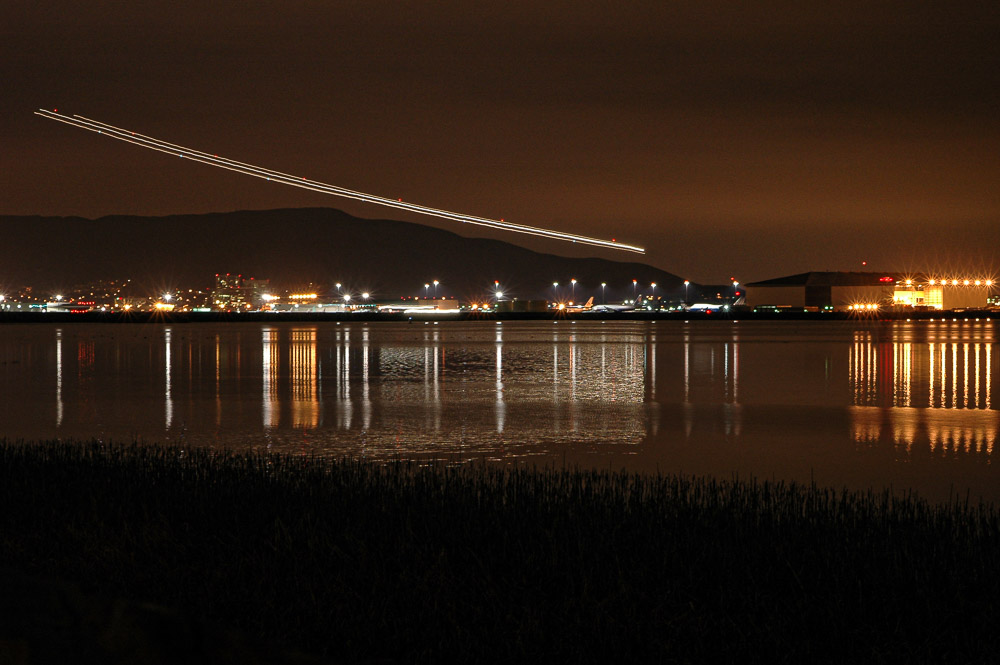
    This was shot in an airport (obviously) with no tripod or monopod. I couldn’t set the camera on the table in the restaurant where we were eating because there was a joint in the glass that was in the way. I put my camera on my camera bag on the floor. This is a composite of several 4 second shots.

    I used a 2 second timer to allow me to get my hand away and not shake the fragile setup. I could have used the camera app on my phone to trigger it, but that is always so tricky and slow to set up that I seldom do it.
  • Find the It-ness

    Find the It-ness

    Sometimes you just have to make up a word when you can’t find the right one. In this case Jay Maisel made it up. I think he is referring to seeing beneath the surface. If we find the it-ness, we are starting to get to a level where we understand more about the scene. Then maybe we can show it to our viewers.

    See past the obvious

    Jay seemed to be telling us to get past the first surface response and burrow down to a deeper response to a subject. The normal mode for a lot of us is to see a scene we like, pull the camera up to our eye, and shoot. Done. Go on.

    But I think Jay i suggesting we slow down and not necessarily give in to our first instinct. With a little more thought and introspection we often come to a different relationship with a subject or scene. In other words, stop and think. Get in touch with why you are reacting to it and see if you can bring that out more.

    There are 3 very interesting videos about Jay Maisel on Kelby One (I am not affiliated with them and I get no benefit for referring them; but it would be worthwhile to subscribe long enough to watch these 3). In each, Jay is spending a day walking around with Scott Kelby, demonstrating his technique and thought process. They are very worthwhile (when Jay is talking, not Scott). It seems like Jay is shooting quickly and instinctively, but keep in mind you are seeing the result of 50 or more years of finely honed craft. When asked about an image he can always articulate a detailed reason why he took it, what it meant to him, and why he composed it like he did. And when he reviews his seemingly quickly grabbed images, it make you want to tell him “I hate you”.

    So maybe there is the promise that, with enough practice, little conscious thought is required.

    Wabi-Sabi

    I always hesitate to bring wabi-sabi up. It is easy to step off into really deep stuff. Apparently you can’t really appreciate it’s true meaning unless you are a native Japanese steeped in Zen Buddhism. There is no simple English translation.

    But that doesn’t deter me from trying. Even though I am American and not at all a Buddhism practitioner. 🙂

    Explanations often start from breaking down the two words wabi and sabi. One good definition says:

    Wabi’ expresses the part of simplicity, impermanence, flaws, and imperfection. On the contrary, ‘Sabi’ displays and expresses the effect that time has on a substance or any object. Together ‘wabi-sabi’ embraces the idea of aesthetic appreciation of aging, flaws, and the beauty of the effects of time and imperfections. The two separate parts when put together, complete each other. They express simplicity and the truest form of an object.

    That seems to be an elegantly simple expression of finding the it-ness of something. Regarding a thing with all its flaws and imperfections and appreciating how it changes and weathers and even decays over time is really getting in touch with its essence.

    More than the subject

    I recently explored the idea of the subject not being the subject. Going on beyond that is this notion of capturing the it-ness of something may be more important that just representing the thing.

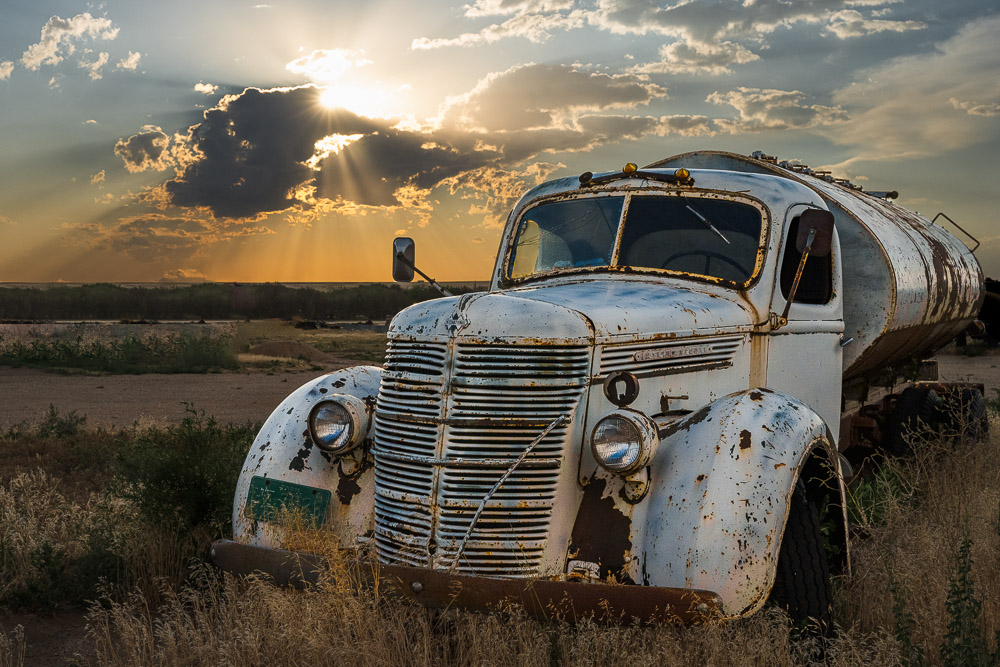
    The image with today’s post is an example. This old International truck fascinated me for years. It is about 50 miles from my house, not on the way to anywhere, but I visited it many times. I was never satisfied that I had photographed “it”. I took many pictures of the truck, but I never felt I actually got what I felt about it.

    Finally, one day I was going by and I knew I needed to visit it one more time. Some junk was starting to encroach on it and, after it setting there rusting for years, it seemed possible that the opportunity might go away.

    But this time, instead of jumping out and taking pictures, I just stared and thought a while. I walked around it slowly. All the while I was trying to explain to myself what my feelings were about this truck and how I would take its portrait.

    After thinking a long time, I basically just took this one image. To me, it perfectly captures the personality, the story, the history – the it-ness – of the magnificent old truck. I felt a relationship to it.

    The next time I came by there, it was all fenced off and junk was stacked all around. The picture opportunity was gone. That makes me sad, but I finally had the picture I wanted. I believe this is a true and accurate portrait of this giant of the Colorado plains. This will always be my memory of that good old truck that I have known a long time.

    This is a wabi-sabi story. It is also an example of another of Jay Maisel’s maxims: shoot it now, because it won’t be there when you come back.

    Find interest

    I have said several times that we can find interest in almost anything if we try. We have to get over looking just at the surface. Maybe it’s not the prettiest of its kind. Maybe there are imperfections. Do those give it character? Does it tell a story of it’s past?

    As an extreme example, we have had a lot of forest fires here in Colorado in the last few years. As have many places. It is sad to see a beautiful forest destroyed. But I have found great beauty in burn scars and the re-growth that is happening.

    It seems to be more and more a case for me that interest does not equate to pretty. Almost to the extent of being a negative correlation, where pretty implies less interest. So a perfect flower is a thing of beauty, but does that make it the most interesting? I’m not saying it is always true for me, but a “past its prime” specimen may tell a more interesting story of struggle, survival, endurance, and the passing of time.

    Try it. Like my example of working on the truck, slow down. Think more. Figure out the it-ness of the thing. Then shoot to capture that.

  • Craftsmanship

    Craftsmanship

    I have written a few times about how intent and expression are more important in a photograph than craftsmanship. I don’t want to leave the impression that craftsmanship is unimportant. It is critically important for a serious artist.

    What is craft?

    Craft is defined as skill at carrying out one’s work, or an activity involving skill in making things by hand. I believe an artist first has to be a craftsman. Proficient with his tools. Using our tools and equipment must be second nature.

    Craftsmanship is usually a learned skill rather than an innate talent. Sure, some things are easier for some people than others, but it still has to be learned. Lots of investment of time and practice.

    When we get skilled at the craft, the mechanics recedes into the background. It becomes a support and enabler for our artistic vision.

    Perfection doesn’t make a picture

    I have argued before that perfection of craft does not make a great image. The classic statement is Ansel Adam’s quote that “There’s nothing worse than a sharp picture of a fuzzy concept”.

    It might be better to say craft alone does not make a great image. It is a table stake. You need it to get in the game. An excellently crafted image may not be great, but a poorly crafted image is very seldom great.

    Craftsmanship is the base

    Craftsmanship is a base we build our work on. But it is only a base, one of the legs of the stool. We also have to have vision and creativity and the drive to express them. I believe this expression cannot happen without solid craftsmanship.

    I have said before that photography is one of the most technical of the arts. We are dependent on our equipment. Knowing how to use it correctly and effectively is absolutely critical to success.

    We must study and practice and drill until it becomes second nature. Have you trained your hands to just “know” where the camera controls are? Can you use them in the dark? With gloves on? Can you quickly and almost instinctively determine the exposure solution that aligns with your intent for the image? Are composition and framing decisions happening rapidly in the background with little conscious thought?

    When you’re out in the field working a scene you like, you don’t need to spend time juggling the technical tradeoffs in adjusting the camera. This distracts you from the artistic side. For instance, recognizing that this scene needs about f/8 to get the depth of focus you want and, since you are hand holding, at least 1/200th second shutter speed to insure a crisp image. Given that, are you willing to go to ISO 1600 to get these settings? These decisions should be almost instantaneous and subconscious.

    This is not to say you are operating by habit or on automatic. Quite the opposite. It is a state of flow. You are channeling all the craft you know to focus on the moment at hand. It is exhilarating.

    Photography is a craft

    Photography is a craft. Most arts are, but it seems more obvious in photography. We cannot create without our tools. And we cannot create well unless we are proficient with our tools.

    Let’s take a quick look at the chain of technologies required in photography.

    On the capture side there is the camera, of course. They are not trivial anymore. The user manual for my Nikon Z7-II is 866 pages. That just describes all the settings available, not how to use them. Becoming skilled at using one of these is formidable. Luckily, most of us only use a subset of the capability.

    And how much data do I need for what I am doing? Shooting full frame 40MPixels and above requires much more refined technique to achieve great results. Maybe what I’m doing today would be just fine with a 20MPixel APC camera. Do I have large and fast enough memory cards for my shoot? Enough batteries?

    There are the lenses and filters to select. It takes training to understand the effects possible and how to select the right look for the situation. Should I use a zoom lens when I know it is theoretically possible get a little better sharpness with a prime lens?

    Am I in the camp that says all images must be shot on a tripod? Or am I a hand-held guy? Or either, depending on the situation? Shooting hand held, do I know the techniques to get maximum sharpness? Or the techniques to shoot moving subjects?

    What about capture file formats? White balance? Camera profile settings?

    Processing

    That’s just the capture of an image. If you shoot RAW images, which I hope you do, the images are useless until they have been processed intensely.

    First, they have to be transferred to your computer. Do you have enough storage? My main image storage is currently using over 7 Terabytes. Then there’s multiple backup of that.

    If you are processing high resolution files you will need significant computing power. Lots of memory and graphic processing power. And a great, color calibrated monitor. Hopefully of 5K or more. That power is required to be able to process images fluidly without having to wait for the machine to catch up. Waiting really breaks your concentration.

    And of course, you use a color balanced process. Your camera and monitor are calibrated and you are using a wide color gamut system like ProPhoto RGB. A wide gamut allows lots of freedom in editing.

    All that processing takes a lot of time. So when you go out and shoot 1000 images, don’t forget that they have to be processed, and culled and keyworded and filed.. For me, processing an image takes anywhere from 1 minute to 8 hours.

    Output

    How you process an image depends on what you are using it for. Getting something ready to post on social media probably just requires some color and tone correction and maybe cropping. Preparing an image for a print could take a long time.

    Let me take the path of going to a print, since that is my preferred utilization.

    A print is a physical object that is perceived different from an image on a screen. The viewing time of a print is usually much longer than an image on screen. As such, it generally needs to be processed to a higher standard. Very careful spotting – removing sensor dust spots – is critical. Spending time removing or mitigating distracting elements is usually important.

    Many of the remaining decisions center on the characteristics of the final output. What size will the print be? What paper will be used. All papers have different properties and strengths and weaknesses. The paper can make the print look very different. Is it matte or glossy? Coated or uncoated? Heavy or thin? What color is it – papers aren’t necessarily white.

    To get an estimate of the final result requires turning on proofing during the editing. The computer attempts to simulate the final printed result. Of course, to do that, you need accurate profiles for the paper and printer combination. But that is just an approximation. It may need more than one attempt. And what about out of gamut colors on your print? Handling those can be tricky and exasperating.

    Build on it

    That is a lot! And this is just talking about still photography. Photographers have to be expert at most of what I described. That is some of the craft involved. All of this craft has to be used intelligently in the process of making a great image. It’s why I say that photography is one of the most technical and craft-based arts.

    But as much as we sometimes like to burrow into the fun details, the craft is a base. Build your base solid. But on top of the base, we need to build our artistic sensibility, our vision. We have to establish our style.

    Craft means knowing how to use your tools to achieve the results you want. Maybe that is an ultra crisp, tack sharp image. Maybe it is a flowing abstract with no sharp pixels. Yours might run to dark and moody and underexposed. Somebody else might be bright and high key. Those are your choices. Whatever your vision leads you to do, it is your craft that allows you to achieve it.

  • Throw It Away

    Throw It Away

    This is a controversial subject. I have touched on it before, but it is time to circle back. My assertion is that most of us should throw away more of our work. Horrors! Kill our darlings? Sounds terrible! But I am convinced that one excellent way to improve our work is to throw it away.

    We probably overshoot

    It is so easy now days with digital cameras. There seems to be no cost for shooting a lot of frames. We “work the scene”, taking many shots at different angles and positions and focal lengths. Refining it to find the best view. And then shoot a few insurance shots, you know, in case one doesn’t record properly or we jiggle the camera. You know.

    That’s a pretty typical process and can be useful. But the reality is these shots are not free. We have to edit them, cull through them to select the best, do some “quick” processing to see if they seem worth investing more in. This takes a lot of time. They take up disk and backup storage space.

    So where with film, we might have taken 3 or 4 images of a scene, now we come back with 15 or 20 or more. That can be good. If you really have to work through different views to determine what is best, then do it. Or increased experience might help to get you there in fewer attempts.

    For example, you come to a nice waterfall. So you shoot brackets of apertures from f/ 2.8 to f/22, and brackets of shutter speeds from 1/1000th to 10 sec, and exposures from -3 to +2 stops. Just in case. Why? You should know from experience what you prefer. You should know that f/8 +/- a little is what you like with this lens at this distance. The amount of blurring you prefer is usually achieved at around 1/4 to 1/10 second for this kind of subject. You should know how to expose to the right and prevent clipping of highlights.

    Just that takes it from shooting all possible combinations to intelligently determining what to do. You have a style and preference and you should be comfortable with the craft. Why shoot things you know you won’t like?

    Overshooting creates a huge backlog of work. And lots of wasted disk space. And a cluttered Lightroom catalog. Simplify.

    We keep too much

    OK, let’s say you intentionally shoot a lot of images of a scene as you work it. How much of that do you really need to keep?

    Are you going to keep all the shots in case you later change your mind later about what you like? Don’t. Make an artistic decision and stick with it. Don’t keep that full bracket of apertures “just in case” you change your mind.

    We make it hard on ourselves by second guessing our decisions. Decide what you like in the group, what matches your intent at the time, and throw away most of the others. My experience is that if I didn’t know what I liked at the time, one of the variations seldom captures “it” either.

    The great gets lost in the sea of good

    Are you drowning in a sea of pictures? So much that you can’t locate the shots you like best? I get the impression that this is an increasing problem for a lot of people.

    A solution is a more disciplined filing and catalog system. This is made much easier when there are fewer images competing for our attentions.

    You don’t need 20 decent pictures of that scene. You need the one that represents your best artistic sensibility at the time. And that one should be processed to bring out your vision as you saw it then. It should never be a case of wading through many competing images to pick out the best one.

    Here is a hard lesson I have had to learn: good images are usually worthless. Only great images have any chance of making it. You seldom need the ones that are only good.

    Declutter

    I am arguing for decluttering our catalog by removing images you aren’t going to need. But yes, that means you have to kill some of your darlings. Delete perfectly good images.

    This hurts. Why should you delete good images? Because as I said earlier, we are artists. We have to have the confidence to make a decision and a statement. This is my vision of that scene. None of the other attempts matter. DaVinci didn’t paint 20 variations of the Mona Lisa.

    If you have a catalog of 100,000 images, are they 100,000 excellent images? What good are all those OK images that you will never use? Wouldn’t it be much better to only have 10,000 great images? The numbers are just for discussion. My point is, declutter your environment.

    But, we say, I need insurance shots in case my great image gets corrupted. Really? How often does this happen. And if it does, that is what your backup strategy is there to correct.

    But I really like all those shots. Yes, but when is the last time you used one of them? Why would you use one of them? If they are not the great image you love, their value is close to zero.

    To use the example from before, if you have 100,000 pretty good images, how do you locate that 1 great one you want to submit to a gallery? It is hard to find the signal in the noise.

    Declutter. It hurts at first, but is healthy.

    Tighten up that portfolio

    The same applies to our portfolios and projects. Less is usually more. This is another of those painful lessons experience teaches if we listen.

    Your portfolio should have a max size you pick. If you want to add a new image to a portfolio, make yourself decide which one you will replace. This is hard. But here is a truth: every time you take one out, you make the remaining set stronger. Taking out a picture you love doesn’t mean you don’t love it anymore. It just means that it is not the strongest in the group.

    I don’t think I have ever damaged a portfolio by taking something out.

    Same with projects. That is a little trickier, because sometimes we need images to set a context or help tell our story, but still, they should all be strong. Less is still usually more.

    A personal example. I recently needed to pull together a group of images for an exhibit. The subject was one I love, so I had a lot of images I really liked. In my first pass, I pulled out 162 images I loved that I thought would be great for it. I knew that was a ridiculous number for this exhibit, but I really liked all of them.

    So hard core culling mode on. After my next pass, it was down to 125. Progress, but way out of range still. I had to remind myself that deleting an image from the set doesn’t mean I don’t like it, just that it was bumped by a stronger image of mine. So with a great struggle, I was down to 69. So far I have taken out nearly 100 of my favorite images!

    Narrowing my focus and getting even more selective got it down to 44. It hurt, but now I have narrowed it to 23. I’m kind of stuck right now, but I know I need to get it down to about 15.

    A funny thing has happened, though. At this point I believe ALL of them are great images and I could almost randomly select the next 8 to cut. That is an interesting realization.

    Be reasonable

    In all things you have to make reasonable judgments for yourself. I’m not saying never keep alternate shots of a scene. I routinely keep a few. But I don’t keep duplicates that do not add any value. And I don’t keep alternate images that I know from experience are not my style.

    And there are those shots you know are flawed, but you just love them. Fine. I have a lot of those. Generally they are segregated from my “main” images, but they are important memories for me. Or they tell a behind the scenes story that is valuable to me.

    I use a multi-pass editing process and I usually let images age some before making many final judgments about them. But I figure if I don’t delete about 1/2 of my shots, either I am on a great run (it happens sometimes) or I’m not being critical enough. Often it runs to 2/3 deleted. And by deleted, I mean really gone, erased, trashed, removed, never to be seen again, digital dust.

    It hurts, but the remaining ones are stronger. I want to always be biased toward making the survivors stronger.

    Today’s image

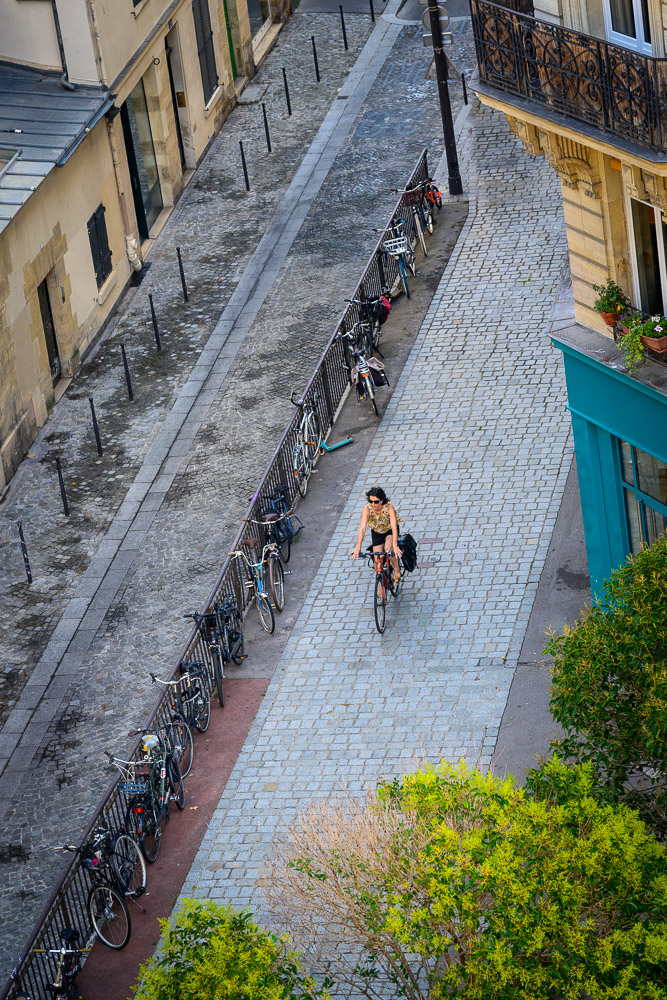
    The project I described above is on France. More about the joie de vivre rather than a tourist view. To present more of a mirror than a window, to refer back to a recent post. This picture is one i am struggling with. Would you keep it? So far I have. I think it says a lot about the environment and culture and spirit of the people. I love it for a number of reasons. If it doesn’t make it into the final set, I will be disappointed, but it means the overall group has a higher bar.

  • I’ll Think of a Reason Later

    I’ll Think of a Reason Later

    I get tired of hearing all the pronouncements from leading photographers about how all our shots should be carefully planned and pre-visualized. While this is good advice sometimes, it is not always true. At least, not for me. I have come to see some of my best work as happening when “I’ll think of a reason later”.

    Source

    I got the title from an old country & western song by Lee Ann Womack, lyrics by Tony Martin and Tim Nichols. Great lyrics, but the song has nothing to do with photography or any art. But when I heard the title, it seemed to perfectly fit what I often experience. So I decided to “repurpose” it.

    You know how you sometimes hear something that sparks other ideas or seems to crystalize some ill-formed thoughts that have been gnawing at you? This was that for me. I love the image it brings to my imagination.

    Planning

    It is part of the accepted religion of many photographers that you never shoot a picture without a well thought out plan. Even to a firm visualization of what the final product should be. Being a matter of faith, it is unquestioned and can’t be reasoned. But I will question it. There is an old quote that says “sacred cows make the best burgers”.

    Is there a time for careful planning? Yes. Of course. Otherwise the whole controversy would be foolish.

    When is planning important? First, on any commercial shoot, where a certain result must be obtained, on schedule and on budget. You will not work in the industry if you can’t deliver repeatable and acceptable results to your client. Sure, you must also have a recognized style to flavor your work, but that is secondary to the results the client wants.

    Second, if you are doing some type of conceptual photography, where you have to synthesize the result from materials you shoot specially for it. It all has to be coordinated so the right materials are available for constructing the final image. The parts must be consistent in lighting, focal length, position, color, etc. Most of all, they have to be complete. You don’t want to start bringing your product together and find that a key piece is missing. This process takes good planning and visualization.

    A third possible one is a once in a lifetime trip to an exotic location. It would be reasonable to scout the location, plan for lighting, weather conditions, etc. I say maybe, because I probably wouldn’t do it. I might want to have some idea of what to expect, but I would be more energized by abandoning preconceived notions and reacting to what I find.

    Spontaneity

    What’s missing in this very disciplined notion of planning? To me, it is spontaneity, happy accident, feelings, reactions. These are the things I thrive on. These things make my work more alive and vibrant.

    The things I find, unanticipated, can captivate me. When something excites me and energizes me, I find I am generally happier with the results. The engagement is memorable and meaningful. I am drawn to the subject or the scene. The feelings I have seem to come through in my images. Dare I say it, there is love there.

    Can a planned, rehearsed shot engage me? Yes, sometimes I like to really get deep into whatever I do. But that is accidental. Usually I find in those situations that my engagement has to be secondary to the planned event. For me, I don’t want it to be secondary.

    I enjoy the discipline of shooting for a project. But even when I have a certain theme in mind, I do not have a fixed plan for what I will shoot. I may hypothesize what some of the images in the project might look like, but that is only a guide to spark my imagination.

    I would much rather find joy in something no one else has noticed. Something that, at just that moment, is interesting, even exciting. Tomorrow it may look like junk, but right now it is something else. This is more interesting to me than getting yet another beautiful shot of an iconic scene.

    I’ll think of a reason later

    So, “I’ll think of a reason later” means to me that I will follow my instincts, my interest at the moment. Later, when I am working on the image on my computer, I will see if I can think of the reason it called to me. Usualy there are some good reasons.

    I will be lead by my heart. Planning can be useful, but I will not be a slave to it. I have no problem abandoning a plan to shoot something more interesting.I am a fine art photographer, not a commercial shooter. This means I will follow my instincts, shoot what I like and what I am drawn to at the moment.

    I will be the first to admit that this does not always lead to the best possible results. Sometimes I follow my instincts down a rat hole to a dead end. That’s OK. Better than OK. It is wonderful. It is better to me to try and fail and sometimes achieve something special than to rise to nothing more than mediocrity.

    So I am amazed sometimes working on these spontaneous images on my computer, to see things I was not conscious of at the time I shot it. I see shapes and forms, color harmony, framing, patterns, and lines that work to make an interesting image. These were mostly subconscious at the time I was shooting.

    I seem to be able to use all my years of training instinctively. Was I pre-visualizing my images? Probably, but it wasn’t conscious. I was not aware of it in the moment I was shooting. The measure for me is: was I excited at the time? This is I’ll Think of a Reason Later.

    What works for you

    I’m reacting here to intense evangelism I see from some so called authorities. The reality is, there is no “one way”. At best, they can tell you what works successfully for them. Sometimes they just want to evangelize you to their point of view.

    An artist’s working style and subject matter is intensely personal. What works for one will completely trip up and block another. Do what works for you without thinking you have to follow a plan some famous photographer told you.

    I don’t mean to ignore everybody. Listen, try their ideas out. Experiment. But ultimately reject what doesn’t work for you.

    Today’s image

    This image was taken going down the Seine River in Paris. I glanced up and instantly recognized a scene of interest to me and snapped it. It was not pre-visualized, and I was not consciously searching for a situation like this.

    Sometimes happy accidents happen. I plan on it. That is, I find if I am receptive and looking around with interest, they happen. Frequently.