An artists journey

Category: Craft

  • Depth of Field

    Depth of Field

    In a previous post I said I would talk about this later. Here it is. I believe most photographers only vaguely understand what depth of field (DOF) means. That’s probably OK, as long as we can still use it to our advantage. You don’t have to know in detail how your car works to be able to drive it, but it helps.

    What is it?

    You have seen it. We focus on a subject, but when we look at the image we are disappointed that another subject or the background was out of focus. We have been bitten by too little DOF.

    Depth of Field is the distance between the nearest and farthest points in the frame that are in acceptably sharp focus. OK, we can intuitively understand distance that is in focus. But what does “acceptably sharp” mean?

    The reality is that when your focus your super expensive, multi-element, rare earth material lens, it technically only focuses at exactly one point. Everything else is to some degree out of focus. But like many things in life, the precise details do not matter. What matters is the result.

    For most of us in most of our applications, it is OK for things to be a little bit out of theoretical sharp focus. We can’t really see that unless we magnify an image greatly.

    Circle of Confusion

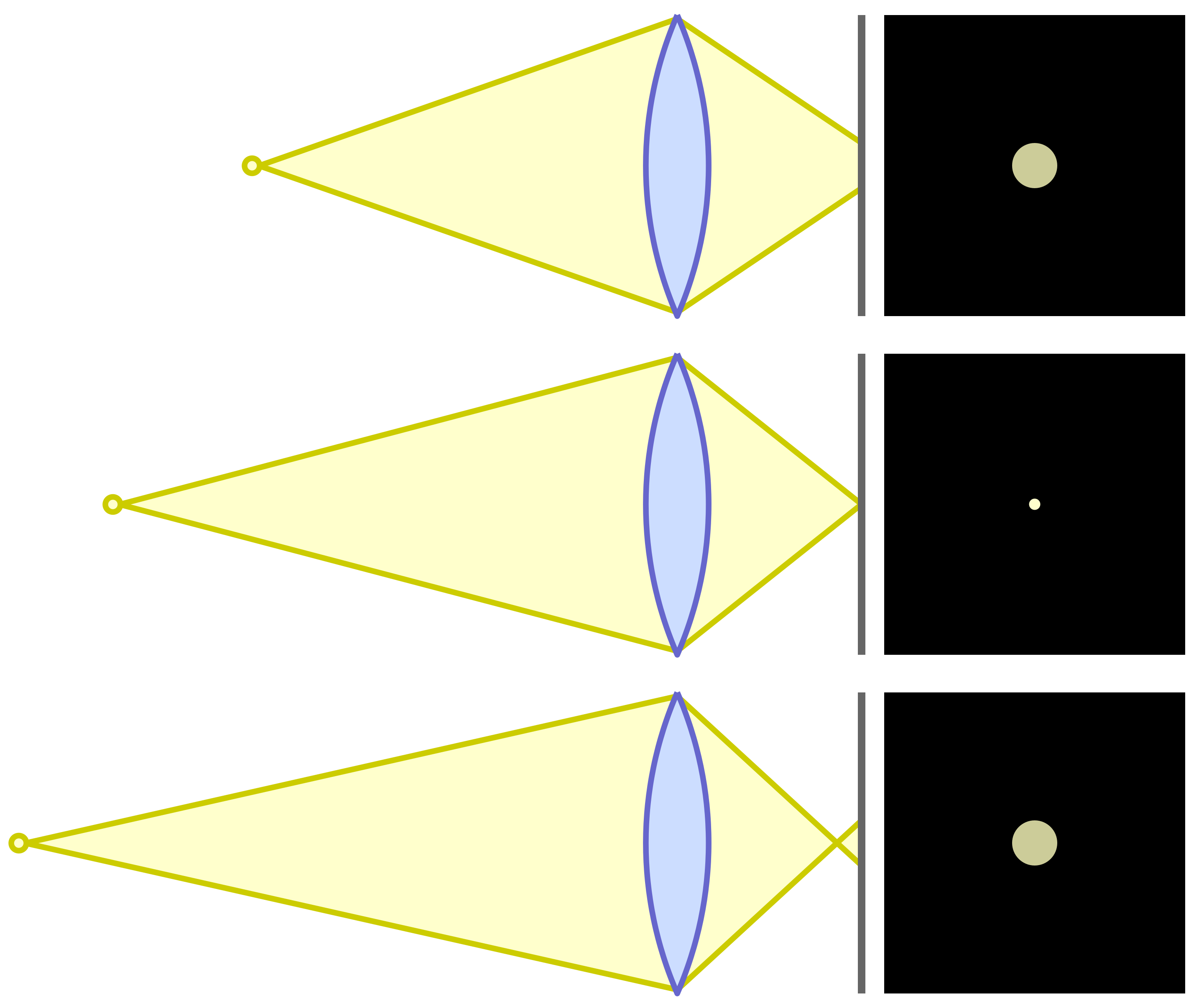
    So for most of our work, we will accept a certain amount of out of focus as unnoticeable. The measure of this for Physicists and Optical Engineers is called the “circle of confusion“. If you focus on a point of light, you expect it to be imaged as a sharp point. But as one of these points gets in front of or behind the sharp focus plane it becomes a circle instead of a point. You have seen this as you adjust the focus point in a scene.

    The overly technical term “circle of confusion” refers to how large these circles are. And what we care about is how large they can get before we perceive them as out of focus. This picture helps illustrate that. The center diagram is focused precisely. The top one is focused slightly behind the focus point. The bottom one is slightly in front of the focus point.

    Circle of Confusion illustration

    Physics

    You probably don’t actually care about the math. But here is it:

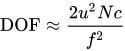
    The approximate depth of field can be given by: {\displaystyle {\text{DOF}}\approx {\frac {2u^{2}Nc}{f^{2}}}}

    for a given maximum acceptable circle of confusion (c), focal length (f), f-number (N), and distance to subject (u).

    This is precise, but not helpful. There are DOF calculators available, but most of us will not use them when we’re out shooting. I never would, and I even understand the math. 🙂

    What does it really mean?

    It means that if we want to maximize the apparent range of sharpness in a scene to our advantage, we need to understand some basic things about our cameras and how to adjust them for the results we want. None of it is magic and we do not need to become mathematicians.

    Controlling the DOF becomes just another of the design choices we make more of less automatically as we set up a picture. When we become familiar with the concept it gets to be an easy thing to take in consideration.

    How do you control it?

    If you unpack the equation above you discover that there are are really only three things to juggle: focal length, aperture, and distance to the subject. I take circle of confusion as a relative constant, since we don’t usually think about it while we are shooting.

    Normally we consider the aperture to be our main control of DOF. That is because it is the easiest one to adjust. You have discovered or been taught that a wide aperture (small f/ number) gives a shallow DOF and a small aperture (large f/ number) gives the most DOF. This is true, as far as it goes.

    But there are 2 other components to the equation. We also affect DOF by our lens focal length choice and by our distance from the subject.

    For any given lens, the closer we are to the subject, the shallower the DOF is. Telephoto lenses exaggerate the effect more than wide angles. Increasing the focal length reduces the DOF. And getting further from the subject greatly increases the DOF. Looking back to the formula briefly, notice that the focal length and distance to the subject are both squared. This means they are a much stronger influence than the aperture.

    Aperture, focal length, and distance to the subject all work together to determine the DOF A smaller aperture (larger f/ number) increases it. Moving further from the subject increases it a lot. Using longer focal length lenses decreases it a lot.

    It is said that wide angle lenses have greater DOF

    Conventional wisdom is that wide angle lenses have more DOF than telephoto lenses. Actually, no. But practically, yes.

    The discrepancy is how we tend to use them. We shoot with a long lens and decide there is not enough DOF. So we put on a wide lens and shoot the scene from the same position. DOF increases a lot. But the field of view has also expanded, so we have a much wider shot. If you were to walk up to the subject to make the image size field the same as before, the DOF would be the same. Thank you physics.

    But in practice, yes, using a wide angle lens usually gives us a great DOF because we usually shoot from relatively far away.

    Hyperfocal distance

    One “trick” that has been used for a long time and that simplifies getting maximum DOF is to know about hyperfocal distance. The hyperfocal distance is an optimum point where everything from infinity to a point near the camera is in acceptable focus. Seems too good to be true, but it is just physics again.

    The technique is getting harder to determine now and is probably falling into disuse. Way back we tended to shoot prime (non-zoom) lenses and they had focusing scales. For a given aperture, all you had to do was adjust the lens so the distant aperture number was at infinity. You were now focused at the hyperfocal distance. Everything from the near focus scale mark to infinity is in acceptable focus. It was easy and very useful.

    Now, though, zoom lenses have gotten very good and most of us use them. The problem is that they are optically complex and do not focus the same. They cannot, by their design, provide us with focus scales.

    What to do? A pretty good solution is called the double the distance method. There is some estimating (e.g. guessing) and approximations involved, but it is better than a lot of alternatives.

    Say you want to have a flower about 5 feet away in focus and have everything in focus all the way to infinity. Focus at about 10 feet. Choose a “suitable” aperture, probably around f/11 to f/16. I told you there was guessing. But by doing this, the field from about 5 feet to about infinity will be sharp. Check it in your viewfinder. Adjust if necessary. The hyperfocal point is about 1/3 of the way from the closest point you want sharp to infinity. You have to estimate it.

    Making some educated guesses based on knowledge of what’s going on is better than a random guess based on no knowledge.

    Just do it

    Photography and video production are probably the most technical of the arts. We are constrained by the physics of the sensors and materials, the properties of the optical systems and lens design, and the effects that can be created by these. Compounding these is the reality that we are typically imaging real subjects with all their flaws and constraints. It’s wonderful!

    Don’t get caught up in the math or the technical details unless you are a nerd that really likes that. It is seldom necessary for making good photographs. I just put the DOF formula in to show you it is based on science, not some mystical mumbo jumbo. I would never use it in the field.

    Learn that depth of field is a balance between the aperture, the lens focal length, and the distance to the subject. Experiment with them. Get a feel of how they relate and practice getting the results you want. It is harder to describe than it is to do.

    Today’s image

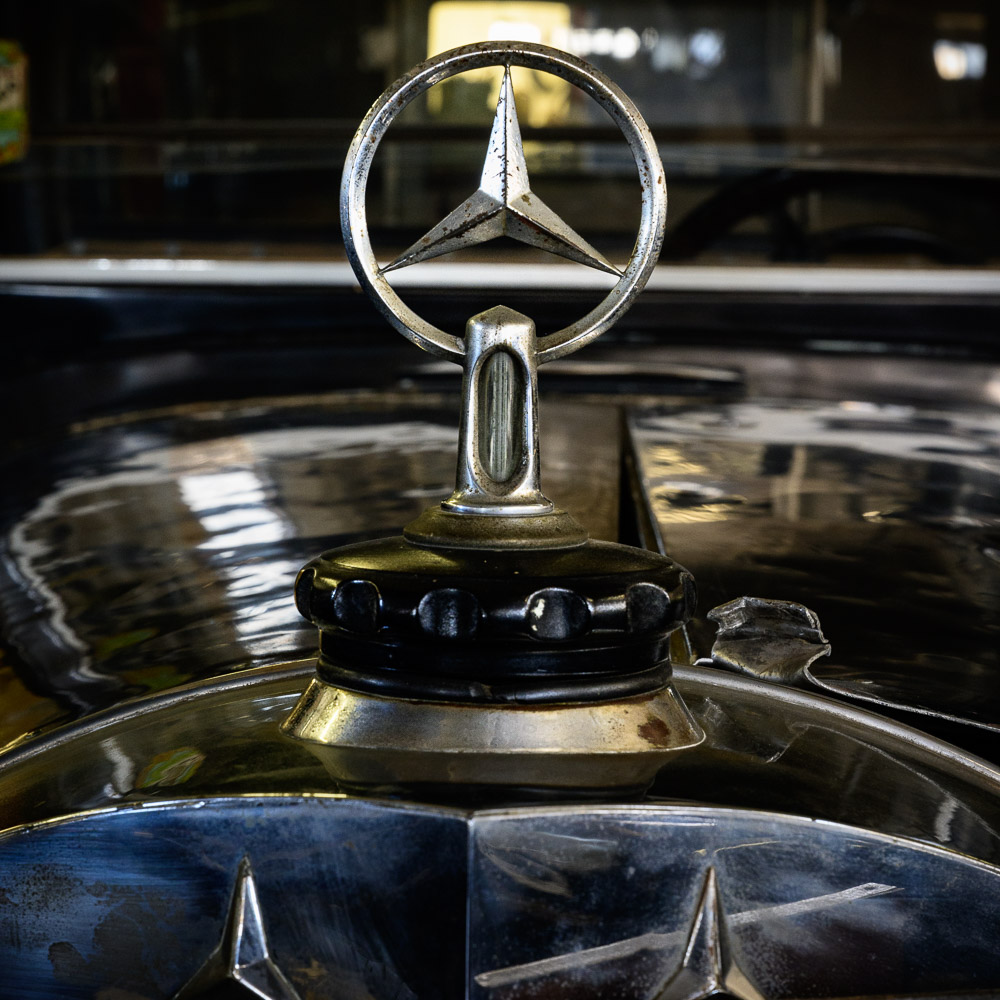
    This image demonstrates intentional shallow depth of field. I wanted the foreground and background definitely blurred, but still recognizable. The effect was achieved with a moderate aperture, f/11, and a short telephoto of 70mm close to the subject. Remember, increasing the focal length and decreasing the subject distance both strongly reduce DOF.

    Experiment more. Make the use of your equipment to achieve your intentions automatic.

  • Traveling

    Traveling

    I have been traveling more than usual this year. It gives me the opportunity to reflect on what I shoot and why. Perhaps it will trigger a response in you.

    This is not a typical travel photography article. You won’t find the expected rules and checklists and how-to advice.

    How I travel

    Travel for me is a rather solitary activity. Being an introvert, I work best alone. Having people around who want to talk about what I am doing and “help” me find pictures is almost always a negative. My wife is occasionally along on these trips, but she has learned to get out of the way and leave me alone when I am shooting. Not always, but that is the norm. I don’t want to make it sound like I push her away, it is just that she knows me enough to recognize when I am in a zone and don’t want to talk.

    When I am traveling with an option of doing photography I prefer to drive or be on foot in a large city. In either case I preserve the freedom of exploring, setting my own path, managing my time. I strongly prefer to explore out of the way, seldom seen sights, even if it means missing the main tourist attractions. Actually, especially if it means missing them.

    As you can tell, if I have to take a tour, especially in a bus, I feel handcuffed, in prison, doomed to follow someone else’s agenda. I may see some interesting things, but there is seldom the chance to explore something as i would like.

    What am I seeking

    As I learn more about myself, I realize I can never restrict myself to certain subjects. I’m afraid I will never be that guy who is known for mountain landscapes, or still lives, or seascapes. I recognize that this is a disadvantage from the sense of marketing and branding. Too bad.

    Of course there are certain subjects I am naturally drawn to. I like particular kinds of landscapes. The area that might be termed wabi sabe – simply things that age and weather with character – appeals to me. It is almost a given a given that I would check these things out. A joke with my wife and some close friends is that, if we see an old rusty truck, I will want to stop and photograph it. Like most humor, it is based in truth.

    But in a more general sense, I have learned that what draws me is the chance to exercise my creativity. When I see an opportunity to bring a fresh perspective or a creative treatment to a subject, I go for it. It does not matter if it is an obscure something on a back road that nobody cares about. If I can visualize it fresh and make an interesting image, that is what I want.

    This is one reason I seldom hang out at the iconic viewpoints that everybody seeks. I have no interest in shooting the same image that thousands of other photographers have made. Yes, I may shoot it for my memory, but I would seldom publish a photo like that.

    How I approach subjects

    This is pretty nebulous. I do not have a distinct process I have written down. I’m just trying to reconstruct my thought processes.

    Basically I have an imaginary dialog with the subject. “Who are you?” “What is your story?” “How would you like to be seen?” I don’t really express these things verbally or even consciously. But this is a process I think I go through.

    In effect, I am making a portrait of the subject. In a good portrait, the photographer tries to get to know the subject enough to recognize the key characteristics and the underlying personality of the person. This is what I try to do, even if I am shooting an old truck.

    It sounds kind of silly to write it down, but it is how I work.

    Environment

    There are some powerful environmental conditions I have control of that have a strong influence on the outcome and productivity of my shooting. I have learned over time to manage these things.

    A powerful one is to get off the freeway. I have seldom made an interesting image alongside a freeway. Cruising down that wide road at 75 mi/hr or more tunnel vision takes over. My focus is the road ahead and cars around me. The most wonderful scene I have ever imagined could be right there next to the road and, if I noticed it at all, I would probably convince myself it was not worth pulling off and falling behind in the traffic stream.

    Another is sound. I find that listening to the radio gives a focus that distracts me from creative viewing. My car radio is often off all day. If I am driving at night I may turn it on to help keep me alert, but that is the only time.

    Having mild ADHD tendencies, I find I cannot ignore words, either when someone is speaking or in music. When that stimulus is occupying me I tend to ignore a lot of things going on outside. And it is easy to get in a groove and be reluctant to stop to check out possible subjects.

    And having a fixed agenda works against my creativity. If it is the middle of the afternoon and I know I have 250 miles to go before I stop, it becomes too easy to judge that this thing I just saw is not worthy of stopping and putting me behind schedule. Agendas can’t always be avoided, but I try.

    Gear

    Photographers tend to be obsessed with gear and the technical side of the art. Who doesn’t like a great camera and a selection of excellent lenses?

    Sorry to disappoint, but I find I become less interested in that with time. The key thing is what you see and what you can do, not your gear. I seem to take less gear each outing.

    On a 1 week road trip I just returned from, I took one body and I only shot with 1 lens – a 24-120 f/4. I had a couple of excellent lenses with me, but never attached them. The lens I used is surprisingly good and covers the range I normally shoot in. I like to become comfortable and familiar with what I am using so that once I have visualized what I want, I just pick up the camera and it is a quick and automatic process to capture my vision.

    Actually the bulkiest equipment I brought was 2 tripods and a monopod. And I didn’t use 1 of the tripods. Next time I will probably not bring it or the other lenses I had with me.

    Just me

    I readily say these characteristics are peculiar to me. And I am peculiar. I am in no way suggesting you should do things this way.

    Over time I have learned what works for me and what I did that increased the amount of images I like. Being an introvert makes it easier for me to reflect on things like this. I like to figure things out. You need to figure out what works for you and maximize it.

    We each have our own unique characteristics and strengths and weaknesses. Learning who we are and what works for us is a big step toward improving our work. And being happier along the way.

  • So Big!

    So Big!

    Our modern cameras have lots of pixels. This is a great benefit for us, especially if we want to make large prints. But sometimes the files we are editing can get so big we have trouble dealing with them. Why is that?

    Sensors

    I have made the point before that our modern sensors are amazing. The camera I shoot captures 47 MPixels for each shot. That’s 47 million pixels. There are sensors that go up to 150 MPixels in some medium format camera bodies. I haven’t seen the need to move to that yet.

    Why do we need so many pixels? Some will state that we don’t. That it is just pixel envy that keeps us seeking more. There is a good argument that about 20 MPixels is enough for the vast majority of applications.

    That is for you to decide for your own needs and preferences. I can state that I believe the quality of our images has moved far beyond film days. Digital images produce the sharpest, most detailed, most colorful, most editable results that have ever been possible, except in some very niche applications. There is no going back.

    Raw files

    Raw files hold the information that comes directly off the camera sensor. There is minimal processing done. I have discussed Bayer filters and how we get color images. The Raw file is not really an image we can look at yet.

    But there are some great features of raw files we need to be aware of. First, this is the closest we can get to the exact data that was captured by the sensor. Little processing has been done. All the processing and interpretation of the resulting image is ours. Among other reasons, this is a reason to always shoot raw instead of jpg files.

    Second, the nature of the raw file is that it cannot be edited. The original data is always preserved. Yes, of course, I can go into Lightroom Classic (I will always call it just Lightroom from here on) and do amazing things to the image. All of the changes are saved as what are termed “processing instructions“. The original data is never altered. It cannot be altered.

    One of the things this means is that years from now when I have new tools or change my mind about how I want the image to look, I can go back and re-edit it. I can even reset to the original captured bits and start over. No data is ever lost. This is a great things.

    And thirdly, the raw file is relatively compact. My camera captures 47 million 14 bit resolution sensor values, each either a red or green or blue data. It is not yet “demosaiced” to expand the Bayer sensor data to full color data for each pixel. In addition certain meta data values are stored in the raw data. Things like the camera and lens information, capture time, my copyright information, etc.

    Raw file size

    My camera is set to do a lossless compression of the data before saving it. So no data is ever lost in the process. Looking at a randomly selected file I just shot, its file size is 58.08 MBytes on my file system. The size of my raw images varies because of the amount of lossless compression that can be done on each image.

    But think about this a minute. I captured 47 million 14 bit images. This should have been 94 MBytes of data, not counting the extra meta data. I am assuming they store the 14 bits in 2 8 bit bytes. I don’t know if that is true. This means the saved raw file is even smaller than the data that came off the sensor. As I edit it and add processing instructions, the file gets somewhat larger, but seldom huge.

    Photoshop bloat

    Now I sent this raw file to Photoshop and immediately saved it. No editing. The file size is 229.16 MBytes! It is about 4 times larger! And I didn’t even do anything to the image! Why is this?

    Well, Photoshop edits pixels, each a triple of (red, green, blue) values for each pixel. Photoshop expands the Bayer data to the flat grid Photoshop needs, This is what Photoshop works with and what is saved. That automatically makes the file at least 3 times its original size. The raw file was compressed, that probably accounts for the difference.

    Now to illustrate more of what Photoshop does, I added a blank layer and used the spot healing brush to correct a couple of blemishes, very little. Saving the file again grows the file size to 548.08 MBytes! It doubled!

    To continue the demonstration, I added a curves adjustment layer and saved the file again. Now the size is 632.72 MBytes.

    The difference

    It is clear that LIghtroom and Photoshop show very different behavior when editing images. This is because of their nature and design.

    Lightroom is called a parametric editor. It does not modify the image data, Rather, it keeps a list of processing instructions to tell how to change the look of the image when it is viewed.

    Photoshop is a pixel editor. It can add/delete/modify pixels at the most detailed level. You have to be careful that you do not lose the original data. It does not care. It will do any amount of change you request. And it has the power of layers to build of levels of modification. This can lead to huge file sizes.

    Did you know that there are maximum file sizes for Photoshop files? Standard Photoshop psd files can only be up to 2 GBytes in size. Tiff files can only be 4 GBytes. I exceed these limits a lot. The only choice then is to switch to Photoshop’s “big” file type, the psb. It can grow much larger. Actually, it can handle us up to 4.2 Billion GBytes. That will work for a while. 🙂 Unfortunately it is not a choice to automatically use it.

    Any solution?

    Well, there is the “if it hurts don’t do that” solution. Stay in Lightroom for most of your image processing. Only go to Photoshop for situations that Lightroom cannot handle. This is a good strategy and I use it.

    But if you have to do that detailed pixel grooming and you have to use many layers to process your image to your taste, accept it. The cost is much more powerful computers and larger and faster hard drives. I have both. It is a cost of doing business the way I want.

    Editing large files in Photoshop will lead to very large files on your disk. I have a lot of multi GByte files. That is, some of my files have grown to about 100 times the original captured file size! Ouch. I can’t do this routinely. It has to be for special images that are worth the time and file size to do this.

    When you have to call out the big power tool, Photoshop can do almost anything. But the cost can be high.

  • The Product or the Experience

    The Product or the Experience

    There is a lot of contradicting statements and articles floating around, especially about photography. I think a lot of it comes down to the statements being more or less true, but the assumptions behind them are different. One of the biggest and often unstated assumptions concerns whether the focus is the product or the experience. Should the focus be the final produced piece or the artist’s state of mind?

    What is the output?

    I am talking about fine art, not commercial photography. What is the purpose of an artist? How do you measure art? Is the artist to be graded on the number of works he creates? Or are there other values or metrics that are important?

    Have you ever been to a great location and not taken any pictures? I have. Sometimes I just want to soak up the experience as it is happening. Enjoy the wonder of the moment. Or maybe I get there and discover I am drawn to something completely different from what I anticipated.

    I will go where my interests take me and not worry about the original plan. Does that make the outing a failure? Not to me. For me there are other considerations besides getting a planned shot or even getting any at all. So the results I value may not be just a particular image.

    That does not seem to be true for some people. There are those who plan an outing to the last detail. Making sure they show up at the “right” spot and time to get the classic light on the subject. If the weather is not what they wanted or conditions have changed, like a forest fire that alters the landscape totally, they are devastated. Not getting the planned shot is a failure to them.

    The product

    Is the goal of an artist to make the most nice works he can? Is an outing a failure if it didn’t result in some minimum number of “keepers”? I think this is a mindset many have. We tend to be very production oriented. Society in general pushes the idea of efficiency. . Sometimes we believe it for our art.

    So, for those times we have gone out to photograph a well known, iconic location , what is your attitude if it doesn’t work out?f Is that a wasted trip? What if all you got was a memory? If your only goal was to recreate someone else’s photograph, I guess it was wasted for you.

    What of the experience you had? Did you experience wonder at the great scene? Did you let yourself be drawn to some smaller scene within the scene? Maybe to something else entirely? Or was the disappointment of having your goal thwarted overwhelming?

    Even if it is not a great icon, what is your goal when you go out? Are you desperate to collect a certain number of good images? Why?

    What is a good image worth compared to a great one? If you create 1 image that you consider shows the peak of your ability as of now, isn’t that more worthy than having a whole memory card full of mediocre pictures?

    My point is that, for art, it is not a game of numbers. Quantity is not better than quality.

    The experience

    Some would say photography is about the experience. That if the artist experiences significant emotion or awe or connection, and if he is able to capture it in a way that helps others participate in the same experience, then maybe he has created art.

    There are a lot of “ifs” and “maybes” there. That is part of the problem. I tend to buy in to the intent of this, but there are a lot of pitfalls.

    One problem with the equivalence postulate is that it can be very difficult to transfer a feeling or experience from one person to another. Or from a piece of art to a person. You have seen it. Have you ever made an image that is dripping with meaning for you, but have someone else look at it and say “meh…”.?

    It is easy to say that I must not be skilled enough as an artist if that happens. Perhaps. But our viewer wasn’t there when we were. The image may not touch the same things in them that it does in us. We all have different experiences and values and feelings.

    I think the point for me is that we should first make images that touch something significant in us. If we are able to do that, them perhaps our viewers can see some of it, too. Then we will have been successful at communicating our experience. If we cannot share our experience through our image, then at least it is notable for us.

    Which are you?

    I have made it pretty clear which way I lean. My images should capture an experience or an idea that is meaningful to me. It is my goal to have you see significance in some of them, too. That said, it can be significant sometimes to just say “wow, that is beautiful”.

    If you are on the other side and feel like you need to collect images of famous scenes or make works that are popular with many other people, then that is your decision. It is your life and your art. I don’t understand why you would let things external to you dictate your interests, but whatever makes you happy.

    Whatever you do, enjoy your artistic life.

    Today’s image

    This article came across as kind of heavy and preachy. So I Iightened up some on the image. But not going off theme.

    This was from a visit to a “famous” landmark in Kansas. It was interesting and I’m glad I went there, but when I turned around, the road leading in to it was more interesting than the landmark. There was no reason to dream there would be a picture here, but I remember this more than I do the landmark. Look around. Be open and flexible.

  • Purity in Photography 2

    Purity in Photography 2

    Because of its nature of recording the scene in front of the camera, people assume that photography is some kind of “pure” imaging form. That is, that what you see is reality. I take opportunities when I can to dispel this myth. Never assume purity in photography unless it is explicitly presented as such. This is a theme that just won’t go away.

    Recording

    Our excellent digital sensors do a pretty good job of reproducing what the lens images onto their surface. For good and bad. Because of this, some people assume that photographs represent exactly what was captured.

    This is just an assumption that in no way restricts me in my art. And it does not restrict anyone else unless they make the explicit determination to not do any manipulation. What the sensor records is often just a starting point in my photographic vision. Not an end point.

    It is so easy now to alter images that you should always assume it has been done.

    Manipulating

    From nearly its beginning, artists have manipulated photographs. Black and white film photographers quickly invented ways to alter their images. Sometimes these were done to overcome limitations with the technology of the time. Sometimes to correct or improve the images, for instance by “spotting” defects and removing distracting objects. More and more commonly alterations were done for artistic improvements.

    For fun sometime look up a “straight” print of Ansel Adam’s famous Moonrise, Hernandez, New Mexico compared to one of his later interpretations. The later is almost unrecognizable as the original. Does that mean there is something false about the later prints? No, it is considered one of the great examples in the history of photography. The artist chose to alter it heavily to make it appear as he wanted it to look.

    It is never safe to assume that a photograph exactly represents reality.

    What is truth?

    Is a photograph “truth”? Is it some form of purity? Why? What makes you assume it is?

    The technology of its capture process leads some people to assume a purity or truth that may lead you astray. Yes, the sensor recorded all the light falling onto its surface, but there is still a long journey from there to a finished image.

    Some might say that Photoshop eliminated truth. That is overstated, but not entirely false. The positive statement is that Photoshop enabled greater artistic expression. Photoshop and other image manipulation tools, along with powerful home computers and large disks, opened a new world of creativity to artists.

    Now most photographic artists do extensive manipulation of images. Photoshop, Lightroom Classic, Capture One, and other tools open new worlds of creativity to photographers. Photographers have always done this, but the modern tools add new power and possibilities.

    But this power is just a modern convenience. It has always been true that images are created in the artist’s imagination. A great example is Albert Bierstadt, a German painter who helped popularize the American west in the 19th Century. His paintings created a lot of interest, but they were often, let’s say, fanciful. For example his work Rocky Mountain Landscape does not depict any real scene I have ever found in the Rocky Mountains where I live.

    The artistic view is that an image is the expression of the artist’s vision and feeling for the image. It seems the truth comes from within rather than being a property of what is represented.

    What is the intent of an image?

    Does this manipulation make an image less “true”? That depends on the intent of the image.

    Maybe it seems obvious, but any image presented as truth must be true. If I see a picture in a news article that claims to show a certain event, it better be exactly that. If it is altered to manipulate the scene or misrepresent the event, that is false and the reporter and their organization should be severely censured.

    In my opinion no AI generated “news” or images can be presented as truth. They were generated by a machine rather than being a direct capture or observation of an event.

    Let’s go a little away from news and talk about a portrait. Must a portrait be a literal, completely truthful depiction of the subject? Well, they never have been. Portraits are always “retouched”, maybe altered extensively to hide blemishes. Perhaps to make the subject look slimmer or taller or a little more handsom. So a portrait should be a recognizable representation of the person, but do not assume it is literally true.

    But I live in the world of art. Art is fantasy and imagination and vision and creativity. We should never get confused that art is reality. I am free to do anything within my image that I think expresses my artistic vision. This makes Bierstadt’s Rocky Mountain Landscape acceptable art, even if not reality.

    Don’t waste your effort thinking photographs are always reality. Most do not even pretend to be anymore. Photographs are another artistic expression, unless explicitly presented as reality.

    Today’s image

    A high altitude aerial? Maybe. Maybe not. Since I have been talking about photographic art not being real, it might be best to assume this isn’t exactly what it seems.

    I won’t say more about it now. This is part of a series I am working on.