An artists journey

Category: Craft

  • Expressing Joy

    Expressing Joy

    Sometimes we feel overwhelmed and beaten down by life. But how can we do our art if that is our attitude? It is hard for me because my art is an expression of joy and wonder, not a gloomy negative presentation. If we take a wider view, I believe we will be a better person if we go through our life expressing joy and that should infuse our art.

    Beautiful world

    It truly is a beautiful world we live in. Sometimes we don’t apply our attention to actually seeing it. It is too easy to get caught up in our problems and go through life with our head down, internally focused.

    Go look. Really look.

    Where I live I can see mountains, plains, forests, wide open spaces, all basically from my house. If you are in a city you can find parks or greenbelts, bike trails or walking trails, beautiful art and architecture. You can probably find trees and flowers and rivers or oceans close by. We can always just look up at the sky, day or night, and marvel.

    Where you are probably has some distinctive characteristics. Learn to see and appreciate them. Mountains are beautiful. Deserts are beautiful. Rolling hills and forests and oceans are beautiful. It is a matter of getting in tune with what is around you. Almost everything can be beautiful in its own way. I won’t argue what “beauty” is, but most people share a view that nature is beautiful.

    It is popular these days to see the world negatively. That everything is polluted, global warming is destroying the environment, humans have wrecked the world, the government is not doing enough to fix things. Maybe. There are problems, but decide to see beauty, too. Choosing to see good where we can is not a head-in-the sand attitude. It is self preservation. Besides, nothing is ever as bad as news channels and extremists on either side want you to believe. Look and decide for yourself.

    Beautiful life

    You’re alive. Life is a precious and beautiful thing. This is our only chance at life. We are living our life right now, this is not a rehearsal. Don’t let it slip by unnoticed. Seize the day.

    Each day is precious. Once it is gone, it is gone forever. Find the good in every day and hour.

    We can live our life bemoaning all the problems there are or we can choose to take a positive attitude. We can’t change the world, but we can make our lives and the environment around us better.

    Next time you are wishing you could change the world, let the sound of your laughter emerge. Be caught smiling, giggling, singing. Demonstrate joy.

    Tania Carriere

    Something my wife taught me is that we shouldn’t act like we feel. We should act the way we want to feel. Our actions go a long way to determining how we feel. Sounds like some kind of new age hokum, but actually it is true.

    Joy of creating

    How does this relate to art? I guess it depends on who you are and what you do. I do not relate to or agree with postmodernist,  metamodernism, post-postmodernism views or any of their spinoffs. To me they are bleak and empty, lifeless and devoid of hope or joy. As art, they do not make the world better. They spread depression.

    I need to feel that my art will improve us, or at least our attitude. And I need to feel affection or affinity with my subjects. Without that, I am not drawn to shoot or process with any enthusiasm. That does not mean the subjects need to be “beautiful” in any conventional sense, just that I am drawn to them. Even if it is an old rusty car or a dilapidated shack, I need to feel attracted to it. I need to fall in love with my subject and see it in a joyful and positive mindset. Like the great Jay Maisel said, “Photography is an act of love.” and “What you’re shooting at doesn’t matter, the real question is: ‘Does it give you joy?’“.

    Art is a creative activity. To me, creation is a positive thing. It is difficult for me to “create” when I feel the outcome is negative and depressing. I am constantly asking myself why I am shooting this and how can I bring what I feel to my viewer. Any image I show you I hope is uplifting in some way.

    Joy is an attitude

    We tend to confuse the notions of joy and happiness. They are very different. I am happy when I look in my wallet and find $20 I didn’t know I had. I am happy when the sun shines nicely and warms the day up, or I sit down to a nice meal. The stock market being up makes most of us happy. These are all external events we do not control. Things that happen to us.

    Joy, on the other hand, is an internal decision. It comes from within us, based on our attitudes and values, not just feelings. It actually is a decision. We decide to be joyful or not. It may not be a conscious decision for many of us, but it is our decision.

    Everything can be taken from a man but one thing: the last of the human freedoms—to choose one’s attitude in any given set of circumstances, to choose one’s own way.

    Viktor E. Frankl, Man’s Search for Meaning

    Mr Franlk was writing this based on observing extreme circumstances: people in Nazi concentration camps. The point being, no matter what circumstances are pressing on us, we are free to choose our response, our attitude.

    I have to choose an attitude of joy and wonder to do the work that wants to come from me. My art seems to be tied to that.

    Conclusion

    I cannot make art unless my head is in the right place. A significant part of getting my head in the right place is having a joyful attitude. When I am expressing my joy, I feel most creative and alive.

    For me, I have to get out and explore to find images. But when I am out, if I am not grounded by joy, I seldom am drawn to subjects to shoot. Being out where the images are is necessary, but I have to see and feel them. I find that without joy, I don’t recognize or feel enthused to make images.

    My art is an expression of joy. This is the way I work. Your mileage may vary.

    This image

    This is joy? Yes, to me and for me.

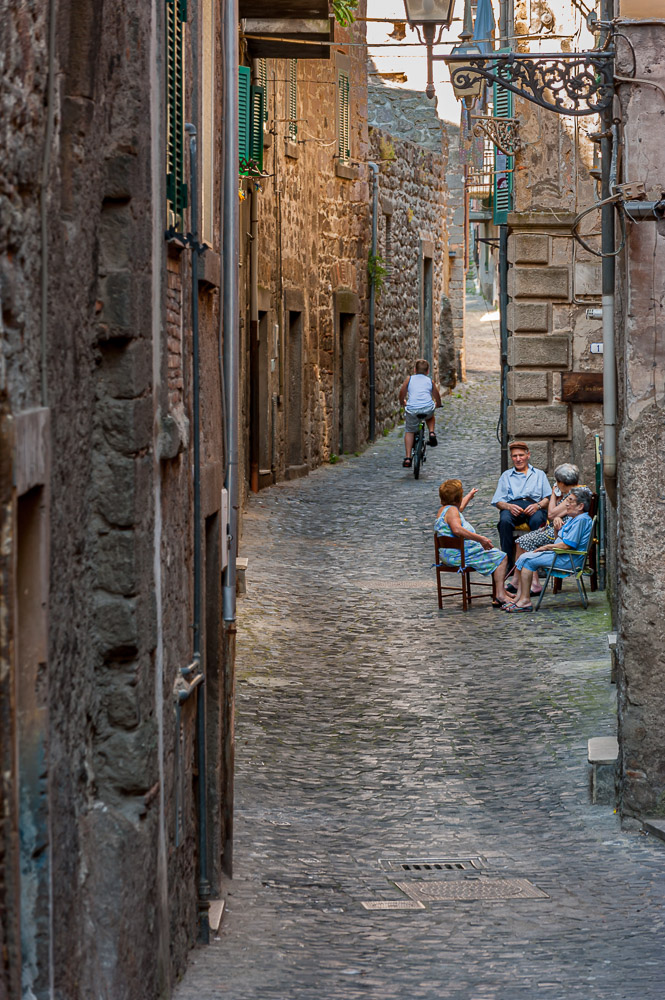
    It is in a small town in Italy. A miserably hot day (at least 100F). I was trudging back to the hotel, dying from the heat. But looking down this side street, this group of old friends was making the best of it, enjoying each other’s company as they have probably done for decades. It was a shady spot with some breeze. Probably the most comfortable place around. They knew how to cope with it. And how to live a good life with joy.

    After seeing this and capturing it, I felt better, too. Expressing joy is contageous

  • What Can it Be?

    What Can it Be?

    You saw something that excited you. All your experience and great camera gear was used to capture it. You poured your heart into representing what you felt. Now what? For fine art, no matter what we felt, now we have to make the best image we can. We have to let go of what we saw and figure out what can it be. Now it takes on a new life.

    Capture time

    When I am in the field with my camera, I have to use all my skill to compose and create the best image I can. I’m speaking for myself, because all my work is captured outside. The same idea would apply in a studio.

    Something caught our eye. We were reasonably sure there was a subject there worth spending the time on. We completely fell in love with what we saw. That is great. If we can show that emotion and enthusiasm to our viewer, they should be drawn to the image just as we were.

    So we work the scene. Design the composition. What is the best position to capture this? The right lens to use? Decide when and where the light is best, Does the background and foreground need work? What depth of field does this need? Work through the technical settings: aperture, shutter speed, ISO, focus, expose to the right but don’t burn out the highlights. It is on a tripod, of course.

    In the field the process becomes a pleasant dance intertwining the technical details, the changing light, compositional tweaks, and the “decisive moment“. If we are new to it, there is a lot to try to think about in real time. If we are extremely experienced, we tend to get in the flow and let our subconscious take over. Either way, at capture time, we are intensely focused on getting the shot.

    Associations

    This (potentially) great image we just shot has a lot of personal baggage attached to it. We bring back all the associations we had in the field. This image has meaning for us in various ways. It may remind us of something significant from our past. We might be proud of a compositional trick we used that we have been wanting to try. It could be one of our favorite places we love to go back to. Or possibly our association is how cold or hot or wet or windy and uncomfortable it was.

    Every image has associations from when and why we created it. We have memories, feelings, expectations.

    But guess what? No one cares. Sorry. Well, the associations may make the image significant to me, but that is a don’t care to someone else unless I have a chance to tell them the story of why it is special. I seldom get the chance to describe my feelings, except in the image itself.

    The reality is that my viewer is going to look at the print and decide what they feel or like, without having those associations I have. They see it fresh and in a completely different context. The image has to stand on its own and be accepted for what it is.

    Letting go

    So I’m back in my studio working on an image. At this point, I’m working on the image to be seen and appreciated by someone else, not myself. To get in the right mindset for this, I have to let go of the associations I feel for the image. The image has to stand on its own.

    This is not saying I should forget the feelings and emotions I had. No, they are important. They form the base of why I responded to the picture. But what can I do to help my viewer see something of what it meant to me?

    A technique that works for me is letting the image age. If I wait long enough before processing it, there is time for the raw emotions and the visceral experience to develop context in my mind. It helps me to see past the excitement of what I felt and look at it with more objectivity.

    Let me give a not entirely made up example. Say I trekked in to a beautiful spot through deep snow. I’m standing on fairly slick rock at the precipice of a canyon. It is snowing lightly and very windy. I’m a little concerned about the wind and the slick rock sending me over the edge to a 100 ft fall. It is very cold. I’m tired and chilled, but the scene is beautiful. Worth the challenge and discomfort. I love it.

    As I snap the picture, all these feelings are imprinted in my memory along with the image. The difficulty and stress and physical sensations impart more importance to the image than it may deserve.

    It is all new in post

    My point is that in post processing, our job as an artist is to finish the image into something our viewers will appreciate. We have to be free enough of our own associations that we can look at the picture and see what the viewer will see.

    The feelings we felt and bring with us are still extremely important. This is the reason why why we made the image in the first place. But the viewer does not know what we felt unless we can convey some of that in the image itself.

    What can we do now, sitting at our computer in a warm, comfortable studio, to bring those emotions to the viewer?

    One thing I am learning is that I have to let go of a technician’s purist view of the reality of what the scene was. We have a wide array of tools available to us in post to make the image stand out without destroying the “truth” of the scene.

    We’re expected to remove that offending tree or boulder that interferes with the sight line or takes attention away from the part we want the viewer to concentrate on. We can do color and brightness correction to get the overall tone to match what we felt. Dodging and burning will do wonders to change the perceived tonal values and let us emphasize or de-emphasize areas.

    Crop it to a different aspect ratio? Of course. There is nothing sacred about the camera’s default crop ratio. Stretch things in one dimension? Sure, the wide angle lens made the mountain range seem less impactful than I remember. Stretch them some. That is not being false.

    Pre-visualization

    Many authorities say we should always pre-visualize our images. I take this to mean we should have worked out the details of what the final print should look like before we take the picture. That works for some people, not for me.

    I’m more ADD. When I am in the field, I like to be in a flow state. I shoot instinctual, emotionally, drawn by what inspires me at the moment.

    Of course I have a good idea of what I will end up with based on my experience and knowledge of the technology. I usually can predict how far I can push something. This is in the background, though. I try to not spend much conscious time thinking about the details while I am shooting.

    Two images

    So for me, every shot basically creates 2 images. The first is what i see and capture in the field. The second is how I interpret and morph the final print. They can be very different.

    Both the images are dependent on my mood, perception, mindfulness, creative flow, health and intent at the time. All images are interpretations of a scene. If I went back to a scene another day, I would shoot a different picture. If I post processed an image I love a second time, I would probably end up with a different result. It is art. It is subjective. There is not right or wrong, only better or worse.

    All of this is to try to convey our feelings and impressions to our audience. A straight, unprocessed image will never let my viewer see my intent. Like a movie, what matters in the end is the effect it has, the feelings it makes us feel. My image has to stand on its own and be accepted for what it is.

  • Directing the Eye

    Directing the Eye

    Directing the eye is a hot topic with photographers and workshop leaders. Even some psychology researchers. It involves understanding the psychology of how viewers look at an image and techniques to encourage them to look at it the way we want.

    Psychology

    There are certain principles of perception that seem to have a lot of agreement. By understanding the principles, we can use them as tools to increase the probability that people will spend the time to look at our images.

    Understand that these are characteristics common to a lot of people, not hard and fast rules. 2 + 2 = 4 is a rule. Not every individual in every situation follows a principle like “the eye is drawn to the brightest region”. Usually, but not always. So while learning and applying these understandings we increase the chance of people relating to our work, we can’t guarantee it.

    Brightness and contrast

    We are drawn to bright areas and we are drawn to areas of high contrast. Use this to draw people to the area of your image you are particularly interested in them seeing.

    Since we tend to look more at light areas and less at dark ones, that is why vignetting is commonly used to “push” the eye away from the edges of an image and into the interior.

    The lighting wasn’t right to give the effect you wanted at capture time? So what? That is what post-processing is for. Don’t be afraid to change the lighting and contrasts for the effect you want. If you do it skillfully, no one will know. If you don’t… well, it’s a learning experience.

    Color and saturation

    Color also effects how we look at an image. Highly saturated colors attract us. Even normally saturated colors are seen differently. Warm tones seem to advance. Cool tones seem to recede. Placing warm tones next to cool tones gives a subtle 3D effect. This is why at concerts or plays you often see warm light on one side of a performer and cool light on the other. It gives them more shape.

    Spots of color attract the eye, too. If a scene has fairly even pastel or monochrome tones with a few small areas of a brighter color, we are drawn to those colorful areas.

    Lines

    Our eye is a marvelous pattern matching engine. We try to make connections whenever we can. Check out Gestalt Psychology for much more information. So lines, especially diagonal ones, tend to lead the eye to find something interesting the line is leading to. We are actually disappointed when we are fooled and the line didn’t mean anything.

    Wide angle lenses are sometimes used to accentuate this effect by exaggerating diagonal lines and bending them. It is difficult to shoot some scenes wide without introducing diagonals. Make sure to not disappoint the viewer. Provide a target to reward them for following the diagonal.

    Faces and words

    Human figures, especially faces have a high visual weight. We are designed to recognize faces and we have a high interest in them. If there is a face, or part of a face, or even an eye in an image that will be one of the first things a viewer is drawn to. A face trumps most other elements of a picture.

    Likewise with words. We recognize words as information. We’re conditioned to read them. I think it is fascinating that we are drawn to them even if we do not understand the language. Besides, by it’s nature, characters making up words are fairly sharp edged and high contrast. We have already seen that viewers are drawn to high contrast areas.

    Since faces and words are so powerful, we have to be careful with them. Having a person walking through the background or a sign off to the side can destroy your composition intent. Or they can make it if you use them well. The point is, you have to be very aware of them and what they will do to your image.

    Depth of Field

    A simple attention focusing technique is to use a shallow depth of field ( a small aperture number such as f/2.8). We are drawn to sharp areas and tend to ignore blurry ones. A shallow depth of field tells the viewer to pay attention to the slice of the image that is sharp.

    This is a excellent trick to eliminate the complexity of busy scenes.

    Techniques

    These eye catching techniques are means we can use to help make the viewer look at our image the way we want. Many photographers seem to obsess about eye paths through an image.

    Eye tracking studies have been done, where subjects are instrumented with devices that can determine what their eyes are looking at at any moment. These studies produce maps, sometimes called “heat maps’, of the viewing patterns.

    This used to be done a lot for web sites. After all, companies spend a lot of money producing their sites and they want to know if customers are seeing what they want them to see. Eye tracking has also been used to instrument image viewing. Researchers are interested in the order in which viewers see things, what they spend the most time on, and what path they use to scan over the image. Much of the information I presented above comes from studies like these.

    This says that techniques can be used to direct viewers to parts of the image we want them to see. Maybe we can even encourage them to scan the image in a certain order.

    Why direct the eye?

    We’ve looked at some of the principles and techniques that can be used to direct viewer’s eyes. But why are some of us keen to do this? There must be a reason.

    A photograph captures everything in the field of view of the camera when the frame was exposed. This can lead to a complex, even chaotic image. There can be many things competing for the viewer’s attention.

    Sometimes the photographer feels the need to help out by saying “here is what I want you to pay the most attention to.” Eye directing techniques are good for this. This is a good use of the techniques.

    Something else I see, though, I feel is unfortunate. We live in a short attention span world and we tend to accept that as a universal truth. It is said that people only glance at an image for less than a second online, unless it really grabs them. So photographers think they better use all the tricks they can to let their potential viewers grasp the image in 1 second.

    Therefore there is a belief by many that we must make our images absolutely clear and unambiguous and immediately graspable. After all, if we only have 1 second, we better package the information clearly. Maybe that is the case if your world revolves around the ephemeral whims of social media.

    I fear this makes images shallow and boring and is a self fulfilling prophecy. Images have less depth so viewers dismiss them more quickly.

    Introducing mystery

    I follow a different path. Most of my work is intended to be viewed as prints. The relationship between prints and the viewer is a little different. If someone is walking through a gallery viewing prints, they are likely to spend a little more time contemplating each one.

    While I occasionally do work that is very clear and unambiguous, even minimalist, I often do the opposite. Sometimes I enjoy presenting images that are rich in content, that I want viewers to spend time looking at and discovering new things.

    I occasionally even misdirect attention from a subtle interest I hope the viewer discovers. Not to be mean or devious, but to reward viewers, to give them a joy of discovery for exploring more carefully.

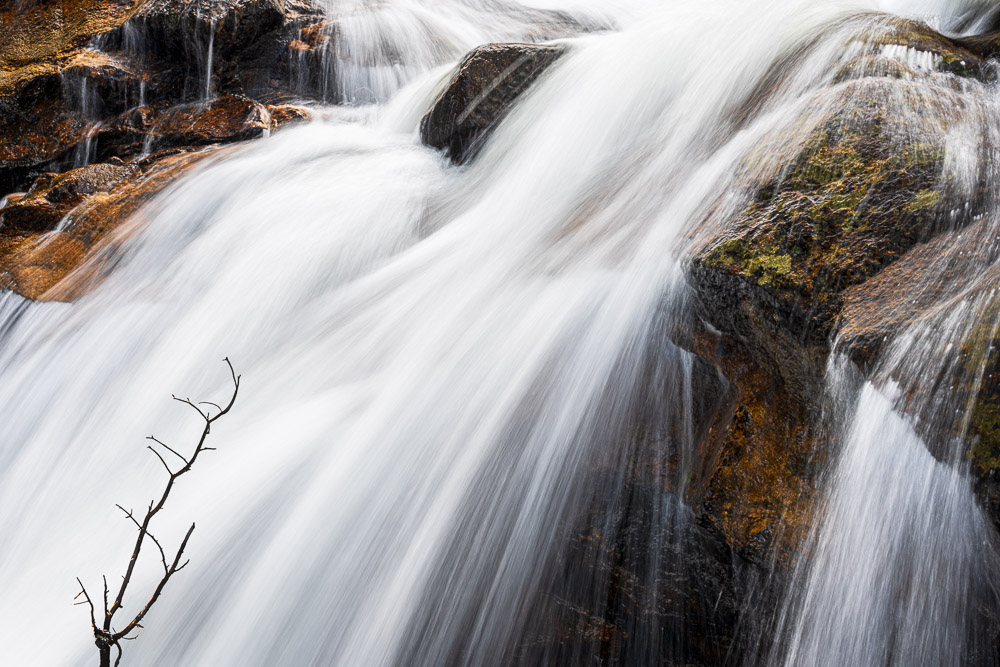
    The image with this post is an extreme example. The eye is immediately drawn to the lower left side. That is where the brightest area is and the presence of the high contrast branch silhouette insures it. There is interest there and I hope people like it. But after you’ve explored that and you follow the cascade up to the top right corner you might discover there is a plaintive, maybe melancholy figure under the water. It is not a face, but you see it as a face. There is a moment of recognition that reignites interest and it raises questions, I hope.

    What do you think?

  • Constraints

    Constraints

    I have written about this before, but I feel it is time to revisit it, maybe from a slightly different point of view. We have constraints on almost everything we do. Usually we try to find ways to avoid or relax the constraints. I am suggesting that they can actually be useful, Working within constraints can make us a better and more creative artist.

    Constraints

    Constraints are anything that bounds us, that limits what we can do. We all have them. You aren’t able to go on a 6 month art sabbatical because you have to work to earn a living. I would like to get the latest super mega pixel camera – no, I need it, really. But I can’t afford it. I feel limited because I don’t have a great wide angle zoom or super telephoto.

    Wherever we turn we bump up against constraints. Time and money are the overriding classics. And there are technology limitations and constraints imposed by our families, school, and job. Maybe the inability to travel to the locations you want. Everything seems to be conspiring against us.

    They seem to limit us as artists

    I was having a discussion recently with a friend I respect a lot. A very good professional photographer who you would know. He was observing that he has always taken multiple camera systems with him on shoots, along with all the associated lenses, batteries, etc. But he is getting older and all that slows him down and makes the experience less pleasant.

    Isn’t this common for photographers? We feel like we have to have LOTS of equipment. You may need that 600mm for a bird shot. You may need that tilt/shift lens to do architectural photography. The portable flash system would come in handy for portraits. Having a small mirrorless camera is good for travel photos, but you might want that medium format system for fine art scenes you find. We always need more gear.

    How can we capture the image we want unless we have that exact, perfect piece of equipment? Well, maybe we have to think. More on this later.

    How to work around our constraints

    We have freedoms of choice in our lives. Don’t have enough money? Earn more. Don’t have time? Get out of the working world and use your time for yourself. Can’t carry all your gear? Get a photo van and outfit it with storage for all your equipment. Drive it to your shoots. Can’t carry all you need to a location? Workout hard to get strong enough to carry a huge backpack. Family taking up too much time? Cut them loose.

    How’s this working for you so far? Yeah, I thought so. Doesn’t work for me, either. We have choices we can make, but I can’t snap my fingers and wish up a life of luxury to feed my art desires.

    I guess we had better resolve to accept most of our constraints. They are there. They are real. We don’t have a magic wand to wave to make them go away. Sure you can adjust your life goals to better accommodate your art. But we will probably not have unlimited money or time or equipment or travel opportunities. That’s life.

    So we have to deal with our constraints and work with them and still create our art.

    Turn it to your benefit

    In some types of self defense programs you are trained to use an attacker’s momentum against them. That is sort of what I am advocating. Our constraints seem to be working against us and limiting our freedom and ability. Use them for our good instead of fighting against them.

    Constraints can be a road block or a creativity enhancer. It is a matter of attitude. Don’t sit around moaning because there is a constraint in the way. Accept it as a challenge. Use it to rise to a new level.

    An example of constraints

    A story to illustrate. In 1974 a young upcoming director named Steven Spielberg was hired to direct a movie called Jaws. It was the first major motion picture to be actually filmed in the ocean. It turned out to be beset with problems. One of the producers later said if they had read the book twice, they would have not made the movie when they realized how difficult it would be.

    There are many interesting examples of constraints with this movie, but one in particular fascinates me. The mechanical sharks turned out to be a nightmare to make work. Even when they were working it took a team of 14 “puppeteers” to operate them. The sharks caused so many production problems that they had to be cut out of most of the first half of the movie. The result was that in the final product, the hidden presence of the shark, combined with John Williams brilliant music, built much more tension and drama than their original plan. The movie was a blockbuster hit and still viewed today.

    It was made better because of the constraints that had to be overcome. Spielberg later said of the difficulties that “The film went from a Japanese Saturday matinee horror flick to more of a Hitchcock, the less-you-see-the-more-you-get thriller.”

    Our constraints

    We may not be making a multi-million dollar movie, but we encounter constraints all the time in our every day lives. How we deal with them makes or breaks what we get.

    Maybe you can’t fit a photo safari to Iceland, Africa, New Zealand,… (fill in your blank) into your life or budget. Does that mean you should put up your camera and sulk and not take pictures? Of course not. Shoot where you are and what you find. The reality is you will have more insights on familiar areas than you do seeing a tourist spot for the first time. Learn to really see what is around you. Let your curiosity lead you to an attitude of awe about what you find.

    You’re a fine art photographer and you feel like you need to have a medium format system to shoot 100MPixels or more with great dynamic range. So you should sit and wait until you can afford to put $20,000 or more into a good medium format system? No. That is something you defined. Get out and work.

    Most fine art photographers I know do not shoot medium format, at least not exclusively. The fact that they do not shoot it exclusively means they recognize that it is not always required. They can do excellent and very salable work with their DSLR. It is more about vision and insight and technique than it is about technology.

    Do the best you can with what you have. Maybe someday you can upgrade, but that will not change your vision or your style. It will just make your images printable at a larger size.

    I could use many other examples of constraints. Many are common to most of us and some are unique to each of us individually. Whatever yours is, embrace it and work with it.

    Become a problem solver

    Embrace it? Yes. You have to live with it, so use it to your benefit.

    Working around constraints is a problem solving exercise. We have to think. We use our creativity to come up with an even better solution to what we wanted to do originally. Like Spielberg in Jaws.

    Looking to shoot a scene, but it would take a super telephoto that you don’t have? Re-evaluate your composition. Maybe there is a different POV that you can shoot with your 200mm. Or get up and move closer.

    Working on a composition that requires a super wide angle to bring in all the lines and shapes you envision? Re-think how to make the image using your 24mm. Maybe get closer. Maybe re-compose it to change the relationship of the elements.

    This is a significant part of creativity. Creativity is not just coming up with wild new ideas that no one else has ever thought of. A lot of it is solving problems to remove obstacles in order to realize your work. Your vision should transcend your constraints.

    So when an obstacle or constraint presents itself, don’t let it derail you. Put your creativity to work on it. It can be a good thing. It can stretch you and grow you as an artist. Find a creative workaround. Let it spur you to produce something better than you originally envisioned. If you react to it positively and exercise your creativity, you may end up being thankful for the constraint.

  • When Do You Make a Picture?

    When Do You Make a Picture?

    When do you make a picture? Have you thought about that? On the surface, it seems an ambiguous or simplistic question. I have been asking myself this, though.

    Time, place?

    I could be flippant and say I make pictures Tuesdays in the canyons west of my home. That is not true, though. I capture images at least 5 days a week, in general. And I make pictures most places I go. There is no special place for making images.

    Looking for things to satisfy my curiosity is not about a time or place. Even traveling to an “exceptional” destination is a special case of just making images wherever I am, of whatever interests me, whenever I have a chance.

    The click

    OK, so you could say I make a picture whenever I click the shutter of the camera. While it is true that the shutter release is the event that causes the recording of the data in front of the lens, I have written before about sometimes needing to think about and process the data before I am done.

    When I go out shooting and come back with 200 images on my memory card, does that mean I have made 200 “pictures”? No, but it is a subtle semantic distinction. My answer would be that I have 200 new possible pictures at this point. However, I am going to go through them, cull out the defective ones, decide which of the duplicates I want to keep, and then try to decide if there is any merit in the ones that are left.

    When all is done, maybe I would end up with 0-10 that are worth doing something with. Your mileage may vary. Mine does, too, depending on time and place and my mood. Note that I still have to do things with them. In my mind, they are not “pictures” yet, since I am not ready to show them to anyone.

    Post processing

    So, of course I have to post process the ones I have kept so far. This may only involve simple exposure processing, especially corralling highlights and shadows, color correction, and contrast adjustment. Typically there may be some spotting and minor blemish removal.

    At this point I “may” have a picture. For straightforward scenes, this may be enough. I am done. It may be beautiful or interesting and no more than the literal scene before the camera. A lot of pictures are just that.

    Deciding what it is and it is going to be

    But not always. Sometimes an image is trying to tell me that it is something more. It may take a while for me to hear it. This often manifests as a discomfort I can’t quite identify. A suspicion that I am missing something.

    When this happens during the initial culling process, I usually keep the frames I am struggling with. I might not be able to articulate why, but I know I’m not ready to eliminate them yet.

    Even after the image is processed and is a nice picture on its own, sometimes it keeps trying to talk to me. Deep down inside, I know I have not understood or brought out all it means to me.

    Sometimes I realize I have been capturing images of a certain subject or mood. I may recognize a theme that is emerging. Recognizing it helps me identify and clarify a truth I was not consciously aware of. This could put me on track to follow the idea for a while as a project. With these nagging images in context, I learn more about why they were talking to me. All seems different. Sometimes I don’t even need to modify the images more. Just understanding what I was feeling may be enough.

    Combining

    And sometimes I recognize an image is an interesting piece, but not complete in itself. I will often file these away as raw material, expecting to revisit it is the future and decide what it needs to say what it wants to say.

    There are times when it comes to me and I know that these pieces have to fit together in a certain way to create a new image. This can be satisfying, fulfilling, exciting. It is a true creative journey.

    It is time consuming but often very rewarding to spend sessions in Photoshop playing with various combinations of pieces and parts, doing “what if?” games. These often end up in “failure”. Failure in the sense that I did not create a new picture. But it is seldom actually failure because I explored ideas and tested new things. It often sparks new ideas for the future.

    Disconnected from capture

    This comes around to an idea I have presented before. Sometimes I have to let an image age before it becomes whole. It can take me an indeterminate time to recognize what the image wants or needs to be.

    Images are raw material until I become comfortable with how they should be expressed and presented. This is a separate creative process from image capture and a necessary part of how I make a picture. It is not until the end of this journey that I feel I have a picture to share with the world.

    Today’s image

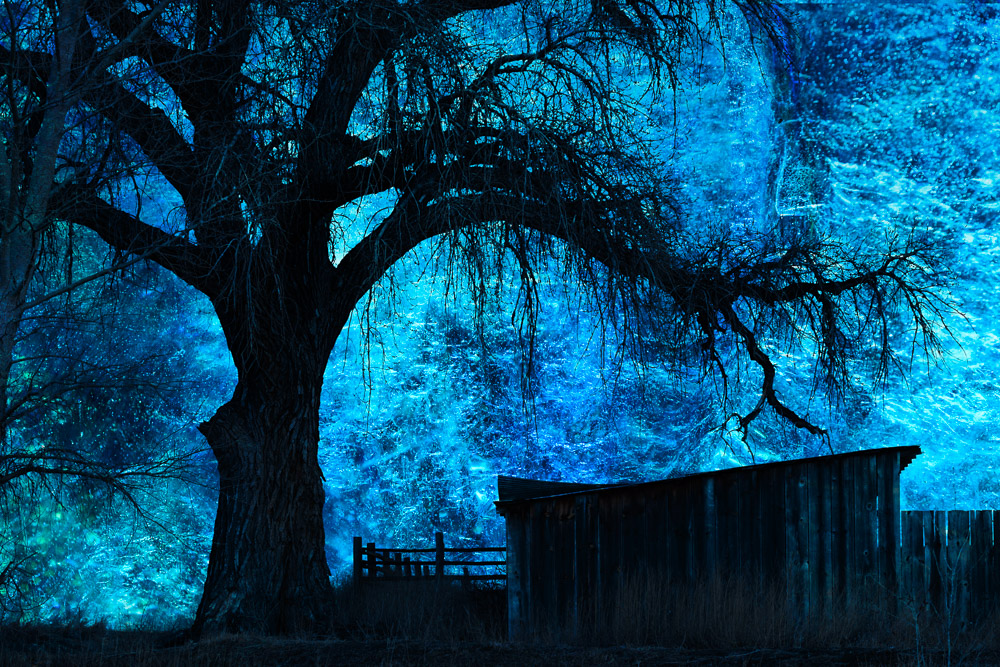
    The image with this article is a minor example of what I describe. I was fortunate to find this scene late one winter afternoon in what I considered an unlikely place in the back country of northern Oklahoma. I’m a sucker for lone bare trees silhouetted against the sky.

    I liked it, but I know it was not “done”. A few months later I added the birds, because I felt they built and reinforced the mood of the image and added some dynamic interest. Just today when I came back to it again after about another 6 months, I saw I wanted to eliminate some distracting foreground elements, crop it to emphasize the sky, and make it overall higher contrast and more saturated. I’m good with it – for now. 🙂