An artists journey

Category: Craft

  • Out of Focus

    Out of Focus

    A few months ago I wrote about being in focus, both technically and mentally. I want to go a little deeper into how technical focus happens in modern cameras and an an experience I had recently where what I did was out of focus.

    What is focus

    Technically, focus is simple when the lens is adjusted so that the part of the subject you are most interested in is sharply defined. Your lens has a focus ring to use to manually focus. Most of us probably use the camera’s built in auto focus capability. This is much more precise than my old eyes. And a lot faster than most of us can do manually.

    Focusing physically moves one or more of the lens elements inside the lens barrel. This is required to adjust the focus point.

    I will let you argue whether focus is an absolute, precise point or just an acceptable range. I will just say that I am swinging away from being adamant about absolute technical perfection and leaning more toward artistic judgement and intent. Set your own values you will live by.

    Whether we manual focus or use auto focus, we observe in the viewfinder the image moving from a fuzzy blob a crisp, detailed representation of the scene before us. Unless we have a very old piece of technology in our camera with something called a split image viewfinder. I had this in my first SLR. It was magic and awesome for most of the subjects I shot.

    The split image viewfinder showed the image sharp regardless of focus. The image was divided into 2 pieces in the central circle. The pieces were offset from each other when out of focus. Use the focus ring to bring the 2 halves into alignment and the image was sharply focused. Magic. Enough trivia, though.

    Little did I know this was a type of and precursor to what we now call phase detection auto focus. Let’s get a little deeper into the technology.

    How does it work?

    Auto focus in a DSLR or mirrorless camera is complex and requires many precise components. But it works so well now that we tend to take it for granted.

    There are 2 basic technologies in modern cameras. The older one is called contrast detection and the newer and better one is called phase detection.

    I have written on histograms, a subject I consider vitally important to photography. Histograms and their interpretation are the basis of contrast detection auto focus. It is brilliantly simple in concept and in process as what we do when we are manually focusing.

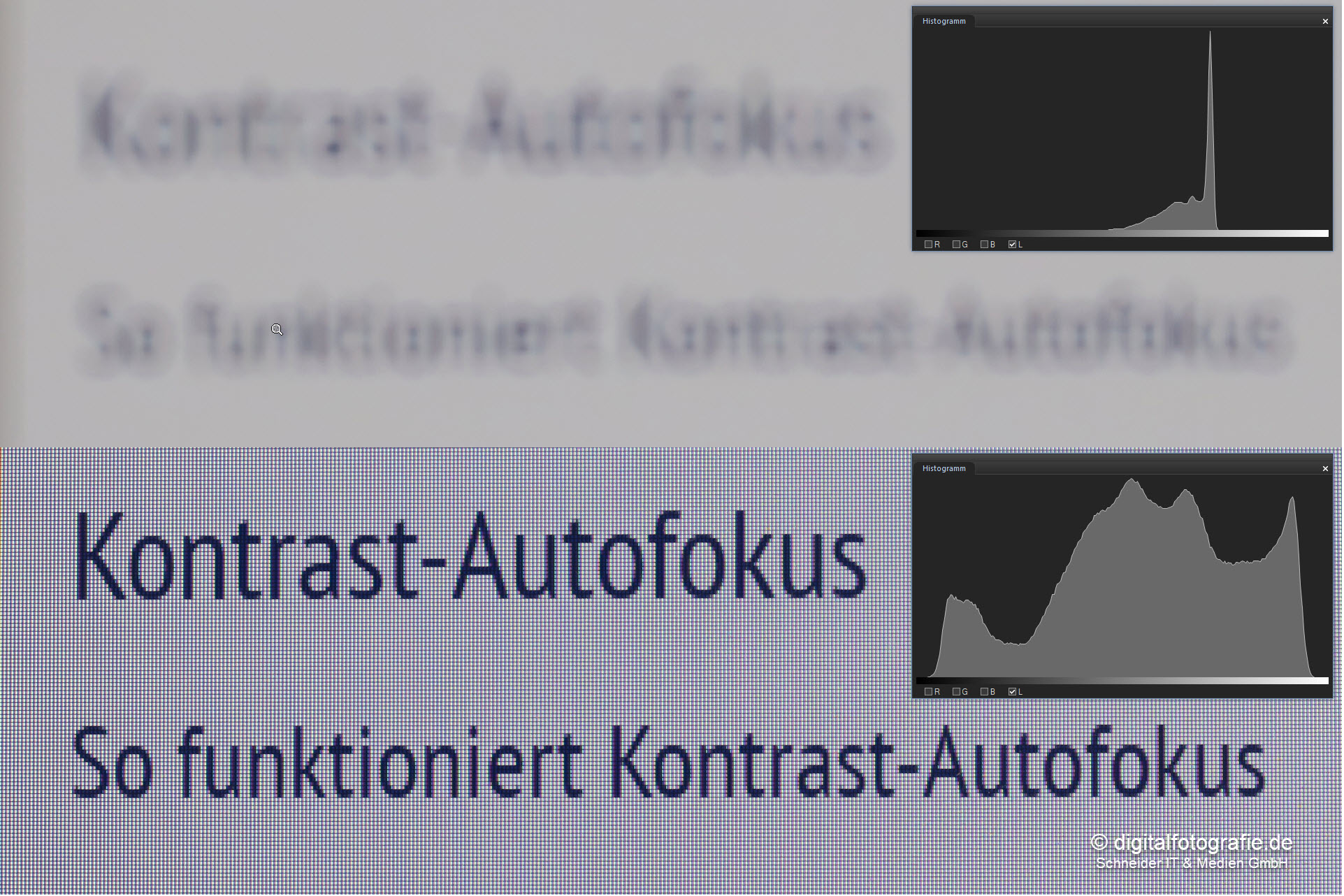
    If an image in the viewfinder is out of focus, the pixels are blurred together. Kind of like looking through a fog. A result is that in the histogram, the values are clustered in the center. This is an indication of low contrast. But when an image is sharp, there is a wider range of brighter and darker pixels. This illustrates it:

    From https://digital-photography.com/camera/autofocus-how-it-works.php
    Focus process

    So conceptually, the system moves the focus a little and measures again to see if the histogram got more narrow (more out of focus) or wider (sharper) . If it got more in focus, continue moving that direction and measuring until the peak contrast if found, But if it got more out of focus, move the focus the other direction and continue the process. It is a hunting process to find the optimum focus point. Just like we do to manually focus.

    Unfortunately, this process is slow. It can take seconds to arrive at the focus. This is why phase detection auto focus came to prominence.

    In phase detection auto focus, some of the light coming through the lens is split off to a separate sensor. Like the split image viewfinder I mentioned above, it is further split into two paths. Through some brilliant engineering, they can determine in one measurement how far off focus is and in what direction. The focus moves there quickly. Note that in mirrorless cameras all the light goes directly to the sensor, so these auto focus sensors are built directly into the sensor.

    I said that phase detection is “better” than contrast detection. That is true as far as being very fast. Actually, contrast detection can achieve more precise focus. There is a kind of system called hybrid the combines the strengths of both. I will not discuss that or go into the bewildering variety of focus areas or focus modes.

    Out of focus

    This is all great as far as technology goes. It works quite well in the cases it is designed for. We are lucky to have it.

    But all of these systems rely on the sensor having enough light to see some contrast. It doesn’t work in the dark. Yes, there is another variation on auto focus that is called active auto focus. It shoots a red beam from the camera to illuminate the focus area. This has a very short range and does not help the scenario I’m about to describe.

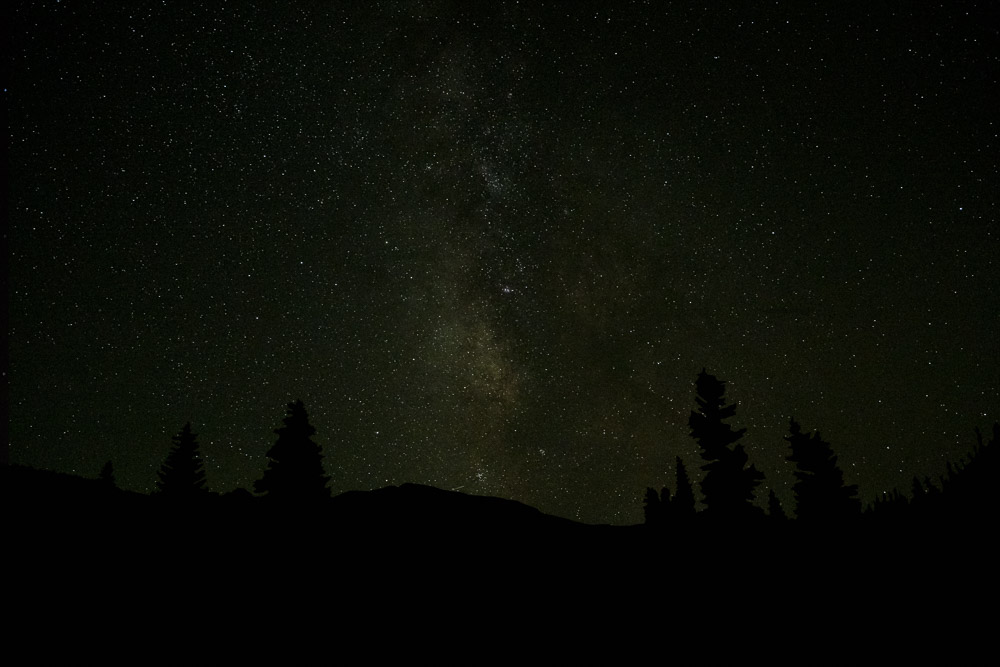
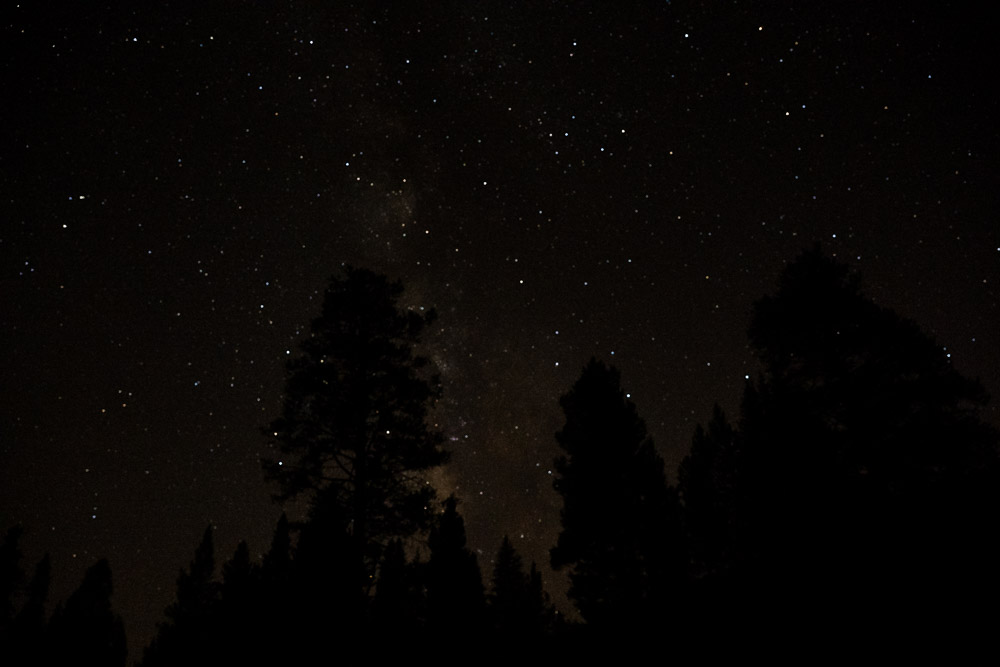
    Recently I was in Rocky Mountain National Park, over on the west slope where there is little light. It was full dark on a moonless night. The mountains all around provided lovely silhouettes. The stars were astonishing. Beautiful. I had to stop and get some star images.

    A trailhead parking lot provided a great and convenient place to set up – wondering if those occasional sounds I heard in the dark were bears. I guess not. It was perfect. Except. There was not enough contrast to focus, even at 6400 ISO. And the viewfinder image was too noisy to be useful for manual focus. I did not have a powerful enough flashlight to cast enough light on the nearest object, over 100 yards away, to allow the focus system to work.

    Adding to the problem, the lens I brought on this outing did not have a focus scale (a curse of modern zoom lens design). Normally, in low light, I switch to manual focus and set the lens to infinity for a scene like this. I guessed, but missed badly for a big section of the images. They were uselessly out of focus. I am ashamed to show an example, but like this:

    A blurry night shot©Ed Schlotzhauer

    Experience is a great teacher

    I write frequently advocating that we study our technology to become expert with it. And to practice, practice, practice to know how to use our gear, even in the dark. I failed. I encountered too much dark and a lens I had never tried to use in low light. The combination tripped me up. I am ashamed to admit I did not follow my own advice well enough.

    But every failure is a learning opportunity, right? It can be a great motivator and reinforcer. I did some research and discovered a “hidden feature” I never knew my camera had. It should save me the next time I do this.

    My Nikon camera has a setting I had never paid any attention to called “Save focus position”. When On (the default) it remembers the focus position of the current lens when the camera is turned off and restores it on wake up. But when Off – this is the brilliant part – it sets the lens to infinity on wake up. Now I will have a known infinity focus setting, even in total darkness! This setting is now in my menu shortcuts so I can access it quickly.

    I would never have learned about this feature if I had not failed so spectacularly. Experience really is a great teacher.

    So dig into those obscure settings you never bother with. There sometimes is gold there.

    Keep learning and failing!

    The featured image

    That night’s shooting was not all bad. I nailed the focus on this star shot. It was purely of the stars and had no foreground. This foreground has been substituted from another blurry image that night (actually, redrawn by hand).

    This is artistic expression rather than literal reality. I do that a lot. As photography progresses and matures, I believe that is more and more the norm.

  • Get in a Flow

    Get in a Flow

    You have probably heard of flow states. Maybe you have experienced it. It is a wonderful place to be. Let’s talk about what it means to get in a flow. It does relate to art. Trust me.

    What is it?

    The concept of a flow state was described by Mihaly Csikszentmihalyi. Good luck with the pronunciation. It is actually fairly easy after you hear it.

    Csikszentmihalyi was a child in Eastern Europe during WWII. It was a deeply traumatizing experience. And he noticed that, even after the war, many people were not able to recover mentally. He was very curious as to why.

    Eventually he moved to America and studied psychology. His main research focus was happiness, what it is and how to achieve it. The identification of what we now call flow was a minor part of this research. He found that people were their most creative, productive, and happy when they were in this flow state.

    In Csikszentmihalyi’s words, flow is “a state in which people are so involved in an activity that nothing else seems to matter; the experience is so enjoyable that people will continue to do it even at great cost, for the sheer sake of doing it” (1990).

    He discovered that flow was a state people could get into temporarily where amazing and beneficial things happened. They had almost complete concentration on their task. Time would seem to speed up or slow down. The activity they were doing was intensely rewarding and pleasurable to them. And there seemed to be effortless ease in what they were doing.

    Who experiences it?

    Different people have differing predisposition to get into flow states.

    Autotelic personalities tend to experience more flow. An autotelic is someone whose personality is driven by internal rewards more than external motivations like money or power. They are creative and curious and independent. This leads them to pursue goals that motivate them and give them internal satisfaction.

    At the other extreme, people with a neurotic personality find it difficult to get into flow. Some think this is because their anxiety and self doubts inhibit the conditions leading to flow.

    What happens to the brain?

    Many researchers approach the study by trying to identify the mechanisms in the brain that support flow. I don’t have much interest in looking at it this way, but I will note some of the thoughts.

    Some believe there can be an interaction between the default mode network (DMN) and the executive control network (ECN) in the brain. The DMN is the background processing we do, as when we daydream. The ECN is most active during problem solving and it helps tune out distractions. They feel that when these 2 centers work together in the right way we can achieve flow.

    Another theory attempts to show that flow is achieved through expertise and practice. The idea is that as we become expert at certain tasks and reinforce that through repeated practice, we train the brain to perform it more effortlessly. The brain can sort of turn in to an automatic mode and let go and let the creativity flow.

    This second research seems to be “winning”, and it is what I subscribe to.

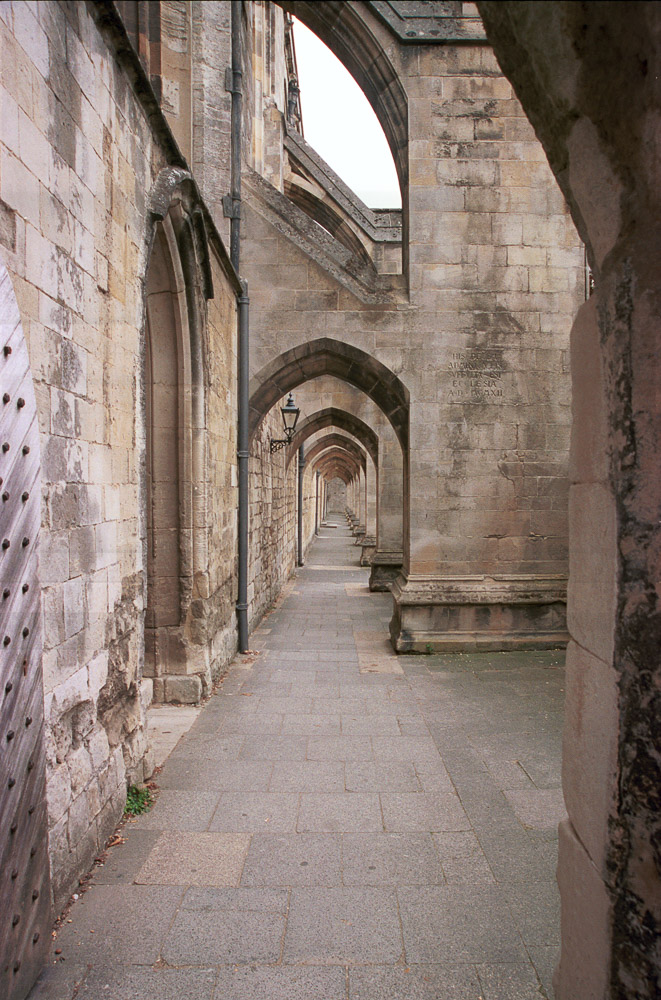
    Gothic cathedral repeating forms© Ed Schlotzhauer

    How to achieve it

    Flow is generally something that happens when we are completely immersed in a task that engages and energizes us. It seldom works to say “I’m going to go get into a flow state.”

    As an example, some of the researchers studying the theory studied jazz guitarists. They instrumented them and recorded their brain activity during improvisation sessions. At a high level summary, less experienced musicians had to concentrate hard on what they were doing and did not enter flow states. Experienced musicians tended to go into “automatic”. They concentrated on the sensory aspects of playing the guitar and little time thinking about what to do or how to improvise. They had a low level of DMN and ECN activity. This seems to support the expertise theory.

    That’s a lot of theory, but it doesn’t say much about how to achieve flow. You have to be expert in the task you are doing, and you have to have a extensive base of practice. Putting yourself in an environment where you are not distracted or interrupted helps, at least until the flow really kicks in. And being the type of person who is curious and self-driven and intuitive with a good ability to concentrate certainly seems to help a lot.

    Does it relate to art?

    I believe it is as common and valuable for artists as for jazz musicians or software engineers.

    Let’s re-examine the qualities I mentioned above for who gets into flow. Aren’t artists generally curious and self-driven and intuitive and with a good ability to concentrate? Don’t we have an intense desire, even need, to create? Aren’t we independent and self-reliant?

    We are prime to be able to find flows! The other missing piece is expertise and practice.

    This is one reason I recommend that we need to study to become expert in our craft. Using our tools should be fluid and natural. Exposure and depth of field and shutter speed and mechanics of using our camera should be automatic. This frees up our conscious attention for exploring composition and framing and expressing out feelings.

    And practice, practice, practice. Shoot frequently, daily if possible. Shoot something, anything. It’s OK to throw them away. The practice is worth is. All that practice is building the equivalent of muscle memory. Your fingers just know how to make the adjustments. Can you take out your camera in complete darkness and turn it on and set it up? Practice.

    When you go out to shoot, immerse yourself in the experience. Concentrate fully on what you are doing. Let the rest of the world fade away. If you are lucky, you will find afterwards that you were in flow. Whether or not you were, do your work. Plunge yourself into your art.

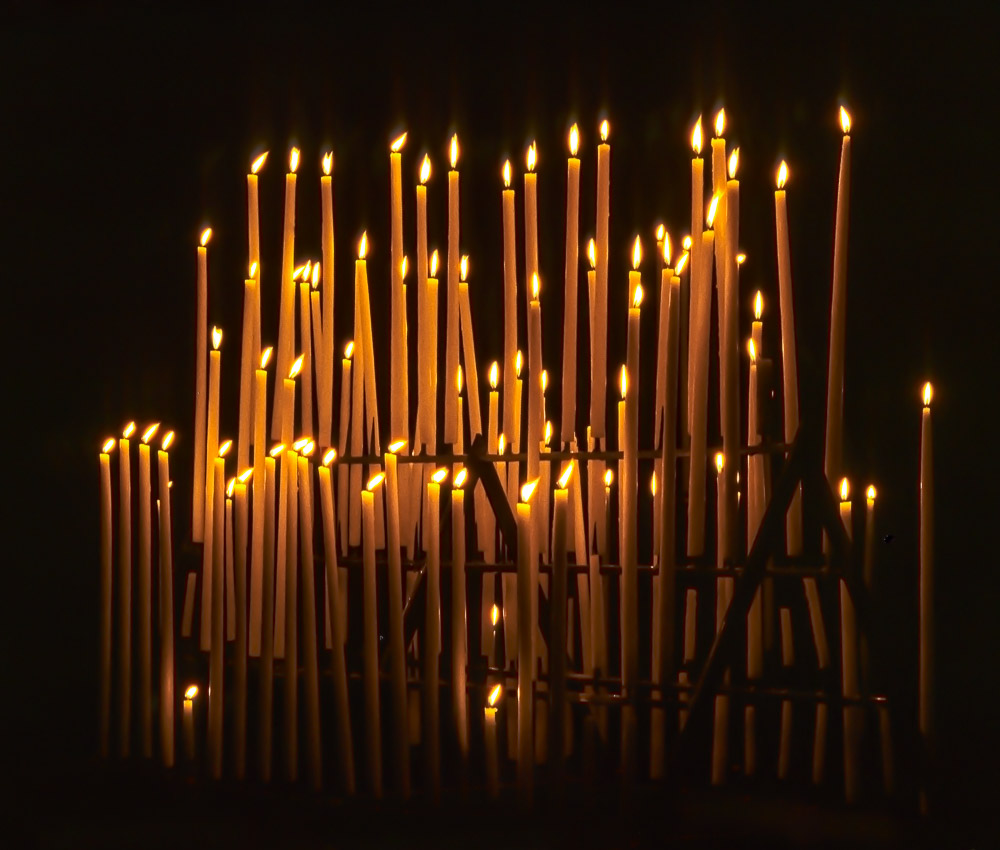
    Candles in a church© Ed Schlotzhauer
    Chartres Cathedral

    It is a positive experience

    I have experienced it, many times. As a software developer, I experienced this strange and exciting feeling regularly, long before I ever heard the term. Sometimes I would realize that hours have vanished and I forgot to eat lunch. And the productivity of what I did in those sessions was astounding. It was great to finally hear it described and find out I wasn’t crazy.

    As an artist it seems to happen different. I seldom work a scene for hours, although I may spend hours in a post processing session. But I may spend significant time wandering and looking and being immersed in the thought process. I believe this is a kind of flow. It seems to have the same result, where creativity flows easily and effortlessly. And it can produce a set of images that are above the norm of what I would expect.

    Even writing articles like this can achieve a flow state. I sometimes open a blog intending to make a few notes and jot down some thoughts I had, and realize a few hours later that I have nearly crafted a complete article. And I sometimes read through it and think “wow, did I write that?” 🙂

    A result

    Being in a flow is joyful. It is a happy state. But it is a result, not the goal. A flow state indicates that we have become completely immersed in a task that engages and energizes us. One that we are expert in and practiced enough in that we can sort of let go and let it happen. Kind of like those jazz guitarists they studied doing improvisations. It is not easy, it requires major commitment. But it is worth it.

    So study your craft. Gain deep knowledge and experience. Be familiar with ideas from other artists. Practice constantly (10,000 hour rule?). These will make you a better and more creative artist.

    Maybe, someday, you will look back on a block of creative energy you have just spent and think, that was probably a flow state. It feels great. Enjoy! Remember, Csikszentmihalyi discovered the idea of flow because he was researching happiness.

    Note

    I found 2 different rationale for calling it “flow”. One was that in Csikszentmihalyi’s interviews it was common for people to describe what was happening as “their work simply flowed out of them without much effort.” Another description says people sometimes described it as like being in a river flow. They were swept along with little effort.

    Decide what to call it when you experience it yourself.

  • What You Find

    What You Find

    This is heresy, but I recommend most of the time we work with what we find rather than planning extensively and expecting everything to be “perfect”.

    Planning

    It is common these days for photographers to research locations is detail before ever going into the field. And there are lots of tools to help us do it.

    For any given location we can find what time of the year is “optimum”, what time of day is best, even where to stand for the best view. We can research the weather we should be able to expect, the temperature, exactly when sunrise or sunset is if that is important to the shot.

    Then, of course, we can work back to where to stay, what time to get up, where the beat eating places are, etc.

    Basically, then, we can just show up at the right time, set up and take the shot we want, and leave.

    Trophies

    A well planned shot like that can lead to some excellent pictures. If you are a National Geographic photographer out on a 6 month assignment to get a certain picture, that is a great approach.

    I have 2 problems with it

    1. It is collecting trophies.
    2. What about the experience?

    Much of photography these days seems to revolve around collecting trophies. We have to get that signature picture of Half Dome or the Eiffel Tower to post on social media to impress our peers.

    That’s not me. I usually avoid places where dozens of other photographers are lined up shoulder to shoulder, fighting for tripod placements. Those sights are well covered. I do not plan to contribute yet another photo of Half Dome to the world, unless I am able to capture something unique. That is less and less likely when millions of shots are taken of it every year by good photographers.

    I fully realize this is a personal value. It also is rooted in my personality type. I derive satisfaction from creating fresh, creative images that represent my vision. Whether or not anyone else likes them. Some other people need to bag trophies. Checking off the bucket list items is more important than actually having the image.

    It would be foolish for me to criticize them. We are different. I do not agree with them, but I recognize that this behavior is true for many people. You have to do what is right for you.

    What you find

    Taking a good photograph is an emotional encounter for me. Talking about the experience you get is subtle and harder to describe. It is intensely personal.

    If you are the meticulous planner I described earlier and you show up at your target location, what happens if things go wrong? What if the weather is too stormy to get out? Perhaps there are forest fires around and it is closed or obscured by smoke. Maybe a road is slowed down by construction and you get to the location “too late” for the planned shot.

    If things like this happen and you can’t get the shot you planned, is it a failure? Are you disappointed with the outing? Was it a wasted trip?

    I’m not usually so disappointed. I am there to see, feel, internalize – and, oh by the way, make images I am proud of. A sunny day may not inherently be better than a rainy day. Why is a snow storm worse than a warm summer day? It all depends on my reaction and attitude and what I am able to do with what I find.

    How good are you?

    I believe the attitude of accepting what we find and using our skill to work with it is healthy and mature. We cannot control what we will encounter. But we can control our attitude.

    So whether I am at the Eiffel Tower or in my neighborhood, I try to make excellent images in whatever conditions I find. OK, allow 2 seconds feeling sorry for yourself, then put it out of your mind, enjoy yourself, and attack the photo problem.

    For example, recently I went out locally to shoot some pictures of trees. A favorite subject of mine. But it turned into an extremely windy day. Did that make it a waste? No. Have you ever tried to shoot pictures of the wind? It was challenging and interesting after I reframed the problem. I enjoyed it and I like some of the images.

    Making good pictures in unexpected conditions is a test of our craft and our character. Loosen your rigid expectations. Roll with the punches. Make lemonade out of lemons. Insert your own cliche.

    But cliche or not, try it. Be flexible. It surprises me that unexpected pictures in bad conditions are sometimes the most memorable to me.

    Today’s image

    This wasn’t taken on the windy day I described. But it was a much worse day. It was in the Garden of the Gods in Colorado Springs, CO. It is not the conditions I came for, but it was what I found. HIgh wind funneling through the rock formations, blowing snow starting to pile up, bitter cold in Colorado in the winter. Sounds like a great day to be out.

    Actually, after I kicked myself out into it and started seeing images, it was great. It turned out to be a very enjoyable experience. I went crazy shooting, when I could keep the snow cleared off my lens. Of course, it took a while later for my hands to thaw out and I was soaking wet and shivering. But I did not notice that very much at the time. All in all, I look back on it as a good time. And I like the image.

  • Diffraction

    Diffraction

    Today I would like to try to help us understand a little about what diffraction is. Not getting too deep in the theory. Just enough to demystify it a bit.

    Scary

    Diffraction is probably a scary word to most of us. Even if we don’t know what it really means, we have heard of it and have been taught that it is a “bad thing”.

    Have you been taught to avoid using apertures smaller than f/11? Note that when I say a “small” aperture I am referring to the physical size. Remember that as the aperture numbers get bigger the actual opening in the lens gets smaller. This simple graphic illustrates that:

    Progression of physical f-stop sizes

    The lore is that very small apertures (large f-numbers, like f/22) make an image too blurry to be useful. Don’t believe everything you hear without testing it.

    Light theory

    I’m going very light on theory (yes, pun intended). We’re just going to graze the surface without taking a deep dive in. (Here is a source to start at if you want to go deeper. Abandon all hope ye who enter…)

    Light behaves as waves (most of the time). Actually, a number of things are waves: light, water waves, sound waves, gravity waves. Quantum mechanics theorizes that even matter is waves. Too deep for me.

    We tend to visualize light going through our lens as rays. That is, straight lines. Yes and no. That is one useful model of looking at it. But light also behaves as waves. An interesting and important property of waves is that every point on a wave is a wave. So if the wave is blocked by a small opening, the wave spreads on the other side of the opening.

    This picture by Verbcatcher does a marvelous job of illustrating that for waves in water:

    Diffraction in water waves

    See how the waves spread after going through the small opening to the sea? The smaller the opening (aperture) the more pronounced the effect. That is, a small aperture opening causes waves to spread out more.

    What does it really mean

    This is the basis of the recommendation to use physically large apertures (small f-numbers). Apertures that are large relative to the wavelengths of light do not cause much “bend” of the waves. Small apertures (large f-numbers) “bend” the light more.

    What we can actually see in practice is that using small apertures causes our images to have a mildly “fuzzy” look. Because the waves spread more after going through a small aperture, the individual waves cover a larger pixel area. This slight spreading of the light causes the image to appear less sharp.

    The best discussion of diffraction for photographers I have found is from this article by Spencer Cox. But even this gets too deep into theory.

    I borrowed this image from it to illustrate the practical effects of diffraction as we change aperture:

    Effects of diffraction with aperture

    See how the larger apertures (small f-numbers) are sharper than the smaller ones?

    This illustration below, also from Spencer Cox) gives a great conceptual representation of what is happening. Take that the grid represents pixels in your sensor. At f/4, the point of light only strikes one pixel. It will be seen as very sharp. But at small apertures, the waves spread some onto adjacent pixels and create a kind of fog.

    Should you fear it?

    Should you fear it and always shun small apertures? No, it is just a reality of physics. It is no more to be feared than gravity. As one of my sons would say, it is what it is. Be aware of what is going to happen and consciously decide how far you need to go.

    All of the exposure determinations we make daily are tradeoffs. How much to stop motion? How much depth of field do we need? Is there enough light for a good exposure? What ISO setting should I use? All of these things and more have to be balanced in the moment of shooting, besides composition and esthetic issues.

    Each setting costs something. As experienced photographers we must understand the tradeoffs and be able to judge what is right for us at the moment.

    Diffraction is one of those tradeoffs. Know what it is going to do and how to use it or avoid it.

    Sometimes you need more

    But why would we ever intentionally make our image less sharp? We seldom actually choose to make it less sharp, but sometimes we need other things. I can give 2 easy examples.

    The first and most common one is to increase depth of field (DOF). It is counter intuitive, but making the aperture smaller increases the perceived depth of field. So on the one hand we are making the image less sharp, but on the other hand we are making it appear sharper throughout. When we need to make a certain range of the field of view acceptably sharp we stop down the aperture until we achieve our goal. A tradeoff.

    Depth of field with small aperture© Ed Schlotzhauer

    The second case that comes to mind is to reduce the shutter speed. I often intentionally shoot motion blur. But I usually forget to bring a neutral density filter for the lens I am using at the time. I can generally achieve the effect I want by using my polarizer, reducing the ISO to the lowest setting, and cranking the aperture down to the smallest possible one. This will probably give me a shutter speed in the range I want to use. Yes, the small aperture increases diffraction and makes the image less sharp. But it is handheld at a long shutter speed. It is already intentionally blurred.

    Intentional blurring based on small aperture.© Ed Schlotzhauer

    But maybe more importantly, in a great video on Lumminous Landscape, Charles Cramer said “sharpness is something we have to get over.” He explained that if we take a picture just because it is sharp, it probably won’t be very interesting. We have to forget about how sharp is it and instead react to the scene before us on an emotional level.

    Shoot the picture

    Diffraction is a side effect of physics and our photographic technology. Don’t be afraid of it. Don’t blindly follow some rule you learned in the past about what you can or can’t do. Understand enough about it to recognize it and know how to use it to your advantage.

    Look at the image above of the woman’s face. Even at f/32 – an extreme case – it is acceptable. Extra sharpening can be applied in your editing tool to compensate for it.

    So diffraction is just there. Allow it to happen if that is the tradeoff you need to make. Just like using a high ISO adds noise, that is acceptable most of the time and better than missing the shot.

    I know many of us don’t want to deal with what we perceive as increased complexity or too much technical detail. We just want to go take great pictures. My hope is that topics like this will actually make your photography life simpler by providing some grounding for information you may have heard in the past. Rather than trying to remember rules for how to use your equipment, you now have a model for what diffraction is doing and how strong its effect is. I hope you will be able to stop fearing it and accept it is just part of the tradeoffs of the technology.

    Today’s image

    This is a great old WWII era truck I found in my town. It is a Coleman. This was actually a Colorado company. It was designed and manufactured in the Denver area.

    I needed enough depth of field to span from the great rust and paint patterns on the near outside through most of the cab. So it is shot at f/22. Diffraction? Works for me.

    What do you think?

  • It Doesn’t Have To Be a Portfolio Shot

    It Doesn’t Have To Be a Portfolio Shot

    Of course we want to build a great portfolio, but don’t stress too much. Sometimes it is best to just go shoot and see what happens. In other words, not every shot has to be a portfolio shot.

    A portfolio shot?

    We all probably have one or more “portfolios” we maintain. Maybe you don’t formally build a physical portfolio box or book. Now days it is probably one or more Lightroom collections (or albums, depending on which flavor you use). That is a separate discussion.

    The portfolio represents our best work. Typically there will be multiple ones for categories like landscapes or portraits or street photography, etc.

    It should be a very limited set. A maximum of 20 works well. If you have 200, either you are a truly exceptional artist or you haven’t edited enough yet. Editing hurts. It is painful to take out a favorite. But the reality is that every one removed makes the remaining set stronger. It is healthy to constantly challenge our portfolio. Test to see if new images are better than existing ones. If they are, replace the old one.

    So my point here is that it is easy to get in our head and not take a picture of a scene unless we are sure it is superior to anything already in our portfolio. This freezes us into fear and indecision.

    Be mindful

    Photography should be a process of mindfulness. We should be present and open wherever we are. This helps us to actually see the possibilities in what is around us at the moment. Being there and being in the moment lets us make the most of whatever situation we find.

    Self-censoring fights against mindfulness. When we pass opportunities because they will probably not make portfolio images, we are building a mental wall to exclude things. It constricts our thinking and leads us to miss great shots that come unexpectedly.

    Practice the craft

    If you are a musician you practice hours a day. Even simple scales train the musical senses. If you are a gymnast you practice hours a day. Strength and flexibility exercise is as important as working on routines.

    Why should it be different in the arts? Our art is part craft. Practice makes us better. We need to be very fluid in handling our equipment. Exposure decisions should be quick. Composition should be almost automatic because we have built such a large base of experience.

    So we need to spend a lot of time just taking pictures. For the practice, if nothing else, even if we discard most of them. It makes us a more virtuoso photographer. The great majority of this practice does not produce portfolio shots. But it sets us up to skillfully make the great shot when we find it.

    Get in the flow

    A lot gets written about flow states. here are reasons for this. One is that it is a simple concept most of us can relate to. Another is that it is a powerful and compelling experience. Everybody seems to understand the basic concept, so I will not define it.

    It is hard to force a flow state. You kind of fall into it and don’t realize it until later. To get there you have to be working – hard. Not working on getting into a flow. Working hard on our craft. That means being out doing it. Not just dabbling in it, but spending significant time and attention. As we immerse ourselves in it for an extended time we may find that we have hit a groove. Time seems to stand still. The stars align, so to speak, and everything seems to work better; ideas come freely; we are on a creative high. We feel good about what we are doing and the results are above normal. It seems to flow.

    Looking back on it with a warm glow we may realize we were in a flow. It is important to realize that the flow is not the goal. The experience we feel and the work we produce is. Flow helps enable that.

    Be surprised

    And by being out and shooting freely with less self-censoring, I often am surprised by what I get. Maybe it is from being more mindful. Perhaps it is when I am in a flow. But regardless of why, I am frequently pleased with images that I thought at the time would be boring. And I am glad I shot them.

    The famous Wayne Gretsky said “You miss 100% of the shots you don’t take.” I think there is application to our photography. Just thinking about a shot does not create an image. Thinking about a shot and deciding not to take it means no image. But when something tickles your subconscious and you go ahead and grab the shot, you might find gold. Even when you are relatively sure it will not make it into your portfolio, it might trigger another thought. Which might trigger another thought. And so on. It can bring you to a better way to see the subject. We can surprise ourselves.

    So don’t be quite so picky. Be very picky in the excellence we demand in our craft. But be careful in prejudging our shots. Do your best with what is there and see where it leads. It could be that it is not a weak subject that is at fault. It could be that we aren’t letting our self think about it very well.

    Today’s image

    I’m a sucker for these. I love shooting them. You never know precisely what you will get, but the surprise can be fun. I really like this one. It is also a great exercise for working on timing. Being able to recognize a shot and execute it. It fascinates me that a few tenths of a second or a slight movement of the frame can make all the difference.