An artists journey

Tag: psychology

  • It’s Not Necessarily About the Outcome

    It’s Not Necessarily About the Outcome

    Sometimes the muse abandons us or conditions conspire against us or we get interrupted by something urgent. This can make us create pictures that do not live up to our expectations. But unless we are shooting for a client, we probably should not worry so much about the results we get, the outcome. We should remember to enjoy the creative exercise and have fun.

    We all want great images

    I assume that creating exceptional images is a goal for most of us. I know my expectations are high. We study technique and browse images by great artists we appreciate. We spend a lot of time getting to a location, exploring, setting up, composing. But it doesn’t always work.

    Despite our best efforts, we are often disappointed. What we get may not be great. It may not even be very good. This can be very disappointing if we only judge our self by the outcome.

    They won’t all be great

    It is not uncommon for me to go out for a day of shooting and end up throwing most of them away, with none to add to my portfolio. Does this make me a failure? I try to see it differently.

    I hope we can be philosophical about it. Sometimes all we seem to get from our effort is experience. Hopefully we learn from our experiences and improve our craft. That’s a bittersweet benefit. But the reality is we will learn more from a failed shoot than a successful one.

    I’m coming to see that I am evaluating it wrong. My attitude was that I failed unless I got a number of great images. I concentrated on the outcome. There are greater goals.

    The process may be as important

    Sure, it is disappointing to not have captured those scenes that called to us at the time. But it is an opportunity for self-examination. What caused them to be unspectacular? Was there something we could have done different?

    The editing process is a mirror where we can see how our mind worked and even see our soul to some degree. The images are captured. For better or worse, the bits are there on the computer. Now we have to deal with them. We can process them, but we cannot change them substantively – well, usually not.

    I actually see something cathartic in deleting bad images. I have evaluated them and analyzed the problems and learned what I can. Now I have no more need of them. Remove them from my world. It’s a purging. In most cases I actually have an informal goal of throwing a certain percentage of my images away in the early stages of editing. The thought process is that I should be experimenting and working at the edge of my comfort zone. This causes a lot of failures. Failure is just part of learning.

    Enjoy your art

    Maybe I’m weird, but I see art as a work of joy. We should love what we do. Loving what we do is not the same as creating great work. They may be related, but they are not the same.

    There are times when I go out and don’t end up with anything to keep except the memory of the great scene and the feelings I had. That is enough. Good art should be based on the feelings we are trying to convey. If I had the feelings but couldn’t realize them in the image, that means I am on the right track but I have to learn more. That is a challenge for artistic growth. I have seen too much art that is technically perfect but seems to me devoid of feeling.

    There is a lot of talk about “flow” in the artistic process. Have you really experienced it? Not the fake stuff that is hyped by a lot of self-help gurus. There is no “hack” or shortcut to get there.

    I developed the ability in my previous professional career, before I ever heard the term defined. There was a “place” I could easily drop into, a creative mode where I did great work and would be completely unaware of time for hours.

    I can occasionally find the same place in my art, both when shooting and when processing. This is a reveling in the work regardless of the outcome. Yes, true flow is independent of what we might or might not produce. It is the joy of creation.

    Let’s learn to revel in the process, the flow. We will create great things, but that is not the goal in itself. The joy of creation will carry us to become greater. Look at what you are becoming, not just what you are producing.

  • Ostranenie

    Ostranenie

    Say what? It is probably a word you have never heard. Ostranenie (good luck on the pronunciation) is a Russian word that refers to “defamiliarizing” scenes so we can see them new. I think it has application to art.

    Definition/history

    The term was created by the Russian writer and critic Viktor Shklovsky in 1917. He was originally referring to poetry as opposed to normal writing. His point was that poetic language was intentionally different from our normal language by being more difficult to understand. By being formal and different, it gives us a different perspective on the world.

    The concept was fairly influential in Europe for a time, known as Russian Formalism. It was picked up in various forms by other writers and playwrights. Even Freud referenced it in his notion of the uncanny.

    How it works

    The Russian Formalists maintained that habit is the enemy of art. Therefore the artist must force the reader (in their case) outside of their normal state of perception.

    The problem with this is that it ends up relying on shock value. But shock wears off and becomes a norm. Then it becomes a degenerate spiral because things have to become more and more extreme to provide shock. Just look at most Amazon Prime or Netflix productions.

    Displacement, alternate reality, removal of what is known – these can become pretty heavy-handed psychological manipulations.

    Application

    A slightly softer definition is “Defamiliarization or ostranenie is the artistic technique of presenting to audiences common things in an unfamiliar or strange way so they could gain new perspectives and see the world differently.” This is actionable and a reasonable artistic device.

    It is easy to see in literature. Science Fiction sets things in a different time or place or it creates environments that do not exist in our world. This lets them make observations about us from the outside. Fairy tales give us great insights on the real world by creating fictional situations. Plays, movies, and poems all do it to some extent.

    How about the visual arts? One artist I see doing this is Brooke Shaden. She creates dark and mysterious scenes to ask questions about our situation. I don’t necessarily resonate with her work, but I respect her artistic technique a lot. And she is a very good instructor. Catch some of her classes on Creative Live.

    Even a simple thing like very long exposures can be a form of this, because it changes what you normally see into something different. My friend Cole Thompson does this well. He sometimes uses long exposures to drastically change what you expect to see in the scene.

    As an unlikely example, black & white photography is kind of this. By removing all color from images our perception is dramatically changed. It is familiar, but unfamiliar. It is definitely a new perspective on the world.

    Personal

    In my own timid way, I like to do this sometimes. Black and white is one example. I am a closet B&W artist. I love it, even though most of my work is dramatically colorful. One of the things I love is its ability to present a new viewpoint on the familiar.

    Time exposures are another common process for me. I like its ability to change our perception of what is happening by shifting the time reference.

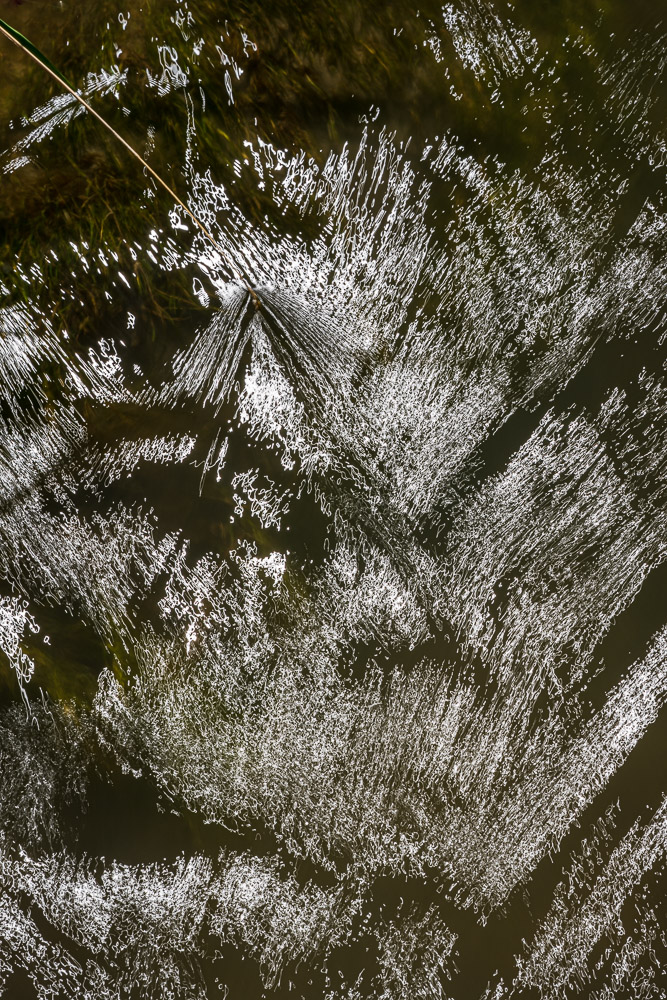
    Intentionally distorting a scene to change the way we see it is another technique I like. The image with this article is an example. This is a straight shot, no Photoshop magic. One day I was having lunch in a favorite restaurant a couple of blocks from my studio. I noticed that some of the old windows in this 100+ year old train station were very distorted. If I photographed through them at a certain angle it enhanced the distortion in desirable ways.

    This shot is a view of my downtown. The distortion reduces it to shapes and color while adding an intriguing texture. I like it. Luckily, the manager is a friend and didn’t mind me exploring to my heart’s content.

  • Seeing

    Seeing

    We take it for granted. Of course we “see” things. But seeing is a marvelously complex and personal process that warrants more thought.

    Forget the mechanics

    The typical way “scientists” study something like sight is to break down the details of the mechanisms involved. So they investigate the ability of the cornea and lens to focus images on the receptors at the back of the eye. On the way the optic nerves process and transmit the data. On the rather large section of the brain that processes the data into what we recognize as “seeing” something and recognizing it.

    It is a very complex process. But looking at it this way is a classic “can’t see the forest for the trees.” It matters little to us what mechanisms we use to perceive images. What matters is that we do. And the process is vastly more complex than the scientific mechanisms would lead us to believe.

    Perception

    When we take visual stimulus into our brain it elicits different responses in different people. Sometimes, different responses in the same person at different times. This is part of the vast complexity of “seeing”.

    Our perception is based on, among other things, our experience, age, education, health, environment, personality, even what we had for lunch. Because of this, what we perceive is different from anyone else in the world. Even identical twins perceive images slightly differently.

    We should always keep in mind that our perception of a scene or a work of art is unique to us. When anyone tells you that you should see it a certain way or this is the interpretation of the image, walk away, quickly. They can only tell you their perception and they are giving you the message that their visualization is better and more complete than yours. Yes, there are societal norms and statistical groupings, but those only apply across large groups of people. They do not say what any of us as individuals should see or feel.

    Verbalize

    Have you ever tried to describe what you see or what it means to you? It is an interesting process. Speech is a very different mental transformation than visual interpretation. Some people are more verbal and some are more sensitive to images.

    When we see something, it creates something in our mind. Perhaps we file it as a memory. Maybe it invokes other memories. It could create a sensory impression on us, like calm or fear or stress. An image may even bring up a song or a smell.

    When we then try to express in words what we perceived it is an impossible task. We can give impressions. We may be able to paint some aspects of it in words. But we cannot create a verbal description that exactly represents the image we perceived in our mind. Words and speech are inherently linear. Information is conveyed through a sequence of symbols over time. Images are much more non-linear. We tend to “grock” the whole image before starting to isolate parts.

    Poets and authors have tried for centuries to paint images with words. They have some success, but the image I get from reading them is different than the one you get. And both are different from the one the author had in his mind. It is a beautiful and fascinating process, but it is different from our visual perception.

    What we experience

    If it is true that we all experience something different when we see a visual image, then is it hopeless to try to analyze it? No, because despite the range of experiences, most of us share enough common experience to appreciate similar things.

    We have all experienced beautiful sunsets. The experience may mean somewhat different things to each of us, but there is something built into humans that appreciates a sunset. Likewise, most people enjoy looking at portraits of people. We are wired to be interested in other people. Again, we each may see something different, but we like it.

    And an image may touch something in you but completely miss the mark with me. That does not say the image is good or bad, but it creates a different response in different people. This is part of the wonderful complexity and depth of viewing images. But can we get deeper in the process?

    Examine it

    I said we should be afraid when people tell us what we are supposed to see in an image, but that does not mean it is wrong for us to analyze what we see. One difference between casual viewers and those who really appreciate a work of art is how deeply they examine what they see.

    Most people are content to be at the “that’s pretty” or “I don’t like it” level. The art creates a response, but they do not reflect on why. To appreciate art more it is necessary to develop a “vocabulary” to express our understanding of it. I don’t mean we need to be able to write a detailed verbal analysis of it.

    Art is seldom created in a vacuum. It builds on traditions, on work of other artists, on classic subjects or themes, on recognized styles or techniques. As we mature and get more familiar with a range of images we can understand a piece in context. We can examine the color pallet used, the style of representation, the tradition it aligns with, and other images we have seen of similar subjects. Then we can start to understand more deeply. We can see that this artist is kind of like this other but departs in these certain ways. It is clear that this is a new twist on something commonly done by a group of artists we have seen. All of this is just a layering of understanding to help us see the work more clearly.

    Trying to be explicit about our reaction to an image forces us to examine our feelings and even beliefs more closely.

    Art should elicit a response

    It seems a truth to me that art should create a response in the viewer. Otherwise it is just documentary or illustration. I want my images to have an immediate and visceral effect on you. I hope it is not just a dismissive “it’s pretty” as you go on to the next image.

    I will go out on a limb and state that if you don’t love my image you are viewing, I hope you hate it. It is better to me for you to react strongly one way or another rather than to be indifferent.

    Do I need you to spend significant time analyzing my images in order to appreciate them? No, I cannot demand that of you. I hope you do want to contemplate them a while, but it would be foolish of me to expect everyone to view them as an artist or an art historian.

    I hope something about my images grabs you, compels you to spend some time with them. As you view them I hope you are intrigued and want to figure out things about them and why you like (or don’t like) them. The process of figuring this out for yourself will help you come to a better ability to express and understand your interests and likes.

    Understand your preferences

    Ultimately your response to a piece of art is your personal experience. It doesn’t really matter if the artist is famous or respected, you have the right to decide for yourself if you like or dislike their work. Who knows? You might like work by an unknown like me better than a Picasso or John Paul Caponigro. 🙂

    One reason there is so much art and so many artists is that it is all very personal. There is no “one size fits all”. Each of us is still at liberty to decide what we like. I recommend that it is healthy to think about what you like and prefer in art. Learn to articulate it, at least to yourself. This way you will understand your preferences better and have a firmer grasp of your interests. Then, when a well meaning friend tells you “no, you can’t like that” or “you must like this” you can gently and persuasively correct them and defend your decisions. They will be impressed. So will you.

  • Is It Interesting?

    Is It Interesting?

    I find myself pondering this question a lot these days. More and more I believe the answer to “is it interesting?” overrides many considerations of composition and technique. This is a personal judgment, of course. as is the question of what is interesting.

    Learning

    Art is almost as much about our training as it is about our natural creativity. We all start somewhere, whether we have formal training or we are self taught. When we are learning a skill or an art we concentrate on the mechanics first.

    The tendency is to focus our attention on what we are trying to master. This is natural. What we should recognize, though, is that we may not really be making art in the process. Yes, it is art in the sense that we create it as art, but it is not a mature and well rounded style yet.

    Technique

    Photography is possibly the most technical of the normal arts. We have to master many layers of technology to get skilled at the craft. There is the camera with its hundreds of settings and controls, each of which may help us make a great image or a terrible one. Then there is the computer system required to store and process the image. And the software we choose to use for managing and editing the image. If you are taking it all the way to the end of the chain, there is the whole printing process to learn.

    Each of these areas is a huge field that could require years of study to master.

    If this is where you are, plow into it. Work through the learning process. Get to the point where the camera is a comfortable tool that you can use with little thought. Ideally you should be able to adjust all the major setting in the dark, just by feel.

    The image processing software is probably an even bigger challenge. Photoshop is one of the deepest tools I have ever used, and that is from the point of view of a long career in very complex software development. There are only a few people in the world I know of who totally “know” Photoshop. Julianne Kost comes to mind, but then she is the chief Photoshop evangelist for Adobe. It is her full time job to be able to train people on any aspect of it. Others at about that level are Ben Willmore and Dave Cross. I study and use Photoshop hours a week but I will never get to their level.

    But the good thing is, I don’t have to be a Ben Willmore. As long as I know enough to realize my artistic vision, I’m OK. I know of excellent and successful photographers who I consider to have only a rudimentary knowledge of the tools. They know enough to do what they want to do. I personally can’t be happy unless I feel I have mastered my tools enough to comfortably use them as an extension of my creativity. So I study a lot. But that is just my own burden.

    It should be about creating interesting art, not our ability to use the tools.

    Composition

    The next major pillar of image making is composition. It is another thing that can become a lifelong study in itself. We can burrow into art history, visual theory, Gestalt psychology, and all manner of ideas and opinions.

    We start with only an intuitive feel for good composition, based on art we have seen and our inherent notions of what we like. Probably we cannot express in words what good composition is. As we study and practice we get to where we have a more formal view of it. We can critique our own or other images in terms of their design. Eventually, we can compose our images intuitively, without much conscious thought. We can repeatedly produce compositions that please us.

    Keep in mind that most of this time, we are producing images that are now technically “correct” and have “good” composition. But maybe nobody wants to look at them yet.

    Is it interesting?

    This idea was clarified for me in a book about poetry. (Writing Poems, Robert Wallace. The link is for a later edition of the book) Weird, huh? It is a book about writing poetry rather than a regular book of poems. I find hints and ideas to improve and better understand my art from all sorts of diverse sources.

    The author made the statement that if the poem is not interesting, what good is it? It can have wonderful form, metaphor, irony, symbolism, etc., but if it is not interesting, no one will read it.

    I believe there is something here to apply to our art.

    I have seen, and made, too many technically perfect, classically composed images of … nothing memorable. While I value sharp, well executed images, and pleasing compositions with flow and leading lines and great light, I have come to realize that is not enough by itself to really be art. This is, of course, just my personal opinion. But then all art is a personal opinion. 🙂

    When you have mastered the basics I suggest you first visualize something that will make a memorable image. Then use your acquired skill to capture it perfectly. Don’t just work on technique. You’re better than that.

  • The Highway – Update

    The Highway – Update

    I’ve written before about shooting from the car. I enjoy driving and I do a fair amount of my image captures during car trips. My advice has been to avoid freeways or major highways when you do this. On a recent driving trip I decided to reevaluate this. To drive some freeways to see if they still have the same effect on me. Spoiler alert: the highway is a creativity killer.

    Please understand that my advice here is from my personal experience modified with my personality. Even more than most of my articles. Your behavior may be completely different.

    Highway anesthesia

    What I had found and observed was that driving a freeway is a mind numbing and deadening experience. The miles roll by at high speed. My attention narrows to mainly the road and cars ahead of me. The goals become to get to the destination, pass that traffic in front, and don’t get a ticket.

    I may pass by beautiful or interesting sights, but there is too much inertia to stop. He impetus to push on down the road was powerful. It would require something truly amazing to break into my coma and pull off, let all the traffic I passed get ahead of me, and look foolish with all the passing cars staring at me. So I seldom do it.

    On the freeway, I may see something potentially interesting, but I can usually talk myself out of stopping. I can convince myself it wasn’t really great. That I will find a better view down the road. Or that it is too dangerous to stop here (maybe a valid objection).

    Whatever the reason or excuse, the whine of the wheels is hard to interrupt.

    A test

    I just got back from a 2700 mile driving trip through parts of Colorado, New Mexico, Oklahoma, Texas, and Kansas. That is a lot of open miles. I decided to check to see if my anti-freeway prejudice still holds. To see if I can overcome the bias against stopping.

    I drove over 300 miles on freeways or major divided highways. Well, I did not stop for a single picture during any of those miles. I told myself I would stop when I wanted to. I thought about it. But nothing I encountered could inject enough energy to make me do it.

    In fairness, a lot of this time I was not in what would be considered pristine landscape areas. But I consider the test valid, because other times, in the same general areas, I got some interesting pictures while driving smaller roads. I believe the difference was the attitude I have when driving smaller roads.

    i examined my reactions as carefully as I can and verified that driving freeways causes a different mindset. I am reluctant to stop or to go back to shoot an image. It is hard to break the rhythm, to stop. The highway is hypnotic.

    A comparison

    Here is a comparison of a specific subject. I drove through huge areas of wind turbines. In one case, on a back road, I stopped and took some side roads and even walked in some fields and got some interesting shots including the turbines, Another time, driving a high speed highway, I drove by a perfectly composed scene, with a single stark white turbine out in a field, with a perfect clear blue sky. The turbine was parked and it was perfectly positioned with one blade pointed straight down and the other 2 lifted in a perfect, symmetrical “Y” and directly facing me. But I drove by it. I wouldn’t bother to stop. I still kick myself about that missed opportunity.

    One of the main differences was that on the back road, it was easy to interrupt the trip for promising pictures. On the freeway, even a very interesting image couldn’t convince me to stop.

    Another subjective comparison: there are people I know who would pay $1000 to avoid driving across Kansas. I can understand that. But a partial solution is to get off I-70 and take back roads. When I do this I am much happier and I usually come back with some decent pictures.

    Why?

    I wish I could give a definitive explanation of the root cause of this. If I could, I might be honored as a respected psychologist. But I’m not and I can’t.

    I have theories, though, based on my on reactions and introspection. Remember, anything I say here is unscientific and may only apply to me.

    I believe the way I travel sets a context, a framework of perception and decision making. On the freeway there is the implicit goal of making progress. Getting to the destination as soon as possible. Minimize stops or interruptions. I’m in a rhythm and I don’t want to break it.

    Driving down the freeway and seeing a picture causes a conflict. Now 2 sets of goals are in opposition: speed vs. interrupting the trip for something that actually slows things down. The conflicting goals have to be weighed and balanced. But even if I decide the scene was worth stopping for, the moment is gone. I’m a mile down the road and it would take miles of driving to backtrack to it. And it is much easier to justify that it probably wasn’t worth it and let the momentum carry me down the road.

    On a small back road, though, the pace is slower, the traffic is light, and I have put myself in a position of committing to looking for images instead of covering as many miles as possible. Traveling this way also seems to keep me more alert. I am more actively engaged with my surroundings and paying attention, not only to the road, but to everything around. There is a constant background thread of playing with compositions in my mind as I drive by them. It is very educational.

    My travel style

    My preferred travel style is to only plan on making 300-400 miles a day at most. I avoid nearly all freeways and large divided highways. I then give myself permission to stop whenever something interests me and even to turn off for side trips according to my whim. Unlike the typical male, I will even turn around and go back when a light bulb goes off and I recognize I have passed an interesting scene.

    As an extreme example on this trip, we got from Colorado to New Mexico via back roads – well hardly what you would call roads and you would be hard put to find them on a map. My Jeep was caked with mud and I left it on during the rest of the trip as kind of a badge of honor. But we saw very interesting things and I got some good images.

    My wife knows, on a driving trip, to bring lots of books and magazines to read while we are stopped. I am very fortunate to be able to create this environment for myself. It would not work for everyone. As a matter of fact, most would probably hate it.

    For fun, the image with this article is from back roads in the Texas hill country. It is the old General Store in Luckenbach (yes, that one). Not my normal style, but it was fun.

    Slow down

    My recommendation is to slow down and give yourself permission to stop for anything interesting. I fully realize this will not work for everyone. But have you tried it? If you are on vacation, can you take an extra day or 2 for your art? What do you have better to do?

    I have practiced this on most driving trips for years and I can completely recommend it. Your mileage may vary. It is a very personal choice.