An artists journey

Tag: photographic technology

  • Diffraction

    Diffraction

    Today I would like to try to help us understand a little about what diffraction is. Not getting too deep in the theory. Just enough to demystify it a bit.

    Scary

    Diffraction is probably a scary word to most of us. Even if we don’t know what it really means, we have heard of it and have been taught that it is a “bad thing”.

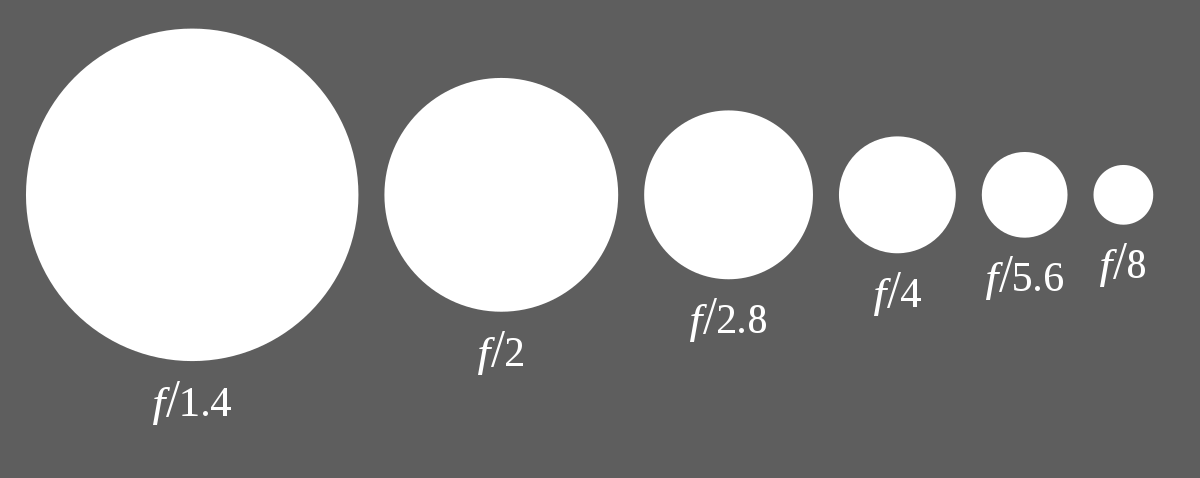
    Have you been taught to avoid using apertures smaller than f/11? Note that when I say a “small” aperture I am referring to the physical size. Remember that as the aperture numbers get bigger the actual opening in the lens gets smaller. This simple graphic illustrates that:

    Progression of physical f-stop sizes

    The lore is that very small apertures (large f-numbers, like f/22) make an image too blurry to be useful. Don’t believe everything you hear without testing it.

    Light theory

    I’m going very light on theory (yes, pun intended). We’re just going to graze the surface without taking a deep dive in. (Here is a source to start at if you want to go deeper. Abandon all hope ye who enter…)

    Light behaves as waves (most of the time). Actually, a number of things are waves: light, water waves, sound waves, gravity waves. Quantum mechanics theorizes that even matter is waves. Too deep for me.

    We tend to visualize light going through our lens as rays. That is, straight lines. Yes and no. That is one useful model of looking at it. But light also behaves as waves. An interesting and important property of waves is that every point on a wave is a wave. So if the wave is blocked by a small opening, the wave spreads on the other side of the opening.

    This picture by Verbcatcher does a marvelous job of illustrating that for waves in water:

    Diffraction in water waves

    See how the waves spread after going through the small opening to the sea? The smaller the opening (aperture) the more pronounced the effect. That is, a small aperture opening causes waves to spread out more.

    What does it really mean

    This is the basis of the recommendation to use physically large apertures (small f-numbers). Apertures that are large relative to the wavelengths of light do not cause much “bend” of the waves. Small apertures (large f-numbers) “bend” the light more.

    What we can actually see in practice is that using small apertures causes our images to have a mildly “fuzzy” look. Because the waves spread more after going through a small aperture, the individual waves cover a larger pixel area. This slight spreading of the light causes the image to appear less sharp.

    The best discussion of diffraction for photographers I have found is from this article by Spencer Cox. But even this gets too deep into theory.

    I borrowed this image from it to illustrate the practical effects of diffraction as we change aperture:

    Effects of diffraction with aperture

    See how the larger apertures (small f-numbers) are sharper than the smaller ones?

    This illustration below, also from Spencer Cox) gives a great conceptual representation of what is happening. Take that the grid represents pixels in your sensor. At f/4, the point of light only strikes one pixel. It will be seen as very sharp. But at small apertures, the waves spread some onto adjacent pixels and create a kind of fog.

    Should you fear it?

    Should you fear it and always shun small apertures? No, it is just a reality of physics. It is no more to be feared than gravity. As one of my sons would say, it is what it is. Be aware of what is going to happen and consciously decide how far you need to go.

    All of the exposure determinations we make daily are tradeoffs. How much to stop motion? How much depth of field do we need? Is there enough light for a good exposure? What ISO setting should I use? All of these things and more have to be balanced in the moment of shooting, besides composition and esthetic issues.

    Each setting costs something. As experienced photographers we must understand the tradeoffs and be able to judge what is right for us at the moment.

    Diffraction is one of those tradeoffs. Know what it is going to do and how to use it or avoid it.

    Sometimes you need more

    But why would we ever intentionally make our image less sharp? We seldom actually choose to make it less sharp, but sometimes we need other things. I can give 2 easy examples.

    The first and most common one is to increase depth of field (DOF). It is counter intuitive, but making the aperture smaller increases the perceived depth of field. So on the one hand we are making the image less sharp, but on the other hand we are making it appear sharper throughout. When we need to make a certain range of the field of view acceptably sharp we stop down the aperture until we achieve our goal. A tradeoff.

    Depth of field with small aperture© Ed Schlotzhauer

    The second case that comes to mind is to reduce the shutter speed. I often intentionally shoot motion blur. But I usually forget to bring a neutral density filter for the lens I am using at the time. I can generally achieve the effect I want by using my polarizer, reducing the ISO to the lowest setting, and cranking the aperture down to the smallest possible one. This will probably give me a shutter speed in the range I want to use. Yes, the small aperture increases diffraction and makes the image less sharp. But it is handheld at a long shutter speed. It is already intentionally blurred.

    Intentional blurring based on small aperture.© Ed Schlotzhauer

    But maybe more importantly, in a great video on Lumminous Landscape, Charles Cramer said “sharpness is something we have to get over.” He explained that if we take a picture just because it is sharp, it probably won’t be very interesting. We have to forget about how sharp is it and instead react to the scene before us on an emotional level.

    Shoot the picture

    Diffraction is a side effect of physics and our photographic technology. Don’t be afraid of it. Don’t blindly follow some rule you learned in the past about what you can or can’t do. Understand enough about it to recognize it and know how to use it to your advantage.

    Look at the image above of the woman’s face. Even at f/32 – an extreme case – it is acceptable. Extra sharpening can be applied in your editing tool to compensate for it.

    So diffraction is just there. Allow it to happen if that is the tradeoff you need to make. Just like using a high ISO adds noise, that is acceptable most of the time and better than missing the shot.

    I know many of us don’t want to deal with what we perceive as increased complexity or too much technical detail. We just want to go take great pictures. My hope is that topics like this will actually make your photography life simpler by providing some grounding for information you may have heard in the past. Rather than trying to remember rules for how to use your equipment, you now have a model for what diffraction is doing and how strong its effect is. I hope you will be able to stop fearing it and accept it is just part of the tradeoffs of the technology.

    Today’s image

    This is a great old WWII era truck I found in my town. It is a Coleman. This was actually a Colorado company. It was designed and manufactured in the Denver area.

    I needed enough depth of field to span from the great rust and paint patterns on the near outside through most of the cab. So it is shot at f/22. Diffraction? Works for me.

    What do you think?

  • Seeing the Unseen

    Seeing the Unseen

    Photography is unique in the arts. It can record things we cannot see or imagine. Photography can be an adventure in seeing the unseen.

    Unique

    Photographers are sometimes made to feel inferior. Usually by proponents of the “real” arts, like painters or sculptors. Get over it. Photography has qualities that go beyond any other arts. Qualities that make them envious.

    Photography is a technology-based art. That technology can be used along with our artistic vision to capture and create things regular art cannot. We can peer into things the human eye cannot see. We can freeze time to examine events the human eye cannot show us. Likewise, we can extend time to show the effects of movement in new ways.

    Exposure

    The human eye is amazing. But it has limits. Even though it can see a huge range of light, photographic sensors can push beyond our eye’s limits.

    When you look at the stars, for instance, we can see what seem to be an immense number. But I have astronomer friends who have a process of taking hundreds of frames of 1 point in the sky. Then they use special stacking software to combine them and sharpen them to create levels of detail far beyond what the eye can see. Even my amateur astronomer friends routinely show me pictures they have taken of distant galaxies that cannot be detected at all with the eye.

    Those same astronomer friends have solar filters – essentially completely black glass – that let them view the surface of the sun! They can see and photograph sun spots and the corona. Things that would destroy our eye if we tried to look directly at them.

    The technology and practice of photography allows these things.

    Light range

    And “normal” (non-photographic) art is all done in the visible light range. Makes sense, That is all we can see.

    But most of us have seen infrared imaging. This is done using a special dark red filter that excludes most light we can see. What is left is what we would consider heat – the world of longer wavelengths beneath the red response of our eye. It gives us a subtly different perception of the world around us. A paint artist could not do that without taking an infrared image of the scene then painting from the photograph.

    Similar filtering can be done to see the ultraviolet world beyond the highest violets we can perceive. And have you had an X-Ray? That is just imaging done in another range of “light” we cannot see well beyond the ultraviolet.

    These are somewhat niche capabilities, but they can bring us information that is exclusive to the photographic world.

    Time

    Time is one of my favorite variables that is unique to photography. One of the three legs of the exposure triad is shutter speed. By varying the shutter speed we can effectively slow down or speed up time!

    People have developed flash systems that can freeze movement in slices of 1 millionth of a second. Even the fastest bullets are frozen in midair. Explosions can be captured as they start. You’ve probably seen pictures of a drop of liquid falling into a dish. The splash patterns are beautiful and interesting. Not many things we come in contact with in our lives are not frozen at this kind of speed.

    At less extremes, a waterfall at a fast shutter speed can look like a cascade of diamonds . A bird in flight is completely frozen at about 1/1000th of a second. Every feather is crisp and sharp. We cannot see it this way with our eye.

    At the other end, long exposures capture movement over time. This is the area I like to work. Not super long. Just long enough to change our perception of what is happening.

    We have all seen long exposure pictures of waterfalls or cascades, where the water is smooth and silky. It is so common that it is in danger of being cliche. But the reason you see it a lot is because it is a pleasing effect. Some photographers make exposures of minutes. This makes clouds streak and water blur to a milky texture. Not really my thing, but I appreciate the reality distortion caused by the time shift.

    Movement

    A subset of this idea of time is where the camera is moving relative to the subject or the subject is moving relative to the camera. The camera motion side has become popular as Intentional Camera Motion (ICM).

    Like many techniques in photography, it is easy to do but hard to do excellently. Anyone can take a blurry picture because the shutter speed was too long to stop the action. Most of us have to work to overcome this. ICM deliberately pushes this “fault” to a point of art. I do ICM for some projects and I have seen a lot of ICM that I consider excellent art. And I have seen a lot more where I have to think, “yep; that’s your standard ICM”. That’s OK. Most experiments in doing something new and creative fail.

    One interesting aspect of techniques that involve movement and time is that it is almost impossible to take the same picture twice. There is always variation. The variation often leads to pleasant surprises.

    Stretch the notion of reality

    So photography is unique in giving us alternate views of “reality”. With conventional arts, like painting, nothing can be created that the artist does not first see or imagine. Photography can show us worlds or effects we did not imagine. This sometimes opens up new creative paths to explore. And the exciting thing is it is actually reality. If the camera captures it out in the “real world” (whatever that is), it is reality. What we get may be a complete surprise, but that is part of the exhilaration.

    Photographers, never feel inferior in the arts. Know that what we do is as valid as any other kind of art. And try not not to be smug knowing we have the option of being more creative than most other forms of art.

    Go explore the unseen and enjoy your discoveries.

    Live always at the ‘edge of mystery’ – the boundaries of the unknown. – J. Robert Oppenheimer

    Today’s image

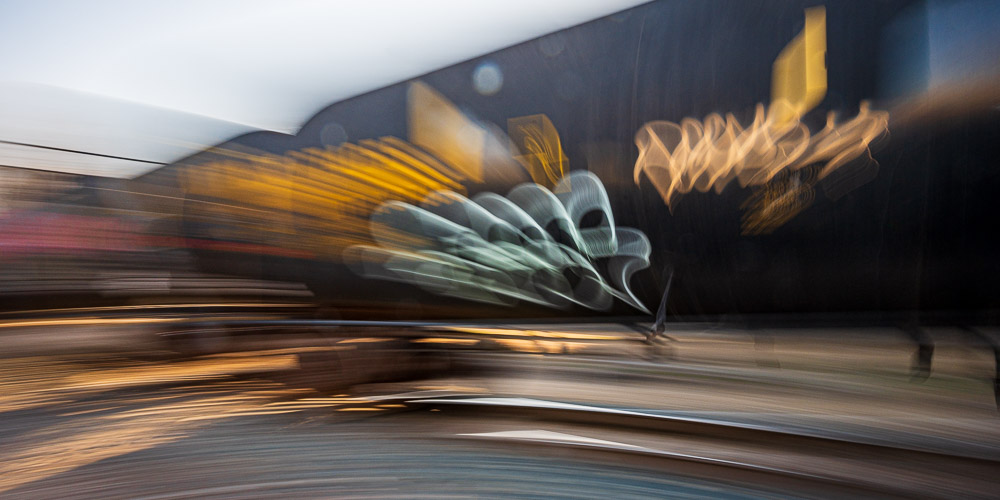
    This is part of a series I did fairly recently. It combines ICM and time and subject motion and some secret sauce optical techniques to create this look. I consider it a creative view on a reality that happens around us all the time, but only photographers can see.

    Is it “real”? Yes, absolutely. It is a minimally modified shot of a real, physical subject. It is a subject most of us can find right around our town.

    To find out more about what it is, go to my web site and find a similar looking image in Projects.

  • They Told You Wrong About ISO

    They Told You Wrong About ISO

    Many of us have a wrong idea about ISO settings. I will just say they told you wrong about ISO. It was a misunderstanding. Whoever “they” are.

    Statement of faith

    It is stated as a “strong suggestion“, especially when we are learning landscape or portrait work. Never shoot with ISO over 100. Maybe it is stated as only shoot at the native ISO setting for your camera. Either way, these are given as rules.

    I hate rules, especially for my art. Rule of thirds. Rules of composition. Never put the subject in the center. Never shoot at midday. Always use a tripod. The list goes on.

    Like with religion, most of the so-called rules are based on good ideas, but over time they are repeated as commands and the underlying reasons are lost. Just do it. (I don’t think that is what Nike meant.) The rules become a statement of blind faith that cannot be challenged.

    What is noise?

    All digital cameras have noise. Noise is randomly generated in the sensor and in the electronics of the signal path until the pixels have been digitized by the analog to digital converter (ADC). The noise is a fundamental property of physics.

    The question is how much noise is there relative to the desired data. This is called signal to noise ratio in engineering. When we amplify a signal by increasing the ISO setting, all the signal including the noise is increased. This is why images shot at high ISO settings tend to look noisy. The image is usually not less sharp, but there is more noise obscuring things.

    It is true for a low cost point and shoot camera or a high end medium format camera. What changes are the relative amounts of noise and the limits the image can be pushed to.

    What is ISO?

    You’re familiar with the exposure triad: the combination of aperture, shutter speed, and ISO that determine exposure. That’s it. Many other things affect the composition and quality of an image, but only those 3 control the exposure.

    Aperture is the size of the diaphragm opening in the lens. It controls, among other things, the amount of light coming in. Shutter speed is the length of time the shutter is open to let light come in. And the ISO setting is kind of like a volume control. It sets the gain or amount of amplification of the sensor data.

    Going way back to early film days, there were no agreed on standards for the measure of how sensitive film was. So a couple of the largest standards organizations (the ASA and DIN scales) came together and created a standards group under the International Organization of Standards. They adopted the acronym of the standards organization (in English) as the name. By the way, officially “ISO” is not an acronym, it is a word, pronounced eye-so.

    Long way around, but now there are defined standards for exposure. For a given combination of aperture and shutter speed, the ISO settings on all cameras give the same exposure.

    Why use higher ISO settings

    OK then, in concept, the ISO setting is a volume control for exposure. Turning it up (increasing the ISO value) amplifies the exposure data. But as I mentioned, it is not free. Amplifying the exposure also amplifies the noise in it.

    It is true that low ISO settings produce less noise in the captured image. Modern sensors are much better than early ones. This is one of the wonders of engineering improvements that happen as a technology matures.

    Then, we should not use high ISO settings, right? Well, everything is a tradeoff. We need to use a minimum shutter speed to avoid camera shake when hand holding or to stop subject movement. We need to use a certain aperture to give the depth of field we want. These decisions must be balanced in the exposure triad, often by increasing the ISO.

    Can’t I just underexpose?

    When you accept that we must use the lowest ISO setting, the logical conclusion is that you could massively underexpose the image and “correct” it in post processing. Unfortunately this doesn’t work well. You are still boosting the noise unacceptably.

    The camera manufacturer knows more about it’s sensors than your image processing software does. The camera’s built-in ISO amplification can take into account it’s characteristics and do a better job. And modern sensors and electronics do a very good job.

    Are you wrong about ISO?

    If you are following a rule dictating you must or can’t do something, yes you are wrong. There are no rules in art. No ISO-like standards body specifies what your image must look like. There are always groups wanting to do this (are you listening camera clubs?), but they have no authority.

    If you are hand holding a shot, it is better to boost the ISO to steady the movement than follow a rule about using low ISO. The noise will be secondary to the reduced shake. Or I sometimes use the lowest ISO setting in my camera to create blur. I enjoy intentional camera movement (ICM) shots and will occasionally force an artificially slow shutter speed.

    If it is night and you want to shoot stars or street scenes, are you not going to do it because you would have to violate a rule by the ISO police?

    Use the ISO setting that lets you express what you want to do. It is your art. There are no rules. Besides, luminance noise looks like film grain. It can be an interesting artistic technique in itself. Do what feels right to you.

    Apology

    I used fairly strong language about this. The reality is that most photography writers have softened their recommendations on ISO. Most of them freely recommend using high ISO. This is healthy.

    But I know many of us were “imprinted” by early mentors who left us feeling there was something dirty about going above 100 ISO. I want to free you if you still have those self-imposed limits. Using even a very high ISO and getting the shot is always better than missing it because you wouldn’t want to chance increased noise.

    Today’s image

    Since I’m advocating it, here is an extreme case that I’m happy with. This was shot hand held with an old Nikon D5500 camera – at ISO 22800. I have corrected out some of the luminance and chromance noise and I am perfectly OK with what remains. Getting the shot made me happy, even if the noise is high.

  • The Histogram is Just Data

    The Histogram is Just Data

    I don’t mean to be insulting, but I cannot understand when people look at histograms as some magical, mysterious, and intimidating technical artifact. It is not. It is just data about what our sensor is seeing. The histogram is just data, and it is useful. Use it. Do not be afraid of it.

    Trigger

    A newsletter I received today triggered this semi-rant. But looking back, I see it has been over 3 years since I wrote about histograms, so it is probably time to revisit the subject. This actually is a subject I feel some passion for and believe it needs to be better understood by photographers.

    The newsletter author declared that our histograms lie. I realize that click-bait is commonly used to try to get people to read articles, but I still feel it is being somewhat underhanded. Now, in fairness, the newsletter author made some valid points – except for the part about histograms lying.

    What is a histogram?

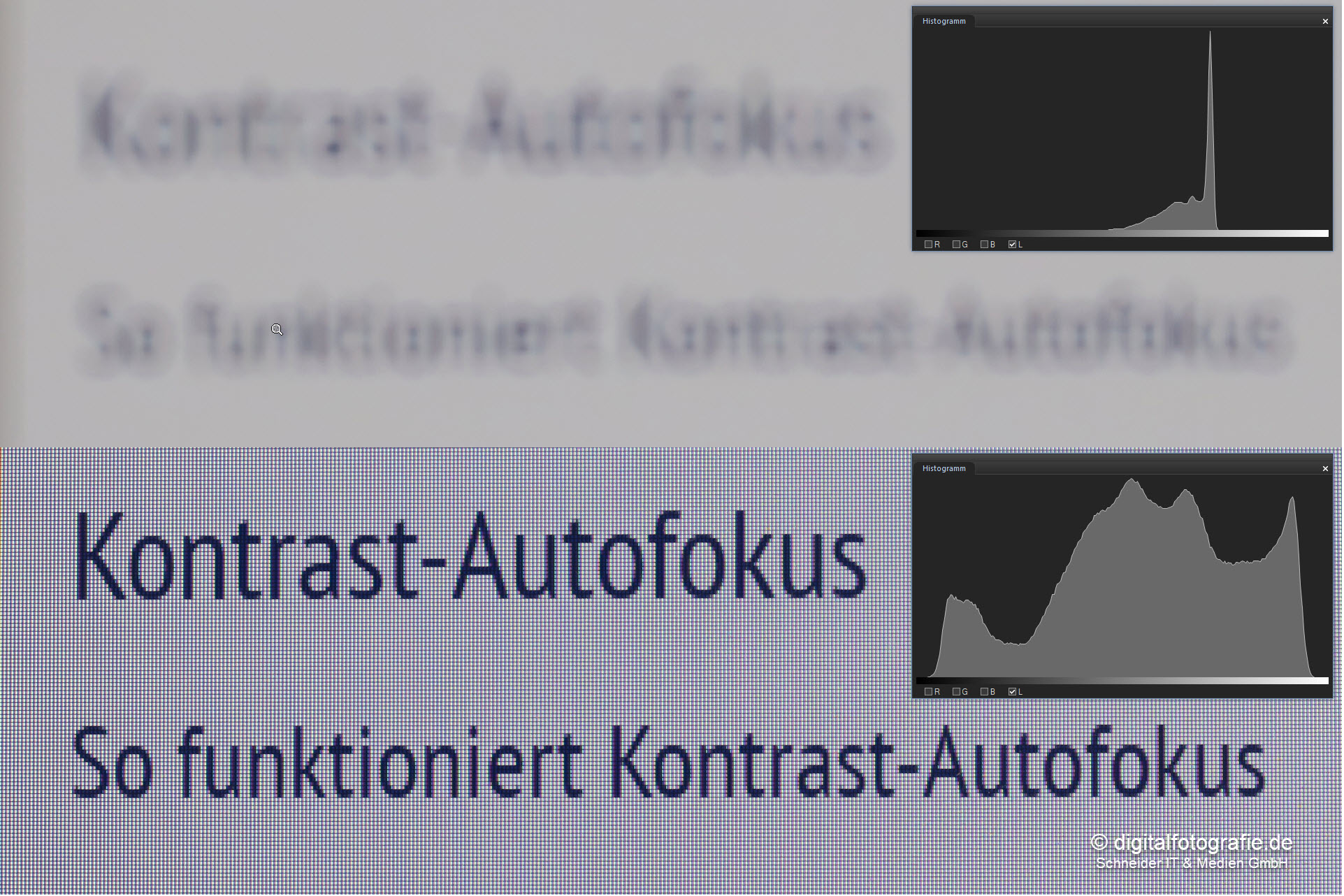
    We see this graph of some data and maybe it does look complex and mysterious if you are not used to working with data and don’t know where the data comes from. Let’s get over that by understanding how simple but effective it is.

    By convention we play like our cameras measure light in a range of 0 to 255. There are no units: 0 represents black and 255 is pure white. The convention came from the history of early digital cameras. It is obsolete today, but still used. That is a topic for another day.

    So there are 256 possible values of brightness (0-255). If we go through and count the number of pixels of each value – the number of pixels in the image that have value 0, the number of pixels in the image that have value 1, etc. – and put them on a graph, we have a histogram.

    Here is a simple example:

    Again, black is on the left going to white on the right. Even without me showing the actual image, we can see that there is a “bump” of dark values on the left and a larger hill of bright values on the right. In between is a relatively low and even count.

    What can we learn from this? It is a black & white image, because there is no separate data for red, green and blue. There is high contrast because of the hills at the dark and bright ends. It is bright but not overexposed. There are deep blacks, but not enough to have lost important information. So, even without seeing the image, we can tell a lot about it. Is the image exposed “correctly”? Ah, that is the question my rant is based on.

    This is why histograms are useful. They are useful data about our image. It gives simple information to help us understand our exposure better.

    Benefit

    Today’s mirrorless cameras bring us the amazing benefit of real-time histograms. We can select to see the histogram live in our viewfinder or on the display on the back.

    What is the benefit? We see an immediate graphical view of the exposure the camera is determining. In the example above, we can see that the light tones are very bright, but not overexposed.

    I routinely use it to watch for “clipping” of brights or darks. If there is a large hump of data jammed up against the left or right edge, that is probably a problem. I will often choose to override the camera’s exposure determination to avoid these peaks.

    Again using the example above and knowing that my camera was in aperture priority mode, we see that it chose 1/750 second as the shutter speed. That works OK in this case, but if I did not agree, I would have easily used the exposure compensation dial to adjust the exposure. I do this a lot.

    So the histogram is a quick and easy to get a feeling for the “shape” of the exposure.

    They don’t lie

    Now coming to the basis of my rant: histograms do not lie (actually, they do; I will say how later and why it doesn’t matter).

    The newsletter author gave the example of a picture of some fruit on a dark table with a black background. She said the histogram lied because the camera did not give the exposure she wanted. It tried to make the whole image evenly exposed.

    No, the histogram is just a straightforward measurement of the data. If you take your temperature but don’t like the reading you get, it is silly to say the thermometer lied.

    What the author was describing was that she wanted to expose to have the same look as the scene she saw. This was a case of disagreeing with the camera’s matrix metering calculation. It was doing it’s job of trying to capture all the data that was there and preventing blown out blacks. But she decided to use exposure compensation to force the camera to expose the scene the way she wanted.

    The histogram did not lie. As a matter of fact, she relied on it to do her exposure compensation values. She used the histogram to determine how to override the camera exposure calculation.

    Actually, I would have used the camera’s original exposure determination. I like to have all the data available to work with. This is called exposing to the right. Bringing the brightness down in post processing to the level she wanted is simple, non-destructive, and does not add noise. Capturing the compensated image the way she wanted irreversibly crunches the blacks.

    They lie

    I said they don’t lie, but they do a little. For speed and efficiency the histogram is derived from the jpg preview of the image. Same as the preview shown in the viewfinder or camera back. If you study jpg processing you will see that it alters and discards a lot of information to give a good perceptual result.

    So the histogram is not actually looking directly at the literal RAW data from the sensor. But there is little observable discrepancy. On my camera, I find that it exaggerates the highlight values very slightly. Still, I typically back the exposure off to avoid highlight clipping, so it adds a little conservatism into the process.

    Trust the data you see. It is good enough.

    They’re not the photographer

    The histogram gives you data. It does not determine exposure. People talk about “good” or “bad” histograms. This is a misunderstanding. There are no absolute good or bad ones. What counts is did you get the exposure you wanted.

    There are valid artistic reasons for shooting what some people would consider bad histograms. If it is what the artist wants, it is correct.

    Histograms give us a reading of the exposure. They do not determine what is right. It gives some insight on what the automatic exposure calculation in the camera is trying to do.

    Use it

    The histogram is a brilliantly simple and wonderfully useful tool. We are lucky to have real-time histograms available to us now. It is a game changer. But it is just data. Do not be afraid of it.

    The histogram does not lie. But it does not automatically ensure that the exposure is exactly what you want. You have to sometimes take change and override the camera settings. When you do, the histogram is there showing you the result of your decisions.

    It is not magical or mysterious. It is a great tool. Use it. A craftsman know how to use his tools.

  • Buy My Presets, Make Work Just Like Me!

    Buy My Presets, Make Work Just Like Me!

    Maybe I’ve just gotten on some bad mailing lists, but it seems I am being bombarded by offers to get the “secret sauce” of many photographers. Promises that if I will just take and use their presets I will now have all I need to be just like them. No sweat; no learning, just buy my presets, make work just like me.

    Plugins and presets can be good

    I use plugins, presets, profiles, Photoshop actions, and whatever else I can use productively. There is nothing inherently wrong with any of them. They can be great productivity tools and they are getting more capable all the time.

    Lightroom Classic’s latest technology allowing us to include “AI” masks in a preset – adaptive presets – that can be a great help. This is one reason a larger preset market is appearing. Including the automatic masks makes the presets more general.

    Adobe includes quite a few presets and profiles in Lightroom Classic. Many of them are useful. If you include all of them in your lists you will be wading through hundreds of choices. That’s before buying sets of them from other photographers.

    Maybe it’s just me, but I find too many choices overwhelming. If you are exploring a look for an image, are you really going to try out hundreds of options? Maybe once every few months just to stimulate ideas. But routinely doing that would waste lots of time.

    That is why I carefully curate a small set of presets and profiles that are important to me and that I may actually use. This gets into the next topic.

    If you didn’t make it, you probably won’t know when to use it

    I have tried downloading a couple of sets of presets from well known photographers. What I find is that the presets represent their thinking and choice sets. They had dozens or hundreds of minor variations of some basic edits. E.g. make the sky a little more blue, make the sky even more blue, make it real blue, make the foreground a little warmer, make the foreground even more warm, etc.

    But there was little there I could not do as well and faster by myself, since i know how to edit in Lightroom Classic. If I want to make the sky more blue, that is some simple, almost automatic edits that I can do in a few seconds with little thought. Doing it myself is much faster than searching through hundreds of presets someone else made and that have confusing names.

    I removed all the ones I downloaded.

    What I find is that if I want to repeat something fairly consistently, I make a custom preset for it. Then I can find it easily, because it is in my User Preset list and I know what I called it and why I made it. Even though it is probably duplicating what many others offer in their preset sets, I will never find theirs and I would not recognize the strange name they called it.

    But if I make it, I know what it does and where to find it. Besides, the adjustments reflect my vision, not someone else’s.

    Profiles

    Profiles are another rich area in Lightroom Classic. They have gotten very powerful in recent releases. If I am doing a B&W conversion in Lightroom, I will usually run through a short list of my favorite B&W profiles to get a starting point.

    In some ways profiles are more powerful than presets, but also more mysterious. Presets do their work by changing the normal settings we can see. It is easy to apply a preset then go look at the settings and modify them to our preferences. A profile’s work is hidden in the internals of Lightroom. You can’t really see how it did what it did.

    This is a problem for me. Maybe I am too much of a control freak, but I take the responsibility for knowing how to create the image I produce. Besides, vintage photography looks and “modern” color styles are not very appealing to me. That seems to be the main application of many profiles.

    Craftsmanship

    I would never say we have to suffer for our art, but I do believe we have to be a good enough craftsman to be able to realize our vision. That is an argument for doing the work ourselves. This is one of the arguments against AI generated “art”. For me, there is a serious question of authorship if we are unable to create the work entirely our self.

    I will capture my own image, not download something someone else shot. My image curating will be done by me. I feel I need to be able to edit and craft my work to the point of being a final image. I will also print it, to the limits of my small printer. That whole cycle is important to me. I feel it defines a lot of me as an artist.

    If it actually did it, why would I want it?

    But this is just looking at mechanisms and process. What is going on behind the scenes in the editor. The overarching question for me is why would I use these artist-specific presets?

    Sorry, but I don’t want my work to look like yours. Perhaps I will analyze what appeals to me about some feature of your work and find out how to do some of that on my own. But I do not want a preset that says “make this image look like <_______> did it”.

    How much different is using a “make it look like x did it” preset from telling ChatGPT (or one of it’s cousins) to “create a landscape image of the Grand Tetons in the style of Ansel Adams”?They are not quite the same, but too close for my comfort. I am deadly serious about wanting to follow my personal vision and do work that creatively expresses what I feel.

    No, I will stumble along in my own way, taking my own path, missing out on the ease of being able to simulate various other artists. The risk is not worth the reward for me. I would feel like a fake.

    Thank you for your offer to buy your presets and easily make work that looks just like yours. I will pass.

    Today’s image

    This is taken in a rail yard near my studio. Nothing very special (although if you look at those rails you can wonder, like I do, how a train stays on the track). Maybe it is not a very good image. But it is all mine. I am responsible for every pixel. The original image is mine and no presets or profiles or plugins were used. No attempts to imitate any other photographer’s style. Just like I want it to be.

    Do you use other photographer’s presets or profiles? Let me know. I am curious. No criticism if you do, I just welcome your experience and thought process.