An artists journey

Tag: photographic technology

  • Pull Out a Moment

    Pull Out a Moment

    Isn’t that what we do so well with photography, to pull out a moment of time to examine? Most art does this, but photography excels at it.

    Time

    Time flows continually. It so envelops and controls us that we often do not even consider it. But we cannot escape it. It carries us along with it whether we want it to or not.

    Some of us live for the future, planning for a “someday” when things will slow down or be better. Some live only for now, trying to experience life or just have fun with little regard for what may come in the future. Others are stuck in the past. Living in memories or regrets for past events.

    Regardless of our attitude about it, time keeps flowing relentlessly along. No one is rich enough to buy more time. No one is powerful enough to command it to slow down or speed up. We each have the same number of seconds in a day.

    But photographers seemingly have a power over time, to freeze it or stretch it and to pull moments out to keep forever. This is an amazing ability for mere mortals.

    Fast action at a County Fair©Ed Schlotzhauer

    Artists view

    To an artist, time can seem like a continuous series of pictures. We look at things happening and think that may have never been seen like that before and it may never happen like that again. We better capture it now before it is gone.

    Much of art is based on capturing moments. Paintings are usually of a moment in time. Sculptures often depict a moment of action or a grand pose.

    But photographs do it better. After all, a painting or a sculpture of a moment is probably based on photographs the artist took to record it. So the photograph is the prime material, the basis of the art.

    That is because photographs have a unique ability to record moments in time. We should be proud of that and use it to our advantage and to make our art more unique.

    Manipulate time

    Time flows constantly and at the same speed for everyone. But through photography we can look at time differently, depending on how we choose to see it.

    We can slice it very fine at 1/1000 of a second or even faster. This will freeze an instant so we can examine things happening too fast for. us to perceive in real time. Birds in flight, a waterfall, a galloping horse, even a bullet in flight are frozen into a clear moment. We can see the details of the action, the turbulence, the skill.

    At the other extreme, we can compress time. Any reasonable length of time can be imaged into a single frame. This allows us to visualize or see the effects of action happening over an extended amount of time. Car lights at night streaking into a long trail. A waterfall smoothing into a velvety flow. We might be able to capture multiple lightning flashes in one frame during a thunderstorm.

    All of these and more help us see action over time. It visualizes what we can only imagine without the aid of photography.

    An interpretation of my feelings for Trail Ridge Road©Ed Schlotzhauer

    Keep a time

    Whether short exposures or long exposures or a “normal” speed, this slice we capture is preserved for us to examine and contemplate at our leisure. We have plucked it out of the stream of time and kept it for ourselves.

    It is said that in a fire or flood, one of the first thing people try to save is the family pictures. These are our history, our memory. Moments that are important to us. (Many online sites tell us at length how to prepare a “go bag“; it’s a good idea; but the emotional reaction is to grab important memories in an emergency.)

    And they keep us together as humans. A friend told me recently about getting together for a rare visit with his brother and sister. One of them had digitized old pictures their parents took of them as children. They spent hours looking at them and sharing stories and memories. Most of these were originally shot 60-70 years ago. They still have power of moments.

    Candles, Catholic Church, Regensburg Germany.©Ed Schlotzhauer

    View differently

    Obviously, family pictures have special memories for us. But how about art?

    As I mentioned before, most art involves the capture of moments that we can look at or think about whenever we want. Photography is uniquely suited for this.

    Street photography gives us insightful glimpses of people in their daily life. Landscape photography captures moments of beauty or awe in the natural world. Portraits give us a formal view of people. Whether abstract or realistic or black & white or an alternative process or any other rendering, they capture a moment.

    When we capture moments, we have the opportunity to study the moments at our leisure. Time ceases to flow for these images. Taking the moment out of the stream of time gives us a unique chance to spend all the time we want with the moment. We see and understand it differently.

    Years from now, that moment will still be there for us to bring out and examine again. Or our descendants may look at them and see a glimpse of what we saw, maybe even what we felt.

    Time is a key component in our photography. Photography is perhaps the best of the arts for capturing and manipulating time. Other forms of art rely on the artist seeing or imagining something, then representing it. Photography allows us to see things that could not otherwise be seen.

    Looking through clock, Musee Orsay©Ed Schlotzhauer

    Reflect

    We see a potential image and take it. What is it for? Who is it for? Does it matter how many people see it?

    It is quite possible it does not have more of a purpose than that we were compelled to make art. If we are making art, it may be sufficient that it fulfilled something in us.

    Most of us would love for great numbers of people to view our work and give us lots of compliments. Especially the compliment of buying it. But is that why we do it?

    Perhaps these moments in time are painting our history, marking our journey, filling our memory bank. Maybe their significance could not be apparent to anyone else.

    Or maybe something is compelling us to capture these moments so that someday we can begin to understand them ourselves.

    Regardless, we are compelled. We pluck these moments out of time and set them aside for reasons we may not understand. Or perhaps it is enough that they are beautiful, at least, to us.

    Every time we press the shutter release, we are capturing a moment. Be very aware of that. They are our moments. They have meaning to us. Sharing them with other people is an intimate act.

    “Life is a collection of moments; cherish them, embrace them, and create more of them.”

  • Photography is About Light

    Photography is About Light

    Stating the obvious? I think we sometimes forget the fundamentals of what we are doing and working with. No light, no photography. Photography is about light.

    Writing with light

    Remember that our word “photography” comes from 2 Greek words that together mean “writing with light”. So, from the beginning of our art form, it was understood that we were recording light on some type of photo sensitive material. Glass plates or tintype or film back then. Mostly digital sensors now.

    Technology changes but still we are recording light.

    Embrace that. It is what we are all about as photographers. Photography is about light.

    Low light is not no light

    Our technology improves all the time. It is possible to get sensors that do a fair job of imaging at 250,000 ISO. Maybe more. I don’t track the latest. The highest ISO I found with a quick scan was the Nikon D6 at 3,280,000!

    A 250,000 ISO is about 11 stops of additional exposure above a nominal ISO 100 setting. Eleven stops is a huge amount as exposures go. I haven’t tried it, but at ISO 250,000 I bet you could make a properly exposed landscape shot lit only by starlight.

    But the point is that very low light is not the same as no light. Have you ever been in a cavern deep underground where they turned off all lights at some point? Then we encounter the eerie experience of actual, total blackness. In those conditions it is impossible to see anything. Put your hand right in front of your face and you can’t tell it’s there. There are absolutely no photons to impinge on our retina.

    We could do no photography in total blackness. Of course, other artists would be almost equally disadvantaged. I suppose, theoretically, painters could make marks on their canvas in total blackness, but they would have no way to know what they were creating. Sculptors could mold clay by feel, but they would have very limited feedback on what they were doing. But photographers cannot do anything without light.

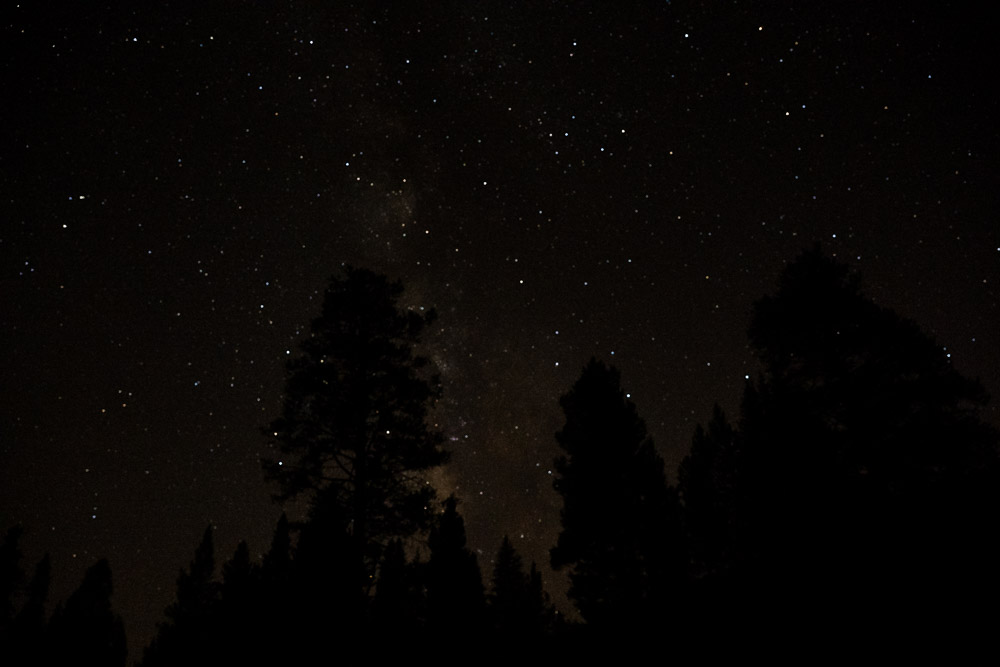
    Night shot, Airport.©Ed Schlotzhauer

    Computational photography

    One clever way to get better results in low light is used in your cell phone and by astronomers. It is generally called “computational photography”.

    Computational photography does not rely on the result of one frame. Instead, tens to thousands of shots are taken and processed by computer to bring out detail.

    This is how your phone takes decent pictures in low light despite having a tiny sensor. It is actually shooting bursts of dozens of frames. Then it quickly processes them in the phone. It uses averaging and other more sophisticated techniques to reduce noise and bring out the desired detail. I am surprised at how well it works.

    Astronomers have special needs in photographing distant galaxies. The light levers are so low that there is nothing to see with our eye. So, they instead take hundreds, maybe thousands of images with the regular sensor on their telescope and run them through dedicated processing software. Using combinations of specialized image processing algorithms and AI, their computers “reconstruct” what is probably there.

    My astronomer friends have shown me some of their new “telescopes” they got recently. These surprising instruments are generally about the size of a moderately thick hard cover book. They rely on small, cheap optics and lots of computation, but produce amazing results.

    Techniques like these let images be created in what seems like black conditions. But the reality is, it is not black. Just very low levels of lighting. If it was actually black, no photography.

    A blurry night shot©Ed Schlotzhauer

    See the light

    As I said, the purpose of this is to remind us that our art is based on light. We need to develop a heightened awareness of the light around us, because it is critical to our art. It changes all the time and is different in different conditions.

    it has been observed that a fish probably does not think about water. But we need to think about light, which is almost as important to us as water is to a fish.

    Light has many characteristics and most all of them affect our photography.

    We need to be intensely aware of the quantity of light at any time, its color, is it direct or diffuse, its angle, whether it is steady or changing, is our subject lit directly or indirectly, and many other properties. It sounds complicated. But learning the light is part of the craft. Learning to apply it creatively is part of the art.

    For instance, it is almost an axiom of photography that you do not photograph in the middle of the day. Like the “rule of thirds”, this is one of those rules I take pleasure in violating. The reality is that it completely depends on what subjects you are shooting, the nature of your light source, and what your goals are. Shooting at midday often enhances the texture of materials. In a dense forest it can create interesting dappled light patterns. In a slot canyon or a cathedral, it can create beautiful light beams. And diffuse overcast light may be perfect for many subjects, with high brightness and soft, even illumination.

    Dead branches. Interesting range of tones.©Ed Schlotzhauer

    And as a practical matter, I am not a National Geographic photographer on assignment. I can’t spend a week in the field waiting for the “perfect” shot I went out to find. I have to be creative enough to make the best use of what I find at the time I’m there.

    There are no rules, only what you can do with what you have.

    Tonality

    Tonality is one of those important things we need to think about and know how to use. It simply refers to the difference of luminance of the parts of our image. The tonality is what lets us distinguish all the parts. It creates separation of various areas.

    Think of a blank white piece of paper. This effectively has zero tonality. There is no image, because without tonal separation we cannot resolve anything. Any actual image we create has a range of tones.

    If the tones are squished together, our image is low contrast. Not much tonal separation. Maybe this is what you want, like a foggy scene.

    On a sunny day there is a wide range of tones. We refer to it as high contrast. Sometimes it can be too much. Do we need to use exposure or editing techniques to tame the contrast? But that is our creative choice

    A low-key image involves pushing most of the tones down towards dark. But the remaining light tones stand out. Likewise, if we create a high-key image, with most of the tones pushed toward light, the remaining dark tones stand out.

    Our eyes are very sensitive to tonality. We perceive tiny differences in illumination levels. Use of tones is a creative process. It should be part of our thought process and toolbox.

    One of the ultimate expressions of pure tonality is black & white photography. All color is stripped away, leaving only tonality to create the image.

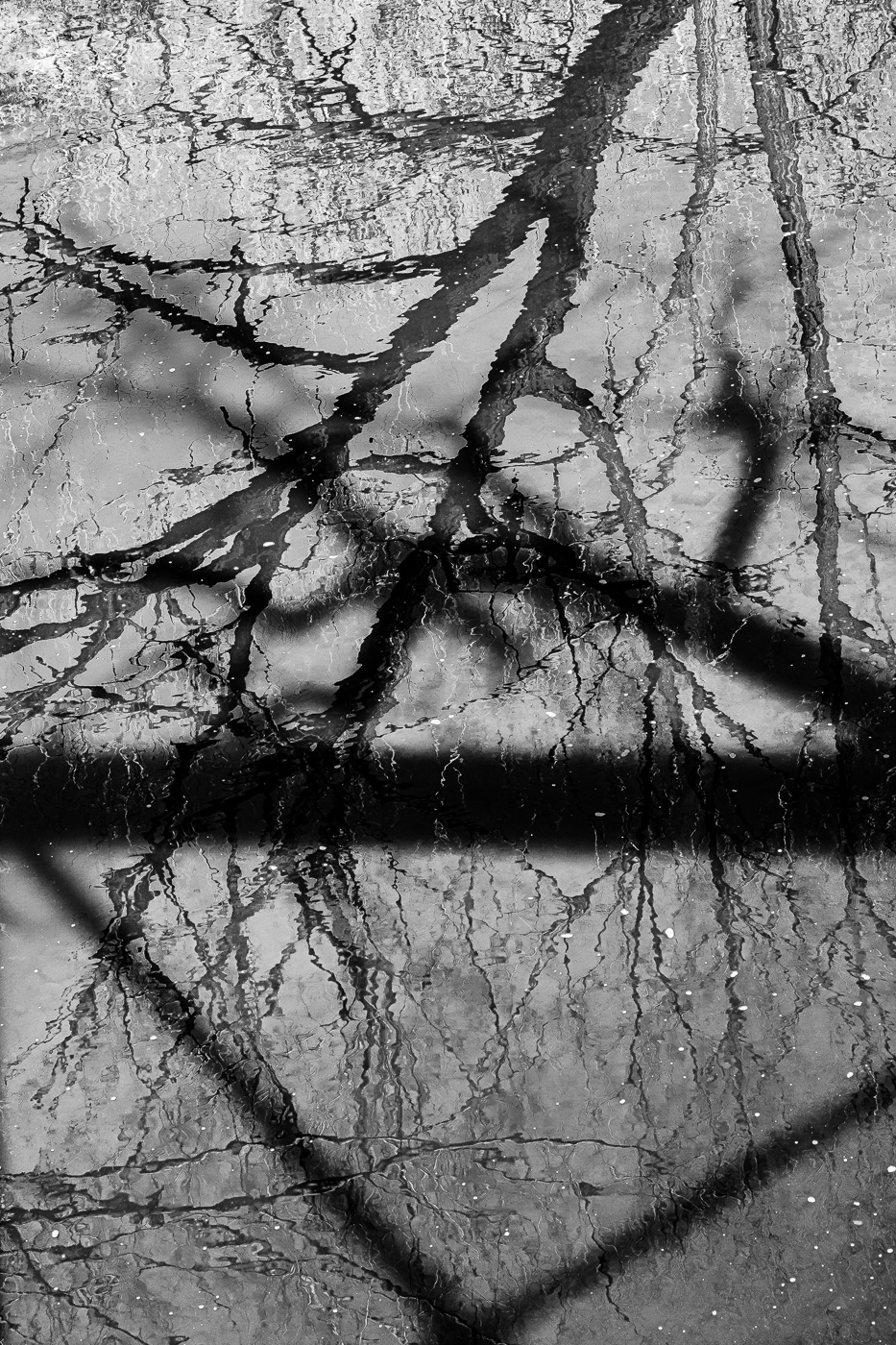
    Tree reflection. Black & white.©Ed Schlotzhauer

    Color

    Our eyes are an incredible design. The rods and cones have different purposes but work together to give us sight. But overall, our eye is less sensitive to color than to illumination levels.

    Think of being in a dim room at night. We can make out the objects around us, but the colors are hard to distinguish. Turn the light on fully and the colors pop.

    Similarly, in our images, good color requires good light. We can’t see vibrant, saturated color in dim light. I mentioned low key art. Have you noticed that most of it is black & white? This is a practical result of not being able to see much color in low light.

    I believe some people’s artistic vision is drawn to color and some to black & white. If you are a color person you have to be doubly aware of light. Not enough and our brilliant colors fade.

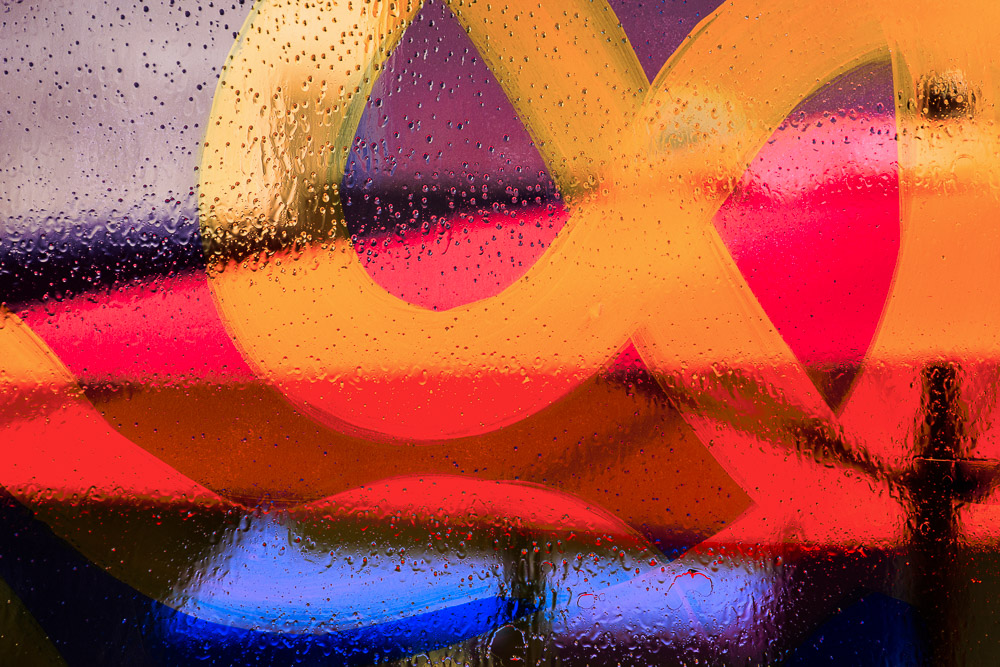
    Graffiti abstract©Ed Schlotzhauer

    Creativity

    All art processes are defined by their technology. Photography is based on light. We cannot do photography without light. To be a photographic artist, we need to be intensely aware of light and how to use it to our advantage.

    Recognize it not as a limitation, but as a creative tool. Light is a marvelously varied thing. We are artists. We paint with light. Learning it and being constantly aware of it and deciding how we want to use it for any image is part of the art.

    We are seldom in a place where there is no light, like the underground cavern I mentioned earlier. There is always light around. It may just be moonlight or city lights or a flash. We may decide there is not enough light to make the image we want sometimes, but there is always light to work with. Recognize it. Use it creatively.

    Light is fundamental to photography. Learn to see it for what it is and learn to use it creatively. It is what you are photographing.

  • Photography is Technology

    Photography is Technology

    There is no separating photography from technology. That is its nature. Photography is technology as much as it is art. It is one of the most technical art forms.

    What is technology?

    One definition of technology is “the application of scientific knowledge to the practical aims of human life.” Other definitions I like refer to applying knowledge to achieve practical goals.

    There is no getting around the fact that there is a tremendous amount of scientific and engineering knowledge packed in all the devices and tools we use in our photography.

    Technology pervades most things in all parts of our life these days. But photography is steeped in it.

    The technologies we use

    When you step back and look at it, every part of the chain from initial image capture to a final print or post relies heavily on technology.

    Our camera is a wonderfully crafted marvel. From the lens to the camera body and all that goes on in it. None of this would be possible without the almost magic technology behind it.

    Just consider the sensor. It can convert incoming light into electrical signals in a tiny fraction of a second. These signals are read out and converted to digital data (yes, the sensor captures analog data) in milliseconds. Our tiny memory card takes in all this data, again in milliseconds.

    And it does all this reliably and repeatably, day in and day out, in all kinds of weather, wherever we are.

    And it is almost impossible to work with images today without a good computer and great software tools. Again, these are technologies that are marvelously better than what anyone had just a few years ago. We regularly and quickly color correct, remove distractions, change tones, and sharpen our images – with far better control and precision than in film days. If we choose, we can bend and stretch pixels in ways that could not have been imagined a few years ago.

    Do. you post your images on social media for your followers to comment on? The scale and extent of the technology behind this is almost unimaginable. That post requires billions of dollars of cutting edge technology to happen.

    It is impossible to do anything photographically without technology.

    Fast action at a County Fair©Ed Schlotzhauer

    Shiny things

    This great technology that benefits us so much can be a liability. It is all too easy to get tangled up in the learning and the process of what is happening. A lot of specific knowledge is required to do our craft well.

    So we get trapped in chasing the technology itself. There are always raging arguments about how many mega pixels we need. Or which sensor has the lowest noise and best dynamic range. And are zoom lenses evil? Do we have to only use prime lenses?

    Is Lightroom Classic the best place to be managing and editing our images or should we use Capture One? And Photoshop is a life-long learning experience all by itself.

    Resolution, color accuracy, modulation transfer functions, RAW image processing – it can make our heads ache.

    A good or bad thing about technology is that there is always more of it we “need”. Studying reviews and specifications of gear can become an obsession. So much so that some spend all their time thinking about what they would do with the next big thing if they could get it and little time actually going out and making images with what they have.

    Don’t get me wrong. I’m an Engineer. I love to compare specs and I can swim in data all day. It would be a pleasant journey for me to spend a day lost in details of acutance or chromatic aberration or dynamic range. For nerds like me, comparing lenses is kind of like shopping for cars. We could talk all day about which one is best and go into great detail about why, even if we do not intend to buy one.

    This way to a Paradox©Ed Schlotzhauer

    Accumulating

    A problem with this focus on technology for its own sake is that we feel the need to always be searching for the “best”. New equipment always comes out and it is a little better than the old. We believe that to do the best job of our photography, we need the best new stuff. So it is an endless treadmill of acquiring shiny new things that will make us a better photographer.

    And it can get to the point where we get into a state of analysis paralysis. Have you seen someone out in the field lugging a huge, heavy pack with most of their “must have” gear? After all, no telling what we may encounter. So we bring the full range of ultra fish-eye to extreme telephoto lenses. And, of course, macro and perspective control lenses. A backup body (or 2) is a must. And a computer for checking our images on a larger screen and maybe doing a quick edit. Just to be safe.

    This person may spend more time trying to decide what to use and fiddling with equipment than they do finding subjects and composing and capturing images. Yes, “fiddling” is a technical term. ☺

    From what I have seen, when painters and sculptors get together with their peers and “talk shop”, there is a certain amount of discussion of technology and tools and equipment. But not like photographers. It can be an obsession with us.

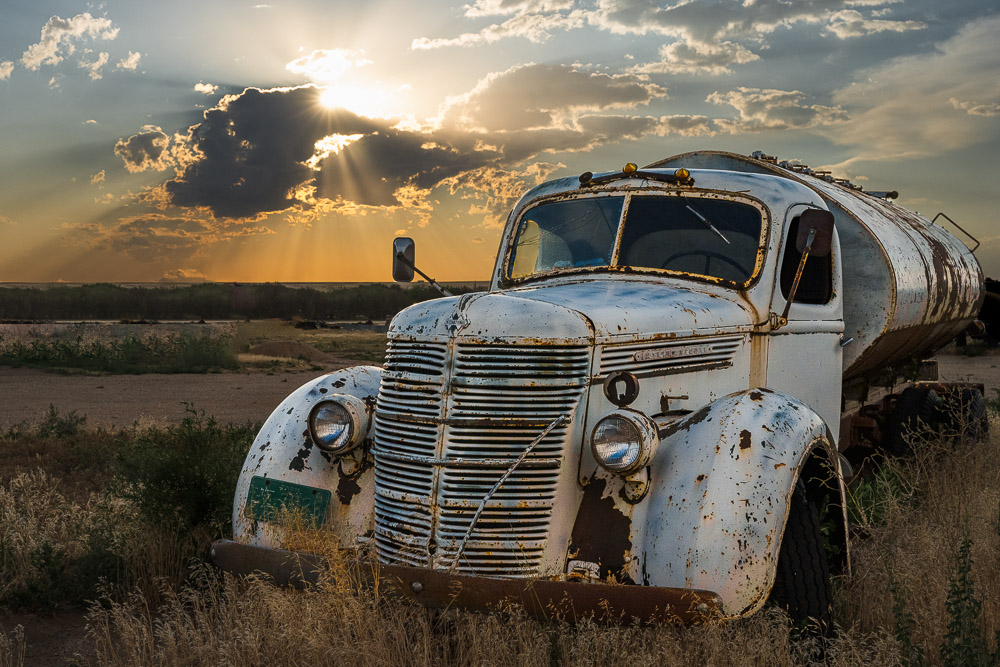
    Dilapidated old store©Ed Schlotzhauer

    Make it disappear

    I don’t want to paint a gloomy picture of technology. I like it and need it, at least when it works right. It would be impossible do my art without technology.

    But go back to that original definition that technology is about applying knowledge to achieve practical goals. Its purpose is to help us do things better. It should not become an end in itself.

    Great technology used right should “disappear”. It is not about the wizard’s wand or the warrior’s sword. It is about what they can do with them. One way to make it disappear is to learn to use it so well that it is fluid and natural.

    I recommend that we choose a small set of equipment and learn it well. Learn its strengths and weaknesses. Yes, weaknesses can become strengths if used artistically. Think of film grain for example.

    Have you noticed that a lot of music pushes an instrument to its highest or lowest range? Pushing the limits can lead to interesting effects. And it tests the skill of the performer. Our photography can be a little like that. Push the limits.

    Practice with your equipment frequently. Go overboard with it. Pick up your camera every day and run through scenarios. It should be automatic. Learn to operate it in pitch dark, relying on familiarity and feel to guide you. Even if you only use one lens, get to know what it can do and learn to see like it sees. You do not always need to carry a full range of lenses. That is what feet are for. Move.

    If we develop this intimate knowledge of our technology, it becomes a tool we can wield for our creativity. It “disappears” in our creative process. Great things happen.

    I love the technology we have available today. It allows us to create great things. Always remember that the technology is for us to make art. Use it. Don’t be controlled by it.

  • Be The 1%

    Be The 1%

    We can choose to be the 1% of photographers. Those who make prints. A print is a special thing with its own life.

    The 1%

    I’m not talking about that 1% we hear talked about in the news – the richest people in the world or the country. The latest data I could find for the USA says that, on average across the country, to be in the 1% financially you need a salary of about $600,000 or a net worth of $11 Million. Another article said that 1% of the people in the world own over 50% of the total household wealth.

    I am not bringing this up to get into any discussion of income inequality, investing practices, demographics, or anything related to that.

    No, I am referring to a group of photographers we can easily choose to join. Peter Eastway speculates that only about 1% of photographers make prints. Why do you think we don’t print more?

    Fall aspen in Colorado©Ed Schlotzhauer

    What is a print?

    First, what do I mean by a print? This may seem obvious, but I want to make sure we are on the same page, so to speak.

    By a print I am referring to an image presented in a fixed physical medium. A print is an object with weight and space and presence. We can hold it and touch it. We perceive it with our physical senses. And it is “permanent”. That is, it persists unchanged over time.

    A print is an enduring expression of the artist’s intent at the time. I say at the time, because it is quite possible for my intent to change with time. The print I make today may be quite different from one of the same image file 5 years ago, or even a few months ago. My vision changes and I often come to see it different. That is natural. I am the artist. Ansel Adams, for example, is famous for drastically changing his vision of how some of his famous images should be printed over time.

    What is a print not? It is not an image on a screen. Not your computer monitor or an iPad or your phone. It is not a fleeting image scrolled by on social media or your web site.

    Screens are important in the production of our art, but I hope they are not the main goal. Psychologically, we know that what we see on a screen is ephemeral. It has no permanence. We discount it easily. Being on a screen, we subconsciously consider it fluid and flexible.

    Why a print?

    A print is tangible. It is an artifact that persists in time and space. That is, it is physical. It is an object. We can hand it off to a client who buys it, and it becomes their possession.

    By giving the print this life of its own, we are creating a new piece of art. It is no longer under the control of the artist. Kind of like a child growing up and going out on their own. They are your family, but they have their own life now.

    As the artist, I can no longer “huddle over it” and protect and explain it. It is on its own. Now it is hanging on a wall. Maybe in someone’s home. Maybe in a gallery. But no matter where, it is now perceived for itself in isolation. It must explain itself, justify itself, fend for itself.

    A mindful view of fall colors near me©Ed Schlotzhauer

    New thought process?

    Deciding to make a print changes our perception of what we are doing.

    For one thing, we must commit our interpretation of what we see or feel in the image. We must resolve the “it could be like this or it could be like that” questions in our mind. Once we make the print, we can’t come back next week and change it. If we do, it becomes a different piece of art.

    And we will go through a more stringent selection process to pick it. Out of thousands of good images, why print this one? Does it do a better job of representing my view on the subject? Is it a more perceptive representation of something I feel? Will this give my viewers more insight than the many other images I could have picked? Is this an image I will hand to the world and say, “this is me?”

    New creative decisions

    And making a print involves new creative decisions. What size should it be? Some images seem to call to be large while others seem to prefer being small. Should this be a paper print or canvas or metal or acrylic? Will it look best as glossy or matte? Sure, some of the decisions will be dictated by the intended application. But many are purely artistic.

    And there are technical considerations that come in now. Does the file have the quality and resolution to make a large print? Can I print it and mount it myself or must I send it out to a service bureau to be done? The selected media imposes constraints on the image itself. If the desired effect is soft and ethereal then a matte finish may be best. But if the image relies on sharp detail a glossy substrate will make that pop more.

    I encourage you to make your own prints when you can. A good, medium size desktop pigment ink printer costs about the same as a mid-range lens for a 35mm camera. Having your own printer encourages you to experiment more. And the immediate feedback you get is gratifying.

    Break all the rules: not sharp, subject centered, subject indistinct, no leading lines, etc.©Ed Schlotzhauer

    Technical considerations

    Creating a good print is a specialized process that requires some detailed knowledge. The fundamental problem is one of basic physics. Screens generate light and emit it. It is an RGB mix, and it is additive. That is, red + green makes orange.

    We see prints by reflected light. Light hits the surface of the print and what bounces back is what we see. It is a subtractive process. The ink absorbs some colors. We see the reflected light that is not absorbed. To reduce the red you add cyan. Cyan is the opposite of red. More cyan absorbing red means less red reflected.

    This and other differences mean that a print will never look exactly like the image on screen. How close we can come is one of the challenges. How close we need to come is an artistic judgment. A print is another art form.

    Editing the image for printing is a task on its own. We load profiles for the media and printer and inks that we are using. A special profiling view is switched on so we see a simulation of what the final print will look like. This is, at best, a fair but not exact model. The reality is it may require several rounds of test prints and re-edits to get to a final print we like.

    It can be a lot of work, but it is part of the artistic process. This is work we must do to “birth” the print as its own entity.

    I usually have a number of prints hanging around my studio. Some because I just like them. But often it is to live with them a while to see if I like them long term. Results vary.

    Obscure found image. Track to nowhere©Ed Schlotzhauer

    Viewing it

    We have gone through all this work and expense to create a print. Why? Was it worth it?

    This is a personal evaluation.

    Sometimes you are disappointed with the result. Some images just do not seem to print well. That could mean we did not choose the best medium or size. Maybe it would have worked better in black & white.

    But most of the time you will feel the satisfaction of creating something new. Because the print is a new work of art. It is a distinct physical object with a life of its own. It lives in the world and is evaluated by viewers.

    We did our best job of composition and subject selection and lighting and a host of other things. We edited it carefully and prepared it for printing. Now it passes into another realm. We have tried to guide the viewers to see what we saw, but now they are on their own to discover it.

    The child leaves home and starts its own life. We are proud of it, but we cannot control it. It is not ours anymore. Likewise, a print becomes an independent entity. The viewers evaluate it on its own by their own criteria.

    Something tugged their interest enough to spend more than a passing look at it. Maybe we can draw them in and take them on a journey they did not anticipate. That is joy for the artist and the viewer.

    Take the leap. Be one of the 1% of photographers who make prints. It can change your art and give you a different relationsip with your images. And it can be a legacy.

  • The Color Is…

    The Color Is…

    Color is one of the major considerations in our photo processing. And it can be hard. Have you ever considered how many tools and settings there are to control color in Lightroom and Photoshop?

    But where are you on the color concern spectrum? For you, is color:

    1. Critical. It must exactly match
    2. Important
    3. An annoyance
    4. Just a design variable
    5. Don’t care

    Why do we need to change it?

    Despite all of the great technology we have, color is still an imprecise and slippery thing to deal with. Different camera manufacturers often create their own unique ‘look”. Fuji, for instance, has profiles built in for some of their famous films (remember Velvia?). But because of different technology and processing tradeoffs, there are subtle differences between, say, Nikon and Canon. There are even small variations between samples of the same camera model,

    The color variations are magnified as we move further along the processing chain. What we see is greatly influenced by the decision to shoot RAW or JPEG, and if JPEG, what color balance is chosen. And is our monitor calibrated to ensure it correctly represents the colors in the digital file?

    Finally, when we make a print everything can change drastically. The print is strongly influenced by the paper we choose and the printer’s ink set. Using good profiles for the printer and paper combination helps to produce an output that is “similar” to what we edited on screen, but it will never be the same. Just the move from illuminated pixels in RGB space to reflected light from a paper substrate in CMYK space means they can never be exactly the same. The physics is completely different.

    The variations along the way are the process of color correcting the image.

    Most of us do not see or pay much attention to these differences. The importance to us depends on our application.

    Graffiti abstract ©Ed Schlotzhauer

    Tools

    The color correction tool chain starts back in our camera. Specifically, the color balance setting.

    The color of the light on our scene varies greatly in different conditions. Bright sunlight is completely different from open shade, as is a cloudy, overcast day. Indoors under tungsten or fluorescent lighting and. even LED’s give different color casts.

    Out eye/brain automatically adjusts for most of these differences, but the camera does not. The color balance setting in the camera is a means to dial out the color casts. But this is only useful for JPEG images and the preview we see in camera. Color balance has no effect on RAW images. Those compensations are made in our image editing software.

    My camera stays set to Auto White Balance. I only shoot RAW, so it has little effect on my processing or results.

    Lightroom

    When I say “Lightroom” that is a shorthand for “Lightroom Classic”. That is the only version I care about. But I”m pretty sure everything I say about it applies to both applications. There are differences in color representations in other RAW image processors like Capture One, but I do not have enough experience with them to say much.

    Lightroom is packed full of ways to change the color of our image. In the Develop module you are never far from something that can modify color.

    Some of the controls change color globally, that is, for the whole image. Just scanning down from top to bottom (I think my controls are still in the default order), we start with profile. This can be a simple selection of default balance or you can set any of the many provided color effects, including black & white toning.

    Next there is the white balance adjustment to allow us to adapt the image to a color that should be neutral. Next to that is the color balance selection to partially compensate for lighting conditions.

    Right under them is the Temp and Tint sliders. Vibrance and saturation do not actually alter colors much, but they have a strong effect on the look of colors.

    Then there is the Tone Curve, where we can adjust red, green, and blue channel properties directly, followed by Color Mixer and Color Grading. Finally there is the Calibration group where we can control hue and saturation of each channel.

    All of these are only the control that affect the whole image. We have many of the same controls to perform selective adjust color in regions (like a linear gradient) or spots (e.g the brush tool).

    Illustrating its the journey©Ed Schlotzhauer

    Partly driven by the application

    Hopefully, you get the impression that Lightroom gives us a lot of control of color. It must be important. I won’t even go into Photoshop with its many adjustments. I trust the point is made. This is not a “how to”.

    Color adjustment is a large part of what we may deal with in post processing.

    Maybe.

    It depends on our application and needs.

    If you are doing product photography, the customer is very concerned that the color of their logo or product absolutely matches their specification. Portrait customers have a fairly narrow tolerance for off colors in people’s faces. Or you may have a self-imposed rule that the final color must exactly match the original scene.

    In these cases you are probably using gray cards or Color Checker swatches to ensure you faithfully match the original. You may even be calibrating your camera to minimize discrepancies. You will probably be using many of these Lightroom controls to adjust the colors to balance out shifts or color casts.

    I’m a Fine Art Photographer

    But I’m a Fine Art Photographer. I dislike that term and I’m not completely sure what it means, but I do know that what I create is art. Art is not tied to a real scene. Maybe someday I will get into a discussion on indexicality, but not today. By my definition, anything I want to do as art is acceptable.

    I may not care at all about the color of the original scene. I’m certainly not fanatical about matching it or balancing color casts. My consideration is how the resulting image looks (to me) and what effect it has for the viewers.

    Yet I do use most of the color controls I listed earlier. Except I very rarely use Calibrarion to adjust color, but that’s just me and my thought process. All the other controls, in global and regional and spots, are tools I use frequently.

    Color is a subtle thing. Almost imperceptible shifts can create large perceived changes. It can be tricky, or impossible, to achieve an effect I have in mind. But I try.

    Abstract image with serious gamut problems.©Ed Schlotzhauer

    Not an absolute

    Breaking the assumption that my image must look like the original was difficult for me. Coming from a very technical, engineering background made me think in absolutes. Precision was important. But now that the assumption is broken, it is freeing. The realities I started with no longer hinder my vision (as much).

    Even so, I do not usually create comic book-like pop art. Unless I want to for some reason. But, on the other hand, I do often enjoy making images that are so extreme you will think I modified them too much, even if I did little at all.

    Sometimes color is the subject. Sometimes an image “needs” to be a different color than the original. An extreme use of color modification is black & white. Yes, taking away all color and just leaving tonality is extreme color manipulation.

    In the questions I posed at the start, I’m usually operating at about 4 or 5. It is a tool I can apply to accomplish my vision. Not something I am stuck with because that’s what the original was.

    Great, saturated color©Ed Schlotzhauer

    Do what you need to do

    Color perception is one aspect of a visual image. But it is a powerful one. With our technology, we are blessed with extreme ability to control or modify color. Don’t be afraid to use it creatively.

    Unless you are working in an application that demands absolute fidelity to the original, color becomes just another design element to be used for art.

    Make your art. The color is… what you need it to be.

    Today’s feature image

    Is this the “right” color? I don’t know. First, I didn’t have a gray card with me. Second, even if I did, I couldn’t have held it out the window at 40,000 ft. Third and most important, I don’t care.

    This is what I remember seeing at the time. It is the way I chose to make the image look. It is art. I like it like that.