An artists journey

Tag: photographic technology

  • Craftsmanship

    Craftsmanship

    I have written a few times about how intent and expression are more important in a photograph than craftsmanship. I don’t want to leave the impression that craftsmanship is unimportant. It is critically important for a serious artist.

    What is craft?

    Craft is defined as skill at carrying out one’s work, or an activity involving skill in making things by hand. I believe an artist first has to be a craftsman. Proficient with his tools. Using our tools and equipment must be second nature.

    Craftsmanship is usually a learned skill rather than an innate talent. Sure, some things are easier for some people than others, but it still has to be learned. Lots of investment of time and practice.

    When we get skilled at the craft, the mechanics recedes into the background. It becomes a support and enabler for our artistic vision.

    Perfection doesn’t make a picture

    I have argued before that perfection of craft does not make a great image. The classic statement is Ansel Adam’s quote that “There’s nothing worse than a sharp picture of a fuzzy concept”.

    It might be better to say craft alone does not make a great image. It is a table stake. You need it to get in the game. An excellently crafted image may not be great, but a poorly crafted image is very seldom great.

    Craftsmanship is the base

    Craftsmanship is a base we build our work on. But it is only a base, one of the legs of the stool. We also have to have vision and creativity and the drive to express them. I believe this expression cannot happen without solid craftsmanship.

    I have said before that photography is one of the most technical of the arts. We are dependent on our equipment. Knowing how to use it correctly and effectively is absolutely critical to success.

    We must study and practice and drill until it becomes second nature. Have you trained your hands to just “know” where the camera controls are? Can you use them in the dark? With gloves on? Can you quickly and almost instinctively determine the exposure solution that aligns with your intent for the image? Are composition and framing decisions happening rapidly in the background with little conscious thought?

    When you’re out in the field working a scene you like, you don’t need to spend time juggling the technical tradeoffs in adjusting the camera. This distracts you from the artistic side. For instance, recognizing that this scene needs about f/8 to get the depth of focus you want and, since you are hand holding, at least 1/200th second shutter speed to insure a crisp image. Given that, are you willing to go to ISO 1600 to get these settings? These decisions should be almost instantaneous and subconscious.

    This is not to say you are operating by habit or on automatic. Quite the opposite. It is a state of flow. You are channeling all the craft you know to focus on the moment at hand. It is exhilarating.

    Photography is a craft

    Photography is a craft. Most arts are, but it seems more obvious in photography. We cannot create without our tools. And we cannot create well unless we are proficient with our tools.

    Let’s take a quick look at the chain of technologies required in photography.

    On the capture side there is the camera, of course. They are not trivial anymore. The user manual for my Nikon Z7-II is 866 pages. That just describes all the settings available, not how to use them. Becoming skilled at using one of these is formidable. Luckily, most of us only use a subset of the capability.

    And how much data do I need for what I am doing? Shooting full frame 40MPixels and above requires much more refined technique to achieve great results. Maybe what I’m doing today would be just fine with a 20MPixel APC camera. Do I have large and fast enough memory cards for my shoot? Enough batteries?

    There are the lenses and filters to select. It takes training to understand the effects possible and how to select the right look for the situation. Should I use a zoom lens when I know it is theoretically possible get a little better sharpness with a prime lens?

    Am I in the camp that says all images must be shot on a tripod? Or am I a hand-held guy? Or either, depending on the situation? Shooting hand held, do I know the techniques to get maximum sharpness? Or the techniques to shoot moving subjects?

    What about capture file formats? White balance? Camera profile settings?

    Processing

    That’s just the capture of an image. If you shoot RAW images, which I hope you do, the images are useless until they have been processed intensely.

    First, they have to be transferred to your computer. Do you have enough storage? My main image storage is currently using over 7 Terabytes. Then there’s multiple backup of that.

    If you are processing high resolution files you will need significant computing power. Lots of memory and graphic processing power. And a great, color calibrated monitor. Hopefully of 5K or more. That power is required to be able to process images fluidly without having to wait for the machine to catch up. Waiting really breaks your concentration.

    And of course, you use a color balanced process. Your camera and monitor are calibrated and you are using a wide color gamut system like ProPhoto RGB. A wide gamut allows lots of freedom in editing.

    All that processing takes a lot of time. So when you go out and shoot 1000 images, don’t forget that they have to be processed, and culled and keyworded and filed.. For me, processing an image takes anywhere from 1 minute to 8 hours.

    Output

    How you process an image depends on what you are using it for. Getting something ready to post on social media probably just requires some color and tone correction and maybe cropping. Preparing an image for a print could take a long time.

    Let me take the path of going to a print, since that is my preferred utilization.

    A print is a physical object that is perceived different from an image on a screen. The viewing time of a print is usually much longer than an image on screen. As such, it generally needs to be processed to a higher standard. Very careful spotting – removing sensor dust spots – is critical. Spending time removing or mitigating distracting elements is usually important.

    Many of the remaining decisions center on the characteristics of the final output. What size will the print be? What paper will be used. All papers have different properties and strengths and weaknesses. The paper can make the print look very different. Is it matte or glossy? Coated or uncoated? Heavy or thin? What color is it – papers aren’t necessarily white.

    To get an estimate of the final result requires turning on proofing during the editing. The computer attempts to simulate the final printed result. Of course, to do that, you need accurate profiles for the paper and printer combination. But that is just an approximation. It may need more than one attempt. And what about out of gamut colors on your print? Handling those can be tricky and exasperating.

    Build on it

    That is a lot! And this is just talking about still photography. Photographers have to be expert at most of what I described. That is some of the craft involved. All of this craft has to be used intelligently in the process of making a great image. It’s why I say that photography is one of the most technical and craft-based arts.

    But as much as we sometimes like to burrow into the fun details, the craft is a base. Build your base solid. But on top of the base, we need to build our artistic sensibility, our vision. We have to establish our style.

    Craft means knowing how to use your tools to achieve the results you want. Maybe that is an ultra crisp, tack sharp image. Maybe it is a flowing abstract with no sharp pixels. Yours might run to dark and moody and underexposed. Somebody else might be bright and high key. Those are your choices. Whatever your vision leads you to do, it is your craft that allows you to achieve it.

  • The Catalog

    The Catalog

    The catalog is the information hub of LIghtroom. There seems to be a lot of confusing folklore about it. Let’s talk about the catalog and demystify it some.

    This is specific to Lightroom Classic. Other tools exist. I do not know them and can’t discuss them. I believe Lightroom is the most widely used image management tool.

    A database

    When I refer to Lightroom, I mean Lightroom Classic. It is the only useful version for me. So be aware I do not discuss the cloud behavior of Lightroom at all.

    Lightroom is both a file management tool and a raw file editor. I’ve discussed raw editing before, so this article will just be about file management. We tend to shoot a lot of images these days. Without a way to organize all these and search for the ones we want, they become almost useless. How do you locate the right file when you need it?

    We do it with Lightroom and its catalog. The catalog is a database. I know that is a scary term to some, but it just means it is a file on the computer. The catalog in Lightgroom Classic is stored locally on your computer. It has a particular structure and capabilities that let Lightroom enter information about each image and rapidly search for it.

    So the Lightroom catalog holds a lot of data about our images. Some that it reads when we import our images and some that we tell it manually, like keywords and ratings and collection groupings. What the catalog does not contain is images.

    None of our images are actually stored in the catalog. They stay in our computer’s file system, wherever we decide to put them, as ordinary image files. They can be on any of our disks, internal or external. The catalog only notes their location and keeps track of it so it can call up images for us in the Lightroom screen.

    Where are the images?

    I mentioned some of the things the catalog contains. Let’s be more specific. I said the catalog does not contain any images. As you import images into Lightroom you choose where they will be stored. LIghtroom records the location about where each images is in the file structure of your computer. For instance, taking a random file that I happened to be looking at a few minutes ago, the path and file name is:

    /Volumes/LaCie-raid/Images/Images/New Mexico/Eastern I-40/Tucumcari/20231110-259.NEF

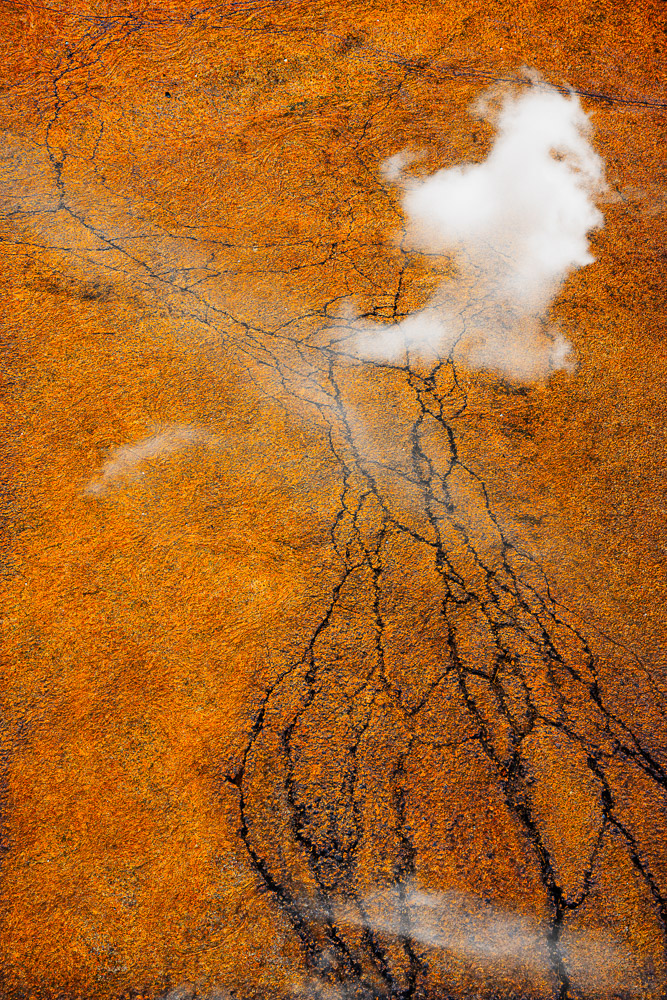
    This is the image above. This is what Lightroom has in the catalog instead of the image. Why? Because the file system of your operating system does an excellent job of managing its disks reliably and speedily. Lightroom does not try to duplicate that. Also, the file above is 52.4 MBytes. Let’s say you had 100,000 images this size stored in your catalog. Over 5TBytes of storage becomes impractical and would overflow a lot of people’s hard drive. And many people’s catalogs are much larger than that. Also, leaving the individual files visible allows us to use other tools to manipulate them.

    As I browse in Lightroom, when I come to where I want to look at this image, LIghtroom goes to the noted location on my disk and reads the image file and displays it. Actually, it first looks first in a special place where LIghtroom caches previews to see if there is a faster way to view it, but that is getting too deep for now.

    Metadata

    In addition, there is what is called metadata. This is just a computer science term meaning data about data. In our case, it is information read from the camera when the file was imported and information we have added manually.

    Examples of automatically gathered data are the camera used, including it’s serial number, the lens used., how the image was metered and exposed, the ISO. Also recorded is the dimensions, the data it was captured and many other details.

    Information we enter can include creator name, copyright information, keywords, rating, a title, a label, a caption, location, and other things. In addition, as we edit an image, all of the edit settings are recorded, from simple things like adjusting exposure to complex masks and adjustments. Virtual files are just copies of a files’ data in the catalog with a different set of metadata, not a duplicate of the file itself. And all Collections we create are simply sets of data in the catalog. Again, no copies of the files are made to create a Collection.

    The catalog holds a lot of data. It is a very important piece of Lightroom and is key to letting the whole thing work.

    How many catalogs?

    One of the first decisions to make when setting up Lightroom is how many catalogs to have. We could have a separate catalog for each type of content or activity. For instance, one for family photos, one for fine art, one for weddings, one for travel, etc. This initially seems logical to keep things separate and minimize the size of each catalog.

    My advice is don’t do it. Resist the temptation to have multiple catalogs. It will just make it harder to organize your work and harder to locate something. It might seem like a good idea to minimize the number of images in a catalog, but as far as I can tell, it doesn’t matter. I have over 130,000 images in my catalog. That is small compared to many other photographers. I am comfortable with throwing away images I deem worthless or exact duplicates. Other people don’t. But that is another discussion.

    I put extensive metadata in, such as location information, keywords, ratings, titles, and captions. And I do most of my image editing in Lightroom. This greatly expands the amount of metadata. The point is that this number of images does not appear to cause any stress or slowdown in my Lightroom catalog. I know of photographers who have catalogs several times larger.

    Don’t do this

    As a “don’t do this” anecdote, I have a friend who decided he knew better than Adobe and was going to manage his data more closely. He set up a catalog for each hard drive he had. As he outgrew a disk and added another one, it was a new catalog. Consequently, he has a data nightmare. It is very difficult for him to locate something unless he can remember exactly when it was shot and consequently what disk and catalog it is on.

    I strongly recommend you use 1 catalog and upgrade to larger disks as you run out of space. Yes, Lightroom can manage files across multiple disks, but you probably don’t want the bother. Disks wear out and need to be replaced anyway.

    How to organize it?

    How you organize your files is a personal decision. You need to figure out how you think about your data and how you “self organize”. You can see several things about my organization decisions from the example I gave of the file location data LIghtroom records. Most of my files are organized geographically. And my file naming is mostly centered on dates. It is not important to me to name images by their content. That is what Lightroom is for.

    All my images are stored on 1 fairly fast RAID disk drive. My feeling is this is easy for me to know where things are and easy to organize my backup strategy. The catalog itself is on an external fast SSD. The catalog is heavily used and this made a large improvement in performance.

    Be fanatical about backup! Your data is important. I use a combination of Time Machine – one of the greatest inventions in the history of computers – and a rigorous backup strategy using Carbon Copy Cloner. I do not receive any compensation from them for saying this. There are 2 external backup disks attached to my computer and another network attached RAID disk physically separate within my studio. I also backup to small hard disks that I rotate to offsite locations.

    So do you have to adopt any of the organization I use? Absolutely not. Every instructor probably has their own unique recommendation that is adapted to their needs and preferences. As I said, it is a personal decision. But it is a decision you have to make. Decide on your strategy and stick with it religiously. It will pay you benefits.

    Do all file operations from Lightroom

    Have you ever seen a “?” in place of an image? That is because Lightroom could not find the file. This is usually because a disk drive is offline or you moved some files using your computer file manager. Lightroom can’t locate the file and the best it can do is show a preview if it has one and mark it with the “?” to indicate it needs to be located. Locating a moved image is easy, but it is easier to avoid the problem entirely.

    Always do all of your file management from within Lightroom. Always! Lightroom has to know the location of each file it manages. It has very good capabilities for creating folders and moving files and folders around. It does the work of moving them on your computer file system and remembers the locations. And It is probably even faster and easier to move a large group of files from LIghtroom than it is using your computers file manager.

    All the eggs in one basket?

    If all your data is in the catalog, aren’t you at risk if it gets corrupted or erased? Yes. But there are many ways to mitigate this.

    LIghtroom has settings to automatically backup its catalog. Use that. Second, use other backup solutions like Time Machine and Carbon Copy Cloner to do your own backups.

    Third, you can optionally have most of your metadata also saved to files alongside your image files. These are known as sidecar files and have the extension “.xmp”. I turn on this capability. If the catalog is lost or corrupted it is possible to recover most of my data to a new catalog by importing the images and these sidecar files. This is a topic for another article.

    And lastly, I have been using Lightroom full time starting with its original beta release. Adobe has done a marvelous job of reliably keeping my data in tact. This is not a guarantee of future behavior, but so far they have earned my trust.

    Summary

    The Lightroom Classic catalog is a database stored locally on your computer. It is well established, good technology. Not magic.

    We do not see the catalog as a database, we do not have to know about databases, and we do not need to know much about searching databases. All that is wrapped in the Lightroom program. But knowing a little about how it works makes managing it easier.

    All of the data about your files is stored in the catalog, but not the image files themselves. The organization of your file structure, the naming of files, and the metadata you add are all completely up to you.

    Create an organization that works for you and stick with it. Lightroom will assist you by managing all the data the way you want.

    The image with this article is the one I referenced to show the location information Lightroom records. You can infer from the file path that it was shot in Tucumcari NM on Nov 10, 2023. It has nothing specifically to do with catalogs, I just decided to show what that image was to make it real..

  • Moving Past Perfection

    Moving Past Perfection

    Photography is a rather technical art form and most photographers get caught up in the gear and techniques. This can be appropriate for some work, but not always. I have stopped worrying about the last line/mm of resolution and absolutely perfect focusing and steadiness. It can be that imperfections can make some images better. I am moving past perfection as a goal.

    Perfection

    Sure, I love technical perfection. I think at some level most photographers do. It is a characteristic of what we can capture. We don’t want to just take a picture of a bird. We want to resolve every detail of every feather. The texture in an image should be so present that the viewer can easily imagine what it feels like. Every part of the subject must be in crisp focus and highly detailed.

    Technical perfection like this is a form of craftsmanship. It shows our viewer that we know how to use our tools and that we can check the craft boxes to prove our work is worthy.

    But this craftsmanship is a table stake, to use a business term. A table stake is the minimum viable offer that will be considered. For example, if you are buying a new car, you would not consider one that does not have a backup camera. It used to be a luxury but it has become an expected necessity. In the same way, digital photography has improved our product so much that there is little room for imperfection. Technical perfection, where is is required, is a necessity to be considered a salable print.

    Unless it is deliberate imperfection. More on that later.

    Don’t let it become the reason for the image

    An overused quote (at least, I seem to overuse it, because I believe it is very insightful) is Ansel Adam’s comment that “There’s nothing worse than a sharp image of a fuzzy concept.”

    I take that to mean that a good image will not be a great image solely because of its technical perfection. Instead, the technical details must serve the mood and intent of the image. Sometimes that means the technical details must be front and center, because they provide the framework that supports the resulting image. But in other cases they may actually subtract from the artist’s intent.

    I keep talking about sharpness, but the same applies to any other technical details. Composition does not make an image. There has to be more there. The absolute peak time and weather conditions at a certain location may help you make a very good image, but by themselves will not guarantee it.

    Who defines perfection?

    But what is “perfection”? That is very difficult. Must every image be 50MPixels or more at 3000 line pairs/mm resolution? Does every picture have to be perfectly aligned with “rule of thirds” lines and points? Does the color balance of the print have to exactly replicate the color of the original scene? How about images that do not have a definite foreground/middle ground/background? And how about the ones where the histogram is just wrong, say pushed too far to the left or right?

    Do these things define perfection? Can we make a great image that violates some or all of these “rules”? If you are thinking about some other articles I have written, you will know that the answer, for me, is there are no rules. There is no authority with the right to define what characteristics my image must have.

    If I have defined for myself that I am doing things in an Ansel Adams style, then that puts me in a box and defines certain expectations of look and sharpness. Or if I have defined that I am doing portrait photography in the style of Richard Avedon, that sets expectations of subject matter and style and print sizes.

    But notice that these are self imposed limitations. I reserve the right to define for myself the nature of perfection for my images. It may or may not include technical perfection.

    How can an “imperfect” image be good?

    If I set the definition of perfection for my images, then what does imperfect mean? It will only be imperfect if I fail to achieve the result I want.

    Think of some of the great shots of photojournalism or street photography. Some of them are a little our of focus. They might be over or under exposed. They might be grainy. But they captured a moment, an emotion, a comment on the human condition that completely overwhelmed all technical considerations. They are great despite their imperfections. Maybe because of them.

    I love (and was infuriated by) the types of comments I used to hear in camera club competitions. A judge might say “the composition would be improved if the photographer had taken 2 steps left”. I appreciate your feed back, but if I had moved left even 1 foot further I would have been over the edge of a cliff. Thank you, I will live with the composition I could get. It works, despite your sincere attempt to improve it.

    Past perfection

    So what do I mean by moving past perfection? For me it is the realization that perfection is not the highest goal. An image can be excellent even if there are technical flaws. Other things can and often are more important. The recording a “perfect” moment that exactly captures the nature and personality and essence of the subject can make a great image, even if there are imperfections.

    Actually, I am finding a lot of my current work is intentionally “imperfect”. I often use camera motion or subject motion as a design element. Some entire projects do not have a single sharp pixel in them. That is what I want, so I am pleased with it.

    A different take on craftsmanship is being able to use your medium to achieve your goals. Would you rather follow your own goals and create work that pleases you or struggle to achieve someone else’s ideal of perfection?

    Judge by your expectations

    No one except you can judge the perfection of your work. The definition of perfection is yours and yours only. They might say they would like it better if it was sharper or more/less colorful, or more/less saturated, of brighter/darker, or composed differently, or if the mid tone contrast was enhanced/reduced. And they may be “right”, in the sense that, after you think about it you decide yes, if I were shooting it again I would change it somewhat.

    But it is you changing your expectations that causes the difference in evaluation. No one else is in a position of judging your work unless you allow them to.

    Today’s image

    This is a horribly imperfect image. And it is just what I wanted. 🙂 It was shot out of a fast train in France. I wanted to represent the sense of speed and motion and changing terrain whipping by. There is not a single sharp pixel in the frame. The focus may not be right, I can’t tell. But this was one of the best of many, many tries, and to me, it captures what I was perceiving.

  • Depth of Field

    Depth of Field

    In a previous post I said I would talk about this later. Here it is. I believe most photographers only vaguely understand what depth of field (DOF) means. That’s probably OK, as long as we can still use it to our advantage. You don’t have to know in detail how your car works to be able to drive it, but it helps.

    What is it?

    You have seen it. We focus on a subject, but when we look at the image we are disappointed that another subject or the background was out of focus. We have been bitten by too little DOF.

    Depth of Field is the distance between the nearest and farthest points in the frame that are in acceptably sharp focus. OK, we can intuitively understand distance that is in focus. But what does “acceptably sharp” mean?

    The reality is that when your focus your super expensive, multi-element, rare earth material lens, it technically only focuses at exactly one point. Everything else is to some degree out of focus. But like many things in life, the precise details do not matter. What matters is the result.

    For most of us in most of our applications, it is OK for things to be a little bit out of theoretical sharp focus. We can’t really see that unless we magnify an image greatly.

    Circle of Confusion

    So for most of our work, we will accept a certain amount of out of focus as unnoticeable. The measure of this for Physicists and Optical Engineers is called the “circle of confusion“. If you focus on a point of light, you expect it to be imaged as a sharp point. But as one of these points gets in front of or behind the sharp focus plane it becomes a circle instead of a point. You have seen this as you adjust the focus point in a scene.

    The overly technical term “circle of confusion” refers to how large these circles are. And what we care about is how large they can get before we perceive them as out of focus. This picture helps illustrate that. The center diagram is focused precisely. The top one is focused slightly behind the focus point. The bottom one is slightly in front of the focus point.

    Circle of Confusion illustration

    Physics

    You probably don’t actually care about the math. But here is it:

    The approximate depth of field can be given by: {\displaystyle {\text{DOF}}\approx {\frac {2u^{2}Nc}{f^{2}}}}

    for a given maximum acceptable circle of confusion (c), focal length (f), f-number (N), and distance to subject (u).

    This is precise, but not helpful. There are DOF calculators available, but most of us will not use them when we’re out shooting. I never would, and I even understand the math. 🙂

    What does it really mean?

    It means that if we want to maximize the apparent range of sharpness in a scene to our advantage, we need to understand some basic things about our cameras and how to adjust them for the results we want. None of it is magic and we do not need to become mathematicians.

    Controlling the DOF becomes just another of the design choices we make more of less automatically as we set up a picture. When we become familiar with the concept it gets to be an easy thing to take in consideration.

    How do you control it?

    If you unpack the equation above you discover that there are are really only three things to juggle: focal length, aperture, and distance to the subject. I take circle of confusion as a relative constant, since we don’t usually think about it while we are shooting.

    Normally we consider the aperture to be our main control of DOF. That is because it is the easiest one to adjust. You have discovered or been taught that a wide aperture (small f/ number) gives a shallow DOF and a small aperture (large f/ number) gives the most DOF. This is true, as far as it goes.

    But there are 2 other components to the equation. We also affect DOF by our lens focal length choice and by our distance from the subject.

    For any given lens, the closer we are to the subject, the shallower the DOF is. Telephoto lenses exaggerate the effect more than wide angles. Increasing the focal length reduces the DOF. And getting further from the subject greatly increases the DOF. Looking back to the formula briefly, notice that the focal length and distance to the subject are both squared. This means they are a much stronger influence than the aperture.

    Aperture, focal length, and distance to the subject all work together to determine the DOF A smaller aperture (larger f/ number) increases it. Moving further from the subject increases it a lot. Using longer focal length lenses decreases it a lot.

    It is said that wide angle lenses have greater DOF

    Conventional wisdom is that wide angle lenses have more DOF than telephoto lenses. Actually, no. But practically, yes.

    The discrepancy is how we tend to use them. We shoot with a long lens and decide there is not enough DOF. So we put on a wide lens and shoot the scene from the same position. DOF increases a lot. But the field of view has also expanded, so we have a much wider shot. If you were to walk up to the subject to make the image size field the same as before, the DOF would be the same. Thank you physics.

    But in practice, yes, using a wide angle lens usually gives us a great DOF because we usually shoot from relatively far away.

    Hyperfocal distance

    One “trick” that has been used for a long time and that simplifies getting maximum DOF is to know about hyperfocal distance. The hyperfocal distance is an optimum point where everything from infinity to a point near the camera is in acceptable focus. Seems too good to be true, but it is just physics again.

    The technique is getting harder to determine now and is probably falling into disuse. Way back we tended to shoot prime (non-zoom) lenses and they had focusing scales. For a given aperture, all you had to do was adjust the lens so the distant aperture number was at infinity. You were now focused at the hyperfocal distance. Everything from the near focus scale mark to infinity is in acceptable focus. It was easy and very useful.

    Now, though, zoom lenses have gotten very good and most of us use them. The problem is that they are optically complex and do not focus the same. They cannot, by their design, provide us with focus scales.

    What to do? A pretty good solution is called the double the distance method. There is some estimating (e.g. guessing) and approximations involved, but it is better than a lot of alternatives.

    Say you want to have a flower about 5 feet away in focus and have everything in focus all the way to infinity. Focus at about 10 feet. Choose a “suitable” aperture, probably around f/11 to f/16. I told you there was guessing. But by doing this, the field from about 5 feet to about infinity will be sharp. Check it in your viewfinder. Adjust if necessary. The hyperfocal point is about 1/3 of the way from the closest point you want sharp to infinity. You have to estimate it.

    Making some educated guesses based on knowledge of what’s going on is better than a random guess based on no knowledge.

    Just do it

    Photography and video production are probably the most technical of the arts. We are constrained by the physics of the sensors and materials, the properties of the optical systems and lens design, and the effects that can be created by these. Compounding these is the reality that we are typically imaging real subjects with all their flaws and constraints. It’s wonderful!

    Don’t get caught up in the math or the technical details unless you are a nerd that really likes that. It is seldom necessary for making good photographs. I just put the DOF formula in to show you it is based on science, not some mystical mumbo jumbo. I would never use it in the field.

    Learn that depth of field is a balance between the aperture, the lens focal length, and the distance to the subject. Experiment with them. Get a feel of how they relate and practice getting the results you want. It is harder to describe than it is to do.

    Today’s image

    This image demonstrates intentional shallow depth of field. I wanted the foreground and background definitely blurred, but still recognizable. The effect was achieved with a moderate aperture, f/11, and a short telephoto of 70mm close to the subject. Remember, increasing the focal length and decreasing the subject distance both strongly reduce DOF.

    Experiment more. Make the use of your equipment to achieve your intentions automatic.

  • In Focus

    In Focus

    Focus, as an optical phenomenon, is unique to photography. But when we consider being in focus, there are other considerations besides the obvious optical one.

    Focus is unique to photography

    I had never considered this consciously, but it is only photographers who worry about optical focus. What is focus? Photography is created by imaging a three dimensional scene onto a two dimensional sensor via a lens. The lens has properties such as focal length and aperture that interact with the light passing through it to the sensor. The physics of imaging determines the thing we call Depth of Field (DOF). This is the amount of the the scene that is in acceptable focus. What is acceptable and what this means is the subject for another article.

    So as I am setting up a photo and making decisions about the focal length and aperture to use, my location relative to the subject, lighting, etc., it is also affecting the range of clear focus I will achieve. I praise the wonderful auto focus systems in modern cameras. They have come a long ways and do a great job if used properly.

    How is other visual art different? Well, a painting is created directly on a canvas. The sharpness or blurriness of elements in the image are determined by the painter by the marks he puts on the canvas. Since the resulting painting is a 2 dimensional thing, it has no depth to influence sharpness or DOF.

    Or take a sculpture. It is a 3 dimensional object. We view it with our eyes. Since our eyes and brain construct a sharp representation of the scene we are viewing, we see it as all in focus.

    Other focus considerations

    But the optical sharpness or unsharpness of an image is not the only consideration. An image can be in focus or not in other ways. How well did the artist understand his intent? Is it clear what we should see as the subject? Does it move us in any intended way?

    Worrying about or concentrating much on optical focus is a beginner issue. Once we mature that becomes just a natural part of the craft we take care of automatically. I don’t know any advanced photographers who worry about “nailing” the focus. Sure, there may be times when camera shake or something causes the image to be blurry, but it is seldom because the artist did not know how to achieve good focus.

    Intent

    Sometimes when we are shooting we are moving fast. Maybe the light or the subject is moving quickly and we are having to react in real time. Or maybe we are just too lazy to analyze what about the scene we are framing interests us.

    I believe very much in instinctive shooting. But our instinct has to be well trained and experienced enough to bring together a huge amount of decisions quickly and without much conscious thought. Until we get there, we need to be very slow and intentional about what we are doing.

    Ansel Adams expressed it well when he said “There’s nothing worse than a sharp image of a fuzzy concept.” Our image may be in perfect optical focus, but were we intentional about what we wanted to say?

    Similarly, Jay Maisel, in his brusque New Yorker manner said “If you talk with nothing to say, that’s bad. When you shoot with nothing to say, that’s worse, because you still have to edit the damn pictures.” Well, he’s right, too.

    Before we even raise our camera we need to go through a dialog with our self. “What draws me to this?” “What do I want my audience to see and feel?” “How can I frame and compose this to achieve my goal?” With experience this process becomes almost automatic, but I strongly recommend being slow and intentional with it for a long time.

    When I feel I’m going too fast I still will slow myself down and consciously go through the dialog. It helps to center me and clarify my focus and intent.

    Subject

    Do all of your images have a defined subject? A certain object or area or pattern that is the key that the image revolves around? If you are shooting portraits or street scenes that may seem obvious. But even then, is it conscious?

    In a video I watched of Jay Maisel shooting street scenes in Paris, one of the images he shot was of a girl riding a scooter in a park. It was a sweet and nice image. But when he showed it and described his reason for taking it, we see that it was captured at the perfect moment when her head was up and she was kicking her pushing leg dramatically. A perfect moment. That gesture, as he terms it, made it a beautiful image.

    So in this case the subject wasn’t just a girl riding a scooter in a park, it was her posing and moving in a very characteristic way that gives a dramatic insight into her personality. He moved beyond the simple surface subject and opened up a deeper insight.

    Shooting the eye of the bird

    When I was learning to shoot (archery and guns) I was taught a simple but impactful lesson. You have to aim for what you want to hit. Duh. But not so simple or obvious as it sounds.

    One expression of it I heard was a story about an archery master teaching pupils to shoot birds. The students arrows were wildly all over. The master almost always brought down a bird. They asked him why. He said they were shooting at the bird. He was aiming at the bird’s eye.

    I have seen the similar effect in hunting, even in modern times. If you are trying to shoot a deer in the woods, if you shoot “at the deer” you will likely miss. Pick out the exact point you want to hit and aim carefully for that. Your percentage will go way up.

    So in our art, the subject isn’t necessarily everything in the whole scene or even that lovely grove of trees. What is really key, important? Pick what is really the subject and make it the basis of the image. The eye of the bird. This may seem nearly impossible in a landscape. But think about it. Give it a try. See if you can’t pick out what is actually the key point in the scene. Make sure it is treated properly.

    Experience

    But even more important and powerful than a clear subject is the experience we bring to our viewer. Photographers, in particular, often get caught up in the technology or craft and sort of forget abut the viewer.

    It’s kind of like what Ansel Adams said about there being nothing worse than a sharp image of a fuzzy concept. If you don’t know precisely what you intend the viewer to see and feel, they probably won’t figure it out, either. Then we’re both disappointed.

    Clear focus and optical sharpness is often important, but will probably not be what makes or breaks a great image. Having a distinct subject is also important, but also will not be the deciding factor. The artist must have a clear vision of the effect he wants to create in the viewer. Everything about the image must work together to achieve that goal. That is being in focus.