An artists journey

Tag: photographic technology

  • HDR

    HDR

    HDR, which stands for High Dynamic Range, is a bad word to some photographers. I think they have been overly influenced by some bad early use of it. It can be an excellent tool for certain kinds of images.

    Dynamic range

    First, though, what is dynamic range? Dynamic range is a measure of the span between the lowest level signal that can be used and the highest level. In most electronic systems the high end is limited by the point where the signal starts to clip or distort. The low end is limited by the point where an unacceptable amount of noise intrudes. For photography it is that range from the darkest value that is usable to the brightest value that doesn’t clip to pure featureless white.

    Modern digital sensors are far better than ones in early digital cameras. High end sensors now are rated at between 13 and 15 stops of dynamic range. That is incredible. Early sensors had maybe 5-6 stops.

    But like many things, the numbers are misleading. It is not that the camera makers lie, just that they do not quantify what they really mean. So my sensor may technically have 14 stops of range, but I cannot really use all of that with no cost.

    If you want to jump in to a little more technical depth, check out this article.

    Noise

    There is this problem called noise. It is worse at the dark range of exposure. We call what we do “digital photography”, but the reality is that a significant portion of it is based on analog signals. The information coming from the sensor is analog and it has to be amplified and digitized before it is actually digital data. Electronics, even the wonderful systems available now, have a certain level of noise in analog circuits. It is not a design fault, it is basic physics that cannot be entirely eliminated.

    So when we capture an image that has a wide range of brightness values, it needs to be processed a lot in order to make a good print or even a good image for social media. A lot of this processing involves boosting the dark values to a more usable level.

    But, the darkest values are close to the noise level of the electronics. So boosting them also boosts the noise. You have seen this when you brighten an image a lot and notice it looks very grainy and even blocky.

    HDR

    Enter HDR as a technique for mitigating the problem. HDR software takes several exposures, usually referred to as an exposure bracket, and combines them into a single image with a compressed dynamic range. Typically 3 exposures are used: one overexposed to make sure shadow data is good, one at the correct nominal exposure, and one underexposed to get all the highlight data.

    In combining this data, the software can select highest quality exposure value for each pixel. It uses sophisticated algorithms to “compress” the dynamic range. That is, it makes the brightest areas less bright and the darkest areas less dark. I could not explain the exact algorithms used.

    Abuse

    This sounds great. What is the problem?

    There is actually little problem with HDR as a concept. The problem is, when it first became popular, it was often abused by many practitioners who applied it in a heavy-handed way. Images with the dreaded “HDR look” were obvious and often scorned. The HDR look is an over compressed image with few real highlights and few real shadows. Everything has a bland sameness to the tonal range.

    The look rightly was looked down on by “serious” photographers. It tarnished the technique as a whole. That is unfortunate, because HDR is great for some things.

    When to use it

    HDR can create images that could not otherwise be made and it doesn’t have to be obvious. If a scene has extremely high contrast then HDR is often the only means to get the results we want.

    Way back in the olden days we had to use graduated neutral density filters in front of the lens to darken the brightest areas, usually the sky. This would pull the dynamic range down to a reasonable range to capture in one exposure. It was the “analog” equivalent of HDR. Of course, this involved adjusting the exposure to try to anticipate the final capture range. It was tricky, but it was the only way to do it.

    Now with HDR, no one I know uses split neutral density filters except the remaining film photographers. Except in one case.

    Movement

    HDR has one Achilles Heal – subject movement. An action scene is very difficult for the HDR software to build a good result.

    If only some small parts are moving, like grass or leaves shifting with the wind, the HDR software may use “ghosting” algorithms to try to work around the movement. If you are trying to photograph a high contrast action scene, like a car race, good luck. You probably will not be able to apply HDR because there is not enough correlation between the different exposures.

    Today’s image

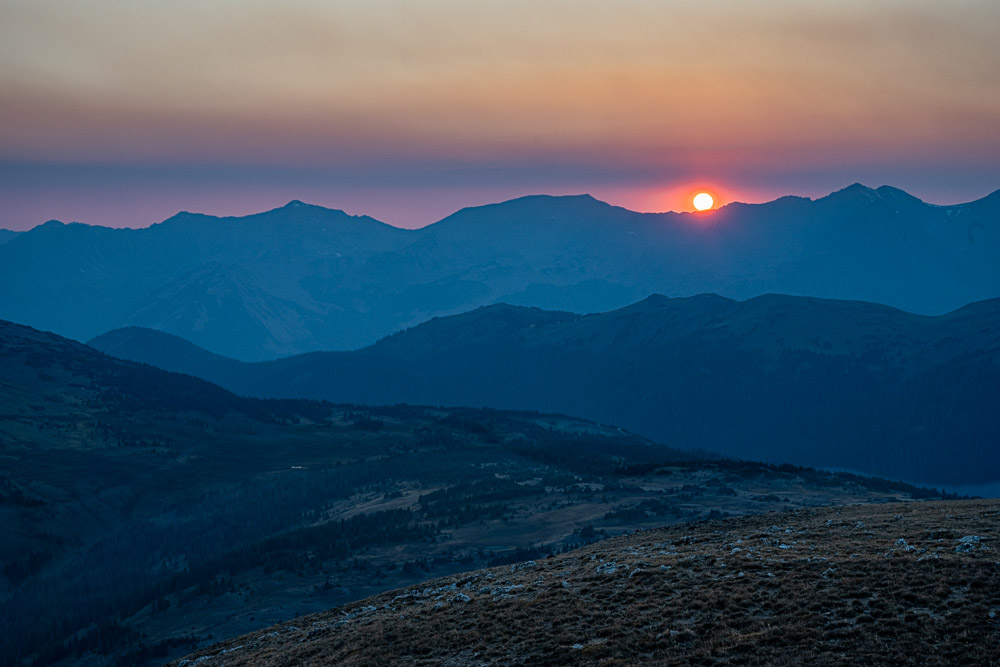
    This is an HDR image. Trying to create an image with the direct sun in it and at the same time preserve the deep shadows in the mountains wasn’t going to work in one exposure. The HDR software was able to pull it all together.

    I don’t think this looks like the bad old “HDR look”. What do you think?

  • Eliminate Scale

    Eliminate Scale

    Photography makes it easy to visualize the world differently. By using various lenses and changing our position we can get closer to or further from the subject and we can change the composition dramatically. A technique I like to use sometimes is to eliminate scale to give a fresh view of a subject.

    Not intimate landscapes

    Intimate landscapes are popular and common. This is simply getting in close to a section of a landscape. It allows us to call attention to shapes and colors and relationships that would be lost in the immensity of a wide landscape scene. It is a classic technique and I use it a lot. I love it.

    But this is not what i am talking about today. Most often in an intimate landscape, it is clear that the scene is a segment of a landscape or nature view. We get in closer to isolate the part we want to call attention to, but we keep the context of the overall landscape. If I make a close view of a rapidly flowing stream, it is clear that the context is a cascade in the mountains.

    Aerial Photography

    It is popular to make abstract aerial landscape shots. They can be beautiful and compelling. The shapes are organic and pleasing yet the scene is somewhat abstract because we can’t place what it is. Some well known photographers like Peter Eastway and Tony Hewitt are known for this technique.

    Drone photography is also increasingly popular and available to more photographers because it is a lot cheaper. Drone photography is typically done at a few hundred feet elevation, as opposed to conventional aerial photography that is typically up to a few thousand feet.

    The common characteristic of these is that the views are looking down, usually straight down, to a relatively flat plane. Scale references are usually missing, so the viewer is left to imagine the size of what is being seen. That is part of the fun of viewing them.

    Macro

    Jumping much further down the scale, another technique to eliminate scale is macro photography. This usually refers to images that are life size or closer. A life size shot is termed 1to1. This signifies that the image is the same size on the sensor as it was in real life. For a full frame sensor that means shooting a scene that is 24mmx36mm. That is getting close. Macro photographers routinely get much closer than this.

    This type of shooting tends to get very technology-heavy. There are special optical techniques with extension tubes and bellows and reversing lenses to give the required magnification. Special tripod fittings are used for focusing, because the whole camera system has to be moved to focus. No auto focus here.

    Lighting is another consideration that gets difficult. Macro photographers use multiple flash setups with bounces or ring lights or even light tubes to direct the lighting to the very small area being shot and eliminate glare.

    On top of that, macro shots have extremely small depth of field. It is more and more common to use focus stacking techniques to record many, sometimes hundreds, of “slices” at different focal points. Special softwar combines it all to produce a final result. I have a friend who designed and built a robot system to automate macro and micro photography with steps of microns.

    I am not saying these things as a negative against macro photography, I am just trying to place it in context of what I am discussing. Macro images are often great and intriguing because they show a realm we do not see with our eye. But I don’t have the patience to do it seriously. I prefer a more spontaneous style.

    Pseudo-aerial

    The particular kind of scale elimination I am talking about today I call pseudo-aerial. I haven’t seen the term anywhere. As far as I know, I coined it.

    I do not lay out the big bucks to book a plane or a helicopter for a shoot. And I have not gotten a drone yet. I already said I don’t have the patience to do serious macro work. So I figured out a way to do my own brand of simulated scale-less images that mimic aerial photography.

    I find small scenes with interesting shape or texture or color and with few if any clues for size and typically shoot straight down from a standing position, basically about 2-3 ft above the scene. The results are my own brand of abstract aerial photography that I call pseudo-aerial. It is sort of the macro version of aerial photography.

    One advantage over true aerial photography is that subjects I shoot are often static. I can spend more time composing and moving freely, compared to being in an airplane. And I can spend longer on a scene, maybe waiting for the light to become “right”. Of course, the subject does not actually have to be horizontal, as long as I can get perpendicular to it.

    Challenges

    There are some challenges, but they are pretty minor. Making sure my feet or the tripod feet are not in the frame is something to always check for. Likewise, being careful not to let my shadow intrude in the scene.

    I often shoot these without a tripod. Without a tripod there is the balancing act of leaning out far enough to be perpendicular to the plane of the image and get my feet out of the frame and not fall over while making sure the shutter speed is fast enough to stop and motion. Yes, I have been off balance. Embarrassing but not yet damaging.

    A bigger challenge is to visualize a small scene as if it were an aerial shot. Making sure there are no clues of scale, like grass or twigs or leaves to de-mystify it. Imagining the final image printed to check the impact and interest. Dare I say “pre-visualizing” it?

    Example

    I will make it concrete with an example. The image presented today is one of these pseudo-aerials. It reminds me of an angry sea breaking on the beach, changing color over the sand and diminishing the violence.

    In “reality”I shot it at my local car wash. The camera is upside down on the center console of my car, pointed up through the sunroof. In that position I had to use the camera’s app on my phone to view and control it and take pictures. Very little was done to the actual image data except to color it to match the effect as I visualize it.

    A lot of experimenting (and luck) was needed to get the timing of the water and soap and brush movement to get an effect I liked. Plan to throw a lot away. But when it works, it can create a unique and interesting scene.

    After describing my pseudo-aerials as shots looking down at a small static scene, I turned it upside down to show an example shooting up at my sunroof at a dynamic scene. I wanted to emphasize that the original orientation and details don’t matter. What matters is if the final result will be accepted as an abstract aerial shot. To me this does.

    I like pushing the boundaries of the medium. This technique to eliminate scale seems to me to be a rich area for exploration. I intend to pursue it a lot more.

    What do you think?

  • Directing the Eye

    Directing the Eye

    Directing the eye is a hot topic with photographers and workshop leaders. Even some psychology researchers. It involves understanding the psychology of how viewers look at an image and techniques to encourage them to look at it the way we want.

    Psychology

    There are certain principles of perception that seem to have a lot of agreement. By understanding the principles, we can use them as tools to increase the probability that people will spend the time to look at our images.

    Understand that these are characteristics common to a lot of people, not hard and fast rules. 2 + 2 = 4 is a rule. Not every individual in every situation follows a principle like “the eye is drawn to the brightest region”. Usually, but not always. So while learning and applying these understandings we increase the chance of people relating to our work, we can’t guarantee it.

    Brightness and contrast

    We are drawn to bright areas and we are drawn to areas of high contrast. Use this to draw people to the area of your image you are particularly interested in them seeing.

    Since we tend to look more at light areas and less at dark ones, that is why vignetting is commonly used to “push” the eye away from the edges of an image and into the interior.

    The lighting wasn’t right to give the effect you wanted at capture time? So what? That is what post-processing is for. Don’t be afraid to change the lighting and contrasts for the effect you want. If you do it skillfully, no one will know. If you don’t… well, it’s a learning experience.

    Color and saturation

    Color also effects how we look at an image. Highly saturated colors attract us. Even normally saturated colors are seen differently. Warm tones seem to advance. Cool tones seem to recede. Placing warm tones next to cool tones gives a subtle 3D effect. This is why at concerts or plays you often see warm light on one side of a performer and cool light on the other. It gives them more shape.

    Spots of color attract the eye, too. If a scene has fairly even pastel or monochrome tones with a few small areas of a brighter color, we are drawn to those colorful areas.

    Lines

    Our eye is a marvelous pattern matching engine. We try to make connections whenever we can. Check out Gestalt Psychology for much more information. So lines, especially diagonal ones, tend to lead the eye to find something interesting the line is leading to. We are actually disappointed when we are fooled and the line didn’t mean anything.

    Wide angle lenses are sometimes used to accentuate this effect by exaggerating diagonal lines and bending them. It is difficult to shoot some scenes wide without introducing diagonals. Make sure to not disappoint the viewer. Provide a target to reward them for following the diagonal.

    Faces and words

    Human figures, especially faces have a high visual weight. We are designed to recognize faces and we have a high interest in them. If there is a face, or part of a face, or even an eye in an image that will be one of the first things a viewer is drawn to. A face trumps most other elements of a picture.

    Likewise with words. We recognize words as information. We’re conditioned to read them. I think it is fascinating that we are drawn to them even if we do not understand the language. Besides, by it’s nature, characters making up words are fairly sharp edged and high contrast. We have already seen that viewers are drawn to high contrast areas.

    Since faces and words are so powerful, we have to be careful with them. Having a person walking through the background or a sign off to the side can destroy your composition intent. Or they can make it if you use them well. The point is, you have to be very aware of them and what they will do to your image.

    Depth of Field

    A simple attention focusing technique is to use a shallow depth of field ( a small aperture number such as f/2.8). We are drawn to sharp areas and tend to ignore blurry ones. A shallow depth of field tells the viewer to pay attention to the slice of the image that is sharp.

    This is a excellent trick to eliminate the complexity of busy scenes.

    Techniques

    These eye catching techniques are means we can use to help make the viewer look at our image the way we want. Many photographers seem to obsess about eye paths through an image.

    Eye tracking studies have been done, where subjects are instrumented with devices that can determine what their eyes are looking at at any moment. These studies produce maps, sometimes called “heat maps’, of the viewing patterns.

    This used to be done a lot for web sites. After all, companies spend a lot of money producing their sites and they want to know if customers are seeing what they want them to see. Eye tracking has also been used to instrument image viewing. Researchers are interested in the order in which viewers see things, what they spend the most time on, and what path they use to scan over the image. Much of the information I presented above comes from studies like these.

    This says that techniques can be used to direct viewers to parts of the image we want them to see. Maybe we can even encourage them to scan the image in a certain order.

    Why direct the eye?

    We’ve looked at some of the principles and techniques that can be used to direct viewer’s eyes. But why are some of us keen to do this? There must be a reason.

    A photograph captures everything in the field of view of the camera when the frame was exposed. This can lead to a complex, even chaotic image. There can be many things competing for the viewer’s attention.

    Sometimes the photographer feels the need to help out by saying “here is what I want you to pay the most attention to.” Eye directing techniques are good for this. This is a good use of the techniques.

    Something else I see, though, I feel is unfortunate. We live in a short attention span world and we tend to accept that as a universal truth. It is said that people only glance at an image for less than a second online, unless it really grabs them. So photographers think they better use all the tricks they can to let their potential viewers grasp the image in 1 second.

    Therefore there is a belief by many that we must make our images absolutely clear and unambiguous and immediately graspable. After all, if we only have 1 second, we better package the information clearly. Maybe that is the case if your world revolves around the ephemeral whims of social media.

    I fear this makes images shallow and boring and is a self fulfilling prophecy. Images have less depth so viewers dismiss them more quickly.

    Introducing mystery

    I follow a different path. Most of my work is intended to be viewed as prints. The relationship between prints and the viewer is a little different. If someone is walking through a gallery viewing prints, they are likely to spend a little more time contemplating each one.

    While I occasionally do work that is very clear and unambiguous, even minimalist, I often do the opposite. Sometimes I enjoy presenting images that are rich in content, that I want viewers to spend time looking at and discovering new things.

    I occasionally even misdirect attention from a subtle interest I hope the viewer discovers. Not to be mean or devious, but to reward viewers, to give them a joy of discovery for exploring more carefully.

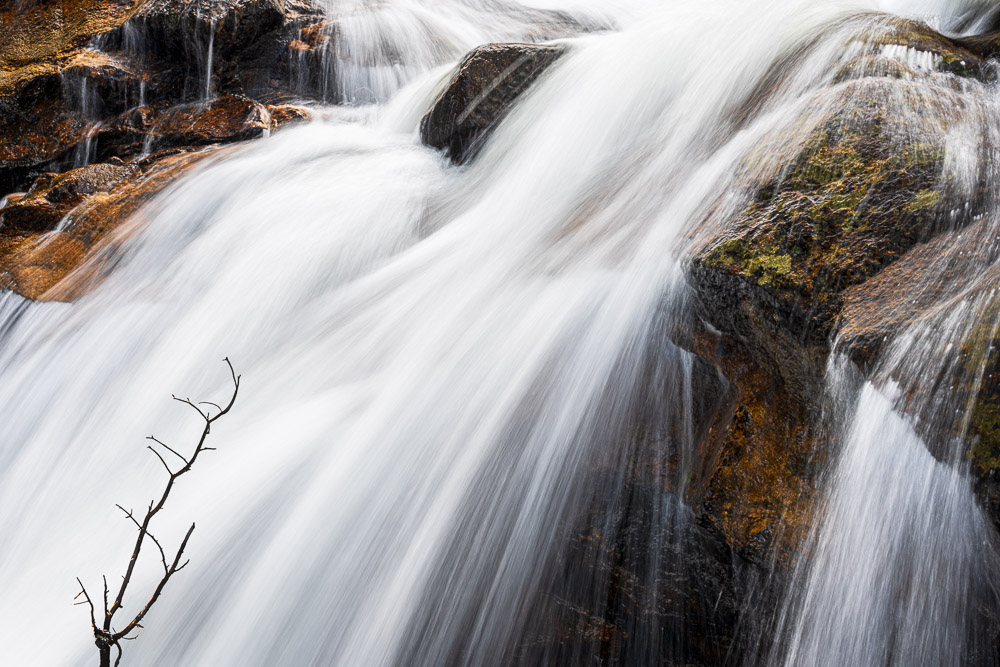
    The image with this post is an extreme example. The eye is immediately drawn to the lower left side. That is where the brightest area is and the presence of the high contrast branch silhouette insures it. There is interest there and I hope people like it. But after you’ve explored that and you follow the cascade up to the top right corner you might discover there is a plaintive, maybe melancholy figure under the water. It is not a face, but you see it as a face. There is a moment of recognition that reignites interest and it raises questions, I hope.

    What do you think?

  • Photographing the Unseen

    Photographing the Unseen

    Photographing the unseen? That is impossible isn’t it? If you can’t see it, how could you take a picture of it?

    Ostranenie

    Osranenie is a concept. It is based on showing things in a new way, from a new point of view. I have written on this before and I want to circle back to give some practical applications. No, I still don’t know how to pronounce it.

    Central to the concept is that the artist tries to force the reader or viewer outside of their normal state of perception. The goal is to make you break your normal habits and look at things different.

    A unique ability of photography

    Photography is uniquely suited to help see things outside of our normal perception. Other types of art, like painting, are generative. That is, you start with a blank canvas and what appears is what the artist envisions.

    Photography is totally the opposite. It is basically subtractive. The camera captures everything in its field of view. It is up to the artist to be selective in framing and composing to restrict the image to what he wants to present.

    That is well understood, but in addition, the camera settings and attachments allow exploration of states that we cannot perceive with our normal sight. Without any special tricks, my camera allows shutter speeds from 1/8000th of a second to 30 seconds. And the long exposures can be extended to any length I desire. I can also change lenses to give different perspectives on a scene.

    Photography may be, at heart, a mechanical and technical based art, but that technology allows us to peek into the world in unique ways.

    Camera vs eye

    As humans, our marvelously designed eyes work in a totally different way than a camera. We constantly scan around and “snapshot” small slivers of our field of view. Our minds seamlessly stitch this constantly changing stream of images together, kind of a real time panorama. We don’t notice it happening. What we think we “see” is actually a model built from these scans and our interpretation of its meaning and our experience with similar subjects.

    The camera has no built in biases. It just represents what it gathers in one exposure.

    Time extremes

    I have mentioned time as a variable of photography. But so what? How can that give us a new perception?

    If I adjust my camera to take a frame at 1/8000th of a second, it does it. The result is a frozen slice of an instant that we cannot perceive with our normal vision. A cascade is a classic example. Shooting at a very short shutter speed freezes the motion of all the water and allows us to examine what is truly happening in an instant. All the complexity and the turbulence we cannot perceive.

    On the other extreme, if I expose it for seconds, the water will blur into streaks that give an impression of the overall motion going on. We sort of understand that this is what it might look like over time, but we can’t actually see it unless we take a picture.

    Here are a couple of (not very good) examples. Actually, I seldom use short shutter speeds on water so I had to go out to the local river and generate an illustration.

    Water flowing at 1/400th second
    Short shutter speed, 1/4000th second
    Water flowing at 1/10th second
    Long shutter speed, 1/10 second

    In the first case, the water seems crystal-like, frozen. In the second case there is a distinct impression of motion and flow. The point in each case is that this is not what we actually see when we’re looking at the waterfall. Each is a bending of our perception, revealing new views on the world to us.

    Space

    Our cameras also have the ability to give us different perspectives on the space around us. Our eyes have a fixed focal length that is around 40-50mm equivalent for a 35mm camera. And we see the world in a horizontal format. But we can put a variety of lenses on our cameras to give views from extreme wide angle to extreme telephoto. And we can rotate our camera in different orientations.

    We’re used to seeing our “normal” point of view – that’s why 50mm is called a “normal” lens. A wide angle stretches our view, Things converge in unexpected ways. Lines make distinct new compositions. Buildings “bend” in funny ways. It brings together much more width of view than we are used to seeing.

    And the opposite, a telephoto lens, compresses our view. It narrows in on a small area, like when we look through binoculars. It gets us closer to something we would not normally be close to, such as a wild animal. And it lets the artist draw our attention to details of small parts of a scene.

    Each of these effects is a distortion or exaggeration of our perception. It is not what we actually see, but it allows us to discern the world around us in new ways.

    Motion

    Our perception of motion is another effect the camera can record but that we perceive much different. Try an experiment: move your head rapidly from side to side. You don’t really notice much as your head is moving. As soon as you stop you have a clear view of the scene before your eyes. Our mind kind of “skips over” the motion.

    Or try another experiment: stand beside a road and start straight ahead as cars go by. What do you notice? Something obscures your vision briefly, but we tend to ignore it. It’s more of a distraction to what we are watching.

    The camera, though, sees all that passes in front of it. It doesn’t know to ignore some things as immaterial. I often use the technique knows as intentional camera movement (ICM) to achieve reality distortions to show the world in new ways. The image at the top of this article is such a motion capture. You know what the scene is, but you also know that you have never actually seen the world like that. It helps you think of it is a different way.

    Color

    Another thing we have excellent control of now is color. More or less, change the hue or saturation – it’s easy with our tools. These things could not have happened in early photography.

    I feel the need to single out one significant category of color manipulation that we are very familiar with. Black & white. This is not the way we see the world. By presenting an image without color information, our perception is changed drastically. It keeps us from getting distracted by color and helps us to really look at the shapes and tones and forms in the scene.

    We don’t produce a black & white print now because we are limited by the medium. A black & white print got there by the artist deliberately deciding to remove the color. We may not think of it this way, but black & white images are a deliberate distortion of our perception to help give us a new point of view. It is an alternate reality.

    Bending reality

    Photography has the ability to bend reality in many ways. That is one of the things I love about it. I am not ashamed of it. It is not cheating or an artifice. It is using our creativity to create art.

    I think this quote expresses it well:

    In our time it seems entirely appropriate that the widest choice be open to artists. Those using the camera or other photographic means to produce works of artistic merit should seek to exploit their medium in the most adventurous ways … The derogatory use of the term artifice is more often than not a bugaboo. Art is artifice. Its reality is of another nature than that of the purely physical world.

    Aaron Scharf

    A different perspective

    I really appreciate that photography has abilities to give us different perspectives on the world. I am tending to push in these directions more and more in my work. Of course, artists in other media can do most of these things, but they would have to either have an amazing ability to visualize the unseen, or they would likely take a picture to show them the unknown and then paint it. Photographers do it directly.

    Maybe it is stretch to call this bending of perception ostranenie, but I don’t think so. I doubt if the term will ever catch on. Probably a good thing, because then I would have to learn to pronounce it.

    There are few actually new things in the world. The idea of ostranenie was penned in 1917 – 106 years ago as I write this. But I am happy that photography lets us push the boundaries into new visualizations of reality. It is a uniquely capable art form.

    Let’s go out and shoot the unseen and impossible! Keep on bending! Get outside of normal perception.

  • My Favorite Lens

    My Favorite Lens

    In general, we photographers love our equipment, Especially our lenses. It is not uncommon to have a favorite one. You can always get a discussion/fight started among photographers when you talk about lenses. I would like to discuss what has become my favorite lens.

    Lenses

    The lens is a critically important piece of equipment to photographers. Sensors are improving dramatically and lenses have to improve with them to achieve all the sharpness and resolution the sensor can capture.

    Modern lenses constantly improve in resolution. Look at DxO image tests of current best lenses vs. the best from 20 years ago. Our lenses now enable us to capture more information and be able to produce wall-size prints that are extremely sharp.

    The lens determines the point of view that is captured in our frame. It establishes the field of view, the width of the scene we are capturing. Some of us naturally have a telephoto view. Others have a wide angle view. This refers to the lens choice we tend to select to frame our subjects. This is just personal preference. The lens is a tool to help express our esthetic.

    Many photographers feel they need a whole bag full of lenses of various focal lengths from extreme wide angle to super telephoto, with macro lenses and tilt/shiftes thrown in. Because, you never know what you might find. 🙂 Personally I have simplified my life a lot over time. I generally only carry a 24-70mm and a 70-200mm in my kit. But that is just me and where I am at right now.

    So what we want is a lens or lenses that allow us to capture all the information we want (resolution, sharpness, dynamic range) in the field of view we want. A big ask, but doable.

    Digital workflow

    Most of us are in the digital world now. The digital workflow is quite different from the analog workflow.

    What we call the analog workflow – the film days- involved developers and enlargers and prints and lots of chemicals and time. Personally, these are days I don’t miss. I am a big fan of the power and freedom and flexibility we have now.

    There is a corresponding workflow for digital processing, though. It includes loading images on our computer, viewing them, culling or grading them, processing selects with our software of choice, etc. Each of theses steps is time consuming. Especially since we tend to shoot so many more frames now that they “don’t cost anything”. And each step requires software and considerable training.

    The result, though, is that we spend a lot of time in front of our computer now. We probably spend more time in the digital workflow than we did in the analog workflow.

    My favorite lens

    What does this have to do with a discussion of my favorite lens? Well, in a sense the “lens” I use the most and that has the most impact on my work is my computer monitor.

    This is where I view all my images. Zoomed in to 100% I look at individual pixels. Here is where I crop and color correct and adjust tones and contrast and saturation. This is where I view and edit the image when I convert it to black & white. When I create new images by compositing others together, that is done entirely though the monitor “lens”.

    Yes, all of the things I just said are actually done through specialized software. In my case it is primarily Lightroom Classic and Photoshop. But metaphorically and to me, the monitor is the lens into the process.

    Now days the monitor is where we view everything we do. Regardless of what the original image looked like, what I see in the monitor at the end of the edits is what counts. The result could be a complete re-imagining of the starting image.

    The new primary lens

    I spend more time in front of my monitor than I do outside shooting. More and more it is coming to dominate my workflow. If I lost or broke a lens, that would be terrible, but I could continue doing my art with other lenses with only minor re-adjustments to my vision. I had this experience recently. My 24-70 lens dropped and shattered the polarizer filter. I was up in the mountains and I did not have a filter wrench with me to get the jammed filter off, so I had to switch to using an alternate lens. A little frustrating, but not a big deal.

    But if my computer died, although I could continue shooting, I could not view or process a single image until I fixed it. Eventually things would back up to a critical point and I would have to get the computer back. I also couldn’t select images for galleries or process images for printing. Dead in the water.

    So in a sense, the focal point of the digital workflow is the monitor. That is the new lens I use to view and do most of my work. The monitor is the lens for the increasingly important part of the digital workflow.

    The future

    In the future will this trend increase or will we return to simpler times? What do you think?

    My money would be on the increase of digital processing. We will trend more toward an attitude that the camera and lenses are used to gather raw material, but pictures are actually made in the computer, looking through the monitor. Increasingly, the final image may look less and less like the original capture. Better processing software opens up new possibilities. And viewers are more willing to accept that photography should create something more than a true representation of reality.

    So the next time you are lusting for a wonderful new lens, it might be better to upgrade your monitor instead.