An artists journey

Tag: fine art photography

  • Seeing the Unseen

    Seeing the Unseen

    Photography is unique in the arts. It can record things we cannot see or imagine. Photography can be an adventure in seeing the unseen.

    Unique

    Photographers are sometimes made to feel inferior. Usually by proponents of the “real” arts, like painters or sculptors. Get over it. Photography has qualities that go beyond any other arts. Qualities that make them envious.

    Photography is a technology-based art. That technology can be used along with our artistic vision to capture and create things regular art cannot. We can peer into things the human eye cannot see. We can freeze time to examine events the human eye cannot show us. Likewise, we can extend time to show the effects of movement in new ways.

    Exposure

    The human eye is amazing. But it has limits. Even though it can see a huge range of light, photographic sensors can push beyond our eye’s limits.

    When you look at the stars, for instance, we can see what seem to be an immense number. But I have astronomer friends who have a process of taking hundreds of frames of 1 point in the sky. Then they use special stacking software to combine them and sharpen them to create levels of detail far beyond what the eye can see. Even my amateur astronomer friends routinely show me pictures they have taken of distant galaxies that cannot be detected at all with the eye.

    Those same astronomer friends have solar filters – essentially completely black glass – that let them view the surface of the sun! They can see and photograph sun spots and the corona. Things that would destroy our eye if we tried to look directly at them.

    The technology and practice of photography allows these things.

    Light range

    And “normal” (non-photographic) art is all done in the visible light range. Makes sense, That is all we can see.

    But most of us have seen infrared imaging. This is done using a special dark red filter that excludes most light we can see. What is left is what we would consider heat – the world of longer wavelengths beneath the red response of our eye. It gives us a subtly different perception of the world around us. A paint artist could not do that without taking an infrared image of the scene then painting from the photograph.

    Similar filtering can be done to see the ultraviolet world beyond the highest violets we can perceive. And have you had an X-Ray? That is just imaging done in another range of “light” we cannot see well beyond the ultraviolet.

    These are somewhat niche capabilities, but they can bring us information that is exclusive to the photographic world.

    Time

    Time is one of my favorite variables that is unique to photography. One of the three legs of the exposure triad is shutter speed. By varying the shutter speed we can effectively slow down or speed up time!

    People have developed flash systems that can freeze movement in slices of 1 millionth of a second. Even the fastest bullets are frozen in midair. Explosions can be captured as they start. You’ve probably seen pictures of a drop of liquid falling into a dish. The splash patterns are beautiful and interesting. Not many things we come in contact with in our lives are not frozen at this kind of speed.

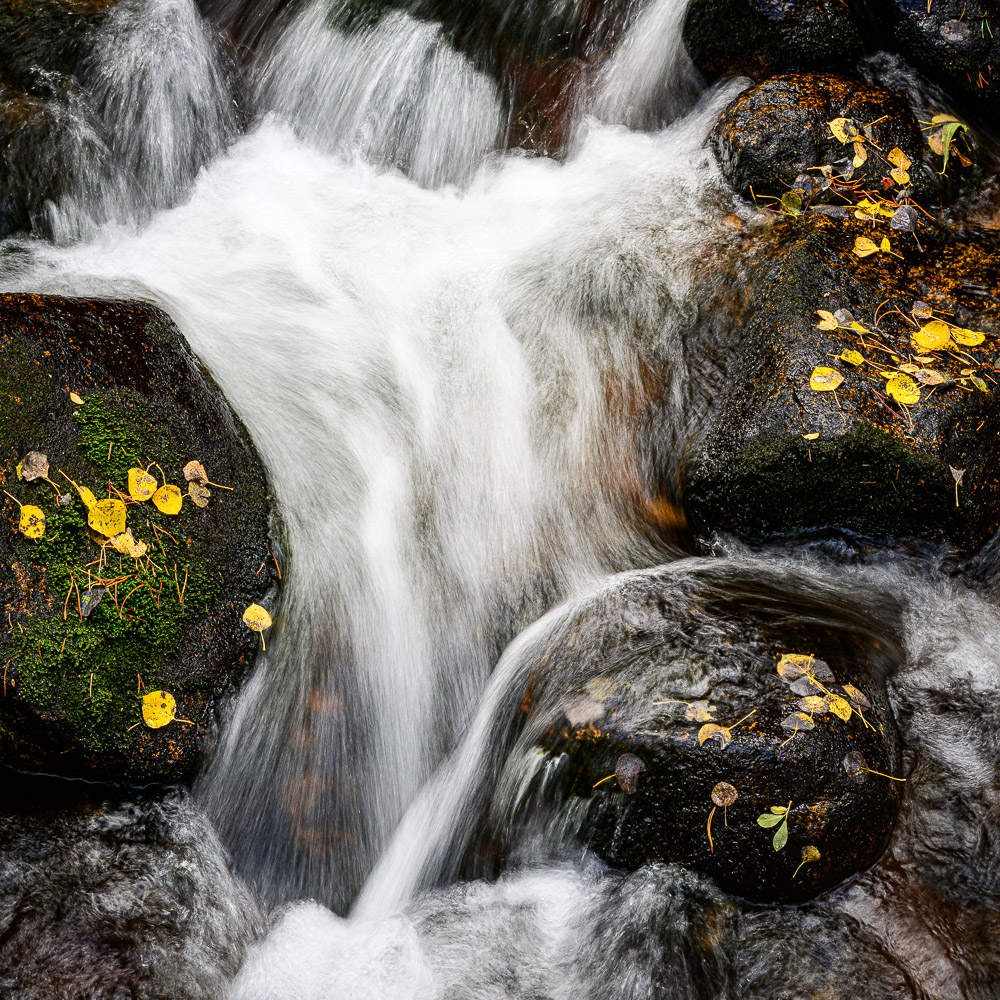
    At less extremes, a waterfall at a fast shutter speed can look like a cascade of diamonds . A bird in flight is completely frozen at about 1/1000th of a second. Every feather is crisp and sharp. We cannot see it this way with our eye.

    At the other end, long exposures capture movement over time. This is the area I like to work. Not super long. Just long enough to change our perception of what is happening.

    We have all seen long exposure pictures of waterfalls or cascades, where the water is smooth and silky. It is so common that it is in danger of being cliche. But the reason you see it a lot is because it is a pleasing effect. Some photographers make exposures of minutes. This makes clouds streak and water blur to a milky texture. Not really my thing, but I appreciate the reality distortion caused by the time shift.

    Movement

    A subset of this idea of time is where the camera is moving relative to the subject or the subject is moving relative to the camera. The camera motion side has become popular as Intentional Camera Motion (ICM).

    Like many techniques in photography, it is easy to do but hard to do excellently. Anyone can take a blurry picture because the shutter speed was too long to stop the action. Most of us have to work to overcome this. ICM deliberately pushes this “fault” to a point of art. I do ICM for some projects and I have seen a lot of ICM that I consider excellent art. And I have seen a lot more where I have to think, “yep; that’s your standard ICM”. That’s OK. Most experiments in doing something new and creative fail.

    One interesting aspect of techniques that involve movement and time is that it is almost impossible to take the same picture twice. There is always variation. The variation often leads to pleasant surprises.

    Stretch the notion of reality

    So photography is unique in giving us alternate views of “reality”. With conventional arts, like painting, nothing can be created that the artist does not first see or imagine. Photography can show us worlds or effects we did not imagine. This sometimes opens up new creative paths to explore. And the exciting thing is it is actually reality. If the camera captures it out in the “real world” (whatever that is), it is reality. What we get may be a complete surprise, but that is part of the exhilaration.

    Photographers, never feel inferior in the arts. Know that what we do is as valid as any other kind of art. And try not not to be smug knowing we have the option of being more creative than most other forms of art.

    Go explore the unseen and enjoy your discoveries.

    Live always at the ‘edge of mystery’ – the boundaries of the unknown. – J. Robert Oppenheimer

    Today’s image

    This is part of a series I did fairly recently. It combines ICM and time and subject motion and some secret sauce optical techniques to create this look. I consider it a creative view on a reality that happens around us all the time, but only photographers can see.

    Is it “real”? Yes, absolutely. It is a minimally modified shot of a real, physical subject. It is a subject most of us can find right around our town.

    To find out more about what it is, go to my web site and find a similar looking image in Projects.

  • It Doesn’t Have To Be a Portfolio Shot

    It Doesn’t Have To Be a Portfolio Shot

    Of course we want to build a great portfolio, but don’t stress too much. Sometimes it is best to just go shoot and see what happens. In other words, not every shot has to be a portfolio shot.

    A portfolio shot?

    We all probably have one or more “portfolios” we maintain. Maybe you don’t formally build a physical portfolio box or book. Now days it is probably one or more Lightroom collections (or albums, depending on which flavor you use). That is a separate discussion.

    The portfolio represents our best work. Typically there will be multiple ones for categories like landscapes or portraits or street photography, etc.

    It should be a very limited set. A maximum of 20 works well. If you have 200, either you are a truly exceptional artist or you haven’t edited enough yet. Editing hurts. It is painful to take out a favorite. But the reality is that every one removed makes the remaining set stronger. It is healthy to constantly challenge our portfolio. Test to see if new images are better than existing ones. If they are, replace the old one.

    So my point here is that it is easy to get in our head and not take a picture of a scene unless we are sure it is superior to anything already in our portfolio. This freezes us into fear and indecision.

    Be mindful

    Photography should be a process of mindfulness. We should be present and open wherever we are. This helps us to actually see the possibilities in what is around us at the moment. Being there and being in the moment lets us make the most of whatever situation we find.

    Self-censoring fights against mindfulness. When we pass opportunities because they will probably not make portfolio images, we are building a mental wall to exclude things. It constricts our thinking and leads us to miss great shots that come unexpectedly.

    Practice the craft

    If you are a musician you practice hours a day. Even simple scales train the musical senses. If you are a gymnast you practice hours a day. Strength and flexibility exercise is as important as working on routines.

    Why should it be different in the arts? Our art is part craft. Practice makes us better. We need to be very fluid in handling our equipment. Exposure decisions should be quick. Composition should be almost automatic because we have built such a large base of experience.

    So we need to spend a lot of time just taking pictures. For the practice, if nothing else, even if we discard most of them. It makes us a more virtuoso photographer. The great majority of this practice does not produce portfolio shots. But it sets us up to skillfully make the great shot when we find it.

    Get in the flow

    A lot gets written about flow states. here are reasons for this. One is that it is a simple concept most of us can relate to. Another is that it is a powerful and compelling experience. Everybody seems to understand the basic concept, so I will not define it.

    It is hard to force a flow state. You kind of fall into it and don’t realize it until later. To get there you have to be working – hard. Not working on getting into a flow. Working hard on our craft. That means being out doing it. Not just dabbling in it, but spending significant time and attention. As we immerse ourselves in it for an extended time we may find that we have hit a groove. Time seems to stand still. The stars align, so to speak, and everything seems to work better; ideas come freely; we are on a creative high. We feel good about what we are doing and the results are above normal. It seems to flow.

    Looking back on it with a warm glow we may realize we were in a flow. It is important to realize that the flow is not the goal. The experience we feel and the work we produce is. Flow helps enable that.

    Be surprised

    And by being out and shooting freely with less self-censoring, I often am surprised by what I get. Maybe it is from being more mindful. Perhaps it is when I am in a flow. But regardless of why, I am frequently pleased with images that I thought at the time would be boring. And I am glad I shot them.

    The famous Wayne Gretsky said “You miss 100% of the shots you don’t take.” I think there is application to our photography. Just thinking about a shot does not create an image. Thinking about a shot and deciding not to take it means no image. But when something tickles your subconscious and you go ahead and grab the shot, you might find gold. Even when you are relatively sure it will not make it into your portfolio, it might trigger another thought. Which might trigger another thought. And so on. It can bring you to a better way to see the subject. We can surprise ourselves.

    So don’t be quite so picky. Be very picky in the excellence we demand in our craft. But be careful in prejudging our shots. Do your best with what is there and see where it leads. It could be that it is not a weak subject that is at fault. It could be that we aren’t letting our self think about it very well.

    Today’s image

    I’m a sucker for these. I love shooting them. You never know precisely what you will get, but the surprise can be fun. I really like this one. It is also a great exercise for working on timing. Being able to recognize a shot and execute it. It fascinates me that a few tenths of a second or a slight movement of the frame can make all the difference.

  • They Told You Wrong About ISO

    They Told You Wrong About ISO

    Many of us have a wrong idea about ISO settings. I will just say they told you wrong about ISO. It was a misunderstanding. Whoever “they” are.

    Statement of faith

    It is stated as a “strong suggestion“, especially when we are learning landscape or portrait work. Never shoot with ISO over 100. Maybe it is stated as only shoot at the native ISO setting for your camera. Either way, these are given as rules.

    I hate rules, especially for my art. Rule of thirds. Rules of composition. Never put the subject in the center. Never shoot at midday. Always use a tripod. The list goes on.

    Like with religion, most of the so-called rules are based on good ideas, but over time they are repeated as commands and the underlying reasons are lost. Just do it. (I don’t think that is what Nike meant.) The rules become a statement of blind faith that cannot be challenged.

    What is noise?

    All digital cameras have noise. Noise is randomly generated in the sensor and in the electronics of the signal path until the pixels have been digitized by the analog to digital converter (ADC). The noise is a fundamental property of physics.

    The question is how much noise is there relative to the desired data. This is called signal to noise ratio in engineering. When we amplify a signal by increasing the ISO setting, all the signal including the noise is increased. This is why images shot at high ISO settings tend to look noisy. The image is usually not less sharp, but there is more noise obscuring things.

    It is true for a low cost point and shoot camera or a high end medium format camera. What changes are the relative amounts of noise and the limits the image can be pushed to.

    What is ISO?

    You’re familiar with the exposure triad: the combination of aperture, shutter speed, and ISO that determine exposure. That’s it. Many other things affect the composition and quality of an image, but only those 3 control the exposure.

    Aperture is the size of the diaphragm opening in the lens. It controls, among other things, the amount of light coming in. Shutter speed is the length of time the shutter is open to let light come in. And the ISO setting is kind of like a volume control. It sets the gain or amount of amplification of the sensor data.

    Going way back to early film days, there were no agreed on standards for the measure of how sensitive film was. So a couple of the largest standards organizations (the ASA and DIN scales) came together and created a standards group under the International Organization of Standards. They adopted the acronym of the standards organization (in English) as the name. By the way, officially “ISO” is not an acronym, it is a word, pronounced eye-so.

    Long way around, but now there are defined standards for exposure. For a given combination of aperture and shutter speed, the ISO settings on all cameras give the same exposure.

    Why use higher ISO settings

    OK then, in concept, the ISO setting is a volume control for exposure. Turning it up (increasing the ISO value) amplifies the exposure data. But as I mentioned, it is not free. Amplifying the exposure also amplifies the noise in it.

    It is true that low ISO settings produce less noise in the captured image. Modern sensors are much better than early ones. This is one of the wonders of engineering improvements that happen as a technology matures.

    Then, we should not use high ISO settings, right? Well, everything is a tradeoff. We need to use a minimum shutter speed to avoid camera shake when hand holding or to stop subject movement. We need to use a certain aperture to give the depth of field we want. These decisions must be balanced in the exposure triad, often by increasing the ISO.

    Can’t I just underexpose?

    When you accept that we must use the lowest ISO setting, the logical conclusion is that you could massively underexpose the image and “correct” it in post processing. Unfortunately this doesn’t work well. You are still boosting the noise unacceptably.

    The camera manufacturer knows more about it’s sensors than your image processing software does. The camera’s built-in ISO amplification can take into account it’s characteristics and do a better job. And modern sensors and electronics do a very good job.

    Are you wrong about ISO?

    If you are following a rule dictating you must or can’t do something, yes you are wrong. There are no rules in art. No ISO-like standards body specifies what your image must look like. There are always groups wanting to do this (are you listening camera clubs?), but they have no authority.

    If you are hand holding a shot, it is better to boost the ISO to steady the movement than follow a rule about using low ISO. The noise will be secondary to the reduced shake. Or I sometimes use the lowest ISO setting in my camera to create blur. I enjoy intentional camera movement (ICM) shots and will occasionally force an artificially slow shutter speed.

    If it is night and you want to shoot stars or street scenes, are you not going to do it because you would have to violate a rule by the ISO police?

    Use the ISO setting that lets you express what you want to do. It is your art. There are no rules. Besides, luminance noise looks like film grain. It can be an interesting artistic technique in itself. Do what feels right to you.

    Apology

    I used fairly strong language about this. The reality is that most photography writers have softened their recommendations on ISO. Most of them freely recommend using high ISO. This is healthy.

    But I know many of us were “imprinted” by early mentors who left us feeling there was something dirty about going above 100 ISO. I want to free you if you still have those self-imposed limits. Using even a very high ISO and getting the shot is always better than missing it because you wouldn’t want to chance increased noise.

    Today’s image

    Since I’m advocating it, here is an extreme case that I’m happy with. This was shot hand held with an old Nikon D5500 camera – at ISO 22800. I have corrected out some of the luminance and chromance noise and I am perfectly OK with what remains. Getting the shot made me happy, even if the noise is high.

  • A Selfish Pursuit

    A Selfish Pursuit

    When you think about it, most art, photography included, is a selfish pursuit. That is, it is about us, the artist. It is our expression. Is that bad?

    Revealing what things look like

    Go back to the mid 19th Century for photography and maybe a hundred years or more earlier for painting and one major reason for creating a work is to show people a (relatively) objective view of what a place looked like. People didn’t travel much back then, especially just for pleasure.

    In the late 1800’s, unless you lived close to them, you would never have seen Niagara Falls, or the Rocky Mountains, or the Grand Canyon, or the Colombia River. Not in person. So there was a need for artists to show us these sights.

    Artists like Bierstadt painted rather romantic and exaggerated views of scenery, like the Rocky Mountains. I hate to break it to you, but the Rockies don’t really look like this. A big selling point for photography was that it quickly captured “reality” (whatever that is). So photography brought views of places to a larger audience. This helped cement the false opinion that photographs are “real”.

    Its been done

    That was then. Now is different. Virtually every place has been photographed. I have a friend who specializes in wilderness photography – places few people have seen. But that is the exception, not the norm.

    Now people travel long distances comfortably and relatively cheaply. And it is estimated that about 3 trillion photos are taken a year ( a trillion is 1012, that is 1 million millions). So nearly every place people want to go has been visited millions of times and they have taken millions of pictures there.

    We don’t need another picture of Niagara Falls or the Grand Canyon just to show people what it looks like. They have seen it. Many times. Too many times.

    What is an aspiring artist to do?

    Art now is about expression

    What there is to do is to show a fresh, new point of view. I won’t say we must make a creative picture. That can easily lead to producing something different for the sake of being different. This leads to a lot of difficult to understand work that may not mean anything, but it is different.

    It may be better to suggest we create work that is authentic. That is, it expresses our feeling or point of view and is also well done and artistic. Supposedly authentic work is fresh and unique because it expresses our own uniqueness. I cynically put the “supposedly” comment in because I’m not sure that many people actually have a refined point of view. A lot of people copy what they have seen someone else do.

    Anyway, authentic work that expresses us should have a well reasoned and optimized composition, a look that is consistent with our other work, and an approach to the subject that reflects our feelings about it. It does not have to be of exotic locations or subjects unless that is what we are drawn to. Actually, the subject matter can be mundane and common if we have a fresh approach to it.

    I have to do it first for me

    Therefore, I claim that art is a selfish pursuit. I have to do it for me, to express what is drawing me to the subject. If it is liked by other people, that is a plus. But if I create the work mainly to please others, I lose sight of my own uniqueness. I miss out on bringing the viewer something new because it is something that comes out of me.

    So in this special case, be selfish. Think of yourself first. Create art that pleases you. Other people will be drawn to the passion that is obviously there. They will ignore lifeless copies of what they have already seen.

    Today’s Image

    This was in downtown Denver one time. I was grabbed by the patterns and lines and reflections. I had to do something with it. The herd of people traveling through in a protected bubble, probably oblivious to most of the beauty around them, really got me.

  • Why Do It?

    Why Do It?

    Here’s a dirty secret of the photography world: we don’t make much money on fine art sales. Then why do it?

    Crowded market

    The art market in general is crowded, over-saturated, cutthroat. And photography is even worse. Everyone is a photographer. Trillions of images are shot every year. If only 1 trillion pictures are taken a year, that is an average of over 2.7 billion pictures a day. Who has time to look at anything anymore?

    And people have come to view photographs as some pixels on their phone screen. They quickly scan through hundreds of them a day. That devalues art in general and fine art in particular.

    Even if your work is excellent, how do you get people’s attention? Not many people go to galleries. If you are looking for a nice image to go over your couch or fireplace, where do you go? Etsy? Art Marketplace? Amazon? Maybe, but you will quickly drown in choices. Some of them are good.

    Other channels

    The fine art photographers I know who are making money sell through galleries or art fairs. But even that generally does not support them.

    No, most “professional’ fine art photographers support themselves through conducting workshops or selling online courses or writing books. There is still money to be made there. Seems like everybody is a perpetual beginner and needs training. A photographer who makes a name for himself can do well teaching other people.

    Fine Art

    I keep saying “fine art” photography. That is what I generally do and what I like. It is a small niche of the overall photography market.

    People whose main motivation is selling art are told, rightly, to go to Art Marketplace or Amazon or places like that and research what people are buying. Then do more of that. Following the crowd is a sure strategy to sales.

    That is not what I do and I do not want to do it. I am interested in creating art – exploring and using my creative vision – instead of copying what other people are doing.

    Self motivation

    I would love to sell more of my prints. ( photos.schlotzcreate.com or contact me ed@schlotzcreate.com 🙂 ), but maybe not for the reason you would first think.

    In my view, my art will be expressed mainly as prints. A print has many great qualities that are well beyond what a screen can provide.

    I want people to appreciate my work enough to pay for a large, excellent quality print to put in their home or office. Something they want to look at frequently over the years because it stirs something in them. It creates a relationship between us, between my vision and its effect on their life. I want to know who is buying the print and why. To me, another nice nighttime shot of the Dallas skyline they buy off Amazon does not do that.

    I spent a great career as an engineer, but I kept alive a secret desire to express my creativity through photographic imagery. It is one of the important things I do to keep growing as a human. I don’t actually have to support myself financially through my art. I can be selective. Call me privileged if you want, or call it good planning and knowing how to build a good life.

    Can’t not do it

    So I have a strong desire to share my works with people, to have them resonate with some of them enough to decide to buy them to look at for years to come. I hope my art will add something to their lives.

    But if no one sees my work and no one buys my prints, I still have to do them. Ultimately, my art is for me. It is something I need to do, that I am driven to do. My art completes something in me. It is something I can’t not do.

    I have long since given up on the romantic notion of becoming rich and famous through my art.

    Today’s image

    I can’t pass up something like this. The simplicity and distinct graphic lines grab me. In this case, I risked getting fired, because I took it at a company I worked for where they had a strict no camera policy. But I walked in this door every day and when the light was right… Well, I couldn’t stop myself.