An artists journey

Category: Mastery

  • The Hardest Part

    The Hardest Part

    I have figured out what I consider the hardest part of photography. Excluding Marketing. It is selecting a portfolio.

    Pick a few

    It’s a common situation. Perhaps I am entering a selection for a gallery competition. Maybe a client has requested a few choices for a job. It could be just needing to pick some images for this blog post. Whatever the reason, I am faced with the problem of selecting a small set of images for a certain use.

    Oh sure, I have the images that would work. It’s not like I”m not happy with my choices. The problem is selecting only a few.

    I’m calling what I am doing here making a portfolio. That is not precisely correct. Formally, a portfolio is a collection of images designed for presentation to an audience. Often one-on-one. However, the process is substantially the same for that and the situations I described. So I will not distinguish them.

    Embarrassment of riches

    Please don’t take it as bragging, but I have lots of images that I like. I have been at it a long time. Lots as in many thousands. That’s just the ones I promote to my top level selection category. A lot of others in my catalog would be useful for certain applications.

    Yes, I have a disciplined filing system. Everything is culled through multiple levels of selection. I find it is hard to pick the ones I like best from a shoot, so my process is oriented around rejecting the ones that are not as good. I don’t know why, but it is easier for me to say “I don’t like that one as well” than to say “I like that one best.” That is repeated through multiple levels. I apply more stringent criteria at each level.

    Giant bear peeking into an urban building©Ed Schlotzhauer

    Most of my images are filed geographically and I have an extensive keyword system for tagging all sorts of information. And I use it.

    All this should make it easy to find just what I want. You would think, but no. It is easier in that I am only wading through thousands, not hundreds of thousands of images to pick. But that’s not even the most difficult part.

    No guidance

    We are awash in training material to help us become better photographers. Some if it is actually good. There are thousands of hours of videos on camera operation and composition and visual design. Many more on techniques in the field and techniques for post processing. And gear guides are limitless. As are books to supplement the videos. All of this can help boost our knowledge and improve our technique.

    But when it comes to pulling together a portfolio, the advice is: it’s hard, keep editing, get it down to a few great images.

    Thanks, but that is not really helpful. Well, it is helpful to find out that I should expect it to be hard and I have to do it myself. But where is the video that shows me to pick this image instead of that one?

    Should a choose a tight theme with carefully coordinated image selections, as for a project? Or would it be best to present a range of subjects and styles to show the breadth of my work? Would it help to research the curator of the exhibit to try to guess what they would like? Why would this image work better than that one?

    I feel kind of left hanging out there.

    I’m on my own

    That’s the point and the conclusion. We are on our own. We have to be grown ups and make responsible decisions. That is no fun. It is downright hard. That’s why, to me, this is the hardest part.

    Very abstract created image. Representa the evolution of an image.©Ed Schlotzhauer

    So a typical scenario is that I have to select, say, 4 images for a gallery. Open theme. I’m on my own. No guidance. It is very easy to go through my catalog and pull 50 images that I would like to submit. Another pass or two might get it down to 30 images. Then it gets harder and harder as I push on. I love every one of these images. Eliminating one seems like I am abandoning it. I know that’s not the case, but the feeling is there.

    It is sometimes easier if I set it aside for a few days to let the emotions settle down. Then I do my best imitation of being coldly realistic to screen out some more. But what seems to happen is that I get down to, say, 8 images. I can only have 4. That final cut is extremely painful.

    i envy people who have a colleague or mentor they can work with to advise the process. I don’t. The decisions have to be made by me with no help. I have an awesome wife, but she isn’t an artist and cannot help with this.

    Well, I get there. It is painful. I come away with sadness because I had to eliminate some of my favorites in the final mix. That disappears with time, though. After a few days I can look at the final set and be proud of them.

    Overthinking it

    A reality is that I tend to overthink it. What I know is that the images I pull are all very good. And I know, and have demonstrated to myself often, that, with a set of excellent images, every time you eliminate one, you make the overall set stronger. That is, if you make intelligent choices. I try to remind myself of great advice I got one time that you will be judged by the worst image you show.

    So why do I agonize over it so much? It’s not like I throw a great image away if I remove it from the set.

    I think there are two problems. First is that I love these images and feel bad about taking one out, because I’m emotionally attached to it. I can live with that. But the second and bigger problem is, how do I know I have made the best choice?

    Self doubt

    That is the core of the problem. There is no guidance. I am on my own. There are much bigger and more important choices in life that are like this. Who to marry, what career to pursue, where to live, what investments to make, etc. We must use our judgment to make the decision. It hurts. We want someone to look over our shoulder and tell us we did the right thing. Unfortunately, being an adult doesn’t work like that.

    Picking some images for a use is way down in importance from those big life events. Why is it so painful then? I think it is the same fear of failure and the consequences. But I try to be realistic.

    So I try to convince myself that the final set I choose will be excellent. Even though I feel like I am in the spotlight and I am being examined to see if I am worthy, I know that if I do the best I can, that will be good enough. And if not, well, nobody dies.

    I tell myself that, but it doesn’t feel like it when I am in the pain of the process.

    All parts of the photographic process are interesting and challenging. All are subjective, But there seems to be a lot of help to be had in all phases of it up until the final image selection.

    Resources

    There actually are a couple of resources I have found to help give some education in this. Unfortunately they are not freely available. Peter Eastway, editor of Better Photography magazine, has written an excellent ebook on creating a portfolio. As it says, it is specifically oriented to putting together a portfolio or exhibit. But it still gives a lot of good insights.

    Creating a Portfolio might be available at www.betterphotographyeducation.com without a subscription. If not, it is an excellent publication and you will enjoy it. 🙂

    Another option that I have found out is not paywalled is a three part series of newsletters in the Paper Arts Collective newsletter. This is a hidden gem of a publication. The series I’m referring to was titled Evolution of a Small Project, and it traced the decisions and selection process he went through to put together an exhibit. If you do prints then you should check out Paper Arts Collective.

    But I come back to my original problem. It is hard, no one can really help you, you have to make hard choices yourself based on your judgment and artistic vision. And you have to have confidence in your decisions. To me, it is the hardest part.

  • Get in a Flow

    Get in a Flow

    You have probably heard of flow states. Maybe you have experienced it. It is a wonderful place to be. Let’s talk about what it means to get in a flow. It does relate to art. Trust me.

    What is it?

    The concept of a flow state was described by Mihaly Csikszentmihalyi. Good luck with the pronunciation. It is actually fairly easy after you hear it.

    Csikszentmihalyi was a child in Eastern Europe during WWII. It was a deeply traumatizing experience. And he noticed that, even after the war, many people were not able to recover mentally. He was very curious as to why.

    Eventually he moved to America and studied psychology. His main research focus was happiness, what it is and how to achieve it. The identification of what we now call flow was a minor part of this research. He found that people were their most creative, productive, and happy when they were in this flow state.

    In Csikszentmihalyi’s words, flow is “a state in which people are so involved in an activity that nothing else seems to matter; the experience is so enjoyable that people will continue to do it even at great cost, for the sheer sake of doing it” (1990).

    He discovered that flow was a state people could get into temporarily where amazing and beneficial things happened. They had almost complete concentration on their task. Time would seem to speed up or slow down. The activity they were doing was intensely rewarding and pleasurable to them. And there seemed to be effortless ease in what they were doing.

    Who experiences it?

    Different people have differing predisposition to get into flow states.

    Autotelic personalities tend to experience more flow. An autotelic is someone whose personality is driven by internal rewards more than external motivations like money or power. They are creative and curious and independent. This leads them to pursue goals that motivate them and give them internal satisfaction.

    At the other extreme, people with a neurotic personality find it difficult to get into flow. Some think this is because their anxiety and self doubts inhibit the conditions leading to flow.

    What happens to the brain?

    Many researchers approach the study by trying to identify the mechanisms in the brain that support flow. I don’t have much interest in looking at it this way, but I will note some of the thoughts.

    Some believe there can be an interaction between the default mode network (DMN) and the executive control network (ECN) in the brain. The DMN is the background processing we do, as when we daydream. The ECN is most active during problem solving and it helps tune out distractions. They feel that when these 2 centers work together in the right way we can achieve flow.

    Another theory attempts to show that flow is achieved through expertise and practice. The idea is that as we become expert at certain tasks and reinforce that through repeated practice, we train the brain to perform it more effortlessly. The brain can sort of turn in to an automatic mode and let go and let the creativity flow.

    This second research seems to be “winning”, and it is what I subscribe to.

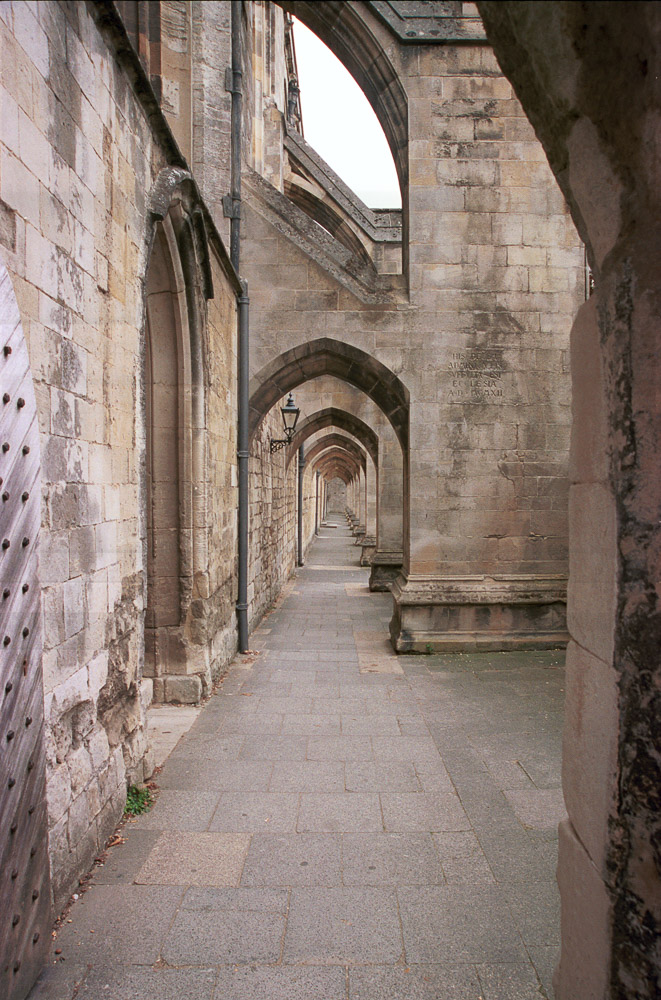
    Gothic cathedral repeating forms© Ed Schlotzhauer

    How to achieve it

    Flow is generally something that happens when we are completely immersed in a task that engages and energizes us. It seldom works to say “I’m going to go get into a flow state.”

    As an example, some of the researchers studying the theory studied jazz guitarists. They instrumented them and recorded their brain activity during improvisation sessions. At a high level summary, less experienced musicians had to concentrate hard on what they were doing and did not enter flow states. Experienced musicians tended to go into “automatic”. They concentrated on the sensory aspects of playing the guitar and little time thinking about what to do or how to improvise. They had a low level of DMN and ECN activity. This seems to support the expertise theory.

    That’s a lot of theory, but it doesn’t say much about how to achieve flow. You have to be expert in the task you are doing, and you have to have a extensive base of practice. Putting yourself in an environment where you are not distracted or interrupted helps, at least until the flow really kicks in. And being the type of person who is curious and self-driven and intuitive with a good ability to concentrate certainly seems to help a lot.

    Does it relate to art?

    I believe it is as common and valuable for artists as for jazz musicians or software engineers.

    Let’s re-examine the qualities I mentioned above for who gets into flow. Aren’t artists generally curious and self-driven and intuitive and with a good ability to concentrate? Don’t we have an intense desire, even need, to create? Aren’t we independent and self-reliant?

    We are prime to be able to find flows! The other missing piece is expertise and practice.

    This is one reason I recommend that we need to study to become expert in our craft. Using our tools should be fluid and natural. Exposure and depth of field and shutter speed and mechanics of using our camera should be automatic. This frees up our conscious attention for exploring composition and framing and expressing out feelings.

    And practice, practice, practice. Shoot frequently, daily if possible. Shoot something, anything. It’s OK to throw them away. The practice is worth is. All that practice is building the equivalent of muscle memory. Your fingers just know how to make the adjustments. Can you take out your camera in complete darkness and turn it on and set it up? Practice.

    When you go out to shoot, immerse yourself in the experience. Concentrate fully on what you are doing. Let the rest of the world fade away. If you are lucky, you will find afterwards that you were in flow. Whether or not you were, do your work. Plunge yourself into your art.

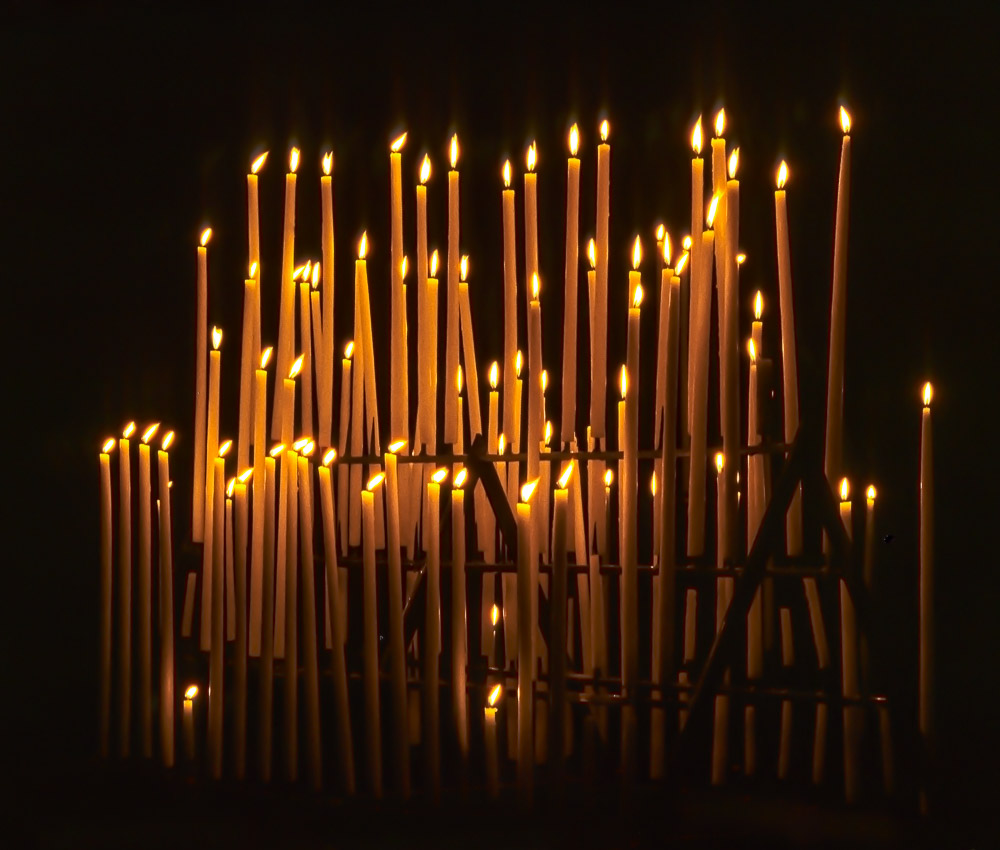
    Candles in a church© Ed Schlotzhauer
    Chartres Cathedral

    It is a positive experience

    I have experienced it, many times. As a software developer, I experienced this strange and exciting feeling regularly, long before I ever heard the term. Sometimes I would realize that hours have vanished and I forgot to eat lunch. And the productivity of what I did in those sessions was astounding. It was great to finally hear it described and find out I wasn’t crazy.

    As an artist it seems to happen different. I seldom work a scene for hours, although I may spend hours in a post processing session. But I may spend significant time wandering and looking and being immersed in the thought process. I believe this is a kind of flow. It seems to have the same result, where creativity flows easily and effortlessly. And it can produce a set of images that are above the norm of what I would expect.

    Even writing articles like this can achieve a flow state. I sometimes open a blog intending to make a few notes and jot down some thoughts I had, and realize a few hours later that I have nearly crafted a complete article. And I sometimes read through it and think “wow, did I write that?” 🙂

    A result

    Being in a flow is joyful. It is a happy state. But it is a result, not the goal. A flow state indicates that we have become completely immersed in a task that engages and energizes us. One that we are expert in and practiced enough in that we can sort of let go and let it happen. Kind of like those jazz guitarists they studied doing improvisations. It is not easy, it requires major commitment. But it is worth it.

    So study your craft. Gain deep knowledge and experience. Be familiar with ideas from other artists. Practice constantly (10,000 hour rule?). These will make you a better and more creative artist.

    Maybe, someday, you will look back on a block of creative energy you have just spent and think, that was probably a flow state. It feels great. Enjoy! Remember, Csikszentmihalyi discovered the idea of flow because he was researching happiness.

    Note

    I found 2 different rationale for calling it “flow”. One was that in Csikszentmihalyi’s interviews it was common for people to describe what was happening as “their work simply flowed out of them without much effort.” Another description says people sometimes described it as like being in a river flow. They were swept along with little effort.

    Decide what to call it when you experience it yourself.

  • It Looks Like a Painting

    It Looks Like a Painting

    This comment used to make me angry. But I have now rationalized that most people mean it as a compliment. If it looks like a painting then it must be art.

    Is painting the standard?

    For most people, painting means art. It is what they were taught. Photographs are those low value things they do on their phone. They’re mostly for memories and bragging rights on social media.

    I believe most people view painting as “high art”. Like they might view classical music. After all, both are remote and fairly difficult to understand. Removed from their daily lives. High art is something they have been taught that they should value, but they seldom partake of it.

    And paintings are viewed as difficult, labor intensive works requiring lots of training and “suffering”. That instills them with high value in many people’s estimation. It is not unusual for painters to encourage an aura of this being something so great and high that we cannot understand it. We viewers are lucky the artist will share a glimpse of such truth with us.

    And on a practical note, a painting is one of a kind. The artist paints one original. This increases the value of the work in some markets.

    Some people, looking at one of my images, describe it as “painterly”. To them, this is a compliment. Even photo reviewers occasionally use the term. Internally, I usually cringe, unless it was actually my goal to look like a painting.

    So for my peace of mind I have decided to accept “it looks like a painting” as a sincere compliment. It may be alien to my goals and values as a photographer, but is probably the best way a lot of people know of to say “it is art”.

    What does a painting look like?

    I will consider that a “painting” is some type of color medium applied to a substrate like paper or canvas by hand. I will stretch the definition to include pouring or throwing paint. Typical color mediums are oil, acrylic, watercolor, or pastel.

    The “by hand” seems to be important. Until print reproductions are made, all paintings are originals. Many people consider a “mechanically created” print inferior to a painting because it was too easy to make.

    Brushes are most often used to apply the color. Although they come in a wide range of sizes, and it is possible to create very detailed paintings, generally paintings are a somewhat coarse expression of a scene. That expression is considered part of the artistry.

    This is what people think of as a painting. It is an Albert Bierstadt painting titled “Rocky Mountain Landscape”. As someone who lives in the Rockies, I can attest this is purely fictional:

    Albert Bierstadt painting, 1870From the White House Collection. Image from Google Art Project

    An artist typically paints a scene they can observe (or make up). This means the scene is fairly static. Unless, of course, they take a picture of it and paint from a photographic print. Is that allowed? Does that make the painting something else? 🙂

    So paintings are generally relatively large, static scenes, less detailed than a photograph, and created by hand.

    Do I want my image to look like a painting?

    Do I want my image to look like a painting? Great question. Sometimes yes. Usually no.

    This is a fairly typical image I do that screams PHOTORGRAPH. It could be painted, but then that would be a painter trying to make his work look like a photograph. 🙂

    Classic B&W photograph.© Ed Schlotzhauer

    Why would I want an image to look like a painting? I do occasionally enjoy creating abstract images. Sometimes they work best done as a dreamy, blurry, hand drawn look. I love that photography can achieve a wide variety of effects. I enjoy pushing the boundary and creating an unexpected look.

    But in these cases, I have chosen to create the image with this look. My goal was not to “make it look like a painting”. Sometimes an image tells me what it wants to look like. Sometimes what it wants to look like is what most people consider “painterly”. If that is what is right for the image, then OK.

    Don’t feel inferior

    I think photography is an amazing art form. Its versatility is unsurpassed. Being technology based allows it to operate somewhat outside the limits of the artist’s mind. We can explore time and scale and space and even non-visual realms in ways that other artistic mediums can only copy.

    With photography, we can make one print and stop or we can make 1000 prints. We can re-scale a file to make a print very small to fit into a locket or up to wall-sized for a gallery or to decorate a large room. Or even billboards or the sides of buildings.

    Never let the intelligentsia convince you you are somehow inferior to painters or other “real” arts. They are just trying to protect their self interests. Photography is as real as any art. Be proud of your art.

    So when someone tells you your image looks like a painting, be gracious. Don’t launch into a lecture about why they are wrong and how they do not understand. This would be rude and even insulting. Accept it as a compliment. They are using terms they know to tell you they like your work and consider it good art. Be happy. But also be confident that it does not have to look like a painting to be great art.

    Today’s featured image

    The image at the top would be considered “painterly” by many people. Did I want it to look like a painting? No. I was exploring possibilities of long shutter speeds with flowing water and reflections in a river. I knew from experience that I could often get abstract results I like. This is an example.

    I like it. It is abstract, and it flows and has a lot of subtle details of interest. Does it look like a painting? That is for you to decide. If you think that, great. But it is not a label I try for when I am creating. I would not market my work as “looks like a painting”.

  • What You Find

    What You Find

    This is heresy, but I recommend most of the time we work with what we find rather than planning extensively and expecting everything to be “perfect”.

    Planning

    It is common these days for photographers to research locations is detail before ever going into the field. And there are lots of tools to help us do it.

    For any given location we can find what time of the year is “optimum”, what time of day is best, even where to stand for the best view. We can research the weather we should be able to expect, the temperature, exactly when sunrise or sunset is if that is important to the shot.

    Then, of course, we can work back to where to stay, what time to get up, where the beat eating places are, etc.

    Basically, then, we can just show up at the right time, set up and take the shot we want, and leave.

    Trophies

    A well planned shot like that can lead to some excellent pictures. If you are a National Geographic photographer out on a 6 month assignment to get a certain picture, that is a great approach.

    I have 2 problems with it

    1. It is collecting trophies.
    2. What about the experience?

    Much of photography these days seems to revolve around collecting trophies. We have to get that signature picture of Half Dome or the Eiffel Tower to post on social media to impress our peers.

    That’s not me. I usually avoid places where dozens of other photographers are lined up shoulder to shoulder, fighting for tripod placements. Those sights are well covered. I do not plan to contribute yet another photo of Half Dome to the world, unless I am able to capture something unique. That is less and less likely when millions of shots are taken of it every year by good photographers.

    I fully realize this is a personal value. It also is rooted in my personality type. I derive satisfaction from creating fresh, creative images that represent my vision. Whether or not anyone else likes them. Some other people need to bag trophies. Checking off the bucket list items is more important than actually having the image.

    It would be foolish for me to criticize them. We are different. I do not agree with them, but I recognize that this behavior is true for many people. You have to do what is right for you.

    What you find

    Taking a good photograph is an emotional encounter for me. Talking about the experience you get is subtle and harder to describe. It is intensely personal.

    If you are the meticulous planner I described earlier and you show up at your target location, what happens if things go wrong? What if the weather is too stormy to get out? Perhaps there are forest fires around and it is closed or obscured by smoke. Maybe a road is slowed down by construction and you get to the location “too late” for the planned shot.

    If things like this happen and you can’t get the shot you planned, is it a failure? Are you disappointed with the outing? Was it a wasted trip?

    I’m not usually so disappointed. I am there to see, feel, internalize – and, oh by the way, make images I am proud of. A sunny day may not inherently be better than a rainy day. Why is a snow storm worse than a warm summer day? It all depends on my reaction and attitude and what I am able to do with what I find.

    How good are you?

    I believe the attitude of accepting what we find and using our skill to work with it is healthy and mature. We cannot control what we will encounter. But we can control our attitude.

    So whether I am at the Eiffel Tower or in my neighborhood, I try to make excellent images in whatever conditions I find. OK, allow 2 seconds feeling sorry for yourself, then put it out of your mind, enjoy yourself, and attack the photo problem.

    For example, recently I went out locally to shoot some pictures of trees. A favorite subject of mine. But it turned into an extremely windy day. Did that make it a waste? No. Have you ever tried to shoot pictures of the wind? It was challenging and interesting after I reframed the problem. I enjoyed it and I like some of the images.

    Making good pictures in unexpected conditions is a test of our craft and our character. Loosen your rigid expectations. Roll with the punches. Make lemonade out of lemons. Insert your own cliche.

    But cliche or not, try it. Be flexible. It surprises me that unexpected pictures in bad conditions are sometimes the most memorable to me.

    Today’s image

    This wasn’t taken on the windy day I described. But it was a much worse day. It was in the Garden of the Gods in Colorado Springs, CO. It is not the conditions I came for, but it was what I found. HIgh wind funneling through the rock formations, blowing snow starting to pile up, bitter cold in Colorado in the winter. Sounds like a great day to be out.

    Actually, after I kicked myself out into it and started seeing images, it was great. It turned out to be a very enjoyable experience. I went crazy shooting, when I could keep the snow cleared off my lens. Of course, it took a while later for my hands to thaw out and I was soaking wet and shivering. But I did not notice that very much at the time. All in all, I look back on it as a good time. And I like the image.

  • Diffraction

    Diffraction

    Today I would like to try to help us understand a little about what diffraction is. Not getting too deep in the theory. Just enough to demystify it a bit.

    Scary

    Diffraction is probably a scary word to most of us. Even if we don’t know what it really means, we have heard of it and have been taught that it is a “bad thing”.

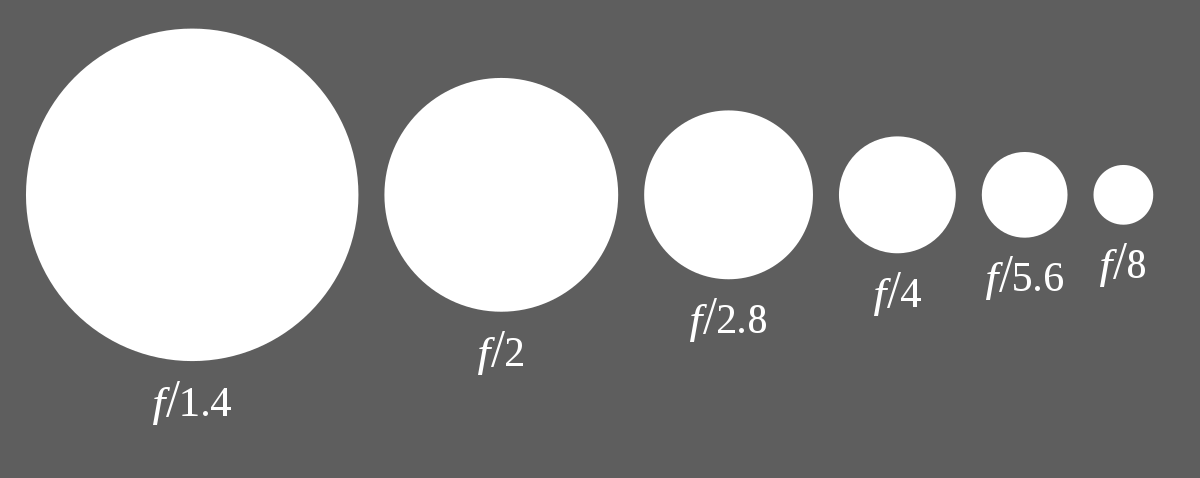
    Have you been taught to avoid using apertures smaller than f/11? Note that when I say a “small” aperture I am referring to the physical size. Remember that as the aperture numbers get bigger the actual opening in the lens gets smaller. This simple graphic illustrates that:

    Progression of physical f-stop sizes

    The lore is that very small apertures (large f-numbers, like f/22) make an image too blurry to be useful. Don’t believe everything you hear without testing it.

    Light theory

    I’m going very light on theory (yes, pun intended). We’re just going to graze the surface without taking a deep dive in. (Here is a source to start at if you want to go deeper. Abandon all hope ye who enter…)

    Light behaves as waves (most of the time). Actually, a number of things are waves: light, water waves, sound waves, gravity waves. Quantum mechanics theorizes that even matter is waves. Too deep for me.

    We tend to visualize light going through our lens as rays. That is, straight lines. Yes and no. That is one useful model of looking at it. But light also behaves as waves. An interesting and important property of waves is that every point on a wave is a wave. So if the wave is blocked by a small opening, the wave spreads on the other side of the opening.

    This picture by Verbcatcher does a marvelous job of illustrating that for waves in water:

    Diffraction in water waves

    See how the waves spread after going through the small opening to the sea? The smaller the opening (aperture) the more pronounced the effect. That is, a small aperture opening causes waves to spread out more.

    What does it really mean

    This is the basis of the recommendation to use physically large apertures (small f-numbers). Apertures that are large relative to the wavelengths of light do not cause much “bend” of the waves. Small apertures (large f-numbers) “bend” the light more.

    What we can actually see in practice is that using small apertures causes our images to have a mildly “fuzzy” look. Because the waves spread more after going through a small aperture, the individual waves cover a larger pixel area. This slight spreading of the light causes the image to appear less sharp.

    The best discussion of diffraction for photographers I have found is from this article by Spencer Cox. But even this gets too deep into theory.

    I borrowed this image from it to illustrate the practical effects of diffraction as we change aperture:

    Effects of diffraction with aperture

    See how the larger apertures (small f-numbers) are sharper than the smaller ones?

    This illustration below, also from Spencer Cox) gives a great conceptual representation of what is happening. Take that the grid represents pixels in your sensor. At f/4, the point of light only strikes one pixel. It will be seen as very sharp. But at small apertures, the waves spread some onto adjacent pixels and create a kind of fog.

    Should you fear it?

    Should you fear it and always shun small apertures? No, it is just a reality of physics. It is no more to be feared than gravity. As one of my sons would say, it is what it is. Be aware of what is going to happen and consciously decide how far you need to go.

    All of the exposure determinations we make daily are tradeoffs. How much to stop motion? How much depth of field do we need? Is there enough light for a good exposure? What ISO setting should I use? All of these things and more have to be balanced in the moment of shooting, besides composition and esthetic issues.

    Each setting costs something. As experienced photographers we must understand the tradeoffs and be able to judge what is right for us at the moment.

    Diffraction is one of those tradeoffs. Know what it is going to do and how to use it or avoid it.

    Sometimes you need more

    But why would we ever intentionally make our image less sharp? We seldom actually choose to make it less sharp, but sometimes we need other things. I can give 2 easy examples.

    The first and most common one is to increase depth of field (DOF). It is counter intuitive, but making the aperture smaller increases the perceived depth of field. So on the one hand we are making the image less sharp, but on the other hand we are making it appear sharper throughout. When we need to make a certain range of the field of view acceptably sharp we stop down the aperture until we achieve our goal. A tradeoff.

    Depth of field with small aperture© Ed Schlotzhauer

    The second case that comes to mind is to reduce the shutter speed. I often intentionally shoot motion blur. But I usually forget to bring a neutral density filter for the lens I am using at the time. I can generally achieve the effect I want by using my polarizer, reducing the ISO to the lowest setting, and cranking the aperture down to the smallest possible one. This will probably give me a shutter speed in the range I want to use. Yes, the small aperture increases diffraction and makes the image less sharp. But it is handheld at a long shutter speed. It is already intentionally blurred.

    Intentional blurring based on small aperture.© Ed Schlotzhauer

    But maybe more importantly, in a great video on Lumminous Landscape, Charles Cramer said “sharpness is something we have to get over.” He explained that if we take a picture just because it is sharp, it probably won’t be very interesting. We have to forget about how sharp is it and instead react to the scene before us on an emotional level.

    Shoot the picture

    Diffraction is a side effect of physics and our photographic technology. Don’t be afraid of it. Don’t blindly follow some rule you learned in the past about what you can or can’t do. Understand enough about it to recognize it and know how to use it to your advantage.

    Look at the image above of the woman’s face. Even at f/32 – an extreme case – it is acceptable. Extra sharpening can be applied in your editing tool to compensate for it.

    So diffraction is just there. Allow it to happen if that is the tradeoff you need to make. Just like using a high ISO adds noise, that is acceptable most of the time and better than missing the shot.

    I know many of us don’t want to deal with what we perceive as increased complexity or too much technical detail. We just want to go take great pictures. My hope is that topics like this will actually make your photography life simpler by providing some grounding for information you may have heard in the past. Rather than trying to remember rules for how to use your equipment, you now have a model for what diffraction is doing and how strong its effect is. I hope you will be able to stop fearing it and accept it is just part of the tradeoffs of the technology.

    Today’s image

    This is a great old WWII era truck I found in my town. It is a Coleman. This was actually a Colorado company. It was designed and manufactured in the Denver area.

    I needed enough depth of field to span from the great rust and paint patterns on the near outside through most of the cab. So it is shot at f/22. Diffraction? Works for me.

    What do you think?