An artists journey

Category: Creative Ideas

Ideas about creativity and the creative process.

  • Creativity is a Process

    Creativity is a Process

    Is creativity something that just happens when the “muse” takes you over and directs you? I want to challenge that. I believe creativity is a process that we can follow almost anytime, not just when we are “inspired”. I hope this will seem inspiring, because it means we can create great work any time we decide to.

    The myth of the muse

    Ah, if only the inspiration would come! I guess I will sit and drink wine and read poetry while I wait for the muse to visit. That sounds like a pleasant way to spend a rainy day, but not a way to create art.

    The concept of muses comes from Greek and Roman mythology. They were 9 goddesses who controlled the arts and sciences and inspired artists. It is amazing how the concept has stuck. The idea of muses makes a good metaphor. We all know that our creativity seems to increase or decrease at unpredictable times. None of us understand the reasons why. But I will not believe my life and psyche is at the whim of Greek goddesses.

    I don’t feel like it

    If you believe some external influence controls you then it is easy to say “I’m not feeling it today, so I’m not going to do any art.” Maybe you can do that. I can only behave that way for very short periods of time.

    My art is something I have to do. Not doing it is worse than feeling like I am not inspired. I would make “bad” art rather than no art at all. I don’t have to show it to anybody.

    I find that when I assign myself a project to focus my creativity or just pick up my camera and get outside looking around I start to feel and see possibilities. Something magical happens to me when I hear the shutter click that first time. Now I am drawn into creative mode. My camera, like many new ones, has a fully silent mode. I don’t use it. I want to hear that shutter slap. It activates decades of muscle memory and discipline. I have made an image. Now I can go on.

    Hard work

    The bad news (for some of us) is that art is hard work. We cannot always sit around waiting for “inspiration”. We have to make our own inspiration.

    Inspiration is for amateurs. Us professionals just go to work in the morning.” – Chuck Close

    Hard work will outperform talent any day of the week.” – Joel Grimes

    Motivation exists, but it has to find you working.” – Pablo Picasso

    A professional is someone who can do his best work when he doesn’t feel like it.” – Alistair Cooke

    Sorry for the blizzard of quotes, but I find encouragement in the experience of others who have been there before. I could have found a lot more quotes on the subject.

    So, if you just dabble in art and it is not a driving passion, it is OK to wait for inspiration. But if you are serious about your art you have to just do it. Create your own inspiration. Work. Push on. Get moving to get the juices flowing.

    The process

    I said creativity is a process. What is the process? As Fast Company magazine said: “stop your whining and sit your ass in the chair.” Sorry to be crude, but it is true. They were referring to book authors, but the same principle applies to other creative efforts.

    It doesn’t do much good to complain about lack of inspiration. Do something. Taking positive action will lead to the work flowing. Eventually. It is hard at first, but it is a learned process. “Professional” creatives, like screen writers, copywriters, commercial artists, illustrators, wedding photographers – people who must deliver work to clients on a schedule – just have to get it done. Whether or not they feel like it. The rest of us can, too.

    Assign yourself a deadline. Define a project and a timetable. Go out and say you won’t come in until you have shot a certain number of images. Re-evaluate and re-organize your portfolio. Take some action to get some momentum going. It will overcome the barriers in your mind and get ideas flowing. The work you do right then may not be great, but it will get you going.

    Projects focus us

    I have said that projects are a good way to get ourselves going when we don’t feel like it. Actually, I am coming to believe it is one of the best tools we have. What is a project and why does it work?

    A project as I describe it is shooting and editing a collection of images that center on a theme or subject. I believe it helps focus us to write an artist statement before starting the project. This collects our thoughts on the purpose of the project, its scope, its meaning, and what your interest or motivation is.

    Write something? You’ve got to be kidding! No, I’ve come to believe writing is just another part of the creative process. It is organizing a linear series of words to communicate rather than communicating solely visually. Both are forms of expressing our thoughts. Both, I believe, are complimentary creative processes.

    The artist statement does not have to be long, maybe 200-300 words. It will serve as the guide to focus us and give unity to the project. So be clear to yourself.

    Maybe I’m just weird, but putting the blinders on and restricting my thoughts to a project gives me a huge boost of creativity. Rather than my thoughts being diffuse and wandering all over the place, they are focused on one thing. My creativity and energy have something to work on. Throwing myself into coming up with diverse ways to express a single subject is a challenge and, actually, fun.

    Get going

    Whether you challenge yourself with projects, go to museums, read books, write, finger paint, whatever, do something. Do not fall into the trap of feeling depressed and uninspired and, therefore, not doing art. Get moving to get your mind working. Doing creative things breeds creativity.

    Let me know what you do to get your creativity going,
  • Boredom

    Boredom

    Boredom. We’ve all been there. We get in a funk. What we usually see and shoot is distasteful to us. We are discontented. Everything has been done, there is no creativity left. Do you ever feel like this?

    The time of year

    This article will be published in the depths of winter. Many of us don’t think there is anything interesting to see or shoot. After all, there are no flowers or green trees or lush fields.

    I would say, look again. Get out in it. Yes, out in the cold and snow if you have that. Or the rain and clouds. Whatever winter is in your area.

    Forget what you want to be shooting. Look with fresh eyes at what is there. You may discover a whole new world. In the words of an old song, “if you can’t be with the one you love, love the one you’re with.” While I do not recommend this as a way of managing your relationships, it can be very useful artistically.

    I actually love shooting in winter. Today I was out shooting in 70+mph winds and temperatures not much above freezing. Do I love being out in that kind of wind? Not at all. When you have to bundle up in layers of wind-tight clothes and hold your tripod to keep it from blowing over, it looses some of its charm. However, there were great opportunities out there. I have, by chance, been working on a project about wind. Today was a great opportunity to fill in some gaps in the image set.

    It happens to all creatives

    We all feel blocked, bored, empty at times. The “muse” is not around. We fear our best work is behind us and there is nothing to look forward to. Might as well give up.

    You are not alone. We all feel this sometimes. Like temperature and climate and relationships, our mental energy is cyclic. Sometimes the spark seems to be gone. It is a low time for us.

    Recognize that this is a natural part of life. Don’t be (too) discouraged. It will change. The creative energy will flood us again. Just give it time.

    Use it!

    But we don’t have to sit passively waiting for the creativity to return! Use this boredom to propel us to a new level.

    If we are bored perhaps we have plateaued on our current path. Maybe we aren’t reaching far enough. It is a great time to reexamine where we are and how we feel about our art. And actually do something about it.

    Boredom is frustrating to most of us. Use that! That is an energy and motivation. What are we lacking? Should we strike out in a new direction? What would we love to do if we had the opportunity?

    Like with our body, if something hurts, that is a sign that we need to take care of it. Taking care of it doesn’t necessarily mean we should rest it and take a “oh, you poor thing” attitude. Maybe we need to work it, eat right, exercise, build it up.

    The point is, the frustration of boredom can be a motivation to change our self or redirect ours thoughts or energy.

    Opportunity

    I have made some of the best discoveries of my life because I was bored. Really.

    Let me give an example. Way back, we owned a timeshare. For those who don’t know them, it is a vacation ownership scheme that was popular at one time. Don’t buy one. It’s not a good investment. The way it worked was, you “bought” a fraction of a property, say one week during the year. Typically your ownership time would be traded for a week at another property. Because of this, we got to visit beautiful places around the world. But a side effect was that we were “planted” at a single location for the week.

    This led to interesting trips. On one occasion I can think of, we were in a nice place way out in the country in Devon, England. Ten miles or more from the nearest town. It quickly got boring. As a result, we started exploring. Even though this wasn’t an area you would find featured on many tourist itineraries, the things we found were intensely interesting. We still cherish the memories.

    Because of the boredom, we were led to explore with our eyes and minds open. We had to forget the expectations that were not being met and become receptive to the wonderful things that were there. Repeating this experience many times completely changed my travel style. Therefore, now I want to settle in somewhere, get to know it, and have to find out what is there.

    Use boredom to your advantage

    So I encourage you to let boredom be motivating. With the right attitude it can free and empower us. It can lead us to opening our eyes to our surroundings, to learning new subjects or techniques, to re-evaluating our work and making improvements, to getting out and doing something about it. Or, you can sit on the couch and feel sorry for yourself. Your choice.

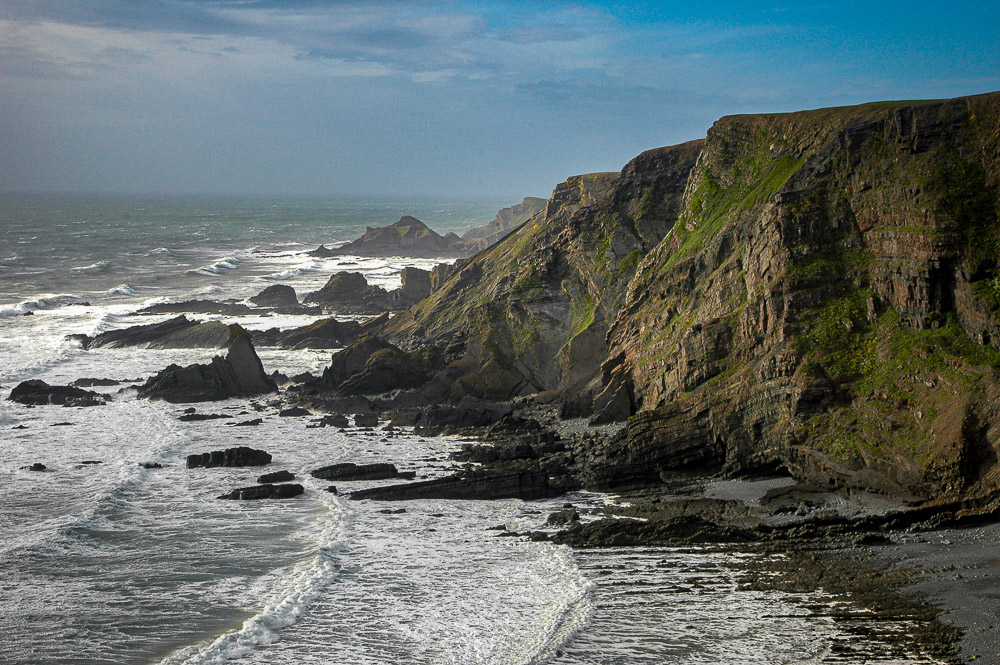
    The image with this article is one of many surprises we discovered on that “boring” trip to Devon I talked about above. It is a beautiful place with hidden gems all around.

  • Ostranenie

    Ostranenie

    Say what? It is probably a word you have never heard. Ostranenie (good luck on the pronunciation) is a Russian word that refers to “defamiliarizing” scenes so we can see them new. I think it has application to art.

    Definition/history

    The term was created by the Russian writer and critic Viktor Shklovsky in 1917. He was originally referring to poetry as opposed to normal writing. His point was that poetic language was intentionally different from our normal language by being more difficult to understand. By being formal and different, it gives us a different perspective on the world.

    The concept was fairly influential in Europe for a time, known as Russian Formalism. It was picked up in various forms by other writers and playwrights. Even Freud referenced it in his notion of the uncanny.

    How it works

    The Russian Formalists maintained that habit is the enemy of art. Therefore the artist must force the reader (in their case) outside of their normal state of perception.

    The problem with this is that it ends up relying on shock value. But shock wears off and becomes a norm. Then it becomes a degenerate spiral because things have to become more and more extreme to provide shock. Just look at most Amazon Prime or Netflix productions.

    Displacement, alternate reality, removal of what is known – these can become pretty heavy-handed psychological manipulations.

    Application

    A slightly softer definition is “Defamiliarization or ostranenie is the artistic technique of presenting to audiences common things in an unfamiliar or strange way so they could gain new perspectives and see the world differently.” This is actionable and a reasonable artistic device.

    It is easy to see in literature. Science Fiction sets things in a different time or place or it creates environments that do not exist in our world. This lets them make observations about us from the outside. Fairy tales give us great insights on the real world by creating fictional situations. Plays, movies, and poems all do it to some extent.

    How about the visual arts? One artist I see doing this is Brooke Shaden. She creates dark and mysterious scenes to ask questions about our situation. I don’t necessarily resonate with her work, but I respect her artistic technique a lot. And she is a very good instructor. Catch some of her classes on Creative Live.

    Even a simple thing like very long exposures can be a form of this, because it changes what you normally see into something different. My friend Cole Thompson does this well. He sometimes uses long exposures to drastically change what you expect to see in the scene.

    As an unlikely example, black & white photography is kind of this. By removing all color from images our perception is dramatically changed. It is familiar, but unfamiliar. It is definitely a new perspective on the world.

    Personal

    In my own timid way, I like to do this sometimes. Black and white is one example. I am a closet B&W artist. I love it, even though most of my work is dramatically colorful. One of the things I love is its ability to present a new viewpoint on the familiar.

    Time exposures are another common process for me. I like its ability to change our perception of what is happening by shifting the time reference.

    Intentionally distorting a scene to change the way we see it is another technique I like. The image with this article is an example. This is a straight shot, no Photoshop magic. One day I was having lunch in a favorite restaurant a couple of blocks from my studio. I noticed that some of the old windows in this 100+ year old train station were very distorted. If I photographed through them at a certain angle it enhanced the distortion in desirable ways.

    This shot is a view of my downtown. The distortion reduces it to shapes and color while adding an intriguing texture. I like it. Luckily, the manager is a friend and didn’t mind me exploring to my heart’s content.

  • Is It Interesting, Part 2

    Is It Interesting, Part 2

    In the first part of this I made a point I learned from a book on poetry, that if it isn’t interesting, no one will read it. It doesn’t matter how formally structured or well composed it is. More and more I am coming to believe this is true for most art, too. But how do we get from boring to interesting?

    Familiarity

    It is conventional wisdom that you do your best work in an area you are familiar with. I sort of believe this, but I violate it all the time. Being an explorer nature I get a lot of energy out of photographing in new areas. Things seem fresh and waiting to be discovered. I get really psyched in interesting new places.

    I am getting enough experience to see the other side, too. Yes, having familiar places can help us to make more interesting images. We learn the range of possibilities. We see the variations with seasons and weather and light. Familiar subjects give us an opportunity to pick and choose. To wait for the best conditions without having to feel rushed because this is the only time we will see this location.

    Once we become well acquainted with an area we can develop a more sophisticated view of it. We won’t waste our time on shots that have little hope of being good. This is a progression to shooting more interesting images.

    I do not feel this is an absolute. That is, it is incorrect to take it to the extreme and sat you will only get interesting images of areas you are familiar with. But I do agree that familiarity probably makes it easier.

    Recording

    Most of us have a progression we go through. We start out making record shots of places we visit. Of the billions of photos taken every day most are record shots or selfies. Have you ever gotten stuck being forced to watch 2000 pictures of someone’s trip to Disney World? Just shoot me.

    I call this taking pictures “of” something. We are recording the superficial. We have not formed a refined artistic opinion of the subject. This is still operating at the “oooh, pretty; I will take a picture of it” level.

    If you follow this blog you probably do a much better job than average. Our record shots can be well composed and exposed. They are decent images. But mostly they are there to record an event that will trigger a memory for us. That doesn’t make them very interesting to other people.

    I’m not being critical, really. We all react this way when we see a new thing that captures our interest.

    Interpreting

    After we get over the initial excitement of a great new location, we can start to examine what we are being drawn to. We become more aware of our feelings and perceptions. Now we can peel back some of the superficial and uncover deeper aspects of the subject.

    I call this taking pictures “about” something. It reveals to our viewers a new side of the subject or our emotional reaction to it. We are giving an interpretation of what we see. These images are probably more appealing than simple record shots.

    Being intimately familiar with a location or a subject does make this easier. Take trees as an example. I have aspen trees where I live. If I didn’t know them well, the first time I saw them I would get a “wow, an aspen tree” shot. After having seen thousands of them in all conditions I have a much more focused appreciation of them. There are far fewer situations where I will capture an image, because I look for certain compositions that appeal to me.

    Hopefully I now make images about aspens, not just of them. Because I appreciate them more, I shoot them more selectively.

    Saying something

    At this point, we have figured out what attracts us about the subject. We have refined our emotional attraction to the subject to the point we know what we want to represent to viewers. Now we can bring our creativity in to allow us to synthesize an interesting image based on our vision. This is above and beyond just our emotional reaction.

    To continue the aspen example, it is the difference between “I like aspen trees because” and “here is a fresh and interesting image; it happens to be of an aspen”.

    Unfortunately, I have to give up the description of what makes an interesting image. I don’t have the knowledge or the vocabulary to be able to quantify it. Actually, I don’t think it is possible to do it.

    Thousands of tutorials and books are out there to teach us how to become better photographers. They can help boost us from the taking pictures “of” to taking pictures “about”. We can study vast amounts of description about composition and gestalt psychology and eye movement and contrast and lighting and color harmony and art history and … All of this is extremely valuable and should be studied.

    I don’t think it is possible for any of the training to give us the secret of making an interesting image. It is too complex and subjective and personal. I sincerely hope it cannot be quantified. If it is ever reduced to a formula then there will be no room left for artistic vision.

    Vision

    At the end, artistic vision is the secret ingredient that creates interesting images. You develop it through your training and experience and self examination. It is unique to an individual. No two of us will have the exact same vision.

    People may not like your vision. It may not be popular – remember, van Gogh never sold a painting in his lifetime. But what emerges is your vision. Embrace it and develop it. Use it to make unique and wonderful images.

    Familiarity with an area or a subject probably helps speed the process. I do not believe it is a requirement. If it were, it would be foolish for me to go to any new locations to try to make images. I do not believe that. Once we have developed our artistic vision I believe we can quickly apply it it new situations.

    Example

    Since I do not know how to describe the details of what happens, I will give some examples. I love the Trail Ridge Road area in Rocky Mountain National Park. I am a frequent visitor there. It resonates with me and I have refined my view of it a lot over the years.

    I give 3 examples here of that progression. The first was taken many years ago. It is a picture “of” Trail Ridge Road.

    Image “of” Trail Ridge Road

    This next image was shot years later. I have a much different feel for Trail Ridge Road. This captures much more of my emotional reaction to it. Notice that here the road is less visible and important than the setting.

    Image “about” Trail Ridge Road

    Finally, the image at the head of this article is a very recent interpretation. I feel I am getting down to the essence of Trail Ridge Road and, I hope, it is interesting also.

    The first time, I usually skim off the outer layer and end up with photographs that are fairly obvious. The second time, I have to look a little deeper. The images get more interesting. The third time it is even more challenging and on each subsequent occasion, the images should get stronger, but it takes more effort to get them.” – Michael Kenna

  • Time

    Time

    Time is common to all of us. We are all given the same amount of time each day. Most of us are not as aware of time flowing by as we are of the events we have scheduled at certain times. Rather than moaning about how busy we all are or talking about productivity, I would like to discuss time as a creative element.

    What is time?

    Time is the continued sequence of existence and events that occurs in an apparently irreversible succession from the past, through the present, into the future.” Deep, but it helps frame the problem.

    We all “know” what time is, but we would probably have a difficult time describing or defining it. Yet it is what we live in. It controls almost every aspect of our lives. We all experience it constantly. We can’t control it or buy or sell it or save it. It flows on by with no regard to our desires.

    It may be a cliche that we all have the same amount of time each day, but like most cliches, it is very true. We can’t control it, we just decide what we are going to do with it.

    Most art deals with moments

    Most art, and most photography, captures discrete moments in time. This is the conventional view of the world. It is what we think we see all the time. Don’t take it as me sounding critical of capturing moments. I do it all the time, too. It records an event or a place or a person at a certain moment, and that matches and triggers our memories.

    In a sense, it is our way of freezing and controlling time. As photographers we usually think in terms of the best shutter speed to use to stop the action, to minimize blur. This is the right thing to do for normal image captures. We, and our viewers, expect the moment to be recorded in sharp detail with no distractions like blurred movement.

    Photography is unique

    Photography is unique in it’s ability to represent time in varying ways. Time is one of the variables of the photographic process.

    If you are painting or sculpting you usually represent what you can see or imagine. We seem to see things still, not moving or traveling through time. And it is very hard to imagine what the movement of time looks like. We may be able to see the effects of years or centuries on something, but even then it is impossible to visualize what it looks like as it is happening.

    But photography has time built in as one of the parameters being controlled. We balance aperture, shutter speed, and sensitivity (ISO) to determine an exposure. Think about that for a moment: we can adjust aperture and sensitivity to set the time window of an image to whatever we want. Within limits.

    Yes, we usually use this to set the shutter speed fast enough to freeze the motion. But that is just the normal convention. We could just as well make the shutter speed very long to observe motion over time. Some photographers do this regularly to feather moving water. It is almost a convention of landscape images, sadly.

    I know my friend Cole Thompson gravitates to very long exposures to give a different view of the world. Many of his images create very interesting effects.

    Movement

    I have recently found myself drawn to visualizing the passage of tiime.. More and more I tend to use relatively long exposures, often hand holding the camera, to examine the effects of movement over time. Some of my images done this way do not have a single sharp edge in them.

    This may seem controversial to many photographers. We are trained to maximize sharpness. We buy very high resolution sensors and ultra sharp lenses to record the sharpest detail possible. But I use those great sensors and sharp lenses to record – blur. A waste? That is an artistic judgment.

    One of the things I am trying to capture is the unseen way things move over time. We know they move. We can point to it and say “that is moving”. But it is nearly impossible to visualize what it really looks like as it moves. That is what I am exploring.

    The image with this article sort of illustrated this idea. This is an event called Cowboy Mounted Shooting. It is a speed and shooting event at some of our local rodeos. I believe the blur and slow shutter speed capture the speed and dramatic action of the event better than a crisp, frozen frame. The sharpest focus is on the face of the horse. That seemed appropriate to me because one of the things I wondered about is how the horse felt about guns going off over his head.

    A new viewpoint

    This concept is a new viewpoint for me. Time exposures are certainly not new and I have done a lot of them over my career. Now, though, I am more consciously using time as a creative element. Instead of a limitation of low light I now see it an an opportunity to show a new view on the world. I am working on a series that emphasizes this. Maybe more on that later.

    Time is too much of a subject to cover in depth in a blog post. It is a theme I will probably return to in the future.