An artists journey

Category: Creative Ideas

Ideas about creativity and the creative process.

  • Labels

    Labels

    We use labels as a short cut to knowing what to think about things. But when we do this without conscious knowledge of what we are doing we blind ourselves to a lot of the world around us. It is probably one of the causes of social, racial, class, sexual biases today. Once we assign a label to someone or something, we cease to see them for what they are. They become what our label stereotypes them as. As artists, we severely limit ourselves if we allow labels to get in the way of actually seeing things.

    Shortcut

    Labels serve a function. They help us quickly sort through the barrage of information we get every day. They also help make the world around us more predictable. When I recognize something as a phishing email or a spam call I can quickly deal with it without having to analyze it or waste time. I get dozens of emails a day, but I can quickly label most of them as useless or useful and dispose of them.

    We use labeling all the time as a prediction tool. I’m about to cross the street and a car is approaching the intersection. It is a fairly late model car and they seem to be obeying the law. I can mostly ignore them. They are not a threat.

    Likewise, I’m walking at night and another person is approaching. They look like they share the same labels I apply to myself, so they are probably “safe”. Does this imply some bias? Of course. That is one of the functions of labels.

    Self-fulling

    We can observe, and psychologists have researched and proven, that labels tend to become self-fulfilling. If a student is told he is smart, his effective IQ usually goes up. In the same way, if a student is told he is deficient, his IQ goes down. And teachers tend to treat them according to the labels.

    Labels set boundaries on the thing we are labeling. To us, it is only this. It cannot be more. When we correctly label unimportant things, it helps us be more efficient. I can get through my emails more quickly. I may occasionally mislabel one and miss something I would have wanted to see, but, oh well. Usually I am right. And it is faster.

    But labeling people is a dangerous thing. People are much harder to judge and the consequences of labeling them wrong can be high. People deserve to be given a lot more leeway in our “judgments”.

    The great old story about the founding of Stanford University after being rebuffed by Harvard is probably not true, but this one probably is:

    In July 1998, William Lindsay of Las Vegas said he contacted an unnamed Scottish institution of higher learning by telephone and told them he intended to give some money to a university in Scotland. Taking him for a crank, the person he spoke to rudely dismissed him. His next call to Glasgow University met with a warmer reception, and in March 2000 that school received a check for £1.2 million, enough to endow a professorship in Lindsay’s name.

    I’m sure you have your own story about labeling a person and then later finding you were very wrong. Did you feel a little ashamed?

    Danger for artists

    Setting aside the moral problems with labeling, as artists we are severely limiting ourselves when we trust labels to tell us about the things around us. We are putting blinders on ourselves. Labels prevent us from really looking at things and seeing them for what they are.

    As an artist, I need to be open and receptive. I need to be able to see things in fresh, creative ways. I can’t do that if I artificially put the things I am seeing into labeled boxes. Labels are fast and convenient, but I feel they get in my way of creativity. And they take away a lot of potential enjoyment we could get from seeing common things in new ways.

    Guy Tal brought out interesting points related to this in his insightful book “More That A Rock“. (I get no compensation for the link; I just point it out to you because it is useful) The title is based on a famous quote by the great photographer Edward Weston:

    This then: to photograph a rock, have it look like a rock, but be more than a rock.

    Mr. Tal goes on to say in the preface to the book:

    In the context of photography, therefore, representation is accomplished primarily through technology and skill, and a fortuitous convergence of “right” place and “right” time. Creativity requires something beyond objective qualities that are inherent in subject, tools, or circumstances – something subjective originating from the unique mind of the photographer that would not have existed had they not created it.

    To use Mr. Tal’s terminology, I am constantly trying to get past representation and find creativity. I believe this type of subjective creativity is difficult, if not impossible, if the thing we are considering is hidden behind labels. Unless we learn to overcome the tricks our minds play.

    Mindfulness

    This brings me around to a subject I keep coming back to more and more – mindfulness.

    To be a creative person ,we have to learn to manage our mind and attitude. We have to train ourselves to stay aware and attuned to interesting things around us. One big part of this is to consciously decide to see beyond labels.

    I don’t think there are any tricks or cheats. No shortcuts. We just have to be aware of being aware. Training and practice.

    Try this sometime. It will be weird at first. Take a block of time to practice mindfulness. Go out walking (or whatever) and keep asking yourself “What is this I am seeing? Have I ever seen anything just like this? How would I make an interesting picture of this?” And do it. Stop and make a picture. Even of silly things: reflections is a window. A chalk drawing on a sidewalk. A flower in someone’s yard. Set your expectations low. You are not doing this to get wonderful pictures. You are training yourself to see and consider more things.

    Give it an honest try a few times, then see if you are developing a new ability to see more and deeper. To see beyond labels. If not, write me. I would like to know why it is not working. And , even if it does work, feel free to write me and let me know what you discovered. I would like to share your experience. My email address is in the sidebar.

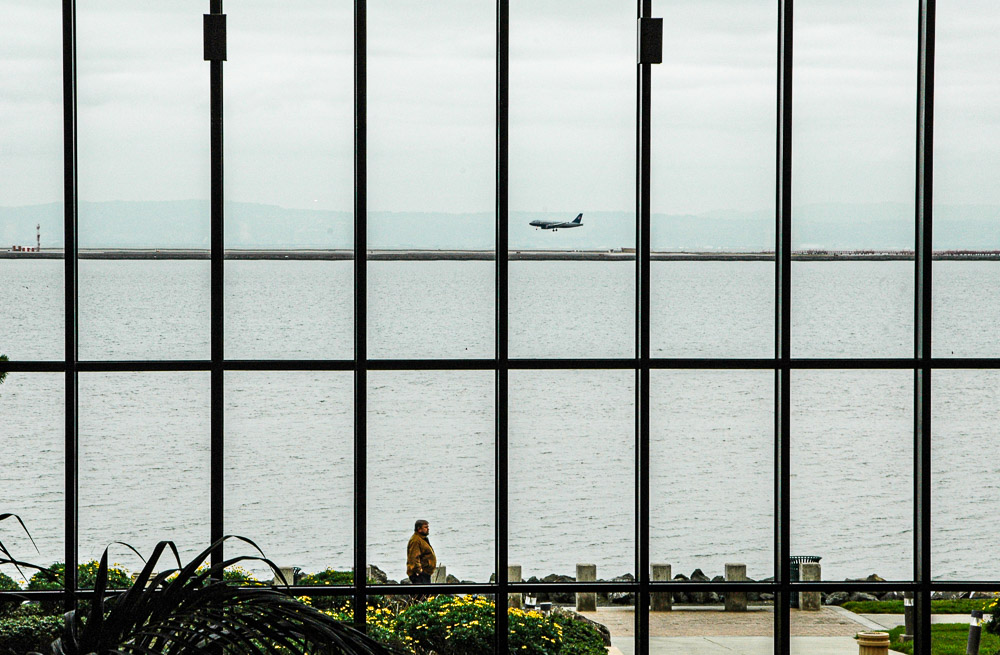
    The image with this article is one of these. I was having lunch near my studio and noticed the way the corner windows were creating abstract reflections. I stopped eating and shot some intriguing juxtaposed scenes. This is one actual image, just found by chance. And because I was looking.
  • I Don’t Know

    I Don’t Know

    How did it get to where we think we are supposed to know everything? Why is it wrong to say “I don’t know“? I think it would be horrible to believe I knew everything. Where would be the opportunity for discovery? To be able to let my curiosity run free? I am quick to tell anyone I don’t know, if I don’t.

    Fallacy of certainty

    Believing we have to know everything is a trap. It will doom us to failure and disappointment. I would say there are 3 general classes of knowledge:

    1. Our values.
    2. The things we interact with on a regular basis.
    3. Everything else “out there”.

    As a person you have to know your values. Those things you will not bend. At what point will you fight for what you believe? These are the bedrock principles we build our lives on.

    In the next circle, we all do our jobs and use a lot of technology every the day. We probably drive a car or use a computer for various tasks or bank or shop online. It is important to being able to function in society that we understand enough about these things to be able to use them. That doesn’t mean we have to have a deep understanding. I was an engineer in the technology/computer industry for a career, and I absolutely know I do not fully understand all aspects of everything I use. In most cases it is OK to just understand enough to efficiently get the task done and minimize surprises. Maybe just to know enough to know how to not be stupid.

    Then there is everything else. The world is so big and interconnected and complex that no one knows how or why most of it works. I don’t understand micro or macro economics, and I’m not sure anyone else does, either. NFTs still seems like a Ponzi scheme to me. I don’t understand why people become zombies when they enter politics. Why do bad things happen to good people? I don’t know and I will never figure it all out. Nor do I have to.

    No one knows even most of everything

    We listen to the talking heads on the news spouting meaningless information with full confidence. We know they are probably wrong, but they speak with authority. Therefore, we distrust ourselves. And after a while we realize they don’t know anything, either. When neither side of the debate or the “experts” can be trusted, we tend to check out, become cynical and angry. Don’t forget, though, that they have an off button.

    There is a saying called Sturgeon’s Law that says “90% of everything is crap”. I have my own corollary to that: Sturgeon was an optimist.

    If most of the information you get is bad, what do you do? Hopefully you start to trust yourself. Learn to research things that are important to you. Research means even listening to people whose opinions you don’t like. You can’t just listen to your favorite guru who says things you like to hear. Make your own decisions. Build enough knowledge to trust your instincts and decisions. Don’t believe anything you hear until you check it out.

    Curiosity

    Too much ranting about heavy stuff. Let’s talk about art!

    After a long time of working up to being an artist, I have concluded that I have to follow my curiosity and trust my instincts. Sounds simple, but it is sometimes hard.

    I have spent time at times doing things in a way that they would be accepted by other people. It wasn’t entirely wasted, but is seemed kind of phony, and it was. I realized I was making someone else’s art. I don’t do that now.

    But do we follow the fashion of the day? Do whatever we have to do to be accepted by the ones who style themselves as the opinion leaders? Who anointed them with this divine authority? They are just people with opinions.

    I find that most of my best work happens when my inspiration is to ask “what if?” or when I say “I have never seen this like this before”. And do something with it.

    Adventure

    Do you lead a boring, monotonous life? Or is every day a new adventure? Much of the choice is ours. It depends on our attitude.

    I believe that artists have the opportunity to lead lives of adventure and excitement and personal growth all the time. Even if we never leave our town.

    Adventure is exploring and finding new things that excite us. We don’t have to go to exotic locations to find that. Our point of view determines our adventure.

    Nearly every day I go walking in the areas around my studio. I always take my camera. It is covering the same ground. Occasionally I create a new route, but there are only so many variations. Sometimes I get bored with it. But I am coming to realize that when I am bored I am not letting my curiosity roam free. If my attitude is better I am likely to discover new things or appreciate something for the first time. The same with driving through Kansas. It can be a nice adventure.

    Artists are on a journey of discovery

    As artists, we should be explorers. Not discovering unknown lands, but finding new things about ourselves and the world we live in. These discoveries could be as close as our back yard.

    To do that, we need to be always asking questions: What is this? What else is it? Can I see it different? What if this was combined with that? What if …?

    At the root, all of these questions are based on the assumption that I don’t know – but I will explore it to see where I can take it. Not knowing is fundamental to being creative. When we don’t know, it should excite and inspire us.

    Forget about the rest of the world that is pressing in and telling us what we should see and believe. We are capable of deciding for our self. Being an artist means being comfortable with high levels of ambiguity. And the accompanying joy of finding new answers or showing the world something they have never seen.

    Be yourself. Trust yourself.

  • Changing the World

    Changing the World

    Is your work important if it’s not changing the world? I know many earnest artists believe this must be their goal. They are focused on their particular cause and it seems the center of the universe. Their work must be serious and significant and world changing.

    And sometimes it happens. A couple of Nick Ut’s and Eddie Adams’s photograph of the Vietnam war or some of Robert Capa’s images of the Spanish Civil War, among others, probably effected a lot of opinion. But these events happen once or a small number of times in a photographer’s lifetime. And they happened because the photographer was there in harm’s way and snapped a quick image of a poignant scene that materialized in front of him.

    Maybe setting this as our standard is an unrealistic goal for most of us, unless we are going to spend our lives in danger zones. It might even be self-defeating.

    Serious art

    You may have a cause that is very important to you. Seems like everyone does these days. It may be climate change or pollution or human trafficking or animal rescue or any of many other things. It is healthy to be trying to make positive change.

    But how does this affect your art? Should it?

    Here is a huge generalization I freely admit I cannot prove: when the cause becomes the center of focus, the art is secondary. This is just logic. If your primary goal is to promote your cause, the art will probably become photojournalism or even propaganda. I have seen things that grab me, but I have seldom also said, “and what great art”.

    Exceptions

    Every “rule” has exceptions. One that comes to mind is the great Paul Simon song Kodachrome. Did you know this was kind of a protest song done to try to stop Kodak from obsoleting Kodachrome film? It didn’t work, but it was an excellent song all on it’s own. It is still well known, long after Kodachrome is fading from memory.

    A famous painting that was intentionally done as a protest was Picasso’s Guernica. While it is almost unapproachable by me, it was influential and generated a lot of support for the Republicans in the Spanish Civil War. But, it was done by Picasso. He already had credibility and a huge following. If Bob Smith (sorry Bob) did it, would it have been so widely received?

    Another whole class of art was done to promote conservation. Great activists such as Ansel Adams and Galen Rowell, often working with organizations such as the Sierra Club, promoted conservation by showing beautiful pictures of wilderness areas. They were making art and serving a cause. It was and continues to be an excellent strategy: beautiful and uplifting art to show the benefits of advancing the cause. First, it was great art. Secondly, it furthered their cause.

    Create art that resonates

    I suggest, for those of us who haven’t reached the stature of a Picasso, that we first create great art. If we can capture beauty or reveal deep insights into the human condition or the world around us, that will attract attention. If we earn a forum to speak from, then we can tie our art in to a cause and try to persuade people. Produce things that attract people so they will listen to you.

    There is an old saying that “you can attract more flies with honey than with vinegar.” Leaving aside the question of why you would want to attract flies, you will build an audience by giving people things they are drawn to.

    Alexandra Klimas paints portraits of animals that are part of our food chain. They are warm and touching portraits and they make us think fresh about the animals. She says, “I am not an activist, I am an artist and I make art. Art should touch people and make them think. I don’t want to shock people. I am satisfied when people feel more connected to this group of ‘forgotten’ animals.” I think she has a great approach.

    Even if you are not promoting a cause, don’t you want people to resonate with your art? Not to say we should take a coldly commercial view and only produce what is popular at the moment. That is a sell-out. Shouldn’t we use our creativity to engage people, to draw them in, to make them ask questions?

    After all, it is supposed to be art. Go and make great art. It might help promote your cause. Or it might just make the world better. We need that more and more these days.

  • The Making of “Brush Off”

    The Making of “Brush Off”

    It was refreshing for me talking about making a piece of art instead of just discussing process or training. I will do it again. This time it is the making of the piece presented here. It is titled “Brush Off”. It is one of those abstract, “what is it?” pieces that I like to do.

    Context

    If you think this is something very exotic, sorry to disappoint you. As a matter of fact, it is something common and mundane.

    This is the brush going over the top of my car in an automatic car wash. Looking up through the sun roof. Like I said, mundane. Sorry.

    The point, though, is: even something as common as this can be interesting if you look at it the right way. That is a constant theme of my images.

    Technique

    It was not as easy as just pointing the camera up and shooting. If I did that, even scrunching down in the seat, the lens would be almost right against the sun roof glass. That doesn’t work.

    In order to get the glass in focus and sufficient field of view and depth of field to render the brush the way I wanted I had to get the camera a couple of feet away from the glass. After a couple of wasted sessions of trying to juggle a small tripod in place, I gave up on that and placed the camera on the console looking up. That was the solution. As long as I didn’t bump it.

    Unfortunately though, with the camera there I can’t see what is going on. I had to use the Nikon software on my phone to connect to the camera and control it. Again after trial and error I figured out that I had to put it in manual focus and stop transferring captured images to the phone.

    Even so, there is a noticeable lag between triggering a capture from the phone and it actually happening. Probably about 1/2 to 3/4 second. This took practice to get in the rhythm. I had to anticipate when things would be in place and try to lead the event correctly. Lots of trial and error. I ended up throwing a lot of frames away.

    Finishing

    After all that, I wish the image I saw on the computer screen had looked like I visualized. But no. This was a sunny day. There were lots of reflections on the sun roof glass, both from outside and inside. It was worse because I had to abandon my polarizer to get the shutter speed I needed. It was a balancing game to blur the brush just enough to add to the mystery and abstraction without making it just a smear.

    I did the initial exposure balance and crop in Lightroom, as usual. Then in Photoshop it required extensive selective color tonal manipulation to eliminate the reflections. Then there was more tonal corrections, dodge/burn, limited sharpening, etc.

    Mindfulness

    What I want to point out, though, is that the image is not mainly about technique. Behind the “how” is the “why”. I was curious and mindful even while in a car wash. I asked what it would look like looking up through the top during the wash. And I spent the effort to explore it.

    I’m glad I did. I like it. This is one of a series of images I did in the same car wash over many washes. It turned out to be a useful place to ask some “what if” questions and see what happened.

    I encourage you to follow your curiosity. Don’t be afraid of looking foolish. Don’t worry what anyone else thinks. It is your curiosity and vision.

  • The Making of “Nothing Is Quite What It Seems”

    The Making of “Nothing Is Quite What It Seems”

    Today I’m going to discuss the making of this image. I created this abstract image titled “Nothing Is Quite What It Seems” from disparate elements put together to achieve the surreal landscape effect I wanted.

    But as the title suggests, nothing is what it seems to be.

    Base, Idea

    When i saw the thing creating the basic silhouette shapes I knew it needed to be a scene of dead trees in a barren landscape. In reality, though, these shapes are actually cracks in ice on a frozen lake in Colorado.

    I framed the scene up to isolate these 2 cracks that looked the most to me like dead trees. The “brush” in the foreground is the near edge of the ice, looking through to some rocks close under the surface.

    The processing required some touch-up editing and some dodge and burn and contrast enhancement. There was a little hue-saturation enhancement to bring out more of the yellow rocks.

    All of this was done as a smart object in Photoshop. Because I wanted to keep my options open I use smart objects a lot. They give me the freedom to come back and continue editing later. I don’t like to commit permanent changes.

    Texture

    With the basic form set, I started building texture. Tone adjustments in the smart object of the base layer helped. Bringing up the contrast brought forward more of the texture of the ice. This is the dimples and spots all over the image.

    To abstract it a little more I used the oil paint filter in Photoshop to soften the edges and give it a more painterly and abstract look.

    Color treatment

    I knew I wanted to change the color palette and make it look like it could be in an abandoned homestead on the Colorado plains. But I also wanted to layer on more interesting texture. After trying many overlays I settled on a beautiful rusty truck panel. The image I used is part of a 1948 Coleman Truck. Pretty rare, and it was aging beautifully.

    The truck had large rust patterns and also areas of old yellow and green paint. Using this to establish the colors across the image worked for me. This truck overlay is also handled as a smart object. Careful blending achieved the look I wanted without it looking like a rusty truck.

    Finishing

    The final polishing and tweaking takes a lot of time, even though it doesn’t make sweeping changes. As we used to say in software development, the first 90% of the project takes 100% of the schedule. The last 10% takes the other 100% of the schedule.

    There was final dodging and burning to do, bits of masking and retouching. Of course, there was a little bit of final color tweaking to my satisfaction. One of the reasons I use a flexible workflow is that I am prone to tweak things after I have looked at them a while.

    Process

    A comment on my workflow. Although this is a fairly complex image, nothing is permanently locked down or committed. While writing this I was able to open up all the layers and smart objects and see everything about how they were processed. I could still go in and change or modify anything in the image. And I did make some tweaks. I told you I can’t leave images alone.

    And as a very experienced Photoshop user I know new tools will be developed and I will learn new ways of doing things. These will lead to new ways to process images that I will want to take advantage of in the future.

    This is the way I choose to work this way on most of my images. It doesn’t take longer and it preserves total flexibility. I need that. I change my mind often!

    Summary

    I like the finished image. It seems to be a surreal Colorado landscape of dead trees, but it contains no trees or plains or anything else that it appears to be. It is truly not quite what it seems. Is this more interesting than a straight shot of the ice?

    Lightroom and Photoshop are powerful and addictive tools. Know when to use them and know when to stop. Otherwise you may never stop. It’s a great time to be doing imaging.