An artists journey

Category: Artist

  • Thinking Black & White

    Thinking Black & White

    It seems to me I have been seeing and thinking in black & white more lately. Not seeing the world as black & white. Things are not that simple and clear cut. No, seeing the world as black and white images. That is the interpretation of reality I am leaning more to these days.

    Contribution of photography

    I believe black and white is one of the great contributions of photography to the art world. Yes, at the time it was a technical limitation rather than an artistic choice. The processes and chemistry of the late 19th century through mid 20th century could only create monochrome images.

    But the look stuck. It became associated with photography, with “reality” in image making. It helped establish photography as a distinct art form from painting.

    Because that is the medium they had, the practitioners of it became extremely proficient at creating beautiful, artistic images. A good artist learns how to use his tools. Some people say their achievements of the old masters of black & white photography have never been equaled. I’m not so sure. We can do a pretty good job today.

    Not obsolete

    Most people view black & white images as obsolete today. Why do that when we have a wonderful world of color imaging? Why throw away all that rich color information?

    The reality is that black & white is still a unique and vibrant art form. It can create very captivating images. Well done and well printed I believe we can still rival the best of the “old masters” like Ansel Adams.

    There are magazines that only showcase black & white. There are galleries that only accept black & white works. Some artists only do black and white. Why? Because many art lovers look to it as a wonderful medium for conveying emotion and feeling. It is still quite popular.

    Advantage of black & white

    But why? What advantage does black & white have? These days, since we have an equal choice between black & white and color, there must be a reason to chose black & white at times.

    Black & white is an abstract medium. Eliminating color brings a new and different view of the world. Without color the image becomes shades of tone and forms. It creates a whole new way of looking at things. It is clear that it is not just a representation of reality, it is an interpretation, a new view. The photographer could have worked in full color. So black & white was a conscious choice to show something different.

    Being so different, it is immediately set apart as something to be looked at in a new way. That helps with the reinterpretation of the scene. Plus, many viewers appreciate the pure tonal variations without the distraction of color. It becomes a new type of art.

    So creating black & white prints is no longer a technical limitation of the medium, it is an artistic choice. We use it because it can better express our view of the scene.

    Why now?

    As I said, it is an artistic choice. Some subjects seem to work better in black & white. There is a lot to be said for removing color distractions and focusing attention on tonal variations. Shapes and form and relationships take on a new prominence. It is a different interpretation of a scene.

    And the technology now shifts the work from the darkroom – in the dark and where you are breathing all sorts of chemicals – to the computer – in the light, maybe with a glass of wine nearby. Sounds more pleasant and creative to me. The masters, like Ansel Adams needed to make a number of test prints to work out the “map” of the dodging and burning and sharpening and spotting required to create the final print they like. Then they, or more likely their assistant, would spend many hours in the darkroom hand creating each print. Each print required hours of work.

    Now technology lets us push the time consuming work up front. I may spend hours on the computer working with an image to get it exactly the way I want. Then in a matter of minutes I can print it. If my systems are set up correctly, the print is a very good match of what I created on the computer. And I can push the button again and produce perfect duplicates every few minutes. The computer and printer technology completely changes the game. No more colored filters on black & white film, no more long sessions in the darkroom in possibly harmful chemicals, no more having each print be a performance piece that may of may not match the artist’s template.

    Technology-wise, this is the best time in history to be creating black & white prints. Artistically it is a great time, too. The world is saturated with color prints and black & white seems fresh and unique – a different point of view. It is time for a resurgence of black & white. At least for me.

  • Fall in Love

    Fall in Love

    I advocate it, but I’m not talking about a romantic meeting. Making art should be an act of love. We should fall in love with our works, or else, why do them?

    Because it’s there

    I mostly wander and explore without a lot of planning or result in mind. Sometimes I shoot pictures just because something is kind of interesting and I’m there to see it. That can be good, but usually not.

    Being an explorer, I follow my curiosity. I tend to try a lot of experiments to see what happens. So if something tweaks my interest I often see what I can do with it. Occasionally I have a tingle and excitement when I press the shutter, knowing that I have captured something I love. Sometimes it doesn’t happen until I am reviewing the image large on my computer. Then I discover that it is far more interesting than I thought at the time I took it. Both are joyous occurrences.

    More often than not, I find I have well composed, well exposed pictures of – nothing much. I look at them later and say “yeah, it was an interesting scene and it’s an OK picture, but it doesn’t grab me.” Usually I think it is because I did not feel strongly about the subject or scene. I didn’t fall in love with it.

    If I don’t feel passion for the image, how can I expect you to when you view it? It is pretty obvious to me which ones really grab me. I think you can perceive it, too.

    Over-planning

    At the opposite end I see some photographers occasionally get trapped by over planning. Conventional wisdom from many renowned photographers is that any photo trip or outing should be planned out in great detail. They will research a location extensively, looking at pictures from other photographers to try to find the “best” places and positions and angles and times and seasons. In addition, they will use tools like The Photographer’s Ephemeris to select the exact time and day and location to get the exact sunrise/sunset/moonrise/ etc. shot they want. And they may book an outing with a workshop or guide to help with the logistics and transportation.

    Is there anything wrong with doing it this way? Absolutely not, if that is the way you work. Different personality types need to approach things in different ways. Do what works for you, but don’t get into a mental trap.

    One of the traps I see is that we tend to get so invested in the preparation for the shot that we have to take it. We spent a lot of time and money to get to that point. It becomes a quest. It has artificially become so important that we have to take the pictures to validate and justify the trip.

    But what happens when you get there and the weather is “bad”? Bad being not what you planned for. Maybe you don’t like the workshop leader or structure. Worst, what do you do when you get there after all the planning and expense, look at the scene, and feel “meh”?

    Of course you take the pictures. You have to. But if you’re honest, they may not make your portfolio set you are excited to show people. There was just no life there. You can check off that you got the iconic shot, but maybe it ends up not being very important.

    Having our expectations too high can lead to disappointment.

    Anti-planning?

    You can guess from what I’ve written that detailed planning is not for me. I am almost an anti-planner. I tend to come at things the opposite way. Going to iconic locations and fighting for a tripod location and taking the exact same image 10,000 other photographers have taken just in the last month is not a motivation for me.

    Yes, the scene is beautiful. Yes, it is probably salable because it is the type of image people like to have on their wall. Economically it is foolish to not get this image and pander to the crowd.

    But for me, even though I think the scene is beautiful, I probably will not feel great passion for it. How can I distinguish myself from the thousands of other photographers shooting the same things? How can I tell my story or share my feelings?

    In love

    Back to the original statement of this article, I believe I have to fall in love with my images. If I am going to show you something I have made, it has to be much more than good. It has to have a passion you can sense. How can I bring you art you want unless I feel strongly about it?

    Thoreau said “A man has not seen a thing who has not felt it.” The famous photographer John Sexton said “Too often we attempt to force a photograph out of a situation rather than allow the situation to speak to us.”

    I am guilty at times of trying to force images to be there when I’m not actually listening and feeling. I recognize it. It is painfully obvious when I am reviewing them in Lightroom that I have a bunch of well executed pictures that mean nothing to me. Trashing them is the best thing to do. And use it as a reminder to follow the passion more than the light. If I don’t have a sense of wonder and passion for the image that is a good sign that it probably didn’t work.

    “Follow your passion” is not always good advice in life – you have to do a lot of things you don’t like. But in art it is great advice. It may not be the clear path to fame and fortune, but you will feel good about what you create. And your viewers can tell. Love your work.

    This example

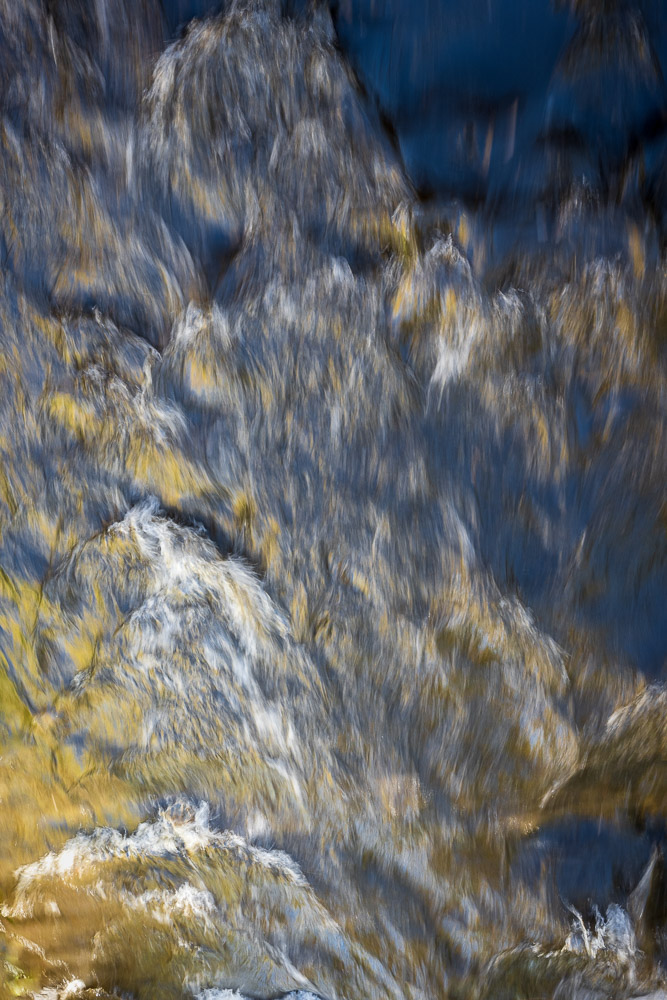
    I have used this image at the top before. It is a good illustration of my point here, though.

    I love this image. I could stare at it for a long time. It speaks to me at a level I can’t even describe. The rich color, the organic flow, the streaks of movement over time, the standing wave shapes, the minimalist simplicity all move me.

    This as shown here is almost straight out of the camera. It is what I shot. Yes, it has been cropped square and had some minor tone corrections, but this is what I discovered and jumped on. The color and the time effects of the flow are as shot. I liked it as seen through the viewfinder. I loved it after I saw it large on the computer.

    It is one of the few pictures I have hanging on my wall at home.

  • Competition

    Competition

    Why is it that we feel like we are in competition with other artists? Maybe, at its root, it is envy or insecurity. I don’t like to live in a competition. My desire is to make art and share my vision with other people. I believe that feeling we are in competition with other artists leads to problems for ourselves and can be a malignant stress eating away at us.

    Not competing until…

    Most people merrily go through their lives enjoying art without feeling any sense of competition. But for those of us who become artists, unfortunately, we tend to become critical and competitive.

    Once we are in the game we tend to look at other artist’s work more critically. It is hard to not think we could do better. Or think that our image that was similar was better composed and executed. Maybe we are right. Often, though, it is our ego or fear talking.

    Theodore Roosevelt (may have) once said “Comparison is the thief of joy”. Regardless of who said it, it is true that comparing ourselves to others is seldom beneficial and uplifting.

    Fear

    Why should we fear looking at someone else’s work? I think a lot of us are insecure. We aren’t secure in our conviction about the adequacy of our artistic skills. We have to boost our confidence by convincing our self that we are as good as them. Perhaps we fear failure and are unwilling to put our work out in the world publicly and face the potential criticism and rejection.

    It is not really a zero sum game – one winner and everybody else looses. When we see someone’s work that is good and excites us, we should be happy. It was a great achievement by them and it can inspire us to rise to greater levels in our own work.

    But doesn’t their achievement strike fear into us? Oh no, we aren’t any good, why am I calling myself an artist, how can I ever compete with them? This is our insecurity turned to fear. We try to compensate by criticizing the other artist’s work. Maybe it will make us feel better. If we believe our self.

    Jealousy

    Another negative feeling we may get is jealousy. We may not like to admit it, but think about it. Other people are getting praise and attention. They are selling well and making a lot of money. I should be in this gallery instead of them.

    We wish we were them. So we resent them. We look for ways to tear them down and to prove, even just to ourselves, that they are not so great. To believe that we are just as good.

    But don’t forget, you are jealous of them because you recognize their talent. That should be sobering.

    Become a critic

    Even if we don’t have full on, green-eyed jealousy, we may become a critic. To paraphrase George Bernard Shaw’s famous quote: “Those who can, do. Those who can’t become critics.”

    We can get to this point through festering fear or envy or jealousy. We try to put ourselves above the other artist. To give ourselves credentials to label them, to minimize their achievements, even to just nit-pick (the top left corner is not in perfect focus).

    Let me be very controversial and say I don’t think there are many critics who are worth listening to. Unless a critic has demonstrated history of creativity and success in similar art forms, they should be just another voice of someone entitled to their personal opinion.

    If George Lepp or John Paul Canponigro gave me a critique I would listen closely and thank them for their opinion. I would carefully consider it and may or may not act on it. If I decided to critique George Lepp, he probably wouldn’t listen to me at all. As he should. I have little experience in his genre and zero track record compared to him.

    Competitive market

    It is unavoidable a highly competitive market. We are always being compared to other artists. Fairly or unfairly, there will be winners and losers. The best don’t always win. “If you make it they will come” is ridiculous. There are biases and vested interests and politics at play everywhere.

    When we compete – and we always compete – we need to avoid the attitude that we are competing against “all those other artists”. That is turning our view out to worry about forces we cannot control. Instead, do your best and make work you are proud of.

    Sure, for a particular contest, we could research the judges and their styles and biases and research the audience and what usually sells and create work designed to score well here. It might work. But whose art are you creating? Is your work going to be dictated by other people’s attitudes?

    Relax

    Fear, jealousy, envy, and being critical are self-destructive attitudes. Look at other artist’s work and admire the ones you like. Go to them and sincerely congratulate them. It will have rewards for both of you. You will reclaim your self confidence and creativity. Getting over the competition and fear and jealousy will free up your emotional energy to create art.

    The reality is that we have our own unique vision, our own style and viewpoint. We are best off when we try to be the best version of our self we can be and create our own art. Even is nobody appreciates it. (cue a vanGogh discussion here 🙂 ) Unless you are starving and view your art as a job to earn money, it is better to follow your own vision. It would feel good to win that contest, but wouldn’t it be more rewarding to feel very proud of what we created?

    Art is an intensely personal internal journey. Hence the tag line for my blog: An artist’s journey.

  • Evolution of an Image

    Evolution of an Image

    Not all images follow the same life cycle. Sometimes it is pretty straightforward. See a scene; click; some post processing; done. Other times the path is winding, even circular. It is impossible for an image to be ready for a final print right out of the camera. Sometimes that shows an evolution of the artists perception of an image.

    Of something

    A lot of very good pictures are simply images of something. We find a lovely or interesting scene and we take a picture. Yes, we work the scene, find a good position to make a good composition. Wait for great light. Then make the shot.

    It represents something real and concrete. It is what it is. There is nothing abstract or surreal about it. No hidden meaning. As I write this I am on a trip going through a part of the country that has lots of beautiful trees. I am shooting a lot of pictures of trees. Just because I like them. And they’re all around.

    Most of these images, though, are ending up being just pictures of trees or fields. That doesn’t mean I don’t like them, but they are straight forward record shots of a scene I saw. It is the rare one that seems to actually have something deeper to offer.

    About something

    A goal is to bring something more than just a “here is what I saw”. I hope to occasionally make a statement or observation that will be helpful or insightful. Hopefully, I can bring you something more than just a pretty picture. I can only reveal to you what I emotionally reacted to at the time. It is up to me to react to the scene and be able to bring some of that to you.

    This is a wide grey area. One person’s “depth” may be another person’s “duh”. My perception of the significance of something may be different from yours. All I can do is to say what I think. I cannot control how you receive it.

    And the degree of depth or insight will vary all over the place. An image may have insight on something of human nature, or it may be humorous, or it may be ironic, or it may make a statement about the march of time or environmental issues. Good images do not have to be deeply serious. Few of mine are heavy commentary on social issues. My reaction to the world is governed more by joy and gratitude.

    So when you see my images, assume they probably have some insight I have perceived about the scene or subject. It may not be dark and depressing, but that does not take away from my intent to say something.

    A life of its own

    Sometimes, though, an image takes on another direction, a new life. I occasionally recognize that the original image is not complete or fully formed. It may need to be combined with other images or heavily worked to change it into something different.

    Take the image with this article for example. It started out a fairly interesting shot out of a favorite restaurant window. This particular window had 100+ year old glass that was wavy and distorted. Blurred in the background were some downtown buildings, trees, awnings, etc. I liked the scene and shot it repeatedly until I captured the impression I wanted (many lunches there!).

    But I was not happy with it as it was. It was an abstract view of downtown, but it was too abstract to be an effective representation of a downtown street, but not abstract enough to become something completely different and interesting in it’s own right. So I decided to go much further.

    Ah, the joys of Photoshop. It is fun to play sometimes. I added textures and played with colors and saturation and hues. Some overlay patterns gave it more definition and shape. Pretty soon it had nothing to do with the downtown scene I originally liked. If you sat where I shot the picture and looked out the same window, you would not recognize it.

    The image now has a life of its own, completely independent of the original scene. I like it. It is a fun creative exercise. But I have to find the right base images to work with. And I have to form a vision of where I want to go. Only a few images are good subjects for such a treatment.

    It means what it means

    Coming to this point requires me to address the question of what does an image “mean”? Can a picture have a meaning? Does it have to?

    There seems to be at least 2 opposing groups. Some say a picture is worthless unless it means something. The other says very few pictures can have an actual meaning, except for some photojournalism. As in most things in life, I range somewhere in the middle. Generally I say don’t take yourself so serious. A good picture can just be a nice, pleasing picture. If I have the opportunity to make images with meaning I usually will, but I don’t want the meaning to get in the way of the quality of the image.

    I get frustrated with people who are so sincere and focused on something that is important to them that they feel everyone must share their angst. Lighten up. First make art.

    I do make images with meaning, especially if I am shooting a project that is fairly serious. When I have the filter of a project in mind my focus tends to narrow to the subject. But unless it is a particularly dark and depressing subject, I want to concentrate first on making art. I tend to avoid the really dark and depressing projects. That is just not me and I don’t think they would make your life better.

    Summary

    The vast majority of the billions of photographs shot each year are record shots of something. They serve to capture a memory or mark an occasion. This was their intent and the work for that.

    A small percentage of photos and paintings go further and reveal something interesting. Maybe it is a new insight on a subject. Maybe it is just the artist’s emotional reaction at the time. But we look at them and often agree that they bring something deeper than just a snapshot.

    Or sometimes a picture becomes a thing in itself. Not a representation or even an interpretation. It just exists as a new creation. A lot of abstract and surreal art is like this.

    In my case, I am a lens-based artist. That means I start from something concrete – an image – rather than a blank canvas. Sometimes as I live with an image and think about what it could be, I morph it into something new. That is the case for the image with this article.

    I’m not saying this is a desired evolutionary path for an artist or that some steps are better than others. But artists tend to evolve their skills and viewpoints as they mature. I have observed myself moving through a progression. More and more of the images I like are abstract.

  • Unrecognized

    Unrecognized

    Sometimes things are right there staring us in the face. But we don’t or can’t see it. We fail to see what should be obvious. This in an internal problem. We don’t get to blame anyone else. Don’t go through life with unrecognized interest all around.

    Unrecognized artist

    “Unrecognized” is a fairly ambiguous word. Well, not really ambiguous, it is just that it can be applied so many ways. One of the first things that comes to mind when I hear the phrase is my sadness at being an “unrecognized” artist.

    Even though I have sales and good gallery representation and I get exhibited, it feels like nothing. Failure. I seek to be more widely known. A goal is to share my vision with many more people.

    But this aspect of “unrecognized” is not what I am discussing in this article.

    Unrecognized beauty

    Most people I know sort of drift through life in a daze. We follow our normal paths, doing basically the same thing all the time without really seeing things around us.

    If we recognize the rut we are in, we can climb out. At least enough to make a difference. Just deciding that we are going to pay more attention to things around us will go a long way.

    There is beauty all around us, even if you live in a city. Disappointed that you don’t live in Yosemite? Get over it. Learn to appreciate where you are. Even if you are not thrilled with your environment, by learning to look more closely we can usually find things, even little things, to brighten our day. Is there a flower, or a tree, or a pattern of light and shadow on a building that catches your eye? Look at it. Stop and take a moment to appreciate it.

    This will grow a habit of mindfulness. It will help us become more aware of what is there and more grateful of the little scenes that brighten out day, make us feel more alive.

    Unrecognized self

    Many of us, I’m pointing to myself, too, have trouble recognizing where our creative instincts are leading us. We change all the time. It can be hard if we feel like we are starting to be recognized for a certain style or subject. We fear that changing would lose our market. But at least that person is aware of what is going on. Most of us, I feel, one day realize that what we are drawn to is different from what we have been practicing for a long time. This can shake us to our bones. But it can also be refreshing and invigorating to re-align with where our subconscious is directing us.

    I think this quote from a very good photographer from the past, David Vestal. is enlightening.

    As we work, we come to know more and become more patient and less inclined to rush past our own work that we don’t yet recognize. Now I am quicker to see in my own new work the “accidental” good photos that I used to ignore.

    Mr. Vestal points out 3 key things that are common and key to our artistic growth.

    Know more

    As we practice our art we learn. Our technical abilities grow and our creative capabilities are stretched. The more we learn the deeper vocabulary we have to express what we see and feel. We also have more ability to examine our art and critique it.

    If we’re lucky, we even get to a point where we know what we don’t know. But the path of knowing more sometimes means we grow away from the positions we held in the past.

    More patient

    Mr. Vestal describes part of the growth process as becoming more patient. With ourselves. I know for myself, I feel less need now to shoot quantities of images. I used to be in a frenzied rush to capture everything that was the least bit interesting. These days I will usually come back with fewer images. I can see something nice and not feel the need to take a picture. Sometimes it is sufficient to just acknowledge it and appreciate it. I would rather have a few images that excite me rather than a whole pile of “OK” pictures.

    I think this also applies to our results and growth as an artist. Have you ever found yourself trying to “force” a great image. I do. Maybe less than I used to. As I grow I am more interested in trying to see more clearly what is there and understand how I perceive it, what I want to do with it. Sometimes it doesn’t come. Rather than be a big frustration, it is an opportunity to try to figure out why.

    Have you ever come upon what would be one of your “standard” images, one you would always shoot, and said, “no, that doesn’t interest me today”? Something is speaking to you to tell you you have grown to a new position.

    Recognize

    To me, the phrase in his quote “less inclined to rush past our own work that we don’t yet recognize” is brilliant. I sometimes run across something while I am looking for a particular image. Something I didn’t think was very good, but for some reason I kept it. Looking at it some time later I liked it much better. Sometimes I realize that if far more representative of my current vision that things I used to shoot.

    He describes them as accidentally good shots. I believe these accidental shots are sometimes our subconscious trying to show us something we don’t recognize yet. As we grow in our artistic concept, we have to leave the past behind. We become bored with what we used to proudly do. Recognize that feeling. Learn from it. It is time to move on.

    I have described before that I tend to be fairly brutal about culling out bad or uninteresting shots. Sometimes, though, I am compelled to keep an image that I don’t think I like. Sometimes I find, later, that this image is significant to me. It may even be a pivot to a new direction in my journey. I did not recognize it at the time, but I did perceive that there was something there that made me keep the image and come back to it later.

    Be receptive

    I believe we should learn to be more receptive to these signals our subconscious is sending us. The subconscious mind is more powerful than the conscious mind. It understands us better. It is not deluded by ego or financial considerations or social media followers.

    I have heard it said that this message from our subconscious is usually not a light bulb going on, it is more like a tickle on the back of our neck. That little feeling that there is something here we are missing or need to figure out. Maturity is learning to be aware of this hint and follow it to see where it leads us.

    How about you? Have you ever puzzled over an image you couldn’t figure out, only to recognize later that it was a harbinger of a new direction for your creative work? The way to a new creative plateau? Did you trust your instincts and embrace the new direction? What was the result?

    I would like to know! Leave a comment or email me.