An artists journey

Category: Artist

  • Purity in Photography

    Purity in Photography

    I couldn’t help follow up on my last article with this. I read a photographer’s blog who was wringing his hands about “fake” images. In his plea for purity in photography he went so far as to coin a new term: “PhoTImagery” (the strange capitalism is his). He proposes the term to refer to any image that was not an absolute literal representation of a real scene.

    What is purity in photography?

    The argument presented was that “pure” photography – what he terms the purist photographer – consists of images made on film and processed in a wet darkroom. The end product is a photograph.

    A couple of questions occur to me. For one, why stop at film? Why not define pure photography as coating wet plates in the field before exposing them? That predates film and is even more basic. The practitioner of this has to be very determined and willing to suffer for his art. That brings even more asceticism and rigor to the practice.

    The second question is brought up by his assertion that the pure photographer can use “all possible techniques” in the chemical darkroom and still be acceptable. Editing negatives to remove distractions and compositing images has been done almost since the beginning of photography. Is that OK as long is it is done with film and chemicals? What would a photographer have to do to make it no longer “pure”? It is interesting that he does not count multiple exposures against the purity of an image.

    Can digital imaging be pure?

    The next step in the continuum he describes is the “photographer”. This is a person who does digital imaging, BUT does nothing to alter the image materially. This person is only called a “photographer”. He seems to have lost the sanction of purity, since he is not using a pristine chemical process. The end product here is still a photography, but I guess it is potentially tainted.

    If you edit out distractions or (gasp) change the sky it is no longer a real photograph. Apparently only the actual scene as shot, with no material changes, is worthy to be presented as art. Of course, like in any legalistic argument, there will be long and heated debate about what constitutes a “material” change. And who is certifying this? Do we have to submit our images to the Board of Photographic Purity before publishing them?

    Not real art?

    Finally Mr. Gordon creates the term PhoTImigery to describe any image that was not created and processed entirely by old school chemical methods, or was composited or heavily manipulated. He labels these manipulated images as deceptive and not true photography.

    Happily, he allows that art might want to do these things, but that the use of them must be disclosed. If not disclosed he claims it to be deceptive and wrong.

    I thought this argument was over a couple of years after digital imaging became really practical. Unless you are a photojournalist it should be assumed that ALL images are manipulated. This is not dishonest unless you are presenting it to your viewers as depicting reality.

    The disconnect

    Herein lies the disconnect, I think. Mr. Gordon wants to assume that all photographs are a faithful and literal depiction of reality unless disclosed as otherwise. It seems much safer to assume that all photographs are manipulated freely unless it is stated otherwise.

    We have long moved past the point where the only purpose of photography is to record the world as it literally is. There are billions of images made every day. Reality is overused. A photographer wanting to be heard among all the noise must present his personal vision of a scene. Or create a scene that may not have existed.

    Is this dishonest? No, it is art. Should it be “disclosed” as not real? No, no more than a Picasso painting should be labeled as “not real”. None of my images, no matter how they are created or manipulated, are fake. They are my artistic work.

    By the way, the image with this article is not literal reality. 🙂 Are all my images this heavily processed? No, not even most of them. But I feel free to do what I want with my pixels.

    The argument of purity makes an assumption of the intent and very purpose of photography. I refuse to be bound by someone else’s assumptions. I will follow my own path. Let me state right now to never assume any of my images are literal truth unless I tell you that they are.

  • Try and Fail

    Try and Fail

    No, I’m not saying try “to” fail. If you have been there trying to do creative work, you know that you will create a lot of failures along the way to some good work. In creative work we often do not clearly know where we are going. That leads to a lot of failed experiments and dead ends. When we try and fail, is that bad?

    Attitude

    Our attitude about failure will have a lot to do with our results. A reality for many of us is that, if we are not failing, we are not stretching ourselves and developing new skills or vision. As creatives we cannot play it safe. We have to be risk takers.

    I love a quote from a blog by Benjamin Hardy. He was talking about Molly Bloom and said “The moment you realize you can try and fail — and that everything will be okay — then you are free to create.“

    This is a liberating event in our creative journey. Failure isn’t final. Failure leads to growth. When you fail, no one comes and takes away your camera or your brushes. No one even laughs at us. Realizing we can fail and go on with no consequences frees us to try without worrying much about failing.

    Learn by doing

    We don’t upgrade our skills and exercise our creativity just by thinking about it. We have to take action. But just taking random action will usually lead to random, unwanted results. We need a way to follow a path that will take us to desired results.

    You are probably familiar with the “do it, try it, fix it” loop. It goes by different names, but the concept is pretty much the same. This is an excellent process for improving things.

    The basic idea is you try something new. Then you evaluate the results, Was it a success or an improvement? Decide what, if anything, you want to keep of this experiment to incorporate into your tool set. Then, based on the evaluation, plan what to try next. That becomes the basis of the next experiment. It is important to realize this is a cycle, meaning it continually loops and repeats.

    Evaluate

    At the evaluation stage many experiments may be tossed out. They did not take us in the direction we want to go. It was a failure, but that does not mean we failed. We just tried something that we decided didn’t work for us.

    This is part of a process. It is a deliberate plan to systematically push the limits. To do that, we will try a lot of things that don’t work out satisfactorily. The failures are expected, planned even. Not something to be ashamed of. We should be happy to know we tried. Now we are free to do another experiment in a different direction.

    Freedom

    Freedom is at the core of the process. We are not just trying random things and mostly being disappointed with the results and insecure with our creativity. Instead, we are following a deliberate process of improving our self and our art. And knowing we can try anything with no fear of failure is extremely liberating.

    It is easy to get discouraged and think of our self as the failure. We have probably all felt like a fraud who has no right considering themself an artist. Remind yourself that we have to change and grow creatively, and to do that requires a lot of risk taking and failed experiments. Following a process like outlined above makes it a methodical plan. It help us keep in mind that the failure is not a personal failing but a necessary and expected outcome of the growth process. It can be exciting. We can risk more when the fails are not catastrophic.

    The image with this article is an experiment. It is probably not what it appears to be. I will leave it to you to decide if it was a failure. I have my own evaluation.

  • The Paint is Never Dry

    The Paint is Never Dry

    I find there are 2 categories of images in my library: ones I am “done” with and ones I want to tweak each time I open the file. Furthermore, it seems the ones I want to do something to each time I see them are the ones I like best. I refer to this as the paint being never dry.

    A significant advantage of digital image manipulation is that it is so easy to make changes. This can also be a problem.

    Wet paint

    Modern technology gives us great freedom to edit and express ourselves. It is so easy to make some changes every time we open the file. Oh, I didn’t see that little flaw. I really don’t like the relation of these tones now that I look at it again. Maybe it would have more punch if I pumped some of these colors some.

    But this is a subtle trap. A trap of time, because this is a never ending treadmill of editing, and of lack of confidence. I will write about this confidence problem in the future. Basically, it has been hard to accept that, as an artist, no one can tell me what is “right” or when I am “done”. I am the only one who can decide.

    Prints

    I wrote once about prints being a frozen moment in time. This is one of the great things about prints. They are not changeable.

    A print represents my interpretation of the image at one moment in time. It is very tempting for me to modify it a little every time I print it. But now that I do editions of prints, I have to discipline myself to create exact duplicates for each print in the edition. It would be dishonest and a disservice to the purchasers if each one was different.

    Part of the process of growth is deciding that an image is “done” and is ready to be shown and purchased . And I have to be able to stand proudly and represent it as my art, that I am proud of, even if I see opportunities for improvement.

    Creative vision

    But my creative vision is evolving all the time. It is frustrating to be locked in to printing a series a certain way when I may see it different now. I am resolved, though, that that is the requirement. I will have to exercise my creativity on new images.

    The images are my children, in a sense. But any parent finds out that after they grow up, you have to let them go. Send them on their way to be independent. I can no longer control them or manage them. Kind of the same with my images. When one is sold, the whole edition is frozen, out of my control.

    Oh, but the new images, the ones that haven’t sold yet. They are free to be interpreted and re-interpreted at will. I love to do this, but I recognize the need to let the paint dry at some point.

    As the artist, all my images are resources to me to use any way I wish. Even the editioned ones can be recycled by compositing, over-painting, or radical cropping. Anything that makes it into a whole new work of art. My creative vision can best be applied to new work rather than reworking old things.

    Growth

    I don’t believe doing a great image “uses me up”. I have to believe I have a boundless well of creativity. It is better to go out and create new work. Learn what I can from the best of what I have done and go on from there. Explore a theme and do variations. Discover new themes.

    My curiosity will lead me to new subjects, new visions for old ones, new points of view. I will learn new techniques for shooting and processing.

    It would be devastating to feel that my best work is already done. I would have to quit if that were the case. I feel sorry for the old rock bands who still tour. No one wants to hear their new work. They only want to hear the hits of 40 years ago. They are trapped. I couldn’t do it.

    So, yes, my tendency is to want to constantly rework and tweak everything. I often see things I would change in my work. But discipline has to be applied. Most old work should be left as a memory and a signpost along the way of my journey. Apply the creativity to the new images. Let the paint dry.

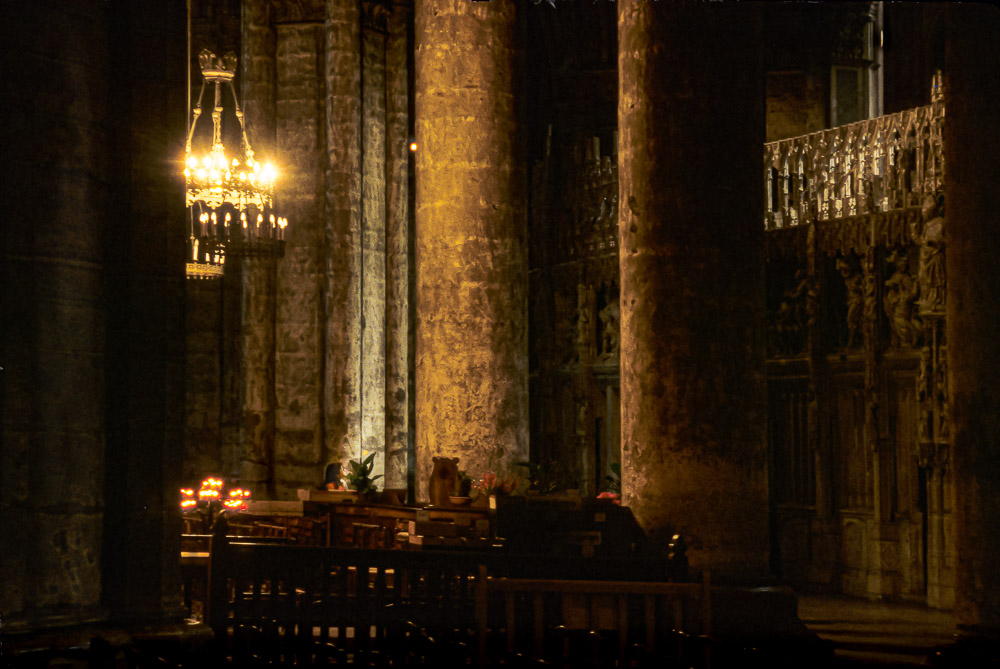
    A confession: even after writing all this about letting the paint dry, I went back and did some minor edits on the image with this article. This is an old image, scanned from film. The quality is not up to today’s standards. But I really like the feeling of the image and the memories it brings back of Chartres Cathedral in France. So I indulged myself in one more little tweak. Do what I say, not what I do.

  • Time

    Time

    Time is common to all of us. We are all given the same amount of time each day. Most of us are not as aware of time flowing by as we are of the events we have scheduled at certain times. Rather than moaning about how busy we all are or talking about productivity, I would like to discuss time as a creative element.

    What is time?

    “Time is the continued sequence of existence and events that occurs in an apparently irreversible succession from the past, through the present, into the future.” Deep, but it helps frame the problem.

    We all “know” what time is, but we would probably have a difficult time describing or defining it. Yet it is what we live in. It controls almost every aspect of our lives. We all experience it constantly. We can’t control it or buy or sell it or save it. It flows on by with no regard to our desires.

    It may be a cliche that we all have the same amount of time each day, but like most cliches, it is very true. We can’t control it, we just decide what we are going to do with it.

    Most art deals with moments

    Most art, and most photography, captures discrete moments in time. This is the conventional view of the world. It is what we think we see all the time. Don’t take it as me sounding critical of capturing moments. I do it all the time, too. It records an event or a place or a person at a certain moment, and that matches and triggers our memories.

    In a sense, it is our way of freezing and controlling time. As photographers we usually think in terms of the best shutter speed to use to stop the action, to minimize blur. This is the right thing to do for normal image captures. We, and our viewers, expect the moment to be recorded in sharp detail with no distractions like blurred movement.

    Photography is unique

    Photography is unique in it’s ability to represent time in varying ways. Time is one of the variables of the photographic process.

    If you are painting or sculpting you usually represent what you can see or imagine. We seem to see things still, not moving or traveling through time. And it is very hard to imagine what the movement of time looks like. We may be able to see the effects of years or centuries on something, but even then it is impossible to visualize what it looks like as it is happening.

    But photography has time built in as one of the parameters being controlled. We balance aperture, shutter speed, and sensitivity (ISO) to determine an exposure. Think about that for a moment: we can adjust aperture and sensitivity to set the time window of an image to whatever we want. Within limits.

    Yes, we usually use this to set the shutter speed fast enough to freeze the motion. But that is just the normal convention. We could just as well make the shutter speed very long to observe motion over time. Some photographers do this regularly to feather moving water. It is almost a convention of landscape images, sadly.

    I know my friend Cole Thompson gravitates to very long exposures to give a different view of the world. Many of his images create very interesting effects.

    Movement

    I have recently found myself drawn to visualizing the passage of tiime.. More and more I tend to use relatively long exposures, often hand holding the camera, to examine the effects of movement over time. Some of my images done this way do not have a single sharp edge in them.

    This may seem controversial to many photographers. We are trained to maximize sharpness. We buy very high resolution sensors and ultra sharp lenses to record the sharpest detail possible. But I use those great sensors and sharp lenses to record – blur. A waste? That is an artistic judgment.

    One of the things I am trying to capture is the unseen way things move over time. We know they move. We can point to it and say “that is moving”. But it is nearly impossible to visualize what it really looks like as it moves. That is what I am exploring.

    The image with this article sort of illustrated this idea. This is an event called Cowboy Mounted Shooting. It is a speed and shooting event at some of our local rodeos. I believe the blur and slow shutter speed capture the speed and dramatic action of the event better than a crisp, frozen frame. The sharpest focus is on the face of the horse. That seemed appropriate to me because one of the things I wondered about is how the horse felt about guns going off over his head.

    A new viewpoint

    This concept is a new viewpoint for me. Time exposures are certainly not new and I have done a lot of them over my career. Now, though, I am more consciously using time as a creative element. Instead of a limitation of low light I now see it an an opportunity to show a new view on the world. I am working on a series that emphasizes this. Maybe more on that later.

    Time is too much of a subject to cover in depth in a blog post. It is a theme I will probably return to in the future.

  • Improvement

    Improvement

    In a recent post I quoted Todd Vorenkamp saying “Search yourself for improvement, not your gear”. I believe that our improvement needs to come from within us, not from better gear. What is your plan to make yourself a better artist? Do you have one? I am an Engineer. I know that nothing gets better by accident. We all need a plan and strategies to improve ourselves. I am not saying we need a 5 year plan or a 10 step process. But we need to consciously strive for improvement.

    Study

    Whatever you believe in and value and spend your life doing, you should be a lifelong student of. We are lucky to live at a time when we have so many channels for learning available to us.

    If you were an aspiring artist in the 16th century you would have to apprentice to a master. There you would spend several years doing grunt work and menial tasks while studying the basics of drawing. Eventually you might advance to a stage where you were trusted to add some parts to a painting the master started. Someday you might be trusted to make copies of the master’s work. Now after 10-15 years you could be deemed ready to go out on your own. Of course, all you know is your master’s style. You don’t really know what you want to be yet. A pretty poor system in my opinion.

    Now, though, there are an abundance of schools and online classes. There are books and magazines. There are mentors available and unlimited examples to view online. Most of us are reasonably close to good museums where we can examine great art at will. We could spend all our time studying and never make an image if we are not disciplined.

    Online classes

    I have gotten lots of good information from classes at CreativeLive and Kelby One. B&H Explora has a great free library to view, among all the sales stuff. Anything by Julieanne Kost is extremely worthwhile. Some other great instructors are Dave Cross and Ben Willmore. I do not receive any compensation for these plugs. Many of these things require subscription. It is worth paying for good instruction. For free stuff, there is more on YouTube than you could ever watch. Be careful. Be wary in deciding who you are going to listen to, especially on YouTube. It’s the wild west.

    One reason I love Julianne Kost, besides that there may not be anyone on the planet who knows more about Photoshop, is that she said “I don’t want a recipe, I want to learn to cook.” This is wise advice. A lot of training presents recipes to do exactly what the instructor did. I don’t want that. I want to know how to fix my own dishes, to create my own recipes. She is good at presenting her training from that point of view.

    The real thing is to do it continually. Learning should be a habit we cultivate for our whole life. We never know all of everything. It might be harder to find new and deeper things to learn, but it is there. I suggest you commit to study as an ongoing process, not an event.

    Critique

    I will put this here, even though I am very bad at it. It has been a long time since I went for a formal critique of my work.

    I know it can be valuable. I remember years ago when I was in a camera club the critique was good discipline. As I matured, I also learned that you had to carefully evaluate it, because most critique was normative. It was trying to mold me to fit the biases of the group or the evaluator. Use at your own risk. Be smart about it.

    I hear there are some good critique sessions you can submit your work to for evaluation. I have not done it, but I would if I found one I trust.

    Possibly the most valuable thing about critiques is that they get you used to hearing negative comments about your work. This, in itself, is good training.

    Experiment

    There is a big difference between 20 years of experience and 1 year of experience repeated 20 times. A lot of people get trapped by their success. They become known for a style and feel they have to keep doing it for fear they may lose their audience.

    I believe an artist grows and evolves throughout their career. Your interests change, your style may change, certainly your point of view changes. How will you follow these changes unless you give yourself permission to experiment some?

    That doesn’t mean you have to suddenly make an abrupt 90 degree turn and go a completely new direction. Experiments may be personal. Most of them will fail. Some, though, will have a glimmer of a new idea, a new viewpoint. Follow up on them. Keep pushing.

    A willingness to experiment and play is healthy. It will keep us fresh and creative as an artist. Evaluate what you have learned about yourself from the experiments and decide what to keep and build on.

    A note about the image with this article: this was the result of an experiment. I liked it. Other people seemed to agree, since it went into a gallery and sold.

    Be open and flexible

    Are you willing to entertain new ideas? New technology and techniques? New points of view that are alien to your normal thoughts? You don’t have to buy in to them. You don’t have to adopt them.

    Stretching yourself with new ideas is kind of like yoga for the mind. You stay flexible. When a mind becomes rigid and inflexible it shuns new ideas, new thoughts. The creative place within us requires fuel, new possibilities, new ways of looking at things. Otherwise we stay in our comfortable rut.

    Creativity is like anything else with our bodies. We have to work at it to develop. If we don’t exercise we lose the ability to move and we get unhealthy. Likewise, being open to new things is an attitude, a habit. We can work to get better at it.

    Think about it

    We should be our own best critic and our own best evaluator. If you’re an artist, how can you not obsess about your art? It is a major part of your life. It should occupy a lot of your thought.

    I am an introvert and an Engineer. That gives me an ability to look at my work fairly objectively. I know that will not be the same for everyone. We are all different.

    But whatever talents we have, we need to learn to be able to evaluate our work fairly. You see what other artists do. You know your own work. What you do has to stack up against your own expectations and your evaluation. We never think we have arrived at the pinnacle. And we shouldn’t. Hopefully we will always be growing.

    Thinking about where we are and where we need to go will help us plot our course. Being realistic will help keep us from deluding our self and also keep us from beating our self up. Don’t be negative. Improvement is a lifestyle. Look for new ideas. Embrace new points of view. Experiment with things that are very different that what we normally do. Grow.

    What’s not here?

    Your equipment is probably not holding you back significantly. Learn to think. Creatively visualize new things. Try new techniques. Grow into the artist you want to be. Then you will do wonders with that expensive new camera. 🙂