An artists journey

Category: Artist

  • Themes Keep Emerging

    Themes Keep Emerging

    Quite a while back I talked some about themes in our work. I mentioned that one theme I come back to is wabi-sabi. As I reflect on my work I find that there are common themes that keep emerging.

    What is a theme?

    In the previous article I gave the simple dictionary definition of a theme as “a subject or topic of discourse or of artistic representation”. This is right, but inadequate. I have come to believe that for artists, themes are ingrained and consistent.

    That is, unless we are doing commercial work for clients, themes represent what we are drawn to. The things that have meaning or symbolism to us. They probably don’t mean anything in themselves, but they disclose something about us. What we see and the way we think.

    So perhaps, for a fine artist, themes are the ideas that tweak our passion, that spark our creativity. It is important to keep in mind that the theme does not have to be deeply meaningful. It just grabs us for some reason.

    Projects

    I am at a stage where I think more and more about projects. These self-assigned projects help focus me and exercise my creativity. Without them I tend to run wild and shoot everything in sight. That is OK, but a project helps me get deepen into an idea.

    I have a list of project idea I think I would like to do. Sometimes, though, when I try to start one, it turns out to be Meh… It is difficult to really get into it with any enthusiasm. I have come to recognize that this is a symptom of the project not aligning with any of the themes that channel my interest. I usually abandon these, unless there is a compelling reason to push on through it. There seldom is.

    On the other hand, when a project aligns with my innate theme interests I can really get into it. It is energizing and exciting rather than being dreary work.

    Look inward

    So I have learned to look inward more to keep projects aligned with my natural themes. This can be hard for some of us cold, analytical types. After all, it is easier to talk about composition or exposure than it is about feelings. But as I have said before, art is primarily about feelings. I have to get in touch with my feelings??! Well, maybe not in that sense. But I have to become a lot more sensitized to them.

    The unique nature of photography is that it is a subtractive art. The world is swirling all around us in unbelievable detail and complexity. When we lift a camera we engage in a process of reducing, filtering, limiting what we show to make a pleasing and coherent image. This takes discipline and a good sense of what we find important in the frame at the time.

    Self discovery

    This self-discovery process sounds hard for some of us, especially guys. But maybe not. Our own work can often tell us, if we listen.

    If you have a body of work (a fairly large collection of images you think are good) you probably have the data you need already – your own images. As an exercise in self discovery, pick out around 100 of your best images. The ones that you feel you are most proud of and that represent the work you are doing now. If I were doing it right now, I would use Lightroom to go through my catalog of top picks and pull 100 of them into a collection to examine.

    As painful and time consuming as that is, that is the easy part. Now it is time to think and reflect. Study this set of images. Write down the themes that come to mind as you look over the collection. Just do a free association, stream of consciousness at first. Write these theme ideas on sticky notes and lay them out on a table or a white board or your monitor or wherever is convenient. Look for groupings of related ideas. Put them together. Come up with a term to represent each grouping.

    Hopefully you now have no more than 3-6 theme ideas. Go back to your image collection and try grouping them according to these ideas. Don’t worry if it is not perfect. A single image may overlap more than one idea. But it is a test to see if you believe the groupings you came up with.

    Now you have a clearer map of the big ideas you are drawn to. This is enlightenment.

    Rocket Science?

    No, this is not rocket science. It is not really science at all, in the sense of being objective and repeatable. If you repeat the experiment you would probably select a different set of images, because they seemed meaningful to you at the time. You would probably label them differently and come up with different themes. Same but different. That is, there should be a lot of overlap, because themes are much more broad than a particular subject.

    Does this make it invalid? No. The process gives you insight about yourself and your interests. It is turning your sights inward and trying to understand more about yourself. The fact that you get different results proves you are a complex and varied individual. That’s good. Be proud of your complexity.

    What am I drawn to?

    I mentioned wabi-sabi as one of my themes. Some others are time travel, weathered, force of nature, and black & white. I haven’t figured out if black & white is a theme or just an attribute of a lot of the art I like to do. Still working on it.

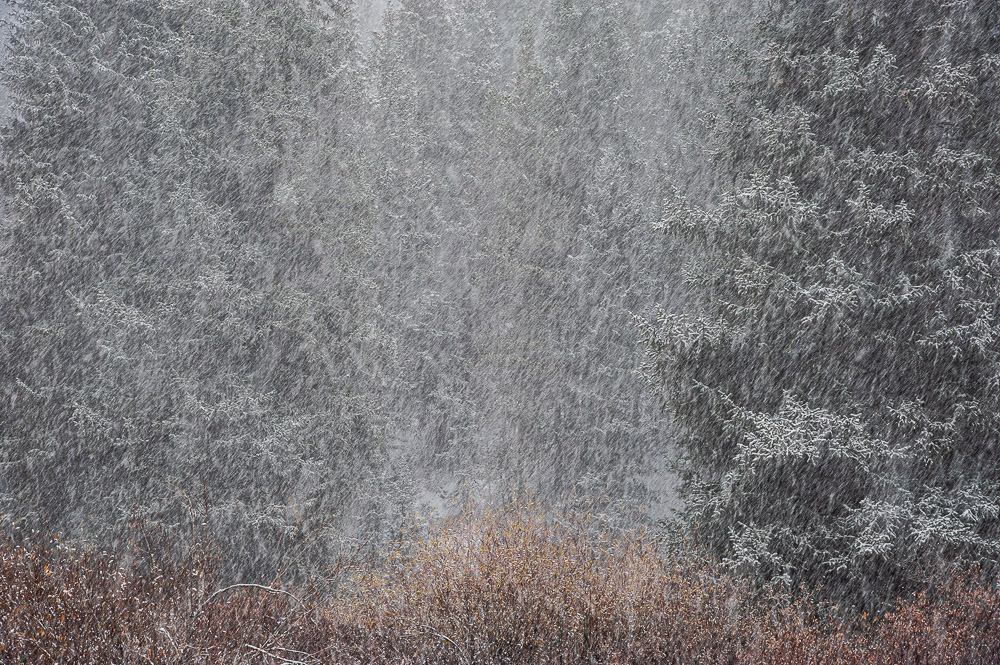
    The image with this article I just shot yesterday (as I write this). This is in the force of nature theme. We just had our first good snow here in Colorado and I couldn’t resist getting up in the mountains to see it. This is not cloud or fog or smoke. It’s blowing snow. It’s not snowing. As a matter of fact the sky is a boring bright blue.

    When we get sandwiched between a high pressure system to the west and a low pressure system to the east, we can get violent winds across the mountains as the pressure tries to equalize. When I shot this, it was about 18 F with about 40-50 MPH gusts. Very cold! But I hardly noticed. I love scenes like this showing the power and majesty and force of nature! I was in the zone. I didn’t even remember to put my gloves on, and I hardly noticed.

    Connect with your heart

    So I find that scenes that excite me when I am shooting them are usually in one of my themes. If I am not excited, I’m probably trying to shoot something that doesn’t inherently draw me to it. By understanding my preferred themes I can more easily decide what to shoot and what to avoid.

    Someone once said “if it doesn’t excite you, why should it excite your viewers?” This is generally true. Have you ever made a technically perfect image of a beautiful scene and then later thrown it away? I have. Lots.

    Art is about showing other people what we felt; what we were excited about. If we’re not in love with an image why should we ever show it to someone else?

  • What’s Your Motivation?

    What’s Your Motivation?

    What’s your motivation? What compels you to do what you do as an artist? If we understand more about our personal motivation it will help carry us through hard times.

    Motivation vs. creativity

    Just so we’re on the same page, let me differentiate motivation from creativity. I wrote recently on creativity. To me motivation is the “why” behind what you do and creativity is the viewpoint or fresh approach you bring to your work. The ideas or substance behind our art.

    Motivation gets us up in the morning or keeps us out shooting after the sun is gone or when the weather is miserable. Something drives or compels us to do our work. Creativity may give us a new idea of something that would make a good image. Motivation gets us off the chair and our the door. They work together to create our art.

    Motivators

    We are all motivated by something, but each of us is motivated by something different. My wife is one of those who is motivated by a check list. Getting everything checked off at the end of the day is her goal. I like to get things checked off, but it doesn’t really motivate me. I need to create, to make things that brings my unique viewpoint to the world.

    There are many

    Some other possible motivators that come to mind are:

    • People’s expectations. We like to please others. For some of us, that can be more important than pleasing our self.
    • Money. This is why some of us work. Now obviously, we all need to support ourselves, but for some, the money itself is how we “keep score”.
    • Fame or recognition. This can be powerful, but realisticaly, few of us artists actually become famous. There is the dream, though.
    • Helping people. An example is Beth Young who, after battling cancer, discovered that peaceful, relaxing images help soothe people’s pain. Now she tries to produce that to help others.
    • Fear. This is sneaky, but do you ever feel you’re being left behind and want to work really hard to catch up? Perhaps you look at other photographer’s work and feel inferior. Maybe you don’t even know where you need to go, but you are plagued by fear. I think this is a lot of what social media is about.
    • Personal drive. Some of us are driven to look around at the world and see things and we need to capture them and bring them to other people. Maybe it’s ego, or maybe it is just the knowledge that people would miss these scenes unless we show them. Either way, it is a motivation.

    I’m sure there are many more motivators. Like I said, we are all motivated by different things. But my point is that, when you think about it, something motivates you.

    Study yourself

    Introspection or self inspection is hard for some. Learning to do it helps us grow and understand our self better. Do you ever sit back and reflect on your motivation? When you don’t feel like doing anything, what gets you going? Can you detect a cause/effect relationship? That is, when an idea comes into your head that seems to push or pull us to expend the energy to do something.

    If we understand our motivation we can accept it and embrace it. Use it to propel us toward our goals. If we can recognize it we might be better at it’s care and feeding.

    You’re not always motivated

    Like creativity, motivation is not always around when we would like it to be. Like most things in life, it has cycles. It ebbs and flows like a tide. Unlike a tide, it does not have a predictable schedule. We can’t control it. We just accept it as our reason for doing what we do.

    What to do when you’re not

    Sometimes we have to recharge. Sometimes we are so drained that we have to rebuild. Maybe we are at an inflection points in our life when our subconscious understands we need to change direction but our conscious mind is still struggling with it.

    Be patient with yourself. Let it work. Feed your mind – read, study, be with people to keep from spiraling into depression. Wait for the motivation to re-engage and push you along. Motivation is a force. It is neither good or bad, right or wrong. It just is and it works on us.

    But don’t just sit passively and watch TV while you wait. Work. Keep doing your art. Shoot; process; market. Stay busy. You may not be happy with what you are creating right now, but doing something is better than sitting around feeling sorry for yourself. Picasso famously said “Inspiration exists, but it has to find you working.” I believe it is the same for motivation. When we are working we are more receptive.

    There is a “why” behind what we do. Sometimes we have to re-discover it. Occasionally, but rarely, it changes. Reflect on your motivation. Understanding it will help you understand why you feel it necessary to do what you do. That understanding can carry us through the dark times when we do not feel inspired.

  • Consistency

    Consistency

    Consistency is good, right? Unless it’s not. There is a time and place for everything, including breaking expectations. Consistency should not be our main goal. What we are led to see and create is more important.

    Hobgoblin

    A quote we all know that is attributed to Ralph Waldo Emerson usually says: Consistency is the hobgoblin of little minds. That seems odd. Why would he disparage consistency?

    The reality is that this has been misquoted for so long that most people have forgotten the real statement. The quote, from his essay “Self Reliance“, actually is: A foolish consistency is the hobgoblin of little minds. Let’s explore that.

    But first, what is a “hobgoblin”? Even though I have heard this quote forever and acted like I understood it, I didn’t know what a hobgoblin was. Wikipedia says: A hobgoblin is a household spirit, typically appearing in folklore, … Like other fae folk, hobgoblins are easily annoyed. They can be mischievous, frightening, and even dangerous.

    So if we accept the concept, a hobgoblin is not a scary monster but something we tend to live with and accept that is kind of annoying, maybe occasionally dangerous. Playing that out, it makes it a spirit or tendency that can be dangerous or difficult to control. Something that can occasionally do more harm than good.

    Consistency is good

    We usually consider consistency a sign of intelligence, of good work habits, of reliability. You are respected when people know you can be relied on to keep your commitments. It is a sign of maturity.

    As adults this should be a quality we cultivate in much of our life. It makes us more predictable and helps us get along well in life. People around us need to know we are not schizophrenic. When they come to us for something, they need to know who they are dealing with, how we will behave.

    So what’s not to like?

    Consistency is bad

    But Emerson is saying that a certain type of consistency can be bad. Is that contradictory? One of the traits of an adult is the ability to keep contradictory concepts in our head and rationalize them. F. Scott Fitzgerald said: “The test of a first-rate intelligence is the ability to hold two opposed ideas in the mind at the same time, and still retain the ability to function.

    What is this, then, that Emerson calls “foolish” consistency? I believe he is referring to being a slave to consistency, even when it would make more sense to change. He says it is a trait of little minds – ouch.

    We all have ideas and opinions and habits we have developed over time. Key is: they have developed over time. This means they change with time. Do not be afraid to seem inconsistent with your past beliefs when you change and adopt new beliefs.

    As artists, we develop a style that is a signature of us. People recognize our work without being told. But is the style who and what we are, or is it merely a reflection of where we are right now? Don’t be trapped by your own success. We become reluctant to change it for fear of breaking our “brand”.

    We grow and change. Sometimes radically. Do you ever feel trapped by a style you no longer believe in? This may be what Emerson refers to as foolish consistency.

    As a couple of examples, I respect Joel Grimes for making a couple of right angle turns in his career. He became very successful for a certain look he brought to his work, mostly advertising. But he came to a point where he “used it up” and changed. He continued being successful.

    Another one that comes to mind is Cole Thompson. Cole is a great black & white photographer who lives near me in Colorado. He has usually done long exposure landscapes. But his new series Negative Intersections is a big departure from his old style. I respect him for taking the risk and breaking out of the rut..

    Go where the spirit leads you

    Artists should stay fresh, alive, seeking, learning. When we do this, we change. We grow and evolve. Practically, this means we will change our style at one or more points in our career. Isn’t your vision different now than 5 years ago?

    Let your feelings and instinct lead you in this journey as you develop as an artist. Consistency is good until it starts to limit you. Be willing to change, even if it means you now seem to be inconsistent with what you did before. You are not really inconsistent, because where you are now is authentically you.

    Change or you are trapped in a box of your own making. Set yourself free. Trust that you are growing to better levels all the time.

  • Secret Revealed: The Meaning of Art

    Secret Revealed: The Meaning of Art

    I may be expelled from the artist guild for revealing a closely guarded secret. I want to talk about the meaning of art. Maybe it is not actually a secret. Maybe I just don’t understand.

    Objective meaning

    Without getting pedantic, we have to talk a little about meaning. This is a deep study in itself that we can only shine a little light on here.

    Something has objective meaning if it creates the same idea in your head that it does in mine. A stop sign has meaning for most of us, but only because of training and convention. A user manual describing a feature of a product has meaning – or it should; many are poorly written.

    The famous psychoanalyst Carl Jung said:

    No individual symbolic image can be said to have a dogmatically fixed generalized meaning.”

    I think he was saying that we all see something different when we look at an image.

    Pictures consist of marks on a 2D surface, such as canvas. We see the marks as lines, shapes, forms, and colors. How we perceive these marks determine the meaning we get from it. Two people viewing the same image: one dismisses it as uninteresting, the other breaks down in tears because it invoked a deep symbolism or meaning or memory for them.

    Some things, like documentary photography or photo journalism, seem to have meaning. They at least motivate a certain response fairly consistently. Even so, the meaning is often not exactly what the creators meant, because everyone is in a different place. So I have to wonder if the work truly has meaning. Another question is whether it is really art. If the focus is meaning, is that at odds with art? Just asking.

    Feeling/emotion

    I spent most of my career as an engineer. Talking about and dealing with feelings is pretty alien to me. But I have discovered that art is all about feelings. I would go so far as to say that if art doesn’t invoke an emotional response in the viewer, it is probably a failure.

    For decades I took technically good, well composed pictures of the natural world. Mostly landscapes. When I look back at them now I see most of them as completely boring. There was little discernible emotion there. I just showed what it was, I did not attempt to give a glimpse of how I felt about it. I was making documentary images, not art. Today, in the same situation, I would strive to bring you my interpretation of the scene, with my feelings prominent. Or if I can’t figure out how to do that, I might take an image for a record of it, but I would never show it to you.

    The left brain/right brain model is useful for describing the logical vs. creative sides of our nature. I don’t want to imply that I have or believe we should switch totally to the right brain creativity. Life works best in balance. We have both natures for a reason. I strive to develop my creative side to an equal level with the logical, analytic side I have emphasized most of my life. But at times I also just let my right brain side run free to see what it creates.

    Where does meaning come from?

    Artists react to and bring out things we may not consciously be aware of. Creativity is a strange and murky process.

    John McGlade, an artist and free thinker from Australia, expressed it very well in a Quora answer to a question: Does art have a meaning that only the artist knows? Please pardon the long quote, but this is good stuff.

    NO! A piece of visual art may have meaning for the artist who made it or not. If you mean meaning statable in words then artists and the public may have no clue, of an artworks meaning. The visual arts are done precisely because words are insufficient to hold the concepts alluded to in the visual arts like painting, sculpture, photography, plays and film. The artist may say or discover or may have no idea of the meaning in their work just by doing it. (Some artists, contrary to popular belief, may have no idea of why they do their work or what it means, nor do they care!) But the moment other minds see the work, because of their individual and unique thinking and perceptual patterns, they will bring their own impression of what the work may mean to them. As an artist, at every stage of my creativity, I will try to put into some words that hunt around what my work may be about. That’s the exciting thing about doing art, I am groping around in the darkness of my mind and it’s ideas, to discover what my mind is trying to tell me. It’s the same for the public, the artist is highlighting some aspect of their experience, but there’s no guarantee that other people will see it the same way as the artist. Meaning, for our complex human minds, is more than just words, it’s a whole conglomeration of words, images, feelings, impressions, prejudices and perceptual biases into one gigantic scrambled omelette of being; and every omelette is unique. Artists may not be as smart as you or they think they are. They are just highlighting what they have noticed and we are free to take our perception on what they present.

    Do I know what it means?

    Like Mr. McGlade highlights, in the art I am currently doing I often have no idea when I am working on a piece where I am going with it or what it means. I just follow my feelings at the time and see where it leads. Even when I get done I may not know what it “means”.

    After I set it aside for a while and think about it I might be able to figure out why it moves me. Maybe even what it seems to be about. Sometimes I can state a meaning – for me.

    I have said before that for art, I am not much of a planner. I react and trust my intuition. So I often do not have a crisp understanding of what I have created.

    Why?

    But maybe that is not enough. Maybe I owe it to myself and my audience to ask “why”. If I am caught up in a creative mood and making something I really don’t understand, I wouldn’t interrupt the process. But maybe later.

    If a gallery requires an artist statement describing a work, I confess that I sometimes have to make up something. Because I honestly may not have words to describe what I meant. Sometimes, though, being forced to write it makes me examine myself and my work . It can be a good exercise to try to express our feelings and intent. Our meaning for a work may emerge over time. It is sometimes hard to force ourselves to go through the introspection required to dig it out.

    Questions?

    Perhaps one of the purposes of art is to make us ask questions. Could that be the meaning of some art? Maybe we should not look at an image and quickly say “I don’t like it”. A better response may be to ask our self why we feel like we do on viewing it.

    Great art, art that stays with us, leaves us feeling like we are on the brink of discovery. That if we keep pushing and examining ourselves we might reveal a great truth. It could be that the unanswered questions are one of the reasons for art. I like William Neill’s quote:

    I would rather make an image that asks a question than one that answers one.

    Make art

    We have enough people going around wringing their hands, promoting their own causes, and painting the world as bleak and depressing and hopeless. I believe art should generally be a positive force in the world. Art to bring us joy, to encourage us to reflect and be mindful, even to aspire to greater things.

    That is the direction I will take with my art. You can accuse me of having blinders on, of having my head in the sand. Maybe. But it is easy to point out suffering and ugliness. It is harder to bring joy and encouragement. That is my goal. So I would say my art has meaning, but it may only make sense to me. That is OK. I hope it has some meaning to you, but it will be a different meaning, because you are a different person with different values and experiences. If I can raise some interesting questions I will have achieved something.

    I apologize to the galleries that require artist statements full of deep thoughts and meaning behind my images: sometimes I just make something up. There is a meaning to me, but it might not seem significant to state it. It might not even be possible right now. But I will keep thinking. Some emotional or intuitive things can be destroyed by trying to precisely describe them.

    I like what E. B. White said about analyzing humor. Paraphrasing it:

    Analyzing art is like dissecting a frog. Few people are interested and the frog dies of it.

    Art is a conduit for feelings and emotions and understanding that cannot actually be expressed in words. So, does art have meaning? It is meaningful. It is powerful. Art moves us in different ways. Art can even change our lives. But it may mean one thing to me and something completely different to you. Perhaps it is better to say art creates meaning.

  • Making a Black & White Picture

    Making a Black & White Picture

    I seem to be following a couple of converging streams lately. Several times recently I have discussed whether art, specifically photography, should be “real” – e.g. faithful to the original. I have also been thinking a lot about black & white. Today I am merging these thoughts (don’t cross the streams!). I want to talk about making a black & white picture. That is explicitly chosen rather than saying “taking” a black & white picture.

    A unique art

    In my last post I mentioned some of the history of black & white imaging. This is important to keep in mind. This is not just general photography. It is a specific art form with a long tradition.

    We are not talking about just taking the color out of a picture. How many times have you heard someone say “that did not work in color, let’s try it is black & white”? As if to say that black & white processing is a last ditch effort to save an image. What a very limited view.

    When we step into the black & white world we are now following a different path. The way we look at the image, the way we work, the results we try to achieve are all very different from working a color image.

    It is art

    By its very nature, a black & white image is an abstraction. It is removed from reality. We use black & white to reinterpret scenes we see. This is art.

    As art, the results do not have to recreate the reality we originally started with. Did VanGogh actually see what he painted as Starry Night? If he did, he was on some serious drugs. Are Monet’s water lilies a faithful representation of the original scene? No, they are an interpretation. This is a characteristic of art.

    Likewise, black & white images are not meant to be a colorless picture of the original scene. It should capture a unique view or feeling about what it was.

    Recent videos

    This was brought home to me when watching a recent video by Serge Ramelli. The course was “Mastering Black and White Photography in Lightroom”, available on Kelby Training. (I get no compensation from Serge or Kelby One.)

    What hit me was not that Lightroom is a pretty good tool for doing black & white – I knew that. I came away with a new view of how Serge approaches modifying a picture to become a good black & white image. Not just the techniques, but the boldness.

    Serge has the ability to forget about the scene as shot and just look at the image on screen and ask what should be done to it to make it interesting. What it was originally is not even a consideration at this point.

    Realization – I haven’t let go

    The realization the hit me is that, despite all my talk about art not necessarily being representational, I have trouble making that transition in my black & white images. I get stuck too much in my memory of the scene as shot.

    All that matters is the image I am working with on the screen and the final print. That is the art. What I started with doesn’t matter.

    I have to get better at letting go and just working the image.

    No sales pitch

    I don’t want you going away thinking I am just promoting Serge. No, while he is unmistakably a very good artist, he is too commercialized for my taste. He has a neatly packaged set of products encompassing books and training videos and actions and tie-ins to other photographers and their training, etc. There is a strong a flavor of “follow my instructions and you can make pictures just like me”. Thank you, but I don’t want to copy you, Serge. I just want to improve my ability to realize my own vision.

    I have learned good things from Serge’s videos, and I recommend you checking them out on Kelby One or Creative Live. He presents a lot of excellent information, but I do not want to be a Serge Ramelli clone.

    My takeaway

    Serge opened my eyes some. I realize that the boldness I thought I had is only a shadow of how I ought to be behaving. What I saw Serge doing was just working with the image until it was the artistic piece he wanted. I need to completely let go of my “knowledge” of what it is and where and how it was made. Those things are not important at this stage. All that is important is how can I make this set of pixels an interesting black & white image?

    The image here is an attempt to follow this advice. This is where I live and this is a snapshot I took on a daily walk from my studio. This is basically the original image, no compositing or major editing. Creating this result was frustrating and a little painful until I really broke down my inhibitions and got in the spirit of the process. What you see here is very different in feeling and impression to the original. It works well in black & white, but it is not a faithful representation to the original. This picture was made, not just taken. I like the result.

    How about you? What do you think? How much liberty should artists take?