An artists journey

Tag: digital photography

  • Photography is Technology

    Photography is Technology

    There is no separating photography from technology. That is its nature. Photography is technology as much as it is art. It is one of the most technical art forms.

    What is technology?

    One definition of technology is “the application of scientific knowledge to the practical aims of human life.” Other definitions I like refer to applying knowledge to achieve practical goals.

    There is no getting around the fact that there is a tremendous amount of scientific and engineering knowledge packed in all the devices and tools we use in our photography.

    Technology pervades most things in all parts of our life these days. But photography is steeped in it.

    The technologies we use

    When you step back and look at it, every part of the chain from initial image capture to a final print or post relies heavily on technology.

    Our camera is a wonderfully crafted marvel. From the lens to the camera body and all that goes on in it. None of this would be possible without the almost magic technology behind it.

    Just consider the sensor. It can convert incoming light into electrical signals in a tiny fraction of a second. These signals are read out and converted to digital data (yes, the sensor captures analog data) in milliseconds. Our tiny memory card takes in all this data, again in milliseconds.

    And it does all this reliably and repeatably, day in and day out, in all kinds of weather, wherever we are.

    And it is almost impossible to work with images today without a good computer and great software tools. Again, these are technologies that are marvelously better than what anyone had just a few years ago. We regularly and quickly color correct, remove distractions, change tones, and sharpen our images – with far better control and precision than in film days. If we choose, we can bend and stretch pixels in ways that could not have been imagined a few years ago.

    Do. you post your images on social media for your followers to comment on? The scale and extent of the technology behind this is almost unimaginable. That post requires billions of dollars of cutting edge technology to happen.

    It is impossible to do anything photographically without technology.

    Fast action at a County Fair©Ed Schlotzhauer

    Shiny things

    This great technology that benefits us so much can be a liability. It is all too easy to get tangled up in the learning and the process of what is happening. A lot of specific knowledge is required to do our craft well.

    So we get trapped in chasing the technology itself. There are always raging arguments about how many mega pixels we need. Or which sensor has the lowest noise and best dynamic range. And are zoom lenses evil? Do we have to only use prime lenses?

    Is Lightroom Classic the best place to be managing and editing our images or should we use Capture One? And Photoshop is a life-long learning experience all by itself.

    Resolution, color accuracy, modulation transfer functions, RAW image processing – it can make our heads ache.

    A good or bad thing about technology is that there is always more of it we “need”. Studying reviews and specifications of gear can become an obsession. So much so that some spend all their time thinking about what they would do with the next big thing if they could get it and little time actually going out and making images with what they have.

    Don’t get me wrong. I’m an Engineer. I love to compare specs and I can swim in data all day. It would be a pleasant journey for me to spend a day lost in details of acutance or chromatic aberration or dynamic range. For nerds like me, comparing lenses is kind of like shopping for cars. We could talk all day about which one is best and go into great detail about why, even if we do not intend to buy one.

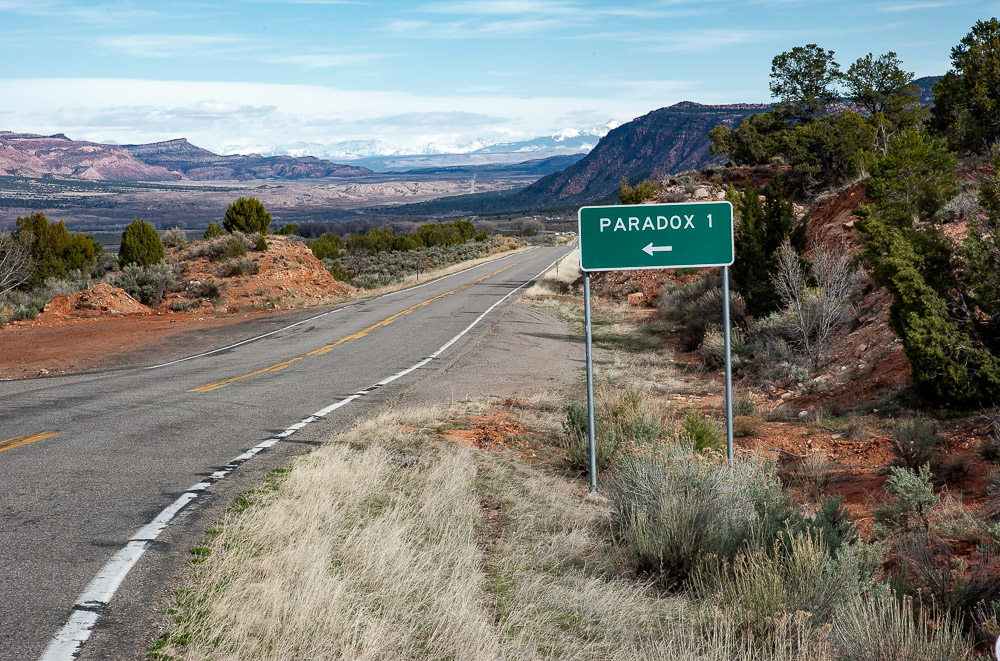
    This way to a Paradox©Ed Schlotzhauer

    Accumulating

    A problem with this focus on technology for its own sake is that we feel the need to always be searching for the “best”. New equipment always comes out and it is a little better than the old. We believe that to do the best job of our photography, we need the best new stuff. So it is an endless treadmill of acquiring shiny new things that will make us a better photographer.

    And it can get to the point where we get into a state of analysis paralysis. Have you seen someone out in the field lugging a huge, heavy pack with most of their “must have” gear? After all, no telling what we may encounter. So we bring the full range of ultra fish-eye to extreme telephoto lenses. And, of course, macro and perspective control lenses. A backup body (or 2) is a must. And a computer for checking our images on a larger screen and maybe doing a quick edit. Just to be safe.

    This person may spend more time trying to decide what to use and fiddling with equipment than they do finding subjects and composing and capturing images. Yes, “fiddling” is a technical term. ☺

    From what I have seen, when painters and sculptors get together with their peers and “talk shop”, there is a certain amount of discussion of technology and tools and equipment. But not like photographers. It can be an obsession with us.

    Dilapidated old store©Ed Schlotzhauer

    Make it disappear

    I don’t want to paint a gloomy picture of technology. I like it and need it, at least when it works right. It would be impossible do my art without technology.

    But go back to that original definition that technology is about applying knowledge to achieve practical goals. Its purpose is to help us do things better. It should not become an end in itself.

    Great technology used right should “disappear”. It is not about the wizard’s wand or the warrior’s sword. It is about what they can do with them. One way to make it disappear is to learn to use it so well that it is fluid and natural.

    I recommend that we choose a small set of equipment and learn it well. Learn its strengths and weaknesses. Yes, weaknesses can become strengths if used artistically. Think of film grain for example.

    Have you noticed that a lot of music pushes an instrument to its highest or lowest range? Pushing the limits can lead to interesting effects. And it tests the skill of the performer. Our photography can be a little like that. Push the limits.

    Practice with your equipment frequently. Go overboard with it. Pick up your camera every day and run through scenarios. It should be automatic. Learn to operate it in pitch dark, relying on familiarity and feel to guide you. Even if you only use one lens, get to know what it can do and learn to see like it sees. You do not always need to carry a full range of lenses. That is what feet are for. Move.

    If we develop this intimate knowledge of our technology, it becomes a tool we can wield for our creativity. It “disappears” in our creative process. Great things happen.

    I love the technology we have available today. It allows us to create great things. Always remember that the technology is for us to make art. Use it. Don’t be controlled by it.

  • Be The 1%

    Be The 1%

    We can choose to be the 1% of photographers. Those who make prints. A print is a special thing with its own life.

    The 1%

    I’m not talking about that 1% we hear talked about in the news – the richest people in the world or the country. The latest data I could find for the USA says that, on average across the country, to be in the 1% financially you need a salary of about $600,000 or a net worth of $11 Million. Another article said that 1% of the people in the world own over 50% of the total household wealth.

    I am not bringing this up to get into any discussion of income inequality, investing practices, demographics, or anything related to that.

    No, I am referring to a group of photographers we can easily choose to join. Peter Eastway speculates that only about 1% of photographers make prints. Why do you think we don’t print more?

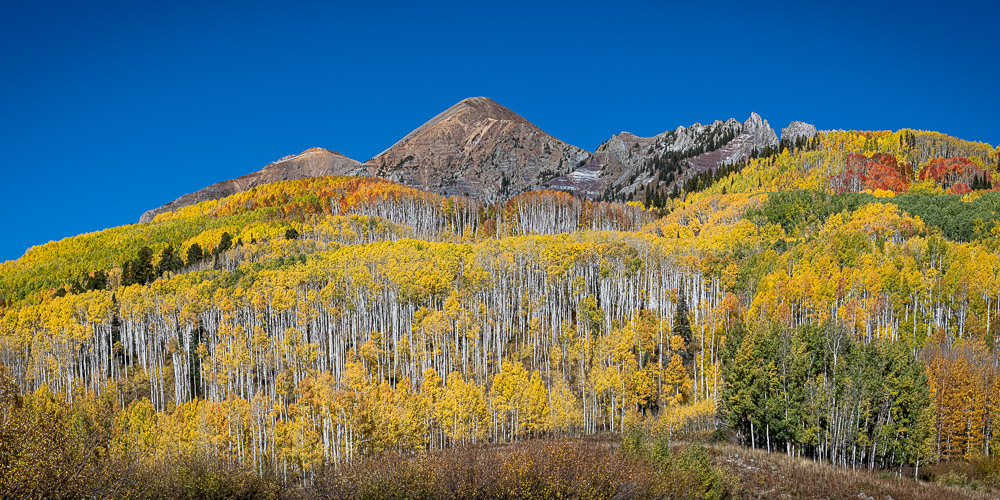
    Fall aspen in Colorado©Ed Schlotzhauer

    What is a print?

    First, what do I mean by a print? This may seem obvious, but I want to make sure we are on the same page, so to speak.

    By a print I am referring to an image presented in a fixed physical medium. A print is an object with weight and space and presence. We can hold it and touch it. We perceive it with our physical senses. And it is “permanent”. That is, it persists unchanged over time.

    A print is an enduring expression of the artist’s intent at the time. I say at the time, because it is quite possible for my intent to change with time. The print I make today may be quite different from one of the same image file 5 years ago, or even a few months ago. My vision changes and I often come to see it different. That is natural. I am the artist. Ansel Adams, for example, is famous for drastically changing his vision of how some of his famous images should be printed over time.

    What is a print not? It is not an image on a screen. Not your computer monitor or an iPad or your phone. It is not a fleeting image scrolled by on social media or your web site.

    Screens are important in the production of our art, but I hope they are not the main goal. Psychologically, we know that what we see on a screen is ephemeral. It has no permanence. We discount it easily. Being on a screen, we subconsciously consider it fluid and flexible.

    Why a print?

    A print is tangible. It is an artifact that persists in time and space. That is, it is physical. It is an object. We can hand it off to a client who buys it, and it becomes their possession.

    By giving the print this life of its own, we are creating a new piece of art. It is no longer under the control of the artist. Kind of like a child growing up and going out on their own. They are your family, but they have their own life now.

    As the artist, I can no longer “huddle over it” and protect and explain it. It is on its own. Now it is hanging on a wall. Maybe in someone’s home. Maybe in a gallery. But no matter where, it is now perceived for itself in isolation. It must explain itself, justify itself, fend for itself.

    A mindful view of fall colors near me©Ed Schlotzhauer

    New thought process?

    Deciding to make a print changes our perception of what we are doing.

    For one thing, we must commit our interpretation of what we see or feel in the image. We must resolve the “it could be like this or it could be like that” questions in our mind. Once we make the print, we can’t come back next week and change it. If we do, it becomes a different piece of art.

    And we will go through a more stringent selection process to pick it. Out of thousands of good images, why print this one? Does it do a better job of representing my view on the subject? Is it a more perceptive representation of something I feel? Will this give my viewers more insight than the many other images I could have picked? Is this an image I will hand to the world and say, “this is me?”

    New creative decisions

    And making a print involves new creative decisions. What size should it be? Some images seem to call to be large while others seem to prefer being small. Should this be a paper print or canvas or metal or acrylic? Will it look best as glossy or matte? Sure, some of the decisions will be dictated by the intended application. But many are purely artistic.

    And there are technical considerations that come in now. Does the file have the quality and resolution to make a large print? Can I print it and mount it myself or must I send it out to a service bureau to be done? The selected media imposes constraints on the image itself. If the desired effect is soft and ethereal then a matte finish may be best. But if the image relies on sharp detail a glossy substrate will make that pop more.

    I encourage you to make your own prints when you can. A good, medium size desktop pigment ink printer costs about the same as a mid-range lens for a 35mm camera. Having your own printer encourages you to experiment more. And the immediate feedback you get is gratifying.

    Break all the rules: not sharp, subject centered, subject indistinct, no leading lines, etc.©Ed Schlotzhauer

    Technical considerations

    Creating a good print is a specialized process that requires some detailed knowledge. The fundamental problem is one of basic physics. Screens generate light and emit it. It is an RGB mix, and it is additive. That is, red + green makes orange.

    We see prints by reflected light. Light hits the surface of the print and what bounces back is what we see. It is a subtractive process. The ink absorbs some colors. We see the reflected light that is not absorbed. To reduce the red you add cyan. Cyan is the opposite of red. More cyan absorbing red means less red reflected.

    This and other differences mean that a print will never look exactly like the image on screen. How close we can come is one of the challenges. How close we need to come is an artistic judgment. A print is another art form.

    Editing the image for printing is a task on its own. We load profiles for the media and printer and inks that we are using. A special profiling view is switched on so we see a simulation of what the final print will look like. This is, at best, a fair but not exact model. The reality is it may require several rounds of test prints and re-edits to get to a final print we like.

    It can be a lot of work, but it is part of the artistic process. This is work we must do to “birth” the print as its own entity.

    I usually have a number of prints hanging around my studio. Some because I just like them. But often it is to live with them a while to see if I like them long term. Results vary.

    Obscure found image. Track to nowhere©Ed Schlotzhauer

    Viewing it

    We have gone through all this work and expense to create a print. Why? Was it worth it?

    This is a personal evaluation.

    Sometimes you are disappointed with the result. Some images just do not seem to print well. That could mean we did not choose the best medium or size. Maybe it would have worked better in black & white.

    But most of the time you will feel the satisfaction of creating something new. Because the print is a new work of art. It is a distinct physical object with a life of its own. It lives in the world and is evaluated by viewers.

    We did our best job of composition and subject selection and lighting and a host of other things. We edited it carefully and prepared it for printing. Now it passes into another realm. We have tried to guide the viewers to see what we saw, but now they are on their own to discover it.

    The child leaves home and starts its own life. We are proud of it, but we cannot control it. It is not ours anymore. Likewise, a print becomes an independent entity. The viewers evaluate it on its own by their own criteria.

    Something tugged their interest enough to spend more than a passing look at it. Maybe we can draw them in and take them on a journey they did not anticipate. That is joy for the artist and the viewer.

    Take the leap. Be one of the 1% of photographers who make prints. It can change your art and give you a different relationsip with your images. And it can be a legacy.

  • Too Many Photographs?

    Too Many Photographs?

    Do you shoot too many photographs? Can we shoot too many? I think this is a question we can only answer individually. A lot of it depends on why we are shooting.

    Easy to do

    We are blessed with amazing digital technology that allows us to frame and compose and take photos rapidly. And some of our cameras can vacuum up 20 or more images a second if we want to. Memory cards are so large now that we can keep stuffing images into them for days and days.

    This is one of the things I love about photography compared to other arts. The way I shoot is usually spontaneous. See it – take it. Maybe think about it some and try some alternate compositions. Maybe.

    Working like this fits my personality. I have shot for so many years that much of the thought process of composition, exposure, etc. is subconscious.

    But a downside of this is that it is easy to shoot a lot of frames. Sometimes more than I ever intended.

    Dancing in the Rust©Ed Schlotzhauer

    Travel

    One of those times when we take many more images than usual is when we travel. Everything seems new and different and special. We are compelled to shoot. And we do.

    On a 3 week trip to France I shot over 4000 images. And I think I am rather disciplined. I know people who take many thousands more images than me on a trip.

    This is not a problem, unless it becomes one for us. It is fun and exciting. A benefit of traveling as a photographer is to take new and interesting images. We reward ourselves by putting our self in a “target rich” environment with our photography equipment.

    We seem to give ourselves permission to take more pictures when traveling. I don’t know why. We should feel total permission all the time.

    Projects

    Another thing that seems to generate a lot of images is a project. Assigning our self a theme or topic to focus on for a time can be energizing. Directing our attention can stimulate new energy and creativity.

    But it takes a lot of great candidate images to put together a story line and a few excellent selects for the final portfolio. When we focus on a project we suddenly see opportunities in places we never dreamed. That can lead to a lot of shots.

    There aren’t any metrics that matter for something like this. But for something to discuss, I figure that to get to a final set of 20 images for a project I need maybe 100-200 strong images that do a great job of representing the theme. To get to those strong selects may require hundreds of attempts. And this is for 1 short term project.

    I have some long term projects that I have accumulated a thousand or more candidate images for. And counting.

    Terra Incognita©Ed Schlotzhauer

    Arguments against

    It seems to me that the arguments against shooting a lot of images come down to 2 things: cost and time.

    It is said that shooting digital images is free. This is not true. If you care about treating your images as an important asset, they have to be managed and curated. This is an overhead expense we have to consider.

    Cost

    Disk space is getting pretty cheap, but that is offset by the quantity we require. I have an obscene amount of disk space. My main image storage is a 20TByte RAID disk. It is roughly half full. In addition, I am a fanatic about backup. A Time Machine backup runs every hour incrementally backing up to an external hard disk. In addition, I have another large network RAID disk for backup plus yet another external drive. These get complete backups of my images and Lightroom catalog every night.

    And once a week I run a backup that I keep offsite for more safety.

    Rotating magnetic drives wear out and have to be replaced. I have a stack of bad ones waiting for me to get into a mood to smash with a sledge hammer. I almost got there this week. SSD’s have an advantage of speed and reliability and I am in a slow process of switching to them as the price gets more reasonable. I don’t have a stack of them to smash – yet.

    This setup is definitely not cheap and has to be managed.

    Ice Streamlines©Ed Schlotzhauer

    Time

    But that is “just” money. There is another hidden cost that sneaks up on us.

    It takes a tremendous amount of time to load, examine, cull, sort, tag, and file all these images. And then the promising ones require a lot of editing. This can add up to a major time investment.

    Without a disciplined approach to managing our images, we basically end up with a “shoe box” full of pictures. A very large shoe box where is is almost impossible to locate an image we have in mind. Can you quickly locate your best images? How do we search for candidates for a project if we have 10’s of thousands of random files on the computer but no organization system?

    I spend more time selecting and filing and editing than I do shooting. And I shoot almost every day.

    I consider this a major unaccounted cost of shooting. The cost is in time. Time that is necessary to spend, but that we cannot apply to more creative parts of our art.

    Learning/growing

    Have I convinced you to shoot less? I hope not. That is not my goal.

    I believe the benefits of shooting a lot outweigh the costs. I just believe in being upfront about the costs so we can make an informed decision.

    For one thing, improving requires a lot of practice to hone and refine our skills. Our vision will only develop over time as we come to understand what we like and are drawn to.

    Cartier-Bresson said your first 10,000 photos are the worst. I think that is true, but it does not mean your next 10,000 photos will be great. Just better. It takes a lot of practice.

    Photography is a combination of art and craft. Both of those improve with practice. but only if we are honestly evaluating our work. Be your own worst critic.

    Linus Pauling said “The best way to have a good idea is to have a lot of ideas and throw away the bad ones.” I think this applies to photography as well. Are all of your shots keepers? I hope not. If they are, you are not out on the edge pushing yourself to try new things.

    Shoot a lot, experiment, do foolish things that probably will not work. Who knows? That is one way discoveries are made. And it can be a lot of fun.

    Why

    But most fundamentally, why are you shooting? Is it to make money? Is it to get likes on social media?

    Know what your goals are. I cannot criticize your goals. That is your personal choice.

    I can say I have come to understand that in my life, my goal in making pictures is the joy of creating something that gives me pleasure. The satisfaction of being creative and creating something I consider beautiful or interesting. Selling prints is welcome and a pleasant validation, but not my driving motivation.

    I am my main audience. If other people like my work, that is nice and it makes me feel good. But if they hate it, I will still create for myself. If I like my images, I am still being successful, even if everybody else dislikes them.

    Dallas Love Field abstract©Ed Schlotzhauer

    No

    So no, I’m not shooting too many photographs. They are for me. You will see few of them, so you do not care how many I shoot.

    I shoot when I travel. I shoot for projects. Just walking around my hometown gives me all the reason I need to shoot something interesting. Something that no one else was likely to see in the same way.

    My art is an important creative outlet in my life. It keeps me young (relatively). Art makes me think and keep a mindful attitude in the world around me. It feeds my curiosity.

    This is worth it to me despite the cost and time involved in keeping up with it. Whether I shoot many or few images does not matter. What matters to me is the art I am able to create and the satisfaction I get from it.

    I sincerely hope you are able to get as much joy from your work.

  • Why Do We See 255 Everywhere?

    Why Do We See 255 Everywhere?

    Do you ever wonder about the magic number 255 you see all over Photoshop and even in Lightroom Classic if you look? It seems like 255 pops up everywhere. Why is that? It is a strange number to choose.

    It’s just a number

    First let me say that at this point in time, 255 is just a number without meaning. It is the number chosen to represent the maximum value of a channel or color. Something has to be used to represent the maximum value. Looking back, 100 (as in 100%) would have probably made more sense. But we have 255.

    Think of it like Fahrenheit and Centigrade scales. The boiling point of water is 212 in Fahrenheit and 100 in Centigrade. Either way, it represents the same thing, the boiling point of water. That does not change no matter how the number is represented.

    So when you see 255 just read it as the maximum value of that thing. If that is the level you wish to understand, this would be a good point to stop reading this article. 🙂

    Personally I hope you continue. Understanding some of the history and details of our tools can only help improve our craft.

    Roots in binary

    Before we go deeper I need to justify where the number 255 comes from. It is rooted in binary coding. You are probably familiar with digital notations. We have lived with it for so long it seems to permeate everything around us.

    Please pardon me for going full on Geek here. I so seldom get to use my training that it is fun. A very, very brief background: when digital computers were being developed, it was found to be simpler and more reliable to create circuits that were either on or off, no in between states. This was called a bit. A piece of data that was either off or on, noted as 0 or 1. The advantage of this seemingly silly decision is that the bits could be made very small and can be operated on very fast.

    Dev on market©Ed Schlotzhauer

    A single bit by itself isn’t very valuable. To represent realistic information and do calculations bits were combined together in larger units. The next widely used unit was 8 bits. This came to be called a “byte”. Eight bits is a byte – Geek humor.

    It turns out that 8 bits is enough to start encoding useful information. For instance, it will hold 1 character. A byte is big enough to code all the upper and lower case letters, punctuation, and some special symbols. At least in English. And we will see that it holds a useful amount of image data.

    Let me give a very simple description of digital value coding using 3 bits:

    Each combination of the 3 on/off values is assigned a value. The encoded values range from 0 to 7.

    Going back to the unit we called a byte, the 8 bits can encode 256 values, 0 to 255. This is the origin of the magic 255.

    History of Photoshop

    It is hard to think that there was a “before Photoshop”. Thomas Knoll needed to develop ways of doing analysis on images for his PhD thesis. In those days, nothing was available, so he taught himself programming and developed a library of operations. Here is an interesting interview with Thomas.

    His brother John worked for Industrial Light and Magic. He saw applications for image processing in some things they were doing, so he encouraged Thomas to enhance his library. Eventually they decided to try to make it a product. Adobe was interested. It is amazing how things come to be.

    In the days when the library, later Photoshop, was developed, the state of the art of image representation was to code each pixel as 3 8 bit values. One byte each for red, green, and blue. Each color had the value range 0 to 255. This number scheme became baked in to Photoshop and a standard metaphor of the user interface.

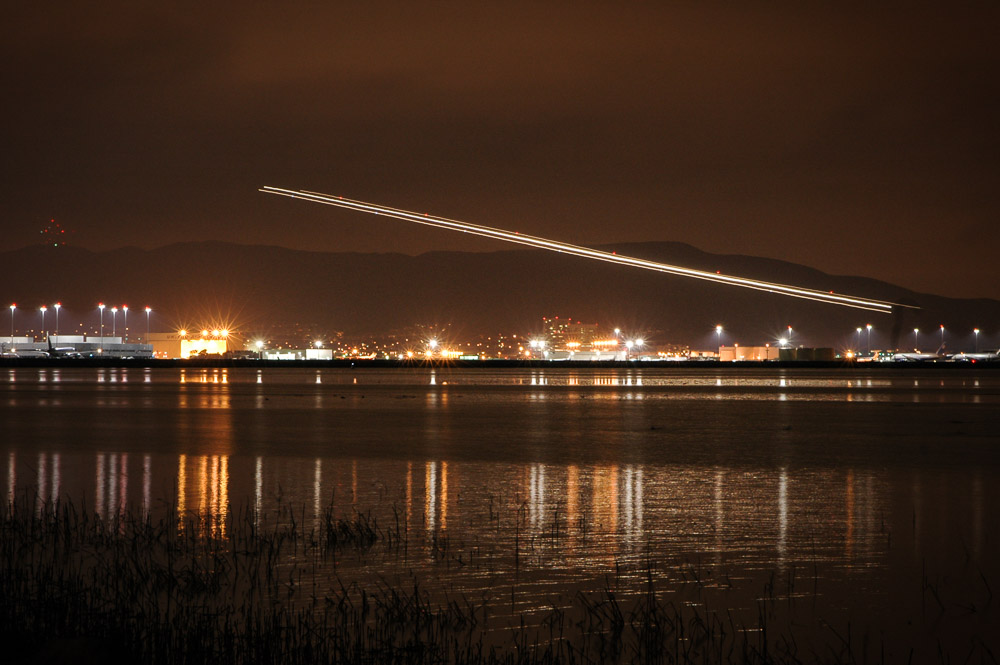
    Airplane taking off. A short project.©Ed Schlotzhauer

    Today’s data

    Early digital cameras shot 8 bit images. Today, though, images and Photoshop has grown well beyond that. As an example, my Nikon Z7 II captures 14 bit data. Each red, green and blue channel is 14 bits. That is 16384 values per channel instead of 256. Some other cameras have even more bit depth.

    Photoshop allows us to select if we will treat our files as 8 bit or 16 bit or 32 bit. With all these variables it could impose a huge burden on the user to deal with the actual value range of the data he is editing. Some of these numbers get to be staggering (for 32 bit data each channel has 4,294,967,296 values). Adobe chose to keep the maximum number we see at 255. In effect, it became an arbitrary measuring scale we work with across the apps.

    By the way, Lightroom uses 32 bit data internally. You do not get a choice. But even in Lightroom (Classic at least) the 255 illusion peaks through in one place. Look at the Tone Curve tool. The scale is 0 to 255.

    Still, it’s just a number

    Fahrenheit or Centigrade. It is just an arbitrary number to represent the same thing, the boiling point of water. Adobe has kept that historical number 255 and given it the implied meaning of “maximum”. It no longer has a tie to the actual size of the data you are editing or the maximum value of an 8 bit chunk of data.

    Eerie headstones©Ed Schlotzhauer

    They have done us a service in this. I would hate to think of the mental complexity I would have to go through if this number changed all over the place to be the actual values I am working with. But a simplification comes with some challenges. People tend to forget why the simplification was made. Even that one was made at all.

    When you are using the curves tool and other things, freely accept 255 as meaning “maximum”. Do not forget and think that your data only goes to 255. Or that it has somehow discarded all those other wonderful bits our modern cameras give us. When someone tells you that white is 255/255/255 and seem to think that is the actual value of their data, remember that is just a number on a scale. Smile to yourself knowing you probably understand it at a deeper level than they do.

    I don’t have many images in my catalog that are actually 8 bit data. I am very glad the technology has moved on in wonderful ways. And I am grateful for the simplified scale that normalizes what I see when I am working with all this data. Thank you Adobe. This is something you did right. It doesn’t matter what the number is, something had to be defined as a convenient value for “maximum”.

    Today’s image

    The image at the head of this is actually 8 bit. An 8 bit jpg file. All the data is actually 0 to 255. Back in 2006 that was about the best I could do with the camera I had. It’s not terrible. I like the image, but I wish I could shoot it again with a modern camera.

    As a matter of fact, all the images in this article are 8 bit. I wanted to emphasize that it was a very workable system.

    Side note

    In today’s digital systems we seldom worry much about a few bytes. Every time I press the shutter on my camera it writes about 50 million bytes to my memory card.

    I mentioned that digital bits could be made very small. As an example, Apple’s M4 processor, which is their main CPU as of this writing, has 28 Billion transistors. On one chip. That is hard to comprehend. It certainly wasn’t anticipated when Thomas Knoll developed Photoshop.

  • Out of Focus

    Out of Focus

    A few months ago I wrote about being in focus, both technically and mentally. I want to go a little deeper into how technical focus happens in modern cameras and an an experience I had recently where what I did was out of focus.

    What is focus

    Technically, focus is simple when the lens is adjusted so that the part of the subject you are most interested in is sharply defined. Your lens has a focus ring to use to manually focus. Most of us probably use the camera’s built in auto focus capability. This is much more precise than my old eyes. And a lot faster than most of us can do manually.

    Focusing physically moves one or more of the lens elements inside the lens barrel. This is required to adjust the focus point.

    I will let you argue whether focus is an absolute, precise point or just an acceptable range. I will just say that I am swinging away from being adamant about absolute technical perfection and leaning more toward artistic judgement and intent. Set your own values you will live by.

    Whether we manual focus or use auto focus, we observe in the viewfinder the image moving from a fuzzy blob a crisp, detailed representation of the scene before us. Unless we have a very old piece of technology in our camera with something called a split image viewfinder. I had this in my first SLR. It was magic and awesome for most of the subjects I shot.

    The split image viewfinder showed the image sharp regardless of focus. The image was divided into 2 pieces in the central circle. The pieces were offset from each other when out of focus. Use the focus ring to bring the 2 halves into alignment and the image was sharply focused. Magic. Enough trivia, though.

    Little did I know this was a type of and precursor to what we now call phase detection auto focus. Let’s get a little deeper into the technology.

    How does it work?

    Auto focus in a DSLR or mirrorless camera is complex and requires many precise components. But it works so well now that we tend to take it for granted.

    There are 2 basic technologies in modern cameras. The older one is called contrast detection and the newer and better one is called phase detection.

    I have written on histograms, a subject I consider vitally important to photography. Histograms and their interpretation are the basis of contrast detection auto focus. It is brilliantly simple in concept and in process as what we do when we are manually focusing.

    If an image in the viewfinder is out of focus, the pixels are blurred together. Kind of like looking through a fog. A result is that in the histogram, the values are clustered in the center. This is an indication of low contrast. But when an image is sharp, there is a wider range of brighter and darker pixels. This illustrates it:

    From https://digital-photography.com/camera/autofocus-how-it-works.php

    Focus process

    So conceptually, the system moves the focus a little and measures again to see if the histogram got more narrow (more out of focus) or wider (sharper) . If it got more in focus, continue moving that direction and measuring until the peak contrast if found, But if it got more out of focus, move the focus the other direction and continue the process. It is a hunting process to find the optimum focus point. Just like we do to manually focus.

    Unfortunately, this process is slow. It can take seconds to arrive at the focus. This is why phase detection auto focus came to prominence.

    In phase detection auto focus, some of the light coming through the lens is split off to a separate sensor. Like the split image viewfinder I mentioned above, it is further split into two paths. Through some brilliant engineering, they can determine in one measurement how far off focus is and in what direction. The focus moves there quickly. Note that in mirrorless cameras all the light goes directly to the sensor, so these auto focus sensors are built directly into the sensor.

    I said that phase detection is “better” than contrast detection. That is true as far as being very fast. Actually, contrast detection can achieve more precise focus. There is a kind of system called hybrid the combines the strengths of both. I will not discuss that or go into the bewildering variety of focus areas or focus modes.

    Out of focus

    This is all great as far as technology goes. It works quite well in the cases it is designed for. We are lucky to have it.

    But all of these systems rely on the sensor having enough light to see some contrast. It doesn’t work in the dark. Yes, there is another variation on auto focus that is called active auto focus. It shoots a red beam from the camera to illuminate the focus area. This has a very short range and does not help the scenario I’m about to describe.

    Recently I was in Rocky Mountain National Park, over on the west slope where there is little light. It was full dark on a moonless night. The mountains all around provided lovely silhouettes. The stars were astonishing. Beautiful. I had to stop and get some star images.

    A trailhead parking lot provided a great and convenient place to set up – wondering if those occasional sounds I heard in the dark were bears. I guess not. It was perfect. Except. There was not enough contrast to focus, even at 6400 ISO. And the viewfinder image was too noisy to be useful for manual focus. I did not have a powerful enough flashlight to cast enough light on the nearest object, over 100 yards away, to allow the focus system to work.

    Adding to the problem, the lens I brought on this outing did not have a focus scale (a curse of modern zoom lens design). Normally, in low light, I switch to manual focus and set the lens to infinity for a scene like this. I guessed, but missed badly for a big section of the images. They were uselessly out of focus. I am ashamed to show an example, but like this:

    A blurry night shot©Ed Schlotzhauer

    Experience is a great teacher

    I write frequently advocating that we study our technology to become expert with it. And to practice, practice, practice to know how to use our gear, even in the dark. I failed. I encountered too much dark and a lens I had never tried to use in low light. The combination tripped me up. I am ashamed to admit I did not follow my own advice well enough.

    But every failure is a learning opportunity, right? It can be a great motivator and reinforcer. I did some research and discovered a “hidden feature” I never knew my camera had. It should save me the next time I do this.

    My Nikon camera has a setting I had never paid any attention to called “Save focus position”. When On (the default) it remembers the focus position of the current lens when the camera is turned off and restores it on wake up. But when Off – this is the brilliant part – it sets the lens to infinity on wake up. Now I will have a known infinity focus setting, even in total darkness! This setting is now in my menu shortcuts so I can access it quickly.

    I would never have learned about this feature if I had not failed so spectacularly. Experience really is a great teacher.

    So dig into those obscure settings you never bother with. There sometimes is gold there.

    Keep learning and failing!

    The featured image

    That night’s shooting was not all bad. I nailed the focus on this star shot. It was purely of the stars and had no foreground. This foreground has been substituted from another blurry image that night (actually, redrawn by hand).

    This is artistic expression rather than literal reality. I do that a lot. As photography progresses and matures, I believe that is more and more the norm.