An artists journey

Blog

  • Staying Creative

    Staying Creative

    Since you are reading this, you probably call yourself a “creative”. That is great. But creativity seems to be cyclic. Staying creative is a continuous process. Some would say a struggle.

    Cycles

    Creativity is not a constant level. We experience creative peaks where exciting new work seems to burst from us. But we also have low points. In those troughs we don’t feel like we can generate any creative ideas. It is depressing and scary.

    The encouraging reality is that this is normal. We do not and cannot operate at a peak of creative output all the time. We empty the tank. The reserve has to be refilled. It can’t be predicted or planned, but at some point it seems to dry up. But keep in mind that we really do not know what creativity is.

    We know it is cyclic. And we know it will come back at some point. But when we are in that valley it can seem like a time of doom and gloom. Will it ever come back? Have I used up all the creativity I had and now I will never have any again?

    You have thought these things. Admit it. I’m not the only one with these fears.

    Tennessee Stream©Ed Schlotzhauer

    Forcing creativity

    So what do we do? At some point we often resort to forcing it. We are determined to regain our creative highs, so we try to make our self create.

    How does that work for you? Probably as poorly as it does for me. Sure, we can do some good work, even very good work. But we can’t kid ourselves that it is up to the level of our best.

    Whatever it is in us that generates creativity operates on its own schedule. It is not sympathetic with our wishes. We can be welcoming and encouraging to it, but it does not operate at our command.

    Do something

    Now I will seem to contradict what I just said, but I do not believe it is a conflict. We will get through a creative valley easier and probably faster if we work through it. I used the idea of “emptying the tank” of our creativity. I believe practicing our craft and following our curiosity are very good behaviors to help refill it.

    You may not be inspired with amazing new creative ideas, but go out and see what you can find. Explore. Do not expect to do your best portfolio work. Taking that pressure off will help you relax and lean into it. But doing something is better than sitting around moping.

    It is a wonderful time to learn new skills, take some courses or watch some videos. Pick out some new technique you have been curious about and learn it. Practicing it now without all those creative bursts getting in the way is a good time to learn. It is a great time to explore some of those dark, scary corners of Photoshop that have intimidated you for a long time.

    Like most of life, doing something is better than doing nothing. Don’t sit feeling sorry for yourself, thinking you are useless and have no more creativity. Fill. your time with learning, exploring, practicing, experimenting, even catching up with cataloging your images. And always follow your curiosity.

    The word “create” is a verb. Be active. Go make things. Make dinner, make a drawing, make a fire, make some noise, but make. If all your attempts at being creative consist of passively consuming, no matter how brilliant what you consume is, you’ll always be a consumer, not a creator.

    Scott Berkun, in The Myths of Innovation

    An un-pre-visualized shot taken from a moving boat on the Seine River.©Ed Schlotzhauer

    Relax

    When creativity seems to slip away, when the muse no longer is with us, relax. It does not mean it is gone forever. Like waves, there are highs and lows. It will come back.

    Even when we are not feeling inspired, we can keep on working and learning. Do not be passive and waste your time. Be preparing for the rush of creativity when it comes.

    We are not a failure when it seems we cannot create astounding new things on command. We are recharging. Accept it. Go do your work anyway.

    Have you done creative work you are proud of? Then you should be able to do it again when you are ready. Creativity is not a limited resource that is used up. When you are feeling it, pour it out on everything you do.

    Let it flow

    Being in a flow state is a great feeling. But it is not exclusive to feeling creative. Anytime you are immersed in applying your skill to a difficult and challenging problem you can be in flow.

    Flow and creativity, then, are not synonymous. We can do great work even when we are not riding the crest of creativity. Don’t stop working.

    Curiosity is the thing that pulls us along through life and through our art. It does not come and go like creativity. In that way, it is more powerful than creativity.

    The cure for boredom is curiosity. There is no cure for curiosity. – Dorothy Parker

    I like that idea that there is no cure for curiosity. I don’t want to be cured of it.

    We can develop our curiosity by asking questions and wondering about things. Give yourself permission to follow your questions. Find the answers. Try things. See what happens. This healthy attitude will carry us through the ups and downs. Creativity may come and go, but our curiosity goes on and gets stronger.

    So, even if you feel that your creativity has evaporated, trust that it will return again, just like it has in the past. While you are waiting, keep photographing, learn, practice, experiment, and especially, feed your curiosity. You might find that the extra kick of creativity is actually just an incremental boost to the power of your curiosity.

    The artist is nothing without the gift, but the gift is nothing without work. – Emile Zola

    An unexpected travel shot. It came from taking the time to stop and watch and wait.©Ed Schlotzhauer

    Staying creative

    So, as far as staying creative. You won’t always be at your peak. Sometimes you may feel way down in the valley. Don’t panic. It will come back. In the meantime, there are things you can do to improve yourself as an artist and a person and to entice the creativity back. Work on your curiosity. Explore new ideas and techniques. When you feel the creativity flowing again, you will be even more ready to use it.

    But no matter what, keep working.

    Today’s image

    Sunset downtown. I turned my view down to the parking lot instead of out at the glowing buildings. Is this creative? Or is it just following my curiosity? I don’t know. I will leave that for greater minds to decide. Either way, I was letting it flow.

  • Life Is Happening

    Life Is Happening

    Life is happening right now. it is not something you hope will happen someday. Make the most of it, now. This includes your photography.

    Now is all we have

    The past is gone. The future is uncertain. The present time is what we have. Use it. Use it up. Wring it dry.

    Time is a scarce and fleeting resource. We can’t slow it or bank it or save it. It passes, whether we want it to or not. It moves at the same rate for all of us. Use this very moment wisely. Once it is gone, it can never be reclaimed.

    I don’t mean to be all Zen or depressing. But this is true and should be top of mind for all of us. Time is a resource we cannot control. All we can do is use it wisely.

    Pinocchio?©Ed Schlotzhauer

    We don’t get a “do over”

    We only have one life. I won’t argue reincarnation with you.

    The choices we make on a day to day basis shape our future. When we decide not to do something, it is rare to get a second chance. How many opportunities do we let slip by to do something that would make us better?

    Deciding to spend our time watching TV or playing games or hanging out on social media is wasting one of our most valuable treasures – our time. Solely my opinion, of course. Only you can decide what is the best use of your life.

    Do days seem to slip away, disappear into a fog of sameness as we repeat the same actions every day? Why do that? That is the result of having no direction. Of letting external voices control our lives. Those voices do not have our best interests at heart.

    It is commonly documented that when people are asked on their death bed what they regret, one of the most common regrets is that they did not take the chances they wanted to. For instance:

    I wish I’d had the courage to live a life true to myself, not the life others expected of me. This was the most common regret of all. When people realize that their life is almost over and look back clearly on it, it is easy to see how many dreams have gone unfulfilled. Most people had not honored even half of their dreams and had to die knowing that it was due to choices they had made, or not made.Old Colony Hospice

    Fear caused them to miss out on the opportunities to lead a different life. This is what they regret at the end. It is so easy to do and it seems like the safe path. But who said everything should be safe or easy?

    Rise Against, representing the daily struggle©Ed Schlotzhauer

    Don’t just live for the future

    On the other hand, we sometimes see people who seem to live entirely for the future. They have a “plan”. Their current time and energy and money is being banked for what they plan to do “someday”.

    This is another way of avoiding living your life in the present. It is great to have goals. Even great goals that will take years to achieve. But what about now? The goals should direct the trajectory of our lives and influence how we spend our time. But they should not shut us down. No matter how important our long term goals seem, we are still living our life right now.

    Even if you’re an entrepreneur and are starting a business from the ground up, you still have a life to live Maybe you decide it is in your best interest right now to be working 100 hours a week and pouring all your money into this business. But at least have an exit plan. It’s got to be a temporary agreement with yourself. Know when to call it quits. Think about what it is doing to your life and health and your family. Some things are more important than making a big bundle of money.

    There is a saying “if you want to make God laugh, tell him your plans.” One point of this is that we are not as in charge of our plans as we sometimes think. If we cannot control the future then it is foolish to pin our entire life on an uncertain outcome. Live for now, too, while we are working for that future.

    I had a friend who worked and saved to retire early. He had great plans: extensive travel, learning languages, doing good works for charity, etc. A great list. A few months after he retired, he was dead. Didn’t see it coming.

    Wouldn’t he have been better off doing those things when he had the chance rather than putting them off to “someday”?

    Be in the moment

    That probably seems very heavy and perhaps depressing. It shouldn’t be. It really resolves to a theme I come around to a lot – mindfulness.

    Mindfulness simply means being present, in the moment, aware of things around you and what you are doing. It helps us to live our lives now rather than fretting about the past or worrying about the future. A mindful attitude encourages curiosity. It leads us to learn, to explore, to experiment.

    As photographers, these are skills we should always be practicing. Are we really seeing what is around us? Are we open to the opportunities that are there? Do we see past our preconceptions? Are we able to see the things around us for what they are and what they can be? And are we willing to put it in action by going out and photographing it?

    Compared to the life experiences I was talking about this may seem trivial. But it is all related. When we are mindful – when we can really be aware and in the moment – we will be more successful living in the present. Think of photography as training for living a more rewarding life.

    So I believe it is at least a double reward. Being mindful in our photography will keep us more engaged. We will be more creative and we will likely be happier with our images. Isn’t that one of our purposes in photography? What is really more important than growing creatively and being pleased with our work?

    But, too, as we practice mindfulness in our photography it helps discipline us to be mindful in our daily life. Just thinking and being aware and in the present helps us to consider what is important. It helps us to decide how to make better use of this moment.

    In a storm? Standing bravely?©Ed Schlotzhauer

    Moderation

    Am I suggesting that you should quit your job and go do whatever “fulfills” you at the moment? Of course not. Living your life means you have responsibilities. Some things are urgent, some are important, some are just necessary. Being mature is knowing the difference and deciding what to do when.

    You have bills to pay. You have a career, a family, housing to provide, people have to eat. Your government wants you to pay taxes. Unfortunately, we do not just get to do anything we want. We will do what is necessary because we are responsible adults.

    But we have a hundred moments a day to choose what to do. When we can choose to drift instead of doing something useful and constructive. To be on automatic and just do the easy things. Practicing mindfulness is a great help in being aware of what we are doing and deciding to choose better things to do.

    Mindfulness in photography is practice that helps us lead a more mindful life overall. Photography can help shape our life. Who knew?

    Life is happening all the time. We can’t call a time out. Let’s not let our life drift away without giving it the best we can do.

    I don’t want to come across as “preachy” or judgmental or having all the answers. I am a fellow traveler, looking for my path. Perhaps I am further down my path than you are.

    Please take this as encouragement to practice a more mindful life. Remind me, too. When we are mindful we can take joy in where we are and when we are.

  • Do You Take Pictures?

    Do You Take Pictures?

    Do you take pictures? Well, of course. We all do. I suggest if we are serious about making art that may not be the best attitude.

    Take pictures

    It is estimated that about 2 Trillion pictures are taken a year. That is several hundred pictures for every person on the planet. Probably 99.999% of those are shot on cell phones. Nothing wrong with that. Cell phones have gotten amazing. But realistically, most of the shots taken are selfies or predictable tourist pictures. Again, nothing wrong with that. If the picture makes them happy, it is good.

    Everybody takes pictures. Do you know anyone who has never taken one? I don’t.

    But I am writing to an audience who admires photographic images and probably aspires to make much better ones themselves. What makes a picture good?

    There are obvious qualifiers like being sharp, well lit, subject easy to see, things like that. Those are things that, if you do not do them, it probably will make the picture bad (unless you did it deliberately). But, as you have figured out from experience, eliminating the problems does not mean your pictures become “good”.

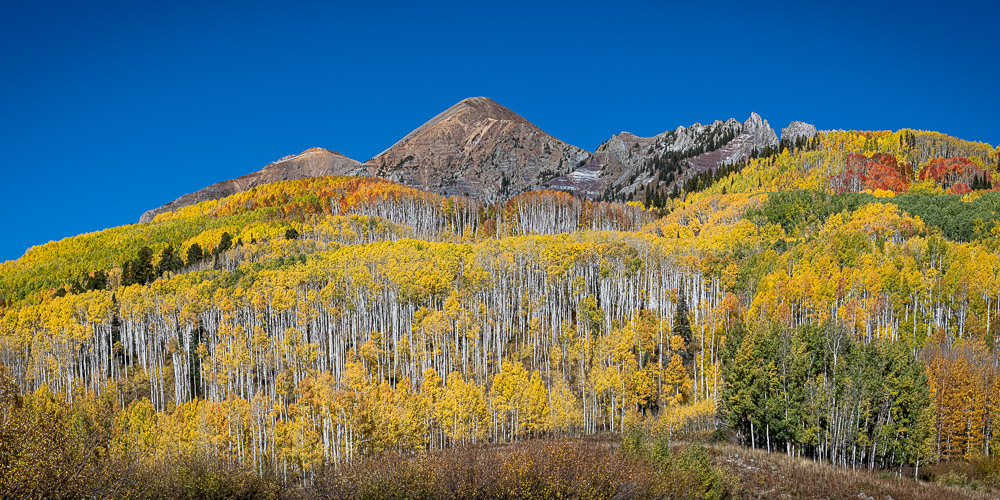
    Rocky Mountain fall panorama©Ed Schlotzhauer

    Taken by pictures

    The concept of being taken by pictures is one I picked up from John Barclay. It resonates with me, because I have seen it working in my art.

    What I have seen in my photo shoots is that sometimes something special happens. We no longer are looking for pictures. We have found a subject or place that captivates us. It releases some kind of creative energy within up. We are not just trying to take a picture, we are trying to capture the magic we are feeling. We have to shoot this. There is no choice not to.

    It may be very easy or it may be hard. That is, the scene may present itself to us complete. We have found a treasure. We just have to compose it, set the camera, and take the picture. It is already perfect. Don’t mess it up;

    Sometimes it teases us. We know there is something great hiding there, just out of reach. Maybe we have to walk around to look for the right angle. Perhaps it is zooming in on the right piece. Or waiting for the right light, Maybe it is a matter of thinking about it to figure out what is calling to us. Whatever it is, we usually know it when we see it. The inner voice guiding us says “Yes!”. Then we know we have captured the essence we are searching for.

    When this happens it is very rewarding. We know we have glimpsed something great and good and we feel like we have captured a view of it.

    What is the difference?

    The difference is taking a picture vs making art. Taking vs giving.

    When you’re at the Eiffel Tower and you think “I like that and I should shoot it”, you probably know how to make a good record of it. You and 50,000 other people that day. When anyone sees it they say “yep, that’s the Eiffel Tower”. No passion. It is just a fact. You might even want to hang a print of it on your wall. But you could get the same thing from any print on demand web site.

    But when we are taken by a scene, there is an intensity and passion invoked in us. It is a personal experience. With luck and skill on our part, some of the feeling might be shared by some of our viewers.

    We did not take the picture to show it to you. We had to take it for us. It was something we were drawn to. It is like it was a gift given to us.

    Geese flying at sunset©Ed Schlotzhauer

    If it does not captivate you

    I use a recent trip to France as an example a lot lately. It is recent and fresh in my mind.

    I was unashamedly a tourist. That means I shot a lot of pictures because I felt I needed to record where we were and what we were seeing. Just like everyone else with their smart phones. Even though I was using a nice mirrorless camera, they were still mostly tourist shots.

    Some of these are nice. That is, they are sharp, well composed, and show what I want of the scene. I will keep too many of them, but just for my own private memories.

    But a few were moments where something spoke to me and drew me into an image. These times were meaningful to me. As far as images go, these were the Wow moments of the trip for me. Whether anyone else ever sees them or appreciates them doesn’t matter. They are special to me. When I go back and look at them I remember the feelings of the moment.

    It’s about emotion

    A common theme that recurs is that it is about passion, emotion. Did I feel anything deep or special about this, or was it a record shot? Record shots are pretty and a few will go into a slide show or book of the trip.

    The really meaningful images weren’t shot to a plan and were not shot primarily to record the event or place. They may be random occurrences. But these are special to me. Times when I was truly engaged and excited by what was there.

    If I wasn’t excited about what I saw, why should you be?

    Car wash brush abstract©Ed Schlotzhauer

    Don’t settle for just taking pictures

    So take pictures. But don’t settle for just taking pictures. Let’s turn up our sensitivity to hear when something is calling to us. If we are not actively listening, we will probably miss it. We know something great is there. Now we have to find it. Work the scene. Peal away the clutter. Follow your instinct. Let yourself be taken by pictures. It is worth it.

    When we get caught up in a situation like this, it doesn’t really matter if all we have if a cell phone. Use what you have. But follow you passion. Figure out what is really there and get the shot. Take the gift. Appreciate it.

  • Take a Cheap Trip

    Take a Cheap Trip

    Most of us like to vacation. Travel is booming at levels not seen for years. Popular vacation spots are often overcrowded. And costs continue to increase. What if I suggested a way to take a cheap trip? One that may benefit your photography. And it’s not a timeshare sales pitch.

    High costs

    Travel inflation seems to be higher than other inflation in general. It restricts some of what we can do.

    A trip overseas for a few weeks can be out of reach, both in money and the time required. It can suck up our entire savings for a year or more. Even taking a local road trip is getting to be a burden and out of reach for some of us.

    But some of us rely on travel to refresh and relax us. What are we to do?

    Antique narrow gauge steam locomotive snowplow©Ed Schlotzhauer

    Why do photographers travel?

    Photographers seem to have a special fondness for travel. We expect the travel experience to renew us, shake out the cobwebs, invigorate our vision and interest. And we want to come back with exciting new images to show and talk about.

    This has long been the case. From the beginning photographers tended to travel.

    As soon as the technology allowed fairly portable equipment, it seems like photographers were traveling. Matthew Brady traveled and photographed extensively during the American Civil War. Other famous artists like William Henry Jackson and Ansel Adams shot exclusively outdoors. And I’m just highlighting American photographers.

    These artists traveled to places most people couldn’t go in those times. They opened up our understanding of the world and what was going on. In this, they did a great service.

    Our travel expectations are probably more modest. We will seldom go to uncharted lands no one has ever seen. But we go to places new to us. Or at least places outside of our normal routine. It is enlightening and changes our perspective and understanding. That is usually a good thing. And refreshing.

    I think a yearning to travel is an inherent part of society these days. Especially for photographers.

    Shake it up

    But I promised you a cheap trip. Here goes: shake up something you usually do.

    Yes, that’s it. That’s all.

    We all fall into ruts. Shooting the same subjects in the same way with the same lens in the same lighting. It becomes a habit. A habit is where we avoid thought and go through life on automatic. Shake that up by changing something. Force yourself to confront a different situation where we have to think.

    One simple thing is to pick one lens we seldom use and photograph exclusively with it for a while, say a month. Some of us are naturally wide angle shooters. Switch to a telephoto. Some of us see only telephoto shots. Switch and only carry a wide angle for a while. Or a macro lens and only shoot closeups. Or a fish eye, or a tilt/shift. If you are a landscape photographer, try street photography. If you do portraits, try night skies.

    And yes, just carry that one lens. Not your whole kit. It will force you to play the game.

    Maybe try putting aside your “serious” camera for awhile and only use your phone. Or shoot with the expectation that you will process everything to black & white. Maybe it could be as simple a thing as deciding everything you are doing now will be cropped square.

    Chain link fence with frayed cloth©Ed Schlotzhauer

    Just do something different

    It really does not matter what you choose, as long as it is different enough from what you usually do. During this time you are not concentrating on adding to your portfolio. The goal is to break free from your normal habits and learn to see better. Think again.

    How is this a cheap trip? Travel encourages us to see different. We are out of our comfort zone. We become more mindful. Basic assumptions have to be re-examined. Things look new and different so we pay more attention to them. Making a change in our routine triggers similar things.

    One way to simulate that same effect as travel to force our self out of our normal rut. A cheap and easy way to do that is to force a change in how we see through our camera.

    Sound too easy? Try it. You may be surprised.

    Practice mindfulness exercises

    Making a change like this is one example of a mindfulness exercise. I’m not talking about chanting and navel gazing. The purpose of mindfulness is to set aside our preconceived notions and expectations. Wall out the distractions that are enticing us to other things. Learn to be in the moment, and to look around and actually see what is there.

    Some people can get there through meditation. Some others through travel or workshops. Maybe for you going to a museum and looking at the work of great masters does it. But regardless of the mechanism that works for you, mindfulness comes down to creating a still place for yourself. A place where you can set aside distractions and competing thoughts for a while. Where you can free yourself to really see and consider what is around you for what it is. Where you can immerse yourself in the experience of creating.

    In a canal©Ed Schlotzhauer

    A cheap trip

    I am not really joking when I say changing up your normal routine or environment occasionally is a cheap trip. It can produce some of the same benefits we often get from travel. Granted, it may not be as much fun, but it is a lot cheaper. And you can do it anytime or anywhere.

    No, I’m not suggesting that this is an excuse to go buy that great new lens you have been wanting. Of course, whatever excuse works for you is up to you. But that shoots down the idea of a cheap trip.

    Getting out of our normal territory and traveling to a new location often puts us in a more mindful attitude as we shoot. It amazes me that everything we see becomes an interesting subject. Part of that is because we set aside the uninterrupted time to be there and shoot. But I believe a large part of it is that we are seeing things new. That refreshes and energizes us.

    I am suggesting another way to stimulate a similar effect of travel is to change something about our routine. Something to make us think, reconsider, focus more on what we are doing. Something to make us see past mechanics and rules of composition and social media likes.

    Make it a habit to challenge yourself like this periodically. It does not require an uncomfortable 10 hour plane ride.

    Today’s image

    The image at the top of this article is an example of shaking myself out of a rut. This was taken in the Rockies in fall. Normally during this time I am concentrating on beautiful fall colors and aspen trees.

    In this case, I tasked myself with ignoring the leaves and shooting the mountains after dark. No trees or fall colors visible. This is the Eisenhower Tunnel from the Loveland Pass road. Stars are just becoming apparent as the last light fades, illuminating the mountain silhouettes. The trail of lights in and out of the tunnel adds unique interest.

    I felt good about it. Definitely not a conventional fall landscape.

  • Slow Editing

    Slow Editing

    What’s your rush? Personally, I find my editing process is improved by what I term slow editing. I let images age for a while before making final decisions.

    What’s the rush?

    I see a lot of photographers who seem to be tied to daily production quotas. After being out shooting all day, at night they feel compelled to edit the day’s shoot and post some to social media.

    I don’t. If that is your need, I can sort of understand, but I don’t agree with you. It is a much better use of my time to go out and have a relaxing dinner with my wife. Later that evening I may sample a few images – in camera only – just to make sure I am getting reasonable results and there are no technical problems. After all, it is too late to do anything about the day’s shoot at that point.

    Sidewalk cafe, Paris©Ed Schlotzhauer

    As a matter of fact, I no longer even backup my memory cards while I’m traveling. I seldom bring a computer anymore, so I don’t and can’t do any processing. This is part of my newfound minimalist attitude for photography. More on that later. It’s not the subject today.

    My point is that I am not pressured to rush updates out to anyone on any schedule except my own.

    Aging helps

    More and more, I find that aging helps the quality of my curation process. That is, if I edit immediately, I don’t make the best decisions. Now I usually deliberately build a lot of delay into my process. This is what I mean by slow editing.

    Why would I slow it down intentionally? I find that time helps me distance myself from the emotions of the moment when I took the image. These emotions can often promote a picture to prominence it does not deserve because of what I felt. Time helps the emotions to subside. I can look at the images with cool objectivity. Well, I can do better. Can we ever truly be objective about our own work?

    There is a double standard that we must apply to our work. I believe that emotion is a key part of making a great image. If we did not feel something special, how can we bring an excellent image to our viewer?

    But during editing, emotion is a hindrance. We have to be brutally objective. We may have loved the moment and captured something that is extremely important to us. But if it is not as sharp as necessary and well composed and well lit, and if it did not capture a moment that shows other people what we felt, it is no good except for our private collection.

    Time helps me get the emotional distance I need to realistically cull out images I love. It’s still painful, but a lot easier.

    Editing takes time

    I find editing to be a very time intensive process. Maybe I do not have a good process. Or maybe I am just inefficient. Or maybe this is just what I must do. But that is where I am. My process works for me.

    I have seen people who are able to burn through a large shoot in minutes. Never spending more than about a second on any one before flagging it as thumbs up or thumbs down. That usually does not work for me.

    Couple in love©Ed Schlotzhauer

    Here is an example of my high-level editing workflow: First, let it sit for a while. One to 2 weeks is usually a minimum. Longer if possible. Then make a pass through marking obvious rejects and doing some quick editing on some of the ones kept, making sure they have a good chance to turn out well. I seldom spend more than 2 minutes editing an image at this point and I do it in Lightroom Classic.

    At this point I have probably eliminated 1/2 of the original images. My next pass is “housekeeping”. I make sure the keepers are tagged with location metadata and some preliminary keywords.

    Slowing down even more

    The next pass, when I get around to it, is a “grading” scan. At this point I allow myself to assign 1 to 3 stars to each. My informal scale means 1 is worth saving, 2 if better than average, and 3 is a possible winner – but it still needs more work.

    In another pass I concentrate a lot on the 1’s. These are sort of on the edge. I ask myself if any should be promoted to 2 or should they be eliminated. Quite a few may change. It is always my goal to try to eliminate when I can. I used to keep almost everything thinking I might need them someday. I don’t.

    Now I go back and look just at the 2 or higher rated images. What other editing needs to be done? This can get very time consuming, with edits in Lightroom and/or Photoshop taking hours in some cases. Ones I feel very good about at this point might get promoted to 4 stars. A very few rare ones maybe to 5. I do more keywording on the best ones.

    But here one of the weird twists of my editing comes in. In reality, stars mainly mark how I feel about the image. Not how highly I rate it. The real rating comes as I sort them into collections.

    By this point I have rigorously shredded and thrashed the image set. I am now ready to file the survivors into permanent storage locations and gather some into collections. At this point a lot of the survivors are tagged for copyrighting. Fewer are “promoted” into my quality hierarchy.

    This promotion process is lengthy and takes several passes. I currently have 6 levels of quality. It may take months and many reviews for an image to rise to the top collection.

    Menu on the mirror©Ed Schlotzhauer

    A recent example

    As I write this I am about a month past an excellent trip to the south of France. Awesome; do it if you get the chance.

    Over the trip I shot about 4000 images. I loaded them in my computer immediately on getting home, but waited 2 weeks before even looking at them seriously. After another 2 weeks I am about halfway through the first pass, eliminating a lot and doing some preliminary edits on the ones not immediately rejected. I figure it will be at least another month before I have my final picks. Even then all the editing will not be competed.

    Yes, I am very slow. It takes me forever to get through a large edit like this. But when I get done, I can be confident that the higher rated ones are decent to show people without embarrassment. I know that the only low ranked ones I need keep are for some textures and backgrounds. I never go back through the low ranked ones to select images for a show or project unless I need a filler to tell a story. That doesn’t stop me from keeping a few of them “just in case”. Emotional attachment leaks in. But they are filed separately.

    Reimes Cathedral©Ed Schlotzhauer

    My experience

    I am being candid about the workflow I have evolved to. This is slow editing in the extreme. All I can say is that it works for me. This is true of any workflow, no matter how famous (or unknown) the instructor is who is recommending it. Your workflow is highly idiosyncratic. Experiment to try alternatives, then do what works for you no matter what anyone else says

    As I am going through these images from France, I find that I am disappointed with a lot of them. Just tourist shots. Of course, I was a tourist. But some, a few, capture my feeling and interpretation of a place or event. Those are a joy to find.

    I have to let the emotion of the experience drain off to make good judgments about my images. This takes time. Luckily for me, I do not have to be on anyone else’s schedule. I’ll get there when I get there.

    Today’s images

    All the images in this article were shot in France on previous trips. After all, I haven’t finished this year’s edits yet.