An artists journey

Category: Technology

Ideas about the mechanics, techniques, and technology behind image making.

  • Not HDR

    Not HDR

    My last article sang the praises of HDR processing. I don’t want to over sell it. Today I will try to balance it by showing we typically do not need to use HDR.

    The good

    My previous article attempted to show when and why to use HDR. There is a time and place for it. In general, if a histogram shows more than about 7 stops of needed information then I would consider HDR, if the subject and situation allows it.

    The example I used was a scene with the sun visible in the frame but where I also wanted to preserve the deepest shadows. Back in the film days we had to use a split neutral density filter over the lens to try to compress the dynamic range in these situations. Whenever you would have reached for the split ND filter is the time to consider if you can use HDR instead.

    The bad

    But HDR has some problems and limitations. There is the dreaded “HDR look” that most people want to avoid. In addition, there are problems with subject movement and extra processing steps to do.

    When HDR first became available, people tended to go crazy with it. It was almost a symbol of showing off the new technique. The HDR look was over compressed with flat tonality and lack of true whites or blacks. Sure, I could shoot that scene with a 20 stop range and make a print. Too bad it looks weird. It became almost a cliche. Many “serious” photographers shunned it as looking artificial. It got a bad reputation.

    But the problem was how people used it, not the technique itself. Almost any technique can be over used to create unappealing images.

    There is also the problem I mentioned with subject movement. To create a good HDR image there must be very high correlation between the pixels of each exposure bracket. That is, there can’t be significant movement.

    And there is the extra processing. This is not too big of a problem anymore. We can quickly do HDR processing from within Lightroom or Photoshop or your software of choice. It is probably easier now to do it than it was to adjust a split neutral density filter and figure out the exposure.

    Why we don’t usually need it

    Trust your sensor and the processing software on your computer. Modern high-end camera sensors are amazing. They record the greatest dynamic range of information that has ever been possible in photography. I’m sure it will only get better with new generations of equipment.

    My camera records a far greater range of information than it is possible to print. Prints are my gold standard. They are the expected outcome of my work. A surprising fact to many is that, although it is hard to compare because the physics are totally different, the effective dynamic range of print media is around 6 to 8 stops. So making any print has some aspects of dealing with HDR data, since the captured data is probably much greater than the final print.

    OK, so I am shooting a high contrast scene. I am careful to allow a little space on each end of the histogram, so say I am dealing with about 12 stops of range. The reality is that, for most needs, this can be used to make a great print.

    But that 12 stops of data has darks that are down dangerously close to an unacceptable level of noise. And the brights are dangerously close to clipping. Is that imperfection OK?

    How to process extreme ranges

    This is not a tutorial on photographic processing. You can find too many of them on the web. I will just give some suggestions. In Lightroom (Classic – the only version I think is worth using) just the 6 controls in the Tones section of the Basic panel can do wonders. And I seldom use Contrast, so there are really 5 most important ones.

    Use Whites and Blacks to set the overall white and black points as desired. Then I often use Exposure to balance the overall tonal range. Finally I use Highlights and Shadows to fine tune the tones.

    These simple adjustments, along with some tweaks in the Presence section, can do amazing things to “rescue” most images. These are probably an 80% fix for most situations.

    Of course, when I select an image to print, I will spend a lot more time working on it. A lot of work will be done with curves and masking and doing fine adjustments. Sometimes I will send it to Photoshop for very detailed tasks that cannot be done in Lightroom. Editing an image can take many hours. Most of us are pretty obsessive about our work.

    My point here, though, is that most single captures have enough data to make a great print or other final image. Sometimes we just have to work with it a little.

    Maybe you don’t want it

    The look of your final image is an artistic decision. It is not dictated by the “reality” of the original scene. You or I as the artist decide the look we want. What we decide is “right”, at least for us.

    So I may not want to create a perfectly balanced image that retains all the tones and data of the histogram. I may want to crush the blacks to make a moody, low key image. I may want to over brighten the image to make an ethereal scene. It is not written anywhere that the final print must look exactly and faithfully like the original scene.

    This is where artistic intent comes in.

    It is not numbers

    I want to end with the point that we are creating an image, not manipulating numbers. Well, we are manipulating numbers, but that is not what counts. What counts is the look and expressiveness and quality of the finished product.

    Photography is the most technical art, but do not be dictated to by the technology. Do not let someone say you can’t do something because the numbers are wrong. All that counts is the final art you create. Emotional response trumps technical excellence. How does it look to you?

    Example

    The image today is a full histogram spread. Single capture. I think this kind of thing comes out OK. What do you think?
  • HDR

    HDR

    HDR, which stands for High Dynamic Range, is a bad word to some photographers. I think they have been overly influenced by some bad early use of it. It can be an excellent tool for certain kinds of images.

    Dynamic range

    First, though, what is dynamic range? Dynamic range is a measure of the span between the lowest level signal that can be used and the highest level. In most electronic systems the high end is limited by the point where the signal starts to clip or distort. The low end is limited by the point where an unacceptable amount of noise intrudes. For photography it is that range from the darkest value that is usable to the brightest value that doesn’t clip to pure featureless white.

    Modern digital sensors are far better than ones in early digital cameras. High end sensors now are rated at between 13 and 15 stops of dynamic range. That is incredible. Early sensors had maybe 5-6 stops.

    But like many things, the numbers are misleading. It is not that the camera makers lie, just that they do not quantify what they really mean. So my sensor may technically have 14 stops of range, but I cannot really use all of that with no cost.

    If you want to jump in to a little more technical depth, check out this article.

    Noise

    There is this problem called noise. It is worse at the dark range of exposure. We call what we do “digital photography”, but the reality is that a significant portion of it is based on analog signals. The information coming from the sensor is analog and it has to be amplified and digitized before it is actually digital data. Electronics, even the wonderful systems available now, have a certain level of noise in analog circuits. It is not a design fault, it is basic physics that cannot be entirely eliminated.

    So when we capture an image that has a wide range of brightness values, it needs to be processed a lot in order to make a good print or even a good image for social media. A lot of this processing involves boosting the dark values to a more usable level.

    But, the darkest values are close to the noise level of the electronics. So boosting them also boosts the noise. You have seen this when you brighten an image a lot and notice it looks very grainy and even blocky.

    HDR

    Enter HDR as a technique for mitigating the problem. HDR software takes several exposures, usually referred to as an exposure bracket, and combines them into a single image with a compressed dynamic range. Typically 3 exposures are used: one overexposed to make sure shadow data is good, one at the correct nominal exposure, and one underexposed to get all the highlight data.

    In combining this data, the software can select highest quality exposure value for each pixel. It uses sophisticated algorithms to “compress” the dynamic range. That is, it makes the brightest areas less bright and the darkest areas less dark. I could not explain the exact algorithms used.

    Abuse

    This sounds great. What is the problem?

    There is actually little problem with HDR as a concept. The problem is, when it first became popular, it was often abused by many practitioners who applied it in a heavy-handed way. Images with the dreaded “HDR look” were obvious and often scorned. The HDR look is an over compressed image with few real highlights and few real shadows. Everything has a bland sameness to the tonal range.

    The look rightly was looked down on by “serious” photographers. It tarnished the technique as a whole. That is unfortunate, because HDR is great for some things.

    When to use it

    HDR can create images that could not otherwise be made and it doesn’t have to be obvious. If a scene has extremely high contrast then HDR is often the only means to get the results we want.

    Way back in the olden days we had to use graduated neutral density filters in front of the lens to darken the brightest areas, usually the sky. This would pull the dynamic range down to a reasonable range to capture in one exposure. It was the “analog” equivalent of HDR. Of course, this involved adjusting the exposure to try to anticipate the final capture range. It was tricky, but it was the only way to do it.

    Now with HDR, no one I know uses split neutral density filters except the remaining film photographers. Except in one case.

    Movement

    HDR has one Achilles Heal – subject movement. An action scene is very difficult for the HDR software to build a good result.

    If only some small parts are moving, like grass or leaves shifting with the wind, the HDR software may use “ghosting” algorithms to try to work around the movement. If you are trying to photograph a high contrast action scene, like a car race, good luck. You probably will not be able to apply HDR because there is not enough correlation between the different exposures.

    Today’s image

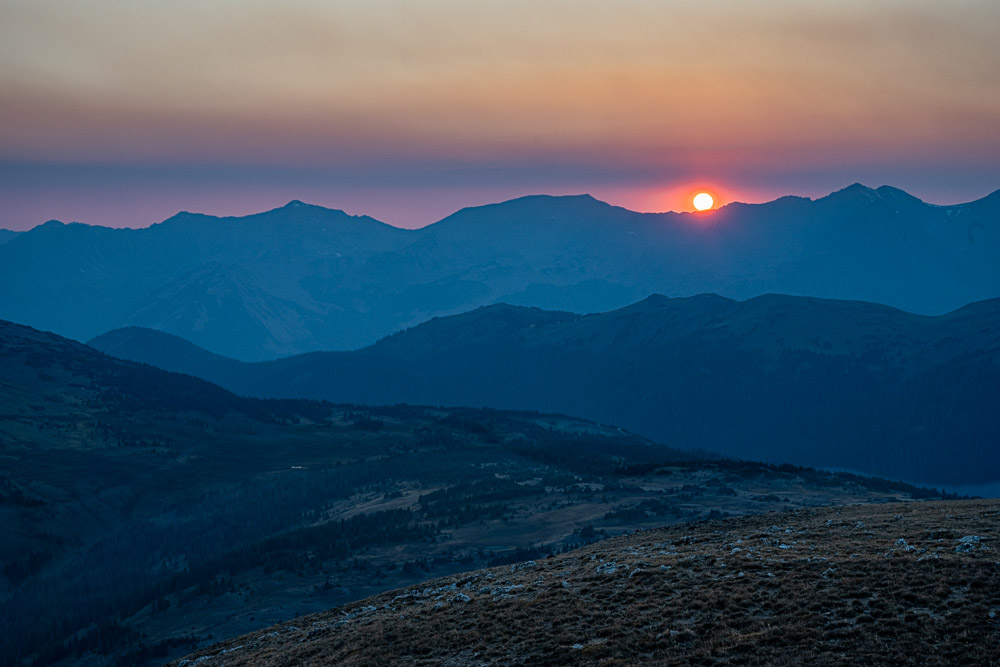
    This is an HDR image. Trying to create an image with the direct sun in it and at the same time preserve the deep shadows in the mountains wasn’t going to work in one exposure. The HDR software was able to pull it all together.

    I don’t think this looks like the bad old “HDR look”. What do you think?

  • My Favorite Lens

    My Favorite Lens

    In general, we photographers love our equipment, Especially our lenses. It is not uncommon to have a favorite one. You can always get a discussion/fight started among photographers when you talk about lenses. I would like to discuss what has become my favorite lens.

    Lenses

    The lens is a critically important piece of equipment to photographers. Sensors are improving dramatically and lenses have to improve with them to achieve all the sharpness and resolution the sensor can capture.

    Modern lenses constantly improve in resolution. Look at DxO image tests of current best lenses vs. the best from 20 years ago. Our lenses now enable us to capture more information and be able to produce wall-size prints that are extremely sharp.

    The lens determines the point of view that is captured in our frame. It establishes the field of view, the width of the scene we are capturing. Some of us naturally have a telephoto view. Others have a wide angle view. This refers to the lens choice we tend to select to frame our subjects. This is just personal preference. The lens is a tool to help express our esthetic.

    Many photographers feel they need a whole bag full of lenses of various focal lengths from extreme wide angle to super telephoto, with macro lenses and tilt/shiftes thrown in. Because, you never know what you might find. 🙂 Personally I have simplified my life a lot over time. I generally only carry a 24-70mm and a 70-200mm in my kit. But that is just me and where I am at right now.

    So what we want is a lens or lenses that allow us to capture all the information we want (resolution, sharpness, dynamic range) in the field of view we want. A big ask, but doable.

    Digital workflow

    Most of us are in the digital world now. The digital workflow is quite different from the analog workflow.

    What we call the analog workflow – the film days- involved developers and enlargers and prints and lots of chemicals and time. Personally, these are days I don’t miss. I am a big fan of the power and freedom and flexibility we have now.

    There is a corresponding workflow for digital processing, though. It includes loading images on our computer, viewing them, culling or grading them, processing selects with our software of choice, etc. Each of theses steps is time consuming. Especially since we tend to shoot so many more frames now that they “don’t cost anything”. And each step requires software and considerable training.

    The result, though, is that we spend a lot of time in front of our computer now. We probably spend more time in the digital workflow than we did in the analog workflow.

    My favorite lens

    What does this have to do with a discussion of my favorite lens? Well, in a sense the “lens” I use the most and that has the most impact on my work is my computer monitor.

    This is where I view all my images. Zoomed in to 100% I look at individual pixels. Here is where I crop and color correct and adjust tones and contrast and saturation. This is where I view and edit the image when I convert it to black & white. When I create new images by compositing others together, that is done entirely though the monitor “lens”.

    Yes, all of the things I just said are actually done through specialized software. In my case it is primarily Lightroom Classic and Photoshop. But metaphorically and to me, the monitor is the lens into the process.

    Now days the monitor is where we view everything we do. Regardless of what the original image looked like, what I see in the monitor at the end of the edits is what counts. The result could be a complete re-imagining of the starting image.

    The new primary lens

    I spend more time in front of my monitor than I do outside shooting. More and more it is coming to dominate my workflow. If I lost or broke a lens, that would be terrible, but I could continue doing my art with other lenses with only minor re-adjustments to my vision. I had this experience recently. My 24-70 lens dropped and shattered the polarizer filter. I was up in the mountains and I did not have a filter wrench with me to get the jammed filter off, so I had to switch to using an alternate lens. A little frustrating, but not a big deal.

    But if my computer died, although I could continue shooting, I could not view or process a single image until I fixed it. Eventually things would back up to a critical point and I would have to get the computer back. I also couldn’t select images for galleries or process images for printing. Dead in the water.

    So in a sense, the focal point of the digital workflow is the monitor. That is the new lens I use to view and do most of my work. The monitor is the lens for the increasingly important part of the digital workflow.

    The future

    In the future will this trend increase or will we return to simpler times? What do you think?

    My money would be on the increase of digital processing. We will trend more toward an attitude that the camera and lenses are used to gather raw material, but pictures are actually made in the computer, looking through the monitor. Increasingly, the final image may look less and less like the original capture. Better processing software opens up new possibilities. And viewers are more willing to accept that photography should create something more than a true representation of reality.

    So the next time you are lusting for a wonderful new lens, it might be better to upgrade your monitor instead.

  • Created by Me

    Created by Me

    Generative AI is all the rage now. I suppose there might be some applications for it, but you will not see any of it in my work. What I show is entirely created by me, and I have no plans of ever changing that.

    It’s all around

    The news is full of hype about ChatGPT and Bard and, for images, DALL-E 2. Tech companies are inventing hundreds of billions (yes, “billions”) in it, so it must be about to take over everything, right?

    It is hard to read anything without seeing references to the coming revolution. It is the “next big thing” in tech. MIcrosoft, for instance, has invested huge in ChatGPT and says it will embed it in its browser and all of its applications. With so much press and money and interest, it must be true, right? Maybe.

    But do you understand what it is?

    What is AI?

    I have said before that I am a reforming Engineer. Well, I must admit that at one time I was involved in AI applications. I even believed in it at the time. That is just to say I have some technical background in the subject, so I am not just quoting press releases.

    “Artificial Intelligence” is a weird term. It is definitely artificial. Whether or not it represents intelligence is debatable. To me, there is no real “intelligence” involved. It is just a fancy computer algorithm with a lot of data embedded in it.

    The AI that is hyped today is called neural networks. It is based on a fairly simple structure that tries to mimic the way the human brain is organized by simulating neurons and synapses. Then they train the network with huge sets of data. The connections and values of the neurons and synapses are adjusted to give a desired output for a given input.

    To over-simplify it, imagine a patient teacher trying to train a neural net to recognize an egg. They “show” it a picture of an egg and say “this is an egg” and let the network adjust its values to give a positive output. Then they show it a picture of something else and say “this is not an egg” and again let the network adjust its values to give a negative output. Repeat it over and over thousands, maybe millions of times with different pictures. Eventually the neural net would get pretty good at identifying an egg, if the training data was good enough and extensive enough.

    But so what? The AI does not at that point know what an egg is. It just classifies shapes as being one or not.

    What is the good of it?

    We are discussing generative AI, so I will try to focus on that. Generative AI takes a request to make a picture or song or some such work, maybe based on the style of another artist. You could say “make a picture of a tree in the style of van Gogh”. It would make one. It would probably look like something Vincent might have done.

    If you were generating the image for an advertisement, you might be able to simulate a certain style without the encumbrances of creative fees or intellectual property laws. For you, the user of the image, you get to bypass paying the artist. Or maybe, charitably, you get something you wish the artist had created, but they did not.

    Many companies are very eager to have AI trained to be able to produce minimally acceptable results faster and cheaper than a human. Be aware of those companies that want to get rid of their people and replace them with minimal acceptable results. Have you used an AI-based chat agent to try to get support from a company? My results have been way below minimum acceptable. Maybe search engines is the best application for these bots. Most of the search results already can’t be trusted.

    So for someone wanting something cheap for a practical use, it can be a good thing.

    Is it art? I have my opinion, but let’s get to that in a minute.

    What are the limitations?

    Neural network-based AI only “knows” what it is trained to do. Its abilities are limited strictly by the data it is fed. And I used “know” in quotes because, one of the great limitations of this system is that it doesn’t know what it knows. It doesn’t even know what knowing is.

    AI cannot explain it’s actions. The data compressed into its network has been stripped away from its source. This is going to become one of the major limitations that will cripple it or stop it’s use. So, for instance, when an AI system turns you down for a loan, you cannot force it to explain why. All it can say is that you just didn’t meet the pattern. Lawsuits will come of this.

    And it may produce wonderful seeming results, but it is a cheap trick. AI products are a regression to the average, at best. That is, a large set of training data defines the average of whatever domain is being learned. This is all it knows. It does not understand the difference between unacceptable and acceptable and exceptional results. It does not understand the concepts behind what it is doing at all.

    So when you ask it to make a picture of a tree in the style of van Gogh, its data bank has many images of trees. It has encodings of parameters describing patterns of van Gogh’s style. It can mix them and make something. But it can’t step back and say “Wow, that is great. I’m proud of that! That is good art.” There is no more feeling than a tax form.

    Where does the training data come from?

    This is a little off topic of the quality of the results, but have you considered where this huge volume of training data comes from? Google, Meta, Amazon, Microsoft and many, many others, including your Government, collect and use all the information they can find . This includes public data like Wikipedia or the Library of Congress, but also everything they can scrape up about you. So every network search you have ever done, every web page you have ever visited, all of your email, all of your pictures, your contacts, your contacts contacts, every post you have ever made, your facial images, your job, your salary, your spending habits, all of your telephone calls, everything is just free data to them.

    This is all used without your permission or control. So for an artist, for example, all of their online works can be used to train the AI to do better to try to replace them. And with no compensation or attribution.

    There is currently no accountability for AI or the companies profiting from it. It has been proven that much of the training data used was biased or incorrect, producing bogus responses from ChatGPT. And Google’s Bard got a black eye the day it was announced when it gave false information to a query about the Hubble telescope. No accountability, no ability to explain.

    A passing fad?

    One part of me thinks AI is just another passing fad. It has come and gone before. AI was going to revolutionize the world about 20 years ago or so. It died. Now the pundits are enamored with it again. Most of them are too young to realize it died of natural causes already. But venture capitalists and tech gurus are very quick to throw billions of dollars at “the next big thing”, even if it has been unable to generate any money.

    But no, I’m afraid we will have to live with this for a while. Too many billions have been invested for it to die soon. And it can show some limited tricks. Either you believe AI is a higher and more perfect form of life that will make the world better or you don’t. I don’t.

    Not on my watch

    Lots of rambling, but back to the adoption of generative AI. As far as I can see, I will never use this in my art. This is not like the introduction of digital imaging, where film purists wailed about the passing of a wonderful era. This is not a technology shift, it is a tool that plans to eliminate artists.

    I will use useful tools, like sky selection in LIghtroom or Photoshop, but that is just a force multiplier to get my job done quicker. I could do the same thing myself and I can often get better results. It is like a woodworker using a planer to smooth a tabletop quickly rather than spending hours sanding it. You don’t say the tool created the piece of furniture.

    When you see images from me, they were created personally by me. I don’t and do not plan to use AI to create my art. I don’t think art created by AI is really art, but that gets into the argument of what art is. What I call art is only created by humans.

    Call me a Luddite, but I believe only humans can actually create.

  • Perfection

    Perfection

    For an artist, I believe perfection is a false goal. It can lead us to spend our energy in the wrong places. This seems especially true for photographers. Our technology-based art can lead us to believe technical perfection makes good art. It doesn’t. At least, not by itself.

    An absolute

    I am a recovering Engineer. I know a lot about specs and technical details and I am naturally drawn to “perfection”, whatever that is. As photographers, we tend to be pulled this direction. Are there any overexposed highlights? Do the shadows contain some information and very low noise? Did the lens and sensor resolve every bit of detail that could be used? Was “proper” technique used to maintain total sharpness and low noise? Did it follow the “rules” of composition?

    More and more I am convinced these things are relatively unimportant compared to the impact of the image on the viewer.

    Normal people view and enjoy prints at a distance of about 1 1/2 times the diagonal measure. Photographers tend to press their nose right against the print to try to see any imperfections. Yes, I do too at times. But this is not realistic or very important for normal viewers.

    One of the themes I enjoy at times is images that have super high detail. Images about complexity and texture and the details of the material. I have good equipment and I am OK at using it, so I can do that whenever I want. Some subjects seem to lend themselves to it. But I don’t think I have any images that I consider great solely because of their technical perfection.

    A moving goal

    And what is “perfection”? Who defines it? Is such a thing achievable?

    Our technology is constantly improving and pushing the boundaries back. The camera I use now is vastly better than the one I used 10 years ago. It has higher resolution, lower noise, and wonderful new features like live histogram view. These things let us achieve ever better results with our craft.

    Likewise with printers, drop sizes get smaller, allowing for sharper prints, inks get better permanence, and printers get larger. Along with that software technologies improve all the time. We can upscale and sharpen images with much less artifacts. New algorithms can reduce noise without materially damaging sharpness. It’s a great time to be a photographer.

    Is this perfection? Sure, a photographer can put his nose up to a large print and see “perfect” detail, low noise, great edge sharpness, and smooth tonal gradation. Is that what perfection is?

    So is perfection the absence of any artifacts and a hyper-realism that looks sharper than real life? That is nice, for some images, but I do not believe it is what perfection is.

    Why perfection?

    Before I attempt to get in over my head, I will ask why we need perfection? Does it make better art?

    I have seen prints by Ansel Adams, Edward Weston, Stiglitz, and many others. Many are stunning and have amazing presence, but not all are technically perfect. At least, by today’s standards. I have also seen many paintings by Monet, da Vinci, Rembrandt, PIcasso, O’Keeffe, etc. Again, I would say that the great ones may not be because of perfection in the sense I have been discussing it.

    Craft trumps perfection

    Take Ansel Adams for example. He shot mostly 8×10 negatives and spent many hours producing a print. But, the film technology he had was arguably not as good as modern high-end medium format sensors. And his lenses were not particularly good compared to modern designs. Some of his prints are not as technically “perfect” as many artists at their studio today making a print on their Epson or Canon printers.

    But there is something else that overrides the technical limits. There is a magic in what he brought out in the printing process. He was a marvelous craftsman. He knew how to work an image until it changed from an average original to a stunning final print. “Moonrise, Hernandez” is a classic example of that. He shot it quickly because he was losing the light. So quickly that he couldn’t find his exposure meter, so he had to guess. Because the negative was badly exposed, it was very difficult to print. It required many hours of work in the darkroom to create a rendition of it. But it became one of his masterpieces. The final print is far superior to the original capture.

    As he himself said

    A photograph is not an accident it is a concept. It exists at, or before, the moment of exposure of the negative. From that moment on to the final print, the process is chiefly one of craft; the previsualized photograph is rendered in terms of the final print by a series of processes peculiar to the medium.

    Ansel Adams

    Adams was very good at all the aspects of photography. But in my opinion, it was his craftsmanship that made him rise above most everyone else. He would work a print until it glowed and had a life in it. The tones and contrasts and lighting were amazing. The results he created went far beyond considerations of technical perfection.

    Story trumps perfection

    I include story here because I believe it is powerful. But in general I struggle some with the concept. In a sense, story happens automatically. If you pause to examine a print for more than a couple of seconds it is natural to build a story. Humans naturally seek meaning and story. Guiding the viewer into seeing a more interesting story is a plus, both for the viewer and artist.

    I do prints. Generally single images, meant to hang on a wall. To me, it is difficult to tell an extensive story with one isolated image. Not that it can’t be done, but I don’t see it happen as much as critics and some artists want us to believe. Probably the Engineer in me is still too literal.

    But I see examples sometimes that make me wrong. A great one is Henri Cartier-Bresson’s “Place de l’Europe, Gare Saint Lazare, Paris“. Long name, but you’ve seen it:

    Place de l’Europe, Gare Saint Lazare, Paris

    I think this is a great story captured at, what Cartier-Bresson called “the decisive moment”. As you look at it, you tell yourself a story about what is happening, why he is doing this, what he is thinking, what happens next. It is still a memorable image today, even though it is under exposed, the subject is slightly blurry, and, depending on your notion of proper composition, the guy being about to disappear out of the right frame can be a problem.

    It is a great and famous and beloved image. Being technically perfect would not have improved it at all.

    Emotion trumps perfection

    Emotion is something I have struggled with for a long time. I now believe that if I can’t make you feel something about my print, it is cold and sterile. I believe it so much that I feel that emotion far outweighs technical perfection. This is one reason I have been doing more ICM (intentional camera motion) projects lately. It throws out all notions of sharpness and detail and focuses mainly on capturing a feeling or impression.

    Emotion in art has been written about a lot lately, but let me repeat and reinforce it. If I can’t make you feel something of what I felt when I made the image, I have probably failed.

    There are techniques for creating an emotional response, but I am not concerned with them here. The fact is, we have to do it. As an artist, I have to share my feelings in an image or there is not much interest for the viewer.

    Sharing and being transparent is a challenge for some of us (me). I am learning. The results are apparent to me. An image with a depth of feeling has more impact and staying power. Sigh. I will just have to force myself.

    But the point is that an image that touches you emotionally is more meaningful than one that is just technically perfect.

    Table stakes

    So perfection, mostly technical perfection. Where does it fit? Am I saying it is not important? No. A technically perfect image may be excellent, but not just because it was perfect. It also has to embody emotion and story and excellent craft. Perfection is a table stake. It has to be there in order to get in the game. It is not the game itself. Art has to go beyond technical measures.

    Today’s image

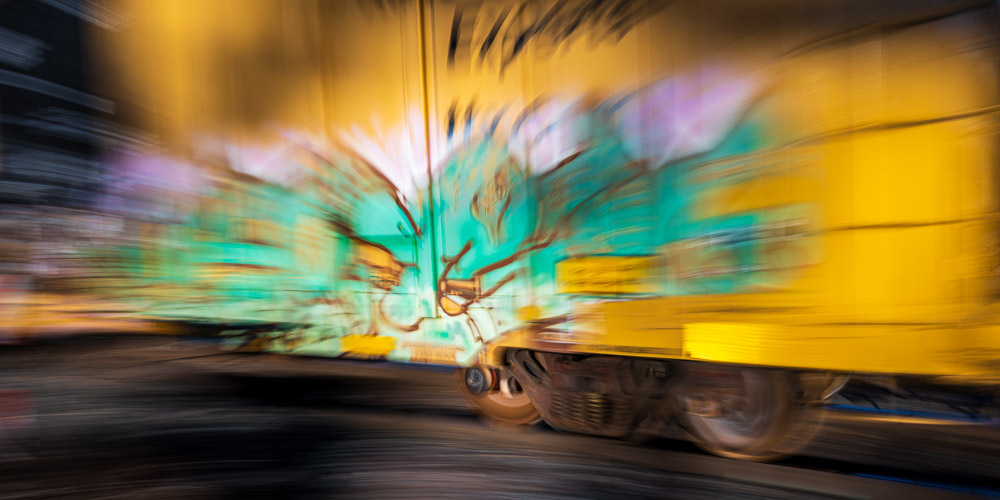
    Earlier I mentioned ICM as a tactic I have been using occasionally to break away from the feeling I needed technical perfection. This image is an example of that. It is from a series I did called Speeding Trains. The intent is to capture the sight and feeling and power of a huge train speeding by. I hope you like it. Read the artist statement and see the rest on my web site.