An artists journey

Category: Psychology

  • Time Builds Perspective

    Time Builds Perspective

    I find that a distance of time often builds a healthy perspective on my images. Sometimes, when the images are “fresh”, the experience of the capture clouds my judgment. Letting them age can build a clearer judgment of them. They can take on a new life.

    Let go

    I have written that we need to fall in love with our images and capture the emotions we were feeling at the time. That is true, but the experience of the moment is not sufficient to make it worthwhile. I could point to many images in my catalog that bring back great memories. Ones where I felt alive and on fire when I took them.

    They will always be meaningful to me, but that does not make them great images. I have to learn to let go of my emotional attachment to them and look at them with detachment. That is the only way to begin to see if they could bring satisfaction to other people.

    Be analytical

    I have said that we need to balance our emotional side with our analytical side. This is one of those times. Looking at one of my images may bring back a flood of joy or suffering or pain or other feelings. But I must coldly and analytically figure out if I have brought any of that to my viewers.

    Just because it was significant to me does not mean it should be to you. This may be the last picture I took of my father before he died, but that doesn’t make it meaningful to you unless it brings out something significant about the human condition.

    I may have a group of shots I took in 2 feet of snow in white-out conditions where hardly anyone was dumb enough to be out. The images may be beautiful to me and bring back the experience as a pleasant memory, but what can they convey to you?

    If I can’t bridge from personally important to an exciting image from your perspective, it is only a selfie.

    Distance

    One way to be able to see this is to use time as a distance mechanism. I have found myself instinctively doing this a lot, but it was interesting to see it discussed by Alister Benn, CaptureLandscape’s 2020 Photographer of the Year:

    When I turned professional, I suddenly found the time between shooting in the field and getting around to processing was extending from a matter of hours, to months, or even years. I have thousands of images I have never looked at since importing them (apart from rating and deleting any obvious weak ones.)

    Alister Benn – Luminosity & Contrast

    He goes on to describe how this separation helped him by allowing him to view images more objectively. They are distanced from their original meaning. How he perceives and reacts to the image right now is all that matters. Sometimes he looks through old images and “discovers” ones he was cool to at the time that he can now develop into a great image. Seen on its own without the baggage of the emotions of the shoot, it means something new. Distance builds perspective.

    See them for what they are

    Alister asks how, then, does he decide what images to work on? “Simply, I work the ones that speak to me.” Sitting in front of the computer days, or even months after the shoot, they look different. They have different meaning. A meaning may arise independent of the original context.

    He is in a different place – literally and figuratively. He has different feelings and emotions. The images are perceived different. Some become more important. Presumably some become less important. But he is processing them from the point of view of where his head is at the time.

    At the time

    Interestingly, this means that there could be a kind of ebb and flow to our perceptions. At any given time our feelings will be different. We may be happy, sad, melancholy, reflective, hopeful. How we feel at the time determines how we perceive our images and how we process them.

    In a recent article, I suggested an exercise to discover our natural themes: pick your “best” 100 images from your portfolio. Brainstorm descriptive terms. Group those into categories and name them. I also gave the opinion that this was not deterministic, because repeating the exercise at another time could be a little different, because you would pick different images as your “best”.

    I think I was discovering the idea that even our portfolio is not a fixed set. There is not necessarily 20 or 50 or 100 images that is fixed in time that represent me. The members can change, not only as we do new work, but as we change our perspective. Time brings new points of view. Distancing our self from the emotions of when we captured the image changes how we view it. We are always growing and learning.

    It’s actually exciting for me to look back through old images in my catalog. The excitement is when I have one jump out at me and I look at the way I processed it and say “what were you thinking?” Then I re-process it from a different point of view and create a new, different image.

    Example

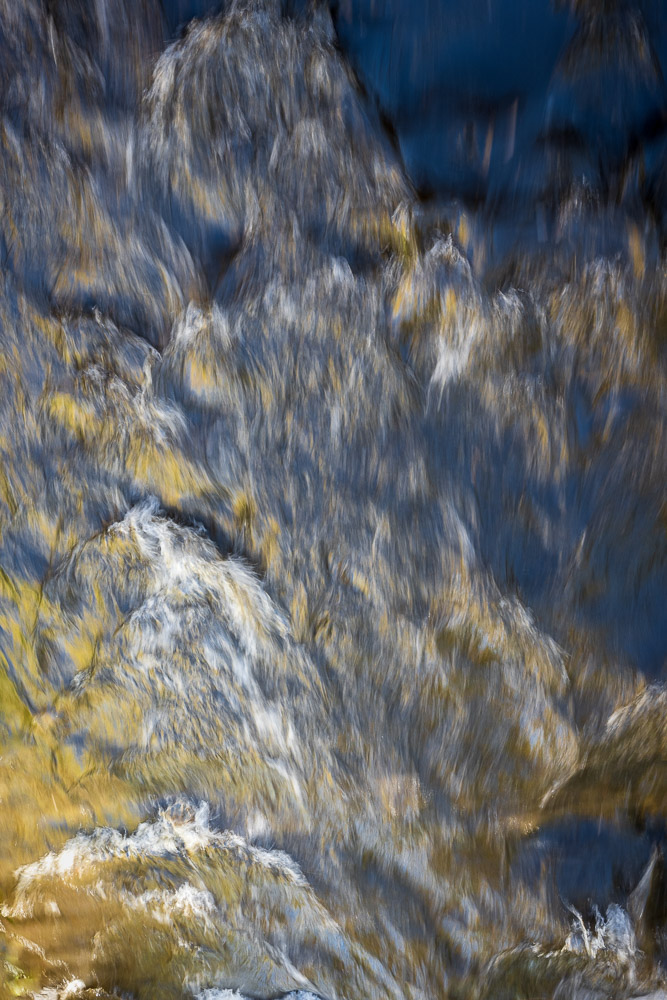
    The image here is an example of this idea. Every time I come back to it, I see something different. Sometimes I love it, sometimes not as much. It is in or out of my portfolio on any given day. The longer I live with it, the more I like it. I am tending to see more layers and ideas swirling through it. Right now I would say it is a definite “in”. It speaks to me.

  • Apples or Oranges

    Apples or Oranges

    If you’ve taken a personality test, it probably showed you to be either rational or emotional. This may be true for most people, but you are an artist. This notion of your personality being a binary, either/or relationship probably presents a false dichotomy. It is based on built in assumptions that go back many years. People are not such a simple thing where you can label or classify them easily into rational or emotional, apples or oranges.

    Basis

    People have been trying to figure out human behavior, well, as long as there have been humans. There was a flurry of activity in the late Nineteenth and early Twentieth century time period. Two prominent psychoanalysts of the time were Carl Jung and Sigmund Freud.

    I won’t attempt to go into their beliefs. It is too deep and depressing and actually not that useful. One outgrowth of Jung’s theories, though, that has become ingrained in our culture is a model of personality theory.

    Jung postulated that there are patterns of personality common to most people. Many personality tests have been developed. You may have taken one or more of them. They can seem very insightful, but in the same way a horoscope can seem to predict events or behavior. We tend to believe what we are told from an “authority”. I do not recommend you bother with any of the tests.

    Anyway, one part of Jung’s theories is that people’s personality tends to be rational or emotional.

    Only choice?

    What I observe is that people are complex creatures. A simple model can predict some behavior of large populations of people, but is too simple to say much about an individual. Each individual has innate tendencies, but they are also modified by past experience, beliefs, education, circumstances, age, and a host of other factors.

    And we have this annoying habit of jumping around all over the map at different times as far as our behavior seems to go. Let me use myself as an example. I have a rational mind trained by decades of engineering experience. I fit that mold well at the time. But I also have become intuitive and emotional. I follow my feelings and intuition first. Rational thought is generally used to analyze my intuitive decision and justify or reject it.

    Also, in another completely different dimension, I am very introverted. If we were together at a networking event there is a very good chance you wouldn’t know I was there, because I probably wouldn’t come talk to you. I’m too shy. Yet I have little trouble speaking in front of a large audience. I actually enjoy it and feel relaxed and welcome spontaneous discussion and questions. Weird. Complicated. Contradictory. But that is what people are.

    Artist viewpoint

    This is about artists, though. Let’s focus down on this strange group.

    I believe artists have to be both rational and emotional. At least if you are a photographer.

    Rationally, we have to know our tools and processes. We have to understand what we can and can’t do and how to use the technology to accomplish what we want. Using the equipment, both camera and computer, need to be second nature. No matter the actual complexity. As effortless as a painter using a brush.

    The rational mind also gives us purpose and continuity. We decide where we are going, what our goals are, and how to market our self. Without a conscious focus on these things, we will drift. Our rational side helps us work out composition, framing, exposure considerations, and lighting.

    But on the “soft” side, we have to understand our feelings and intentions. Why are we doing what we do? What experience are we trying to bring to our viewer? If we do not have strong feelings for our work how can we expect our viewers to? For most work, if we are not conveying strong emotions, it will fall flat.

    Those of us who are naturally rational may have trouble with this. But it is possible to bend, to learn, to open up. We have to.

    It’s a balance

    The trick for artists is that we have to balance these two sides. Most non-artists can get away with not having to do that as much. Think of your stereotype of an accountant. Cold, objective, numbers person? Unemotional?

    An artist needs balance. The rational side will decide what we are trying to do and what path we will follow to get there. It keeps us focused. Yet if we are totally rational our work will be static and dry. Precisely composed and technically perfect, but empty.

    Our feelings will bring us passion and emotion, love of the image. Our viewers will sense this. They want to feel what we were feeling when we created it. But if we live totally in our feelings we will drift. We will follow every whim that tweaks our interest at the moment. We could even become one of those self-indulgent stereotyped artists whose personal life is a mess, who can’t keep focus on any goals and neglect their family and friends and even personal care.

    Talking about that tendency to go too deep into the emotional side, Sean Tucker said:

    Our rational minds are the foil that serves to balance those tendencies. They allow us to go deep but stay tethered to something truer and more stable than our shifting moods. They allow us to make our way far into the maze, knowing that we still have a thread to follow back into the light when we are done.

    Sean Tucker, The Meaning in the Making

    I love this image of the rational mind providing a safe path back when we have run off too deep into the wilderness of our feelings. We need to explore this maze, but we need to be able to get out, too.

    Don’t be put in a box

    Never allow yourself to be defined into a box by other people. Always surprise them, and yourself. Do the unexpected. If someone labels you as something, understand that that is just their opinion. It does not make you into anything. Other people’s expectations should not define us. You do not have to be either an apple or an orange.

    Likewise, do not put yourself into a box. It limits your thinking. It artificially places bounds on what you can and can’t do. What thoughts you will allow yourself to even think. How much freedom you have to experiment.

    Always do new things and try new ideas. This self-limitation is an even more serious problem, because we do not think there is anything we can do about it. Be aware of it and fight it.

    When we feel trapped in one of these boxes, rather than accepting it we should ask “who put the box there” and “so what?” That is someone else’s box. If someone comes up to you on the street and draws a chalk box around you on the sidewalk and tells you you are in this box, just step out of it and keep going. Let them have their box. You don’t have to be in it.

    Balance

    I believe, as artists, we have to be both rational and emotional. I’m not trying to give a new personality theory. Are we exhibiting both conflicting traits at the same time or are we bouncing back and forth between them? Don’t know and don’t care. The results are all that matter to me.

    It doesn’t have to be either apples or oranges. That is letting someone else define the problem. We are walking a tightrope. If we get overbalanced too far one way or the other, we will fall off into the pit. We won’t like that and won’t be doing much satisfying art there. But we have to walk the tightrope. It is part of the artist calling.

    Today’s image

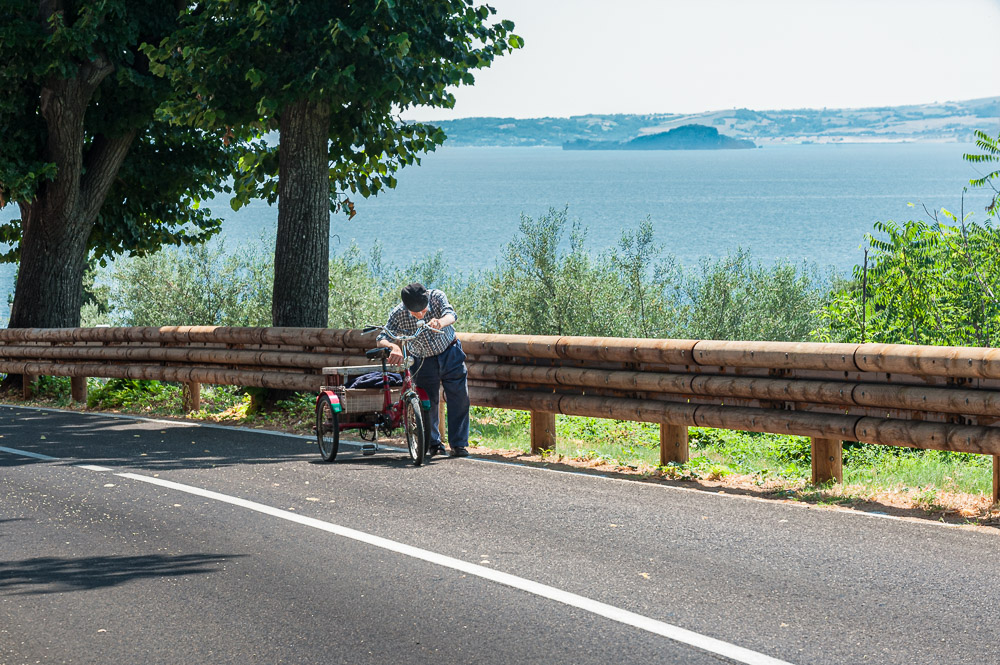
    The image above represents this tightrope. I took a brief time to get a reasonable composition, proper exposure, depth of field, balance of forms, etc. That was mostly instinctual. But mostly, I hope you get how I feel about the guy. And I hope it makes you feel something, too, and think about him. I have my story, influenced by the range of sights and emotions at the time. I’ll let you tell your own.

  • Themes Keep Emerging

    Themes Keep Emerging

    Quite a while back I talked some about themes in our work. I mentioned that one theme I come back to is wabi-sabi. As I reflect on my work I find that there are common themes that keep emerging.

    What is a theme?

    In the previous article I gave the simple dictionary definition of a theme as “a subject or topic of discourse or of artistic representation”. This is right, but inadequate. I have come to believe that for artists, themes are ingrained and consistent.

    That is, unless we are doing commercial work for clients, themes represent what we are drawn to. The things that have meaning or symbolism to us. They probably don’t mean anything in themselves, but they disclose something about us. What we see and the way we think.

    So perhaps, for a fine artist, themes are the ideas that tweak our passion, that spark our creativity. It is important to keep in mind that the theme does not have to be deeply meaningful. It just grabs us for some reason.

    Projects

    I am at a stage where I think more and more about projects. These self-assigned projects help focus me and exercise my creativity. Without them I tend to run wild and shoot everything in sight. That is OK, but a project helps me get deepen into an idea.

    I have a list of project idea I think I would like to do. Sometimes, though, when I try to start one, it turns out to be Meh… It is difficult to really get into it with any enthusiasm. I have come to recognize that this is a symptom of the project not aligning with any of the themes that channel my interest. I usually abandon these, unless there is a compelling reason to push on through it. There seldom is.

    On the other hand, when a project aligns with my innate theme interests I can really get into it. It is energizing and exciting rather than being dreary work.

    Look inward

    So I have learned to look inward more to keep projects aligned with my natural themes. This can be hard for some of us cold, analytical types. After all, it is easier to talk about composition or exposure than it is about feelings. But as I have said before, art is primarily about feelings. I have to get in touch with my feelings??! Well, maybe not in that sense. But I have to become a lot more sensitized to them.

    The unique nature of photography is that it is a subtractive art. The world is swirling all around us in unbelievable detail and complexity. When we lift a camera we engage in a process of reducing, filtering, limiting what we show to make a pleasing and coherent image. This takes discipline and a good sense of what we find important in the frame at the time.

    Self discovery

    This self-discovery process sounds hard for some of us, especially guys. But maybe not. Our own work can often tell us, if we listen.

    If you have a body of work (a fairly large collection of images you think are good) you probably have the data you need already – your own images. As an exercise in self discovery, pick out around 100 of your best images. The ones that you feel you are most proud of and that represent the work you are doing now. If I were doing it right now, I would use Lightroom to go through my catalog of top picks and pull 100 of them into a collection to examine.

    As painful and time consuming as that is, that is the easy part. Now it is time to think and reflect. Study this set of images. Write down the themes that come to mind as you look over the collection. Just do a free association, stream of consciousness at first. Write these theme ideas on sticky notes and lay them out on a table or a white board or your monitor or wherever is convenient. Look for groupings of related ideas. Put them together. Come up with a term to represent each grouping.

    Hopefully you now have no more than 3-6 theme ideas. Go back to your image collection and try grouping them according to these ideas. Don’t worry if it is not perfect. A single image may overlap more than one idea. But it is a test to see if you believe the groupings you came up with.

    Now you have a clearer map of the big ideas you are drawn to. This is enlightenment.

    Rocket Science?

    No, this is not rocket science. It is not really science at all, in the sense of being objective and repeatable. If you repeat the experiment you would probably select a different set of images, because they seemed meaningful to you at the time. You would probably label them differently and come up with different themes. Same but different. That is, there should be a lot of overlap, because themes are much more broad than a particular subject.

    Does this make it invalid? No. The process gives you insight about yourself and your interests. It is turning your sights inward and trying to understand more about yourself. The fact that you get different results proves you are a complex and varied individual. That’s good. Be proud of your complexity.

    What am I drawn to?

    I mentioned wabi-sabi as one of my themes. Some others are time travel, weathered, force of nature, and black & white. I haven’t figured out if black & white is a theme or just an attribute of a lot of the art I like to do. Still working on it.

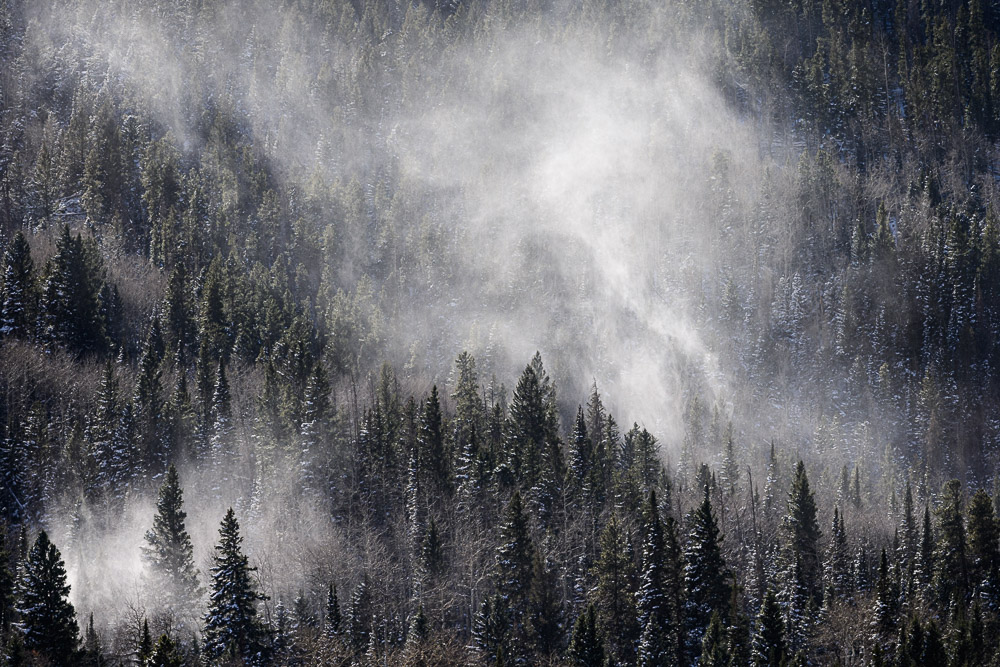
    The image with this article I just shot yesterday (as I write this). This is in the force of nature theme. We just had our first good snow here in Colorado and I couldn’t resist getting up in the mountains to see it. This is not cloud or fog or smoke. It’s blowing snow. It’s not snowing. As a matter of fact the sky is a boring bright blue.

    When we get sandwiched between a high pressure system to the west and a low pressure system to the east, we can get violent winds across the mountains as the pressure tries to equalize. When I shot this, it was about 18 F with about 40-50 MPH gusts. Very cold! But I hardly noticed. I love scenes like this showing the power and majesty and force of nature! I was in the zone. I didn’t even remember to put my gloves on, and I hardly noticed.

    Connect with your heart

    So I find that scenes that excite me when I am shooting them are usually in one of my themes. If I am not excited, I’m probably trying to shoot something that doesn’t inherently draw me to it. By understanding my preferred themes I can more easily decide what to shoot and what to avoid.

    Someone once said “if it doesn’t excite you, why should it excite your viewers?” This is generally true. Have you ever made a technically perfect image of a beautiful scene and then later thrown it away? I have. Lots.

    Art is about showing other people what we felt; what we were excited about. If we’re not in love with an image why should we ever show it to someone else?

  • Am I Creative?

    Am I Creative?

    Am I creative? I wonder this a lot. Especially when I look at a lot of other people’s art. Surprisingly, it is not that I think the other work is better, it is that I look at most of it and think: that’s not very creative. I must not understand.

    Is everyone else creative except me?

    When you seem to be going in a different direction from everybody else, you have to think either they’re wrong or I’m wrong. It is hard to tell, because there are no anchors, no fixed points of reference, no authority to judge. So in a sense, it seems to be entirely subjective.

    If there are no absolute standards, I guess I can’t look at other art and think it is not creative. It might be very creative, I just don’t see it. Or maybe I am jaded from making images too long. Maybe I am burnt out or I have set my standards too high.

    Been there, done that

    It is hard for me to look at art with the wonder and joy I want to. Too often my reaction is “been there, done that; seen it before, and better”.

    Is it true that everything has been done? That there are no more new images to make, no new songs, no new novels to write? I hope not. That would be very depressing. It seems like fresh, new, creative things happen. I’m just not seeing it too much in photography.

    What is creativity?

    It has been said that creativity is your capacity to make innovative connections and free associations that others don’t do the way you do. So apparently there is something unique about our particular makeup and viewpoint of the world. I see things different from everyone else. You do too. So, if we can execute on our ideas, we should be able to bring forth unique and creative things that other people would not do.

    But if I create something, does that make it creative? Most of us love to create. The joy and personal satisfaction of bringing something into being that would not have existed without us is extremely satisfying. Those of us who have learned that we can do this become addicted to it.

    I hear people equate the concepts, though. I create therefore I am creative. This seems to be at the heart of the issue for me. Creating vs. creative.

    Here is one of the places I get stuck. I see a lot of people go to extremes, to the bizarre or ridiculous just for the sake of being different. Is being different sufficient to be creative? By my standards, not every creation I see seems to me to be creative. I can relate to this somewhat satirical quote by Banksy: “Modern art is a disaster area. Never in the field of human history has so much been used by so many to say so little.

    On the other hand, even if it is not bizarre, much of what I see labeled as “creative” leaves me puzzled. I look at it and think “how can that be creative? I’ve seen images like that lots of times.”

    Buzz word

    Has “creative” become just a required buzz word that everybody uses? Like “story telling” It seems like today everybody is story telling with their art. No, most of what I see has no story. It is just art that may or may not invoke some feeling or imagery in you. It may just be a pretty picture.

    I guess “creative” has become like that. It would be an insult these days to say that someone’s art is not creative or not telling a story. Even when it is not.

    Does an image have to be truly original?

    It seems to me that there are 3 general classes of creativity: imitative, derivative, and unique. In my opinion, most art is in the first 2 categories. A few works are truly unique.

    In imitative art, we see something we like and file it away so we can do something kind of like it later. We may create a very pleasing image, but it has not added anything new to our understanding. Maybe your goal was only to create a nice image. That’s OK, but it will not take you to the level of great art. It is not creativity.

    In derivative art, something we have seen someone else do connects with some other ideas in our experience and inspires us to visualize something a little different. To me this is a valid type of creativity. We are building on other ideas and adding to the dialog. We have created fresh new art.

    Occasionally, rarely, we or someone come up with something that is a leap from the mainstream. Something that is unique, that truly did not exist before. But even that is kind of an overstatement. There are stepping stones that lead even the greats to where they end up. Andy Warhol couldn’t have gotten to where he went without Picasso, Duchamp, even DC Comics. It is just that some artists seem to leap further and get there ahead of the rest of us. And we envy them.

    But maybe I am arguing myself into the position that there is little wild, radical creativity. Most things progress in small steps.

    Maybe it just needs to be our own?

    With no scientific data, I am guessing that the majority of artists are imitative, and that most of the rest are derivative, as far as their creativity goes. A very few are truly, uniquely creative. Maybe that is good. If there were more creativity then the art world would be yanked in too many directions at the same time.

    Even the art world, that thinks it is always looking for something new, resists change. Every major trend, like impressionism, modernism, realism, etc, was resisted by the critics and the entrenched leaders of the current movement. People actually don’t like wild leaps.

    Maybe the best we can hope for is to look for derivative opportunities. Try to connect disparate ideas to synthesize something fresh and “creative”. Take risks, but not just for the sake of being different. This will help us rise above conventional ways of viewing things. It will let us contribute new ideas into the discussion and help people take their own steps to new ideas. Maybe the best view of creativity is that we make associations our own unique way to create things different from other people.

    This is probably the level of creativity most of us can achieve. Maybe that is all that is required.

    For me, I guess I will try to stop worrying about it so much. It shouldn’t matter to me whether or not I think other people’s work is creative. I will focus on making my own work creative in my estimation. I’m the one who has to be satisfied with my work.

  • Labels

    Labels

    We use labels as a short cut to knowing what to think about things. But when we do this without conscious knowledge of what we are doing we blind ourselves to a lot of the world around us. It is probably one of the causes of social, racial, class, sexual biases today. Once we assign a label to someone or something, we cease to see them for what they are. They become what our label stereotypes them as. As artists, we severely limit ourselves if we allow labels to get in the way of actually seeing things.

    Shortcut

    Labels serve a function. They help us quickly sort through the barrage of information we get every day. They also help make the world around us more predictable. When I recognize something as a phishing email or a spam call I can quickly deal with it without having to analyze it or waste time. I get dozens of emails a day, but I can quickly label most of them as useless or useful and dispose of them.

    We use labeling all the time as a prediction tool. I’m about to cross the street and a car is approaching the intersection. It is a fairly late model car and they seem to be obeying the law. I can mostly ignore them. They are not a threat.

    Likewise, I’m walking at night and another person is approaching. They look like they share the same labels I apply to myself, so they are probably “safe”. Does this imply some bias? Of course. That is one of the functions of labels.

    Self-fulling

    We can observe, and psychologists have researched and proven, that labels tend to become self-fulfilling. If a student is told he is smart, his effective IQ usually goes up. In the same way, if a student is told he is deficient, his IQ goes down. And teachers tend to treat them according to the labels.

    Labels set boundaries on the thing we are labeling. To us, it is only this. It cannot be more. When we correctly label unimportant things, it helps us be more efficient. I can get through my emails more quickly. I may occasionally mislabel one and miss something I would have wanted to see, but, oh well. Usually I am right. And it is faster.

    But labeling people is a dangerous thing. People are much harder to judge and the consequences of labeling them wrong can be high. People deserve to be given a lot more leeway in our “judgments”.

    The great old story about the founding of Stanford University after being rebuffed by Harvard is probably not true, but this one probably is:

    In July 1998, William Lindsay of Las Vegas said he contacted an unnamed Scottish institution of higher learning by telephone and told them he intended to give some money to a university in Scotland. Taking him for a crank, the person he spoke to rudely dismissed him. His next call to Glasgow University met with a warmer reception, and in March 2000 that school received a check for £1.2 million, enough to endow a professorship in Lindsay’s name.

    I’m sure you have your own story about labeling a person and then later finding you were very wrong. Did you feel a little ashamed?

    Danger for artists

    Setting aside the moral problems with labeling, as artists we are severely limiting ourselves when we trust labels to tell us about the things around us. We are putting blinders on ourselves. Labels prevent us from really looking at things and seeing them for what they are.

    As an artist, I need to be open and receptive. I need to be able to see things in fresh, creative ways. I can’t do that if I artificially put the things I am seeing into labeled boxes. Labels are fast and convenient, but I feel they get in my way of creativity. And they take away a lot of potential enjoyment we could get from seeing common things in new ways.

    Guy Tal brought out interesting points related to this in his insightful book “More That A Rock“. (I get no compensation for the link; I just point it out to you because it is useful) The title is based on a famous quote by the great photographer Edward Weston:

    This then: to photograph a rock, have it look like a rock, but be more than a rock.

    Mr. Tal goes on to say in the preface to the book:

    In the context of photography, therefore, representation is accomplished primarily through technology and skill, and a fortuitous convergence of “right” place and “right” time. Creativity requires something beyond objective qualities that are inherent in subject, tools, or circumstances – something subjective originating from the unique mind of the photographer that would not have existed had they not created it.

    To use Mr. Tal’s terminology, I am constantly trying to get past representation and find creativity. I believe this type of subjective creativity is difficult, if not impossible, if the thing we are considering is hidden behind labels. Unless we learn to overcome the tricks our minds play.

    Mindfulness

    This brings me around to a subject I keep coming back to more and more – mindfulness.

    To be a creative person ,we have to learn to manage our mind and attitude. We have to train ourselves to stay aware and attuned to interesting things around us. One big part of this is to consciously decide to see beyond labels.

    I don’t think there are any tricks or cheats. No shortcuts. We just have to be aware of being aware. Training and practice.

    Try this sometime. It will be weird at first. Take a block of time to practice mindfulness. Go out walking (or whatever) and keep asking yourself “What is this I am seeing? Have I ever seen anything just like this? How would I make an interesting picture of this?” And do it. Stop and make a picture. Even of silly things: reflections is a window. A chalk drawing on a sidewalk. A flower in someone’s yard. Set your expectations low. You are not doing this to get wonderful pictures. You are training yourself to see and consider more things.

    Give it an honest try a few times, then see if you are developing a new ability to see more and deeper. To see beyond labels. If not, write me. I would like to know why it is not working. And , even if it does work, feel free to write me and let me know what you discovered. I would like to share your experience. My email address is in the sidebar.

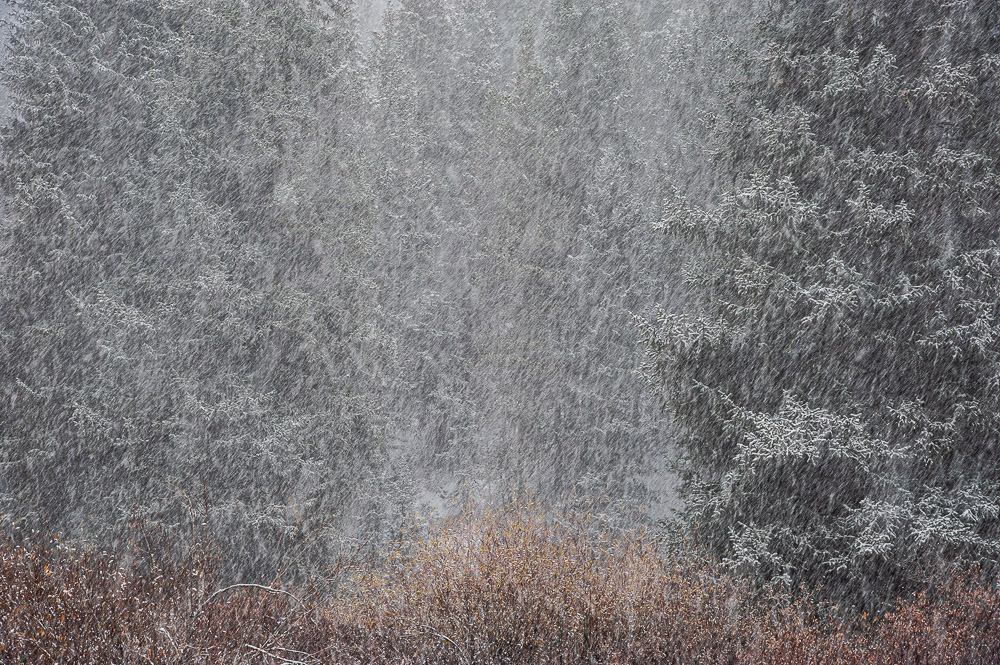
    The image with this article is one of these. I was having lunch near my studio and noticed the way the corner windows were creating abstract reflections. I stopped eating and shot some intriguing juxtaposed scenes. This is one actual image, just found by chance. And because I was looking.