An artists journey

Category: Psychology

  • Down Time

    Down Time

    I’m just coming off a week of being too sick to work. The enforced down time seemed strange to me, since I’m never sick or not working. It was an interesting time to reflect.

    Not going into my studio for an entire week. That’s unheard of. Stuck at home, your mind goes to weird places.

    But did I get anything useful to share with you or am I just ranting?

    Filling the time

    There was, of course, the requisite TV binging. Well, watching the screen, large and small. [Opinions expressed are my own. Void where prohibited by law.] There is nothing useful to watch on TV or cable. There might be a few decent shows, but they are so broken up by commercials that it’s pure frustration.

    Netflix, Amazon, and iMovies have a lot of good shows and series. That was mainly where I got my movie fix. It was a good chance to catch up on movies I had been wanting to see, especially those my wife didn’t want to watch.

    Where’s the beef?

    I enjoyed the movies and am still watching them, but that became very unsatisfying. There was no substance. My mind craved something better for it. It was like going to the buffet and gorging on dessert. I needed meat, vegetables, salad, too.

    One excellent source of nourishment was Creative Live. It has a very good selection of quality instruction and inspiration for creatives and makers. I watched several courses, including some I had already seen before. Being able to watch in uninterrupted blocks is better than a few minutes at a time whenever you can grab it.

    Another focus in the time was a Selective Color workshop by Alain Briot that I’m trying to work through. It’s pretty dense material, but I’m determined to dig more into luminosity masking and color enhancement. I’m getting the luminosity masking pretty well, but the color enhancement is far behind. For one thing, the realist in me sometimes digs in and blocks me experimenting with extreme transforms.

    Old school

    The whole world isn’t video. I went back to browse some of my old books (remember them?) on various aspects of photography and art. Especially helpful were books by the distinguished Michael Freeman. He has a fantastic talent for communicating in writing. Being able to grasp a complex subject and make it understandable to other people is a real art.

    I even dug into a history book I am reading. For some reason this year I got curious about Pearl Harbor and picked the excellent book by Gordon Prange, “At Dawn We Slept“. Wow, there is so much here. Mr. Prange was a very diligent historian. You find out what the relevant players on both sides were thinking and doing almost minute by minute. This is going to take some time but I’m definitely going to finish it.

    Learnings

    Sorry, no blinding revelations from the mountain. I didn’t change my life much.

    I did, though, conclude it is healthy to have some down time occasionally. If you spend your days nose-down working on projects, marketing, whatever busy work we have to do, it is good to pull out occasionally to rest and regroup. Sometimes we have to disengage from the demands of the urgent and let your mind rest.

    How you do it is probably very personal. Having private time to think and meditate works for me. For some getting together with friends is what they need. That’s a great idea too, but being sick for the week prevented that. Or schedule yourself into a retreat or a spa. We all have our notion of how to recharge.

    So I’m going to start scheduling down time (without the sickness).

    Try it! Let me know what you think!

  • Get Your Head Out

    Get Your Head Out

    Shame on you. That’s not what I meant. I am suggesting that you need to get your head out of the day-to-day FOMO rat trap most of us are caught up in and reconnect with the amazing world around us.

    How much time have you spent on social media this week? How many times did you check your phone in the last 24. hours? Is Facebook where your face is more than with the people around you? Did you successfully keep up with today’s trending happenings? Did Fear of Missing Out (FOMO) keep you glued to your screens because you’re, well, afraid of missing out? How many hours of TV did you watch yesterday?

    Missing what's going on
    Isn’t that … Oooh, look at this!

    If you identified with this assessment, congratulations! You are exactly what the American tech giants have trained you to be. Or remember that great line in Men In Black “Gentlemen, congratulations. You’re everything we’ve come to expect from years of government training.

    Yes, I’m being harsh for emphasis. But this heads-down, isolated, tech-centric phenomena is recent. It has mostly happened in about the last 10 years. We have allowed ourselves to be deluded. Social media should not be the center of our world. Several other things are much more important. I won’t go into my list, because they represent my values and I am not attempting to sell you on mine. There is, though, one I want to discuss here.

    Reconnect

    I believe it is more important now than it ever has been to reconnect with the world around us. When did you last take actual time to look at things around you? Have you turned off the radio on your commute and looked out the window? Have you turned off your music and listened to things? When did you last stop to be amazed by a sunset?

    Well who am I and what do I have to say about this? I’m nobody important. But I have started doing just what I am recommending. And I am an artist. As an artist, I am in a position to observe the world with a different eye, a different point of view. At this time, my point of view is strongly driven by the theme of reconnecting. I hope to help people along this path.

    Addiction?

    How do you reconnect with the beautiful world around you? It’s not easy. Just like it is not easy to quit smoking or drinking if you are addicted to those things. Yes, I believe social media and entertainment has become an addiction for many of us. First step is realizing your state. You might actually have to look at yourself in the mirror in the morning and say “Hi. I’m _____, and I’m a Facebook addict”.

    If you say that to yourself it will help you start to see the situation in a different light. You might look at yourself and realize you just spent another 2 hours on Facebook (or whatever). Now the kids have gone to bed and you didn’t spend time with them or even interact with them much. Lost opportunity, again. But for what? What about that social media was more important than your family?

    I recommend a little book by Svend Brinkmann, “The Joy of Missing Out“. Or a similarly named book “The Joy of Missing Out: Live More by Doing Less“, by Tanya Dalton. (I do not receive any compensation from these). They have the time to express it in much more depth.

    What can I offer?

    But I’m just an artist. What can I offer you? I can offer images of the amazing world around us. Not vacation shots or selfies at the beach. Rather, thoughtful views of life going on all around us that you do not see unless you slow down and look. Things that help us to remember who we are and where we live.

    This kind of art is not just about pretty pictures, although the things we want to reconnect with will typically be pretty. It is something that gives us a shiver. Art like this can cause us to think and remember. It makes us stop and quietly say “wow”. It reminds us of what brings us peace and rest.

    Note, I’m not a happiness guru. I am not selling a formula for being happy. I am trying to help you reconnect with the world.

    If you surround yourself with images like this it will remind you, every day, what is out there. It will remind you to look and listen, to reconnect with the world.

    Check out my images at photos.schlotzcreate.com. Perhaps some of them will resonate with you.

  • Gestalt

    Gestalt

    No, not Gesundheit. Gestalt psychology is a a system that looks at things as a whole rather than just parts. It goes for the “big picture”.

    What does a relatively obscure European psychology theory from the early 20th century have to do with anything I have been discussing here? Quite a lot, actually. One of the famous summaries of Gestalt principles is “The whole is different than the sum of its parts.” I believe this is profoundly true for many things, especially photography.

    Proponents of Gestalt included notables such as Immanuel Kant, Ernst Mach, and Johann Wolfgang von Goethe. Actually knowing who they were is not important, just that you have probably heard the names. It is interesting to me that the theory developed as a reaction to the prevailing trend of the day to break things down to the smallest possible parts. Something that still happens with some people to this day.

    A brief explanation of Gestalt

    A simple explanation of Gestalt is that the human mind makes patterns, it completes fragmented shapes to make wholes, it extends dots to see lines, etc. We are designed to complete pictures. The following figure shows an example of this. It is called the Kanizsa triangle. The Gestalt principle of closure is illustrated.

    Kanizsa Triangle

    Almost everyone sees 2 equilateral triangles in it. There are actually no triangles. Our brain “closes” the straight line segments to see one triangle and we “close” the shapes of the cutout circle segments (Pac Man?) to see the other one.

    Other Gestalt principles include similarity, proximity, continuity, and common regions. I’m not going to go into them here. I have no illusion of this being a course on psychology.

    Examples

    My point is that that these principles are real and common to most people. They are used by designers and artists all the time to guide our perception of images. Here are some examples from my library. They were not shot consciously thinking about Gestalt psychology, but they show some things that trigger my mental library because I have learned over time that they work.

    Implied lines

    Here you see the shadows forming dark lines going from upper left to lower right. They are formed by our mental connection; they do not really exist. The three sets of shadows do not even touch each other.

    Implied arc

    In the lower part of this image you see an arc of yellow lights. They are really just discrete points. Since they are closely spaced and in a regular pattern, we see a complete arc. And it continues despite the dropout on the far side.

    Implied region

    The area inside the magenta line is seen as a distinct region of the image. Inside the line is one area, outside is another separate one. It’s not really true, but that is the way we see it.

    Application

    The marvelous human brain is unsatisfied with incomplete forms. We “fill in the blanks” unconsciously. And it is even rewarding. You feel more satisfied by solving a puzzle, by completing an image from clues. A few points is seen as a line, some repeated shapes is a region, things in proximity seem to go together. It is amazing. When an artist works with his viewer to make a game it can be fun for both.

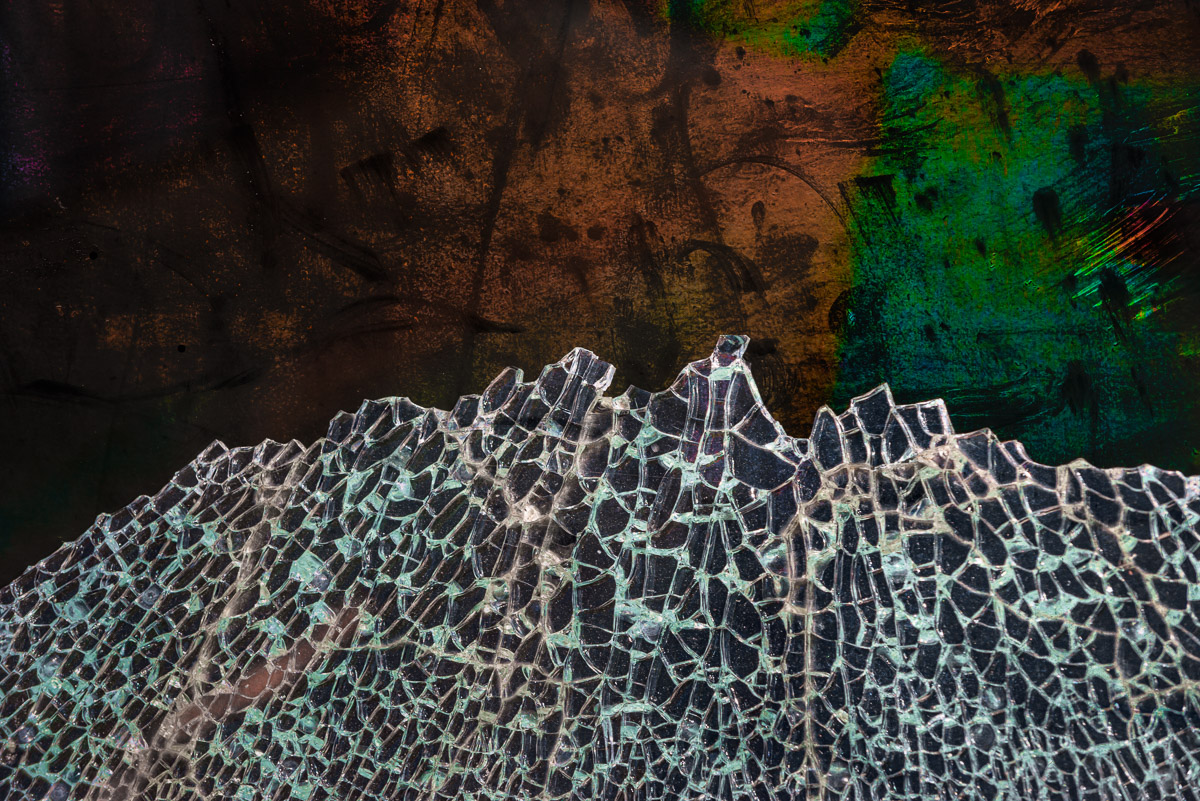
    So how about the image at the top of this topic? A few arcs? A couple of rectangular blobs? Or is it a spotlighted figure? Or a spider?

  • Image Library vs Creativity

    Image Library vs Creativity

    I recently wrote 2 articles that seem, on the surface, to be contradictory. In When The Flash Goes Off I discussed the cognitive theory that we recognize images we like based on a library stored in our mind. In It’s Complicated I argued that there is a creative side of our mind that discovers and creates new things. Which is right? I believe both are. It is recognition from the image library and creativity, not either or.

    I believe that when I am searching for images, the mental library is being scanned all the time. This is a fairly conscious activity. I have asked my mind to let me know when there is something there that I probably want to be aware of. This is the active hunting phase.

    Here is an example from a recent shoot. I was near Leadville Colorado. One of my favorite areas in the world. Cruising around the old mining area I came on this scene below. I love old mining cabins, beaver ponds, ice, mountain views, and historic areas. So those are all filed in my image library. This hit on all of these. It was immediately obvious that I would have to stop and work on this scene. No chance of going past it. My head was exploding.

    Colorado Mining Cabin, Late fall

    Vs. Painting

    By the way, why does this hunting work much better for photography than for painting? Because a painting is constructed from nothing. The canvas starts blank. The artist must decisively choose and place every element wanted. The camera, instead, constantly receives massive amounts of information. Every place the camera is pointed and every time the shutter clicks, there is a complete, fully formed image. The photographic artist’s job is to sift, reduce, minimize, compose, organize this embarrassment of riches to select what would be a worthwhile image from all this. A completely different mindset from painting. And this is why the mental image library works to locate promising scenes.

    Where is creativity?

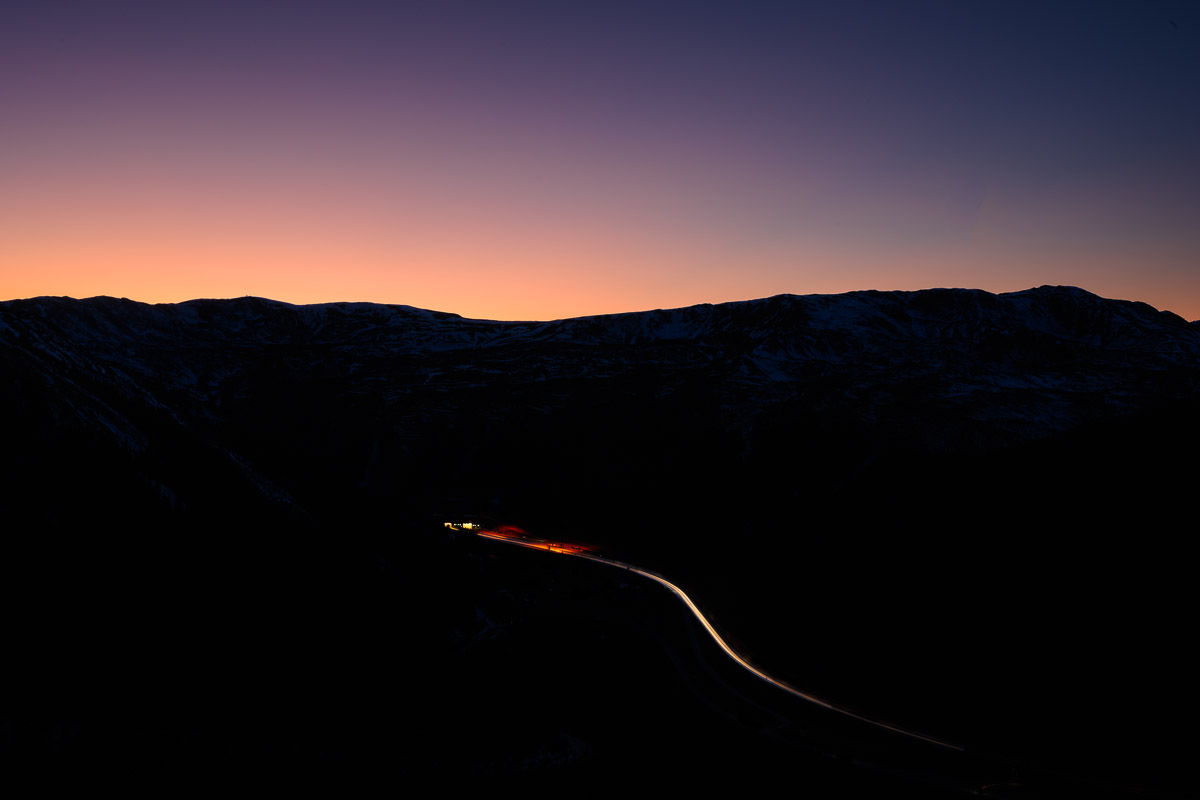
    Contrast the mountain cabin above to the image at the top of this post. This was taken on Loveland Pass in late fall in the early evening after sunset (burrr – very cold). This image was preconceived before I got to the location. The reason I was at Loveland Pass was specifically to look for this. I challenged myself to explore the concept of “dark” and this was one variation that formed in my mind. I had never taken an image quite like this before. This one, as a matter of fact, is a composite of several time exposures.

    I hope this is perceived as a valid and fresh take on the concept of “dark”. I hate the phrase “out of the box” and seldom apply it to myself. Maybe because I fought long and hard to never let myself be confined to a box. Too many people toss it off casually. The trouble is, it’s easy to say it, but doing it takes a lot of discipline.

    So this was not a result of my mental library. It was a new creative event. I consciously pre-visualized the image rather than recognizing it as I passed by. Actually, it was too dark to have recognized much of anything.

    So where did it come from? In this case, I posed a project for myself and that got the other side of my subconscious mind working on solutions. This is one source of creativity. Other creativity drivers are looking for connections, asking “what if”, and seeing examples of other work. The subject of creativity is too big for here. It needs other posts.

    Complementary

    Mental image library or “out of the box” creativity? Yes, both.

    These are not in opposition. Rather they are just 2 different aspects of our marvelous minds at work. They are complementary. Together they are 2 of many tools we have that allow us to see and create great images.

  • It’s Complicated

    It’s Complicated

    Last time I wrote about the cognitive theory of vision that says we have a library of images stored in our mind and we automatically match them against scenes in front of us. This time I will say, it’s complicated. Nothing in life is that easy and straightforward. The simple theory can’t explain everything.

    To reference one of my favorite quotes from The Count of Monte Cristo (movie version). “it’s complicated”. Life and art is. A model, like the model I described last time, is a simplified version of reality. It may be useful to explain some things, but it cannot fully describe real life.

    The safe path

    If it is true that we are drawn to reproduce images we already know we like, we get stuck. Now, I think many people would acknowledge that this is true and they spend much of their career remaking the same images. Maybe they are OK with this. It is, after all, safe and comfortable.

    I can only speak for myself, but safe is not my goal. Safe gets boring and all the same. If I were a wedding or portrait photographer I’m sure I would have a different attitude. I’m not, so I can get as far “out of the box” as I want.

    Where is creativity?

    If we only remake images that match our mental library, where is the creativity? Where is that spark that takes us completely outside the normal? What causes a change of direction?

    The answer is: I don’t know for sure. But I know it happens. While I believe creativity is a learned process, it is undeniable that it sneaks up on us unexpectedly sometimes. Maybe we intentionally go out looking for something new. Maybe a familiar scene make us ask a question that leads us in a new direction. Sometimes we might have just had something weird to eat and it sparks our brain in a strange way.

    Be receptive

    I believe creativity is something you can practice and stimulate and cultivate. But those things only encourage it to happen. When it happens, when something new hits you out of the blue, you need to be receptive to it. Sometimes our natural reaction is to resist the risky new “thing”. We may not even recognize it as an entirely new direction at the time we first see it.

    Embrace the new idea. Run with it and see where it goes. At worst you decide you don’t like it. Better to have tried and failed than to not try at all. At best, though, it may change you. It may be a new viewpoint on the world.

    Think of Bilbo in The Hobbit. He did not want to leave home, but he came back changed in ways he could never have imagined. Most of us are not inviting life changing experiences like that when we follow a creative instinct. But it may be a close as we come.

    Personal

    I’m an artist. If I go through life taking the same pictures over and over, because that’s what is in my mental library, I am stale. I thrive on creativity. I enjoy following my curiosity to find new things. I am refreshed by expanding my vision in new ways. It makes me grow. It keeps me young.

    I embrace creativity, not for its own sake but for what it does for my vision. When I grow to a new place in my art I find I need to add some new images to that mental catalog and maybe remove some that I do not care for any more. That is life. That is growth. It’s complicated, but awesome.

    Let me know what you think!