An artists journey

Category: Mastery

  • A Balance

    A Balance

    Being an artist is a balancing act. There are many dimensions that must balance against each other. Get too far off in the weeds in any dimension and you risk losing the path you are seeking. This time I will discuss the balance between egotism and self doubt.

    Egotism

    Egotism is the sense of being self-important. It is arrogance. It is being focused on yourself and thinking, for instance, that your opinion is more important than others.

    Who would want to be such a person? Well, an artist does.

    He doesn’t seek to be arrogant, but it is a necessary component of the creative struggle. An artist has to feel he has something to say. That he has a point of view that is unique and worthwhile. And you feel compelled to share your vision with other people.

    You have to believe you have the right, even duty, to grab people and say “look at this!” Because you are bringing something fresh and new into the world that people should see. If you are not bringing something new, then why are you wasting your time? But you are, so you should shout about it.

    Your art is the best art you know how to make. You believe it is worthwhile. Therefore you should be a little pushy and arrogant. Egotistical, within bounds..

    Self doubt

    On the other hand, most artists are plagued with self doubt. There is always the voice whispering (shouting?) in our ear. Telling us we are not good enough. We aren’t doing anything new or creative. No one would want to see our work. What the critics say is right – we’re not really an artist.

    Because of that self doubt we shrink back. We don’t shoot those extreme or controversial images. We don’t push our work to galleries or contests. Aren’t we quick to believe the worst about ourselves and equally quick to believe that everyone else knows more than us?

    That little voice thinks it is doing us a favor by trying to keep us from making a fool of ourselves. To keep us from being hurt. But the reality is we can’t be an artist unless we are willing to be a fool. We will be hurt and rejected and told by the “experts” that we are not good enough.

    It is up to our egotism to balance that and help us push on despite criticism and disappointment.

    The intersection

    Where egotism and self doubt balance is where I believe most artists live. You need both.

    Egotism gives us the confidence to believe in ourselves. Self doubt makes us evaluate ourselves more objectively and see if we need to improve. We need both.

    If they are not in a healthy tension we can go off track. Unchecked egotism can be self destructive. We can delude ourselves into believing everything we conceive is wonderful and a benefit to the world. Unchecked self doubt will cripple us and shut us down from ever risking anything.

    On the other hand, a healthy amount of egotism keeps us moving forward, creating new work, experimenting, believing that we are doing something useful. Balancing that with a certain amount of self doubt will temper us. It will make us question and evaluate things but not be enough to paralyze us.

    Like many things in life, being mature and creative means being able to manage the tension of competing and contradictory ideas. We have to use our core values and faith and life experience to understand the inherent contradictions and still deal with them. Without going crazy.

    It’s about balance.

  • Frozen in Time

    Frozen in Time

    Many of us go around trying to freeze moments in time. For a lot it takes the form of happy, smiling images to post to social media to prove (to us?) what a great time we are having on vacation, graduation, the wedding, etc. Or we may freeze great landscapes or seascapes or sunsets so we can show their beauty.

    But what is your experience when you share these moments with other people? You pull them up on your phone to show your buddy. Flip, view a few seconds, flip, flip (faster now), flip…. People only look at images on screen for a couple of seconds.

    As someone who shoots thousands of images and makes prints I can say from experience that an image is not really complete and meaningful until a great print is made.

    Digital images are impermanent

    Digital images are impermanent in several ways. They are just bits on your hard disk or in the “cloud”. Unlike in the days when we had albums or even shoe boxes of prints, our pictures now can disappear in an instant. Hard disks fail. I know very well. I have thrown away dozens of them.

    My main storage devices now are all RAID drives. This means they have multiple drives in each and the information is partitioned so that if one drive fails, everything can continue with no data loss. But that is just mitigating the problem.

    Technologies change and become obsolete. How many of you have some pictures on a floppy disk or CD or some other media that you can’t read anymore? It happens. Fairly frequently.

    And your cloud provider can go away or stop serving you if you don’t pay. Or if you don’t keep up with the never ending system updates for your computer and they stop supporting your version.

    Another problem with digital images is that most people do not have a good cataloging system for them. Are your images stored in chronological order in Apple Photos? How do you locate that great photo of Grandma you took once? Do you even remember the year? It sounds harsh, but if you can’t find it, you basically don’t have it.

    Digital images are fluid

    Another property of digital images is that they are fluid. That is, they can be changed at any time. That can be useful sometimes. Break up with that loser? Edit him out.

    On a more serious note, it also means that the look of the image can be changed at a whim, depending on your mood or your developing Photoshop skills. Your digital image will be content to exist on your disk in an easily editable state. By its nature, it is perpetually a work in progress. It does not require you to ask or answer hard questions. It is not forcing you to confront your feelings or interpretation. But a print commits the image to a hard media.

    When you make a print, you are compelled to think it through in more depth. You are not going to take the time and effort and expense of printing unless you know how you view the image. You work on it more that if you are going to put together a slide show. It has more permanence and It represents our convictions about the image at a point in time. This forces us to think about it more.

    When the ink is laid down you have created a piece of art, not just some bits. It means something different to you and your viewers.

    A good print is compelling

    Have you been in front of a well crafted original print by Ansel Adams or Dorothea Lange or John Paul Caponigro or any great photographer you like? It has depth and significance that is impossible to create on a screen. We assume from our experience that images on screen are fleeting. But these great prints are different.

    People look at images on a screen for a few seconds. They study great prints for minutes. The print can grab you; stop you in your tracks; confront you with something you can’t ignore. It is a piece of art, not just flickering bits. It is real.

    Prints are the gold standard

    I talked before about how transient bits can be and how devices fail and technologies go obsolete. Good prints, though, have substance. They are physical. They are a real object with weight and texture and size. A well done print can last 100-200 years without degrading. It is something that can stand the test of time.

    Ansel Adams stopped printing over 40 years ago, but one of his prints is as impressive today as it was then. And it will probably be as impressive 100 years from now.

    A print is a frozen idea

    As I mentioned, you are not compelled to “finish” your digital images. It is far easier to shoot than to finish them. You can leave them sitting there on your computer with only a fuzzy notion of how we really feel about them.

    When you commit to creating a print it forces you to confront your feelings or interpretation. You go through some serious self-examination. Once the ink is on the paper it is not going to change. It represents our idea about the image at a point in time. We have to go through the work to decide how we really feel about the image in order to print it. And we spend a lot more time bringing it to a high level of perfection.

    This is a good thing. We are creating a real, permanent object. It represents us. We feel pressure to make it our art. It is our expression for the world to see. We are creating something that will probably outlive us. We want our viewers to see what we saw and feel what we felt.

    It is quite possible to return to an image years later and make a new print that is very different. That is quite common and healthy. It means we have grown and developed new viewpoints. If we rework the image and create a new print, it is a new work of art. It could hang proudly beside the original as portraits of the artist at 2 different points in his life.

    It is the only physical result of photography

    When I press the shutter of my digital camera, not much really happens. Some photons are exposed to the sensor and some electrical change is read and converted to bits and transferred to the memory card.

    Even when I import the digital files into my computer, they are still just bits – minute, almost unmeasurable units of electrical or magnetic energy. I can hit the Delete key and they are gone without a trace. My main photo disk has over 6 TBytes of data on it (6,000,000,000,000 chunks of 8 bits). But it does not weigh a gram more than it did empty.

    I can argue that I have not actually made anything of value until I make a print. The print is something real. It is physical. People can see it and feel it and look at it as art or garbage. But regardless of how they feel about it, they can’t see or feel anything until it is a print. The print can be framed and hung on the wall and passed down to generations or sold. The bits cannot.

    It completes the cycle

    And printing is good for you as an artist. It completes the process. It brings art to life. You have to work at it, wrestle with it, make mistakes and do it over. You have to make hard decisions that shape the final result. The print is a commitment of your vision, frozen in time.

    And when you get done, you may be disappointed. You envisioned more. You hoped, when it was just bits, that it would be more. The reality of the print can be cruel. You have to reexamine everything from your conceptual idea to your technique. It is what it is. Learn from it. We want people to see and feel what compelled us to take the picture. Sometimes it works. Sometimes it doesn’t.

    But you won’t know what it really is until you have made the best possible print. That is your art. If you revisit the image later you may see it differently and print a different interpretation. Printing is a key expression of our art.

    I reference Ansel Adams a lot in this article. In closing, he famously said:’

    The negative is comparable to the composer’s score and the print to its performance. Each performance differs in subtle ways.”

  • Keywording

    Keywording

    Keywording is a pretty mundane subject. But I recommend not ignoring it. It is valuable to you and good discipline. I have tried to ignore keywords at times but I have always changed my mind.

    What

    The photo filing software you use probably has provisions for adding keywords to your images. It probably also has ways to add a lot of other meta data, like location or client or your copyright information. Use this other information, too. I use Lightroom Classic for my organization and keywording.

    Keywords are simply arbitrary tags that add words or phrases to help you locate or identify your image later. This is important, the keywords are completely chosen by you and for your use, unless you work for an organization that enforces standardized keywords. I will assume here that that does not apply to you.

    So they are only meant to be useful information for you. They may tag location or subject or color or mood or anything that seems relevant to you. You can add as many keywords to an image as you want. Perhaps there is an upper limit, but I have never found it or read about it. Again, let me emphasize that you decide what they are.

    Why

    Why go to this trouble? Because one of the problems with digital images is that we tend to collect a lot of them. And since they are “hidden” on your computer and not nice physical prints you can flip through, you need extra help finding things. Someday you will want to find a particular image or images of a certain subject or those pictures of a red cardinal in a winter snowstorm you took a few years ago. Keywords are one of the means of locating or grouping your pictures.

    One of the challenges of keywording is to Goldilocks it: not too much, not too little, but just right. How do you know what is just right? That’s the challenge. Partly it has to be sort of backward looking. That is, when you find you can use your keywords to locate the images you want and it did not seem too much trouble to have added them, it may be just right. Sorry, not a really helpful description. The trouble is, your mileage may vary.

    Strategy

    Most photographers eventually determine a strategy for keywording that works for them. I have seen people who do a lot of wildlife photography who tag images with the common and scientific name of their subjects. That is too much work for me. Since I don’t shoot much wildlife I may only tag the occasional one with “elk”, or “deer”, or “pronghorn”. Or a very generic thing like “bird”.

    Works for me. Would not work for some people I know. Choose an approach that is right for your needs.

    There are places on the internet where you can find lists of keywords. I have looked at some of them, but they tend to be too detailed for me. Plus, since I did not create them, I have trouble thinking of the words the author chose. So I make up my own keywords as needed. A quick export of my keywords shows that I have nearly 2200 unique keywords in my main catalog. I am completely sure many people have far more.

    For the most part, I use keywords to identify subjects, attributes of the image, and “housekeeping” information.

    Example

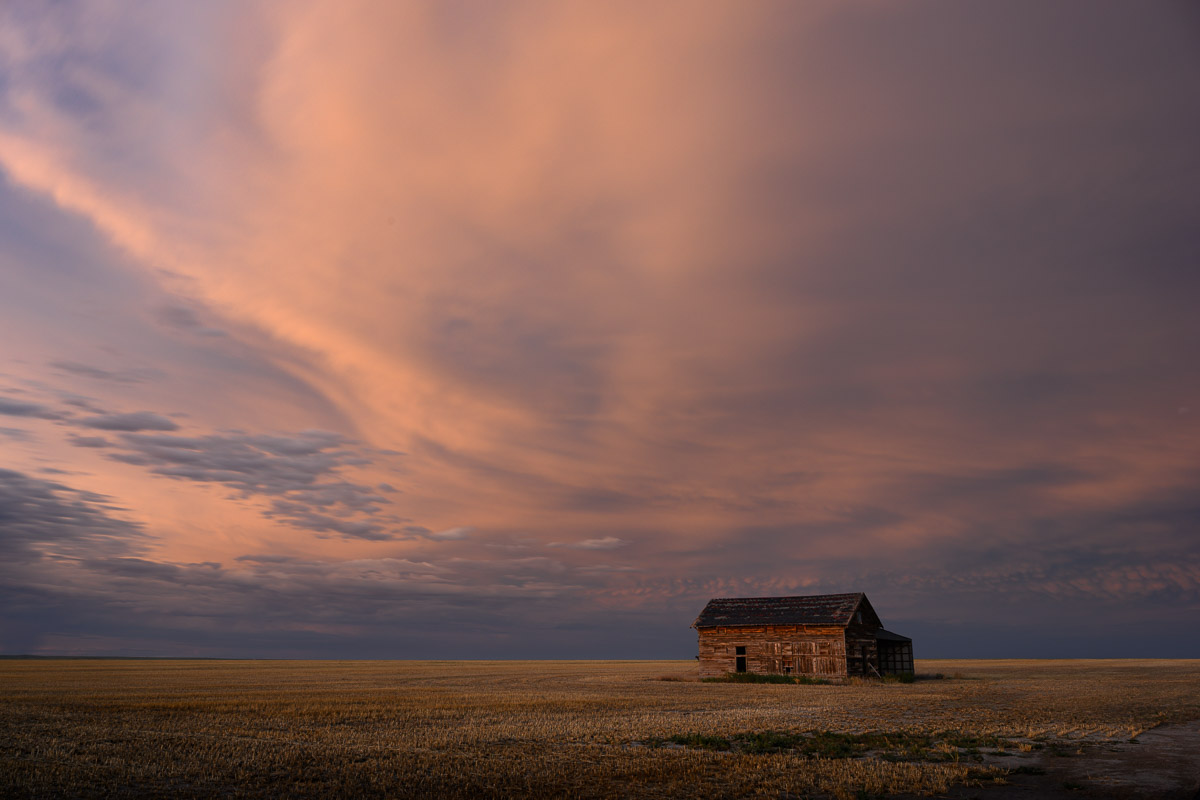
    Let me give a simple example. This is a somewhat randomly chosen image that seemed fairly typical of my keywording.

    Sunset, wide open spaces

    This image has 14 keywords currently. For the subject ones, it is identified as a cabin on the eastern plains of Colorado with interesting clouds. For the attributes that seemed important to me, it is a landscape, it is abandoned, it is made of wood, a sunset image, taken in summer, and showing an expanse of distance.

    The potentially most interesting are what I term housekeeping keywords. I use these to track important information that often has nothing directly to do with the image. An example for this one is that it is copyrighted. Yes, all of my images are copyrighted technically at the moment I take them, but this extra level signifies that the image has been filed and accepted for copyright by the United States Copyright Office. In addition it has keywords indicating the copyright registration number and date of grant. Other example housekeeping tags are that it is in my Select5 group, one of my highest ratings, and it is used in this blog.

    Why do it this way? Because I developed a system over time that works for me and is based on real needs that needed to be solved. I do not claim it is the only way to do things or that it is the best way. It is just the workflow I use. I encourage you to also adapt your tools and process to meet your needs rather than bending your needs to match the tools, or what someone has told you you should do – including me.

    Worth it?

    It is solely up to you to decide if it is worth it to you. It is to me. I often do searches to locate a particular image or a certain type of scene. The more identifying information I have, up to a point, the better. I also use smart collections sometimes to group together all images of a certain criteria. For example, I mentioned using a keyword for my selection level. I have smart collections that will show me, for instance, everything at select level 3 that has not yet been evaluated for possible promotion to level 4. This is a key part of my workflow.

    I always keep in mind what I termed the Goldilock effect. If my keywords are not adding value for me I will modify or abandon the process.

    These are your images and your process. Do what works best for you. But it is good discipline to enforce on yourself. I can say that if you go a long time ignoring something like keywording and decide later you should do it, it is a lot of boring work for a while.

    The tradeoff for me is that keywords are valuable for my work and useful for my processes. I will put in the effort to do it. Taking a little time to think about an image from several aspects like subject and attributes and housekeeping has benefits for me. It is one of the steps that ensures I am curating my valuable assets rather than just accumulating a big bag of pictures.

    Postscript

    A growing trend is software that attempts to analyze your images and automatically generate keywords. One new one I’ve seen is Excire. Another system I have seen described is fotoKeyword Harvester. I’m sure there are more. Lightroom itself agressively tries to get me to let it scan to identify people. It’s little brother, now named just “Lightroom” also automatically tries to keyword images. All this comes with the increasing penetration of so called AI technology.

    I don’t use these tools. As a matter of fact, I don’t trust them. All that I’ve seen will suck your images into “the cloud” for analysis. I have no sure way of knowing what will happen to them then. I am very protective of my rights and possession of my images.

    Yes, I may be a Luddite, but it is not entirely out of ignorance. I am a Software Architect who had done AI work and even developed practical applications based on some of its research. I have some idea of the downsides of using it.

    Besides, as I indicated above, my system is based on a network of keywords I have grown organically over a long time. I am not interested in some software system deciding to re-describe and re-interpret my image data.

    So for the foreseeable future, I will continue doing my keywording manually.

  • A Private Journey

    A Private Journey

    Being an artist is a private journey, but one the viewers are invited to participate in. I don’t collaborate or take votes to guide my journey. It is just me. It is intensely private.

    Private

    I have to make my own way in the world. As such, I am stuck in my own head. Creativity has to somehow spring up from within. Being an artist is lonely. LIke a writer, there are those terrifying times when you are facing a blank page (or empty frame) and you have to create something. No one else can do it for me.

    Not everyone agrees with this approach. Some people, especially if they are young and just learning, want to run in a crowd. They have to immediately post every image to social media to get feedback. To me this is a form of insecurity. My values and style is deeply ingrained and I do not seek immediate validation from the internet. But that is just me.

    What works for me is to explore, to be receptive to what I encounter. I seldom have a detailed plan for what I want to shoot. Rather, I turn myself loose and let myself be drawn to scenes that interest me. It doesn’t always work, but that is what inspires me. The word that keeps coming up is”me”. Not in an egotistical way, but in the sense that I am the only one who can take this journey. If it wasn’t me it would be someone else’s art.

    I also find, and this is just me, that when I put pressure on myself to “have” to come up with something creative the results may be good but they are seldom great. But when I let go and just react and experience then creativity can flow. Understanding this about myself has let me keep my art constantly being a joy.

    A journey

    Virtually all my subjects are collected outdoors. It is extremely rare for me to set up a controlled indoor shoot. So a shoot for me involves movement. I have to leave my studio and get out in the field where my subjects are.

    This is a joy for me. I am an explorer. It is hard to pass a road I haven’t seen the end of. As an example, just a couple of days ago I was exploring up along the border of Wyoming. I went down an obscure dirt road I knew was a dead end, but I had never been down it. It was great! I loved the sights, the remote wildness, the windswept barrenness, the newness. It was fresh. Something I had not seen before. It energized me. Even if none of the images make it into my portfolio, it was well worth it for me personally.

    But a journey doesn’t have to be far. I do a lot of shooting while walking around within a mile or 2 of my studio. Journeying is an attitude. A sense of exploring and investigating. It is sometimes difficult to feel a sense of discovery in an area I have been over and over so many times. But that is part of the game. It is a mental discipline. If I can find new and fresh sights in a familiar area then it is even easier to get inspired in an interesting new place.

    Viewers

    It is true that my art makes me happy. If I never showed it to anyone I would still have the joy of creation and discovery that would compel me to make it.

    But artists are also somewhat egotistical. We feel we have something worthwhile to share with other people. I hope those who see my work enjoy it and can share in the sense of wonder and amazement I felt while making it. I’ll be honest, I also hope you decide to buy some of my prints for your walls. The money is nice, but even more is the knowledge that this had an impact on you and that it will now continue to influence you. We all would like to leave a legacy.

    I know your time is valuable and increasingly scarce. I seek to make art that is captivating enough for you to give me some of your time to view it and think about it. I hope my art will awaken some new thoughts and feelings that will make your day better, to refresh and renew you. I like to feel that some of my pieces on your wall will have a long term benefit as you see them every day.

    Internal and external

    My art is a private creation of my own mind and energy. I do not collaborate with others or shoot assignments. What energizes me is exploring and finding wonder in the everyday sights around us. I may work a project or a theme at times, but mostly I let myself be drawn to whatever is exciting me at the moment. I am very much in the moment when I am creating, even when working at the computer.

    Even though my art and my process is intensely private and personal, I also have the viewer in mind. I am constantly reaching for something creative and fresh to share with my you. If you give me some of your time and attention I want to give back. I hope I can succeed with you. It is my private journey but I want to share it with you.

    Go to my web site at photos.schlotzcreate.com to view a little of my work and let me know if any of it resonates with you. Please join me in my private journey. I welcome your feedback.

  • JPG vs. Raw

    JPG vs. Raw

    It seems like deciding on jpg vs. raw formats for our images is a problem for some photographers. I’m not sure why. Maybe it is lack of knowledge or maybe because it is sometimes discussed in almost mythological terms. Jpg and raw are just 2 ways of saving our images. Each is good for some things but there are tradeoffs to consider. It is just technology, not magic.

    Image formats

    When you take an image on your digital camera, each manufacturer has their own proprietary magic they do on the bits coming off the sensor. This lets them tune their image to meet their goals. If you shot the same scene with different cameras you would notice subtle differences – slight color balance differences, slight variations is tonal contrast, different handling of shadows and highlights, etc. These are usually small, but they give a camera it’s unique character.

    But we need to consume these pixels in our image processing software. So there needs to be standardized ways of storing the images and reading them in our computer. These are file formats. There are 2 main choices.

    Jpg is an industry standard format. The format is very widely understood and used. All images, once converted to jpg, are compatible.

    What we call raw files are really proprietary file formats created by different camera manufacturers. Image processing software, like Adobe Lightroom, has taken the responsibility to be able to read the files written by virtually all camera manufacturers. For instance, I shoot Nikon, so the images LIghtroom reads and handles have the “.nef” extension. Lightroom knows how to interpret this and convert it to editable pixels.

    The key thing here is that these raw files all contain roughly the same information, but are not directly compatible. Thankfully our software handles the differences gracefully.

    Technical details – jpg

    The term jpg, more precisely “jpeg” is derived from a standard created by the Joint Photographic Experts Group. The name jpg is an abbreviated acronym.

    The problem was that digital files are very large, this made them consume lots of disk space back when disks were small. It also used up lots of bandwidth transmitting them back when internet was slow and much more expensive (anyone remember dial up modems?).

    The jpg standard is based on some brilliant insights on human perception to allow encoding image files so they look good but are much smaller. The underlying principle is that humans are more sensitive to variations of tone (luminance) than they are to color (chrominance). The jpg processing reduces the luminance information and greatly reduces the chrominace data to acheive reductions of about 10x typically.

    In general, transforming an image to jpg is a multi step process. It involves a transformation where the luminance and chrominance information is separated. Then the chrominance information is downsampled, or reduced. Then there is a grouping of data into blocks and a process called discrete cosine transform is applied to the data blocks. This transformed information is quantitized and encoded. Finally the data is written out in a defined format as a jpg file. It is not at all necessary to know these details, just that the data in a jpg file is far removed from the original pixels that came from the camera.

    It is a lossy compression technique. Yes, it throws away a lot of data. This is one of the big tradeoff points of jpg. But a fringe benefit is that the image is made to look “nice”. The result is pleasing to most people without further processing

    Technical details – raw

    These files are called “raw” because they contain minimally processed data from the camera sensor. They are absolutely not ready to be viewed or processed. Some people describe it as a digital negative. Conceptually this is pretty good way to help us think about it, but it is not a valid description. The data is not negative and it is not viewable. It might be better to think of it as exposed but unprocessed film.

    To follow this metaphor, a raw image processor like Lightroom “develops” the image and makes it viewable and editable.

    Why raw? It captures and beings into the computer all the data that the camera sensor was able to record. It has the full range of color and tones. Nothing has been eliminated yet.

    In addition, the raw format has not had any lossy compression applied. Nothing is thrown away or reduced. Because of these things an image from a raw file requires manual editing to complete it. Sometimes a lot of editing.

    Tradeoffs

    So jpg is made small as possible and generally nice looking as soon as you see it. You can immediately look at it or send it to someone or post it to your social media. Yes, some information has been intentionally eliminated, but that is not important to most people. If you don’t notice it then it must not matter.

    On the other hand, if you want to make a large print of a jpg you may see noisy patterns that are euphemistically called “artifacts”. This might be mitigated with clever software, but your mileage may vary.

    And there is an editing danger you need to be aware of: every time you save a jpg file it goes through the transform process to reduce data. So every time you edit it and save it you lose information and introduce more artifacts. If you want to edit a jpg always save the edited file in a lossless format, like psd or tif.

    The raw files are usually very large. On my current main camera a typical raw file is 50-70 MBytes. A high quality jpg of the same resolution is around 4-5 MBytes. So, 10 to 1 or greater differential. And the raw files require an investment of time and training and tools to process them into a respectable state.

    But, and this makes up for everything, the raw file preserves every bit of information that we can wring out of the sensor. A modern sensor is marvelous and enables very aggressive processing. The raw format contains the full resolution of the pixels. It is not limited to 8 bit data like jpg. I often do things with the image data that I could not have envisioned when I took the original photo.

    Different needs

    When would you want to use one vs. the other? Well, if I was shooting a wedding I would probably use jpg. Say I come away with 3000 images. I would want to be able to scan through and see good views of all of them so I can quickly pick the 100-200 best to share with the client. If I did my job well the images should not need much editing. I would not have time to process this many raw files.

    Also, if I am shooting snaps of my family that is a time for jpgs. And if I was on vacation and just shooting travel photos for memories that is good jpg territory. I guess if my memory card was nearly full and I didn’t have a spare I might switch to jpg to keep shooting a few more frames. I try to prevent that from happening.

    For me, any other time requires raw files. It is my go-to choice. I know I want to process the images heavily. I am not afraid of the techniques. Given the choice I will always want to retain the maximum information and resolution possible. This given me the flexibility to make massive changes or change my mind and go back to re-process the image for a different look

    I tried to present a very neutral view of the tradeoffs of the 2 formats. I can sympathize that the choice is hard for some people. For me, it is straightforward. Use jpg if I am taking shots of people and I am confident it will need little processing. Otherwise, definitely raw.

    The image with this article is a jpg. It looks fine for this application.