An artists journey

Category: Craft

  • Loud Whispers

    Loud Whispers

    Most images today are designed to explode, to attack, to shout. Are these the ones you remember? I usually don’t. I think the quiet ones, the loud whispers, have more staying power.

    Attention

    It is repeated endlessly and taken for true that we are in an attention economy. Media vendors make money by keeping people engaged on their site. So entertainment, doom-scrolling, click bait, fake news, short videos, and many other products and psychological tricks are used to hook us and keep us watching. I read that the average person now touches their phone 2,617 times a day. We spend over three hours daily on social media alone.

    A byproduct of this attention manipulation is that it changes us mentally. Many people develop a short attention span. We must be continually stimulated to keep the dopamine flowing. Basically, the companies encourage us to regress to childhood.

    Do not believe that the media companies care about art. It is just a commodity. They don’t care what they sell so long as it keeps eyeballs on their app.

    Layers of grafitti©Ed Schlotzhauer

    Photography

    This short attention span affects much photography today. Images are expected to have punch, to hook us immediately. It is believed that they should immediately reveal their meaning without requiring any work by the viewer.

    Implicit in this is the assumption that a viewer will look at an image for about 1 – 2 seconds and then go on, looking for the next exciting image. The next dopamine hit. Doom scrolling until we go blind.

    Even in a gallery or a museum, where it would be expected that people would have a higher level of appreciation, it is normal to watch people just strolling by the lines of art on the wall. Just idly considering some of them, but dismissive of most.

    Now I will be quick to say that a lot of art, including photography, can be quickly dismissed. Things that try so hard to be “creative” that they forget to be good. If it is made by or for the short attention span generation, there is little staying power.

    Sunset on the plains, two trees©Ed Schlotzhauer

    Impact

    I believe that much of the “impact” that is promoted in the attention economy is false. It’s like eating candy. There is a quick sugar rush that feels good for a minute, but it fades quickly and there is no food value that is good for you. It is actually worse for you than skipping it completely.

    The dramatic, over saturated sunset is pretty, but there is little to get from it. The classic landscape image is pretty, but it is just another wide angle shot from the same viewpoint everybody stops at. Portraits tend to be either selfies or would-be fashion shots that tend toward creepy.

    Most of these are easily forgettable. A few minutes later we don’t even recall anything about them.

    I guess the question is was it OK to put it out there just to get a few “likes”, or did you want people to engage with your image? That is a very personal question. I can’t claim there is a universal right or wrong answer.

    Spreading oak branches.©Ed Schlotzhauer

    What stays

    I have noticed, over the years, that many of my images are “nice” and people like them, but only a few leave a lasting impression on me. It would be nice to be able to give a definitive description of what makes one have staying power, but I cannot.

    Since I cannot define it, I cannot reproduce it on demand. Often, I do not recognize these images immediately. It is not uncommon for the images that excited me when I was taking them to not be ones that had this staying power. It may even be that some of these long term keepers are on the edge of being culled out during editing. Sometimes, though, something pulls at my subconscious, and I keep it until I can figure out how I feel.

    It may be days or weeks in coming, but eventually I have a mini-epiphany and recognize that there is something significant there calling to me. Or perhaps I must work with the image for a while. Crop it, change it around some, maybe see it in black & white. But at some point, a new understanding may emerge. It changes magically from a picture I guess I will keep to something I really like.

    That is like finding a buried treasure.

    Three paths. Don't take 2 of them.©Ed Schlotzhauer

    Quiet

    I said I can’t define what makes one of these images, but one thing I can identify as a frequent characteristic is that they are quiet images. They don’t shout for attention. They don’t jump up and scream “look at me!”

    Instead, they are often more reserved, almost shy. These are the ones that whisper instead of shout. These are the loud whispers. They quietly have something to say, and they know it. It is there to see, if the viewer takes the time to look for a while. The reward will come through investing the time and attention to appreciate it. I think that is the side of the attention economy I prefer.

    Fence built of skis©Ed Schlotzhauer

    Out of the mainstream

    So, maybe it is true that the attention economy. has completely taken over photography. Perhaps most people expect every image to jump up and shout and bare all in 1 second.

    I am old and out of touch. I still have this notion that a photograph must be well crafted and thoughtful. That it should be something you want to keep coming back to. You want to spend time with it and reflect on the subtle interest and meanings you find. These are the ones I call a loud whisper.

    So, I will continue to shoot a lot, to experiment freely, and to try to think fresh about my subjects. Occasionally I will discover one of these quiet gems. I will continue to go along my own path of obscurity, but content in the joy and satisfaction my work brings me. And it does. Sometimes the whisper becomes a shout.

  • Love the Unlovable

    Love the Unlovable

    Do you ever take any bad pictures? Of course. We all do. Some of us more than others. But instead of immediately deleting the bad ones, I suggest living with them a while. Love the unlovable ones. Study them. We can learn from them.

    What is “bad”?

    What constitutes a bad picture? That is subjective and/or technical.

    There are clearly, technically bad pictures. Badly out of focus. Poorly timed so that the subject has left the frame. Badly exposed. Handheld at too slow a shutter speed so it is unintentionally blurry (as opposed to intentionally blurry). Most of us would agree that these are bad and we probably immediately dismiss them as useless.

    Other than that, a bad picture is one not up to our expectations. This is subjective. A bad picture to a highly experienced photographer may seem excellent to a novice. If you judge it bad, it is bad.

    A related question for another time is, how do you know it is bad? Learning to critique your own work is challenging. If you can’t, how can you know what is good?

    But in most cases, bad is obvious to us and we can learn from bad pictures. Humans generally learn more from failure than success.

    Pseudo terra incognita©Ed Schlotzhauer

    It is your picture

    First, though, let’s acknowledge that this is your picture. You took it. Sure, there are exceptions. I have sometimes accidentally pressed the shutter while I was carrying my camera and gotten random sidewalks or blurred bushes. That is a clear, unintentional mistake. All the other bad pictures were deliberately taken photos.

    But in all cases, it is our picture. No one else is responsible for it. These bad pictures didn’t just happen for some reason we don’t understand. They did not magically appear on your memory card. We raised the camera and pressed the shutter.

    There’s a reason you took it

    We intentionally took these bad pictures I am talking about. And we did not intend them to be bad. Something happened between the intent and the execution to cause it to not work.

    You thought there was at least a reasonable chance that this would be a usable photo. The picture is probably not totally bad. Not meeting our expectations does not necessarily mean it was bad in all respects. There are many possible reasons it was a failure.

    I have talked about the chain of steps between our brain and a final print. Failures can happen anywhere along that path. Specifically, any of the technical decisions required in camera to capture the image could be faulty. It is easy for the exposure or the focus to be off, especially in the excitement of capturing a good scene.

    When you discover that the failure was a technical problem, that is easy. Figure out what you did wrong, so you won’t make the same mistake again. This is just improving your technical skills.

    Or maybe the failure was in your head. As you were visualizing the shot you want, maybe you weren’t clear in your own mind about the best framing and composition. Maybe it is inexperience. You look at the resulting shot and think “no, that’s just not quite right.” If you’re lucky, the scene is still there, and you can work it more. If not, you try to determine how you would approach the same thing next time.

    In all these cases, the bad picture provides an opportunity to learn how to do better next time. We will benefit from taking the time to learn what we can from the experience.

    Layers of grafitti©Ed Schlotzhauer

    Was it an experiment?

    Another big area of failure for me is experiments that did not work out. I experiment a lot. It comes from curiosity and an ongoing process of wondering “what if…” I often push the edge of my comfort zone.

    Maybe it is intentional camera movement (ICM) at different shutter speeds and with different types of movement, just to see the effect. Perhaps it is shooting a mountain stream at different shutter speeds to determine the amount of water blur I like best today. Maybe it is trying shots straight up or straight down, just to see what I can do.

    There is no end of these. I might use a slow shutter on a passing train to see what happens. Sometimes I will take shots of a sprinkler in a park, just to see what I can do with it. Bad weather is a great motivator for me to get out and try things. Travel is a great source. Can I get interesting pictures that are not the typical travel shots? If there is great light on something, I will shoot it. Just to see what I can get.

    The possibilities are endless. That is part of the fun and challenge. But when shooting experiments, I know that most of the shots will be failures. They may all be failures. I expect it and am more curious than upset to examine them.

    That time when you do get something good in an unusual situation is pure joy. It makes all the failures worthwhile.

    Reflections in the Rhine River©Ed Schlotzhauer

    Out of your control

    A lot of what we attempt to do relies on things out of our control. The light may change before we get the shot. The subject may move. Clouds come up and dampen that reflection you were trying to capture. Clouds go away and leave you with an uninteresting clear blue sky. It got windy, so everything is moving. You had a day set aside for photography, but it was a blizzard.

    Unless we are setting up a still-life scene or controlling a set, we are at the mercy of conditions and events. We must learn to roll with the conditions. When our planned shot goes away, find a better one. Use your artistic talent to make something great of what is there. That is being resilient.

    The bad shots may open our eyes to new learning. We may discover we really like B&W scenes with dramatic clouds. Or we enjoy intimate details of scenes rather than only grand landscapes. A new world may present itself in a decaying, rusty truck.

    Keep them permanently?

    There will always be discussion about keeping the mistakes or less good images. Some photographers say they keep everything except technically really bad pictures, e.g., out of focus.

    I will give my opinion, but you probably do not want to listen to me on this. Every photographer adopts a workflow that fits his style. Part of mine is that I shoot a lot, and I don’t hang on to pictures unless I can convince myself there is a reason to.

    I have given some insights on my process (slow edits, etc.). Part of it is a multi-step editing process to promote images. Good ones rise to the top with time. A side effect is that bad ones get dropped out and discarded. Eliminated. Deleted from my disk.

    If I shoot several frames of the same scene, I seldom feel compelled to keep more than the best and maybe 1 or 2 other promising views. The rest are gone.

    Since I usually shoot handheld, I often shoot 2 or 3 duplicates to ensure I can select the sharpest. After I select the keeper, the others are deleted.

    It’s brutal. Many people will disagree. That’s OK. It is my style and workflow. I have never found myself in the position of wishing I had one of those deleted frames instead of what I kept. But, when in doubt, keep them until you can figure out your feelings.

    Through a Screen©Ed Schlotzhauer

    Learn from mistakes

    But the point of the article is that our mistakes are a valuable learning for us. Sometimes, they can be as valuable as the keepers. We should examine them, determine why they were a mistake, use it to build our skill or our artistic vision. Every failure is an opportunity.

    Failure often means we stepped out of the safe rut we were in and tried new things. The failure rate is high when we are innovating. But so is our growth rate as artists.

    So be courageous. Choose to eagerly adapt to conditions, to try new things, to explore new ways of seeing, to look carefully at your bad pictures. Our bad pictures help us along the way. Learn to love the unlovable ones. Learn from them.

  • Image Quality

    Image Quality

    As photographers, we often obsess over image quality. The highest resolution, the sharpest focus, the best light, the best composition. All these things are important, but is that really what defines image quality?

    Technical perfection

    Photography is more closely tied to technology than most other 2-dimensional art forms. Our cameras embody sophisticated technology. Our editing tools are leading edge, sometimes AI driven.

    The field seems obsessed with specifications and details. What is the MTF of this lens? Does this sensor have 14 bits of dynamic range or only 12? Should I go to a 100 MPixel medium format system to be a better photographer?

    I have chased all of this at times, and I still have that tendency. A couple of times recently I have gone through the specs and lens choices for medium format, longing for a move up to the “better” gear.

    Underlying all this is the belief that better technology will give us better image quality. But a more technically perfect image is not necessarily a better one.

    Abandoned tracks join©Ed Schlotzhauer

    Composition rules

    The visual arts seem to accumulate a large set of rules meant to guide our work. These are generally sound principles, based on long history of practice and evaluation. Most of them are good, except for the “rule” part.

    The “rule of thirds”, for instance, helps balance compositions and give some dynamic life to an image. Same for rules like leading lines or diagonals or don’t center the subject. All are good advice to keep in mind. The problem comes when it becomes an absolute rule. When a gallery or a photo club judge rejects our photo because it did not conform to one of the standard composition rules, then we are in the wrong place.

    Know and use the rules, and understand that you can freely “break” them whenever you feel you need to. Guidance like these “rules” are good general advice. But general advice does not apply to each individual case. You are the artist. Your decisions create the image. Trust your intuition.

    Canterbury Cathedral©Ed Schlotzhauer

    Work the scene

    Other advice I have heard recently is to work the scene to develop it into the best shot. We are counseled to take many exposures from different angles and maybe with different lenses, with the objective that by shooting all this variety, one of the shots will be “best”.

    It is probably true that one will be best, but is this the best, or only way, to get there? Let’s work through a scenario. Say I am there with lenses of 24mm, 35mm, 50mm, 70mm, 100mm, and 200mm (full frame equivalent). Let’s further say that that I have access to shoot front left from ground level, center above ground level, front right at eye level, and rear center at ground level. Just those individual choices give 24 shots to take. Then throw in bracketing for aperture and exposure and composition and that gives possibly hundreds of shots. For one scene.

    It is true that if you do that, you may occasionally be surprised by the one you select as best. It is a great learning exercise if you are developing your style and vision. And a good exercise to go through occasionally to check yourself.

    But I generally know what I want. I have the experience of shooting and viewing hundreds of thousands of images. My preferences are established, but flexible. That is, I experiment frequently so as not to fall into a rut. But I do not need to shoot hundreds of frames of one scene to get to what I would consider “best”.

    And ever worse, I fear that blindly following this “work the scene” advice will lead to the best possible shot of a mediocre scene. Meanwhile, we miss the better, more imaginative, more creative scene because we were over-concentrating on one thing. I prefer to use my judgment to frame the best shot and go on to find the next, even better one.

    Antique diesel locomotive©Ed Schlotzhauer

    Disappointment?

    I have done all of these. For years I chased technical perfection. During my time in a camera club, I faithfully followed the composition rules. I shamefully confess that as a judge I criticized some images for not following the rules. And at times I have ended up with piles of images bracketing one scene to insensibility. Usually with the result that I kept one of the first ones I shot and threw the rest away.

    Many of these efforts led to technically good images that are lifeless and disappointing. They do not capture my reaction or relationship to the scene. There is no depth of insight. Only a very small fraction are printed and hanging on my wall now.

    I have had to completely rethink what “image quality” means.

    Image quality

    These observations are strictly my personal judgments. I have no authority over your artistic values. As artists, we each should come to our own conclusions.

    I have seen that many of the famous photos and paintings in history are not technically perfect. But something about them elevates them above the crowd. What is that? I know I have images shot with inferior cameras with cheap lenses that are “better” than many taken with much better cameras. This makes me wonder what image quality really means.

    Now days, we are inundated with images. Most are adequately sharp and well exposed. What makes one stand out among those trillions of bits of noise?

    We must reevaluate what it means to be a good image. It is no longer the obscurity of the location or the difficulty of the shot or the perfect composition or the sharp detail. None of those are enough, by themselves, to make an outstanding shot. In a Substack article, Lee Anne White said: “There are always photographs that are technically solid, but missing that something extra“. Ah, that something extra is so hard to describe.

    Photography is a craft as well as an art. We must strive to do an excellent job of technical perfection, composition, etc. But those things are not the something extra that make an outstanding image.

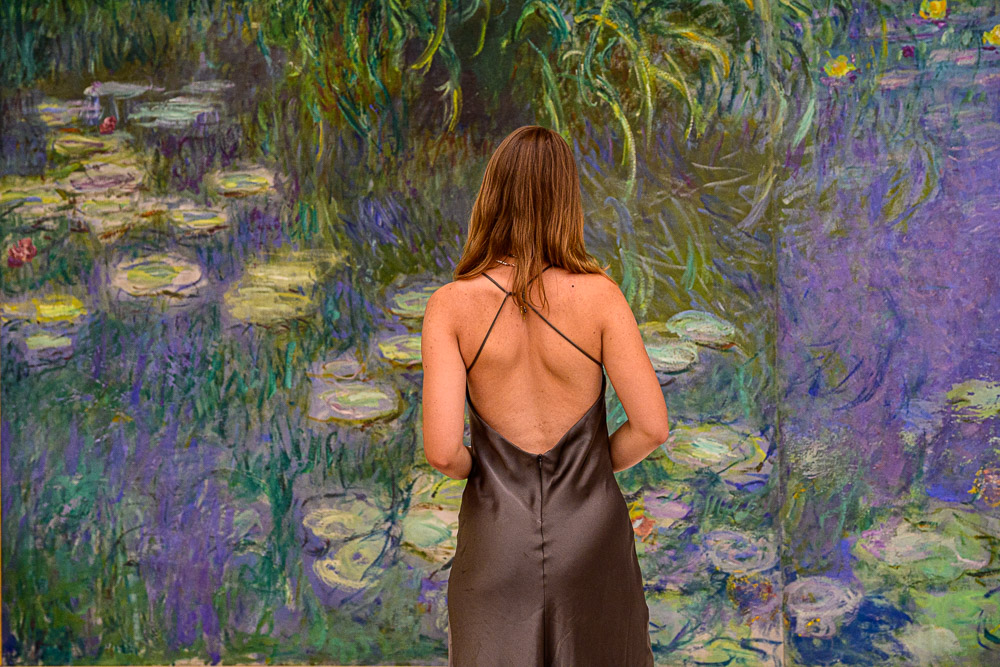
    Looking at a Monet©Ed Schlotzhauer

    Something extra

    In the crowded and noisy world of images, it seems that what we look to now is an emotional attachment. Something must touch us personally. To do that, it generally had to touch the artist, too. We must be able to let our emotional reaction to the scene come through our image.

    Maybe this is what Cartier-Bresson meant by the decisive moment. Perhaps this is what Jay Maisel means by the gesture of something. Either way, an idea is that the subject is expressing something. We must be in sync with it and ready and able to capture the best expression of that.

    These instances sometimes happen in a fleeting moment. Perhaps we can anticipate them and be setup and prepared. Sometimes it is a singular event, and we have one shot at it. But either way, we must recognize and react. We must understand what is happening and be mentally and physically prepared to capture it.

    And being prepared involves understanding our emotional involvement with what it is. We must recognize when that gesture is best expressed to us, and pounce on it.

    Of course, images do not have to be of a fleeting moment to be good and express an amazing gesture. There are those that are static scenes, where you can linger over it to wait for the right light or weather.

    Still, what the viewer relates to is your feeling about it. Why did you take this picture? Why did you select it out of all the others?

    Paraphrasing Jay Maisel: “If the thing you’re shooting doesn’t excite you, what makes you think it will excite anyone else?”

    If an image meant something special to me, and I can capture that and make you feel what I felt, then there is a chance the image is meaningful to you, too. That it embodies the “something extra.” Isn’t this what image quality is about?

  • Post Exploration

    Post Exploration

    We focus a lot on the process of taking pictures. And rightly. But the world of post processing is another rich opportunity for “making” images.

    Taking pictures

    When we think about photography, we think about taking pictures. After all, that is what photography is, isn’t it? That is where we capture the data that becomes the final image. For many, the thinking stops there. Click – picture.

    Maybe crop it a little or remove a distraction. Perhaps work on the overall color. But the picture is the picture. No reason to make many changes.

    Many people, especially some “serious” photographers, feel that the image should be made whole and complete in the camera. Anything other than simple edits that make no substantive changes to the original image is suspect or forbidden. That is their opinion, and they are welcome to it, so long as they do not try to bind it on me.

    Imagined unexplored land©Ed Schlotzhauer

    Post processing

    But for other photographers, the world of post processing is much larger than that. Yes, there is cropping and distraction removal and some color tweaks, but those are just the basic first steps.

    I will go out on a limb and say that post processing is as large and important a skill as is capturing images. The world of digital imaging has thrown us into a situation where what happens after the shutter press can be as important as what happens leading up to it. And our tools have become far more powerful, enabling “darkroom” processing far beyond what any film shooter ever dreamed of. It would be foolish not to take advantage of it.

    I assume you shoot RAW images. There are times to shoot jpg, but those are rare in my world of fine art photography. But RAW images require extensive editing. They look bland right out of the camera, since they did not go through heavy-handed jpg processing that is trying to make a best guess of what we wanted.

    Just enhancing

    After that initial round of basic edits, we get more serious for the images we pull out to work up. Now we probably do some initial sharpening. Then set overall contrast, black & white points, maybe some clarity to punch it up some more.

    At this point the image is starting to take shape. Now I may spend a lot of time working on tonal gradations. Working on the details of lighting and separating element so they can be seen more clearly. Then there is working on global saturation and luminance and maybe even hue of individual colors.

    We may decide to add a vignette to help focus attention on the subject. Perhaps we will use color grading or profiles to change the overall “look” of the image. Maybe so far as going to black & white.

    There are so many more. This is just the tip of the iceberg. We can easily spend hours on one image doing these and many more. I have watched hundreds of hours of tutorial videos describing techniques for doing these things. Really getting in depth on Lightroom Classic or, especially, Photoshop is a project requiring years. And they are moving targets.

    But at this point, we have a nicely corrected image – that is still basically the original photograph. It may be exactly the scene as we remember it, or it may have a color wash, or even be in black & white, but it is the same photograph.

    Again, this is where another large group of photographers stop.

    A fanciful composited image with interesting processing. Good luck guessing what the original image is.©Ed Schlotzhauer

    Permission to play

    And that’s where I stop with most of my images. But there are other doors to open that can lead to new destinations.

    Here is a statement of belief for me: pixels are raw material. They are just pieces of data saved on your computer. They do not “mean” anything except for the meaning we ascribe to them when we view them all together as an image. This is my belief. but since it is not based on laws or regulations or fundamentals of nature, it is just my belief. Feel free to disagree and act accordingly.

    But since this is my belief, I am free to do anything I want with my data. There is nothing like PETA for protecting against the abuse of pixels.

    I give myself unlimited permission to play with my data. And I do, to degrees. The problem is that it is hard to break away from old habits and beliefs. Too often, I am trapped by my limited thinking. I see an image. I don’t always see what those pixels could become. That, more than camera resolution or tools or computer power, limits what I make.

    Permission to play does not mean I will always take advantage of my freedom. I am self-limited. My actions don’t always follow my beliefs. But I’m trying to break my mental barriers.

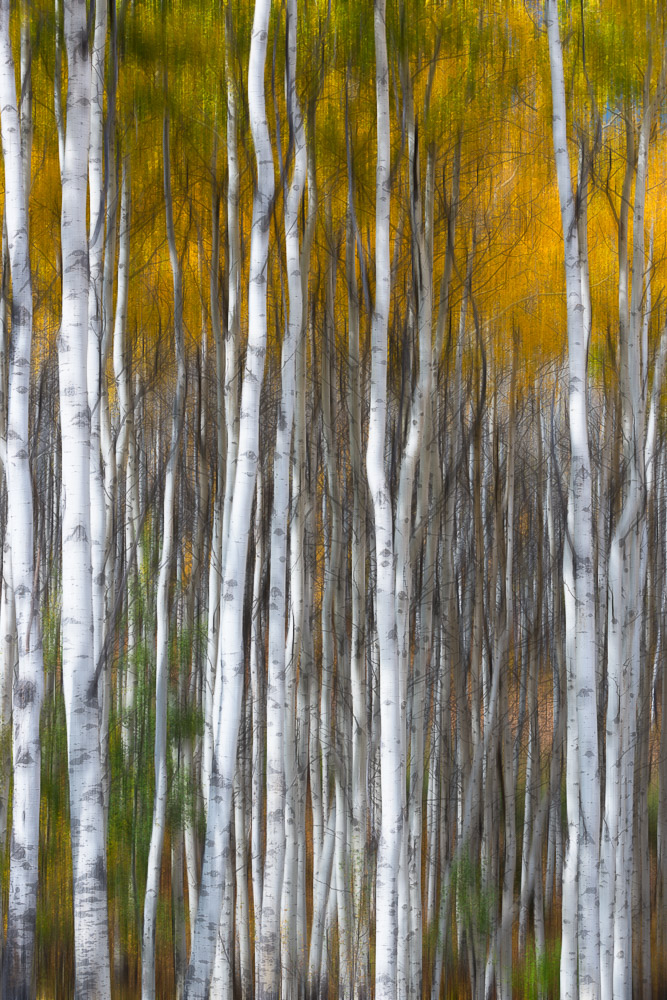
    Impressionistic photography©Ed Schlotzhauer

    Making new images

    I love compositing, combining 2 or more images to make something new. It is a joy when I can take 2 dissimilar images and make something different from either. Sometimes I put together 3,4, 10 images. The resulting image may only have bits and pieces of each source file. Did you know that a TIFF file has a maximum size of 4G Bytes? After that you must bump up to the PSB format. Quite a few of my experimental images do that.

    And I love taking an image and processing it with different textures or digital effects to create a very different look. So much so that sometimes when I am out shooting, I mainly shoot textures. I have a good library of them.

    And have you played with some of the interesting Photoshop filters that are built in? Quite a variety of tools for blur, rendering, warp, landscape mixer, distort, stylize, etc. I can experiment for hours in Photoshop trying new combinations of things.

    Some actually create results I like. But you never know until you try.

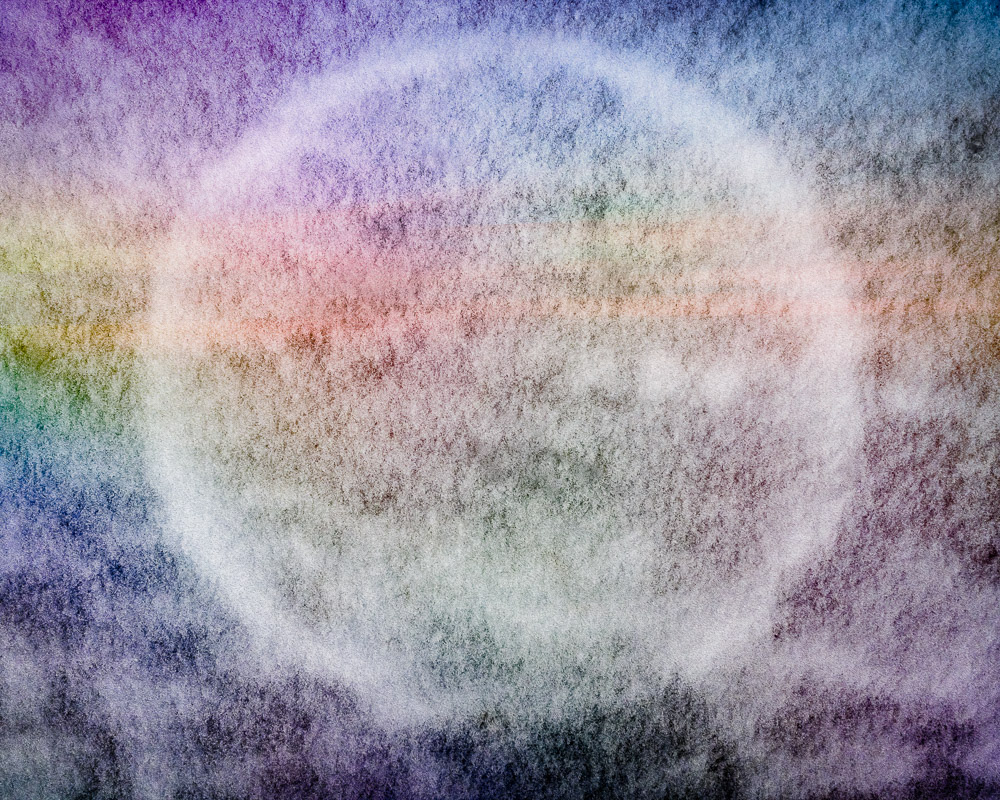
    Heavily processed image, not reality©Ed Schlotzhauer

    The digital world

    My point is that our “photo opportunities” do not stop when we press the shutter. Capturing a good image is very important. But there are endless possibilities for improving it or totally changing it in post processing. Sometimes we see opportunities for doing more than just making an image look better. Post processing is another creative outlet.

    Digital images are much more malleable than film. Pixels are just data. Data can be processed. There is a world of opportunity in the post processing, if we can break out of our limited view of what can and should be done to our pixels. I call it post exploration.

    If you are a fine art photographer, the ethical choice is to do your best, most creative work. Not to protect pixels.

  • No Medium Format

    No Medium Format

    Despite their advantages, and as much as I would like to, there is no medium format camera in my plans any time soon.

    Fine tools

    It is a joy to use fine tools. The better we become in any craft, the more we appreciate our tools. After all, we use them frequently and tend to push them to their limits. I believe this is as true for a photographer as any other artist or craftsman.

    Plus, there is the ego boosting feeling of possessing and using something expensive and exceptionally well made. It makes us feel important. We must be a better artist, because we have better tools.

    Most photographers are familiar with mega-pixel lust and/or lens lust. We “need” the latest technology breakthroughs, the highest scoring products. They will improve our photography, right? Well, sometimes. But probably not by themselves.

    One of the ongoing lusts I fight is the desire to move to a medium format system.

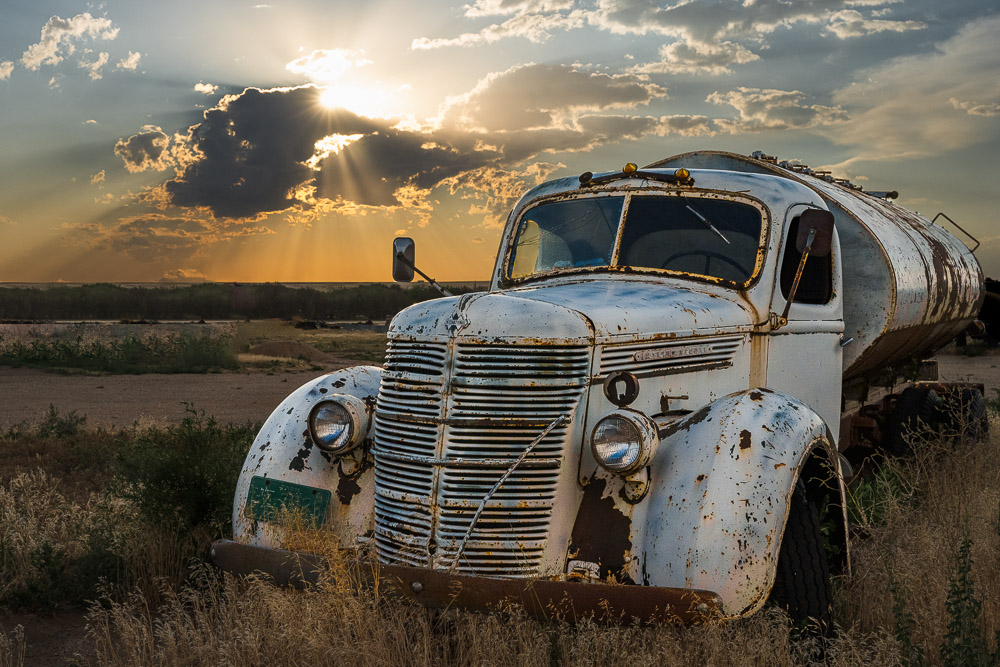
    Old rusty International Truck. I finally got it's portrait.©Ed Schlotzhauer

    Medium format

    Camera systems have always been characterized by the size of the recording medium they expose. In film it was 8×10, 5×7, 6×6 cm, down to 35 mm. Digital systems tended to smaller formats, because of the cost of the sensor chip. For a long time, the 35 mm “full frame” sensor was king. Other lower cost sizes also became common, like APS-C, micro 4/3, etc.

    Of course, there are many other contenders. Polaroid made a few huge sheets. There were 11×17 cameras. Others, especially in digital, range down to microscopic cameras small enough to fit unobtrusively in a pair of glasses. And don’t forget the tiny sensors in your phone, probably the most used cameras in the world today.

    The cameras in the slot between 5×7 and 35 mm are called medium format.

    Brave adventurers in the digital world decided to push digital larger than 35 mm. Their goal was to recapture the detail and mystique of legends like the Hasselblad 6×6 cm or Mamiya 6×4.5 cm medium format systems.

    These huge sensor chips are a strain on semiconductor production. They are very expensive because the yields are low for such a large chip, and the production volume is small. But makers like PhaseOne, Hasselblad, and Fujifilm persisted and developed successful products, and the results seem to be spectacular.

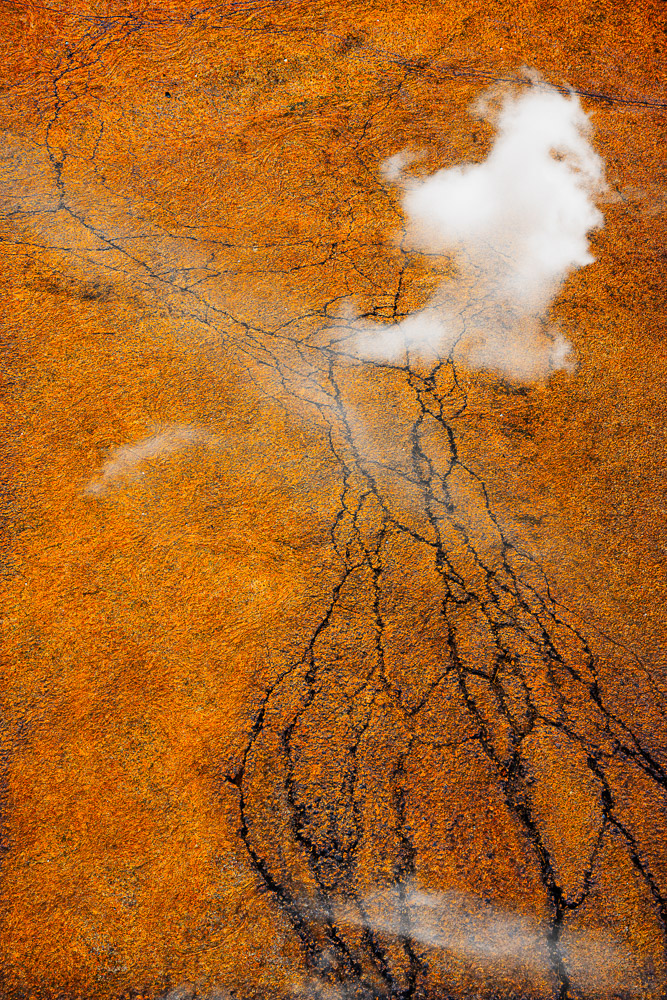
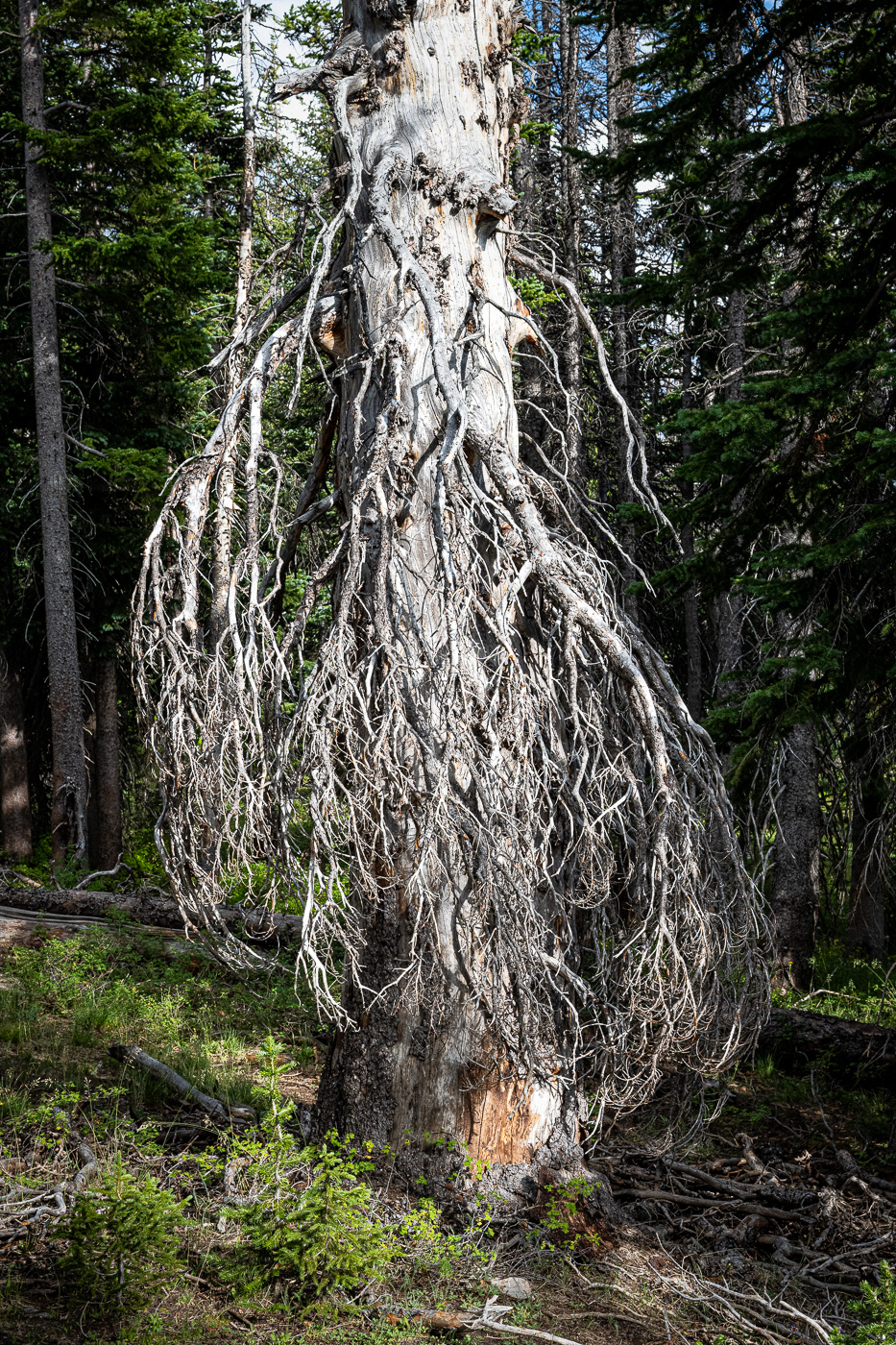
    Dead branches. Interesting range of tones.©Ed Schlotzhauer

    Advantages

    I do not speak from first-hand experience. Only from extensive research and reading. From what I can determine, the medium format digital systems are a marvel of image quality, with tangible and intangible properties that cannot be matched by 35 mm full frame cameras.

    One obvious thing is that the larger sensors have a larger number of pixels. Typical medium format cameras have 100 MPixels, compared to 60 for the highest resolution full frame camera today.

    But it is more than just number of pixels. The larger sensors allow larger pixel sites. This means each pixel gathers more light and each pixel has lower noise, greater dynamic range, and better color accuracy. Medium format lenses are also generally higher quality than 35 mm ones.

    Overall, the whole system is high quality all the way through. This leads to files that can be printed at huge sizes with astounding detail and color.

    An image with some minor processing in Photoshop. It is well over 1GByte.©Ed Schlotzhauer

    Disadvantages

    Of course, these advantages do not come for free. Everything must scale up physically with the sensor size. This makes the cost of all the components, including the sensor and lenses, go up exponentially.

    Larger also means heavier. In a studio that is not a concern. But I shoot only outdoor, and I lug my equipment wherever I go. Heavy is bad. Big is bad. Medium format is both.

    I indicated that the lens sizes must scale up for medium format. The lens must create a larger image circle to cover the larger sensor. This not only makes them heavy and expensive, but the physics of lens design and the small market limits the practical ability to make wide range zoom lenses. So, currently, something like a 35 mm equivalent range of 28 mm to 75 mm is about the best that is common for a medium format zoom. Other sizes are available, but nothing like the “super zooms” we love in full frame cameras. Medium format wide angle lenses are much easier to make and more common.

    Underlying all of this is the sheer cost of the system. Buying into a medium format system with a reasonable selection of lenses can add up to 10’s of $1000s. Much more if you decide to go with PhaseOne. Do I want medium format or a new car? Medium format or a luxury anniversary trip to Europe?

    Reality

    The reality is that the medium format system currently is too big and heavy, it is too expensive, and I can’t get the type of lenses I want to use. At least, this is true for my value system.

    My old body wants to shed weight I must carry, not add to it. Less is more when I am out for hours at a time. I seldom even carry a tripod anymore.

    The “mainstream” camera companies like Sony, Cannon and Nikon have done a great job of improving their full frame products. To the point where it is a hard decision to make the jump. Yes, I’m sure it is true that if I did an A/B comparison between my Nikon and a Hasselblad 100 MPixel I would agree that the Hasselblad was better. But maybe not better enough for my needs.

    Cost seems obvious. I am not earning enough from my photography to justify the huge increase in cost. I would have to rationalize it on factors other than cost, and I can’t right now.

    But for me, an overriding factor right now is lens availability. This is a very individual decision point of view. I have become a photographic minimalist. I don’t like carrying extra lenses and I don’t like changing lenses in the field. One simple reason, besides fear of dropping one off a cliff, is that I get far fewer dust spots on my sensor if I do not change lenses outdoors.

    I have adopted much of my vision around my marvelous Nikon 24-120 mm Z lens; it covers 98% of my needs. To the extent where my attitude now is that if this lens does not work, I will move to get the shot or make a different shot. I have made several multi-week trips now, taking only one camera body and one lens. It has worked great for me. No regrets. I can’t yet do this with a medium format system.

    Girl sitting on rock over cliff©Ed Schlotzhauer

    No compelling need

    I would love to use medium format. Just the sheer quality of the output would almost be worth it. Looking at the detail of my images at 1-to-1 on my monitor is a joy right now. I’m sure the joy would be even greater for a medium format image.

    But I understand the reality of my life is that I am not called on to make billboard sized prints where you could put your nose up to it and marvel at the detail. I am not required to do portraits that have glowing, lifelike skin tones and shading when printed life size.

    Would I like to be able to shoot like this? Of course. We always long for the best tools, the next technology bump. But the cost is so great I cannot justify it.

    Fortunately, or unfortunately, Nikon has satisfied my basic needs with a high quality 46 MPixel sensor in a small mirror-less body, coupled with small, lightweight, high-quality lenses that meets my expectations. These cover my real-life needs. I can’t justify the change just for my ego.

    Canon and Sony also cover those needs with excellent products, but I am a long-time Nikon user.

    As of right now, there is no medium format system in my plans. It could change, but there is a high barrier to climb. I hope Nikon jumps their full frame system to 100 MPixel before I give in and take the plunge.