An artists journey

Tag: psychology

  • Confidence

    Confidence

    I believe one of the things we develop as we mature as photographers is confidence. Not arrogance, but certainty in who we are and what we want to do.

    Introvert

    I’m an introvert. I suspect many of you are, too. Introversion seems to be strong in artists. After all, what we do is not really about social events or winning contests or getting to praise ourselves. If you seek those things, you are probably an extrovert and you do art for entirely different reasons than I do.

    As an introvert, you wouldn’t think at first that confidence is one of the traits I would claim. But confidence comes from competence. We know we can do what we need to do. We know what we like and when we find it, we are confident we can deal with it well.

    An un-pre-visualized shot taken from a moving boat on the Seine River.©Ed Schlotzhauer

    Arrogance

    This is not arrogance. Arrogance gets into hubris and self-importance. Confidence is the simple assurance that I can do it. Now, the “it” may be different for different people. For me, it is that I know that when I see a scene I want, I can photograph it in a way that will make an image I will be proud of. That does not mean I know how to make that image well known and sought after in galleries. That is a whole different skill set.

    But our confidence is arrogance if we believe we are too good to learn how to improve. We should always listen to criticism. And be our own worst critic. Learning and practicing and trying to improve are part of our life-long growth.

    Confidence also lets me stay away from things I know I would not like or would be bad at. For example, if, for some strange reason, you came and asked me to shoot a wedding, I would turn you down. Even if the money is great, I know from experience that I would hate it. I do not enjoy the pressure of a bride’s expectations and performing to someone else’s shot list. And I really do not enjoy trying to pose people and make them seem like they’re having fun.

    But if you want me for a second shooter to get candid shots, we might do a deal. I love shooting spontaneous moments, and I’m often pleased with the results. Studying people and anticipating a good moment is fun for me.

    An unexpected travel shot. It came from taking the time to stop and watch and wait.©Ed Schlotzhauer

    Not technical skill

    The confidence I am talking about is not mainly in the technical side of photography. I have done photography for many years, and I am introspective enough to learn from my mistakes. Technical skill should be a given for a serious photographer.

    You won’t find me “chimping” a lot, checking the back of the camera to see if I got the shot. I may check to verify I nailed the focus and placed moving elements in the right position or got the right blur if it is a slow shutter speed. But the technology of making a properly exposed image is rather straightforward.

    I urge you to practice to the point where you are confident in your ability to get what you visualize. It makes me wonder when I hear photographers asking a workshop leader or another photographer what exposure they used. That is basic craftsmanship that we must put in the reps to learn.

    Besides, our cameras do a wonderful job of helping us out. With great auto focus, including eye tracking, with powerful computers analyzing the overall exposure, even giving us real-time histograms, with constantly improving sensors with great dynamic range, it gets easier all the time. I remember when shooting film, there was always the fear of not exposing correctly. Now, with digital systems, our technical confidence should be high.

    ICM blur of dead tree. Take that, generative AI.©Ed Schlotzhauer

    Vision

    Our vision shapes our work, and it is unique to each of us. Confidence bolsters our creativity. We see connections and possibilities. Scenes are recognized intuitively as aligning with our vision. Our confidence encourages our creativity to express new insights, because we know we can do that new thing we have never tried.

    We are self-assured to go for it, to stretch for that artistic vision just out of reach.

    And even if we could not quite reach far enough this time, we know we did the right thing by trying and next time we will be even better equipped to succeed. Our confidence is built by failure, because each failure brings us closer to our goal.

    We take in information, blend it in our brains, and a random spark ignites some sort of alchemy. Whole new things emerge. We’re almost spectators in the process. But confidence tells us what is happening, that we have seen it before, and we will go with it to see where it leads us. Confidently.

    Very abstract created image. Representa the evolution of an image.©Ed Schlotzhauer

    Independence

    Despite its potential for good, more often social media is a force for conformity. When we are unsure of ourselves and rely on likes or comments for feedback on our worth, we are channeled to do work like everything else we see there.

    The “same as everybody else” images get likes. But the fresh, possibly genre-bending new things are voted down. Until a well-known influencer picks it up and starts promoting it. Then, suddenly, everyone is doing it.

    Our confidence in our own vision and ability should help us break out of this stifling cycle. If you’re out shooting with 10 other photographers and you see something they ignore, will you shoot it? I hope so. That is confidence in yourself.

    Confidence helps give us independence. We do not have to follow what someone else thinks. We do not have to do work that is mostly like what an “authority” thinks is good.

    It is a wonderful freedom to set our own standards and select our own subjects and treatments. This allows us to make the art we can bring to the world, not someone else’s.

    Color outside the lines

    So confidently color outside the lines. Or inside, if that is what you prefer. Or don’t do that paint-by-numbers sheet at all. Go find your own blank frame to fill in.

    Outside, inside, saturated or black & white, tack sharp or blurred, rule of thirds or not, shoot at the golden hour or at noon. Find what you are called to do right now and confidently do it.

    No one can tell you what you must like. No one can tell you what picture you must make. That should come solely from within you. Have confidence in yur vision and ability.

  • Shoot It Now

    Shoot It Now

    Shoot it now. If you see it and like it, shoot it. It may not be the same later. This moment is the most control you have.

    Conditions change

    The world about us is in constant motion and change. The light, the weather, what people are doing, how things are arranged, even our attitude. Things are different all the time. We must give ourselves permission to take advantage of what we find when it is there and right.

    It is too easy to say: “that’s nice. I will plan to come back and shoot that scene when I have time.” But we’re not in control of events. When it is convenient for us, everything else may be wrong. My experience is, it likely will be so different that we will lose interest in it.

    Or have you found conditions to change quickly, but you were able to take advantage of it? Maybe you were at a location you like, trying to make a good landscape. Except conditions were not helpful. Perhaps it was cloudy and rainy, and the mood was not what you hoped for. But you stayed there seeing what you could do, and, for a moment, the clouds broke. A golden sunbeam poured through and spotlighted the subject you wanted. It was magic.

    The whole look and feel of the scene changed in a blink. And then it was gone in seconds. You had to shoot it right then, in those few seconds when conditions were optimum.

    When we find a subject we like in conditions we like, we better shoot it right then. It may never be the same.

    40,000 ft sunset©Ed Schlotzhauer

    Nothing is permanent

    When something has been there for a long time, it is easy to take the attitude that it will be there forever, so we can shoot it at our leisure or when conditions are spectacular.

    Maybe. But maybe not. We do not control circumstances and other people’s decisions.

    This image at the top of this article of the car on a roof is an example. I shot it at various angles and conditions for years. It was always there as an exercise to work on. Until one day it was gone. I didn’t pass by the location for a couple of days and next time, the car was no longer there. I can never shoot it again. All the future shots I had envisioned for finding certain weather or light are useless now. I have to be content with the ones I have, that I took the time and effort to shoot when I had the chance.

    In the same way, that interesting railroad track fragment in the next picture was evocative to me and a metaphor for several ideas. But it does not exist anymore. It was removed

    Another example, at the other extreme, last week we had a heavy rain – rare here. I walked a new trail the next day and there were a couple of places where dirt had washed across the path, making interesting patterns. That is something that interests me, so I shot a couple of frames and went on, intending to come back and work it some more after I thought about it. I only walked down, maybe, a half mile and came back, and a city worker was sweeping the path. Gone.

    Shoot it now.

    Derail track to nowhere.©Ed Schlotzhauer

    Now is the moment

    A good picture is a dance of many conditions. If everything comes together ideally, we have a much better opportunity to get an image we want.

    Likewise, when we have a mindful attitude and are open to seeing things, we often encounter things we did not deliberately go looking for. And when the conditions and our observation come together at the right time and place, we discover magic.

    But those magical moments are transitory. Light changes, people move, trees are cut down, even building are torn down. Floods change things. Forest fires alter the landscape. Have you ever gone back to a spot you really liked after a couple of years and found it a condo development now?

    Familiar subject at an optimum time.©Ed Schlotzhauer

    Gone forever

    It’s like in a conversation where you had something important to say, but as you were waiting for the right opportunity, the direction changes and it would no longer be relevant. The opportunity was there, but you didn’t take it and now it is gone forever.

    One of my heroes, Jay Maisel, said “Always shoot it now. It won’t be the same when you go back.” I have found this to be true too often.

    What if you break open a river rock?©Ed Schlotzhauer

    To be honest, I am a mindful explorer. I follow some of Jay’s other advice to “go out empty”. That is, I usually do not have specific shots in mind. Instead, I am mindful of interesting things I encounter as I wander. This may not be your style. I understand. Photography, like all art, is intensely personal.

    But for me these days, I try to shoot it now. If possible and it’s not too disruptive, I stop to shoot it when I see something I feel is worthwhile. Apologizing for being late feels better than missing the shot. I have a lot of regrets of shots I didn’t stop to take when I had the chance.

    That realization of the possible fleeting nature of our subjects drives me to act outside my comfort zone. My “what if” is engaged all the time.

  • Photography Isn’t Creative

    Photography Isn’t Creative

    Photography isn’t creative. I know, those are fighting words. Please put down the pitch forks for a few minutes and let me explain the distinction I see.

    A medium

    Photography is a medium, not something magic. Merriam Webster defines the aspect of “medium” I am referring to as “A means of effecting or conveying something; a mode of artistic expression or communication”.

    I know artists who express their art by taking pictures, some who put paint of a canvas, some who sculpt, others who make fabric creations, some who write or create music or make videos. I have known some who build art from scrap metal, even some who cut out bits of paper and create designs on a wall with them, and one or two who dance. These are just some I know personally.

    These artists all use a different medium for their creation. The medium sets parameters about what the resultant creation is: large, small, heavy, light, 2 dimensional, 3 dimensional, persistent or transient, etc. But the medium does not create the art. It is the mode through which the art is expressed

    Going around in circles©Ed Schlotzhauer

    Cameras don’t create

    A camera is a tool of the photographer. Some people think photography is not art because you just point a camera at something and press the button and capture it. When you do this, you usually get pictures that look like you just pointed the camera at something and pushed the button. No life. No excitement. Not that much interest. A record of something, not art.

    Luckily we have not gotten to the point that AI-equipped cameras try to make art all by themselves. It is still up to the photographer as artist to make the creative decisions.

    These decisions are what shape most of the outcome.

    Skill

    Photography is a medium and a technology. As such, it has limits on what it can do. Some things can be done very well and some things are difficult or impossible. For instance, it is difficult to create 3D images photographically. Not impossible, but difficult.

    Amazing things can be done by a craftsman wielding their tools expertly. As a photographic artist, we learn to think photographically, to internalize how to use the technology to create what we visualize. How to use our tools.

    But what I am describing is a process of an artist using tools to create art. The tool does not create the art. It helps express the artist’s will.

    A general flow for photography is establishing a concept, visualizing the intended result, capturing the image, and refining it on the computer. Which of those stages allow creativity?

    Trick question. All of them.

    Silhouetted tree against glass skyscraper©Ed Schlotzhauer

    People create

    A paintbrush does not create a great work of art. A chisel does not produce an amazing sculpture. And a camera does not produce an amazing, creative photograph.

    It is the artist using the tool that receives the credit, because it is his creative vision that applies the tools skillfully to achieve his intent. Every artist or craftsman I know appreciates excellent tools and likes to use the best he can afford. The quality and precision of great tools makes the creative process more of a joy when you know how to use them well.

    Same with photography. All the photographers I know love to talk about their tools. They long to have the highest quality cameras and lenses, the best computer and monitor. But they also recognize that these things are only tools. Good tools might make their work a little easier, but it doesn’t change their art.

    But the tool does not do the creative work. Photographic technology is a medium. If we are using a camera we must understand the strengths and weaknesses of the medium. As creatives, we must know how to use the medium to achieve our goals. That is very different from just taking a picture.

    Zig-zag shadow©Ed Schlotzhauer

    The medium isn’t the art

    So the medium is the channel we use to create or deliver our art. Nothing more. It is a “means of effecting or conveying something.” What we convey is our artistic vision. How we use the properties of the medium is part of the creative process.

    The way we express our vision may be different in a painting versus a photograph. We may have to choose the correct medium to achieve certain outcomes. You would have a challenge to express your music as a painting, for instance. Or maybe that would inspire you to push the medium of painting in new directions.

    Note: AI isn’t people

    An elephant in the room in conversations about art and creativity is AI. Let me go on record as saying, in my opinion, AI does not and cannot create art. It can make nice pictures that are very useful for advertising and utilitarian use. But it can never create, because computers can’t think, or feel, or appreciate art.

    AI models are trained using data from existing work. This is a major ethical question being debated, but not the issue here.

    Everything the model “knows” is work that has been done in the past. It will not be inspired to create something new. Inspiration requires a consciousness. Only humans are able to do that.

    AI can be useful as a helper, just not as a creator.

    Fall trees via intentional camera movement©Ed Schlotzhauer

    Photographic art

    Despite being maligned and excluded from the ‘inner circle” of fine art by established interests, photography continues to make inroads as a recognized art medium. Photographic artists continually push the limits of the medium and use those limits to inspire their creativity. Much of the creative discovery is at the limits of what can be done.

    Photography is just a medium. As that, it is not creative in itself. But artists can product creative works using it. The medium influences the art. The art uses the medium.

    Postscript

    As I write this, it is the day of the 50th anniversary of the release of the movie Jaws. The story behind it is fascinating. I would like to share a few highlights I have found that are relevant to today’s topic.

    Jaws was conceived as a low budget horror movie. It was given to an almost unknown director named Stephen Spielberg. But 2 unanticipated things happened that set it apart and allowed it to become one of the iconic movies of history.

    First, Spielberg collaborated successfully with a relatively unknown music writer, Jon Williams. Many say half the impact of the movie was the famous theme song.

    But of even more interest to me is that a huge factor in what the final product became was that the mechanical shark didn’t work. It was cheaply made. No one had thought to test it in salt water. Because it didn’t work reliably and he felt it looked pretty dumb, Spielberg showed it a lot less than they originally planned. Surprisingly, this resulted in greater drama and made the shark more menacing. Overall, the movie was a great success, partly because of a balky mechanical shark.

    A great artist, creatively adapting to the limitations of his medium and budget, unexpectedly created something wonderful. Something that is still recognized as great 50 years later. Creative problem solving. That is inspiring.

  • Pull Out a Moment

    Pull Out a Moment

    Isn’t that what we do so well with photography, to pull out a moment of time to examine? Most art does this, but photography excels at it.

    Time

    Time flows continually. It so envelops and controls us that we often do not even consider it. But we cannot escape it. It carries us along with it whether we want it to or not.

    Some of us live for the future, planning for a “someday” when things will slow down or be better. Some live only for now, trying to experience life or just have fun with little regard for what may come in the future. Others are stuck in the past. Living in memories or regrets for past events.

    Regardless of our attitude about it, time keeps flowing relentlessly along. No one is rich enough to buy more time. No one is powerful enough to command it to slow down or speed up. We each have the same number of seconds in a day.

    But photographers seemingly have a power over time, to freeze it or stretch it and to pull moments out to keep forever. This is an amazing ability for mere mortals.

    Fast action at a County Fair©Ed Schlotzhauer

    Artists view

    To an artist, time can seem like a continuous series of pictures. We look at things happening and think that may have never been seen like that before and it may never happen like that again. We better capture it now before it is gone.

    Much of art is based on capturing moments. Paintings are usually of a moment in time. Sculptures often depict a moment of action or a grand pose.

    But photographs do it better. After all, a painting or a sculpture of a moment is probably based on photographs the artist took to record it. So the photograph is the prime material, the basis of the art.

    That is because photographs have a unique ability to record moments in time. We should be proud of that and use it to our advantage and to make our art more unique.

    Manipulate time

    Time flows constantly and at the same speed for everyone. But through photography we can look at time differently, depending on how we choose to see it.

    We can slice it very fine at 1/1000 of a second or even faster. This will freeze an instant so we can examine things happening too fast for. us to perceive in real time. Birds in flight, a waterfall, a galloping horse, even a bullet in flight are frozen into a clear moment. We can see the details of the action, the turbulence, the skill.

    At the other extreme, we can compress time. Any reasonable length of time can be imaged into a single frame. This allows us to visualize or see the effects of action happening over an extended amount of time. Car lights at night streaking into a long trail. A waterfall smoothing into a velvety flow. We might be able to capture multiple lightning flashes in one frame during a thunderstorm.

    All of these and more help us see action over time. It visualizes what we can only imagine without the aid of photography.

    An interpretation of my feelings for Trail Ridge Road©Ed Schlotzhauer

    Keep a time

    Whether short exposures or long exposures or a “normal” speed, this slice we capture is preserved for us to examine and contemplate at our leisure. We have plucked it out of the stream of time and kept it for ourselves.

    It is said that in a fire or flood, one of the first thing people try to save is the family pictures. These are our history, our memory. Moments that are important to us. (Many online sites tell us at length how to prepare a “go bag“; it’s a good idea; but the emotional reaction is to grab important memories in an emergency.)

    And they keep us together as humans. A friend told me recently about getting together for a rare visit with his brother and sister. One of them had digitized old pictures their parents took of them as children. They spent hours looking at them and sharing stories and memories. Most of these were originally shot 60-70 years ago. They still have power of moments.

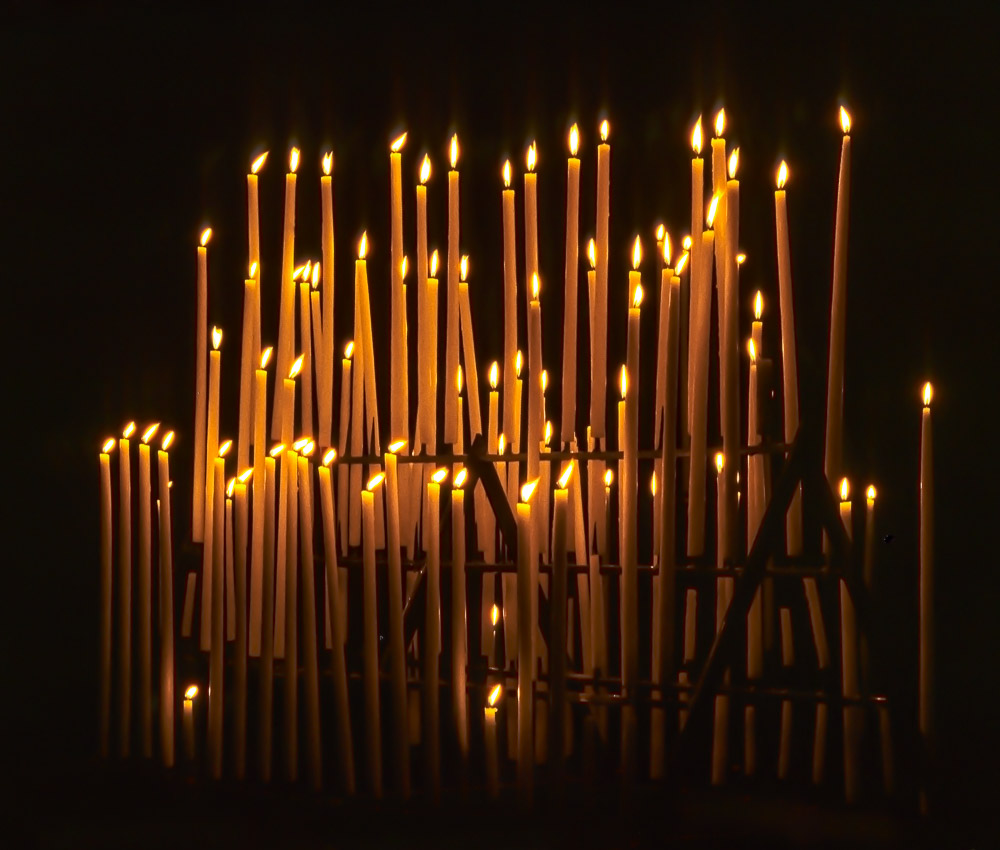
    Candles, Catholic Church, Regensburg Germany.©Ed Schlotzhauer

    View differently

    Obviously, family pictures have special memories for us. But how about art?

    As I mentioned before, most art involves the capture of moments that we can look at or think about whenever we want. Photography is uniquely suited for this.

    Street photography gives us insightful glimpses of people in their daily life. Landscape photography captures moments of beauty or awe in the natural world. Portraits give us a formal view of people. Whether abstract or realistic or black & white or an alternative process or any other rendering, they capture a moment.

    When we capture moments, we have the opportunity to study the moments at our leisure. Time ceases to flow for these images. Taking the moment out of the stream of time gives us a unique chance to spend all the time we want with the moment. We see and understand it differently.

    Years from now, that moment will still be there for us to bring out and examine again. Or our descendants may look at them and see a glimpse of what we saw, maybe even what we felt.

    Time is a key component in our photography. Photography is perhaps the best of the arts for capturing and manipulating time. Other forms of art rely on the artist seeing or imagining something, then representing it. Photography allows us to see things that could not otherwise be seen.

    Looking through clock, Musee Orsay©Ed Schlotzhauer

    Reflect

    We see a potential image and take it. What is it for? Who is it for? Does it matter how many people see it?

    It is quite possible it does not have more of a purpose than that we were compelled to make art. If we are making art, it may be sufficient that it fulfilled something in us.

    Most of us would love for great numbers of people to view our work and give us lots of compliments. Especially the compliment of buying it. But is that why we do it?

    Perhaps these moments in time are painting our history, marking our journey, filling our memory bank. Maybe their significance could not be apparent to anyone else.

    Or maybe something is compelling us to capture these moments so that someday we can begin to understand them ourselves.

    Regardless, we are compelled. We pluck these moments out of time and set them aside for reasons we may not understand. Or perhaps it is enough that they are beautiful, at least, to us.

    Every time we press the shutter release, we are capturing a moment. Be very aware of that. They are our moments. They have meaning to us. Sharing them with other people is an intimate act.

    “Life is a collection of moments; cherish them, embrace them, and create more of them.”

  • Curiosity

    Curiosity

    I admit, I am consumed with curiosity. It drives a lot of what I do. It strongly pulls me in different directions. More and more I see that it is curiosity that drives a lot of my creativity.

    This is an update of an article I wrote in 2020.

    Curiosity

    What is curiosity, really? Is it a learned skill or an inherent personality trait? Is it good or bad?

    Dictionary.com says it is “the desire to learn or know about anything; inquisitiveness”. That is a good start. Like any large concept, there is a lot more depth to it than we get from a short statement.

    I like that it is presented as a “desire”. There is a longing. Something burns inside you that causes you to pursue things. A variety of things. You never know where it will lead you.

    Inquisitiveness is a great word, too. It implies exploration, searching, investigating. Curiosity is the basis of learning. I mean real learning, not what passes for it in our education system. Learning comes from wanting to know about something and working to figure it out.

    I am no authority, but my observation is that some people have a greater tendency to curiosity than others, but it is a skill that most people could develop. If they really want to. Most little kids seem to burn with curiosity, but life, upbringing, and our education system tends to beat it out of most people.

    Educational researcher Edmund Duncan says that by age 10 or 11 most kids have stopped asking questions and by 25 less than 2% can think outside the box. Recent findings say that of Americans age 45-54, 60.9% have not read a book in the last year. This is concerning. Actually, it is terrifying.

    Fabric covered head©Ed Schlotzhauer

    Afflicted

    In one of his books, Jonathan Kellerman has a character say “Most people aren’t overly afflicted with curiosity. It separates the creative and the tormented from the rest of the pack.” I think he has captured the idea very well. But does being afflicted with curiosity imply we are tormented?

    There is a well-known stereotype of the semi-crazed starving artist. Like many stereotypes, it has some grains of truth but generally is not an accurate model.

    The starving artist? Well, yes, most artists are starving unless they have another means of support. Unless they become the one in a thousand who is so good at not only art but marketing and sales that they can carve out a reputation and make good money.

    But the tormented, half crazed artist? I don’t think I have ever met one. And I know quite a few artists in various mediums. Probably van Gogh is the prototype of the image. But, well, he had issues that were not directly related to being an artist.

    So, I dispute that the curious are either tormented or afflicted. It seems to me that the curious are generally happier and more content than others.

    Dog backpack?©Ed Schlotzhauer

    What is “not curious”

    Sorry, I can’t even picture what it would be like to not be curious. I think of Sherlock’s quote in the great BBS series “Sherlock”:

    Dear God. What is it like in your funny little brains? It must be so boring.

    Unlike Sherlock, I’m not trying to be arrogant or insulting, It’s just so far from me that I really can’t imagine it.

    Being curious and researching it ☺, some traits of the incurious seem to be:

    • Sticking to their comfort zone
    • Being resistant to change
    • Not seizing opportunities
    • Not living a passionate life. They seem to move through life with few ups or downs.
    • Little personal growth and development

    This is horrifying to me. Of course, we all feel safer in our comfort zone, and we all resist change, but the downsides of giving in to that are too costly to accept. At least, for me.

    The items on this list that resonate most with me (most irritate me?) are no passion and no personal growth. Society today disguises activity as passion. You were not “passionate” about going to a concert last weekend. You may have been excited, and it was probably a lot of fun, but you were still just a spectator. In the same way you can’t be passionate about a Disney ride. It is all manufactured sensation. The person in the next car gets the same experience. Passion come from doing something through your own effort, often something creative.

    Giant flamingos, in Colorado.©Ed Schlotzhauer

    It doesn’t matter at all if you are a “success” or a “failure” at what you do. What matters is that you put yourself into it and gave it your best shot.

    And I cannot understand why a person would go through even a day without learning something new, improving some skill, or at least meditating. Not improving yourself would be like spending all day sitting and watching TV.

    Curious photography

    Enough ranting. We’re supposed to be talking about our journey as artists. How does curiosity relate to that?

    Among all its other benefits, curiosity helps to keep our work moving on in new directions. It is too easy to get trapped by the past, especially if we have had a little success. Do you feel you are known as the bird photographer or the portrait photographer or the food photographer? Does that fence you in mentally, making you feel like you must keep trying to repeat past successes?

    Curiosity can help lead you to new interests, or new ways to imagine what you used to do. Use a different lens. Go somewhere new. Do a personal project in a different genre. Try intentional camera movement (ICM) or long exposures or black & white.

    These are not just for the sake of doing something different (although that helps). Making a change in how you normally work helps you see things in a new way. It fractures some of the mental channels we unconsciously flow in, our comfort zone.

    Terra Incognita©Ed Schlotzhauer

    Intelligent curiosity

    It is said that being curious involves asking “what if” about things you are doing. This is true, but it should not be a mindless, random process. The what ifs are based on knowledge and an intelligent assessment of possibilities.

    Chemists may discover useful new compounds while mixing unlikely components. But they also have knowledge and training that informs them that certain things tend to go boom when mixed. So, unless boom is part of what they are looking for, they would avoid things they know to be dangerous and impractical.

    Now, our photography doesn’t usually react so dramatically, but still, not everything we might could do is realistic. For instance, wandering alone at night through a bad section of town to get some gritty urban shots may not be a good idea. Hanging out over a cliff to get a new perspective may not be intelligent unless you have taken safety precautions.

    But they are in the right spirit.

    No Photographers©Ed Schlotzhauer

    Practice it

    I am sure curiosity can be developed and enhanced, even if we think we don’t have a curious bone in our body. After all, you are reading this.

    Curiosity is an attitude of wanting to know more, to discover what will happen if I try this. Read encouraging material (like this ☺). Find instructors who lift you and watch their videos. Not to imitate them, but to be inspired. Go to museums and galleries and art shows. It will give you new insights. Put down your camera and read a biography of a historical figure.

    But most fundamentally, practice, practice, practice. Yes, practice curiosity. When you go out shooting, determine to do at least one thing different, even if you don’t think it will make good pictures. Practice a mindfulness where you really look at what is around you. When you have a question about something, research it. Google can be useful occasionally. And take side trips to related things that tweak your curiosity. New ideas will be sparked.

    I will confess that I go back to pre-internet days. When I was a kid, I had to look up things in an Encyclopedia. Do you know what those are? It was one of the greatest things I could have done. Sure, I found what I was looking for to complete the school report. But the real benefit and excitement was all the interesting things I found along the way. That was an advantage of having to flip through pages of a book rather than having an algorithm take me directly to the answer I was looking for. I found unexpected treasures. And it helped make me more curious.

    What are you curious about?

    What are you curious about? Look at it like this: what are 2 new things you have learned or tried this week?

    Wanting to be curious without doing anything about it does not get you there. Like most things, it takes action to make it real.

    Let me give a few curiosity related highlights from my last week. Not to make it sound like I am something special. Just to give you some encouragement.

    • Took a video class on live audio mixing
    • Took a class on selling to wholesalers.
    • Watched 2-3 video classes on Photoshop and Lightroom techniques
    • Did some ICM photography for the first time in a long time.
    • I saw some opportunities to composite some of my images and did some experimenting.
    • Put together a submission for a gallery show (if you want to evaluate your work, force yourself to edit down to a very small number of images in a portfolio).
    • Go out 5 days with my camera and 1 lens, challenging myself to be mindful and find fresh material in the same old locations.
    • Read an online photography magazine
    • Read about Theodore Roosevelt’s early political experiences and his time out west.
    • I wrote this blog, which I consider being curious about curiosity.

    That is just some I can remember. I don’t consider this very special. It is basically a typical week.

    Out the window - through a beer glass.©Ed Schlotzhauer

    Just do it

    Curiosity is a learned behavior and a practice. Don’t think you are curious? Maybe you just haven’t given in to it for too long. Go back to being like you were as a kid. Be curious about everything. Ask questions and, now that you are an adult, learn how to answer them. It will keep you young. But it is not just about finding answers. The exploration is at least as important. It takes you outside the familiar and teases you with new things to be curious about.

    I firmly believe curiosity is a path to creativity. It has never worked well for me to say ,”I’m going to be creative today.” But I have often been stimulated by curiosity to follow new ideas to new ends.

    “I have no special talents. I am only passionately curious.” – Albert Einstein