Other than doubt and discouragement, cynicism is probably one of my worst traps. Do you ever think there is nothing left to do or no use trying to do it? Overcoming cynicism is a constant battle.
It’s been done
It has been done already. Everything has been photographed. Trillions of photographs are taken every year (“Trillions”, not a misprint). How can I find something new and interesting?
It is hard to look around at all the work that is out there and not be cynical. And depressed.
But occasionally I see something that looks new and fresh to me. That gives me hope that there are still opportunities to be creative. It can be hard to hold on to the hope, though.
Nobody wants it
There are probably millions of people with web sites selling photographs. And there are probably thousands of galleries carrying art, including photography. This is in addition to the limitless supply of photos on social media. It is an over saturated market. What makes me think my work can stand out and be noticed and bought?
It seems like most photographers who have to support themselves with their art do workshops to earn enough money. There seems to be more money in teaching than in sales.
Why try?
Given all this discouraging news, it sometimes seems like none of us should even try to sell photographic art. The probability of success (however you measure it) seems remote.
It appears that an artist needs to become a marketing machine to survive. Marketing has to be an almost full time job. Promoting our self, contacting outlets, getting recognition, talking our self up constantly seems necessary to be noticed. But a lot of us are rather introverted and would almost prefer a root canal to doing these things all the time.
So why bother? It seems useless.
Antidote
When I am feeling like this, one of the things that will sometimes pull me out of it is going back through my image catalog. When I do, I sometimes decide maybe I do bring something to the market that is useful. Maybe I do have some occasional creativity. My point of view, my vision might be fresh and different enough to be welcome by some people.
I find that reviewing some of my favorite images can, if not cure cynicism, at least diffuse it enough for me to go on. It can reinforce my faith in myself and encourage me to believe I should keep on, because I have something for people to see.
Sure, a lot of my work is mediocre and “me too”, but some, well, seems to me to be extraordinary. When I can get out of my own way, when I can take the pressure off to try to produce great images, I can occasionally create something nice.
I find that feeling like I have to create an outstanding image in a given situation is self defeating. It is like sitting down with the goal to write a world class bestselling novel. Too much pressure.
Instead, my working style is to let it flow. If I can get excited by what I am seeing, it draws me in and inspires me to create. Feeling too much pressure chills that creativity. I am better off to relax and just be me.
For me, that is what art is about. Being myself, expressing my vision, my point of view in my art. If I am doing that, maybe that is enough. Maybe I don’t have to be famous or rich. The first and most important person to please is myself.
Move
Being creative and producing art that pleases me is the reward. That is what I can control. I cannot control how it is received or if galleries are contacting me to get me to exhibit with them. The internal reward of being satisfied with my work is for me to create in myself. No one else can give it to me.
So the way to combat cynicism is the same as the way to combat depression or fear or inertia: get up and get moving. Being in motion – doing something constructive – will help overcome the doubts and negative thoughts. Doing something positive almost always beats sitting and feeling sorry for yourself.
Today’s image
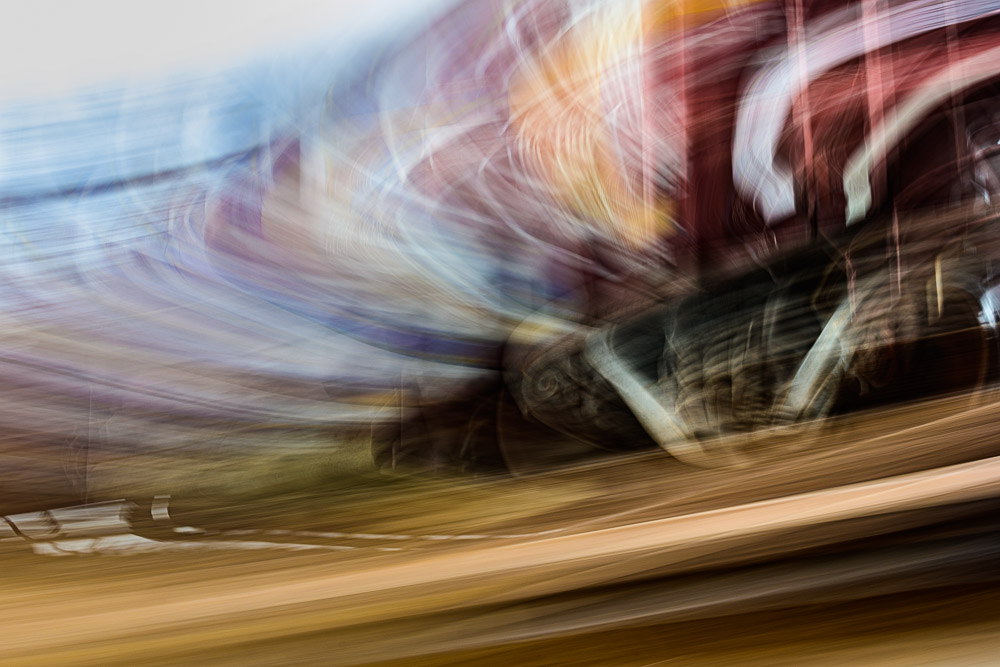
This is a train. An “ordinary” fright train. Actually, they are extraordinary. Have you ever seen one like this? Probably not. You would have to be stupid close to a fast moving train and shoot it with a slow shutter speed a certain way. I think it captures the moment in a creative way. What do you think?
Who gets to judge art? What criteria do they have to use? Is it objective? This is a difficult subject and I will probably step on some toes. Judging art is something we all do. When we see art, we judge it. How should we do it?
This is actually a pretty good definition, but it leaves a lot of room for interpretation. Basically if the artist says it is art, it is. This includes the picture on your fridge your 6 year old drew
But 2 people can go out to the same location and paint the same scene and we will look at them and say one is valuable and the other is much less so. Why is this? Does it have to do with the skill of the artist, their creativity, their choice of color palette?
Even if we acknowledge them both as art, we will judge that one is “better” than the other.
Is Photography art?
Let me take a side track to address photography; a subject near and dear to me. I am a photographer, so I may be accused of bias.
I will hedge some and claim that photographs can easily be art, but not all photographs are art. Billions of photographs are taken every day (yes, Billions). The vast majority are selfies, friends, or food shots. These are taken as a record of something. Even the person snapping the picture does not consider it “Art” in the formal sense with a capital “A”.
But a few images are taken to be art. They are created by human skill and creativity. These images seek to show us something new or in a different way. The photographer is expressing something fresh and unique.
These rare images are art. Every bit as much as a symphony or a sculpture or a painting.. You may disagree that much skill is involved, but try it. Try creating photographs at this level. This isn’t getting to the top 10% of the photographs taken, but rather something like the the top 1 in 10,000,000. I consider creating a great photograph a life altering exception. If you can do that regularly, you are truly a top performer.
Twelve significant photographs in any one year is a good crop.
Ansel Adams
Is it good enough to just be “pretty”?
In Better Photography magazine* issue 111, Tom Putt describes the challenge of selecting images for his gallery in Australia. He laments that local customers want to see “pretty” pictures of the area, but he would prefer more abstract, edgy images that show off his artistry. He even clearly states that the prints that sell in galleries are not the ones that win awards in competitions.
I share the feeling. If I show what I consider a very creative, artistic image to most non-artists I get a polite “that’s nice”. But if I show a nice landscape to them I get a “Oh, wow; that’s very pretty!”. I can’t criticize them. The landscape is much more relatable to where they are. Mostly it is curators and avant-garde collectors and other artists who value the non-traditional work.
I used to get upset when someone said my work was pretty. Now I just say thank you. I’m glad to bring them something that meets their criteria for good art, even if I disagree with its true artistic value. I would be happy to sell them something they like.
Who gets to judge artistic merit?
So who’s call is it? Who judges the merit of art? Actually, we all do and nobody does.
Everyone is entitled to their opinion of art according to their criteria and values. Even if the intelligentsia with credentials and large followings disagree, what you like is good art to you. I will no longer try to educate people to show them how their opinion is immature or unsophisticated. Actually, it may not be. I have come to see how they may be educated and sophisticated enough to know what they like. I am happy for them.
And there will always be the self-appointed gate keepers who want to dictate style and judge competence.
It is impossible for art, or any of the higher creative activities, to flourish under any system which requires that the artist shall prove his competence to some body of authorities before he is allowed to follow his impulse.
The artistic police always tend toward building up their cause and rejecting new or differing work. As a matter of fact, their blinders usually make them incompetent to judge truly new and creative work.
What is the criteria for judging art?
When people are honestly trying to judge art, how are they to go about it? They must have some criteria to raise it above just “I like it”.
This is an area where I feel the gatekeepers are doing artists a disservice. When I apply to a show or a contest or a gallery, I get back a “sorry, you weren’t selected.” or a “congratulations, you were selected.” But in either case there is no criteria stated up front or feedback as to why my work was selected or not. I am getting very frustrated with this.
In most cases I have to pay to submit to a show. For that fee I don’t get back much value. There may be a theme stated for the show, but no actual criteria for judgment. I feel that we should get back some useful feedback. I am not seeking a full portfolio review, but this should be professional practice. Artists are the lifeblood of galleries and the galleries should be taking a long term view to help develop upcoming talent.
But even if they are not going to take an enlightened long view like that, I feel that we deserve to know the criteria for judging and how we were scored. Even in my local camera club competitions way back, every photographer heard a discussion by the judges and knew how the evaluation of their entry was derived. When I was a new photographer that was extremely valuable. It should be taken to a higher level now for professional artists. Otherwise we are feeling blindly in the dark.
Why is some art good?
So 2 artists are creating art at the some time. Why is one significantly better than the other? It could simply be skill. One of them has studied and practiced far longer and better than the other. Or it could be natural talent.
I used to write software. Numerous studies showed that some people have a natural talent for performing at a higher level than the norm. In the case of software, even with the same education and experience, differences of 20 to 1 in productivity were seen. I suspect it is similar with artists.
Or is could be their vision and creativity. This can’t be measured or quantified, but it makes all the difference.
Where does creativity come in?
Imagine again the 2 artists standing on the bank of the Seine River in France painting a landscape scene before them. One is an acclaimed Realist painter of the era. He renders a very skillful, detailed representation of the scene. The other is Claude Monet. He sees the same scene totally different. The painting he creates looks nothing like the one done by the man standing next to him, even though the subject is the same.
Monet’s impressionistic style was initially rejected and unpopular, He was criticized and mocked by the learned critics of the day. But today a significant portion of the people on the planet know Monet and recognize his work. Even after 100 to 150 years we still line up for hours to see a collection of his paintings. On the other hand, I bet you can’t name even one of the popular and well regarded Realist painters of his day.
This is the edge that creativity brings.
How about feeling?
We constantly hear that an artist needs to convey what they felt about the subject. I usually agree with this, although it is hard for some subjects. Most of the time, when I make an image, I am asking myself what I am feeling and how I am showing that to a viewer.
How does a viewer judge feelings? Isn’t it totally subjective? One viewer can look at a picture and break down in tears because of the associations and meaning it invokes in them. The viewer beside them may say “yeah whatever…” Obviously one was touched and the other wasn’t.
Was the problem of not reaching the second viewer the artist’s or the viewer’s? Maybe neither. If the artists did what he could, that’s all he can do. We don’t all react to the same things. We all have different criteria of “goodness” in art. Let’s acknowledge that and make it more transparent.
So, judging
We all judge art when we see it. Most of us probably are not practiced in introspecting and analyzing our response. So all we can say is something like “I like it”.
The professional gatekeepers who judge shows and contests and gallery submissions should be held to higher standards. Artists should get better feedback on their submissions. Even if a juror told me “My training and curation experience is in post-modernism; your entry did not fit that style so I was unable to evaluate it well.”, that, at least, gives me some good data. It is an honest response. I know I will not be accepted in a show this juror is judging. Even better would be for the show publication to state clearly that the theme is Urban Decay and the juror will be giving special consideration to post-modernist work. Here is a link to see other shows she has curated.
If criteria were made clear, even at such a rudimentary level, we would have much better guidance. I would know not to not submit a lovely landscape sunset to a show that was only going to consider gritty post-modern images. Even better, if I got actual feedback from the juror on why my image was or was not rejected, I could learn. I could evaluate where I stand against their criteria and decide if I need to change or find a new venue.
What judging counts?
Judging happens everywhere and all the time. What is important?
As I see it, there are 3 primary audiences to consider. The first is me. I, the artist, must decide how I feel about this image I have created. I must be able to express why it was made and how I felt and what I was trying to say with it. If I can do this and I am happy with the image, that is of first importance.
The second consideration, I think, is the viewer. They are the intended audience for the image. If someone likes one of my images and purchases it to hang on their wall for their pleasure and to show other people, that is high praise and it does not matter what any gatekeeper may say about it.
Lastly and least are the myriad of gatekeepers. Those who give anonymous judgment of our images according to secret criteria. Since they are working behind the scenes in secret, they are basically a Star Chamber court.
I am disappointed when I am voted out by one of these secret courts, but I refuse to take it as a judgment against my work. Since I don’t know the criteria used, I assume my work did not fit the pattern they are “promoting” in their curation.
So, we are all going to be judged whenever our work is seen. Accept that. Art judgment is not objective. It cannot be. But when someone other than a potential purchaser “votes” us down, ask what criteria was used. Understand the criteria and we understand the judge. Know that these 3rd party judges generally have their own agenda they are following.
And remember, when we get bad feedback, the judgment is on the piece of art, not us personally.
Footnote
Better Photography magazine is a lovely publication edited by Peter Eastway. Peter is an amazing Australian photographer who justifiably has multiple Professional Photographer of the Year and similar awards. I get no compensation from them. I just want to point this out as a fresh and interesting publication run by extremely knowledgeable and talented artists.
Are you using all your artistic talent and showing the world what you really see? Or are you waiting for permission to be an artist? Guess what, no one is going to give you permission.
Priorities
You are an artist. As such, you have to be fiercely independent and confident. Yeah, I know. Few of us are really that confident, especially when we get criticism. But criticism comes with the job. We are an artist if we let it roll off and not distract us from what we feel we have to create. It hurts just as much, but it can’t derail us.
As an artist, we each have a unique viewpoint. This is what gives us our own style. Expressing our viewpoint has to be a priority for us. Even if it is not popular. Even if it seems to be going in a different direction to the mainstream.
Our priority has to be making the art we see and feel. If we are not following our own heart artistically, we are not authentic, we are an imitation of someone else. Sorry to be harsh, but if we are copying someone else’s art to be popular, we are a fake.
Agenda
The world has an agenda. Never believe otherwise. Galleries are not interested in the creativity or uniqueness of your art. They only want to include what their customers have historically bought. Curators have built a reputation for promoting a certain style or type of work. They are only going to select art that matches their program. Art consultants seek to maximize sales by choosing safe, known styles for their applications.
If you are creative and following your own path, you may well not be a match for their agendas. Anything even slightly outside the norm or expected will be rejected.
Does that mean your work is inferior? No, If it is your heartfelt creation, it is your art. Just because the gatekeepers do not embrace it does not mean they have the authority to deny you being an artist.
It may not be popular
There are people selling programs to “help” us sell our art to a wider audience. Usually they are based on some version of “look on Etsy or Artfinder and see what is selling, then do that.” These programs probably work, and if your only goal is to sell things, that is OK.
But I’m assuming you feel a burning need to create your own art, not a copy of someone else’s popular work. Now things get more difficult.
Of course, public reaction, either negative or positive, in not the point. The point is that the long history of creativity – in every imaginable field – takes us inevitably into places where we have to pour new wine into old wineskins, and that invites criticism, which in turn invites fear, and soon we’re back to hiding in the shadows, letting others take the risk while we abdicate the responsibility to do the one great thing we can do with our lives – be fully ourselves and make art of our lives.
As an artist we have to be able to stand up and say “This is what I see and feel; look at my view of the world.” We are out in the world seeing with fresh eyes. Capturing images to present to our viewers from a new perspective. No one should be able to take that away from you.
As Mr. duChemin puts it, we cannot shrink back in fear and hide in the shadows. If we do, we have robbed our self of creating our art and we have robbed the world of what we can give them.
Go your own way
One of the sayings I live by, to my wife’s alarm, is “ask for forgiveness, not permission”. Actually, I seldom ask forgiveness either.
Asking permission gives someone the opportunity to say no. Why give this person the authority to place rules or limits on your creation? They should not have the right to deny you your art. Do not be left waiting for permission.
An artist is driven by his vision and a need within to create. Do not let the world discourage you or quench your creative spirit. Do not accept labels or let the world pigeonhole you. Take responsibility for your own art. Avoid the trends and whims of the gatekeepers around you. Be what you feel is right for you. Create for the joy of creating.
I have written before on learning to see. This is a follow on to that and talks about a psychological tool that works for me to see more and move to actually making images. When I pick up a camera, that is a license to see.
We forget to see
I have made the point many times that as adults, we become so busy and caught up in daily life that we protect ourselves by closing our world down around us. Our interest and curiosity doesn’t extend much beyond our immediate problems of every day life. Job, kids, kids activities, paying bills, maintaining the house and car. It seems like there is not much room for anything else.
Yet every day as we go to work or kids activities or shopping, we pass through a beautiful and interesting world. But mostly we don’t pay much attention to it. It just doesn’t seem important because we are focused inward.
We are robbing ourselves of a lot of joy and good mental health. Learning to see more of what is around us is great for our head and our attitude.
We have to relearn to see
I hate to repeat myself, but I think this is important. Seeing more of what is around us is a learned skill. One that can be developed with practice.
We used to do it. As kids we were interested in everything around us. This gets beaten out of us as we grow up. But the fact that you used to do it means you still could. It’s a matter of relearning and practicing.
It’s also a matter of valuing it and increasing its importance. If you are an artist, I believe it is a vital skill. Isn’t that one of the important things that distinguishes us from non-artists? We observe, we see things, we see things different. To see things different, we have to first see things.
Awareness comes first
Seeing, in my view, starts with 2 things. First is curiosity. Curiosity helps us eagerly seek to find out about things. It gives us the motivation to see. Second is awareness. Curiosity is necessary, but it can be directed inward. We can get lost in our head and not do anything external. Awareness helps get us in touch with the world around us.
In more flowery language than I usually use, Eden Maxwell says: “To be aware is the prerequisite for experiencing life beyond illusion, your own, or the cumulative self-consciousness amassed by society.”
Awareness requires us to be, well, aware. Sorry. It seems too simple and obvious, but do you actually practice it? We can practice doing it. Driving to work tomorrow, after you pass a car ask yourself: what color was it? What make was the car? What color shirt was the driver wearing? When you go for a walk stop and look at a tree you pass all the time. Did you ever really notice the pattern of the branches and the shape of the leaves? Did you see that bird’s nest? Pay attention to the reflections in windows you go by.
All these things add to your awareness of things around you.
My hacks
But these things require work, or worse, thinking. It seems most people don’t want to do those things anymore. Everyone wants a quick hack to make it seem like they can do something.
So let me present 2 tools that work for me. I will call them “hacks”. For me they are a license to see. They trigger action.
The first is picking up a camera. Yes, that simple. With a camera in hand I become immediately focused on making images. It amazes me how this works, but it usually does. I may think I am being aware and thinking like an artist, but a camera in hand focuses me. Most often I fall into the zone and flow and move toward actually making images instead of just thinking about doing it. The camera is compelling. This usually works even with an iPhone in hand.
There are times, though, when my head just doesn’t seem to be in it. Then I have to go to the next hack: take a picture. Something happens to me mentally when the shutter clicks. The sound triggers years of muscle memory and behavior. It breaks the fear of not being able to find a subject. I am in motion now. The mental block is removed and I can go on creating images. This first frame may be intentionally a throw-away. It doesn’t matter how good it is. Now I am across the barrier and actively making images.
Artists
As artists, we have to be more aware of the world around us. We have to see better to help interpret life and the world to other people. Seeing is a learned skill that can be practiced and improved.
I hope these simple “hacks” – picking up a camera and taking a picture – work for you. They are tools I use all the time in my own life, especially when I am not feeling motivated. It gets me out of my head and actually moving and doing something. Once in motion things seem to roll along better.
Today’s image
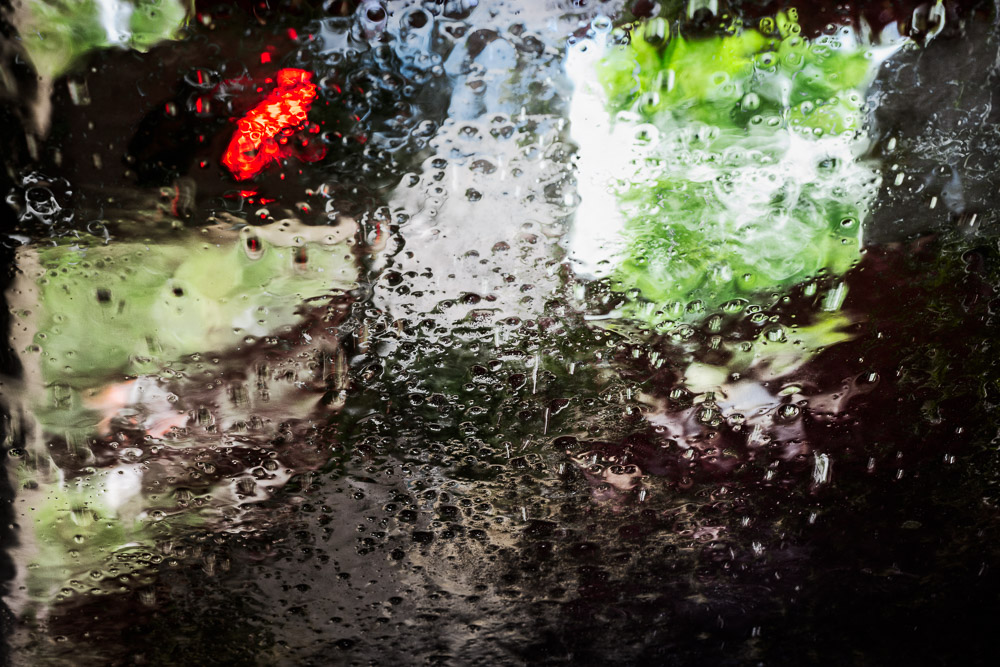
Following my own advice, one day sitting, bored, in a car wash, I decided to pick up my camera and see what I could do. I am happy with the result. It was not planned, it happened because I held my camera and looked around. The world is rich in images and interest. We just have to see.
Directing the eye is a hot topic with photographers and workshop leaders. Even some psychology researchers. It involves understanding the psychology of how viewers look at an image and techniques to encourage them to look at it the way we want.
Psychology
There are certain principles of perception that seem to have a lot of agreement. By understanding the principles, we can use them as tools to increase the probability that people will spend the time to look at our images.
Understand that these are characteristics common to a lot of people, not hard and fast rules. 2 + 2 = 4 is a rule. Not every individual in every situation follows a principle like “the eye is drawn to the brightest region”. Usually, but not always. So while learning and applying these understandings we increase the chance of people relating to our work, we can’t guarantee it.
Brightness and contrast
We are drawn to bright areas and we are drawn to areas of high contrast. Use this to draw people to the area of your image you are particularly interested in them seeing.
Since we tend to look more at light areas and less at dark ones, that is why vignetting is commonly used to “push” the eye away from the edges of an image and into the interior.
The lighting wasn’t right to give the effect you wanted at capture time? So what? That is what post-processing is for. Don’t be afraid to change the lighting and contrasts for the effect you want. If you do it skillfully, no one will know. If you don’t… well, it’s a learning experience.
Color and saturation
Color also effects how we look at an image. Highly saturated colors attract us. Even normally saturated colors are seen differently. Warm tones seem to advance. Cool tones seem to recede. Placing warm tones next to cool tones gives a subtle 3D effect. This is why at concerts or plays you often see warm light on one side of a performer and cool light on the other. It gives them more shape.
Spots of color attract the eye, too. If a scene has fairly even pastel or monochrome tones with a few small areas of a brighter color, we are drawn to those colorful areas.
Lines
Our eye is a marvelous pattern matching engine. We try to make connections whenever we can. Check out Gestalt Psychology for much more information. So lines, especially diagonal ones, tend to lead the eye to find something interesting the line is leading to. We are actually disappointed when we are fooled and the line didn’t mean anything.
Wide angle lenses are sometimes used to accentuate this effect by exaggerating diagonal lines and bending them. It is difficult to shoot some scenes wide without introducing diagonals. Make sure to not disappoint the viewer. Provide a target to reward them for following the diagonal.
Faces and words
Human figures, especially faces have a high visual weight. We are designed to recognize faces and we have a high interest in them. If there is a face, or part of a face, or even an eye in an image that will be one of the first things a viewer is drawn to. A face trumps most other elements of a picture.
Likewise with words. We recognize words as information. We’re conditioned to read them. I think it is fascinating that we are drawn to them even if we do not understand the language. Besides, by it’s nature, characters making up words are fairly sharp edged and high contrast. We have already seen that viewers are drawn to high contrast areas.
Since faces and words are so powerful, we have to be careful with them. Having a person walking through the background or a sign off to the side can destroy your composition intent. Or they can make it if you use them well. The point is, you have to be very aware of them and what they will do to your image.
Depth of Field
A simple attention focusing technique is to use a shallow depth of field ( a small aperture number such as f/2.8). We are drawn to sharp areas and tend to ignore blurry ones. A shallow depth of field tells the viewer to pay attention to the slice of the image that is sharp.
This is a excellent trick to eliminate the complexity of busy scenes.
Techniques
These eye catching techniques are means we can use to help make the viewer look at our image the way we want. Many photographers seem to obsess about eye paths through an image.
Eye tracking studies have been done, where subjects are instrumented with devices that can determine what their eyes are looking at at any moment. These studies produce maps, sometimes called “heat maps’, of the viewing patterns.
This used to be done a lot for web sites. After all, companies spend a lot of money producing their sites and they want to know if customers are seeing what they want them to see. Eye tracking has also been used to instrument image viewing. Researchers are interested in the order in which viewers see things, what they spend the most time on, and what path they use to scan over the image. Much of the information I presented above comes from studies like these.
This says that techniques can be used to direct viewers to parts of the image we want them to see. Maybe we can even encourage them to scan the image in a certain order.
Why direct the eye?
We’ve looked at some of the principles and techniques that can be used to direct viewer’s eyes. But why are some of us keen to do this? There must be a reason.
A photograph captures everything in the field of view of the camera when the frame was exposed. This can lead to a complex, even chaotic image. There can be many things competing for the viewer’s attention.
Sometimes the photographer feels the need to help out by saying “here is what I want you to pay the most attention to.” Eye directing techniques are good for this. This is a good use of the techniques.
Something else I see, though, I feel is unfortunate. We live in a short attention span world and we tend to accept that as a universal truth. It is said that people only glance at an image for less than a second online, unless it really grabs them. So photographers think they better use all the tricks they can to let their potential viewers grasp the image in 1 second.
Therefore there is a belief by many that we must make our images absolutely clear and unambiguous and immediately graspable. After all, if we only have 1 second, we better package the information clearly. Maybe that is the case if your world revolves around the ephemeral whims of social media.
I fear this makes images shallow and boring and is a self fulfilling prophecy. Images have less depth so viewers dismiss them more quickly.
Introducing mystery
I follow a different path. Most of my work is intended to be viewed as prints. The relationship between prints and the viewer is a little different. If someone is walking through a gallery viewing prints, they are likely to spend a little more time contemplating each one.
While I occasionally do work that is very clear and unambiguous, even minimalist, I often do the opposite. Sometimes I enjoy presenting images that are rich in content, that I want viewers to spend time looking at and discovering new things.
I occasionally even misdirect attention from a subtle interest I hope the viewer discovers. Not to be mean or devious, but to reward viewers, to give them a joy of discovery for exploring more carefully.
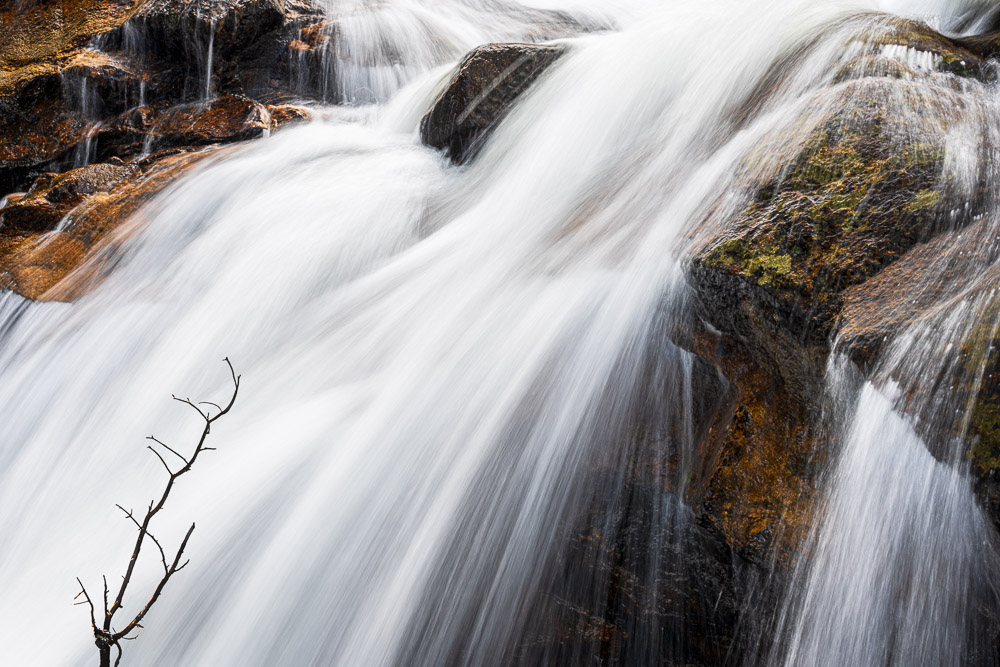
The image with this post is an extreme example. The eye is immediately drawn to the lower left side. That is where the brightest area is and the presence of the high contrast branch silhouette insures it. There is interest there and I hope people like it. But after you’ve explored that and you follow the cascade up to the top right corner you might discover there is a plaintive, maybe melancholy figure under the water. It is not a face, but you see it as a face. There is a moment of recognition that reignites interest and it raises questions, I hope.