An artists journey

Tag: creativity

  • Post Exploration

    Post Exploration

    We focus a lot on the process of taking pictures. And rightly. But the world of post processing is another rich opportunity for “making” images.

    Taking pictures

    When we think about photography, we think about taking pictures. After all, that is what photography is, isn’t it? That is where we capture the data that becomes the final image. For many, the thinking stops there. Click – picture.

    Maybe crop it a little or remove a distraction. Perhaps work on the overall color. But the picture is the picture. No reason to make many changes.

    Many people, especially some “serious” photographers, feel that the image should be made whole and complete in the camera. Anything other than simple edits that make no substantive changes to the original image is suspect or forbidden. That is their opinion, and they are welcome to it, so long as they do not try to bind it on me.

    Imagined unexplored land©Ed Schlotzhauer

    Post processing

    But for other photographers, the world of post processing is much larger than that. Yes, there is cropping and distraction removal and some color tweaks, but those are just the basic first steps.

    I will go out on a limb and say that post processing is as large and important a skill as is capturing images. The world of digital imaging has thrown us into a situation where what happens after the shutter press can be as important as what happens leading up to it. And our tools have become far more powerful, enabling “darkroom” processing far beyond what any film shooter ever dreamed of. It would be foolish not to take advantage of it.

    I assume you shoot RAW images. There are times to shoot jpg, but those are rare in my world of fine art photography. But RAW images require extensive editing. They look bland right out of the camera, since they did not go through heavy-handed jpg processing that is trying to make a best guess of what we wanted.

    Just enhancing

    After that initial round of basic edits, we get more serious for the images we pull out to work up. Now we probably do some initial sharpening. Then set overall contrast, black & white points, maybe some clarity to punch it up some more.

    At this point the image is starting to take shape. Now I may spend a lot of time working on tonal gradations. Working on the details of lighting and separating element so they can be seen more clearly. Then there is working on global saturation and luminance and maybe even hue of individual colors.

    We may decide to add a vignette to help focus attention on the subject. Perhaps we will use color grading or profiles to change the overall “look” of the image. Maybe so far as going to black & white.

    There are so many more. This is just the tip of the iceberg. We can easily spend hours on one image doing these and many more. I have watched hundreds of hours of tutorial videos describing techniques for doing these things. Really getting in depth on Lightroom Classic or, especially, Photoshop is a project requiring years. And they are moving targets.

    But at this point, we have a nicely corrected image – that is still basically the original photograph. It may be exactly the scene as we remember it, or it may have a color wash, or even be in black & white, but it is the same photograph.

    Again, this is where another large group of photographers stop.

    A fanciful composited image with interesting processing. Good luck guessing what the original image is.©Ed Schlotzhauer

    Permission to play

    And that’s where I stop with most of my images. But there are other doors to open that can lead to new destinations.

    Here is a statement of belief for me: pixels are raw material. They are just pieces of data saved on your computer. They do not “mean” anything except for the meaning we ascribe to them when we view them all together as an image. This is my belief. but since it is not based on laws or regulations or fundamentals of nature, it is just my belief. Feel free to disagree and act accordingly.

    But since this is my belief, I am free to do anything I want with my data. There is nothing like PETA for protecting against the abuse of pixels.

    I give myself unlimited permission to play with my data. And I do, to degrees. The problem is that it is hard to break away from old habits and beliefs. Too often, I am trapped by my limited thinking. I see an image. I don’t always see what those pixels could become. That, more than camera resolution or tools or computer power, limits what I make.

    Permission to play does not mean I will always take advantage of my freedom. I am self-limited. My actions don’t always follow my beliefs. But I’m trying to break my mental barriers.

    Impressionistic photography©Ed Schlotzhauer

    Making new images

    I love compositing, combining 2 or more images to make something new. It is a joy when I can take 2 dissimilar images and make something different from either. Sometimes I put together 3,4, 10 images. The resulting image may only have bits and pieces of each source file. Did you know that a TIFF file has a maximum size of 4G Bytes? After that you must bump up to the PSB format. Quite a few of my experimental images do that.

    And I love taking an image and processing it with different textures or digital effects to create a very different look. So much so that sometimes when I am out shooting, I mainly shoot textures. I have a good library of them.

    And have you played with some of the interesting Photoshop filters that are built in? Quite a variety of tools for blur, rendering, warp, landscape mixer, distort, stylize, etc. I can experiment for hours in Photoshop trying new combinations of things.

    Some actually create results I like. But you never know until you try.

    Heavily processed image, not reality©Ed Schlotzhauer

    The digital world

    My point is that our “photo opportunities” do not stop when we press the shutter. Capturing a good image is very important. But there are endless possibilities for improving it or totally changing it in post processing. Sometimes we see opportunities for doing more than just making an image look better. Post processing is another creative outlet.

    Digital images are much more malleable than film. Pixels are just data. Data can be processed. There is a world of opportunity in the post processing, if we can break out of our limited view of what can and should be done to our pixels. I call it post exploration.

    If you are a fine art photographer, the ethical choice is to do your best, most creative work. Not to protect pixels.

  • Lean Into It

    Lean Into It

    I can’t be passive about my art, my photography. The only way I know to approach it is to lean into it. To boldly and confidently attack it.

    Different styles

    We all have different personalities and different working styles for our art. A portrait photographer or wedding photographer might need to be in positive control of the situation. To direct the subjects to get the shots and results anticipated. On the other hand, a street photographer may unobtrusively “stalk” the shots he wants. He works completely in the background and usually without the subjects being aware of being photographed.

    A landscape photographer may plan a trip long in advance to be at a certain location at what he determines to be the best time for the shot he wants. Or another one may just go wandering with no preconceived plans or shot list.

    These are examples. All show different methods of approaching the craft. But regardless of the approach or the personality, one of the common ingredients in our art is intensity.

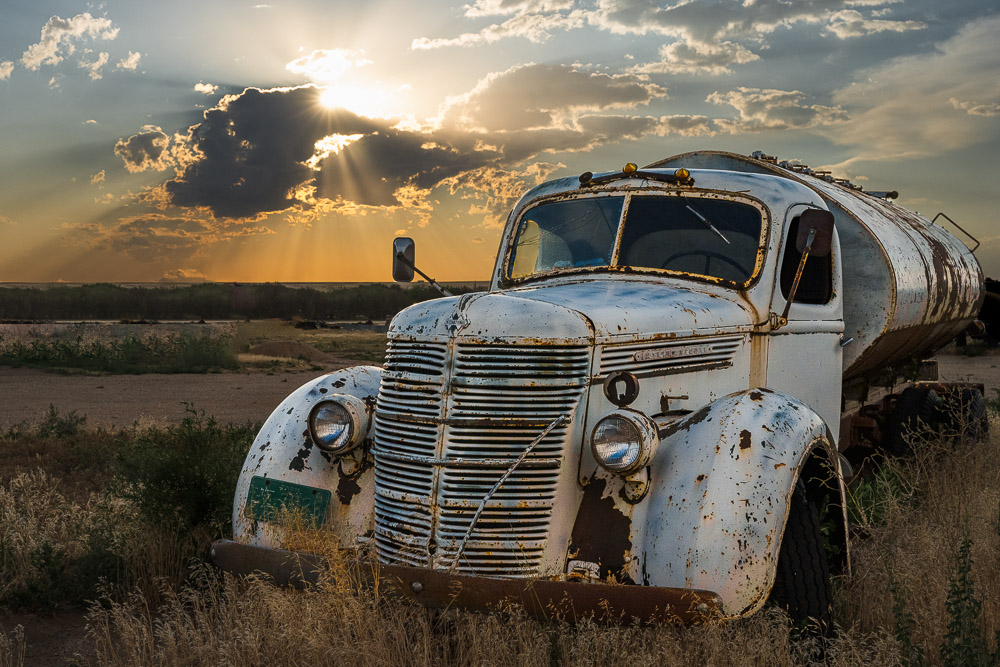
    Rusty Ford truck; delaminated window.©Ed Schlotzhauer

    Intensity

    All good artists I know share a certain type of intensity about their craft. When they are doing their art, they are “on” – focused, earnest, single-minded.

    In my limited experience, this seems to be true no matter what genre they work in. Their personality modifies the way this intensity is expressed, but it is usually there.

    I think this intensity helps to focus us on where we are and what is happening. On our goals or what we are experiencing. It helps us to stay in the moment.

    People talk with some longing about flow states and how desirable they are. But in my art and in the career I had before that, I find them common. Valuable and wonderful, but fairly easily achieved.

    That is not bragging. I think the intensity and focus I can bring to my work enables flow. It is not uncommon for me to be so caught up in my photography or writing or editing that hours can pass without me being conscious of them. From talking to other artists, I believe this is a shared experience for many.

    Canterbury Cathedral ceiling©Ed Schlotzhauer

    Mindful

    I often talk about the desirability of being mindful. The intensity of our focus on our work leads to this type of mindfulness. Mindfulness in the sense that we are completely caught up in the moment. We are immersed in our art and the creative process. Other concerns and considerations do not exist for us at that moment.

    Let me emphasize that I am taking about lower case “mindfulness”. Not some system of chants or meditation. It is not a semi-religious experience for me. I hold my own religious beliefs, and they are separate from this.

    I believe this type of mindfulness is a result of my intense focus on my art, not a cause of my creative output. That is, my focus leads to creativity and mindfulness, not the other way around.

    Fall River, Rocky Mountain National Park©Ed Schlotzhauer

    Do it

    We all get into creative slumps. No new ideas are popping up. We aren’t even enthusiastic about getting out and taking pictures or editing. That’s natural.

    But I feel that one of the worst things we can do is just sit around waiting to feel inspired. At these times, I believe it is important to get up and get out and work. Go out to “do” art and do it until we loosen up and get into the moment and things start to flow.

    This is what I mean by “lean into it“. It is a process of embracing what we are doing and the situation we are in, making it into something good. It is a matter of overcoming a situation or our inertia. We push back against what is resisting us, and deal with it, with confidence and determinism.

    The Word - is shut©Ed Schlotzhauer

    Resistance can often be a good thing. That is what exercise basically is. Forcing our body to work against the weights or the track builds up strength and endurance. I believe strongly that it works the same way for our mental powers. We need to read and think about challenging material. Things that exercise our brain. I can’t prove it, but I believe it also works for our creative powers. We learn to create better by going through the pain of creating.

    Same in our photography. We often blame circumstances, and they are real and inescapable. But much of the time the real barrier is our attitude. We are not willing to change our attitude and put in the work to overcome the situation. Get out the door (or go to where you do your work), get switched on, find your intensity. Lean into it.

    Nike was right: just do it.

    Do one thing every day that scares you. Those small things that make us uncomfortable help us build courage to do the work we do.

    Eleanor Roosevelt

    Inspiration is for amateurs. Us professionals just go to work in the morning.

    Chuck Close

  • If No One Ever Saw It

    If No One Ever Saw It

    Would you still take this shot if no one ever saw it? The answer to that can tell us important things about our goals and motivation.

    There are many reasons for shooting images. I am focusing on “serious” pictures. Not just selfies or simple travel pictures or sunsets. Rather, ones where we are motivated to put our best effort into it because it is important to us. Where we are trying to create something lasting.

    Shoot for hire

    Some photographers are hired to create images for a client. It may be commercial photography or weddings or other things. but the result is that you will shoot images as specified by the client. They expect to see most if not all of the shoot.

    This is a good way to earn money and build a reputation. If you can impose some of your style and personality on the result, it can also be a creative outlet. But ultimately, the client dictates.

    In the context of this article, the point is that the client expects to see most of your shots. They will pick the ones they want to use.

    Contemplating the power and vastness©Ed Schlotzhauer

    Shoot for a competition

    Sometimes we shoot for a competition. Whether it is International Photographer of the Year or your local camera club monthly contest, the process is generally the same.

    We probably are given a subject or genre to focus on. We may have a deep catalog of relevant images to choose from, or we may go out and shoot specifically for the contest.

    But ultimately, we will have to go through the painful process of deleting all except the one (or 5 or 10, depending on the contest) that will be submitted. Then it will be judged and, hopefully, shown to the “world” as a winner.

    The point is that this is an outward focused process. The result of the exercise is to carefully present our star image to the world to compete. Sometimes we even study past winning images and the judges to try to game the system and give ourselves an edge.

    The goal is to win in a public arena. Maybe at the expense of what we really like best.

    Yellow bicycle©Ed Schlotzhauer

    Shoot for exposure

    Many believe the siren song of “likes”. That lots of clicks, comments, and followers makes us a “real” artist, maybe even important.

    I am having to talk here from what i have observed. I do not personally participate in this. Sorry if I overstate it.

    I will just ask what has that social media presence earned you, versus what it has cost you? Becoming well-known and widely followed, maybe even becoming an ‘influencer”, is usually a long process with lots of time and effort. It involves learning the algorithms used by your social media channels of choice and trying to optimize for them. Maybe this involves conforming to the type of work that is popular with their viewers. The things that usually get “likes’.

    This may not be the work you resonate with. Perhaps your real creative work is unpublished.

    Keeping up with this takes a lot of time and may involve bending our artistic vision to the popular taste du jour. I can see that if you are a commercial photographer this might be a way to get visibility and some new clients. But I do not play this game. It is not worth it to me.

    Paint swirls with water drops. Not real, but close.©Ed Schlotzhauer

    Shoot for ourselves

    Or, if you are very lucky or strong minded, you decide to shoot primarily for yourself. You are the audience who matters.

    It is hard to get rich or famous like this, so why would anyone choose to do it? Well, I believe that comes down to our goals, our personality, and our situation.

    Is your goal to be famous and, maybe, rich? Or is it to satisfy some creative need within? I shoot to fill that creative need. I am an introvert. The marketing and self-promotion required to shoulder my way into the mainstream art world is alien to my personality. It is too big a price for me to pay. Trying to do that made my art drudgery, not creative fun. Plus, I am very lucky and grateful that my situation doesn’t require me to earn my living from my art. At this point in my life, I can reserve it for my personal joy and expression.

    I realize that everyone is different and has varying goals and needs. This is just being honest about my motives.

    You won’t see it

    So, back to the question of what if no one sees it. I think I have established that my primary audience is myself. I’m not trying to make my income from photography, and I do not really care about likes or comments. They are welcome when they happen, but they are not the reason for making an image.

    I do share some images with friends and the occasional show entry or online article, like here. Even an infrequent hanging in a gallery. Most of my images are for sale. But I would give a print away to a friend who appreciates it rather than sell it for an insulting price that doesn’t even cover my costs.

    And the ones anyone does see just are the tip of the iceberg. I would not show an image I am not proud of. That means only a small portion of the images I shoot might ever be seen.

    If I shoot thousands of images but only consider a few of them worthy of being seen, am I a failure? Not in my mind. My standards are high, and I am not motivated to try to get much seen publicly.

    More than a rock - seeing it different.©Ed Schlotzhauer

    Would I shoot it?

    Photography is mainly a creative exercise for me. I resonate with the challenge of trying to do something above average with the scene I find. If I am learning and growing and making fresh new work that pleases me, I am content. That is my standard and reason for making pictures. Your mileage may vary.

    So, would I take the shot if no one ever saw it? Trick question. I will see it, and I am the audience that matters for my work. Yes, whenever I get the chance, I will shoot it. It may not be a “money” shot. It may not make me famous. But if it excites me, that is what is important.

    Note: The inspiration of the phrase “if no one ever saw it” came from Nuno Alves on Medium.

  • Depth of Insight

    Depth of Insight

    In a recent Medium article, Marc Overmars gave a good introductory description of depth of field (DOF) This is a technical term uniquely applicable to photography. I want to take the concept in a somewhat more philosophical direction. Maybe there is a concept of depth of insight.

    Purely technical

    On the surface, depth of field is purely a technical concept. it only applies to photography, because it is associated with the physics of focusing through a lens.

    I went into some of the issues in a previous blog. Sorry for the math. 🙂 I know most people don’t like that. I don’t have much use for it either, and I would never use it when I’m out in the field shooting, but some level of understanding is helpful for mastery of the art.

    Maybe the most challenging concept from that article, and a fundamental concept of DOF, is “circle of confusion”. The idea that there are acceptable levels of unsharpness. Very briefly, only one point in the frame is technically “in focus”. But practically, a certain amount of unsharpness can be tolerated before we would consider something blurry. The size of this allowable unsharpness is called the circle of confusion. So, when your DOF calculator gives you a distance range, those are the points where the focus becomes unacceptably blurry. The math is exact, but the concept isn’t.

    Perhaps there are analogies in our understanding of what we shoot.

    Red barn, red truck©Ed Schlotzhauer

    Looking deeper

    Let’s set the math and technical details aside for now. I can hear the sigh of relief.

    I propose that there is an analogous concept concerning the sharpness of our intent when we are shooting. That is, did I just point my camera at a subject, make a decent composition, and shoot? Or was I clear in my mind why I was taking the picture and what it was really about?

    I have often referenced the Ansel Adams quote that “There’s nothing worse than a sharp image of a fuzzy concept.” There are 2 reasons for that. First, it is a brilliant observation. Second, it is something I struggle with, so it is very real and close to me.

    Yes, I can compose, and I can use good technique to get the sharpness I want. I can use light to my advantage, and I have a lot of experience post processing. But even so, I often look at my images in despair. Too often they are sharp images of a fuzzy concept. When I am honest with myself, I know that sometimes I didn’t have much in mind when I shot them.

    Silhouetted tree against glass skyscraper©Ed Schlotzhauer

    Art happens in our head

    Maybe it is too obvious to state, but art happens in our head, not in the camera or the computer. As with any definite statement about art, this is a generalization. Sure, there have been many times when I was working with a scene and experimenting (e.g. playing), and things seemed to come together. That is the exception, though.

    All too often I look at my images and realize they are, at best, just record shots of a place I was at. No depth of insight. Not much below the surface to give you a reason to pause over it and consider it.

    The fault is entirely my own. I didn’t have anything to say, and I said it.

    There is a marked contrast with the images I get when I go out to shoot a project, or ones I shoot when I feel strongly about the subject or the situation. Many more of them are strong and satisfying.

    We all know this: the more we put into something the more we are likely to get out of it. Why don’t I remember it more when I am out shooting?

    My excuse, other than simply laziness, is that I like to go out exploring and shoot interesting things I come across. I don’t always find interesting or “deep” things. That is just that, an excuse. Maybe it is as much that I didn’t have much to say that day. I try to remind myself of Jay Maisel‘s quote that “If you talk with nothing to say, that’s bad. When you shoot with nothing to say, that’s worse.”

    Kentucky Coal Miner©Ed Schlotzhauer

    Circle of confusion

    So, is there a “circle of confusion” concept for our shooting? Maybe so. If we can’t get our ideas into focus, maybe we shouldn’t shoot. Do our ideas have to be in perfect focus? No. Like the technical term, maybe there is an acceptable level of unsharpness. I hope so.

    What do I mean by this? Well, sometimes I realize exactly what the scene means to me, and I can determine exactly how to shoot it. That is great. I am often happy with the result. Sometimes, though, I just have a feeling, a sense of what I am experiencing. I have learned to follow those instincts even if I cannot clearly express their meaning at the moment. If something is drawing me, there is probably a reason.

    Later, while editing, I may realize what was calling me to it. Sometimes an image I was initially dismissive of emerges as the strongest of the shoot. It could be that’s just luck. I prefer to think my instincts were trying to tell me something.

    Maybe I am being too hard on myself. Jay Maisel also said “You always end up with too many pictures to edit and too few that you feel ‘got it’.” I suppose the feeling is common to all photographers, but it still is frustrating.

    Chartes Cathedral interior. Mystic, spiritual impression.©Ed Schlotzhauer

    Projects for focus

    I am learning to use projects to help me focus more clearly. A project is a chance to think deeply about something, decide how I feel about it, and then find opportunities to express it.

    It is basic psychology that when you are concentrating on something you are more attune to it. A simple example: a friend was thinking about buying a Nissan car. I don’t think about there being many of them around, but after that conversation it seemed like every other car I saw was a Nissan. I was more attuned to them.

    A somewhat more relevant example is from a recent trip to France. It was a family trip, not a dedicated photo expedition. But I didn’t want to come back with just random tourist shots. So, I created a few projects to keep in mind to focus my thoughts and energy. One of them I called Sacred Places. It helped me be much more aware of cathedrals, of course, but also monuments and memorials and standing stones. Even a small village celebration of their liberation in WWII. I felt it helped me to see more opportunities, and I looked deeper at the occasions I found.

    If I don’t see it, why should you?

    Circling back to Jay Maisel’s quote: “If you talk with nothing to say, that’s bad. When you shoot with nothing to say, that’s worse.” If we can’t focus our feelings and experience, are we shooting with nothing to say? Just taking a sharp or well composed picture isn’t enough. If you can’t participate in the experience I felt, then I’m not bringing you anything other than an “I was there” picture. Maybe it is pretty, but there isn’t much to feel or remember.

    Perhaps I do not have to be able to precisely express what I was feeling at that moment. Maybe there is a “circle of confusion” associated with our understanding of the image we are creating that gives us some margin for imprecision. But the circle of confusion in focusing helps discuss a range of acceptable sharpness, not permission to be out of focus. Maybe there is a range of acceptable understanding of our feelings leading to making an image. But little or no understanding is out of range. With no real understanding or feeling, there is little interest for viewers. Have something to say.

    I am starting to concentrate. much more on depth of insight than depth of field.

    Moody, mysterious Aspen grove; a created image©Ed Schlotzhauer

    Head image

    I mentioned having Sacred Places in mind and encountering a memorial celebration in a small village in France. The image at the top was a result of that. We happened, by accident, to be there on the day of their annual celebration of liberation in WWII. They still remember and memorialize it to this day. That is heartwarming.

    This flag display was presented while local dignitaries and military officials made speeches. I didn’t understand enough French to follow it, but it was moving.

    Having the Sacred Placed project in mind made me more attuned to this. We stayed for all of it and loved being there. When they discovered that we were Americans I barely avoided having to give a speech at their village celebration afterward.

    I hope a little of the dignity and solemnity of their memorial comes through.

  • Challenge and Stimulation

    Challenge and Stimulation

    We are all motivated by different things. That is good. Otherwise, we would all make the same art of the same subjects. But do you understand your personal challenges and stimulation?

    Different personalities

    Our personality type partially determines what motivates us and how we approach our art. I have mentioned introverts versus extroverts, but there are other dimensions.

    Some of us are visual learners. We take in new ideas best through pictures, diagrams, even videos. Others receive information best through words. There is not a best way. It all depends on how we are wired. I am more of a visual learner.

    Some want to carefully design their art and work slowly and deliberately. Others work better at a fast moving, “run & gun” approach. Some feel that their images must be created entirely in camera in a single frame. Others prefer to manipulate images heavily and even composite them together. Some like hyper-realistic, razor sharp images where others prefer to use intentional camera motion to create impressionistic images.

    All people can make art, but they must approach it in the way that makes sense to them.

    Zig-zag shadow©Ed Schlotzhauer

    Different goals

    Some of us are challenged by the hunt, the contest. We need to be working toward a goal of a competition. It is a contest against others. Winning is the motivation. A prize and its bragging rights are up for grabs.

    Others of us could care less about that. We are challenged by inward values and goals. We are self-motivated to do our best work even if just for ourselves. An audience is nice, but not necessary.

    There is not a best way. What matters is what works for you and understanding yourself well enough to know those things.

    I got frustrated recently reading David duChemin’s Light, Space, and Time: Essays on Camera Craft and Creativity . He goes on a lot about working a scene from many angles and points of view to get the “best” shot. The best shot seemed to be all important. Then I realized he is an extrovert. I should have figured that out from a video I saw of him. As an extrovert, the product is the goal. With me, an introvert, it is more the experience.

    There is no one right way in art. We tend to project what works for us onto other people as “the answer”. That is an error.

    We need challenge

    However it comes, we all need challenge and stimulation. Challenge gets us out the door on a cold morning. We are seeking something. We need to do this. Some people need the fire of competition to test and motivate them.

    Challenge might come from wanting to enter a contest or the prospect of a gallery show or to pay the bills. Or it might be the need to answer questions for ourself. Questions like what can I do with this topic, or is there more interest to be found in this subject I have photographed many times?

    Challenges do not have to be public. It could be a personal quest. One for me has been to get what I consider to be an interesting and non-cliché shot of the Eiffel Tower. That is a challenge for such an iconic and over-shot subject.

    Pictures of pictures©Ed Schlotzhauer

    It may be the challenge of having “failed” to get results we were happy with in previous attempts with a subject. The belief that there is a better way to do it if we just learn from our mistakes and dig deeper, is a challenge.

    Whatever it is for us, our challenge presents us with a goal or idea that has been out of our reach, but we are striving for it. We need to elevate our art, our ideas, our craft a little to get there. It is an effort, and it tests our ability.

    We all need to test our ability frequently. Whether it is by entering competitions or by our self-examination when we review our images in Lightroom, we need to honestly evaluate if we are growing as an artist. Challenges stimulate growth.

    We need stimulation

    We also need stimulation. Maybe I should say that I need stimulation. I realize that we are all different.

    Stimulation is different from a challenge. It is something that elevates our thoughts or consciousness beyond your present state. Stimulation is that spark that ignites something in us, that tweaks our interest. It gets us excited.

    Each of us is stimulated by different things at different times. I do not think there are any universal answers. I can only give anecdotes of the kind of things that stimulate me.

    Travel stimulates me. When I am out of my home area, things look different. I look at things as new and interesting. It energizes me and helps me to continue to see things fresh when I get home.

    Learning stimulates me. New ideas, new images, new techniques add to the mix of things swirling in my head and sometimes pop out in surprising new ways. That excites me. It might even take my art in a new direction. It is great to feel that you have stepped up to a new level.

    I don’t usually need stimulation to get out the door and take pictures. But it helps to break me out of ruts and look at the world in new ways.

    Rusty chair, shadows at sunset©Ed Schlotzhauer

    Creativity

    We humans sometimes need to be prodded to do our best work. Challenges and stimulation are part of that. I view it as the classic carrot and stick. Stimulation is the carrot. It energizes and excites us to go forward. Challenge is the stick. We have accepted a challenge now we have to get busy and go for it to keep from failing.

    Creativity is not well understood, despite many smart Psychologists spending whole careers studying it. Creativity seems to happen in our subconscious. That is why ideas “pop out” at seemingly random times, like when you’re going to sleep or in the shower.

    The process may not be understood, but history tells me we can do things to feed our mind and encourage our subconscious to be more creative. Some of the important things are these ideas of challenge and stimulation. And keep working. It is important to avoid just sitting around feeling sorry for our lack of creativity.

    Terra Incognita©Ed Schlotzhauer

    Feed your head

    My model is that we can lure our subconscious to work for us by assigning it a task. Say we want to create a new art project that is significantly different from our normal work. We do not know the best way to approach it or even understand yet what the end should look like. But by turning it over to our subconscious and letting it work on it without much interruption from us, we are often surprised later to find that we have clarified our thoughts a lot and now have a direction for the project. Maybe a creative new direction.

    Giving the subconscious a goal is setting the challenge. But I also find my subconscious needs stimulation to energize it. The stimulation is often completely unrelated to the goal. Start to learn a new language, research how knives are forged, read a biography of a famous person, go to a museum. I’m not sure the topic matters as long as we are stimulating our mind with new learning and following our curiosity. (TikTok is not new learning) I do believe that the new information makes new connections in our mind and energizes it to do creative work.

    Surprises happen. That is creativity.

    Keeping Knowledge locked away©Ed Schlotzhauer

    Push through

    So, when we get stuck and it seems the creative muse has left, often the best things to do is to not worry about it. Instead, decide if there are some challenges you are wanting to undertake. Then go on a learning binge. Don’t stress about your challenges or lack of creativity. Just follow your curiosity and learn new things. Immerse yourself in something new that is stimulating to you.

    But through it all, keep working. You may not be doing career changing art, but it is important to keep trying. Creativity will come back even stronger, but in its own time. When it happens, accept it and be grateful. And it will happen if you challenge it and stimulate it.