An artists journey

Tag: creativity

  • Too Much Help

    Too Much Help

    Is it possible to have too much help in our photography? Are there long-term downsides to some of the technology we employ? What does it do to us as creatives?

    Photographic technology

    One of the characteristic things about photography is that it is closely tied to technology. Since the invention of photography, it has been technology based. The specialized emulsions and chemicals and techniques required training and a certain level of technical savvy.

    Today the technologies have changed drastically, but the tie between photography and technology has not changed. If anything, it is stronger than ever. Being a “serious” photographer just about requires a complex camera system, a capable computer system, and specialized training in the tools.

    The companies that make our technology try to ease some of the cognitive load by getting more helpful all the time. Usually, we welcome that. Who would not want our tasks to be easier? But we need to ask ourselves if there are hidden costs in taking the easy path.

    Leaning trees.©Ed Schlotzhuaer

    AI

    The antagonist I want to single out is what we generally call “AI”, or Artificial Intelligence. It is creeping into many aspects of our art with the promise of making our life easier or getting things done faster.

    I will be very open that I am against most uses of the things called AI, as embodied by large language models like ChatGPT. Not only in photography but most areas of life. I am not just a Luddite. I spent a long career in the tech industry, and I studied and practiced AI at some points of my career. So I have some familiarity with what it is and how it works, including a moderate knowledge of the technology within it and its limitations.

    Study of coding

    I am curious about lots of things. I enjoy looking at seemingly unrelated areas and trying to see parallels or applications.

    Many studies are starting to be done on the human impact of AI. One that intrigued me was a study of software developers in Italy and what happened when their access to AI was cut off.

    In 2023, the Italian Data Protection Authority suddenly banned ChatGPT based on privacy and security and non-compliance with European data protection laws. The effect on software developers was immediate and dramatic. Code check-in on GitHub – a proxy measure of output – dropped 50% in 2 days.

    But on further analysis, 2 very interesting things emerged: the output of inexperienced coders went up slightly while the output of experienced coders went way down, accounting for most of the drop in output.

    One of the suggested explanations is that novices were concentrating more on developing basic skills for themselves, therefore not relying on AI as much. Experienced developers, on the other hand, embraced AI to do a lot of the routine work. But the productivity booster had become a crutch. They lost a lot of the ability to do the work they used to do.

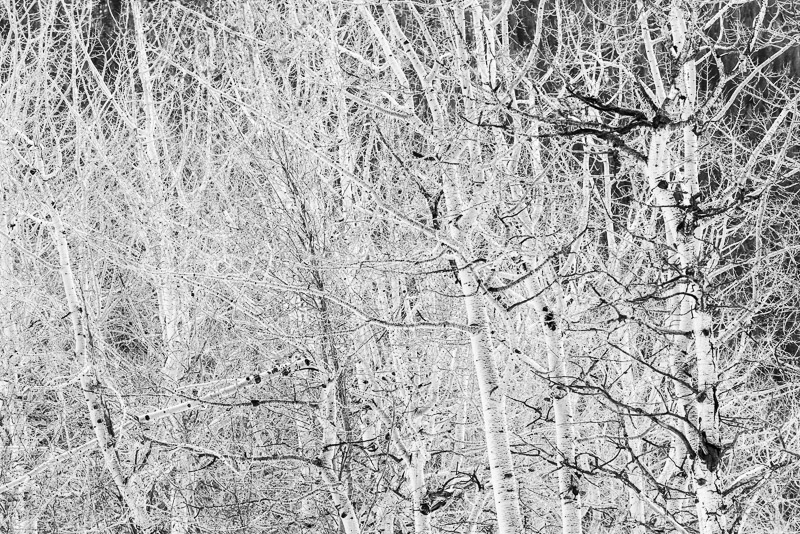
    Stark, bare aspen tree. Chaos of branches.©Ed Schlotzhauer

    Productivity tools

    I believe there are parallels for photography. At this point, I will ignore the novices just learning the craft, since I am not there and can’t think like them anymore. Let’s concentrate on experienced artists.

    Our tools constantly offer to take over more of the photographic process. Some of this is good, but not all of it all the time. I have bought into a lot of it. I don’t think my handheld light meter even works any more. And I have long forgotten how to use the manual calculators to determine exposure or desired depth of field. Now, my camera’s metering is so good that I usually trust it. And DOF, well, I can immediately see my image after shooting, so I can check it easily.

    I often use “AI” tools in limited ways. In Lightroom (Classic, the only “real” one ☺) I often use the Auto button to see it’s opinion of a good starting point. It does a pretty good job for the outdoor shots I usually take. I seldom leave its settings untouched, but it can be a time saver. Likewise, I use the manual Remove tool a lot for dust spots and distraction removal. I very occasionally use the generative remove, although it is about a 50/50 chance of it being better than doing it manually. Lightroom is getting much more capable of creating useful masks. I often use them as a starting point.

    Sunset sihlouette©Ed Schlotzhauer

    Creative rot

    But who says art should be effortless. Our tools want to take over increasing portions of our work, to “help” us and make it easy They offer to automatically remove dust spots, they provide great aid in removing distractions, they offer to distort our images to align verticals and horizontals, they offer to cull our photographs and assign keywords, etc. All these things can be helpful time savers, but at what cost?

    Like the experienced coders in the Italian study, at what point do we start losing the ability to do our own work?

    Editing, for example, is something I consider a necessary skill for photographers. I have noticed in my own work that I am now sometimes uneasy in manually removing complex distractions. My initial instinct is “that’s hard and will take a lot of time; maybe it would be better to just let the software do it”. That is a warning flag to me. I feel that I need to be skilled at doing this and confident that I can. If I cede these decisions to my tools, I believe I have abrogated part of my role as an artist. I am responsible for every pixel of my image. Software should not take over important creative decision making.

    Or take culling images as an example. I strongly believe culling is a critical part of the artistic process. Confronting our mistakes and selecting the best of a series is a necessary part of improving our work. I would rather not spend the time required to do it, but I feel I must. Without it, I am deluding myself about my actual work. I can’t afford to let the computer do it for me.

    There are too many examples to list. AI technology is trying to embed itself in most phases of our process.

    Dead tree in snow. Bent, broken, but still trying to stand.©Ed Schlotzhauer

    The other AI

    Let me pause for a moment and note that I am not discussing fully AI generated images. There are times and places to use them. They are not inherently bad. It is kind of like hiring an illustrator to create some graphics for a presentation or a graphic designer to make pictures for a marketing brochure. Those are business products, not art.

    I firmly believe that AI is incapable of coming up with creative new ideas or art. It cannot do more than it is trained on. Good art is a product of human creation. I admit that there is a lot of bad art that is no better than AI.

    Caution

    I am not going to abandon technology advances. Many of them make my life easier and more convenient. But I do intend to maintain a certain skepticism that will keep me from becoming dependent on convenience features.

    If the great automatic metering and auto focus in my camera went away, I still know how shoot fully manual. If most of the automatic aids in Lightroom and Photoshop disappeared, I still remember how to do things the hard way.

    I fear that younger photographers who have grown up with the tools do not have that fallback position. We could soon be in a position where photographers require AI tools to do their work, because they cannot do it themselves. If they have to rely on it to do their basic work, then why not allow it to do more and more. At some point, who (or what) is the artist?

    I do not believe my smarter tools have negatively effected my images or my creativity so far. I keep a watch for that.

    Or maybe I am wrong and completely out of touch. Maybe photographers are no longer required to be masters of our technology. It could be that the requirements for making an original and creative work are different from what I believe. In that case, I am just an old dinosaur holding on to a forgotten past. But I choose to believe my knowledge and experience is something AI cannot copy.

    Maybe this disquiet about too much help is one of the reasons there is a resurgence of interest in “old school” technology, like film and manual cameras. Many long for simpler days when we were more in control and closer to our end result. I am somewhere in the middle. I don’t want to give up most technology, but I refuse to be controlled by it.

  • Transmogrification

    Transmogrification

    Photography is a process of transmogrification – a transformation of one form to another. It’s a wonder an image ends up a recognizable representation of a scene. Some don’t.

    Transmogrification

    If “transmogrification” is unfamiliar to you, you are probably not a Calvin & Hobbs fan. I am a shameless fan. In my opinion, it was one of the most creative and humorous cartoon strips in history.

    Calvin (a little boy) and Hobbs (his imaginary friend who is a stuffed tiger) were always getting into typical little boy trouble. One of his “inventions” was a transmogrifier, a device (cardboard box) that could transform anyone into anything else.

    One of the reasons the comic is meaningful to me is that I had 2 active boys who always pushed the limits, and then some. Now, I have another newborn grandson, so I will be starting over in that world.

    I thought the author, Bill Watterson, invented the word, but it turns out to have been used as far back as 1671. It is a real word, not a made-up cartoon word.

    Not deep philosophy

    This discussion of the transformations that take place in making a photograph will be purely practical. I will not get into philosophical questions. We could do long analysis of indexicality or semiotics or formalism or the photo theories of John Szarkowski or any of dozens of other theories that attempt to explain why we see what we see.

    I don’t avoid this just because I am not capable of the deep thought. My nature is to be more of a pragmatist in my basic life philosophy. That’s why I went into Engineering rather than Science.

    A theory of why I made a particular image may be of a little bit interesting to me. It might help me to understand my process and vision. But I don’t think it benefits my viewers or really changes the final image.

    To someone viewing my image, it is what it is. It has to stand on its merits as they see them. I may have had deep theoretical intent behind what I did. but they don’t care. And despite any philosophical basis I may have used, if I don’t like the image either, it is useless. Don Giannatti recently said on Medium “A good photo is a good photo.” So true

    A series of transformations

    There are 3 main groups of transforms between a scene and a final print: in our head, in the camera, and in the computer. I include our head because it is probably the most important one. I will only describe a raw image processing path, since that is all I use. When I talk about a processing step, I mean a point where the result can be altered.

    Image processing transform in our head©Ed Schlotzhauer

    We see a scene and our brain goes through a lot of steps before we are even close to pressing the shutter release. We evaluate what we are seeing, determine what is significant, decide how we feel about it, what is our intent in taking this picture and if it is even worthwhile, and generally how we will compose and frame it.

    These steps may happen rapidly and instinctively, or they may be a slow deliberate process. That depends on the situation and our shooting style and our experience. But they probably happen.

    Camera transforms

    image transforms in the camera©Ed Schlotzhauer

    Assuming we decide to take the picture, now several processing steps take place within the camera. First, the light from the desired scene comes in through our lens. The lens determines the field of view, wide or narrow. It also “contributes” its own distortions – the MTF, barrel or pincushion distortion, chromatic aberration, vignetting, etc.

    After or within the lens is the aperture. This opens or closes to let in more or less light. As a side effect, the aperture size determines the depth of field – the amount of the image that is in sharp focus. Focus depth is one of the creative decisions unique to photography.

    Then the light is controlled by the shutter. The shutter opens for a precisely controlled amount of time when the photographer presses the shutter release. That opening time controls the amount of light that can pass through. The aperture and shutter work together to provide two of the key variables that determine exposure. The side effect is that shutter speed also determines the perceived motion blur of the scene. This is another creative decision.

    Next, the light hits the sensor where photons are converted to electrical signals. The total number of pixels is fixed here, as is much of the quality of the final image. The sensor also introduces some kinds of noise into our data.

    A deep, dark secret that many people do not internalize is that at the sensor, the information is “analog”. That is, it is varying levels of electrical signals. It goes through an Analog To Digital converter (ADC) to digitize it. Gain is also applied here as determined by the ISO setting. Higher ISO values apply more gain to boost the signal. There is a tradeoff the artist must make about the ISO setting, the amount of gain, since that determines a lot of the noise in our image data. Each pixel’s electrical value is digitized to create the matrix of digital values representing the image.

    Next the digital data flows through the digital signal processor (DSP) section. Each manufacturer applies its own proprietary “secret sauce” of processing to enhance the response of the sensor. This is why there is a Leica look and a Fuji look, etc. A jpg image is also processed from this to create a quick preview of the RAW data. The data is assembled into RAW data format for storage and then written to the memory card.

    The memory card receives the raw data that represents the image as processed by the camera.

    All these steps are just what is within the camera. I have not even mentioned our decisions of how to orient the camera or support it. Is it fixed or intentionally moving? Where is it positioned in relation to the scene? These decisions were probably made at the “head” stage.

    Computer transforms

    Image transforms in the computer©Ed Schlotzhauer

    We typically take that memory card and read its contents into our computer through a cataloging program such as Lightroom. Now the data is stored locally on our computer system for access.

    The type and amount of processing that can be done here is too vast to describe. We might use Lightroom or Photoshop or Topaz or any of several other software applications to operate on the pixels, bending and shaping and polishing them to our satisfaction. We may crop or delete large sections, combine images in various ways, change color drastically, even to black & white. There is little limit.

    Finally, to make a print, our print processing software uses profiles for the printer and paper we will be using to re-transform the image to a new color space. This is necessary to create a print that mostly matches what we see on our monitor. Raster Image Processing is used to do error diffusion and other complex calculations to create a new representation that creatively shapes the pixel values to patterns of microscopic ink dots that will produce the final image. The printer sprays the ink onto the paper substrate.

    We now have an image.

    Uniqueness of photography

    This series of transformations partially serves to define the basic difference between painting and photography. It should be clear that a photograph is a capture of all the light and forms that was seen by the lens. Everything gets recorded.

    The photographer has command of composition and viewpoint and lens selection and exposure to control what gets captured. But everything that was there is recorded. One of our jobs is to carefully select what to record, removing distractions.

    Distraction removal often continues to the post processing steps. And new elements may be added to the image. These happen long after the image is captured by the camera.

    A painter starts with a blank canvas and adds the elements he desires. Nothing can be there unless it was his intent to place it there. If he didn’t paint it in, it does not exist.

    Photography is a subtractive process while painting is an additive process.

    Over time we photographers learn how to control what ends up imaged on the sensor. We must be vigilant as we are looking through the viewfinder. Learning to actually see all the faults and distractions is a skill. Learning how to deal with them is part of our art, as is learning how to process the image to end up with the result we want.

    Looking through clock, Musee Orsay©Ed Schlotzhauer

    The chain

    As we can see, there is a complex chain of transforming steps that an image goes through between the “real” scene and the resulting depiction in a print. Most of these steps can seriously change the final result.

    I take 2 main points from this: all images are modified and as artists we exert the control over the intent of what we are creating.

    An image is not the object or scene. It is possibly a representation of the original. Or it can be completely different. I intentionally avoid any discussion of referent philosophy, other than to say a picture is not the original thing, it is an image that may or may not have something to say about the thing..

    How the image corresponds to the “real” scene is the artist’s choice in creating the image. As artists, we have an abundance of control points in the process. How we choose to use them is our decision. It is what we do as photographers. The result of all these transformation steps is an expression of our artistic vision.

    I called it transmogrification because the complexity of what is going on is almost science fiction or fantasy. But this is what we deal with every time we take a picture. As photographers, we must understand this chain. We do not have to understand all the technical details, but we must be able to use the steps available to us to create the image we want. As artists we must understand how to control all this technology to shape the final image to our vision.

    It’s a great thing, though. Taming all this technology and learning to use it well is part of the joy of being a photographer. It gives us tremendous creative freedom.

    Ultimately, though, our viewers do not care at all about our technology. They only look at the image and decide if it is worth looking at for more than an instant and if it has some relevance to them. Technology, like good magic, should be invisible.

  • Shoot What Interests You

    Shoot What Interests You

    Should we shoot what we are paid to do, or what we love, or what interests us? Yes, probably all of them. But perhaps the most important thing is to shoot what interests you.

    Motivation to shoot

    We are motivated by different things at different times. Everything from paying the bills to self-actualization are motivators. We must bend to the circumstances.

    When a client is paying you to create a shot, we have to rise to the occasion. We give it our all, even if our heart is not in it. Chances are we are not in love with the product they want to sell. The executive’s head shot is probably not our idea of the pinnacle of creative artistry. And this wedding. Well, maybe we would rather not be here.

    But if we receive money for it, we must give good value to the client and make them happy. Paying the bills is often a motivator.

    Neon and incandescent abstract at night©Ed Schlotzhauer

    What we love

    It is often said that we should shoot what we love. I have probably said it. I agree in principle, but there are other considerations.

    What we love may inspire us. But long term, we could trap ourselves. We can get burned out on a subject. We still love it, but at some point, it does not challenge us anymore. It is easy to get into a rut. Doing the same things over and over with little new thought. See it – shoot it.

    This becomes a comfort zone trap. It becomes too easy and safe. We may believe our favorite subject is the most beautiful thing there is. But if we run out of things to say about it, our images get stale.

    This happens sometimes with “experts” in a field. They become more interested in protecting their position as expert than they are about learning new approaches or even contradictory ideas. We can sort of build a mental fort around our thoughts to protect ourselves from being challenged.

    I see this myself with 2 dispirit things I love to shoot: landscapes and stained glass. I live in Colorado. Rich sources of landscape opportunities are all around me. But as time goes on I find it harder to create something new with them. Similarly, I am drawn to beautiful stained-glass windows. I can’t help but shoot them. But I recognize when I am doing it that this is the same old record shot of a window. It is very hard to find much new to say about them.

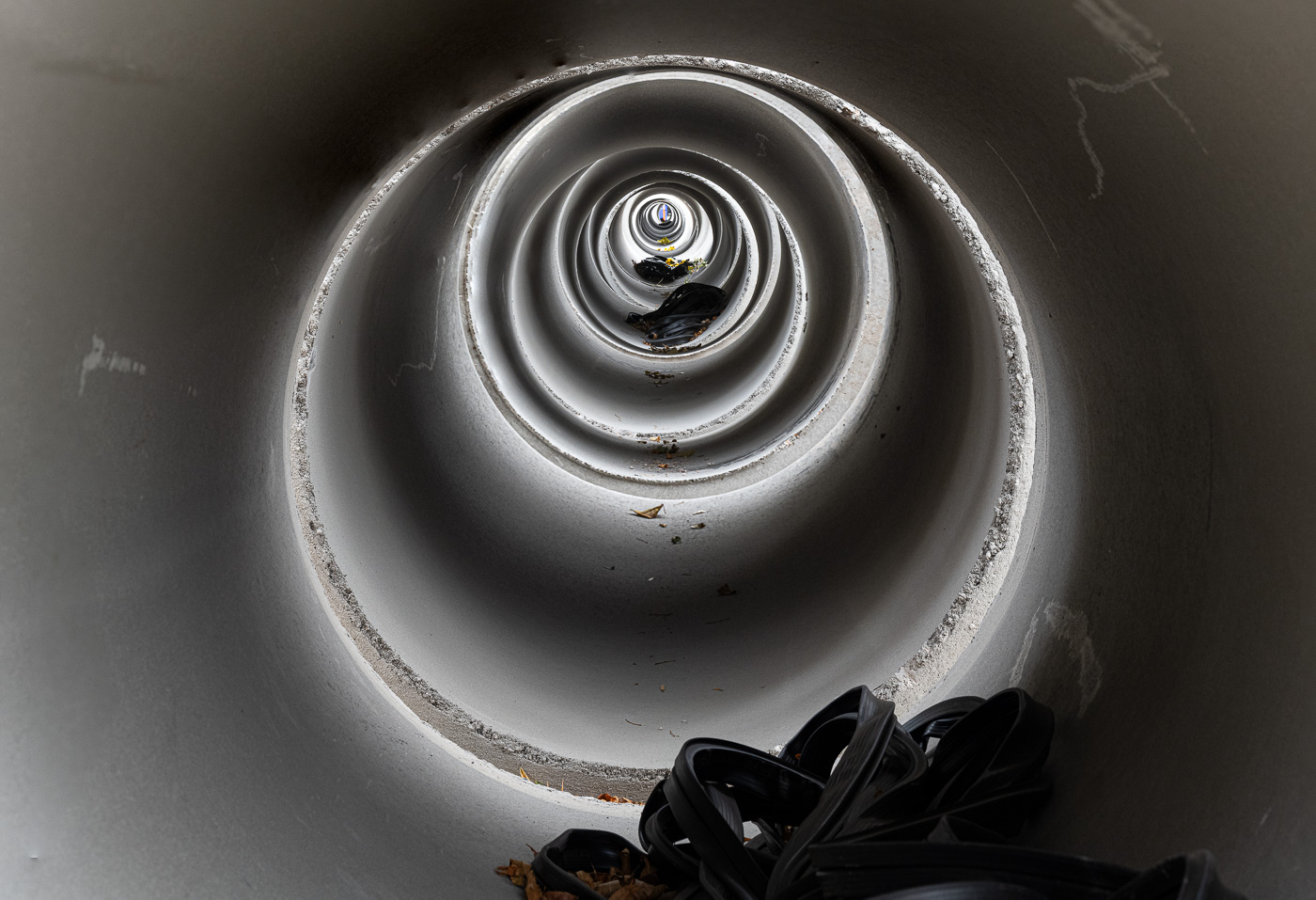
    Tunnel through the mountains©Ed Schlotzhauer

    What interests us

    I have come to believe the greater motivator is to shoot what interests us. This may not be what we think we love.

    More and more I believe that our curiosity is a searchlight that will lead us to challenging and creative new work. I love a phrase from David duChemin: “Go in the direction your brain is already running.” This beautifully captures the idea that our interests and our curiosity is pulling, nudging, directing us forward to new things. We just have to follow. And marvel at how we got there.

    He points out that this might take us far from what other people are doing. But that is great! It lets us play in exciting new areas that other photographers are not trampling all over, working to death. Our curiosity will lead us to areas that are uniquely our own vision.

    Antique reflections©Ed Schlotzhauer

    Practice

    Everyone is naturally curious as kids, but it seems to be squeezed out of us as we “adult”. But we can relearn. it. How can we practice being curious? Easy. Let go and don’t try to force it. Ask yourself questions.

    Curiosity is our brain making connections between things and asking questions to learn more. The more sources of connections we have, the better that works. We must encourage the questions.

    One way to learn about curiosity in practice is to be around a 4-year-old. They have questions about everything. Many of their questions are things we might wonder about but wouldn’t ask because we are too “mature”. That’s the advantage of the kid. They feel free to ask any question. Imitate that. Ask the questions, at least in our head.

    And since curiosity is about our brain making connections, it helps to feed our head, Dabble in all sorts of different things. Get a little information on everything you encounter, even if you don’t think you will be interested in it. No telling where that path will take you or how that random bit of information may emerge later.

    You know that Google makes an extensive dossier of you based on your searches (don’t use Google search). Be so eclectic that their algorithm gives up on you because it can’t pigeonhole you.

    Going around in circles©Ed Schlotzhauer

    Challenge

    Creativity needs challenge. Without challenge, it will atrophy. Staying in a safe comfort zone does not challenge us. This is why I believe it is important to shoot what interests us. When we are shooting pictures, always be asking “What if…?”

    Our interests are fluid. They shift and move to new ideas as we learn and think more. And if we accept the challenge to experiment with those ideas, we can see new things in even the common things around us.

    Following our shifting interests keeps us fresh and challenges us with learning and adopting new viewpoints. It is based on our curiosity rather than a particular subject.

    Always be curious. Always be asking questions. And give yourself permission to follow your curiosity. No one is stopping you except you. Follow your curiosity and shoot what interests you.

  • Love The One You’re With

    Love The One You’re With

    Good general advice is that we should photograph subjects we love. I want to bend it some and suggest we love the one you’re with.

    Love our subjects

    It seems good advice to say we should concentrate on photographing subjects we love. Then we will feel a strong draw and affection for it. We will think more and look deeper into what it means and what it can be.

    We see it all the time. Some photographers only shoot landscape, others only portraits. People focus exclusively on food photography or mini-figures or architecture. There are hundreds of specialties.

    That’s great. I agree that if we have an affinity for a subject, we should photograph it. It will be fun and rewarding. But it can be limiting.

    But what if your only true photographic love is reefs in Fiji, or volcanoes in Iceland, or hidden temples in Malaysia? Unless you are retired with fat investments, most of us would not have the opportunity to do that very often.

    Have you painted yourself into a corner in that case? Do we have to resolve that there’s nothing for me to shoot here where I live? I must wait until I can go to my dream location. But when I get there someday, I will kill it.

    This is where Paradox's come from©Ed Schlotzhauer

    Song

    For some reason I was reminded of the very old song by Stephen Stills, “Love the One You’re With“. Yes, I go back that far. I don’t remember hearing it recently, but this idea of shooting what you love must have triggered it.

    The main theme of the song is “If you can’t be with the one you love, love the one you’re with”. That is so 1970’s. It is good advice for causal relationships with groups of friends, but terrible advice for couples. But no marriage counseling here.

    Love the one you’re with

    Yes, it is great to be able to photograph the subjects and themes you love. But we don’t always get to do that. I recommend adopting a more mindful attitude of being attuned to what is around you.

    If you are so exclusive that you will only photograph certain subjects I suggest getting checked for obsessive/compulsive tendencies. You are passing by many joys of discovery that happen when you let your curiosity take you down unexpected paths. And being so selective means, you miss the practice that comes from taking the opportunity to explore how to photography other things. Anytime we use our camera to take a picture, we are practicing our craft.

    Instead of waiting exclusively for the thing you love, fall in love with what you find. It is great photographic practice, it is great mindfulness exercise, it keeps you engaged where you are, and you might find new love interests.

    Rock creatures©Ed Schlotzhauer

    Mindfulness

    Accepting the challenge of photographing things you did not know you were interested in requires re-orienting your mindset. It is that scary idea of practicing mindfulness.

    Mindfulness used to have a negative connotation for me. I associated it with some of the ridiculous examples I see on the internet involving a deep spiritual philosophy, incense, yoga poses, chants, and, what seemed to me to be mind games. It is that for some.

    But I already have a strong spiritual path, I don’t bend the way a 20-year-old yoga instructor does, and if I started changing mantras, I would burst out laughing at myself. Few of those things have much to do with photography, in my opinion.

    Mindfulness in our art involves the mental discipline of staying aware of what is around us. Looking, being in tune with what is there, being receptive. And, going back to the original idea of this article, looking for and learning to appreciate the interest, even beauty, in what we find. Even to the extent of falling in love with the ordinary things around us.

    Dry docked. Permanently.©Ed Schlotzhauer

    Challenge

    Exercises like 52 Week Photo Challenges are popular. That is one reason there are so many of them. I know from experience that they are good learning experiences. They keep us trying new things and having to creatively find a solution for a word problem.

    I don’t do these anymore, but mostly because am not competitive and because I find so many challenges around me all the time that I don’t want to distract myself. That’s just me. Don’t let me discourage you if you have not tried it.

    If you are not going to do one of these scripted challenges, I encourage you to challenge yourself. Ignore your one great subject love. Go out wide open. Turn off the music and your phone. Walk around and look around. “Force” yourself to look more closely at what is there. Determine that you are going to shoot things you never photograph. See something and think “that is mildly interesting; how could I make it very interesting?” Discover that there are endless possibilities besides what you normally focus on.

    it seems like I often come around to the idea of mindfulness in our photography. I guess it is one of my ongoing themes. Mindfulness seems to be joined to creativity. Mindfulness helps us discover interesting things. Creativity stimulates us to do something interesting with them.

    It’s simple. That’s why it is so hard.

    In your photography: Love The one you’re with.

  • Generalist or Specialist

    Generalist or Specialist

    We are often told that we must specialize in a genre of photography. Otherwise, we will not make a name for ourselves and become successful. Is this really true?

    Specialist

    Conventional wisdom is that a photographer must specialize to have a market and recognition. After all, the overall field is so crowded that you need to focus your efforts on a narrow slice to be able to compete. Only by becoming one of the best ____ can you ever be seen.

    Specialization gets very selective. Are you going to be a portrait photographer or a pet photographer? A fashion photographer or a food photographer? The list goes on endlessly. Aerial, underwater, astro, street, wedding, event, etc. There are probably dozens if not hundreds of narrow genres.

    The advice to specialize is probably wise from a financial perspective. The more you can narrow your market the easier it is to identify and reach customers. If you work at it, you can probably become one of the well-known pet photographers in your city. That can become a good business.

    Plus, in theory, a specialist should become an expert in the nuances of their field. They should be familiar with the subtle signs that elevate a common moment to an extraordinary one. And they should be completely familiar with the “tricks of the trade” that other pros use to make outstanding pictures of their chosen subjects.

    Bicycle wheels©Ed Schlotzhauer

    Generalist

    A generalist usually covers a broad set of subjects and locations. Like a small-town doctor who treats everything from kids to the elderly and everything in between.

    The equivalent in photography might be the artist who says they do not restrict themselves to a single subject but shoots anything that interests them. A generalist, again in theory, may have a good working knowledge of the overall field but lacks deep knowledge in any area.

    Such a photographer will probably have a difficult time of making a name for themselves. A natural human tendency is to label people. Galleries or dealers or museums want shortcuts. They want to say this photographer does this type of subject. Then they can file that away until they are looking for works of that subject. But if we say we do “everything”, then to this audience that effectively means we do nothing.

    That is not them being mean or overly narrow minded. They are just efficiently dealing with an overload of information. One way to do that is by pigeon holing people. And that is reinforced by their underlying belief that artists must specialize to become well known.

    Dead tree in snow. Bent, broken, but still trying to stand.©Ed Schlotzhauer

    Only choices?

    Are specialist or generalist the only choices? Is that even the right question?

    In my simple-minded view, there are only 2 reasons to be a specialist. The first is because you truly love a subject and want to devote your life to studying only that. For some it may be flowers. For others it may be dogs. It doesn’t matter what it is. The point is that for you, it is big and important enough to block out everything else.

    The other reason to specialize is to make more money. As I said, specialists can develop a reputation and generate lots of business. In this case the focus is on business rather than art. I can’t say that that is bad. That is for you to decide.

    But maybe the question is do you execute a business plan or follow your artistic instincts where they lead you? They are not necessarily mutually exclusive. Photographers Joel Grimes and David duChemin come to mind as examples of changing their subject matter focus over time as their artistic vision changes. And in painting, Picasso is a significant example. He went through several periods of distinctly different art styles.

    Steam locomotive in Fall©Ed Schlotzhauer

    Omnivorous

    I’m not a specialist and I am not really a generalist. At least in the sense that a generalist does a little of everything.

    I see my artistic style as being omnivorous. In the sense of taking in or using whatever is available. There are some subjects that interest me greatly. These are things I will nearly always shoot when I find them.

    But the larger space is things I encounter that pique my interest because they are a creativity challenge. Things where I see a situation and think it could make an interesting, even good picture if I work it right. The challenge of making something attractive out of an ignored or inconsequential seeming scene motivates me. It is kind of like making something out of nothing.

    Layers of grafitti©Ed Schlotzhauer

    Is the subject really important?

    Is the subject the overriding concern? This seems like a strange question, because the discussion of specialist or generalist revolves around the choice of subject. Looking back on my work over the years, I see a strong trend of moving from a small set of subjects to a broad interest in more things.

    Along with this is the realization that particular subjects are less important to me than they used to be. I get excited from making something interesting out of what I find where I am right now. It is not the subject in this case. It is the graphic or composition possibilities or the lighting or possibly the symbolism. The challenge of making an interesting picture out of what most other people would ignore.

    So, I have discovered that now, I seldom go looking for certain subjects. Instead, I seek compositions that are interesting. I try to find what would be considered mundane or uninteresting things and make them interesting. I understand that, once I capture the image, it is not that subject anymore. It is a 2-dimensional image containing that subject. What the image becomes is often independent of the actual subject.

    I think this is one reason why I seldom photograph people. A person is a dominant element in an image. Almost any photo containing a person becomes about that person. I prefer to control my composition more. If to me it was about the lighting or the graphical design, I want to be able to make it so.

    Make your own kind of music, sing your own special song. Make your own kind of music, even if nobody else sings along. 
    Cass Elliot

    Specialist or generalist?

    Is it true that we need to specialize in one genre of photography to make a name for ourselves? Probably. It is easier that way. But is it true that we must specialize to be a creative and good photographer? My feeling is: absolutely not.

    At this point in my life, photography is a personal challenge and a creative exercise. I feel compelled to make beauty out of uninteresting things. That is my personal reaction to the world today. And I prefer spontaneity, even chaos. Sifting through the clutter to find something interesting is fun.

    I am more closely related to generalists. But with a difference. I pick and choose based on what interests me, what draws my eye, what poses a challenge I am willing to accept. I love some subjects more than others, but the subject itself is becoming less important to me than the creative challenge.