An artists journey

Category: Technology

Ideas about the mechanics, techniques, and technology behind image making.

  • Far Enough

    Far Enough

    “You don’t know you’ve gone far enough until you’ve gone too far.”John Paul Caponigro

    This very insightful quote by Mr. Caponigro has become important to me. But before getting too far into it, I need to deal with a basic assumption it is based on. It assumes that you will be processing your images heavily. Not everyone believes or practices this. I didn’t either for a long time

    Do I need to process images?

    Yes is the basic answer. The bits that come out of the sensor that you load into Lightroom or whatever you use to process your images are not just RAW, they are “raw”. It is a faithful data capture but it is not what you remembered or want to see.

    Any image needs basic sharpening, contrast adjustment, color correction, and usually tone mapping. In addition there are esthetic changes like removing distractions, cropping, vignetting, etc. All this is usually necessary just to create a “straight” version of the image that faithfully matches the scene you saw.

    Once you have bought in to the need for processing, now the question becomes “how much?”

    What is the picture?

    Every artist must be able to answer for themselves what their goal is for an image. Is it a faithful rendering of the scene as they remembered it? Or is it to create an interesting piece of art?

    The answer has a lot to do with the type and amount of processing they will allow themselves. The answer is a personal and artistic decision. There is no right or wrong.

    For me personally, the further I go as an artist, not just a photographer, the more tolerant I become of serious modifications.

    On the other hand, in an article in the September 2019 issue of Photoshop User Magazine, Ramtin Kazemi states “I will never change the permanent subject matter of a scene”. His self imposed limit is that he will not move a tree or remove a boulder, although he may make dramatic changes in lighting and color. He will also change “impermanent” things like clouds. This is his decision as an artist. I will not criticize his choice. That does not mean it binds any boundaries on my artistic vision.

    How far is enough?

    When you give yourself permission to dramatically alter the basic image it opens up significant artistic opportunities. The digital tools we have today are marvelous. Artists today can do far more post processing than ever before; vastly more than chemical darkroom users ever could.

    We have such an embarrassment of riches that it can be a challenge to know when to stop. This is part of what Mr. Caponigro was talking about. How do you know you have taken your artistic vision to its limit?

    You do it by taking it beyond your limit and them backing off. I believe you will only know what your personal limit is in any dimension by going to the point where you say “too much”. Now you have found a limit for this image for where you are right now. In other words, the limits are moving targets and you need to keep pushing to find where they are today.

    And that is just talking about post processing. The same applies to how we approach all of our art. Push the boundaries. Keep trying new things.

    Use the tools

    The marvelous tools we have usually allow non-destructive editing. Most of the tools have a workflow that can be adopted to allow us to remove or modify changes and make different decisions in the future.

    For instance, Smart Objects in Photoshop allow most adjustments to be edited at a later time. Using new layers and adjustment layers prevents making permanent changes in the basic image information. Lightroom is inherently non-destructive for al its adjustments.

    So assume you do your basic image correction in Lightroom. Push all the adjustment to the point where you say “I don’t think so”, then back them off to the point that seems best. This works for all the controls in Lightroom. You can come back to an image months later and visualize it differently. You can re-process it with no loss of fidelity. I do this often.

    I occasionally see artists doing tutorials who still do destructive editing. That is, they do things like making a couple of adjustments in Photoshop and then merging them down. This commits them as a permanent, uneditable part of the image. Their work is beautiful. They must have such confidence in their artistic vision that they know they will never change their mind.

    I admire them, but that doesn’t work for me. I am forever learning and seeing differently. I like doing “what if” exercises, where I take an old image and try new things with it. I am sometimes amazed at what I discover.

    Is there a “too far”?

    If there a “too far” point, it can only be decided by each individual artist. I know I lean towards a lot more processing of my images now than I did a few years ago. I also realize it is a moving target for me.

    On any individual adjustment I can usually find a “too far” point. But in the larger sense, I do not believe there is a fixed point beyond which we should not go. There is no edge of the earth point where we fall off into chaos. The limit for any image is determined by my current artistic vision and my intent for the image. It is fair game to use any and all of the tools available to create the art I visualize. Ultimately, the far enough point is a personal judgment.

    Your mileage may vary.

  • Is Digital Imaging Going to Stick Around?

    Is Digital Imaging Going to Stick Around?

    Got ‘ya. 🙂 Sorry to disappoint, but this is not a rant against digital imaging or a plea for a return to the “good old days” of film. Digital imaging is a technology. As such it should be a neutral consideration. It doesn’t matter if our art if it is created “digitally” or by some other means.

    It’s just a technology

    Art, by its nature, is created with a medium using specific technology. Digital imaging is the currently popular medium and technology used by most photographers. If I were writing this 30 years ago, the medium would be film and no one would give it a second thought.

    That is one reason I think it strange that people feel the need to qualify it most of the time. It is said to be digital photography using a digital camera and modified using digital post processing. To me that is putting undue emphasis on the technology.

    Pushing the limits

    Any medium or any technology has limits. Artists are inspired by pushing the limits of the medium. Whether it is painting or music or photography, a great craftsman knows the capabilities of the medium he is using. It becomes a game, a quest, to push the limits of the technology to create new art.

    But photography is fairly unique in that the technology is advancing rapidly. I don’t think people are inventing new cellos ( well, there are the electronic ones…). The quality and capability of oil paints is probably improving slowly, but not being revolutionized. Digital photography is a much less mature technology and it is based on the electronic and integrated circuit industry, which is huge and rapidly moving. Consequently we tend to think of getting a new shiny gadget that pushes out the boundaries rather than learning the limits and using them as part of our art. That is a problem for photographers.

    I love the quality of my equipment and the things I can express with it. But there is a tendency for most people to focus too much on the technology. The resolution, the dynamic range, the focusing, the low noise are easy to see as the important thing. I am glad these things are improving all the time. Too often, though, we get caught up in looking at what the technology can accomplish rather than focusing on what the artist is doing with it.

    Art is made by an artist, not a camera

    It is easy to get blinded by the brilliance of the technology and loose sight of the fact that ultimately, we should be talking about the art. Art is made by an artist, not a camera. An artist can make exciting art with a cell phone or a disposable film camera. Resolution and dynamic range do not make art.

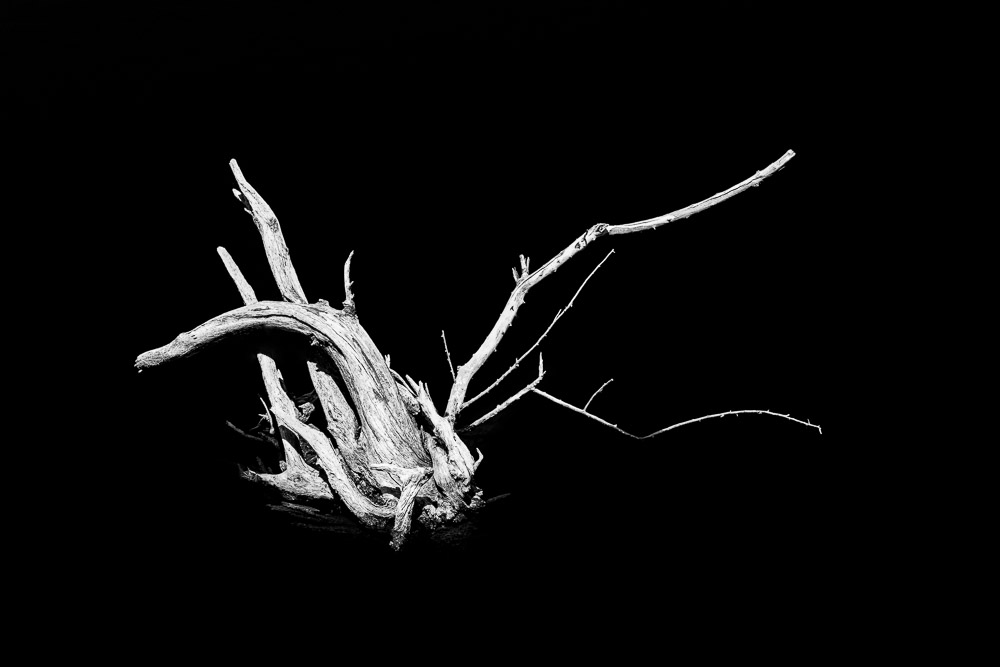
    I am delighted to admit that my main camera is a mirrorless 46MPix wonder. The image quality is remarkable. I will confess that in one part of my work I like super detailed, crunchy sharp images. But I also, more and more, find myself making extreme abstracts that are unrecognizable from the original capture. The technology enables this, because the images have such depth and fidelity to begin with that they can survive serious processing. Pushing the limits. The technology lets me do these things. It does not do any of them for me.

    I love the technology and I make use of it, but it is not digital art, it is just art.

    It’s not perfect

    Saying that digital is just a technology also admits that is is not perfect. It is so good that it has displaced film, but it is not ultimate truth. Someday it too will be displaced by something else.

    A digital image is simply an array of pixels. That means there are artifacts that become obvious at extreme magnification. The sensors are getting better all the time, but that is a built-in limitation of the technology.

    A digital sensor can only capture about 14 bits of dynamic range (+/- 2). This is 16,384 brightness steps for each color. It is amazing how good this looks, but it is far short of the capability of the human eye. And the sensor is linear while the eye response is logarithmic. Again, the eye had a significant advantage.

    Technically, current digital imaging products are the best photographic devices that have ever been made. Technically. That does not mean they produce better art.

    Ephemeral

    Another important consideration for digital imaging is that it is and has promoted an ephemeral view of images. Digital images have fed the huge social media, entertainment industry, online viewing trend. People have become used to glancing at images for about 1 second or less and moving on. This has tended to devalue most images. Especially if they are on a screen.

    I don’t believe this short attention span culture is healthy for the viewers or artists.

    But there is a still more insidious problem with digital images: they have no physical presence. Did you at some time end up with a shoe box of family pictures that brought important memories back? Did you discover and enjoy a drawer full of negatives and old prints at your parents? Those do not exist any more.

    Digital images only exist on your computer or in “the cloud”. E.g. once the computer dies or you stop paying for the cloud, they are gone. Totally. No record of their existence. A career of art, a lifetime of family memories can disappear in an instant.

    This is a dark side of digital imaging.

    Prints are even more important

    Because digital images are so ephemeral, I believe it is even more important now to make prints of important images. Prints have substance, weight, physical presence. They seem much more real than an image on the screen. And they are.

    A print is “permanent” – well, maybe 100 years for a good quality pigment print on professional paper. When you handle it it has weight and the image seems important. It is something that can be displayed proudly on your wall to view often and for others to see. It can be handed down to others later. A print is a real material thing, not just a bunch of bits.

    Some photographers say an image isn’t finished until it is printed. More and more I’m coming to agree with that view.

    Will it stick?

    So, will digital imaging stick around? Sure. It already has. It is really hard to find film any more. Even harder to get it processed. Digital has become so clearly superior to the alternatives that it has displaced them all. That is not to say it does not have faults. Everything does.

    But digital is just a technology. It will dominate until something better comes along. A technology does not make art. What an artist does with the medium is art. A super high tech digital camera is not a requirement to make art.

    I would much rather be remembered as an artist than as someone who was very proficient with digital technology.

  • Ansel Wasn’t an Oracle

    Ansel Wasn’t an Oracle

    Ansel Adams famously said that the negative is the score and the print the performance. Ansel was one of the great lights of 20th Century photography and his writings are generally very good. In this case, though, I think this famous quote has become a little outdated by technology changes.

    I love this quote and have been guided by it for a long time. As I began to understand it more deeply, it was empowering. For a long time my work was basically a documentary or reportage style. It was very literal photography of scenes in the natural world. I even for a time subscribed to the false doctrine that if an image was altered in any way it was no longer pure and virtuous.

    Ansel’s quote helped me understand that that had never been true and was not a worthy or even useful goal. At least for me. I truly believe that the negative (raw file now) is only a start. It usually must be perfected by the artist to become art rather than just a record of something.

    The darkroom process

    Let me talk a little about the darkroom process, as I understand it. This is so I can contrast it to the current workflow. I will confess that, although I built a darkroom in my basement, I only ever used it for a few black and white images. About that time I discovered a new program called “Photoshop”. 🙂

    The image captured on film is generally considered “read only”. It is never modified. There are exceptions to every rule, but this is by far the typical case.

    The extensive set of transformations and modifications that can be applied to the negative in the course of printing are done in “real time”. That is, it is a dance involving adding or holding back light from certain areas during the time the paper is exposed to light. It can also involve variations of development time or chemicals and even manual operations like bleaching or spotting of the print.

    Given this workflow, it is completely appropriate for Ansel to describe it as a score that will be performed by an artist. The outcome will vary somewhat with each performance, depending on the feelings and inspiration of the performer. Each print is a unique creative process.

    The digital workflow

    Fast forward now to the current generation of digital imaging. Digital imaging is wonderful in too many ways to list. I absolutely believe it is superior to film in almost all important respects. There is no reason for most artists to ever want to go back to film and chemicals. Your mileage may vary, but that is a personal artistic decision.

    One of the places where digital processing is most different is in the post processing to complete the image. The raw file (the “negative”) is processed in the computer using software like Photoshop.

    The software allows extensive, non-destructive manipulation of the image. The great dynamic range captured by modern sensors now gives us far more information to work with and more freedom to transform the image. It is easy to remove distracting elements, composite images together, and vastly change the tone and color profiles and even exposure.

    Ansel had to select a type of film to use prior to taking an image. He also had to use color filters to change the tonality of his black and white images. It was a guessing game based on lots of experience. He called it “pre-visualization”. Now we retain all the color information until processing time and we can convert to black and white via multiple types of software transforms and with extensive control over tonality. Much more subtle artistic decisions can be made. He would have loved it.

    Furthermore, these changes are built on the computer and recorded as a complete package. All the modifications can be done slowly and I can backtrack, undo things I don’t like, try alternatives, even easily create multiple versions of an image.

    The “performance” aspect of Ansel’s darkroom manipulation now becomes a considered, one-time transformation. All the artistic decisions are immediately seen on my nice color corrected monitor. I can study the effects at leisure and decide to change them. When I am done, I have virtually a finished image.

    The print

    It almost sounds like printing has been reduced to a minor step. Not so. It is still a complex artistic process. But again, the digital world gives many new options.

    Choice of paper is a big deal. It controls a major part of the look of the resulting image. A glossy Baryta has a very different look from a matte watercolor paper. Paper with varying textures and base color can be selected.

    This is assuming you are printing yourself. I recommend it. It is a joy and it connects you with the final product. But many other options are available. You can have your image rendered on canvas, metal substrates, acrylic, transparencies, cloth – too many to list. All vary the look and potential use of the final image.

    But the thing that is ultimately the most different from film days is that the artistic result has been determined prior to hitting Print or sending the file to the producer. Each time you print the image, the results should be so repeatable as to be indistinguishable. As Alain Briot said, somewhat tongue-in-cheek I think, this is one of the problems with printers: they do not need our help in any way while they do what they do.

    So, in a way, a print is like a good illusion. The magic happens before we ever see the print appear. This is a huge contrast to the film days where creating a print required a virtuoso performance in the darkroom.

    Was Ansel right?

    I believe Ansel was completely right and very insightful when he wrote this famous quote. Like with many things, though, time and technology changes. Since he was describing a particular technological process, it is not surprising that it will change.

    The real genius of the quote, and the reason I believe it is still useful, is to point out that the captured image is only the starting place. I am free to apply my vision to complete the image. Without that injection of originality, it is too easy for it to just be a snapshot.

    How that is done is not that big of a deal. Art is a physical product and expressed via currently available technology. The technology should not determine an artist’s vision. Make it your own.

    The quote was an observation by a great and experienced artist. It did not come down from heaven written on stone. Don’t be limited by changes of process or technology. Understand that it frees you to create!

  • What is DPI?

    What is DPI?

    DPI is simply an acronym for “dots per inch”. It should be a simple concept, but people sometimes get twisted up in knots over it. Our printer manufacturers have not helped the situation.

    What are “dots”?

    Unless you are reading a printer spec sheet, dots just mean pixels. A pixel is a “picture element” – the smallest piece of a digital image. By convention, a pixel is a triplet of red, green and blue values. That sounds very technical, but it just means they are 3 values carried around together, say something like 95, 134, 47. By convention each value can have a range of 0 to 255. That is not representative of what camera sensors really do anymore, it is the convention. The convention comes from the 8 bit representation of color values way back in early times. The maximum value 8 bits of binary data can represent is 255. The practice has been established and perpetuated by Photoshop over the years. The actual data range we use is a subject for another post.

    The image that gets stored in your computer is a grid of pixels. The camera I am using most often right new creates an image that is 8256 x 5504 pixels. That makes a lot of data!

    A fuzzy quality metric

    Your camera does not know the concept of DPI. As a matter of fact, DPI is a fairly useless term unless you are printing an image.

    Have you ever had someone tell you they need a file that is 8×10 inches at 300 DPI? Unless you are sending the file to whoever does your photo printing, it really means they do not understand what they need.

    At best DPI is a metric for the quality of an image viewed or printed at a certain size. The more pixels you have in a given distance, the better the image should look, in general.

    But in most people do not even know the pixel resolution of their screen or printer. If you save a file in jpg format there is a good chance the default is 72 DPI. This was considered the “normal” screen resolution – way back. The main monitor I use is 219 DPI. And it is several years old. And I don’t really care, because that is a number that is never important to me. I never use it for anything.

    DPI really doesn’t matter for the screen

    One of the reasons DPI doesn’t mean much for most of us is that our computers scale images for viewing on our screen. And they usually do a really good job. But what most apps do is map the pixels available to the pixels of the screen. So if you look at a file that says it is 10″x10″ at 72 DPI, you will see a 720×720 pixel image. It will be however large 720 pixels measures on your screen.

    When you view an image on your screen all that really matters is the resolution. The DPI number is generally ignored.

    Size matters

    If DPI is not as important as many people think, then is resolution unimportant? No. Absolutely not. The number of pixels you have to work with is always an ultimate limitation of what you can do with the file. As is said in many things, size matters.

    With plenty of pixels imaged through good glass you have the flexibility to print large, or to crop tightly or to create images of astounding detail. Also, massive numbers of pixels gives sharper edges and smoother gradients.

    DPI for printers is a whole different thing

    The major printer manufacturers have confused the issue for us. A printer ad may proudly proclaim it does 4800 DPI! This is technically correct, but not helpful. They are talking about the density of ink drops they can lay down on the substrate (paper). But printers do not print pixels.

    A drop of print ink is not a pixel. You do not send the printer an image scaled to 4800 DPI!

    A printer takes the pixels available in a given area and transforms them to densities of the subtractive colors needed to come close to reproducing the colors and gradations contained in the original pixels. This is a complex technology and I will not attempt to explain it here. Sufficient that you remember a drop of ink is not a pixel.

    Where DPI means something

    When you know how large of a print you wish to make then DPI becomes meaningful. The number of pixels available combined with the desired print size give us the DPI. DPI is a measure of the amount of information available for an inch of print.

    For optimum printing the guideline is supplying a source file of around 250-360 DPI. This gives the printer driver enough information to do the ink transform we talked about above.

    My Canon printer, for instance, has a “standard” resolution of 300 DPI. It can print well with a range of values, but this is considered optimal. This means that one of my image files of 8256 x 5504 pixels could be used to print an image of 27.5″ x 18.35″ with no scaling or loss of resolution. That is the size of this image at 300 DPI.

    If I want to print one of my images at a more typical size, say 18″x12″ I could scale a copy of my master file down to 300 DPI. Or not, because Photoshop or Lightroom is perfectly capable of scaling it down when printing with little discernible degradation. One person even says that higher DPI gives better results.

    If I have an image with insufficient pixels I could just try to print it. Printer drivers do amazing things. Or I could scale it up in Photoshop, which also does an excellent job within limits.

    It’s those limits that you have to be able to estimate. If you have a 2 MPixel image and you want to print it poster size, well, your results probably will not meet your expectation. No free lunch.

    Conclusion

    So what about DPI? Don’t sweat it unless you are printing. Only if printing is it a meaningful metric. And it is only meaningful when you are taking about a particular image printed at a particular size.

    There are plenty of technical issues to stress out about. This should not be one of them, unless you are producing high quality prints.

  • Night Photography

    Night Photography

    Most people put away their cameras when the sun goes down. But night photography can be a wonderland of visual interest. It does require some new disciplines and knowledge, though. It’s a different world at night.

    What’s to know? My camera has excellent exposure metering. I just point it at the subject and take a picture. Right?

    Well, your mileage may vary. If you are taking pictures with your phone or taking jpg images, you will get pretty good results sometimes. That is because the jpg processor is making many creative decisions for you to try to render an image it thinks you wanted. If it guessed right it might do an OK job.

    With night photography, more than many other types of image making, you really need to be the decision maker in charge of your images. Your intent determines how you approach each scene. The type of subject, the type of light available, whether or not movement is desired, the mood desired, weather conditions, etc. all factor in to the strategy. And most of these factors are interrelated.

    Type of image

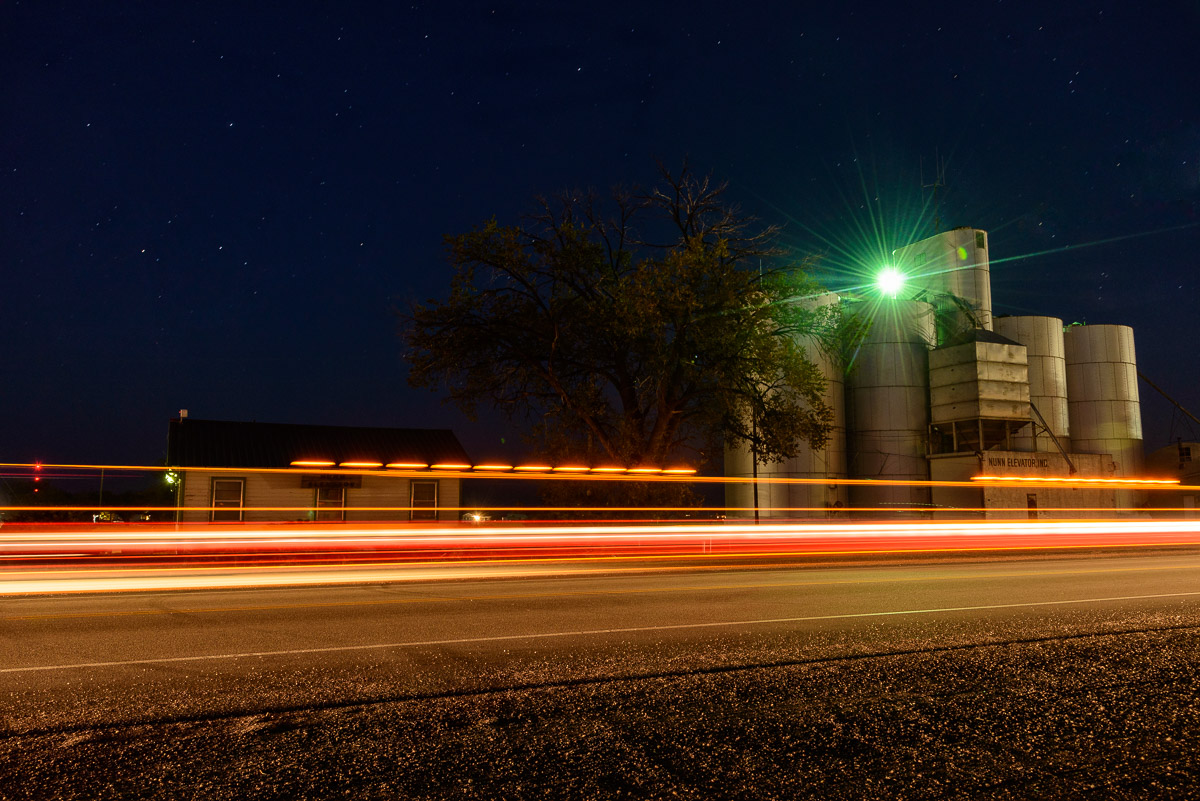
    A portrait at night will (probably) require a well lit subject. This may involve external lights and/or reflectors. A star field scene, on the other hand, may have just a vague or silhouetted foreground. No lights, but you need to know good techniques for capturing the stars as crisp points. A cityscape at night may require very long exposures to streak car lights.

    Movement

    A big decision is if movement is desired or not. Some possibilities: a street scene with everything crisp and frozen, a street scene with car lights and people streaked, a star field with crisp points of light, a long exposure star field with obvious streaks from rotation of the sky, a portrait with a crisp subject but blurred background motion. Each of these requires a different exposure approach and different planning and preparation.

    Motion is often one of the signature characteristics that distinguish night images. It is something you completely control by your exposure settings.

    Mood of image

    The time of day, the subject matter, and your desired treatment establish the mood of an image. Time of day? We’re talking about night. Well, “night” starts at different times. There is sunset, twilight, dusk, blue hour, and full darkness. I don’t have space here to discuss each one, but I love all of them and enjoy making images in each. Probably blue hour and full dark are my favorites, except I can seldom resist a beautiful sunset.

    Blue hour probably deserves some discussion. This is the time after the sun is completely gone and the orange glow is gone from the sky. The sky is a rich, dark blue and still light enough to set off a foreground like city lights. It is a beautiful time of day. Blue hour is perfect for some city skylines and for some landscapes.

    Full dark is required if you want to see the stars. It is probably necessary if you want long exposures like smoothly streaked car lights.

    But all of this is modulated by the desired result. Do you want dark and gritty or more cheerful and upbeat? Is it a realistic image of architecture or an abstract?

    Full manual control

    You will usually need to override the auto exposure of your camera. The poor exposure system with fail miserably trying to determine what you want if you point it at an almost totally black sky. So a camera with full manual control is required. You will need to determine and set the ISO, aperture, and shutter speed yourself.

    This is not as bad as it seems. You will learn some guidelines for initial settings for the scenes you most commonly shoot. And with digital, it doesn’t cost much to shoot some test shots. Since you can get immediate feedback you will quickly zero in on the correct settings.

    Technology and technique

    Night photography is an extension of normal daylight photography. Some new techniques must be learned. They are specialized, but most are pretty straightforward.

    Night photography generally implies longer exposures. This implies keeping the camera rigidly positioned. Therefore a good tripod is almost a necessity. And a shutter release to minimize camera shake when you press the release button. And if your camera is an SLR with a mirror, you need to know how to lock the mirror up to eliminate shutter slap motion.

    Let me emphasize again, a good tripod is necessary. Don’t scrimp on this. Get the best you can afford and use it all the time. I generally use Really Right Stuff tripods and heads (I get no compensation for this), but I know that Gitso is also very good. There are many good tripod manufacturers, I just don’t have first hand experience to allow me to recommend others.

    Unless you are going for really long exposures, you will often need to use a high ISO at night. Many modern digital cameras have excellent high ISO performance. If you go back to film days or early digital cameras, you probably think of ISO 800 as a really fast and grainy setting. Not anymore. On the Nikon Z7 I use now, noise is hardly detectable at 3200!

    Another example of a specialized night photography technique is the “rule of 500”. Like all photography “rules” it is a guideline. It can be a helpful starting point for setting up a night sky shot. For a full frame camera, set the ISO to 3200 and the shutter speed to 500 / [focal length] seconds. So using a 24mm lens, that is 500/24 or approximately 20 seconds. This is a great guideline to memorize for when you are out in a really dark place at night trying to get the night sky exposure tweaked in.

    Noise

    Noise during the image capture is a potential problem unique to digital sensors. At least we do not have to try to estimate reciprocity failure as we did with film. Noise in electronics is a function of temperature. Long exposures power the sensor much longer than usual, which can heat it up and increase noise (it looks kind of like grain).

    Most camera manufacturers provide a setting to have the camera take a dark frame immediately following an exposure. This gives a noise sample which is automatically subtracted form the image you just took. This does a pretty good job of compensating for the sensor noise. Sometimes you will want to use it and sometime not. I usually do not, because it is often cold when I am out, which minimizes noise. The main cost of the noise cancelling is doubling the exposure time. If you set a 20 seconds exposure it will immediately follow it with a 20 second noise sample.

    Post processing

    Post processing is almost always required, in night images or any others. It is common to want to reduce luminance and/or color noise, to make the blacks deep and full, to sharpen, and, for some scenes, increase saturation or contrast.

    I mention it here, not because night photography necessarily needs it more, but to emphasize that you need to shoot RAW and always post process.

    After the sun goes down

    A whole new world opens up when the sun goes down. Don’t put your camera away as soon as sunset fades! Get out and experiment. Try some different things. You don’t have to go to Moab and shoot grand night sky shots of the Milky Way with arches in the foreground. Experiment in your city. Learn to be confident manually setting exposures. Practice until you regularly get the results you want.

    Try it! Don’t worry about failing. It can be fun and instructive! I ended up loving some of my failures.