An artists journey

Category: Psychology

  • Intimate Landscapes

    Intimate Landscapes

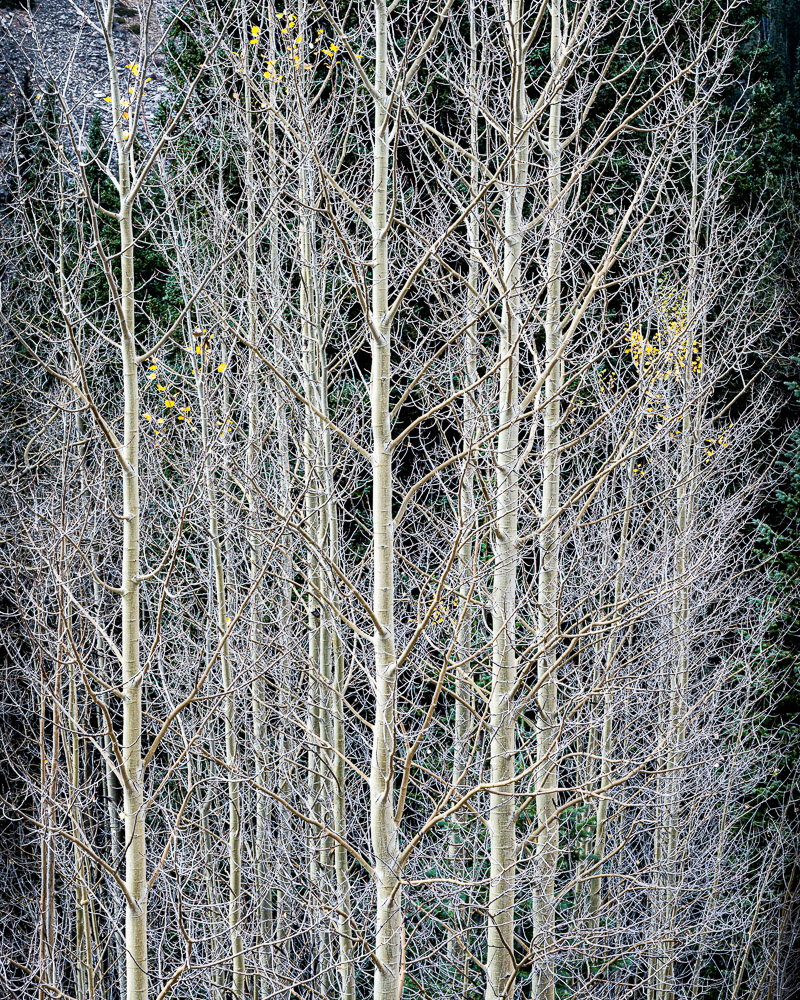
    The term Intimate Landscape was coined by Eliot Porter. It was the title of the first one-person color photography show at The Metropolitan Museum of Art, New York, back in 1979. By convention it refers to isolating one small part of a scene rather than the entire vista. Even though it is called “Intimate Landscape” the technique can be used for almost any type of subject.

    Details rather than sweeping whole

    Landscapes can generally be approached at 3 levels: whole scene, micro/macro view of extreme details, and “in between”. This “in between” area is what we will be discussing. Some consider it the Goldilocks region – not too big, not too small.

    It is easy to pull up to a beautiful, vast landscape view and immediately want to pull out your widest angle lens and capture the whole sweeping scene. That’s great. It will probably be a beautiful image. I’m not suggesting there is anything wrong with that. But unless there is something really magical going on, it tends to look like every other visitor’s picture of the same place.

    I am also going to ignore the macro end of the spectrum for now. This is the domain of the crazies with specialized gear and their own language, who will set up a strange looking rig with focus stages, wind blocks, multiple flashes, and run a 200 image focus stack set. You know who you are 🙂 – I’ve been there too.

    To me the distinguishing characteristic of intimate landscapes is the focus on details rather than the whole.

    Describe the whole by a part

    In formal logic intimate landscapes are related to the process of inductive reasoning. That’s just for free, there is no real reason you need to memorize that. Inductive reasoning is making broad generalizations from specific observations. In logic this can be dangerous – Harold is a grandfather; Harold is bald; therefore all grandfathers are bald. This is a non-sequitur. The conclusion does not follow from the facts.

    But we are not talking about formal logic, we are discussing art. Art is what we feel and perceive. Using parts to give insight on the whole is a valid and very useful technique.

    For instance, let’s say I am looking at a beautiful mountain scene in Colorado, because I hang out there a lot. If I shoot the whole scene it may be very beautiful, but it is a very specific location. You may have been there and seen the same thing. You expect to be able to go to a map and pinpoint the exact spot and be able to go there and see it.

    But what are the features and details I am drawn to? I find that when I focus on these details it helps me to interpret the whole. The details become much more general. They are views of things we all have seen and relate to rather than just a particular place. They are vignettes, glimpses into the grand scene. The detailed scenes represent the concept or essence of the place without pinning it down to a specific location. To me this is more powerful and easier for us to relate to. The part really can represent the whole.

    Telephoto eyes

    Jay Maisel was the first I can remember to express the concept of having “telephoto eyes”. He is not the only one. What he is saying is that he has a natural tendency to zoom in on details in a scene. I discovered that this is my natural inclination, too.

    For many years I shot almost exclusively with a moderate telephoto lens. Recently I have made myself use a wider angle much of the time. This is more to train myself to be able to see other options than because I switched my perspective. And because the Nikon Z 24-70 f/2.8 I am using is a really sweet lens.

    But my instinct to to isolate details. It is the way I perceive scenes. I have to interpret it by deconstructing it into component parts. It requires some patience. To look beneath the obvious beauty of the whole and find the parts that make it up. To me, the parts represent and describe the essence of the scene. And they transcend a particular location and bring out what is interesting about places like this.

    An intimate scene, to me, focuses our attention on nuggets of significance. Guy Tal has a book entitled “More Than a Rock“. He describes that a picture of a scene can take on significance greater than the obvious object. That is the way I feel about intimate landscapes. If I isolate a cascade in a larger scene, it can become more than just a particular place. It says something about mountain cascades in general.

    Opportunity for interpretation

    This generalization process is very attractive to me. I can stop just making pretty pictures of particular places. Now I can respond to the parts individually and emotionally. I can interpret the details in their own right. It is my reaction to and view of cascades or trees or rocks, regardless of the specific location. They take on a life and meaning of their own.

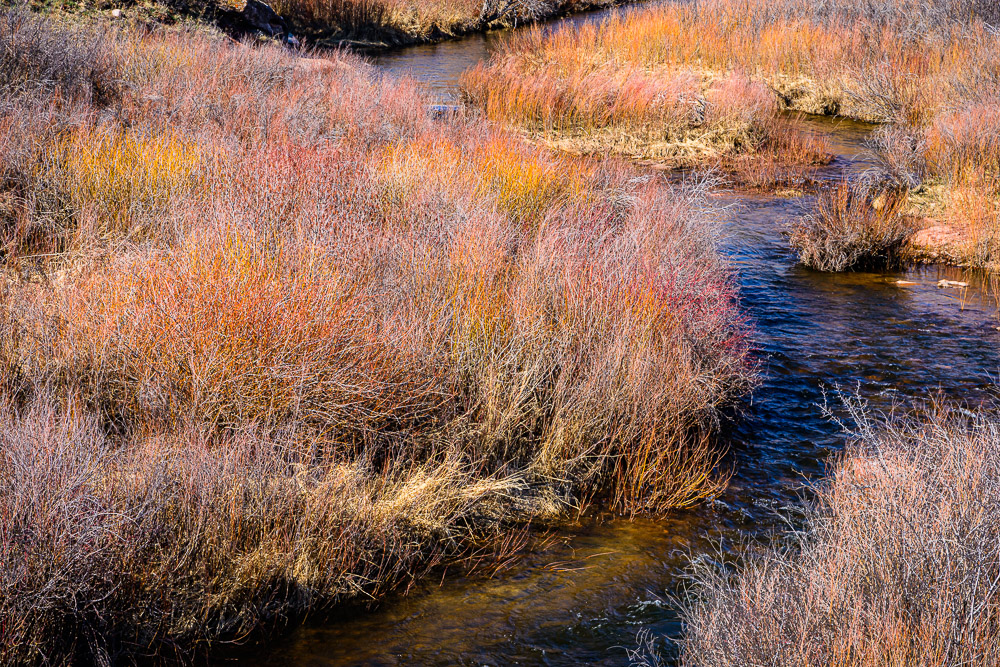
    The process involves deliberately paring away everything that is not adding to my interpretation of a particular detail. The details become independent of any certain location. Without the context of the whole scene they represent the things that catch my attention and that I want to share with viewers. For example, the image in this article of a brook meandering through willow bushes is very representative of many typical locations in the part of the world I hang out in a lot. It is very characteristic of the area, not of the specific location.

    So for me, I view it as a process of breaking a wide scene down to the individual components that make it interesting to me, interpreting the parts, and from that coming to a greater appreciation of the whole scene. I don’t claim this is a conscious process I do methodically or deliberately for every scene. I’m just thinking through how I seem to react to views and trying to understand why.

    We all should seek to understand what we do and why. Even if we are not entirely successful we might learn something about ourselves.

    Intimate landscape

    Maybe it’s quirky and peculiar. Maybe me and Jay Maisel and Eliott Porter and Guy Tal and a few thousand other photographers are the exception. I tend to see the world in details, in bits and pieces. These details come together for me to paint a picture of the whole.

    Sometimes the whole scene is necessary. But more often I find the details help me take it apart and decide what is important to me.

    Anyway, that’s the way I perceive things. I’m glad for the concept of intimate landscapes. It makes me feel a little sane. If you approach the world differently, that is fine, as long as it works for you.

  • Experimenting

    Experimenting

    I can’t speak for your goals or interests or learning style, but I know that my creativity is enhanced by actively experimenting some of the time. It is a conscious decision to try something completely different than what I normally do.

    Break the rules

    If you have read this blog much you have picked up on a love-hate relationship to photographic rules. Rules have a place but also a time when they should be abandoned.

    Learn, study, internalize the normal rules of composition. Get excellent at the techniques necessary to create well executed images. These things prevent you from embarrassing yourself by releasing well meaning garbage to your viewers.

    Sorry to be so blunt, but not bothering to learn the accepted conventions established over the years for good images is just arrogance and immaturity. Learn the conventions and follow them until they are deeply ingrained in your subconscious. Follow them until they become uncomfortable. and confining You will eventually understand when that is.

    Breakout

    At some point you will find yourself saying “yes, but…”. Then the rules are no longer enough for where you are creatively. They are restraining you to do the same kinds of images everyone else is doing. Something inside is compelling you to do it differently.

    It is very important then to realize you have permission to change your norm. You don’t have to ask anyone or apply to some authority for permission to do this. Just follow where your now trained instincts lead you.

    Now you will begin a period of experimentation and uncertainty. The old foundations you trusted are beginning to crumble. Will you trust your instincts to carry you to a new place?

    To be honest, you will probably start doing a lot of bad work. At least, work that is very different from your norm but far short of the vision you have for where you want to go. That’s OK. Push through it. Keep on trying and modifying until you get closer.

    At this point you probably better be content to get criticism. The people who enjoyed your old work will not be happy and you haven’t really gotten to a stage where you could develop a new audience to support you. Honestly, if you have to support yourself from your art you may have to continue doing the old style work and confine this experimentation to personal projects and off times alone. For a while.

    But you have to really ask yourself why you are changing and experimenting. Isn’t it because your vision is changing and you are no longer content with what you used to do? You will need to decide at some point if you want to be true to your vision or keep in the safe zone of doing what worked in the past.

    Do things that can’t possibly work

    Let me challenge you to regularly set aside time to experiment with wild ideas. Come up with crazy ideas that can’t possibly work – and try them. Can’t work might just mean no one has tried it like you are approaching it. Or it really can’t work. Either way you learn something.

    History is full of failed experiments that led to whole new ways of doing things or looking at problems. Did you know that Post-It Notes came from a failed adhesive experiment? What would anyone want with an adhesive that didn’t stick? Until somebody needed a bookmark that didn’t fall out of the book. They got together and things sparked.

    And those things you are trying that don’t seem useful? You are building a catalog of possibilities. A base of knowledge and ideas that will find surprising applications in the future. And you are accepting that not every image has to be “successful” in the conventional sense. Success in expanding your vision and your abilities may be more important long term.

    A special snowflake

    Please pardon the cynicism, but everybody is told they are unique snowflakes and many of us believe it. But do you act it? Or do you spend your energy trying to make the same pictures everyone else does.?

    Most photography tutorials are “how to create the same image I made”. Most workshops take students to locations where they can take the same iconic images everyone else does. Aren’t most online comments praise for safe, conventional images that are just like the norm?

    Everybody has the possibility of being truly unique, but you have to develop that uniqueness. You have to reach deep inside and bring a vision that is truly you. You have to be able to express that vision is a tangible way that others can see.

    Experimenting with ideas you have never seen before is one good exercise for that.

    And now for something completely different…

    All right, so I’m old enough to have been a Monty Python fan.

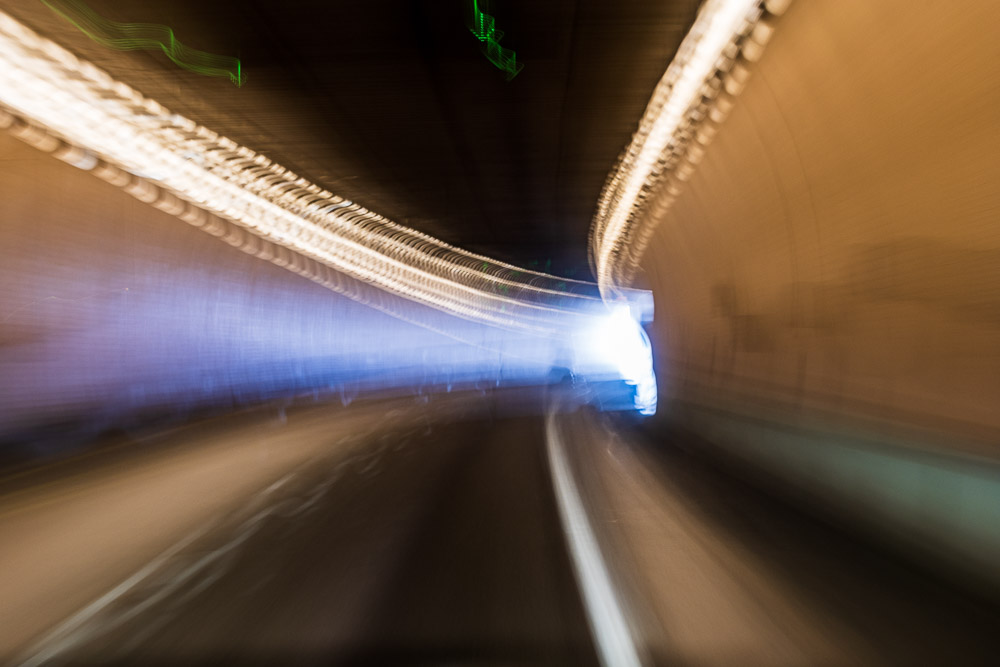
    I have preached the faith of experimenting but I haven’t shared any examples I have done. The image with this blog post is a deliberate experiment I did recently that violates virtually all rules I know of. It is long exposure, hand held, taken from a moving vehicle. There is nothing sharp in the entire image. It doesn’t fit normal composition rules. I certify that this is a single original frame with no double exposure or compositing.

    What has it got, in my opinion? Intrigue, interest, great flow, visual interest, ambiguity, questions, a staying power that makes me want to put is on the wall and look at it for a long time. Those things give me joy. And hope. I’m very glad I experimented.

    It keeps you fresh

    Training yourself to have a habit of experimentation will help keep you fresh. Always ask “what if?”. You lose the fear of trying something new and maybe failing. You gain the benefit of letting your vision expand and bloom in new ways.

    Do you look at your work and see the same subjects, the same treatment, the same composition over and over? Experimenting and taking on “strange” personal projects outside your norm and with no intent of commercial success will keep you from getting stagnant. You need it to keep your creative energy flowing.

    And when your experiments lead to results you are proud of, be confident to incorporate the technique into your mainstream work. You are a dynamic, living being who changes with time. Your work should reflect that. Don’t be afraid.

  • Seeing Better

    Seeing Better

    Beginning a new year might be a good time to think about seeing better. Many of us have been mostly looking at the interior walls of our homes for a long time. If anything, this leads us to see worse. Seeing better is not just our visual acuity, I refer to our ability to perceive, to notice, to be aware of what is around us.

    Acuity

    When we think of seeing better we naturally think about the sharpness of our vision. Technically, this is called acuity. When we go to the optometrist and read the letters on the wall we will hear some number pair, like, say 20/30. This means we can see at 20 feet what most people can see at 30 feet. We would like, of course, to hear that we have 20/20 (normal) or even 20/10 (extra sharp) vision.

    The doctor will be glad to prescribe corrective lenses or contacts to bring our acuity up to par. There are also other visual conditions like glaucoma or astigmatism that need attention. It is good to visit a vision specialist regularly.

    The ability to see well is very important, as an artist and a viewer and to lead a rewarding life. My art is a visual medium. If I cannot see to make it or appreciate it I am greatly handicapped.

    Perception

    But it is not simply a matter of getting good glasses. Most people see, but don’t see. That is, they are able to image the world around them very well, but they do not think about or perceive what they see. This is head skill, not a visual ability.

    I hope I am being too critical. I hope you do not have this problem and you really pay attention to the world around you. If you are a regular reader of this blog perhaps this is so. What I observe of the people around me tells me I am not wrong, though.

    Put away your phone for a few minutes – I’ve tried it; a few minutes without it is not fatal – observe people around you. Are they glued to their mobile device? Are they in a daze, oblivious to what is around them? How many people do you see with their heads swiveling, really observing the people and sights around them? What about you?

    Before you can perceive, you have to see. Seeing is not perceiving, but it is a necessary step. To actually see you have to detach from the attention grabbing time wasters that have mastery of us. When we get to the point of taking the time to intentionally see, we can start to learn to perceive.

    Perceiving is an attitude. It is a skill we develop with time and discipline.

    Observation skills

    Have you watched a good Sherlock Holmes? I recommend the most recent series with Benedict Cumberbatch and Martin Freeman. IMHO it is the best version ever done.

    Anyway, what sets Holmes apart from other people, other than being a self-described “high functioning sociopath”? It is his observation skill. He can take a quick glance at someone and describe their story in detail. He picks up on the clues and tiny details that everyone else overlooks.

    Sherlock Holmes is, of course, a fictional character. But he serves to show a contrast to the way most of us go through the world. Most of us do not take the time and effort to look closely and really see things. To pick up on the details, the story.

    A large part of perception is attitude and training. It is a mental skill. I believe any of us can learn to perceive more of the world around us if we work at it. It takes conscious effort and awareness. Some people are more naturally attuned to it than others, but it is not impossible for anyone.

    See from inside

    Unless you just want to take “pretty pictures”, you cannot make a very interesting image unless you have something to say. I’m not dismissing beauty, I’m just saying even a beautiful scene doesn’t have much staying power unless we can see through the artist’s eyes. Unless he can make us see what he felt about it.

    We have to find something inside of us to connect to so we can interpret it and express our feelings to the viewer. To connect to something, we have to truly see the subject. Not just forming the image on our retina but really taking it in and letting it affect us. This is perception. Jonathan Swift said “Vision is the art of seeing what is invisible to others”. It may be lonely and nobody else may “get it”, but an artist is compelled to share his vision.

    Good or bad, beautiful or ugly, grand or tiny, we have to be able to have an emotional reaction to the subject to give our reaction to the viewer. Any worthwhile image is not just a record of what was there. It is our interpretation of it. You can’t really interpret unless you have taken it in, processed it, examined it, contemplated it, thought about it. All enough to be able to give it meaning.

    I’m not saying you have to develop a deep relationship with the subject, or write an essay about your feelings, or spend weeks visiting it. Any of these things might help, but none are necessary. An artist should build a broad base of experience and interests. That allows a quicker perception and reaction to encountered subjects.

    I find some excellent images driving down the road. It is probably something I can react to quickly because I have thought about the type of subject a lot. Also, I give myself permission to stop and get out and examine it. To set up and frame it give my best interpretation of it. Do you ever stop when you are driving and just look at things?

    Beethoven

    Beethoven? I mention him because he is an inspiration and example to me. Toward the end of his life he became deaf, yet he created what some consider his greatest masterpiece, the Ninth Symphony. He never heard a note of it, except in his mind. What he was able to perceive in the silence of his mind was greater than what anyone else could hear.

    That, to me, is true perception. He could hear without hearing. We should learn to see without seeing. It is in our minds, our experiences, our feelings. We can create experience at a deeper level than just pixels. But first, we have to be able to operate on that deeper level. That takes time and self-discipline. We have to train ourselves to perceive.

    Seeing better is a responsibility of the artist. If we do not perceive and feel, how can we bring something meaningful to our viewers? They want more than just a record of something. We have to see better so we can bring more to them.

  • Whose Art?

    Whose Art?

    Who do you make your art for? No, really. It’s a serious question. A recent post discussed Finding Beauty. I think it is important to follow that by asking who determines the beauty and worth of our art. Whose art are we making? Who for?

    For the whole world

    If you are making your art for everyone, time to rethink your plan. Not everybody is going to like what you make. Sorry, that is the truth. And if your “style” is determined by what gets likes on Instagram or Facebook you are just chasing popularity.

    You have your own style and you should stick to it. You may not recognize your style or know how to express it yet, but you do have one if you are authentically trying to express your values.

    I don’t care much for a lot of images I see. I won’t say they are not art, just that they do not appeal to me. My style and values are different. The same with you. What you make will resonate with some people and not with others. Even if you become very popular I guarantee not everybody will love them. Accept that. Not everyone gets a ribbon for participating.

    Be honest and do the work that appeals to you. Be genuine. If you spend your time trying to make images that “everybody” likes, you are chasing a false and impossible goal. You are not doing your own work.

    It is better to be hated for what you are than to be loved for what you are not. – Andre Gide

    Why did you shoot that?

    Why will I/did I shoot it? That is a question we all should consider and answer every time we take a picture. If it has meaning for us on a personal level it is probably worth taking the time to capture it and process it. If it is to duplicate something that got a lot of Facebook likes, forget it.

    You have probably figured out I like to use quotes to reinforce ideas. And to let you know that greater minds than mine have expressed some of the same ideas before. Here are 2:

    If you shoot for the love of it, you know why you shot it. Jay Maisel

    There is no way to know what others want as well as we know what we want, so trying to please them instead of ourselves is a mistake.David Vestal

    As usual, I am only talking about the realm loosely called “fine art”. I wish we had a better term. In order to create our own art, we first and foremost have to please ourselves. If this image doesn’t blow us away, why waste time on it? Whose art is it? It has to be our own. If we get to where we can make images that make us very happy we will find a core of other people who share the same viewpoint.

    Your style

    Is it your style? Are you developing a style? Is your style acceptable to your peers? How do you know your style?

    These questions can cause a lot of angst for artists. I say stop worrying about it. Your style is a result of who you are, not a skill you develop or an affectation you present.

    Someone said to go through your portfolio and pick out your 20 best images. Lay them all out and examine them. This defines your style right now. This is what appeals to you and how you make your images. It will show the types of subjects you prefer, the lighting you like, the composition you tend to use, how you like to post process them, etc. This is you. You are not what someone else wants you to be.

    Can a style be consciously changed? Yes, some people are able to do it. I’m thinking of Picasso as he went through several distinct periods. Or Joel Grimes who has redefined his signature look at least a couple of times. This is unusual. But even for the rest of us, our style evolves with time. We change and adapt as we mature and get more knowledge and experience. I know that the images I make now are very different from the ones I made a few years ago.

    The point is, we each have a style and it comes from within. Don’t worry about what is in vogue today or what you see on social media. Be you.

    What critic do you listen to?

    But I posted an image I liked on Instagram and it didn’t get many likes. Or the judges in my camera club competition told me my treatment of the subject was not going to win any awards. Or a gallery I applied to rejected me because my images did not fit their needs.

    There are critics all around. That doesn’t mean they should dictate our values. To paraphrase the famous George Bernard Shaw quote “those who can, do; those who can’t, become critics”. It is a lot easier and safer to criticize from the sidelines than to be in the battle trying to do something no one else does.

    No critic can define your values, your vision, your art. If you have done your job well so that your image is technically correct as far as you want and composed the way you want and pleasing to you then it is nobody else’s business to tell you it should be different. They will try, but don’t listen to them. Maybe they are an artist, too, and have some good suggestions. Fine. Listen to them, but take it in and process it through your own values and style. Keep what feels right to you and discard the rest. No one is qualified to tell you what you have to do artistically. Notice in my description above what kept coming through was “the way you want”.

    Your inner critic

    If you’re not your own severest critic, you are your own worst enemy. – Jay Maisel

    The great Jay Maisel is right. You have to decide what is right for you. Only you can truly criticize your work. You owe it to yourself to be hard on yourself. Be brutally honest. Throw away most of what you do.

    You might feel that you need to get a lot of images to fill out a portfolio. No. You need some great images for your portfolio. If 5 is what you have then that is what is in your portfolio. Anything that is not a stand-on-its-own, awesome image you would be proud to show to anyone detracts from the collection. Weed out everything that does not show your best work

    Let me give an example. I recently went on a car trip. I allowed plenty of time for slow travel with side trips and stops for pictures whenever I wanted. This is how I like to travel. I shot over 300 images during the trip. My editing workflow is a multi-stage culling process for selecting images. Just in the first stage I eliminated all but about 45 to be further considered and processed. I am still in process, but I expect that maybe 4-6 will make it into my final select group.

    That seems fairly severe. Less than 2% of the images I shot will make it. But actually it is probably not severe enough. Realistically 2-3 of these would actually add value to my portfolio. I’m still in love with some that should be cut. That hurts. But I have really come to understand that a single weak image can bring down the level of an entire portfolio.

    The only critic

    So the only critic you should listen closely to is yourself. Only you are fully qualified to judge your work. Look at a lot of images from a variety of artists with different styles and interests. Get feedback from other people. Take what you can learn from everyone but stay true to your own vision.

    Whose art are you trying to make? I hope it is your own. Then you have earned the right to be very proud of your art.

  • Indoor Time

    Indoor Time

    During the times when going out to shoot is difficult or impossible, you can still use your indoor time to develop your creativity and refine some critical skills for your photography practice. Just being indoors should not mean we are shut down. We can claim this indoor time as a opportunity to build ourselves up.

    Forced indoor time

    A reality today is than many are locked indoors with few opportunities to get outside. What are you doing with this new found time? When this virus started nearly a year ago I bet most of us had all kinds of upbeat plans for self-improvement activities. We could make a significant dent on our reading list, learn a new language, catch up on years of photo filing, use that rusting exercise bike, etc. How’s that working out for you?

    After we got bored and depression set in we have probably gained a few pounds, played too many hours of video games, and binged on Amazon Prime. Time to make a New Year resolution to take back control of our attitude and refocus on our art.

    It’s not too late. The opportunities are still there. Get off the couch and start working that list again. Remember your earlier resolve. Just because you’re indoors doesn’t mean you brain is shut off.

    Bad weather

    Weather is another factor that shuts some of us indoors. I live in Colorado. Winters here can get rather cold and snowy. But that is cyclic. It happens every year. I plan it into my week. I may get out and walk less, but I get out. Maybe I don’t travel as much, but I still do some.

    A reality for me is that bad weather creates opportunity for some of the types of images I really like. Things on the edge or extreme: the edge of a storm, a raging blizzard, ominous clouds. These are things most sane people do not go out to see. I do. What does that say?

    It’s cold at times, but I can dress for it. There might be some pain, but that is life. If a certain amount of pain is a cost of getting images that please me. I’m willing. And I find that when I come back in, with my fingers aching and my beard covered over with ice, I am happy. I am proud that I made myself do it. I feel better about myself and invigorated. There is the satisfaction that I went out and tried instead of sitting at home telling myself the weather was too bad to get out.

    Let me disclaim that I have many years of experience doing this, I get pretty good clothes for the climate, I have a good 4 wheel drive, and I carry proper emergency equipment. Don’t jump off a cliff without looking.

    Seek ideas

    OK, you’re stuck inside. How can you pursue your art? Maybe you can’t be making your images right now, but you can be getting ready to hit it strong when you can. Browse other artist’s sites. (Sorry, blatant plug.) Be amazed at their work and gather inspiration to weave into your style. Not to copy but to motivate new ideas.

    Look, too, for interviews and discussions with artists. These are more prevalent these days because so many of us are feeling very isolated. Artists, among others, are are starting to reach out more to build community. Some are inspiring and motivating.

    Seriously consider online training, like KelbyOne or Creative Live. It costs a few bucks, but really, less than a Netflix subscription. And they are more valuable to your career. Or there are many sources of free videos, such as B&H Explora. The Learn Photography section has an amazing amount of material. Their series on Understanding Exposure is very good.

    And of course You Tube has more photography videos than you could watch in a lifetime. For free. There are valuable ones if you can find them. Your mileage may vary.

    Focus on skill building

    A specific suggestion is to focus on improving your post processing skills during this time. Most of us could use more depth in Lightroom or Photoshop or your tool of choice. This is a great opportunity.

    “For photographers, Adobe Photoshop is still the gold standard of editing applications, and the one to which all others are compared. And even if you’re not a Photoshop user, its omnipresence almost acts like the foundation of a communal language from which to talk about editing photos in general.” – Bjorn Petersen

    Yes, love them or hate them, Lightroom and Photoshop are the basis of a shared cultural experience for photographers worldwide. It is useful to know whether or not you use it.

    The sources I mention above have a lot of good training for this. And you have extra time now for practice and experimentation. That is a great benefit. This new information should be used to build competence. A lot of repetition is necessary before they are ready to be incorporated into your workflow.

    It is not a skill until you can actually do it. The more familiar and experienced you are with your craft, the easier and more fun it becomes. It can be a valuable goal to decide to come out of this with an improved workflow and ability to better craft your art.

    Opportunity

    Opportunity is there. It is always there. My glass has been half empty for too long. I am trying to re-frame my viewpoint. I’m done with the “poor me” attitude.

    The same opportunities are still there. Turn off the TV and Facebook and remember what your creativity is pushing you to do. Start with one little thing. Something you would enjoy and can do in an hour or less. Do it. Now you have accomplished something. Celebrate! Use that to build momentum. Keep going.

    This indoor time is too valuable to waste. Use it wisely.

    Some photographers who inspire me (in random order):

    Cole Thompson

    Fran Forman

    John Paul Caponigro

    Julieanne Kost

    Ctein

    John Shaw

    Ben Willmore (Ben is also a master Photoshop and Lightroom trainer)

    Lorri Freedman

    Karen Hutton

    Jay Maisel