An artists journey

Category: Photography

  • Bring Mystery

    Bring Mystery

    Some art lays everything out for you. What you see is what you get. Some art, though, seems to bring mystery to the image. You, the viewer, must become involved with it and imagine what you cannot see. I find I am being drawn more to the mystery side.

    Note: this article was inspired by an article "The Imaginary Shadows" in Better Photography Magazine #112.

    Reveal all

    I used to think full tonal range realism was the ideal for most art and photography in particular. I loved hyper realism. Honestly, I still do. Super detail throughout, Textures so crisp you think you can feel them. That is one reason I use a camera with good lenses and lot of pixels.

    You know the drill, especially if you are were in a camera club. Expose to the right, but no blown out highlights. Full histogram down to a few spots of rich blacks. The subject must be in the sharpest possible focus. Well sharpened overall, but with no halos. Printed using the best available paper and techniques so another photographer can come right up to the print as close as he can see and it all looks smooth and sharp to his critical eye.

    All these things are good ideas, but not a formula for making great art. I spent years honing my craft to be able to capture all those pixels in the best way. And more learning how to process the files to bring out all that detail. The technician in me loves the technical challenge. And the purist in me loves to see all that gorgeous detail and texture.

    Contrasts

    There is a problem I am starting to see, though. When you clearly show the viewer everything there is to see, it gets boring quickly. There is little holding power in the image. It is like a movie preview that gives away the whole plot. There is no mystery left. Viewers pass on fairly quickly.

    It is starting to sink in to me that in art and life, a lot is about contrasts. Contrasts put things in opposition. We are drawn to regions of sharp contrast. It is in our hard wiring.

    Contrasts are a way of comparing things by showing opposing qualities. The contrasts can be light vs dark, in focus vs out of focus, warm colors vs cool colors, moving vs still, hard vs soft, textured vs smooth – there are too many to enumerate.

    But we instinctively know that contrasts define a comparison that is important to the image. So we are drawn to the contrasted areas. We spend time looking and trying to figure out the meaning or importance of the contrast.

    It helps guide our understanding of the image and we become more involved in figuring out the artist’s intent.

    Use contrasts

    So, perhaps, viewers actually appreciate some need to think about and spend some time with an image. I call this introducing mystery. The viewer wants to get engaged and invest some energy in it. Contrasts are one primary way to do this.

    Unlike just a flat field of pixels, contrasts help the viewer understand the artist’s intent. It shows what relationships the artist wants to point out. What comparisons he wants to make. Contrasts help point out what the artist wanted us to notice.

    The mystery of black

    There is a special type of contrast often used in black & white images: areas of black. An article by Len Metcalf in a recent issue of Better Photography magazine brought this to my attention. It was kind of an “Aha” moment. You know how when you know something subconsciously, but then you see it written down and it is like a flash of insight?

    Len is an excellent photographer and teacher in Australia. He was describing a realization that came to him while teaching one of his master classes. They were surrounded by prints from great photographers, from Ansel Adams to contemporary artists. He says

    As I looked around the room, I became acutely aware of the intense blackness in each of the prints. As I stared, I realized that these were not little black speckles as we are cautioned about by judges in camera club competitions. … These were humongous areas of beautiful, deep rich velvety, black black, blacker than black blacks.

    He goes on to observe that some artists, like Ansel Adams and Bill Brandt for example, tended to make their prints darker and darker as they got older.

    Why? What were they seeing?

    Hold back

    One of his conclusions was that they realized that, in some cases, the less said, the better. That is, areas of blacks added a new quality to the images.

    He speculates that areas of highlight show all their information clearly. You see everything there is to see. The whole story is laid out clearly for us, so we do not have to work or use our imagination. But the dark areas, the spaces where we can’t see what is going on, hold interest for us. We wonder what is there. We make up our own story. it engages our imagination.

    Maybe this is why artists like Ansel Adams printed larger and larger areas of deep black as they evolved in their art. By holding back some information from the viewer the image actually becomes more interesting.

    Crush the blacks

    So I seem to be on a campaign to crush the blacks. What this means is intentionally pushing some of the darkest grays down to pure black. Yes, it eliminates information from the image. That is something we were always taught not to do.

    But it is an artistic choice. It brings the benefits I mentioned about introducing mystery and drama into an image.

    It is not for all images in all situations. But when you decide to use it, go for it. Be heavy handed. Overdo it to see how far you want to take it. When I overdo it and back off some, I find that I do not back off as far as I would have if I didn’t overdo it. In other words, after seeing the result, I often want to retain more of the effect that I would have thought

    It is surprising. Sometimes less is more. Experiment with making your blacks darker to see how it feels to you. I like what I am seeing so far. I used to consider dark images as somber and melancholy. Now I would more likely refer to them as mysterious. Try it and see if it feels better to you.

    Today’s image

    For fun and an experiment, I went back to an old image and re-processed it to crush the blacks even more. The result is more dark and mysterious than the original. I like it much better. Maybe it is approaching the “humongous areas of beautiful, deep rich velvety, black black, blacker than black blacks” that Len was talking about.

    One other reason for doing this is to investigate a point Len made that an advantage previous generations of photographers had was that, to re-print an image, they had to go through the whole darkroom process. This gave them a chance to think about the image anew and re-interpret it according to their current sensibility. We tend to just hit print to make a new print. No thought involved.

    I found, indeed, that I changed the image when I took a new fresh at it.

  • Not HDR

    Not HDR

    My last article sang the praises of HDR processing. I don’t want to over sell it. Today I will try to balance it by showing we typically do not need to use HDR.

    The good

    My previous article attempted to show when and why to use HDR. There is a time and place for it. In general, if a histogram shows more than about 7 stops of needed information then I would consider HDR, if the subject and situation allows it.

    The example I used was a scene with the sun visible in the frame but where I also wanted to preserve the deepest shadows. Back in the film days we had to use a split neutral density filter over the lens to try to compress the dynamic range in these situations. Whenever you would have reached for the split ND filter is the time to consider if you can use HDR instead.

    The bad

    But HDR has some problems and limitations. There is the dreaded “HDR look” that most people want to avoid. In addition, there are problems with subject movement and extra processing steps to do.

    When HDR first became available, people tended to go crazy with it. It was almost a symbol of showing off the new technique. The HDR look was over compressed with flat tonality and lack of true whites or blacks. Sure, I could shoot that scene with a 20 stop range and make a print. Too bad it looks weird. It became almost a cliche. Many “serious” photographers shunned it as looking artificial. It got a bad reputation.

    But the problem was how people used it, not the technique itself. Almost any technique can be over used to create unappealing images.

    There is also the problem I mentioned with subject movement. To create a good HDR image there must be very high correlation between the pixels of each exposure bracket. That is, there can’t be significant movement.

    And there is the extra processing. This is not too big of a problem anymore. We can quickly do HDR processing from within Lightroom or Photoshop or your software of choice. It is probably easier now to do it than it was to adjust a split neutral density filter and figure out the exposure.

    Why we don’t usually need it

    Trust your sensor and the processing software on your computer. Modern high-end camera sensors are amazing. They record the greatest dynamic range of information that has ever been possible in photography. I’m sure it will only get better with new generations of equipment.

    My camera records a far greater range of information than it is possible to print. Prints are my gold standard. They are the expected outcome of my work. A surprising fact to many is that, although it is hard to compare because the physics are totally different, the effective dynamic range of print media is around 6 to 8 stops. So making any print has some aspects of dealing with HDR data, since the captured data is probably much greater than the final print.

    OK, so I am shooting a high contrast scene. I am careful to allow a little space on each end of the histogram, so say I am dealing with about 12 stops of range. The reality is that, for most needs, this can be used to make a great print.

    But that 12 stops of data has darks that are down dangerously close to an unacceptable level of noise. And the brights are dangerously close to clipping. Is that imperfection OK?

    How to process extreme ranges

    This is not a tutorial on photographic processing. You can find too many of them on the web. I will just give some suggestions. In Lightroom (Classic – the only version I think is worth using) just the 6 controls in the Tones section of the Basic panel can do wonders. And I seldom use Contrast, so there are really 5 most important ones.

    Use Whites and Blacks to set the overall white and black points as desired. Then I often use Exposure to balance the overall tonal range. Finally I use Highlights and Shadows to fine tune the tones.

    These simple adjustments, along with some tweaks in the Presence section, can do amazing things to “rescue” most images. These are probably an 80% fix for most situations.

    Of course, when I select an image to print, I will spend a lot more time working on it. A lot of work will be done with curves and masking and doing fine adjustments. Sometimes I will send it to Photoshop for very detailed tasks that cannot be done in Lightroom. Editing an image can take many hours. Most of us are pretty obsessive about our work.

    My point here, though, is that most single captures have enough data to make a great print or other final image. Sometimes we just have to work with it a little.

    Maybe you don’t want it

    The look of your final image is an artistic decision. It is not dictated by the “reality” of the original scene. You or I as the artist decide the look we want. What we decide is “right”, at least for us.

    So I may not want to create a perfectly balanced image that retains all the tones and data of the histogram. I may want to crush the blacks to make a moody, low key image. I may want to over brighten the image to make an ethereal scene. It is not written anywhere that the final print must look exactly and faithfully like the original scene.

    This is where artistic intent comes in.

    It is not numbers

    I want to end with the point that we are creating an image, not manipulating numbers. Well, we are manipulating numbers, but that is not what counts. What counts is the look and expressiveness and quality of the finished product.

    Photography is the most technical art, but do not be dictated to by the technology. Do not let someone say you can’t do something because the numbers are wrong. All that counts is the final art you create. Emotional response trumps technical excellence. How does it look to you?

    Example

    The image today is a full histogram spread. Single capture. I think this kind of thing comes out OK. What do you think?

  • HDR

    HDR

    HDR, which stands for High Dynamic Range, is a bad word to some photographers. I think they have been overly influenced by some bad early use of it. It can be an excellent tool for certain kinds of images.

    Dynamic range

    First, though, what is dynamic range? Dynamic range is a measure of the span between the lowest level signal that can be used and the highest level. In most electronic systems the high end is limited by the point where the signal starts to clip or distort. The low end is limited by the point where an unacceptable amount of noise intrudes. For photography it is that range from the darkest value that is usable to the brightest value that doesn’t clip to pure featureless white.

    Modern digital sensors are far better than ones in early digital cameras. High end sensors now are rated at between 13 and 15 stops of dynamic range. That is incredible. Early sensors had maybe 5-6 stops.

    But like many things, the numbers are misleading. It is not that the camera makers lie, just that they do not quantify what they really mean. So my sensor may technically have 14 stops of range, but I cannot really use all of that with no cost.

    If you want to jump in to a little more technical depth, check out this article.

    Noise

    There is this problem called noise. It is worse at the dark range of exposure. We call what we do “digital photography”, but the reality is that a significant portion of it is based on analog signals. The information coming from the sensor is analog and it has to be amplified and digitized before it is actually digital data. Electronics, even the wonderful systems available now, have a certain level of noise in analog circuits. It is not a design fault, it is basic physics that cannot be entirely eliminated.

    So when we capture an image that has a wide range of brightness values, it needs to be processed a lot in order to make a good print or even a good image for social media. A lot of this processing involves boosting the dark values to a more usable level.

    But, the darkest values are close to the noise level of the electronics. So boosting them also boosts the noise. You have seen this when you brighten an image a lot and notice it looks very grainy and even blocky.

    HDR

    Enter HDR as a technique for mitigating the problem. HDR software takes several exposures, usually referred to as an exposure bracket, and combines them into a single image with a compressed dynamic range. Typically 3 exposures are used: one overexposed to make sure shadow data is good, one at the correct nominal exposure, and one underexposed to get all the highlight data.

    In combining this data, the software can select highest quality exposure value for each pixel. It uses sophisticated algorithms to “compress” the dynamic range. That is, it makes the brightest areas less bright and the darkest areas less dark. I could not explain the exact algorithms used.

    Abuse

    This sounds great. What is the problem?

    There is actually little problem with HDR as a concept. The problem is, when it first became popular, it was often abused by many practitioners who applied it in a heavy-handed way. Images with the dreaded “HDR look” were obvious and often scorned. The HDR look is an over compressed image with few real highlights and few real shadows. Everything has a bland sameness to the tonal range.

    The look rightly was looked down on by “serious” photographers. It tarnished the technique as a whole. That is unfortunate, because HDR is great for some things.

    When to use it

    HDR can create images that could not otherwise be made and it doesn’t have to be obvious. If a scene has extremely high contrast then HDR is often the only means to get the results we want.

    Way back in the olden days we had to use graduated neutral density filters in front of the lens to darken the brightest areas, usually the sky. This would pull the dynamic range down to a reasonable range to capture in one exposure. It was the “analog” equivalent of HDR. Of course, this involved adjusting the exposure to try to anticipate the final capture range. It was tricky, but it was the only way to do it.

    Now with HDR, no one I know uses split neutral density filters except the remaining film photographers. Except in one case.

    Movement

    HDR has one Achilles Heal – subject movement. An action scene is very difficult for the HDR software to build a good result.

    If only some small parts are moving, like grass or leaves shifting with the wind, the HDR software may use “ghosting” algorithms to try to work around the movement. If you are trying to photograph a high contrast action scene, like a car race, good luck. You probably will not be able to apply HDR because there is not enough correlation between the different exposures.

    Today’s image

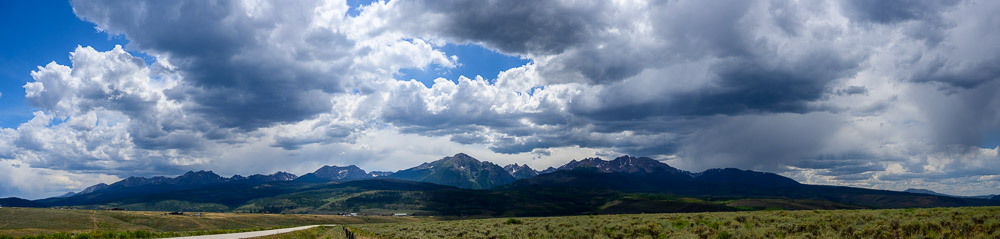
    This is an HDR image. Trying to create an image with the direct sun in it and at the same time preserve the deep shadows in the mountains wasn’t going to work in one exposure. The HDR software was able to pull it all together.

    I don’t think this looks like the bad old “HDR look”. What do you think?

  • My Favorite Lens

    My Favorite Lens

    In general, we photographers love our equipment, Especially our lenses. It is not uncommon to have a favorite one. You can always get a discussion/fight started among photographers when you talk about lenses. I would like to discuss what has become my favorite lens.

    Lenses

    The lens is a critically important piece of equipment to photographers. Sensors are improving dramatically and lenses have to improve with them to achieve all the sharpness and resolution the sensor can capture.

    Modern lenses constantly improve in resolution. Look at DxO image tests of current best lenses vs. the best from 20 years ago. Our lenses now enable us to capture more information and be able to produce wall-size prints that are extremely sharp.

    The lens determines the point of view that is captured in our frame. It establishes the field of view, the width of the scene we are capturing. Some of us naturally have a telephoto view. Others have a wide angle view. This refers to the lens choice we tend to select to frame our subjects. This is just personal preference. The lens is a tool to help express our esthetic.

    Many photographers feel they need a whole bag full of lenses of various focal lengths from extreme wide angle to super telephoto, with macro lenses and tilt/shiftes thrown in. Because, you never know what you might find. 🙂 Personally I have simplified my life a lot over time. I generally only carry a 24-70mm and a 70-200mm in my kit. But that is just me and where I am at right now.

    So what we want is a lens or lenses that allow us to capture all the information we want (resolution, sharpness, dynamic range) in the field of view we want. A big ask, but doable.

    Digital workflow

    Most of us are in the digital world now. The digital workflow is quite different from the analog workflow.

    What we call the analog workflow – the film days- involved developers and enlargers and prints and lots of chemicals and time. Personally, these are days I don’t miss. I am a big fan of the power and freedom and flexibility we have now.

    There is a corresponding workflow for digital processing, though. It includes loading images on our computer, viewing them, culling or grading them, processing selects with our software of choice, etc. Each of theses steps is time consuming. Especially since we tend to shoot so many more frames now that they “don’t cost anything”. And each step requires software and considerable training.

    The result, though, is that we spend a lot of time in front of our computer now. We probably spend more time in the digital workflow than we did in the analog workflow.

    My favorite lens

    What does this have to do with a discussion of my favorite lens? Well, in a sense the “lens” I use the most and that has the most impact on my work is my computer monitor.

    This is where I view all my images. Zoomed in to 100% I look at individual pixels. Here is where I crop and color correct and adjust tones and contrast and saturation. This is where I view and edit the image when I convert it to black & white. When I create new images by compositing others together, that is done entirely though the monitor “lens”.

    Yes, all of the things I just said are actually done through specialized software. In my case it is primarily Lightroom Classic and Photoshop. But metaphorically and to me, the monitor is the lens into the process.

    Now days the monitor is where we view everything we do. Regardless of what the original image looked like, what I see in the monitor at the end of the edits is what counts. The result could be a complete re-imagining of the starting image.

    The new primary lens

    I spend more time in front of my monitor than I do outside shooting. More and more it is coming to dominate my workflow. If I lost or broke a lens, that would be terrible, but I could continue doing my art with other lenses with only minor re-adjustments to my vision. I had this experience recently. My 24-70 lens dropped and shattered the polarizer filter. I was up in the mountains and I did not have a filter wrench with me to get the jammed filter off, so I had to switch to using an alternate lens. A little frustrating, but not a big deal.

    But if my computer died, although I could continue shooting, I could not view or process a single image until I fixed it. Eventually things would back up to a critical point and I would have to get the computer back. I also couldn’t select images for galleries or process images for printing. Dead in the water.

    So in a sense, the focal point of the digital workflow is the monitor. That is the new lens I use to view and do most of my work. The monitor is the lens for the increasingly important part of the digital workflow.

    The future

    In the future will this trend increase or will we return to simpler times? What do you think?

    My money would be on the increase of digital processing. We will trend more toward an attitude that the camera and lenses are used to gather raw material, but pictures are actually made in the computer, looking through the monitor. Increasingly, the final image may look less and less like the original capture. Better processing software opens up new possibilities. And viewers are more willing to accept that photography should create something more than a true representation of reality.

    So the next time you are lusting for a wonderful new lens, it might be better to upgrade your monitor instead.

  • Out There

    Out There

    My previous article discussed being an explorer based on curiosity. I absolutely, intensely believe that. But I don’t want to leave the impression that most of the exploration can be done in books and videos and trips to museums and even on the computer. For what I do, I have to be out there. Out there in the outdoors. Thinking about images is great, but you haven’t created art until you actually make an image.

    Exploration can happen anywhere

    Exploration is partly a mental activity. Feeding your mind with new ideas and new images causes growth, new connections. This is a vital activity for artists – and for everyone if you care about growing. There is a limit to it, though.

    Creativity is a balance between thinking and doing. Thinking allows us to consider new possibilities and imagine what we would do. Actually getting out shooting lets us test the ideas, see unexpected things, apply the ideas and discover new ones.

    The craft of making something balances and perfects the ideas of what we might do. It is a feedback loop. They reinforce each other. Thinking new ideas helps us see more possibilities when we are out shooting. Capturing images helps refine what works and doesn’t. Then when we see what works we discover new possibilities to try another time. Putting theory to practice is necessary to perfect both.

    I shoot outdoor images

    At some point we have to stop just thinking about what we want to do and actually go do it. Get off the couch and out the door.

    Occasionally I set aside time to travel someplace specifically to shoot pictures. That is a joy. But i don’t get to do it as much as I would like. Some reasons are:

    1. It is expensive
    2. I have to be at my studio to process images and take care of all the things that need to be done.
    3. New places are enjoyable but I’m a visitor there. I feel the need to find fresh images where I live.

    So I force myself to get out frequently and explore in my own backyard, so to speak. I consider it great discipline to find new, interesting images in familiar areas. And I do find many that I consider good.

    I will confess that I am naturally something of a couch potato. Getting out in all kinds of weather is a significant act of will. Especially when you consider that where I live the temperatures can range from -10F to 110F. It can be easy to convince myself that is is just not fun. But it is a habit I force myself to do. When I am home, then 4 to 5 days a week I go our walking with my camera.

    Yesterday, for instance, it was 2F and snowing and we had about 4 inches of fresh snow on the ground. I walked over 4 miles. I’m not bragging. Probably many of you do much more. My point is that it is a conscious decision that I will go out with my camera and explore every chance I get. I am somewhat amazed at what I find.

    When I am looking at an image I like, I always remember what the conditions were when I shot it, but that is not a factor in my evaluation of the worth of the image itself. The image must stand on its own. But I sometimes find the best pictures in the worst weather.

    Practice makes perfect

    Exploration is largely a mental activity. Feed your mind. Take in new ideas and possibilities all the time and assimilate the learnings into your vision. But you have to do it, too. Make images. Express the creative ideas you formed. Realize the idea in a finished product for your viewers. It can be hard.

    In his e-book “10 Tips for Aspiring Photographers”, William Patino said

    One thing that I feel greatly helped my learning was the amount of time I was willing to invest in being outdoors, playing with my camera and observing light and the land.

    Invest the time. Be out looking and feeling. Getting good at anything takes time. Practice. Play.

    I find that creative ideas tend to be rather vague. They tend to come as an idea of something that would be interesting. But actually making it happen can sometimes be difficult. It may require planning or more research or travel or, typically, many attempts to capture the idea in a real image.

    When I was working on my Speeding Trains project I threw away hundreds of attempts before I learned how to capture the impression of motion and speed and power and presence that I envisioned. Even after I sort of figured it out, my “hit rate” was probably about 1 in 10. Practice makes perfect. Or at least better. 🙂

    Believe you are very lucky

    Being an artist is hard work. If anyone tells you different, they haven’t tried it. You have to create a huge body of work and continually refresh it. You have to deal with rejection. Gatekeepers are everywhere proclaiming themselves to be the arbiter of taste and style and you are not fit to be allowed in to their select club. You will want to give up. As an artist you have to believe in yourself and your work. Regardless of what others say or do. Push on.

    It seems a contradiction, but on the other hand, many people admire and look up to you. They dream of being able to step out of their drab world and create. To have the freedom to make art and tell the world they don’t care if no one else likes it, because it pleases them. We seem an independent rebel, living the creative artistic life. They are right.

    In a private correspondence my friend Les Picker said:

    It’s like a colleague of mine once said: There is no such thing as a bad day for a nature photographer. We’re out there. We’re walking the path. How fortunate we are!

    So when it’s 0F and I am feeling frostbite or it’s 100F and I’m about to pass out from heat exhaustion, I remind myself that I am out creating and following my vision. How can this be bad?

    My vision leads me to shoot outdoors. So this is where I have to go. I can’t cherry pick and just say “Oh, today is not totally perfect , so I will just stay in”. That would never get anything done. Get out in it. Get dirty or wet or hot. Look past the conditions and discover what is there to see.

    Being an artist is about seeing. I have to be out in the place I plan to shoot before I can see. I want to make art, not just think about art.

    Your mileage may vary

    It sounds like I am saying that you have to shoot landscape scenes to be an artist. Not at all. I think the principles apply to anything you do. If you do portraits, do them, a lot. Don’t just think about doing them. If your thing is commercial or food or street photography or abstract still life studio shots, it doesn’t matter. Do it. Practice. Get in the reps.

    My thing involves outdoor photography. I have to kick myself out the door to shoot. If you do your work in the studio then make yourself get up and go do the work there.

    You’re not an artist unless you are creating art.

    Don’t think about making art, just get it done. Let everyone else decide if it’s good or bad, whether they love it or hate it. While they are deciding, make even more art.

    Andy Warhol

    The image this week

    I mentioned suffering in the cold. That is the time of year I’m in as I write this. What would be worth going out in that kind of weather? Well, things like this. I love patterns and reflections in ice. It is a very interesting subject to me. This kind of shot makes me forget the discomfort and think of the beauty in unlikely places. I hope you get out and find things like this, too.