An artists journey

Category: Mindfulness

  • Raw Material

    Raw Material

    I have come to consider many of the images I shoot to be raw material. They don’t become a finished picture until I have worked the raw material in post processing.

    Bits

    Today’s cameras are great generators of data. Every time I press the shutter I am sending around 50-60 MBytes of data to my memory card. And that is using a compressed RAW format.

    A funny thing happens, though. The more data there is, the less the importance of each bit. For instance, even though my camera has great metering and a live histogram, I may shoot several frames of the same subject. This will allow for minimizing motion or camera shake. Or, if I am intentionally moving the camera (intentional camera motion) I will shoot many frames to up my chance of getting a keeper.

    I never would have been so “wasteful” with film. It was too expensive. But digital images seem free. The perceived value of any frame is smaller.

    But a side effect of this commodity view leads to a different relationship with the image data. It is no longer necessarily a “picture” as an indivisible unit. It is data. I feel more free to repurpose any of the picture data for other uses.

    Repurposing

    So now I have new ways to look at an image. Maybe I like its texture and want to apply it to another image. Maybe there are one or more elements in the picture that I think would be good included in another image. There could be a form structure that could be used to build another image.

    I have moved from a “take it or leave it” judgement of an image as a whole to a sense of “parting out” a picture to harvest the good parts. That is so much easier now than it ever was in the past. The tools are there, it is a matter of adjusting the mindset.

    Post processing

    In today’s world, post processing is where a lot of the magic happens. Photoshop and Lightroom and some of the other editing programs have developed marvelous feature sets. They can handle large files and 16 bit depth and work comfortably in good image spaces like ProPhotoRGB, Photoshop is the choice (IMHO) for heavy duty pixel pushing.

    It is almost (not quite) true that is you can think it, you can do it. The tools are not perfect, but they are so good that, for the most part, they stay out of the way and let us create fluently with them.

    A lot of us have come to believe that a picture does not become a picture until we have spent some serious time in post processing. There is no reason anymore to be limited to what we originally captured, unless it turned out to be exactly what we want.

    Vision

    We artists are no longer “stuck” with what we captured at the moment we pressed the shutter. We have huge latitude for changing the look, the content, the color, and the whole feeling of the image.

    Some people are threatened by this, but I see it as an opportunity to realize my vision. There are few excuses any more. Photography is very different from painting, but we have one new similarity: if we can think it we can create it.

    Emotion

    To bring you a good image, I have to show not only what I saw but how I felt about it. Revealing the emotion behind it is easier now. Because we do not have to take the original bits of the image as fixed and unchangeable, we can add or subtract as necessary to achieve the effect we desire.

    This can be a very freeing and empowering realization. Those of us who have done photography for a long time have to re-learn how to approach image making. We have to give ourselves permission to do any amount of modification, even to the point of completely creating a new work out of raw material from others. But it gives us a medium for expressing ourselves more fully.

    This image

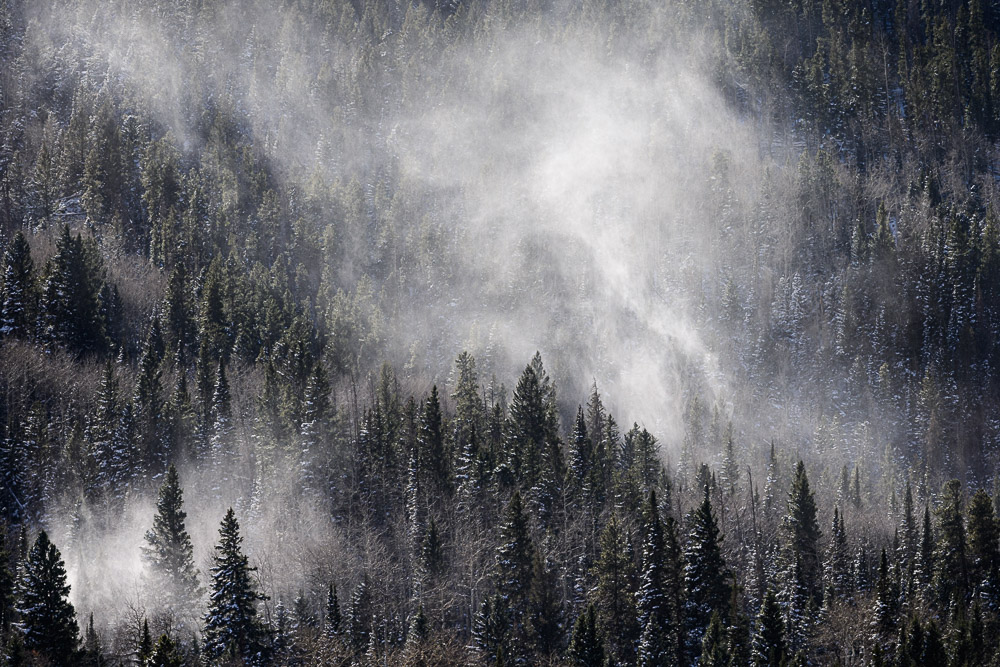
    The image with this article is an example. That is not what the original scene looked like. No in-camera technique could have given the resulting image. A lot of Photoshop time was spent in blurring the image except for the evergreens. It is not what I saw when I was there. I did not even envision this at the time. I spent time thinking about surreal variations and eventually visualized this.

    Dishonest?

    This is not dishonest. It is the same thing as a painter painting in what he likes and leaving out what he doesn’t like. The end result is art, not documentation.

    Art is neither honest or dishonest. It is art. It means what the viewer takes it to mean. We are long past the time when we assume a photograph is “truth”. We should assume that every image is altered, composited, tweaked, and blended. That’s not just OK, it is healthy.

  • Evolution of an Image

    Evolution of an Image

    Not all images follow the same life cycle. Sometimes it is pretty straightforward. See a scene; click; some post processing; done. Other times the path is winding, even circular. It is impossible for an image to be ready for a final print right out of the camera. Sometimes that shows an evolution of the artists perception of an image.

    Of something

    A lot of very good pictures are simply images of something. We find a lovely or interesting scene and we take a picture. Yes, we work the scene, find a good position to make a good composition. Wait for great light. Then make the shot.

    It represents something real and concrete. It is what it is. There is nothing abstract or surreal about it. No hidden meaning. As I write this I am on a trip going through a part of the country that has lots of beautiful trees. I am shooting a lot of pictures of trees. Just because I like them. And they’re all around.

    Most of these images, though, are ending up being just pictures of trees or fields. That doesn’t mean I don’t like them, but they are straight forward record shots of a scene I saw. It is the rare one that seems to actually have something deeper to offer.

    About something

    A goal is to bring something more than just a “here is what I saw”. I hope to occasionally make a statement or observation that will be helpful or insightful. Hopefully, I can bring you something more than just a pretty picture. I can only reveal to you what I emotionally reacted to at the time. It is up to me to react to the scene and be able to bring some of that to you.

    This is a wide grey area. One person’s “depth” may be another person’s “duh”. My perception of the significance of something may be different from yours. All I can do is to say what I think. I cannot control how you receive it.

    And the degree of depth or insight will vary all over the place. An image may have insight on something of human nature, or it may be humorous, or it may be ironic, or it may make a statement about the march of time or environmental issues. Good images do not have to be deeply serious. Few of mine are heavy commentary on social issues. My reaction to the world is governed more by joy and gratitude.

    So when you see my images, assume they probably have some insight I have perceived about the scene or subject. It may not be dark and depressing, but that does not take away from my intent to say something.

    A life of its own

    Sometimes, though, an image takes on another direction, a new life. I occasionally recognize that the original image is not complete or fully formed. It may need to be combined with other images or heavily worked to change it into something different.

    Take the image with this article for example. It started out a fairly interesting shot out of a favorite restaurant window. This particular window had 100+ year old glass that was wavy and distorted. Blurred in the background were some downtown buildings, trees, awnings, etc. I liked the scene and shot it repeatedly until I captured the impression I wanted (many lunches there!).

    But I was not happy with it as it was. It was an abstract view of downtown, but it was too abstract to be an effective representation of a downtown street, but not abstract enough to become something completely different and interesting in it’s own right. So I decided to go much further.

    Ah, the joys of Photoshop. It is fun to play sometimes. I added textures and played with colors and saturation and hues. Some overlay patterns gave it more definition and shape. Pretty soon it had nothing to do with the downtown scene I originally liked. If you sat where I shot the picture and looked out the same window, you would not recognize it.

    The image now has a life of its own, completely independent of the original scene. I like it. It is a fun creative exercise. But I have to find the right base images to work with. And I have to form a vision of where I want to go. Only a few images are good subjects for such a treatment.

    It means what it means

    Coming to this point requires me to address the question of what does an image “mean”? Can a picture have a meaning? Does it have to?

    There seems to be at least 2 opposing groups. Some say a picture is worthless unless it means something. The other says very few pictures can have an actual meaning, except for some photojournalism. As in most things in life, I range somewhere in the middle. Generally I say don’t take yourself so serious. A good picture can just be a nice, pleasing picture. If I have the opportunity to make images with meaning I usually will, but I don’t want the meaning to get in the way of the quality of the image.

    I get frustrated with people who are so sincere and focused on something that is important to them that they feel everyone must share their angst. Lighten up. First make art.

    I do make images with meaning, especially if I am shooting a project that is fairly serious. When I have the filter of a project in mind my focus tends to narrow to the subject. But unless it is a particularly dark and depressing subject, I want to concentrate first on making art. I tend to avoid the really dark and depressing projects. That is just not me and I don’t think they would make your life better.

    Summary

    The vast majority of the billions of photographs shot each year are record shots of something. They serve to capture a memory or mark an occasion. This was their intent and the work for that.

    A small percentage of photos and paintings go further and reveal something interesting. Maybe it is a new insight on a subject. Maybe it is just the artist’s emotional reaction at the time. But we look at them and often agree that they bring something deeper than just a snapshot.

    Or sometimes a picture becomes a thing in itself. Not a representation or even an interpretation. It just exists as a new creation. A lot of abstract and surreal art is like this.

    In my case, I am a lens-based artist. That means I start from something concrete – an image – rather than a blank canvas. Sometimes as I live with an image and think about what it could be, I morph it into something new. That is the case for the image with this article.

    I’m not saying this is a desired evolutionary path for an artist or that some steps are better than others. But artists tend to evolve their skills and viewpoints as they mature. I have observed myself moving through a progression. More and more of the images I like are abstract.

  • I Don’t Know

    I Don’t Know

    How did it get to where we think we are supposed to know everything? Why is it wrong to say “I don’t know“? I think it would be horrible to believe I knew everything. Where would be the opportunity for discovery? To be able to let my curiosity run free? I am quick to tell anyone I don’t know, if I don’t.

    Fallacy of certainty

    Believing we have to know everything is a trap. It will doom us to failure and disappointment. I would say there are 3 general classes of knowledge:

    1. Our values.
    2. The things we interact with on a regular basis.
    3. Everything else “out there”.

    As a person you have to know your values. Those things you will not bend. At what point will you fight for what you believe? These are the bedrock principles we build our lives on.

    In the next circle, we all do our jobs and use a lot of technology every the day. We probably drive a car or use a computer for various tasks or bank or shop online. It is important to being able to function in society that we understand enough about these things to be able to use them. That doesn’t mean we have to have a deep understanding. I was an engineer in the technology/computer industry for a career, and I absolutely know I do not fully understand all aspects of everything I use. In most cases it is OK to just understand enough to efficiently get the task done and minimize surprises. Maybe just to know enough to know how to not be stupid.

    Then there is everything else. The world is so big and interconnected and complex that no one knows how or why most of it works. I don’t understand micro or macro economics, and I’m not sure anyone else does, either. NFTs still seems like a Ponzi scheme to me. I don’t understand why people become zombies when they enter politics. Why do bad things happen to good people? I don’t know and I will never figure it all out. Nor do I have to.

    No one knows even most of everything

    We listen to the talking heads on the news spouting meaningless information with full confidence. We know they are probably wrong, but they speak with authority. Therefore, we distrust ourselves. And after a while we realize they don’t know anything, either. When neither side of the debate or the “experts” can be trusted, we tend to check out, become cynical and angry. Don’t forget, though, that they have an off button.

    There is a saying called Sturgeon’s Law that says “90% of everything is crap”. I have my own corollary to that: Sturgeon was an optimist.

    If most of the information you get is bad, what do you do? Hopefully you start to trust yourself. Learn to research things that are important to you. Research means even listening to people whose opinions you don’t like. You can’t just listen to your favorite guru who says things you like to hear. Make your own decisions. Build enough knowledge to trust your instincts and decisions. Don’t believe anything you hear until you check it out.

    Curiosity

    Too much ranting about heavy stuff. Let’s talk about art!

    After a long time of working up to being an artist, I have concluded that I have to follow my curiosity and trust my instincts. Sounds simple, but it is sometimes hard.

    I have spent time at times doing things in a way that they would be accepted by other people. It wasn’t entirely wasted, but is seemed kind of phony, and it was. I realized I was making someone else’s art. I don’t do that now.

    But do we follow the fashion of the day? Do whatever we have to do to be accepted by the ones who style themselves as the opinion leaders? Who anointed them with this divine authority? They are just people with opinions.

    I find that most of my best work happens when my inspiration is to ask “what if?” or when I say “I have never seen this like this before”. And do something with it.

    Adventure

    Do you lead a boring, monotonous life? Or is every day a new adventure? Much of the choice is ours. It depends on our attitude.

    I believe that artists have the opportunity to lead lives of adventure and excitement and personal growth all the time. Even if we never leave our town.

    Adventure is exploring and finding new things that excite us. We don’t have to go to exotic locations to find that. Our point of view determines our adventure.

    Nearly every day I go walking in the areas around my studio. I always take my camera. It is covering the same ground. Occasionally I create a new route, but there are only so many variations. Sometimes I get bored with it. But I am coming to realize that when I am bored I am not letting my curiosity roam free. If my attitude is better I am likely to discover new things or appreciate something for the first time. The same with driving through Kansas. It can be a nice adventure.

    Artists are on a journey of discovery

    As artists, we should be explorers. Not discovering unknown lands, but finding new things about ourselves and the world we live in. These discoveries could be as close as our back yard.

    To do that, we need to be always asking questions: What is this? What else is it? Can I see it different? What if this was combined with that? What if …?

    At the root, all of these questions are based on the assumption that I don’t know – but I will explore it to see where I can take it. Not knowing is fundamental to being creative. When we don’t know, it should excite and inspire us.

    Forget about the rest of the world that is pressing in and telling us what we should see and believe. We are capable of deciding for our self. Being an artist means being comfortable with high levels of ambiguity. And the accompanying joy of finding new answers or showing the world something they have never seen.

    Be yourself. Trust yourself.

  • The Decisive Moment

    The Decisive Moment

    Henri Cartier-Bresson was well known for promoting the “decisive moment”. I know from experience that in some situations there is an optimum instant to capture the image you want. But for some it becomes a mantra. Let’s examine some nuances of the concept of a decisive moment.

    Sometimes it is not a precise moment

    Almost all of my work is shot outdoors. Sometimes I shoot straight landscapes. Often other found objects around me.

    I believe I have the experience to say that in these outdoor settings, the “decisive moment” may last from a second to many minutes. Or I may have to wait an hour for the moment to occur. In a slowly changing landscape scene it can be difficult to recognize which moment was decisive – and hope you had the presence of mind to capture it.

    In these situations, there may well be a decisive period of time, maybe not an actual moment. It often requires great patience rather than lightning fast reflexes.

    A decisive moment

    I have shot some sports and kids. These are areas with definite decisive moments.

    Sports is easier, in a way. Most sports have a rhythm, a pattern. Once you learn it for a particular sport, you can anticipate the action and predict the best moment. It still may be difficult and you may not be in the best position, but you often will know when it will happen.

    I consider kids more challenging than sports. They are unpredictable. Their moods and expressions can change quickly. Framing then, lighting them, and being in position with the right lens and camera settings requires constant attention. Then on top of all of that is the delicate trigger you need to “spring” at the right moment, when the expression or activity is just right. You have to be fully engaged and in the moment.

    I make it harder on myself, because I never do formal portraits where I try to control things. I greatly prefer being in the environment where they are comfortable and letting them basically forget about me. Candid shots are what I like.

    Now is the decisive moment

    This brings up one of the main points I want to make here: now is the decisive moment. Wherever we are and whatever we are doing, we should consider it a decisive moment. We need to be in this moment. Things will never be the same. We will never have exactly this light or these clouds. We won’t feel the same or look at the subject the same.

    This used to be a problem for me. I would see something interesting, but I was on my way to do something else “important”, so I didn’t stop. If I even remembered what interested me, it was usually not the same when I came back. The light was wrong. The vegetation had grown up and obscured it. It was raining and foggy. Just not the same. If I wait a couple of months before coming back, it may be a housing addition now!

    Well, it may still be a problem, but I recognize it and fight it now. I am much more prone to go ahead and stop and get the shot when I see it. If I am late to something, I don’t mind asking forgiveness. It has not become a problem, except maybe for my wife. She knows now to bring something to read, because I will stop at unpredictable times and places.

    Being mindful

    This all now brings us to the larger issue of mindfulness. Not the pseudo-spiritual mumbo jumbo we get from the self-help crowd. Real mindfulness involves being in the moment. Being fully aware and conscious.

    Modern society does it’s best to train us to not be mindful. We are constantly distracted and entertained. Other people’s ideas bombard us and lead us to pay attention to what they want us to do. But learning to think our own thoughts and to look around and actually see what is there is necessary and healthy.

    Do you walk down the street looking around and actually seeing what is there, or are you scrolling Facebook or email to make sure you don’t miss something? Where is your focus?

    Do you ever take time for yourself? To think, to consider things, to read? Not to think about work or politics or where you are going with your friends tomorrow night. Is the idea of being alone with yourself scary or exciting?

    I suggest you practice being alone in your own head. It might be hard at first. Give yourself some time to just think and to just look around, not expecting something – just looking. Making a quiet place in your head could be a welcome retreat in our noisy, distracting world.

    The image with this post is a result of just being mindful. I noticed this scene on a walk along an ugly little canal in town. The location was not “pretty” in itself, but the conditions were right to make an image I love. I am very glad I took the time to notice it.

    Do you practice mindfulness? Let me know your experience!