An artists journey

Category: Creative Ideas

Ideas about creativity and the creative process.

  • Open to the Unexpected

    Open to the Unexpected

    When you go out to shoot do you know before you leave exactly what you want to find? Many people do. I feel sorry for them. I greatly prefer to “go out empty” as Jay Maisel would say and let the amazing world around me surprise and delight me. Learn to expect the unexpected.

    This is absolutely my opinion and my photographic style. I am a fine art photographer who works primarily outdoors. The world outside is my canvas. If I were a portrait or commercial photographer I would have to do things differently. When there are crews and talent and art directors and contracts to fulfill, I recognize that the photographer has to plan and organize tightly. I am glad that that is not my world. I thrive on spontaneity.

    Subjective vs. Objective

    In a recent webcast by Chris Murray on Nature Photographer’s Network, he discussed the idea of objective vs. subjective photography. (Sorry but this is a fee site, but you can sign up for a free month.) It was a good talk. He spend a lot of time on his journey from objective to subjective.

    He characterized objective images as ones that document a scene and subjective images as images that convey how the artist felt about or responded to the scene.

    I think most of us start out objective. It happened naturally when we point our camera at a beautiful landmark and get a picture that makes us say “wow, that’s beautiful”. But if it has no more interpretation by us, it is not really different from the hundreds or thousands of other captures of that scene.

    The thing I want to point out here, though, is that Chris said when shooting objective images he would research a location, decide the time of year and time of day that would be best for it, and go there and sit until the conditions were what he expected. He told about camping on a mountain for 3 days waiting for the image he visualized.

    The image he got was a beautiful scene in the Adirondack Mountains. But my reaction to it was “meh…”. (Sorry Chris). To me it did not have any passion or depth. He got almost exactly the shot he planned, but my thought was “why?”.

    What do you miss?

    What did he miss while he was waiting 3 days on that mountain for the “right” time and conditions? Maybe nothing, but maybe a lot. To me that is too great a price to pay.

    I have heard other photographers talk about fighting for a tripod spot at a grand, iconic spot, realizing that they were about to take the same shot that thousands of others take every year. Then they turn around and see a scene the other direction that is more meaningful to them. One that most of the other photographers failed to see because they were totally fixated on the iconic scene.

    I try to be open and aware of what is around wherever I am. Same applies as much if I am walking a downtown street as if I am in a wilderness. Wonderful images can be discovered anywhere.

    Avoid preconceptions

    If you decide before you head out what you want to shoot, you put mental blinders on yourself. It is a fact that you only see what you expect to see.

    This is called “selective attention”. A famous, effective, and short demonstration of this is in this video. Watch it! It is very enlightening. I won’t give a spoiler here, but this applies to any of us. If you are only looking for birds you will tend to only see birds.

    Maybe that works OK for you. It’s not what I want for me. I want to be open to all the exciting things around me. And there are a lot of them. Many of my favorite images are things I would not have known to look for if I was making a list beforehand. I don’t want to miss out on the excitement of truly seeing and openly exploring what an area has to offer..

    Grow

    We all need to practice our skills and our visualization. Even the most famous and experienced photographers make themselves take time for personal projects to keep from getting stale and to grow in creative ways. Learning to avoid the trap of preconception can be part of that growth.

    All artists need constant practice. Pablo Casals was possibly the greatest cellist.

    The world’s foremost cellist, Pablo Casals, is 83. He was asked one day why he continued to practice four and five hours a day. Casals answered, “Because I think I am making progress.”
    — Leonard Lyons

    Repetition is one thing. I have advocated for that before. It is necessary. But there are other ways of learning to break your habit of preconception.

    A great thing to do is to go minimalist. Go out for a day of shooting with one camera body and one lens. I can hear you sputtering now. ☺ “But I might need my fisheye; or I might need 400mm”. No, not if you don’t have it. Practice getting great shots with what you have.

    An interesting thing happens when you let go and go with it. Let’s say you just take your 50mm prime. When you get into it, you will quickly start to see the world from the 50mm perspective. This is probably a type of selective attention, but it is forcing you in a different dimension. Instead of being selective on subjects, you are selecting your viewpoint on the world around you. It is a great exercise.

    I did something similar on a larger scale. My natural vision is telephoto. My ideal lens is 70-200mm. Even longer is great for me sometimes. I like to crop in on details. But for over a year I have switched to mainly shooting with my wonderful 24-70mm. I think it has helped me grow in my creativity. I am surprised at some of the new things I see.

    Let yourself be surprised!

    For me, my art is a voyage of discovery. It is exciting because I never know what I will find. I like to be surprised!

    When I can get into seeing the excitement and possibilities all around me there is sometimes so much to shoot that I have to just stop and take some deep breaths. Slow down. Decide how I feel about what I am seeing and what I want to say. Pace myself. It can be an embarrassment of riches. I am drowning in the imagery.

    The image with this article is an example. I was head down by a lake shooting grass and reflections. That is all I was paying attention to. Eventually I noticed that things were changing and getting colorful. Looking up, I discovered this gorgeous thunderstorm was forming practically right by me. This became the picture. The other images I shot that day are forgotten.

    It even applies to post processing. Sometimes I shoot frames just because my instinct tells me there is something there I am not consciously seeing. Sometimes whatever I was drawn to becomes apparent in post. As I work an image, something magical begins to emerge. It is like creating an image in front of me on the screen directly from light and the manipulations I am doing to coax out an elusive something. That is a joy, too. It is the kind of surprise that makes art worthwhile.

    So I invite you to stop limiting yourself artificially. Don’t block your vision by deciding in advance what you only want to find. Let go. React. Be open to the unexpected. Go out empty, as Jay Maisel famously says. Enjoy discovering what there is instead of being frustrated by what you can’t find.

  • 15 Minutes From Home

    15 Minutes From Home

    It is pretty easy to take good images in exotic locations. A real test of our skill is to see how well we do in familiar territory close to home. What if we arbitrarily said we were going to restrict ourselves to 15 minutes from home? Actually, that kind of sounds like the situation many of us are in right now.

    I use ideas from Cole Thompson too often, but he often says things I wish I had said. In a recent newsletter of 3/27/2020 he challenged the idea that you have to go to great locations to take great pictures. Referring to the fact that many of his recent images were made in far flung locations, he said “You see the same coming from other photographers: exotic images coming from exotic lands. The conclusion is obvious: To create great images you must go to great locations! But that’s a lie. The real truth is this: great images are created anywhere you can see them. Even at home, your back yard or hometown. “

    He went on to show a portfolio of great images taken within 15 minutes of his home. To me, his picture of wrenches hanging in a tool shed is at least as beautiful and intriguing at the classic figures on Easter Island.

    Then why travel?

    I will readily confess to being a traveler. I love to travel (hate airports and airlines though). Seeing different cultures and different landscapes energizes me. I tend to see things with a fresh eye. It’s an opportunity to give yourself permission to be a tourist and to view new things differently.

    Travel makes you set aside time for the new. It removes you from the clutter and noise of your everyday environment. It may replace it with different clutter and noise, but the difference makes it new. Plus, you don’t worry much about the routine things that occupy you at home. That email you need to write, the business contact you need to follow up on, that blog post you have been meaning to write – they are just a distant murmur in the back of your mind. The lure of the exotic location tends to drown out the mundane things that usually shout so loud for your immediate attention.

    The immediacy of the new sights in front of us makes it pretty easy to lose ourselves in the experience.

    Burnout

    Many of us can get in a rut and suffer from creative burnout. We start to think there is nothing new to photograph. Nothing new to inspire us or make it worth even getting the camera out of the bag. Travel to a new location seems to hold the hope of drawing us out of our slump.

    I’ve been there. I still fight it frequently. Now with travel restrictions it seems worse than ever. What can we do?

    I advise you not to get overly frustrated and fight head on against it. Reframe the problem. Go out walking with your camera. Tell yourself you do not expect to make any portfolio images today. You just want to look and practice, maybe work on technique. With no pressure to try to “make” a great shot you might be surprised at what you see. Give it time to work.

    You will probably find yourself less dismissive of things. You might notice new things you never took the time to actually see because you were too focused on a preconceived notion of what you wanted to find.

    Burnout is a real problem, physically, mentally, and creatively. Let yourself heal by taking it easy. Ease up on yourself by reducing the pressure you feel to make “great” shots every time.

    And do something. Don’t let yourself wallow in feeling sorry for yourself. Get off your rear end and do something. Anything. Build something. Take walks or bike rides. Keep moving.

    Inspiration

    Ah, the problem of inspiration. I already admitted I am inspired by travel. Is that the only drug to feed my need?

    Being confined at home is a great time to learn new skills. Learning should be a life long pursuit. Here is an exceptional opportunity to catch up.

    We all have an opportunity now to pull back. It is a good time to read inspiring books. To view a lot of training online, such as Creative Live, The Nature Photographer’s Network, or B&H Photo. Or just play with Photoshop. Experiment. Try things you would not give yourself permission to do normally. Photoshop by itself is a life long learning experience.

    But these activities do not directly apply to creating images in our particular style, do they? How do they really help?

    Do you know how a laser works? (Not a laser diode; that is different mechanism) The acronym stands for Light Amplification by Stimulated Emission of Radiation. Without getting technical, a laser has two mirrors parallel to each other with a cavity in between. Electronics around it pump energy into it causing it to start emitting light. The light bounces back and forth between the mirrors, getting pumped to higher and higher energy states, until it finally breaks out as a focused, high energy beam. The point is that the signals that pump the laser to higher energy levels are not the same as the laser light. They feed the energy of the laser.

    I believe my creativity is like that. I believe it is actually common to many people. Anything that feeds my knowledge, that makes me see new things, stimulates my creativity like a laser. So for me, some authors do that. Some classes may. Even some movies. In a strange way, even writing this blog pumps my inspiration. Get pumped and then do something with it.

    Lack of faith in our creativity

    A problem many of us have is little faith in ourselves. Deep down we believe we are fakes. That we really don’t have much creativity. Just because we did something good last week does not give us confidence that we will be able to do something great next week. This is called The Imposter Syndrome.

    I believe this is more common than we let on. Some people have said that almost all creatives suffer from this. We do not like to admit it.

    I am a fine art photographer and most of my work is outdoors. My personality and workflow is such that I do not plan my outings in any detail. I go with the flow snd take my inspiration from what I find. It can be scary when I’m not “feeling” it. I have to trust that something will capture my imagination and get me started and into the groove. If I relax and let myself be attuned to what is around me, it usually works.

    But when it doesn’t, that can be a challenge to my self confidence. A usually reliable cure for me is to spend time in my image collection. I am lucky to have a large collection of images. Of that large collection, a small percentage are the ones I would not be ashamed to show to other people. Browsing through these picks can be inspiring to me. It reassures me that I can make good images over a long time. Remembering the story behind some of the images can be especially heartwarming. Like the times when I was in a hurry or not feeling inspired or creative or not happy with the work I was doing that day and suddenly I come up with a great image that I still love years later.

    Close to home

    Exercises and mind shifts like this give me the faith that valleys of inspiration, like virus epidemics, do not last. I believe most of my best work is yet to come.

    It may seem easier to shoot good images in beautiful exotic locations, but there are very good reasons to focus most of our energy on the near, the familiar, the things we grow to love. Having a relationship with an area will usually lead to more intimate and insightful pictures. And I believe that there is great potential even in the overworked area 15 minutes from my home.

    How about you? Are you shut down because you can’t travel? Let me know.

    The image at the top of this article was made less than 100 ft from my studio.

  • Not All Who Wander Are Lost

    Not All Who Wander Are Lost

    You are probably familiar with this quote, even if you can’t place exactly where it is from. I’ll get to that. The point here is to talk about my need to wander. I am seldom lost, especially when I wander.

    This quote is part of a poem by J.R.R. Tolkien in The Fellowship of the Ring:

    All that is gold does not glitter,
    Not all those who wander are lost;
    The old that is strong does not wither,
    Deep roots are not reached by the frost.

    This is only half of the poem. The rest is specific to the plot of the story. But these 4 lines are golden. I may write about each line sometime.

    This time I am drilling in to the second line: “Not all those who wander are lost.”

    Get lost

    I am admittedly weird. I intentionally try to get “lost”, in the sense that I end up in places few people visit, that aren’t apparent on maps, and I don’t know what I’ll find when I get there. One characteristic of this kind of place is that there are few if any people around.

    Perhaps I am just an anti-social loner, but this kind of place invigorates me. I experience a kind of freedom I don’t feel in well populated areas.

    No, I don’t think I am dangerously deranged. As a matter of fact as I’m writing this I have to leave in a few minutes to meet with a group of friends. As much as I like friends and companionship, I will leave them for times to seek out the “off the map” experiences I crave.

    So far I find that these times of solitude are best experienced alone. I am shy and quiet. If people are around I find the “noise” drowns out the voice of the wilderness I am trying to listen to. With people around I feel compelled to “get on down the road” or get to dinner at a reasonable time. Not so when I am alone.

    One of my joys is to get an extremely detailed map and try to explore the tiniest, most remote roads I can find. And that is paper maps – a lot of the places I like to go don’t have cell phone service, so forget Google Maps, and I often can’t trust my Nav system in the car. They are seldom detailed enough.

    Don’t be foolish

    I am painting a picture of just heading off into the wild randomly and getting into all kinds of predicaments. When you go out to explore barren areas, don’t be stupid. Even though I generally travel alone, I have a good 4-wheel drive vehicle (with a large gas tank), food, water, and winter or summer survival kits. And I try to give someone a general idea of where I am going and when I should be back. And I’ve done this type of travel for a long time.

    Getting stuck in some of these places can be dangerous, even life threatening. Know what you are doing and be prepared. Ease into it to get a lot of experience before heading off solo.

    So, what’s it going to be — safety, or freedom? You can’t have both. – Louis Sachar

    I personally am willing to take a fair amount of risk to live a more free and rewarding life.

    Renewal

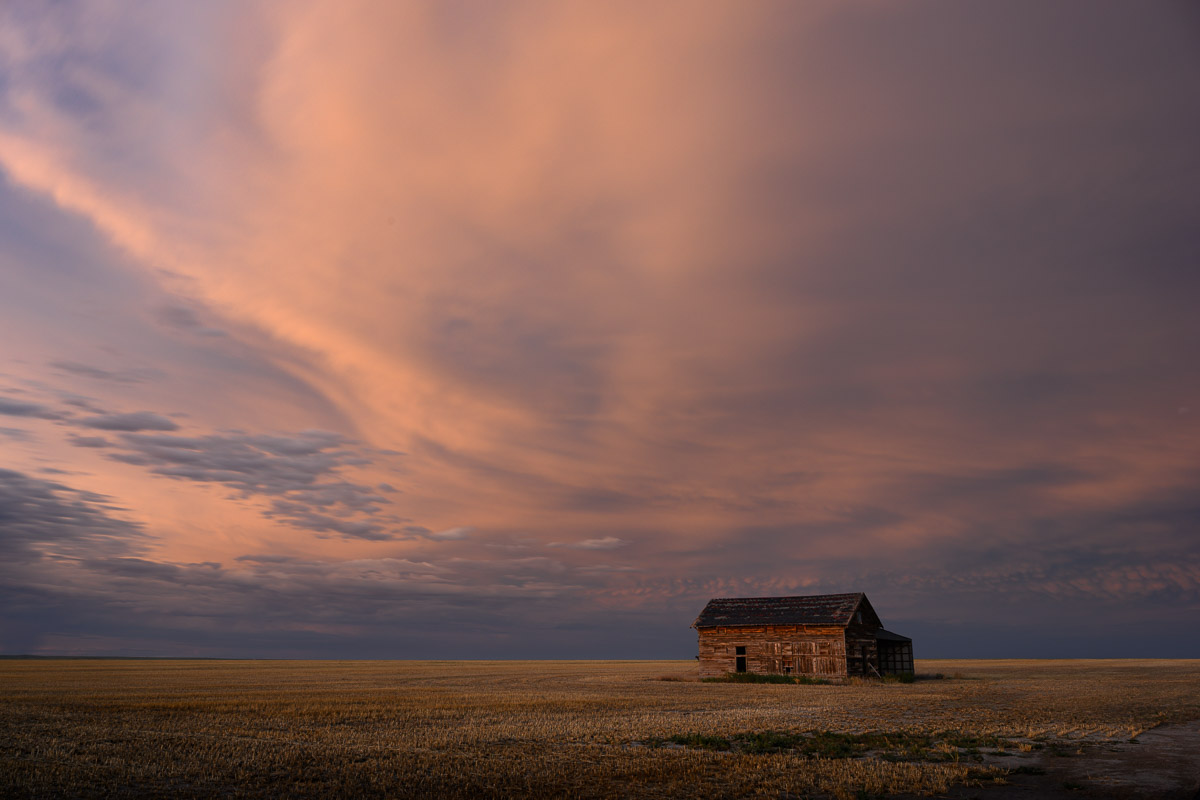
    I find that getting away and taking time to “listen” to that part of the world is refreshing and renewing. It does not have to be a conventionally beautiful place. I can easily be as renewed in the barren plains of eastern Colorado or Wyoming as I am in the mountains. The image at the top of this post is in eastern Colorado.

    When I come to one of these places and I feel a connection to it, I have a better chance of getting images I love. Ones where I feel I have something to say. I find I am usually missing that deep connection in a place that is just beautiful and where other photographers often record the same scene.

    Even if I do not get any great images, the renewal of my mind and soul is well worth it.

    Get found

    We live in an increasingly noisy world. Our jobs demand almost full time engagement. The giant media companies demand we be “plugged in” 24/7 because of fear of missing out. Learning to be content in solitude is an antidote to this. It is a way to take back control of your mind. Don’t be afraid of missing something. Those things actually don’t matter much compared to the benefits of our mental health.

    I don’t fully understand it, but there is something about the wild or neglected places that are uplifting to me. I don’t really know what it means to “find yourself”, but I often experience something that must be like it when I spend time in some remote places.

    Right now it is not as important to me that I understand the why. It is sufficient for my psyche that I know how to get found. And when I am found I can do work that calls to me, lifts me up, and pleases me.

    I hope it calls to you, too. Try it sometime. You might not know until you unplug for a while and try. Let me know what you find.

  • Memory

    Memory

    Photographs are memory. Most of us take “snapshots” to record moments we want to remember. Facebook, Snapchat, and most other social media exists on snapshots.

    I have a whole image library of family and friend pictures. They are very important to me personally, even though I do not share them on social media (I’m one of the last remaining holdouts in the world).

    My images are my memories

    I also have a large library of my professional images. These are just as much my memories as the pictures of my grandkids. In some ways these are even more important.

    I have a terrible memory for dates, which is weird, because as an engineer, I have a better chance of remembering your phone number than I do your name. My wife can ask me when we went on a certain trip and I might guess a date that is 10 years off.

    But when I see one of my images, the whole context immediately comes back as a well formed memory (except for the date ☺). Without hesitation I can tell you where it was, what time of the year, what the weather was like, what trip it was on, who we were with, and what the circumstances of the picture were. And if it was a trip, what we were driving.

    Is this relevant to you? Probably not. It definitely is to me. These are my memories. Sometime in the future, if I start loosing my memory, I hope these will still bring back these contexts for a long time.

    But I want you to hang my images on your wall. Why should you want my memories? You don’t. I hope to bring other things that are of value to you.

    Place

    If I tell you that when making a certain image the temperature was -10F and the wind was blowing and my hands were freezing even with gloves on, that might give you some greater sense of the situation. Kind of like the image at the top of this post. This brings a notion of place to the appreciation of an image. You didn’t experience it directly, but you can empathize.

    Even better, though, is if I can bring this sense of place into the image. So you can feel the bone chilling conditions by looking at it. If I am sufficiently skilled and if my story telling skill is up to it, it can often be done. I try.

    This example isn’t necessarily a place many of us would want to be. I’m weird that way. But I think it illustrates that an image doesn’t have to be about puppies and beaches and sunsets to tell a worthwhile story. And a story can be compelling enough to make you want to have it to look at, even if you’ve never been there and don’t want to. It brings more of the world to us.

    Connections

    More powerful even than a strong sense of place is the connection it can bring you. I believe most of us long for more connection to nature, to the real world. It feels like home.

    Unfortunately, most people these days live in cities. Even if they are not directly in a city, most people are so busy with everyday life that they lose touch with the real world. When you are so busy, you forget.

    Images, on your wall, where your can meditate and reflect on them, are a powerful antidote to this disconnection. Especially if the images are places or things that symbolize where you want to be, that make you feel whole. Even if they are just of something that makes you stop to look and think.

    Some ask me why my landscape images almost never have people in them. This is part of my value system. I feel that if people are there, that is their place, their memories. If no one else is there, it is pristine, unclaimed in a sense. It can be your place, your memory. Even if you have never been there, you feel that it is someplace you would like to be. You can visualize yourself in the scene. It becomes a connection for you to that world.

    The knowledge that such places exist, even if we do not see them ourselves, is powerful and centering. Pablo Picasso said “The purpose of art is washing the dust of daily life off our souls.” I believe this is one of the things that makes art worthwhile.

    I hope you will adopt some of my memories to bring more peace to your day.

    Is this true for you? Let me know what you think. And check out my online gallery at photos.schlotzcreate.com. Contact me if you find something you connect to and would like to have.

  • Meaning

    Meaning

    Does art have “meaning”? Especially a deep meaning that leads to truth or changes the life of the viewer. This is a thorny subject that has been debated for centuries. I’m not going to settle the question. (Sorry) But I can give my POV.

    The Elitist view

    Some say that all art does, or should, have meaning. It should educate or enlighten. It should lead the viewer to a new state of understanding. To some all art should support a cause or attempt to change the world. One of the unfortunate extremes of this is the frustrated attitude that if you don’t “get it” you are not in the privileged elite. You are too lowly, unworthy to understand.

    This very high minded view is often presented by galleries and some artists in their artist statements. I can understand it, really. They are selling a product. The more elite and special it seems to be, the higher price it can command. The more collectable it is. I’m guilty of it at some level.

    And it probably is more typical of art that takes a long time to produce. If you worked for weeks or months on a painting or sculpture you naturally want to believe it has some reason to be worth a lot. Otherwise, why did you waste your time? It is natural.

    But I don’t want to discuss those more classical media. My art is based on photography.

    Does my photography have intrinsic meaning?

    Does a photograph, one of my photographs, have meaning or represent some great truth?

    Maybe.

    Sorry, that’s the best I can do, because I believe it is the right answer. Meaning, if any, is a communication process between the artist and the viewer.

    Take the image with this post. Does it have meaning to you? I could write a whole post on the symbols and relations I see in this. That does not mean you will or should.

    Communication

    When I produce an image, it is an instant of the world seen through my eyes. But is it also interpreted through your eyes. I may believe it has significance, but I may not communicate it effectively to you. Or I may capture something I think is interesting, but to you it represents an insight or truth I did not consciously see.

    That represents part of the problem. There are multiple parties involved. There is me, the author, on one side. I produce it. It is interpreted through my viewpoint, through my beliefs and vision and talent. I had a reason for creating the final image. On the other hand, each person viewing it sees something different. Some may see deep meaning. Some may only see a pleasing image. Others may be completely bored with it. Even if I believe there is meaning there I may fail to effectively convey it to you.

    My thought is to say it is my failing if I do not succeed in conveying the meaning, but that is too simple. We each have our own values and history and viewpoints. You may not be receptive to what I have to say. If that is the case it is not so much that I have failed, but that we just can’t get together on our viewpoints. Maybe that’s kind of like the current political mess we have.

    Do I have to bring meaning?

    Ah, but there is a subtle assumption in this argument. It assumes I really was trying to teach you something deep. Here’s a secret: I don’t usually. It is often sufficient that an image is pleasing to me.

    Life is multi-faceted. There are many layers and levels. Not everything has to be deeply significant and serious. Lighten up. Let some things exist just for pleasure. I am very happy with an image that I believe conveys beauty or joy or simply brings something interesting to your attention.

    It is a consistent theme with me, but I believe our high pressure, hurried lives are causing many of us a great deal of stress and actually reducing our pleasure in life. I want to produce art for your wall that will give you a moment of pleasure when you notice it. Hopefully you will slow down a minute, contemplate it, use it as a reminder to look around more for what is going by all the time. That’s enough meaning for me.

    So, meaning? It’s overrated. I hope my art beings you to a new place, but art should bring joy, not be a school exercise. I promise I will not score you down for not seeing all I believe there is in one of my images. Analyzing the meaning of my work doesn’t being me joy, I just want to create!

    But that’s just where I am. What are your thoughts?