An artists journey

Category: Art

  • The Magic of Silhouettes

    The Magic of Silhouettes

    We’re all familiar with silhouettes. Do you ever think about why they are interesting? I believe there is a kind of magic of silhouettes.

    What silhouettes are

    “A silhouette is the image of a person, animal, object or scene represented as a solid shape of a single colour, usually black, with its edges matching the outline of the subject. The interior of a silhouette is featureless, and the silhouette is usually presented on a light background, usually white, or none at all.”

    You are familiar with them. You see them often. A featureless black form in a picture. Have you ever thought how something that shows no detail can be interesting?

    We know from experience that they happen when a foreground object has a bright light behind it. A simple explanation and they are easy to generate, but that by itself does not explain their impact.

    On mountain top looking toward setting sun. Reflecting on life?©Ed Schlotzhauer

    Origin

    I love history and finding out how things came to be. I assumed silhouettes have been an artistic technique for centuries. Not exactly. It mainly dates from the 18th century. Cutting portraits out of black paper became a popular and inexpensive art form. It was especially popular for miniatures, small images on lockets and things like that.

    You can argue the technique was used by Greeks and others as far back as 7 to 8 centuries BC on some of their pottery. Perhaps it is possible to include some even older cave art. But as far as I could find, there was no name given to it back then and the technique seems to have fallen mostly out of practice until the 18th century.

    Here is a piece of nerd interest that will be of absolutely no use to you, but is an intriguing part of our history. The word “silhouette” is not an artistic or technical term. In 1759 Étienne de Silhouette was the French Finance Minister during the Seven Years War. The country’s finances were hard pressed and he had to institute a lot of unpopular austerity measures. So much so that people began to use the term “silhouette” to refer to things done cheaply.

    This was the same time period (18th century) when paper cutouts were becoming popular for portraits and the name transferred and stuck. Silhouettes were an inexpensive art form. It fascinates me that no one remembers Étienne de Silhouette, but we use his name all the time without realizing it.

    Looking through clock, Musee Orsay©Ed Schlotzhauer

    Why are they interesting

    But that still leave open the question of why they are interesting. Just being black does not make it interesting. Being featureless would seem to make them less interesting, not more. Why do they catch our interest?

    They are somewhat different from what we normally see, but that should not in itself be enough to make them special. There are a lot of “gimmick” techniques that photographers and other artists use to try to catch our interest. Generally these fads do not have staying power and fade out as quickly as they appear.

    I believe there is something fundamentally important and intriguing about silhouettes that catches our attention and has lasting power. There seems to be something about them that captures the essence of a subject.

    Less is more

    Less really is more sometimes. This is particularly true in photography, where our super megapixel sensors capture lots of information and detail. We can confuse our viewers with too much detail. I generally love lots of detail, but the subjective experience we want to present is more important than technical details.

    A silhouette is an exercise in simplicity. We remove all information about a subject except its outer form. The way our marvelous brain works, this is usually sufficient for us to recognize the object.

    But even though we recognize it, it is presented in a completely different form. With no interior detail we only have its outline. We are left to guess what is in the big, black, featureless area in the middle of it.

    And we do. We fill in the blanks. Based on our experience, we “know” what is in that shape. But still, the mystery remains and we perceive it different. We see it in a new way.

    It is an exercise in simplicity and minimalization. Absolutely nothing except the information about its shape.

    Similar to black & white

    In some respects silhouettes are related to black & white photographs. They often are presented in black & white. I believe there is a reason for this beyond just the big black area.

    The beauty of black & white is that it removes all color from the image. Color is the most powerful visual sense. We tend to see it first. It can overpower everything else.

    But when the color is removed, we more fully perceive the shapes and tonal relationships that are there. The image is transformed into a different art form, giving us an altered way to see it.

    Silhouettes are like that, but with an emphasis on just the shape of the isolated black forms. The shapes become the subject of the image. There is generally no tonal range in the silhouetted object, just form.

    So, although silhouettes are often made as black & white images, that is not required. It is often preferable to leave the color information in the rest of the image to emphasize the difference of the silhouetted objects and to draw more attention to them.

    Silhouetted tree against glass skyscraper©Ed Schlotzhauer

    The featured image

    The image featured at the top of this article illustrates some of these points. This was taken in a field on a tiny, nameless back road in northeast Oklahoma. I doubt if I could find it again.

    I chose to make both the foreground and mid ground black. Everything that is black is featureless black silhouettes. But there is no problem at all knowing what they are. Adding interior detail would not have improved the image. I could argue that it would have weakened it. It is the exterior shapes we see.

    And this is a case where I felt that preserving the color of the background helps set the context and emphasize the shapes of the foreground. I believe the color adds to the mood.

  • Do You Take Pictures?

    Do You Take Pictures?

    Do you take pictures? Well, of course. We all do. I suggest if we are serious about making art that may not be the best attitude.

    Take pictures

    It is estimated that about 2 Trillion pictures are taken a year. That is several hundred pictures for every person on the planet. Probably 99.999% of those are shot on cell phones. Nothing wrong with that. Cell phones have gotten amazing. But realistically, most of the shots taken are selfies or predictable tourist pictures. Again, nothing wrong with that. If the picture makes them happy, it is good.

    Everybody takes pictures. Do you know anyone who has never taken one? I don’t.

    But I am writing to an audience who admires photographic images and probably aspires to make much better ones themselves. What makes a picture good?

    There are obvious qualifiers like being sharp, well lit, subject easy to see, things like that. Those are things that, if you do not do them, it probably will make the picture bad (unless you did it deliberately). But, as you have figured out from experience, eliminating the problems does not mean your pictures become “good”.

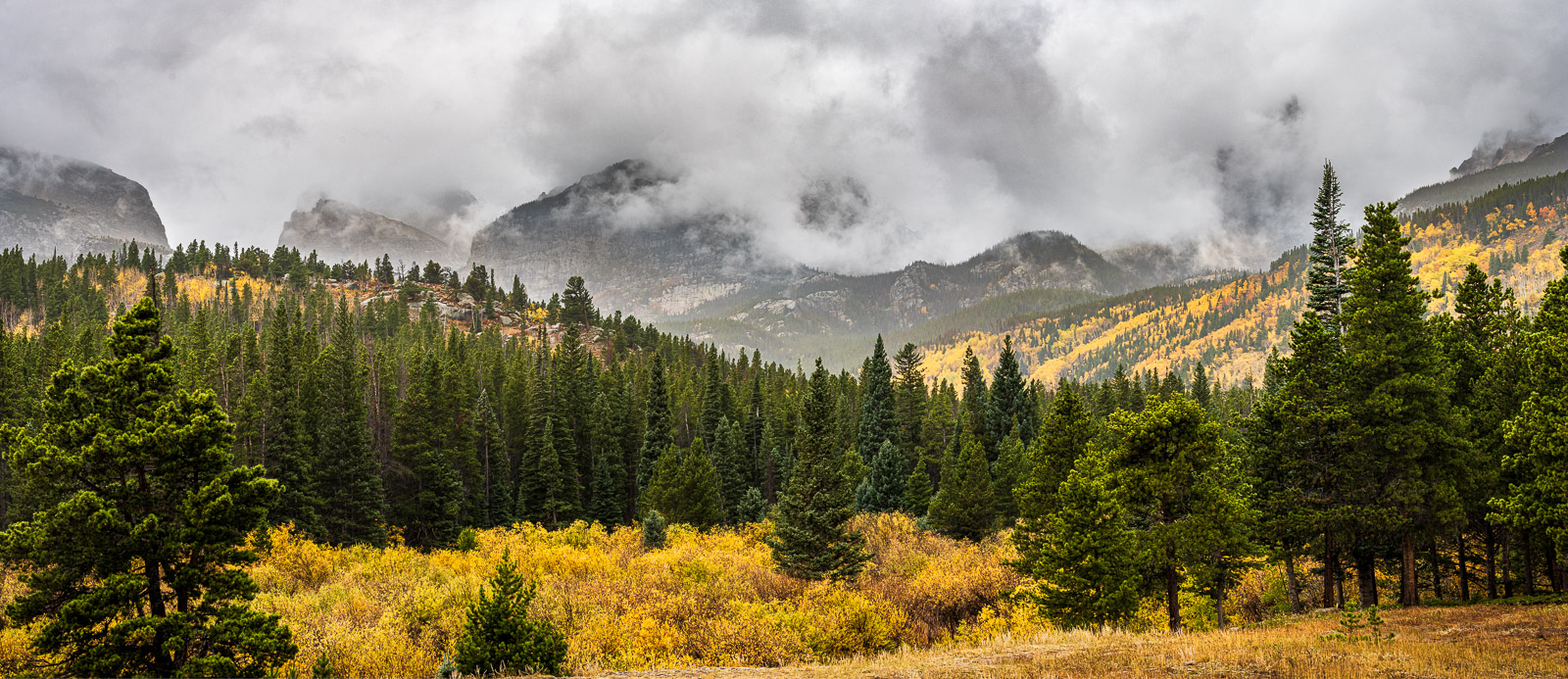
    Rocky Mountain fall panorama©Ed Schlotzhauer

    Taken by pictures

    The concept of being taken by pictures is one I picked up from John Barclay. It resonates with me, because I have seen it working in my art.

    What I have seen in my photo shoots is that sometimes something special happens. We no longer are looking for pictures. We have found a subject or place that captivates us. It releases some kind of creative energy within up. We are not just trying to take a picture, we are trying to capture the magic we are feeling. We have to shoot this. There is no choice not to.

    It may be very easy or it may be hard. That is, the scene may present itself to us complete. We have found a treasure. We just have to compose it, set the camera, and take the picture. It is already perfect. Don’t mess it up;

    Sometimes it teases us. We know there is something great hiding there, just out of reach. Maybe we have to walk around to look for the right angle. Perhaps it is zooming in on the right piece. Or waiting for the right light, Maybe it is a matter of thinking about it to figure out what is calling to us. Whatever it is, we usually know it when we see it. The inner voice guiding us says “Yes!”. Then we know we have captured the essence we are searching for.

    When this happens it is very rewarding. We know we have glimpsed something great and good and we feel like we have captured a view of it.

    What is the difference?

    The difference is taking a picture vs making art. Taking vs giving.

    When you’re at the Eiffel Tower and you think “I like that and I should shoot it”, you probably know how to make a good record of it. You and 50,000 other people that day. When anyone sees it they say “yep, that’s the Eiffel Tower”. No passion. It is just a fact. You might even want to hang a print of it on your wall. But you could get the same thing from any print on demand web site.

    But when we are taken by a scene, there is an intensity and passion invoked in us. It is a personal experience. With luck and skill on our part, some of the feeling might be shared by some of our viewers.

    We did not take the picture to show it to you. We had to take it for us. It was something we were drawn to. It is like it was a gift given to us.

    Geese flying at sunset©Ed Schlotzhauer

    If it does not captivate you

    I use a recent trip to France as an example a lot lately. It is recent and fresh in my mind.

    I was unashamedly a tourist. That means I shot a lot of pictures because I felt I needed to record where we were and what we were seeing. Just like everyone else with their smart phones. Even though I was using a nice mirrorless camera, they were still mostly tourist shots.

    Some of these are nice. That is, they are sharp, well composed, and show what I want of the scene. I will keep too many of them, but just for my own private memories.

    But a few were moments where something spoke to me and drew me into an image. These times were meaningful to me. As far as images go, these were the Wow moments of the trip for me. Whether anyone else ever sees them or appreciates them doesn’t matter. They are special to me. When I go back and look at them I remember the feelings of the moment.

    It’s about emotion

    A common theme that recurs is that it is about passion, emotion. Did I feel anything deep or special about this, or was it a record shot? Record shots are pretty and a few will go into a slide show or book of the trip.

    The really meaningful images weren’t shot to a plan and were not shot primarily to record the event or place. They may be random occurrences. But these are special to me. Times when I was truly engaged and excited by what was there.

    If I wasn’t excited about what I saw, why should you be?

    Car wash brush abstract©Ed Schlotzhauer

    Don’t settle for just taking pictures

    So take pictures. But don’t settle for just taking pictures. Let’s turn up our sensitivity to hear when something is calling to us. If we are not actively listening, we will probably miss it. We know something great is there. Now we have to find it. Work the scene. Peal away the clutter. Follow your instinct. Let yourself be taken by pictures. It is worth it.

    When we get caught up in a situation like this, it doesn’t really matter if all we have if a cell phone. Use what you have. But follow you passion. Figure out what is really there and get the shot. Take the gift. Appreciate it.

  • En Plein Air

    En Plein Air

    This is a big buzz with my colleagues who manually put pigment on a substrate (e.g. they paint). There is an aura that makes it something exotic about creating “en plein air”. Actually, plein air is what I do, too.

    Plein air

    In itself, plein air art is not a new concept, or even an artistic concept. It has been done commonly by painters since the 1800’s.

    It is sometimes spoken like an advanced technical term. Something your have to be an insider to truly appreciate. But it is just an everyday French phrase. I have been studying French recently (another story) and was surprised to find this in normal use. It literally means “plain air”, or outdoors. Nothing fancy or hidden there. If you go to a “plein air” concert it just means you are going to an outdoor concert.

    Silhouetted tree at sunset©Ed Schlotzhauer

    In painting

    So if you are a painter and you gather up all your stuff and take it outside to paint scenes from nature or whatever is in front of you, you are painting “en plein air”. Does that make it different or special? Maybe. Monet thought so. I”ll talk about that in a minute.

    But to give the painters credit, it required some technical and workflow innovations for this to happen. We forget history sometimes.

    It used to be (pre-1800) that artists had to find or buy their own pigments. Then they had to purify them and laboriously grind them into an extremely fine powder and mix them in a binder, usually a type of oil. By the way, you know those beautiful warm, rust toned palettes favored by Renaissance artists in Italy? Ochre pigment was a common, naturally occurring mineral there. Coincidence?

    But then, sometime in the early 1800’s, the technology for producing and selling pigments already ground and mixed and in tubes was developed. This allowed the artists two things: first, they could get any colors they wanted. But second, and more important for this discussion, it became much easier to take your oils with you. As the desire to move about grew, enterprising vendors also developed smaller, portable easels and pre-stretched prepared canvases. Artists were not tethered to a studio nearly so much.

    Now artists could pack their gear into a relatively small bundle and go where they wanted. One of the places they moved was outside.

    Monet

    I find I use Monet as an example a lot. I like his work, but another thing is that he was an innovator and revolutionary. He fought the entrenched art establishment and helped establish a whole new style. Something photography is still struggling to some extent to do.

    Monet was one of the early practitioners of the plein air movement. One of the motivations of the whole Impressionist movement was his and others desire to paint outdoor scenes in the light of the moment. As Guy Tal put it in his marvelous book The Interior Landscape, (I get no incentives for promoting it) “Monet famously credited the success of his work to the emotions he felt when working out in nature … As Monet himself put it, ‘My only merit lies in having painted directly in front of nature, seeking to render my impressions of the most fleeting effects.’ “

    Working outside and observing fleeting effects. That’s what I like to do, too!

    Moving clouds, moving lights©Ed Schlotzhauer

    I work outdoors

    The same impulse motivates me, even though the technology I use is very different. I find and capture my images almost exclusively outdoors. Shooting in a studio does not motivate me.

    Seeing things most other people do not see excites me. Finding those things, even if they are little, seemingly insignificant things, that I can show you in a new way gives me joy. Especially if I can show you something and you share my joy and excitement.

    I admit I do not have the patience for painting. It’s too slow for me. Spending a few hours or days capturing a scene would be so frustrating to me that I would quickly give up. Seeing something, visualizing what this could be and what to do with it is hard and takes lots of experience. That is one of the fun and creative parts of photography to me. And it is fast enough to not bog me down or interrupt my creative flow. The process of capturing and producing the artifact doesn’t need to be so difficult.

    Other than post processing work on my computer, my images come from outdoors, en plain air.

    A new genre?

    Have I created a new genre of art? Should I trademark the term “plein air photography”? Sign up for my workshop!

    Well, I probably can’t do that. Photography has always been strongly associated with the outdoors. I think the first surviving photograph was an outdoor scene. Admittedly early photographs were outdoors because that’s where a good light source was available. Flash had not yet been invented. Even when it first was, it was difficult and dangerous to use (and smoky).

    But those are technical considerations. The fact remains that photography has always had a strong connection to the outdoors. Especially for crazy people like me who photograph outside year around in a place like Colorado.

    Snow, wind, cold - all the ingredients for a great photo shoot.©Ed Schlotzhauer

    It’s the outdoors that motivates me. I’m a hunter. That’s where I find most of my prey. And my inspiration. It is not an uncommon obsession. Look at publications like Luminous Landscape, Nature Photographer’s Network, Outdoor Photographer magazine and many others.

    To the painters, if working outside motivates you, excellent. We share a common bond. I hope the outdoors inspires us both to do our best work. But working outdoors is not a new concept or unique to painting. Plein air just means “outside”.

    I’ll be looking for you outside. But we will just pass each other. I’ll be moving about a lot discovering and shooting a lot of things while you are painting. Not to say one is better or worse, just very different art forms. Both en plein air. Let’s wave to each other.

  • Have an Opinion

    Have an Opinion

    I spent most of my photographic career just recording scenes. But now I think you probably won’t make a compelling image unless you have an opinion and express it in your art.

    Just the facts

    I started mostly focusing on just the facts. My goal was literal representation of scenes. I wanted to capture what was actually there, with no interpretation. I regret that.

    Being an engineer didn’t help. It is very easy to get caught up in technical details of resolution and depth of field. My excuse is that I grew up in Texas and moved to Colorado in my early 20’s. The mountains were new to me and I wanted to record everything I could. I was basically running around saying “Wow, look at this! I never knew this existed!”.

    If I had an opinion about it, it was something like awe and excitement about the new landscape. I took a lot of accurate, factual representational pictures back then, but very few are in any of my current collections. Beautiful images some of them, but little depth. Not compelling.

    Is it interesting?©Ed Schlotzhauer

    What makes it special?

    What makes an image special or worth lingering over? That is a hard question. Great photographers have been wrestling with that for 150 years. Painters have been agonizing over it for hundreds of years. There are no rules or definitive answers (despite all the rubbish you may find on the internet).

    I am not in a position to give you a definitive answer either. If I could it would make my art a lot easier to do.

    I think we can agree that some images jump out at us or hold us to linger over them. If we can agree on that then we can agree that there must be some quality or qualities that distinguish one from others.

    It could simply be the composition or lighting or the precision of the execution or the decisive moment or something in the scene that grabs our interest. Maybe some combination of all of that.

    I am drawn to believe it is all that but more. We see far too many well executed images of beautiful scenes that seem soulless, flat, uninspired. So there must be an unidentified quality that some get but others do not.

    It is probably oversimplified, but I speculate that part of it could simply be whether the photographer was excited about it. We tend to be drawn to excitement in others. When someone is telling us a story that happened to them, their excitement has a lot to do with our engagement. If it is just a “I went to the grocery store and got some oranges”, well, we quickly drift away. But if it is “I went to the grocery store and the most amazing thing happened…” then, if they can keep the story going, we will follow.

    Could it be that simple with our pictures?

    Express yourself

    I said when I started my photography I believed mainly in literal representation. It seemed wrong to try to project my feelings or opinion on them. Now I think I was totally wrong. That is why most of those early images were completely forgetable. I wasn’t truly being authentic because I was keeping my feelings to myself.

    One thing the great and very quotable Jay Maisel said was “What you’re shooting at doesn’t matter, the real question is: ‘Does it give you joy?’”.

    Now I believe that unless I am feeling something strong, it is useless to press the shutter. I want to believe that my excitement will carry through in some of my images. The good ones.

    Another quote that guides me is “if it doesn’t excite you, why should it excite anyone else?” I think that is a Jay Maisel too, but I can’t find it. If not, maybe I’ll claim it. 🙂 Either way, I believe it. Why should you care about any of my images unless they came from something inside of me? Not just pressing the shutter button and capturing what is there.

    So it is not enough for me to just capture an image of something. I want you to know what I was feeling, how I perceived it. I may have loved it or hated it, but you be able to sense it and participate in it.

    It is not only OK for me to express my feelings, I think it is completely necessary to make something good.

    Curious reflections in a shop window©Ed Schlotzhauer

    Nobody has to agree

    But there is a dark side to human nature: when we express our feelings, some people will not agree. I know now that that is fine. When I took the attitude that everybody does not have to like what I did, it was tremendously liberating.

    So now when someone says “I like that” or “I don’t like that” I basically ignore the comment. It is no use to me without more discussion. Actually, if someone does not like a picture I love to get into a conversation with them to find our why they felt that way. I will not change my image and I do not try to change their mind, but I am always curious about the reasons for negative reactions.

    One of my goals is to create a reaction in you. I’m generally a positive and upbeat person and that is more often the type of reaction I aim for. But I would rather cause you to hate my work than to be indifferent to it. If you are indifferent I failed to move you at all.

    I encourage you to fall in love with your subjects. Or find the subjects that revolt you and you want to have changed. Either way, feel something. Strongly. Your audience needs it and deserves it.

    Today’s image

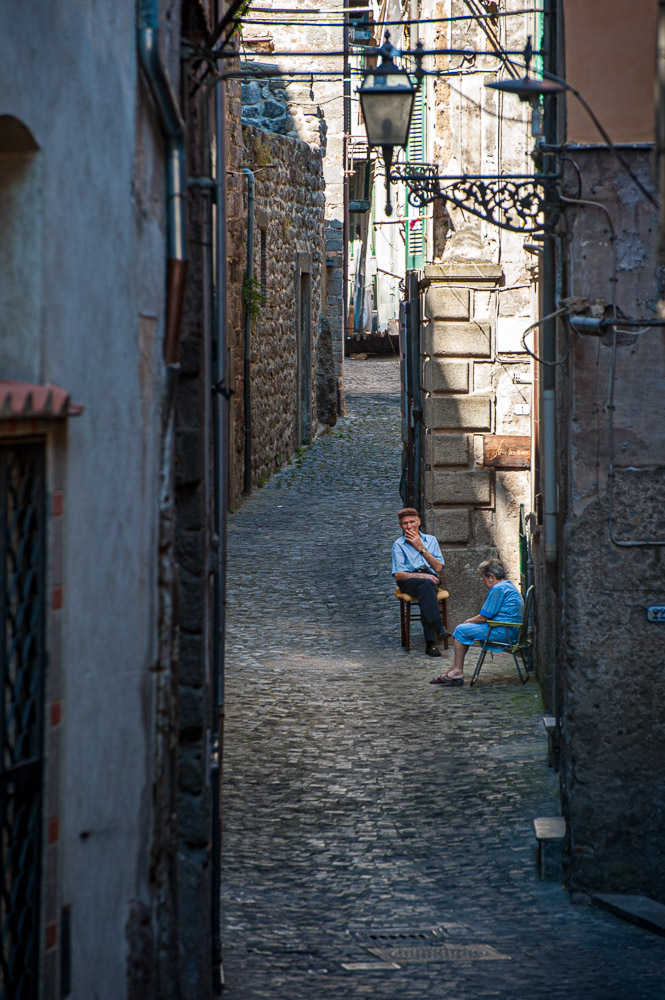
    This was a quick “grab” shot, but that was because I did not want to disturb or upset the guy looking at me. I was more shy then. This has a lot of feeling for me. I was suffering and I’m sure they were, too. It was in a village in central Italy and it was about 100°F that afternoon. We were dying and the only people stupid enough to be out sightseeing. This old couple seemed to have found a relatively shady spot in the narrow street. Hopefully with some breeze. I’m sure that other neighbors would soon gather for their daily ritual.

    I fell in love with the area and the way of life. They seemed to have contentment in their circumstances and the pace and traditions of their life. I came away with great respect for them. I wish I would have visited with this gentleman, but the heat was about to take me down and I don’t speak Italian. I’m pretty sure he did not speak English. So I let it go be. I’m sorry for that.

  • Human Effort

    Human Effort

    I have been considering what makes “art”. I have only gotten as far as believing a necessary ingredient – maybe the only one – is human effort.

    Random beauty

    The world is a riot of random beauty. Flowers, trees, waterfalls, mountain ranges, oceans, sunsets abound. When you think about them, most of them are exceptionally beautiful in their way.

    I am blessed to live in Colorado. We have all of those things above (except oceans) and more. It is fall here as I write this. The last two weekends I have been out for long drives within a few hours of my home. The fall aspen colors are great. I’ve seen waterfalls and mountains and interesting trees and even burn areas – yes, they can have a kind of beauty of their own. It is a new moon time and I have been blown away by the beauty of the night sky in dark areas of the mountains. I’m not bragging. Most of you probably live in a beautiful area if you learn to appreciate it.

    Beauty like this and grand landscapes are some of the first things that come to mind for most of us when we think about going out to take pictures. How can we not take great pictures when we are surrounded by natural beauty? Well, that’s where the difference happens that changes it from a pretty picture to art.

    Blank canvas

    Let’s look the other direction and imagine our self a painter. We have a blank canvas in front of us. What will we put on it?

    This makes it a little easier to think about creativity and art. One of the unique things about photography is that the sensor records whatever we have framed in our viewfinder. One of our challenges is to very selectively limit what we want to see. Painters must design their composition and add every element, color, and brush stroke manually. A very different skill set, but still, as I will argue, the same kind of art.

    So everything that ends up on the canvas had to be consciously placed there by the artist. What the painter creates is undeniably a work of human effort.

    Interpretation

    Have you experienced a time when two photographers have been together at a location, but you each got very different results? How can that be? You saw the same scene in front of you but made something different out of it.

    Actually, that is not only common, it is typical. It is a difference between art and reporting.

    When a newspaper journalist (there are still a few of them) sees a scene or event, if they are an honest reporter, their goal is to accurately report it to their readers. They want to capture the essential information without bias, while keeping it interesting. Whether in words or still images or videos, they want their audience to have an detailed first hand account of it.

    But let’s say another crew of filmmakers was there at the same time. They have no implied imperative to be factual. Their focus may be on the drama of the scene, or it’s visual impact, or how it affects people, or even how it supports their particular political bias. Is this group doing a bad job?

    No. Not if they are clearly interpreting events from a subjective viewpoint. What they bring back will probably be vastly different from the newspaper reporter. It may even be difficult to believe it was the same event. By taking a loose interpretation of facts, they had more freedom to create art.

    When you are out photographing, are you reporting or making art?

    Two photographers

    Let’s get back to those 2 photographers at the same scene. It could be that one takes a very conventional, factual approach. Implicitly he believes this landscape shot should encompass his field of vision and it should show “just what he saw”. No more. No less. The result could well be a beautiful photo that many people would love to hang on their wall.

    ©Ed Schlotzhauer

    But let’s say the other photographer takes a very different approach. Let’s say for him, a wide shot of the whole scene is not how he relates to the spirit of the place. Instead, he zooms in on a small part of the scene. Say a small cascade with fallen leaves on it. By getting low and close and using a slow shutter speed and a polarizer, he gets the motion of blurred water among the rocks with reflections of the seasonal colors. Not something you could look at and definitely know the location. But the viewer gets a feel for the place and time as expressed by the photographer.

    Which is better? I can’t say. Maybe neither. Depends on their skill and vision. But one is more likely to be art.

    Created

    Now we come around full circle to my statement about human effort. One photograph is exactly what you would have seen if you drove to the same overlook. Some skill was required to successfully capture the image, but you know almost nothing of what the photographer was feeling about the scene.

    The second image demonstrates effort by the artist to create a scene for us to see. By scanning, evaluating, focusing in, moving, they bring us to a new point of view. This photographer is trying to create something beyond a straight image anyone would have seen and taken. It has (potentially) elevated the dialog and given us a new insight. I say potentially, because it may be a failure. Still, he tried.

    I am showing my biases. For me, at this point in my journey, the more interesting images are the result of effort to understand and interpret my feelings. It is not totally black & white, just a statistical prediction.

    Human effort

    These feelings about human effort are not just my own conclusions. Are there any original thoughts left to think?

    W. Eugene Smith, for instance, said

    “I am constantly torn between the attitude of the conscientious journalist who is a recorder and interpreter of the facts and of the creative artist who often is necessarily at poetic odds with the literal facts.”

    Guy Tal pointed out in his great book The Interior Landscape that

    “Poetry” derives from a Greek word meaning “to create” or to bring something into being. “Art” derives from a Latin word referring also to items brought into being by human skill (as opposed to things occurring naturally or randomly).

    So “art” and “poetry” basically mean the same thing, just from 2 different languages. Art is an act of creation that comes as a deliberate use of human skill. We bring something into being. Our art may be, as Smith said, at odds with the literal facts. I like that phrase.

    Is it art?

    Ah, the existential question behind all this. What is “art”? At this point, I have to come down on the side of a definite “I don’t know.” I have heard it said that “anything created as art is art.” I’m at a loss to do much better than that. I say that because I look at a fair bit of “art” and for a lot of it, I have to just scratch my head and think “Really? What were they thinking?”. So I obviously do not understand. Maybe I can’t understand.

    But for this little subset of the universe I am writing about today, maybe we can make some judgments.

    So, is photography art? Yes. It absolutely can be. If it is created as art, it is art. It requires artistic sensibilities to do a good job. I’m not talking about selfies.

    Is a representational photo less “good” than an interpretive one? I can’t say. It varies with time and context. You do what you have to do. Make your own art and follow your own values.

    ©Ed Schlotzhauer

    I used to be a straight representational photographer. I did everything I could to capture a scene exactly and in detail. Just like it was. Over time I have morphed into someone who values interpretation more. Even trending into abstraction and occasionally surreal. For the most part, if I show you something, I want it to be interesting and fresh. Perhaps that is a natural progression with maturity, like tending to prefer drier wine as your taste gets more sophisticated. I don’t know.

    Sorry to disappoint you. At this point I can only suggest you do your art and I will do mine and let’s not judge each other. If we are both happy with what we are doing, what else matters? And that is part of the beauty of it all. I used to be an engineer. One thing I appreciate as an artist is the much higher level of ambiguity. That is also a sign of maturity.