An artists journey

Category: Art

  • It’s Been Done

    It’s Been Done

    It’s been done. A dreaded phrase we hear all the time that is meant to dismiss and disparage our creative work. Don’t fall for it. Just because someone says it has been done does not mean you don’t have just as much right to do your own take on it.

    Over and over

    Artists have always done the same subjects over and over. There are only a limited number of subjects and not that many truly different ways to approach them.

    Are you not going to do ponds because Monet had “done” them? Are you not going to do a night sky because Van Gogh was the only one to be able to do that? Are you not going to do landscapes because there are no more to do after Ansel Adams finished? Are you going to forever avoid flowers because O’Keeffe did everything that could be done?

    Of course not.

    Are you going to avoid shooting any subject that has ever been photographed?

    Let’s see, landscapes have been done; portraits have been done; street photography has been done; abstracts have been done; food has been done; travel has been done… It is getting pretty hard to find something that has never been shot. Near impossible.

    So “never been done” must not be the important test.

    Every artist repeats subjects other artists have done before. The real question is, do I have something new to say? Can I make this fresh and unique? Can I offer something that will make my viewers think new thoughts?

    Writers, for instance, all write the same stories but try to make them fresh. It is said that there are only, depending who is giving the data, 3 to 36 fiction plots. All books are a variation of the basic patterns. A. Hyatt Mayor has an interesting take on it when he says: The really original artist does not try to find a substitute for boy meets girl, but creates the illusion that no boy has ever met a girl before.

    Likewise, can we create the illusion that our work is original?

    Do it different

    Just because a famous artist did the subject before does not mean they created the definitive work that can never be topped or even equaled. An artist should have an unshakable belief in his vision. We should not be timid and shy away from controversy. No critic owns the right to disallow your work.

    Creative thinking may simply mean the realization that there is no particular virtue is doing things the way they have always been done. Rudolph Flesch

    If we are going to do things the way they have always been done, then why bother? If we are just copying other work,that is not adding anything interesting to our art. Re-envision what has been done. Do it different.

    Creativity is not usually something radically new. Usually it is an incremental build on the past. It is the little twist we came up with that makes it uniquely our own. It is our own spin on the conventional way it has been done.

    I think artists of necessity are a little crazy. Obsessed. Focused. This drives us to separate ourselves from the crowd. To share our vision and show that we see things differently. I seem to be putting in a lot of quotes this time, so here are 2 more:

    Follow your enthusiasm … The only quality common to all great artists and creative people is that they are obsessed with their work. Richard Avedon

    If you are not criticized, you may not be doing much. Bill Swanson

    Apply your style and vision

    Our vision usually applies to the unique way we see the same thing other people see. We will not often see something that no one else in history has ever seen before. The secret is what we bring to the common. Can we make something new out of things everyone else sees? Can be see different? Be different?

    That is what we are called on to do as artists. Everything has been seen or thought of before. But how can we bring a new interpretation, a fresh point of view, an unencumbered view?

    Finishing with a final quote:

    I believe in looking reality straight in the eye and denying it. Garrison Keillor

    Most people are burdened with reality. A thing is what it is and can’t be anything else. What a limiting view! A thing can be almost anything we can envision it to be. That is creativity.

    Don’t waste time being an imitation of anybody. Spend your life being yourself.
  • Try it Different

    Try it Different

    Ruts. It is human nature to get in them. They are safe and comfortable. These days, safe is sometimes welcome. But ruts become boring and our work starts looking all the same. We do not grow as an artist if we are stuck in a rut. A great way to shake ourselves up and break out of a rut is to try it different. Force ourselves to “break the rules” we impose on ourselves. Do something we wouldn’t normally do.

    When we try it different, sometimes we learn new things about what we like and want to do. A great photographer, Karen Hutton, says “Whatever you usually do, try it different.” This is wise advice. It is self-help to maintain our edge.

    Different lens choice

    An easy way to start slow is to spend a few days using a different lens. Something you don’t normally use. This makes you look at your surroundings differently. It is amazing, but a simple thing like this can change your point of view enough to freshen your images.

    I discovered over the years that I naturally have a “telephoto eye”. That is, I tend to zoom in on details rather than shooting wide angle views. About a year ago I got an awesome 24-70mm lens for my new camera and it has become my standard lens. I now shoot the majority of my images with it. My POV has changed to adopt its range.

    Perhaps that means it is time to get a super wide angle or go back to telephoto. Just to “try it different”. πŸ™‚

    Different time of day

    Ah the magic hours, the golden light within an hour after dawn and an hour before sunset. It is beautiful. It is warm, the sky has great color, and the light is horizontal so it emphasizes texture and form. I tend to go crazy if I am in a great location at those times.

    But I see it presented as a “rule” that you never shoot between those times. Especially for landscapes. This is so bogus. The goal is to find the right light to create the effect you want for the subject you have chosen. I sometimes find the best light is at high noon. There is not a hard rule.

    Experiment. Work backwards from the light to the mood and subject. For example, you are out at, say, 1 pm. It is a sunny day with harsh light streaming directly down. Figure out what kind of mood is emphasized by this light and what subject would work best in the light. Look around with this mental filter and you may be surprised. Deep canyons often fit this. Also, vertical walls or buildings where the harsh parallel light shows off interesting texture or shadows. There is always something.

    Here is a short but good article that discusses choice of light. It emphasizes that “good light is light that matches your goal for a photo“.

    Do you find that must of your work is shot at the golden light time? Habits can be re-examined. Experiment. Learn to see the possibilities of different light.

    Different composition choices

    Now this is getting harder. I suggest you start shaking up some of your fundamental style beliefs. Photographers tend to spend years agonizing over whether or not we have a “style”. When we convince ourselves we have one, we’re afraid to step outside of the confines of what we believe our style is for fear of being lost again. The more mature we become as an artist the more we understand that we are our style.

    Compositions are made up of our choice of subject, lighting and mood, arrangement of forms, contrasts, and exposure. I recommend that you give yourself permission to play with all of these and more.

    If you are a landscape shooter, spend some time doing people, street photography. It will sharpen you eye and reflexes and it can be a joy. If you pride yourself on “perfect histograms” start playing with high key (overexposed) or low key (underexposed) images. It helps to impress the point that an exposure is proper if it creates the effect you want. A perfectly shaped histogram may be completely wrong if you were going for something else. An image is for the effect it has on the viewer, not its technical perfection.

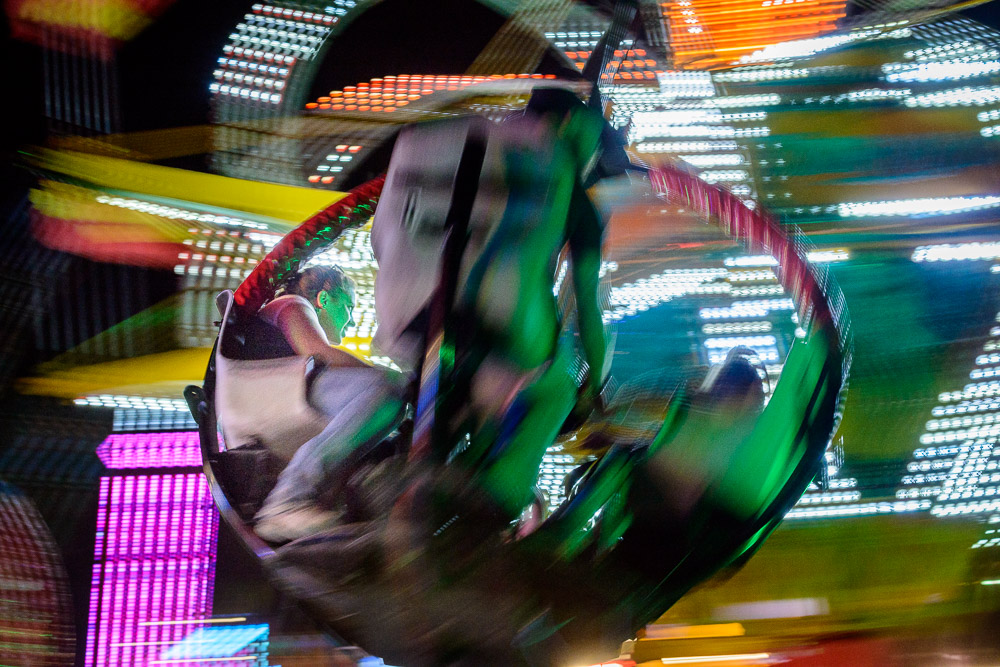
    I have a love of super detailed, “crunchy” sharp images. To explore that, I have challenged myself to experiment at the other extreme. I now sometimes do projects with little of no sharp or even identifiable subjects. Sometimes they are motion blurred or out of focus. Sometimes they are post-processed beyond recognition. I have come to love many of them and it has helped me discover new spaces I want to work in. The image with this blog is an example.

    Grow

    Sometimes we are our own worst enemies. We listen to what a teacher tells us and follow it without judgment. We get into patterns and stop questioning. Our work becomes routine, habitual. We stop learning.

    But just like we may be our own worst enemy, we can also be the agent of changing ourselves. Start experimenting. Take workshops. Study online courses. Read books. Tryout what other people tell you, but only keep what works for you. Examine yourself and your work, clearly and without bias.

    Does the work you are doing today look exactly like what you did 10 years ago? You may be satisfied with that, but for most of us, if we’re not growing, we’re dying. I know that my artistic vision is an evolving thing. It is always a little out of my grasp, so I have to follow it and try to keep up. I like it that way. I’m growing.

    Stay fresh

    Artists work on the edge. If we have just done work we like, we are compelled to better it on the next project. We are usually our own measure. That is, to see if we are getting better we compare our current work to our past work. It is part of staying fresh. We have to keep ourselves invigorated, rejuvenated, challenged. It is how we do our best work. We are driven by curiosity. The “what if” questions keep leading us in new directions. Habit kills thought.

    β€œA good shock often helps the brain that has been atrophied by habit.” Napoleon Hill

    How about you? Do you have a process for challenging yourself, for questioning conventions and norms, for keeping yourself sharp? A significant part of this is forcing yourself to sometimes try it different.

  • Far Enough

    Far Enough

    “You don’t know you’ve gone far enough until you’ve gone too far.”John Paul Caponigro

    This very insightful quote by Mr. Caponigro has become important to me. But before getting too far into it, I need to deal with a basic assumption it is based on. It assumes that you will be processing your images heavily. Not everyone believes or practices this. I didn’t either for a long time

    Do I need to process images?

    Yes is the basic answer. The bits that come out of the sensor that you load into Lightroom or whatever you use to process your images are not just RAW, they are “raw”. It is a faithful data capture but it is not what you remembered or want to see.

    Any image needs basic sharpening, contrast adjustment, color correction, and usually tone mapping. In addition there are esthetic changes like removing distractions, cropping, vignetting, etc. All this is usually necessary just to create a “straight” version of the image that faithfully matches the scene you saw.

    Once you have bought in to the need for processing, now the question becomes “how much?”

    What is the picture?

    Every artist must be able to answer for themselves what their goal is for an image. Is it a faithful rendering of the scene as they remembered it? Or is it to create an interesting piece of art?

    The answer has a lot to do with the type and amount of processing they will allow themselves. The answer is a personal and artistic decision. There is no right or wrong.

    For me personally, the further I go as an artist, not just a photographer, the more tolerant I become of serious modifications.

    On the other hand, in an article in the September 2019 issue of Photoshop User Magazine, Ramtin Kazemi states β€œI will never change the permanent subject matter of a scene”. His self imposed limit is that he will not move a tree or remove a boulder, although he may make dramatic changes in lighting and color. He will also change “impermanent” things like clouds. This is his decision as an artist. I will not criticize his choice. That does not mean it binds any boundaries on my artistic vision.

    How far is enough?

    When you give yourself permission to dramatically alter the basic image it opens up significant artistic opportunities. The digital tools we have today are marvelous. Artists today can do far more post processing than ever before; vastly more than chemical darkroom users ever could.

    We have such an embarrassment of riches that it can be a challenge to know when to stop. This is part of what Mr. Caponigro was talking about. How do you know you have taken your artistic vision to its limit?

    You do it by taking it beyond your limit and them backing off. I believe you will only know what your personal limit is in any dimension by going to the point where you say “too much”. Now you have found a limit for this image for where you are right now. In other words, the limits are moving targets and you need to keep pushing to find where they are today.

    And that is just talking about post processing. The same applies to how we approach all of our art. Push the boundaries. Keep trying new things.

    Use the tools

    The marvelous tools we have usually allow non-destructive editing. Most of the tools have a workflow that can be adopted to allow us to remove or modify changes and make different decisions in the future.

    For instance, Smart Objects in Photoshop allow most adjustments to be edited at a later time. Using new layers and adjustment layers prevents making permanent changes in the basic image information. Lightroom is inherently non-destructive for al its adjustments.

    So assume you do your basic image correction in Lightroom. Push all the adjustment to the point where you say “I don’t think so”, then back them off to the point that seems best. This works for all the controls in Lightroom. You can come back to an image months later and visualize it differently. You can re-process it with no loss of fidelity. I do this often.

    I occasionally see artists doing tutorials who still do destructive editing. That is, they do things like making a couple of adjustments in Photoshop and then merging them down. This commits them as a permanent, uneditable part of the image. Their work is beautiful. They must have such confidence in their artistic vision that they know they will never change their mind.

    I admire them, but that doesn’t work for me. I am forever learning and seeing differently. I like doing “what if” exercises, where I take an old image and try new things with it. I am sometimes amazed at what I discover.

    Is there a “too far”?

    If there a “too far” point, it can only be decided by each individual artist. I know I lean towards a lot more processing of my images now than I did a few years ago. I also realize it is a moving target for me.

    On any individual adjustment I can usually find a “too far” point. But in the larger sense, I do not believe there is a fixed point beyond which we should not go. There is no edge of the earth point where we fall off into chaos. The limit for any image is determined by my current artistic vision and my intent for the image. It is fair game to use any and all of the tools available to create the art I visualize. Ultimately, the far enough point is a personal judgment.

    Your mileage may vary.

  • Dealing With Plateaus

    Dealing With Plateaus

    Plateaus are not only common in the landscape, they happen metaphorically in our lives in various ways. A simple dictionary definition of the type of plateau I am discussing is “a state of little or no change following a period of activity or progress“. In other words. we’re stuck for a while.

    Life is not a linear progression. We’re not always moving forward to achieving goals and bettering ourselves. No matter how good our intentions or our will power, there are plateaus where things go level for a while.

    This is frustrating, but something to accept. The plateaus are probably necessary to let us regroup and “catch up”. Kind of like getting a good night’s sleep. Usually we go on and start progressing again.

    Like losing weight

    Some of us have a body type that easily puts on weight. When it gets bad, we have to take some action to get our weight back in control. I hope you don’t have this problem.

    Dieting is a futile activity. It doesn’t work long term. My strategy is cutting back eating to what I need and getting more exercise. But this is not a rant on dieting.

    As I lose weight I hit plateaus sometimes. There doesn’t seem to be a reason for them. I haven’t changed what I’m doing. It’s just that sometimes the same actions do not get the same results. Sometimes my weight even goes up with no discernible cause. It can be very frustrating if I don’t remind myself that this is natural and expected.

    Plateaus in our art

    Progressing in our art is kind of like losing weight. We work at it diligently, but sometimes it is an up and down process and sometimes we get stuck at a plateau. I think we have to accept it and keep working.

    We can’t force it. Inspiration, creativity, the muse, whatever you call it is not a constant part of our life. We don’t know why it chooses to visit us sometimes and not others. But that is the way it works.

    As a matter of fact, what I observe is if we get too frustrated and try to force the creativity to happen, we are very disappointed with the results. Let it be and wait for it to happen.

    Be persistent

    We can’t force the creativity to come, but we can do things to encourage it. When we’re on a plateau, of even in a valley, I find it helps to train, to learn, to seek inspiration from other’s work. This is a great time for study, reading, reflection, trying new things. Not a discouraged resignation that our creative life is over. If a plateau is kind of like sleeping, get a good sleep. It helps a lot of things and life looks better in the morning.

    Keep working, just don’t focus on the truly creative work at this time. I know I always have a lot of filing and cataloging to do. Re-evaluating portfolio selections and changing things around. It is a good time to contact galleries and submit to shows. Do the dreaded marketing that I put off when I’m “too busy being creative” to do it. Maybe even catch up on my bookkeeping. Yuch. But is needs to be done.

    Accept the dark times, they will end

    Know for a fact that the dark times will end. Trust that your creativity is not “used up”. Creativity breeds creativity. If you have been creative in the past it will happen in the future. Probably even better and stronger.

    A plateau is a temporary stage. Our mind will decide when it is time to move on.

    Use the plateau time wisely. It will help you come out the other side stronger and better equipped to move on.

    Relish the joy of moving to the next stage

    Finally it happens. One day you wake up with a renewed vision, a new point of view, an eagerness to resume work. Rejoice in it. Fill your work with the new vision.

    You are rejuvenated. All is well. You are still an artist.

    Enjoy. Do your best work. Know that the cycle will repeat and more plateaus are coming. But trust that they are temporary and you will come out even better. That actually gives you hope.

    And I hope I will break through my current weight plateau and achieve my goals. πŸ™‚

  • Is Digital Imaging Going to Stick Around?

    Is Digital Imaging Going to Stick Around?

    Got ‘ya. πŸ™‚ Sorry to disappoint, but this is not a rant against digital imaging or a plea for a return to the “good old days” of film. Digital imaging is a technology. As such it should be a neutral consideration. It doesn’t matter if our art if it is created “digitally” or by some other means.

    It’s just a technology

    Art, by its nature, is created with a medium using specific technology. Digital imaging is the currently popular medium and technology used by most photographers. If I were writing this 30 years ago, the medium would be film and no one would give it a second thought.

    That is one reason I think it strange that people feel the need to qualify it most of the time. It is said to be digital photography using a digital camera and modified using digital post processing. To me that is putting undue emphasis on the technology.

    Pushing the limits

    Any medium or any technology has limits. Artists are inspired by pushing the limits of the medium. Whether it is painting or music or photography, a great craftsman knows the capabilities of the medium he is using. It becomes a game, a quest, to push the limits of the technology to create new art.

    But photography is fairly unique in that the technology is advancing rapidly. I don’t think people are inventing new cellos ( well, there are the electronic ones…). The quality and capability of oil paints is probably improving slowly, but not being revolutionized. Digital photography is a much less mature technology and it is based on the electronic and integrated circuit industry, which is huge and rapidly moving. Consequently we tend to think of getting a new shiny gadget that pushes out the boundaries rather than learning the limits and using them as part of our art. That is a problem for photographers.

    I love the quality of my equipment and the things I can express with it. But there is a tendency for most people to focus too much on the technology. The resolution, the dynamic range, the focusing, the low noise are easy to see as the important thing. I am glad these things are improving all the time. Too often, though, we get caught up in looking at what the technology can accomplish rather than focusing on what the artist is doing with it.

    Art is made by an artist, not a camera

    It is easy to get blinded by the brilliance of the technology and loose sight of the fact that ultimately, we should be talking about the art. Art is made by an artist, not a camera. An artist can make exciting art with a cell phone or a disposable film camera. Resolution and dynamic range do not make art.

    I am delighted to admit that my main camera is a mirrorless 46MPix wonder. The image quality is remarkable. I will confess that in one part of my work I like super detailed, crunchy sharp images. But I also, more and more, find myself making extreme abstracts that are unrecognizable from the original capture. The technology enables this, because the images have such depth and fidelity to begin with that they can survive serious processing. Pushing the limits. The technology lets me do these things. It does not do any of them for me.

    I love the technology and I make use of it, but it is not digital art, it is just art.

    It’s not perfect

    Saying that digital is just a technology also admits that is is not perfect. It is so good that it has displaced film, but it is not ultimate truth. Someday it too will be displaced by something else.

    A digital image is simply an array of pixels. That means there are artifacts that become obvious at extreme magnification. The sensors are getting better all the time, but that is a built-in limitation of the technology.

    A digital sensor can only capture about 14 bits of dynamic range (+/- 2). This is 16,384 brightness steps for each color. It is amazing how good this looks, but it is far short of the capability of the human eye. And the sensor is linear while the eye response is logarithmic. Again, the eye had a significant advantage.

    Technically, current digital imaging products are the best photographic devices that have ever been made. Technically. That does not mean they produce better art.

    Ephemeral

    Another important consideration for digital imaging is that it is and has promoted an ephemeral view of images. Digital images have fed the huge social media, entertainment industry, online viewing trend. People have become used to glancing at images for about 1 second or less and moving on. This has tended to devalue most images. Especially if they are on a screen.

    I don’t believe this short attention span culture is healthy for the viewers or artists.

    But there is a still more insidious problem with digital images: they have no physical presence. Did you at some time end up with a shoe box of family pictures that brought important memories back? Did you discover and enjoy a drawer full of negatives and old prints at your parents? Those do not exist any more.

    Digital images only exist on your computer or in “the cloud”. E.g. once the computer dies or you stop paying for the cloud, they are gone. Totally. No record of their existence. A career of art, a lifetime of family memories can disappear in an instant.

    This is a dark side of digital imaging.

    Prints are even more important

    Because digital images are so ephemeral, I believe it is even more important now to make prints of important images. Prints have substance, weight, physical presence. They seem much more real than an image on the screen. And they are.

    A print is “permanent” – well, maybe 100 years for a good quality pigment print on professional paper. When you handle it it has weight and the image seems important. It is something that can be displayed proudly on your wall to view often and for others to see. It can be handed down to others later. A print is a real material thing, not just a bunch of bits.

    Some photographers say an image isn’t finished until it is printed. More and more I’m coming to agree with that view.

    Will it stick?

    So, will digital imaging stick around? Sure. It already has. It is really hard to find film any more. Even harder to get it processed. Digital has become so clearly superior to the alternatives that it has displaced them all. That is not to say it does not have faults. Everything does.

    But digital is just a technology. It will dominate until something better comes along. A technology does not make art. What an artist does with the medium is art. A super high tech digital camera is not a requirement to make art.

    I would much rather be remembered as an artist than as someone who was very proficient with digital technology.