An artists journey

Category: Art

  • How Do You Upgrade a Boring Photo?

    How Do You Upgrade a Boring Photo?

    I recently got an email with this subject line. Really. And it was from a high profile photographer who frequents the internet. I won’t name names. It made me think, though, about boring photos. What to do with them? How to improve them? We all take boring photos on occasion. Should we upgrade them?

    What to do with a boring photo?

    My first reaction is to say throw them away. Or don’t take them in the first place. It seems a waste of time to spend a lot of effort working on a boring photo. It is a waste of resources in some ways to even keep them, because they are choking your catalog and disk, filling up your backups, and just creating clutter.

    A little further down I talk some about when and why you might want to shoot boring photos, but for here I question your intent. If you are a regular reader of this blog you probably have more than a passing interest in taking photos. Hopefully you have progressed to the point where you seldom make bad images. At least, you know how to do better.

    When I am editing a shoot on the computer – never in camera – I sometimes am almost yelling to myself “Boring! Boring! Boring!” Usually I throw almost all of that set away. Yes, I know photographers who say they keep everything, but that seems silly to me. It ascribes too much valuable to a collection of pixels that doesn’t do anything for me. Save yourself a lot of useless future work and throw it away now.

    Once in a lifetime images

    But what about that once in a lifetime trip or a one of a kind event? Sorry. I’ve been there, too. Maybe I was so excited that I didn’t get the camera settings right. Maybe in my haste the shutter speed was too slow and everything was blurry.

    Keeping some bad photos of that special trip to Paris is fine, for your memories only. Working on a few of them to try to make them better is a good idea because they are personal to you. Never think you can show them to anyone else outside your family. And never try to enter them in a portfolio submission. Be realistic. If they are not good, they are not good. Only show your best.

    The only major exception I can think of only applies if you are a photojournalist. A key shot of an important event can be perfectly acceptable and publishable even if it is flawed technically. In this case it’s the subject that is important.

    I’m not being judgmental. Your mileage may vary. Set your own standards.

    Why shoot boring photos?

    Circling back to the idea of shooting boring photos, why did you do it in the first place? You know how to do better. Why not always try to take exceptional photos?

    I’m not saying you need to interrupt the family trip and spend 3 hours “working a scene” with tripod and a selection of lenses, waiting for the right light. That would be rude unless you have a very understanding family and a flexible schedule. No, but you can apply what you know of composition and lighting quickly in most situations.

    You know, the basic stuff that makes a huge difference: look for a good vantage point, try a step to the left or right to see if that improves the composition, think leading lines, contrast, pattern and repetition, foreground/background, nail the exposure. I’m sure this is familiar to you. Learn to do it fast and automatically when you need to. Applying decent workmanship to a photo when you are taking it can improve a lot of them.

    I wouldn’t presume to tell you to never shoot a photo if it is boring. Doing that is your decision and there are times it is valuable to you. Just make sure it is a conscious decision. That is, don’t be surprised when you look at the photo and find it is boring. Know when you took it that it will be boring and do it anyway if it is valuable to you.

    One compelling reason why I sometimes shoot boring photos is when I am experimenting. When I am trying new techniques or styles the results may not be exciting at first. I do this a lot. This is that area where I knew I was taking a chance, and if they came our boring, well, I can still evaluate the results of the technique I was trying. One way of another, I learned something. I’ll improve it next time. I wouldn’t do the experiment where I was very concerned about getting a lot of keepers.

    When to keep boring photos

    I freely admit I keep some boring photos. I even intentionally make some. Usually this is to use parts of them as raw material for compositing or texture or skies. Not every image needs to be great and complete in itself.

    Compositing is a creative and fun exercise. It is interesting to build a new image from pieces of others. It is a new way of thinking. To do it, you need a good library of “parts”. This is challenging and needs some time to build.

    Building your library is not an excuse to keep bad images, though. When you want to composite images together, each part must be strong enough to carry its weight in the resulting image. Say you want to “mine” a photo for its sky. The sky has to be large enough, the right perspective, the right lighting, exposed the same way, and sharp enough to be included with the other pieces. That is a reason to rescue a boring photo, if the part you want to use for something else is not boring.

    The other reason I routinely keep them is for my memories. But I hide them. That is, I do not show them or kid myself they will ever be anything other than a boring photo.

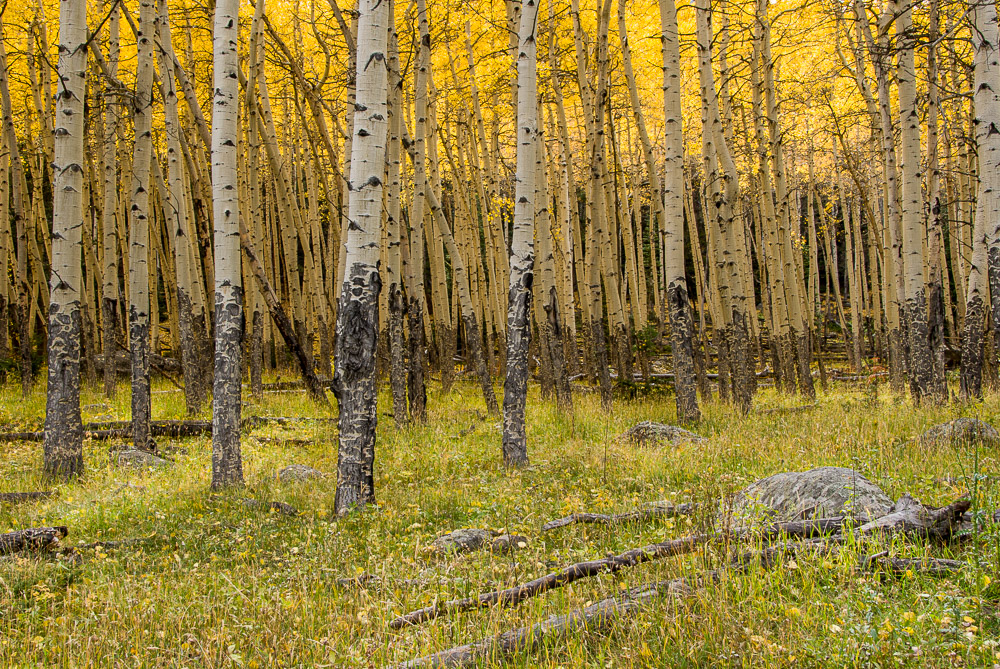
    Sometimes, rarely, I am undecided about a set of images. I may keep them and let them age. Later on, maybe weeks or even months later, I may find there was something there calling softly to me that should be explored. Usually not, and I throw them away. πŸ™‚ The image with this article is one of those exceptions. Something told me I should keep it, although I didn’t know why. Years later I noticed the rock and fallen trees in the foreground looks like a dead horse. That was the interest that didn’t register with me consciously. I like it now.

    If it comes out boring

    Despite your best efforts, sometimes you find you have shot a batch of boring photos. It is a learning opportunity. Evaluate why. What were you thinking when you shot them? Is this the result you anticipated? You were excited when you took then, why did they come out boring?

    This batch probably cannot be salvaged, but maybe you can avoid repeating the experience in the future.

    So boring photos? Don’t do it. Learn to do better. You should seldom shoot boring images unless you have a well reasoned need to. Make your compositions and camera handling smooth and automatic so your photos will improve. Don’t give in to wishful thinking – bad photos are bad. Don’t waste too much time trying to polish them. It will be disappointing.

  • Seeing

    Seeing

    We take it for granted. Of course we “see” things. But seeing is a marvelously complex and personal process that warrants more thought.

    Forget the mechanics

    The typical way “scientists” study something like sight is to break down the details of the mechanisms involved. So they investigate the ability of the cornea and lens to focus images on the receptors at the back of the eye. On the way the optic nerves process and transmit the data. On the rather large section of the brain that processes the data into what we recognize as “seeing” something and recognizing it.

    It is a very complex process. But looking at it this way is a classic “can’t see the forest for the trees.” It matters little to us what mechanisms we use to perceive images. What matters is that we do. And the process is vastly more complex than the scientific mechanisms would lead us to believe.

    Perception

    When we take visual stimulus into our brain it elicits different responses in different people. Sometimes, different responses in the same person at different times. This is part of the vast complexity of “seeing”.

    Our perception is based on, among other things, our experience, age, education, health, environment, personality, even what we had for lunch. Because of this, what we perceive is different from anyone else in the world. Even identical twins perceive images slightly differently.

    We should always keep in mind that our perception of a scene or a work of art is unique to us. When anyone tells you that you should see it a certain way or this is the interpretation of the image, walk away, quickly. They can only tell you their perception and they are giving you the message that their visualization is better and more complete than yours. Yes, there are societal norms and statistical groupings, but those only apply across large groups of people. They do not say what any of us as individuals should see or feel.

    Verbalize

    Have you ever tried to describe what you see or what it means to you? It is an interesting process. Speech is a very different mental transformation than visual interpretation. Some people are more verbal and some are more sensitive to images.

    When we see something, it creates something in our mind. Perhaps we file it as a memory. Maybe it invokes other memories. It could create a sensory impression on us, like calm or fear or stress. An image may even bring up a song or a smell.

    When we then try to express in words what we perceived it is an impossible task. We can give impressions. We may be able to paint some aspects of it in words. But we cannot create a verbal description that exactly represents the image we perceived in our mind. Words and speech are inherently linear. Information is conveyed through a sequence of symbols over time. Images are much more non-linear. We tend to “grock” the whole image before starting to isolate parts.

    Poets and authors have tried for centuries to paint images with words. They have some success, but the image I get from reading them is different than the one you get. And both are different from the one the author had in his mind. It is a beautiful and fascinating process, but it is different from our visual perception.

    What we experience

    If it is true that we all experience something different when we see a visual image, then is it hopeless to try to analyze it? No, because despite the range of experiences, most of us share enough common experience to appreciate similar things.

    We have all experienced beautiful sunsets. The experience may mean somewhat different things to each of us, but there is something built into humans that appreciates a sunset. Likewise, most people enjoy looking at portraits of people. We are wired to be interested in other people. Again, we each may see something different, but we like it.

    And an image may touch something in you but completely miss the mark with me. That does not say the image is good or bad, but it creates a different response in different people. This is part of the wonderful complexity and depth of viewing images. But can we get deeper in the process?

    Examine it

    I said we should be afraid when people tell us what we are supposed to see in an image, but that does not mean it is wrong for us to analyze what we see. One difference between casual viewers and those who really appreciate a work of art is how deeply they examine what they see.

    Most people are content to be at the “that’s pretty” or “I don’t like it” level. The art creates a response, but they do not reflect on why. To appreciate art more it is necessary to develop a “vocabulary” to express our understanding of it. I don’t mean we need to be able to write a detailed verbal analysis of it.

    Art is seldom created in a vacuum. It builds on traditions, on work of other artists, on classic subjects or themes, on recognized styles or techniques. As we mature and get more familiar with a range of images we can understand a piece in context. We can examine the color pallet used, the style of representation, the tradition it aligns with, and other images we have seen of similar subjects. Then we can start to understand more deeply. We can see that this artist is kind of like this other but departs in these certain ways. It is clear that this is a new twist on something commonly done by a group of artists we have seen. All of this is just a layering of understanding to help us see the work more clearly.

    Trying to be explicit about our reaction to an image forces us to examine our feelings and even beliefs more closely.

    Art should elicit a response

    It seems a truth to me that art should create a response in the viewer. Otherwise it is just documentary or illustration. I want my images to have an immediate and visceral effect on you. I hope it is not just a dismissive “it’s pretty” as you go on to the next image.

    I will go out on a limb and state that if you don’t love my image you are viewing, I hope you hate it. It is better to me for you to react strongly one way or another rather than to be indifferent.

    Do I need you to spend significant time analyzing my images in order to appreciate them? No, I cannot demand that of you. I hope you do want to contemplate them a while, but it would be foolish of me to expect everyone to view them as an artist or an art historian.

    I hope something about my images grabs you, compels you to spend some time with them. As you view them I hope you are intrigued and want to figure out things about them and why you like (or don’t like) them. The process of figuring this out for yourself will help you come to a better ability to express and understand your interests and likes.

    Understand your preferences

    Ultimately your response to a piece of art is your personal experience. It doesn’t really matter if the artist is famous or respected, you have the right to decide for yourself if you like or dislike their work. Who knows? You might like work by an unknown like me better than a Picasso or John Paul Caponigro. πŸ™‚

    One reason there is so much art and so many artists is that it is all very personal. There is no “one size fits all”. Each of us is still at liberty to decide what we like. I recommend that it is healthy to think about what you like and prefer in art. Learn to articulate it, at least to yourself. This way you will understand your preferences better and have a firmer grasp of your interests. Then, when a well meaning friend tells you “no, you can’t like that” or “you must like this” you can gently and persuasively correct them and defend your decisions. They will be impressed. So will you.

  • Is It Interesting, Part 2

    Is It Interesting, Part 2

    In the first part of this I made a point I learned from a book on poetry, that if it isn’t interesting, no one will read it. It doesn’t matter how formally structured or well composed it is. More and more I am coming to believe this is true for most art, too. But how do we get from boring to interesting?

    Familiarity

    It is conventional wisdom that you do your best work in an area you are familiar with. I sort of believe this, but I violate it all the time. Being an explorer nature I get a lot of energy out of photographing in new areas. Things seem fresh and waiting to be discovered. I get really psyched in interesting new places.

    I am getting enough experience to see the other side, too. Yes, having familiar places can help us to make more interesting images. We learn the range of possibilities. We see the variations with seasons and weather and light. Familiar subjects give us an opportunity to pick and choose. To wait for the best conditions without having to feel rushed because this is the only time we will see this location.

    Once we become well acquainted with an area we can develop a more sophisticated view of it. We won’t waste our time on shots that have little hope of being good. This is a progression to shooting more interesting images.

    I do not feel this is an absolute. That is, it is incorrect to take it to the extreme and sat you will only get interesting images of areas you are familiar with. But I do agree that familiarity probably makes it easier.

    Recording

    Most of us have a progression we go through. We start out making record shots of places we visit. Of the billions of photos taken every day most are record shots or selfies. Have you ever gotten stuck being forced to watch 2000 pictures of someone’s trip to Disney World? Just shoot me.

    I call this taking pictures “of” something. We are recording the superficial. We have not formed a refined artistic opinion of the subject. This is still operating at the “oooh, pretty; I will take a picture of it” level.

    If you follow this blog you probably do a much better job than average. Our record shots can be well composed and exposed. They are decent images. But mostly they are there to record an event that will trigger a memory for us. That doesn’t make them very interesting to other people.

    I’m not being critical, really. We all react this way when we see a new thing that captures our interest.

    Interpreting

    After we get over the initial excitement of a great new location, we can start to examine what we are being drawn to. We become more aware of our feelings and perceptions. Now we can peel back some of the superficial and uncover deeper aspects of the subject.

    I call this taking pictures “about” something. It reveals to our viewers a new side of the subject or our emotional reaction to it. We are giving an interpretation of what we see. These images are probably more appealing than simple record shots.

    Being intimately familiar with a location or a subject does make this easier. Take trees as an example. I have aspen trees where I live. If I didn’t know them well, the first time I saw them I would get a “wow, an aspen tree” shot. After having seen thousands of them in all conditions I have a much more focused appreciation of them. There are far fewer situations where I will capture an image, because I look for certain compositions that appeal to me.

    Hopefully I now make images about aspens, not just of them. Because I appreciate them more, I shoot them more selectively.

    Saying something

    At this point, we have figured out what attracts us about the subject. We have refined our emotional attraction to the subject to the point we know what we want to represent to viewers. Now we can bring our creativity in to allow us to synthesize an interesting image based on our vision. This is above and beyond just our emotional reaction.

    To continue the aspen example, it is the difference between “I like aspen trees because” and “here is a fresh and interesting image; it happens to be of an aspen”.

    Unfortunately, I have to give up the description of what makes an interesting image. I don’t have the knowledge or the vocabulary to be able to quantify it. Actually, I don’t think it is possible to do it.

    Thousands of tutorials and books are out there to teach us how to become better photographers. They can help boost us from the taking pictures “of” to taking pictures “about”. We can study vast amounts of description about composition and gestalt psychology and eye movement and contrast and lighting and color harmony and art history and … All of this is extremely valuable and should be studied.

    I don’t think it is possible for any of the training to give us the secret of making an interesting image. It is too complex and subjective and personal. I sincerely hope it cannot be quantified. If it is ever reduced to a formula then there will be no room left for artistic vision.

    Vision

    At the end, artistic vision is the secret ingredient that creates interesting images. You develop it through your training and experience and self examination. It is unique to an individual. No two of us will have the exact same vision.

    People may not like your vision. It may not be popular – remember, van Gogh never sold a painting in his lifetime. But what emerges is your vision. Embrace it and develop it. Use it to make unique and wonderful images.

    Familiarity with an area or a subject probably helps speed the process. I do not believe it is a requirement. If it were, it would be foolish for me to go to any new locations to try to make images. I do not believe that. Once we have developed our artistic vision I believe we can quickly apply it it new situations.

    Example

    Since I do not know how to describe the details of what happens, I will give some examples. I love the Trail Ridge Road area in Rocky Mountain National Park. I am a frequent visitor there. It resonates with me and I have refined my view of it a lot over the years.

    I give 3 examples here of that progression. The first was taken many years ago. It is a picture “of” Trail Ridge Road.

    Image “of” Trail Ridge Road

    This next image was shot years later. I have a much different feel for Trail Ridge Road. This captures much more of my emotional reaction to it. Notice that here the road is less visible and important than the setting.

    Image “about” Trail Ridge Road

    Finally, the image at the head of this article is a very recent interpretation. I feel I am getting down to the essence of Trail Ridge Road and, I hope, it is interesting also.

    β€œThe first time, I usually skim off the outer layer and end up with photographs that are fairly obvious. The second time, I have to look a little deeper. The images get more interesting. The third time it is even more challenging and on each subsequent occasion, the images should get stronger, but it takes more effort to get them.” – Michael Kenna

  • Is It Interesting?

    Is It Interesting?

    I find myself pondering this question a lot these days. More and more I believe the answer to “is it interesting?” overrides many considerations of composition and technique. This is a personal judgment, of course. as is the question of what is interesting.

    Learning

    Art is almost as much about our training as it is about our natural creativity. We all start somewhere, whether we have formal training or we are self taught. When we are learning a skill or an art we concentrate on the mechanics first.

    The tendency is to focus our attention on what we are trying to master. This is natural. What we should recognize, though, is that we may not really be making art in the process. Yes, it is art in the sense that we create it as art, but it is not a mature and well rounded style yet.

    Technique

    Photography is possibly the most technical of the normal arts. We have to master many layers of technology to get skilled at the craft. There is the camera with its hundreds of settings and controls, each of which may help us make a great image or a terrible one. Then there is the computer system required to store and process the image. And the software we choose to use for managing and editing the image. If you are taking it all the way to the end of the chain, there is the whole printing process to learn.

    Each of these areas is a huge field that could require years of study to master.

    If this is where you are, plow into it. Work through the learning process. Get to the point where the camera is a comfortable tool that you can use with little thought. Ideally you should be able to adjust all the major setting in the dark, just by feel.

    The image processing software is probably an even bigger challenge. Photoshop is one of the deepest tools I have ever used, and that is from the point of view of a long career in very complex software development. There are only a few people in the world I know of who totally “know” Photoshop. Julianne Kost comes to mind, but then she is the chief Photoshop evangelist for Adobe. It is her full time job to be able to train people on any aspect of it. Others at about that level are Ben Willmore and Dave Cross. I study and use Photoshop hours a week but I will never get to their level.

    But the good thing is, I don’t have to be a Ben Willmore. As long as I know enough to realize my artistic vision, I’m OK. I know of excellent and successful photographers who I consider to have only a rudimentary knowledge of the tools. They know enough to do what they want to do. I personally can’t be happy unless I feel I have mastered my tools enough to comfortably use them as an extension of my creativity. So I study a lot. But that is just my own burden.

    It should be about creating interesting art, not our ability to use the tools.

    Composition

    The next major pillar of image making is composition. It is another thing that can become a lifelong study in itself. We can burrow into art history, visual theory, Gestalt psychology, and all manner of ideas and opinions.

    We start with only an intuitive feel for good composition, based on art we have seen and our inherent notions of what we like. Probably we cannot express in words what good composition is. As we study and practice we get to where we have a more formal view of it. We can critique our own or other images in terms of their design. Eventually, we can compose our images intuitively, without much conscious thought. We can repeatedly produce compositions that please us.

    Keep in mind that most of this time, we are producing images that are now technically “correct” and have “good” composition. But maybe nobody wants to look at them yet.

    Is it interesting?

    This idea was clarified for me in a book about poetry. (Writing Poems, Robert Wallace. The link is for a later edition of the book) Weird, huh? It is a book about writing poetry rather than a regular book of poems. I find hints and ideas to improve and better understand my art from all sorts of diverse sources.

    The author made the statement that if the poem is not interesting, what good is it? It can have wonderful form, metaphor, irony, symbolism, etc., but if it is not interesting, no one will read it.

    I believe there is something here to apply to our art.

    I have seen, and made, too many technically perfect, classically composed images of … nothing memorable. While I value sharp, well executed images, and pleasing compositions with flow and leading lines and great light, I have come to realize that is not enough by itself to really be art. This is, of course, just my personal opinion. But then all art is a personal opinion. πŸ™‚

    When you have mastered the basics I suggest you first visualize something that will make a memorable image. Then use your acquired skill to capture it perfectly. Don’t just work on technique. You’re better than that.

  • Take It Out

    Take It Out

    A lot of times, our image can be improved by taking out some of what’s there. This point of view tends to come with experience. When we start photographing the tendency is to go wide and try to get “everything” in the frame. It is a learned discipline to restrict our view and take out distracting elements.

    A subtractive art

    One way that photography is fundamentally different from most other arts is that the sensor in our camera automatically records everything it sees. Other arts construct an image by consciously selecting and adding elements to the frame. If you don’t like something in the scene you are painting, don’t include it.

    This creates a very different workflow and thought process for photographers. I have to be aware of everything in the frame in real time. That is, I don’t have the luxury of easily picking and choosing what I will include. Unless I am very careful everything the camera is pointed at will be recorded. Yes, I could spend many hours in Photoshop removing the things that distract, but I don’t like doing it like that. Besides taking a lot of time, I believe it is better to be careful when composing the image capture. I feel better as an artist to get the captured image as close to the desired result as I can get it.

    It takes lot of discipline to make myself aware of every bit of the frame. Even those far away corners where distractions seem to lurk. And those mysterious things poking in from the edges must be seen and dealt with. And that trash in view. Being aware is crucial. I must move or reframe to eliminate distractions.

    You are responsible for every part of your image, even the parts you’re not interested in. – Jay Maisel

    Elimination

    Photography is much more about elimination than inclusion – John Paul Caponigro

    Mr. Caponigro is on to a great truth here. I find when I am composing a shot that I’m caught in a strong tension. “What should I include?” fighting with “what should I exclude?”. Usually this battle plays out quickly in my subconscious. I have a lot of experience. But even so, I sometimes find myself blindsided. I look at an image and think “what is that doing here?” when I was blind to a distracting element.

    I find that the decisions to eliminate things often are more taxing that the ones to go ahead and include them. When you are unsure it seems safer to include it, just in case. This is usually the wrong attitude. If you are not sure it should be there eliminate it. Taking things out, to some limit, usually makes for more clear images. Anything that competes with the main subject and composition should be very suspect.

    Minimalism

    Does the desire to take out distracting elements lead to minimalist images? Maybe. Not necessarily.

    Minimalism tends to be an extreme. To me it can be a bleak and harsh discipline. My work is not minimalist. I love the richness of excellent textures and compositions that may include a lot of elements. Simplicity and reduction of distraction are different from minimalism.

    I would characterize minimalism as a mind set. The process is to take out absolutely everything that is not completely required for the image. My attitude is to strongly consider eliminating everything that seems to be distracting. I allow for occasional riots of seemingly useless complexity when I thing it adds to the image.

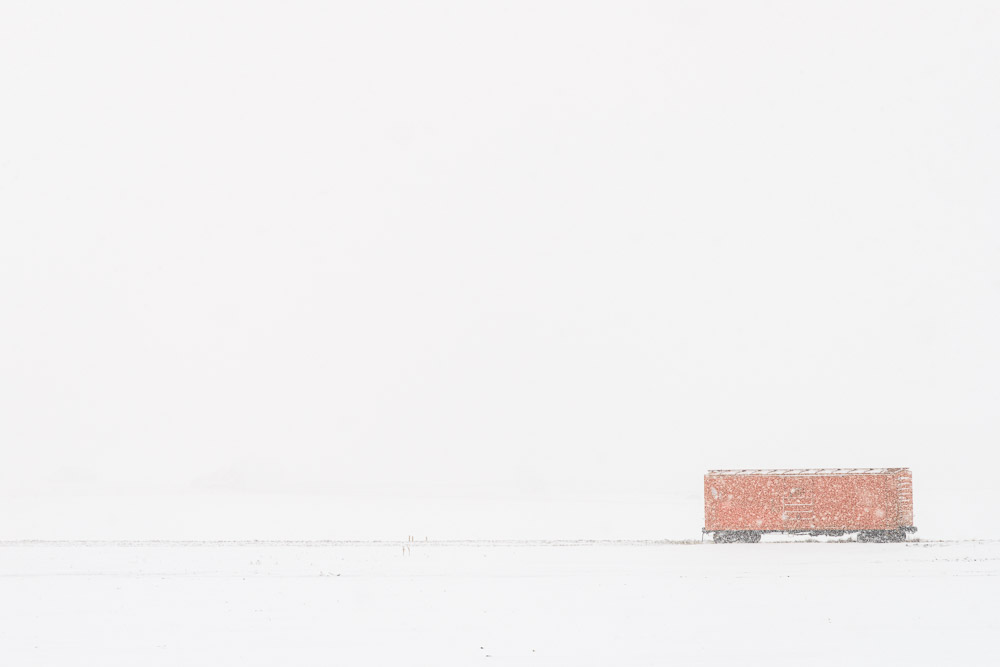
    The image with this post is borderline minimalist. If I had removed the grass and the hints of field it probably would qualify for minimalist in my mind. I don’t care. I don’t like labels.

    Ambiguity

    Less information often leads to more interpretation. – John Paul Caponigro

    Have you noticed in some paintings or songs or stories that less is actually more? Less complete information leads to some ambiguity. It allows space for the viewer to fill in what’s missing. Viewers like to be challenged a little, to have to work some to figure out an image. It is engaging and stimulating. It also allows for their private interpretation to be applied. They may well create a story that is different from what the artist envisioned. That is wonderful. It means the image is big enough to encompass multiple points of view.

    Enjoy the creative stimulation of the frame. Deciding what’s in the frame is composition. Where you put the frame is cropping. Keeping things out of the frame is selection, selectivity, defining the subject. Less is often more. Use your judgment and don’t be afraid to take it out.