An artists journey

Tag: fine art photography

  • It’s Complicated

    It’s Complicated

    Last time I wrote about the cognitive theory of vision that says we have a library of images stored in our mind and we automatically match them against scenes in front of us. This time I will say, it’s complicated. Nothing in life is that easy and straightforward. The simple theory can’t explain everything.

    To reference one of my favorite quotes from The Count of Monte Cristo (movie version). “it’s complicated”. Life and art is. A model, like the model I described last time, is a simplified version of reality. It may be useful to explain some things, but it cannot fully describe real life.

    The safe path

    If it is true that we are drawn to reproduce images we already know we like, we get stuck. Now, I think many people would acknowledge that this is true and they spend much of their career remaking the same images. Maybe they are OK with this. It is, after all, safe and comfortable.

    I can only speak for myself, but safe is not my goal. Safe gets boring and all the same. If I were a wedding or portrait photographer I’m sure I would have a different attitude. I’m not, so I can get as far “out of the box” as I want.

    Where is creativity?

    If we only remake images that match our mental library, where is the creativity? Where is that spark that takes us completely outside the normal? What causes a change of direction?

    The answer is: I don’t know for sure. But I know it happens. While I believe creativity is a learned process, it is undeniable that it sneaks up on us unexpectedly sometimes. Maybe we intentionally go out looking for something new. Maybe a familiar scene make us ask a question that leads us in a new direction. Sometimes we might have just had something weird to eat and it sparks our brain in a strange way.

    Be receptive

    I believe creativity is something you can practice and stimulate and cultivate. But those things only encourage it to happen. When it happens, when something new hits you out of the blue, you need to be receptive to it. Sometimes our natural reaction is to resist the risky new “thing”. We may not even recognize it as an entirely new direction at the time we first see it.

    Embrace the new idea. Run with it and see where it goes. At worst you decide you don’t like it. Better to have tried and failed than to not try at all. At best, though, it may change you. It may be a new viewpoint on the world.

    Think of Bilbo in The Hobbit. He did not want to leave home, but he came back changed in ways he could never have imagined. Most of us are not inviting life changing experiences like that when we follow a creative instinct. But it may be a close as we come.

    Personal

    I’m an artist. If I go through life taking the same pictures over and over, because that’s what is in my mental library, I am stale. I thrive on creativity. I enjoy following my curiosity to find new things. I am refreshed by expanding my vision in new ways. It makes me grow. It keeps me young.

    I embrace creativity, not for its own sake but for what it does for my vision. When I grow to a new place in my art I find I need to add some new images to that mental catalog and maybe remove some that I do not care for any more. That is life. That is growth. It’s complicated, but awesome.

    Let me know what you think!

  • When the Flash Goes Off

    When the Flash Goes Off

    The process of taking a photograph is intensely personal, yet there are probably commonalities among the population of artists. I am a hunter, a stalker. I call that instant when I recognize there is a viable picture in front of me “the flash going off”. It is often a blinding recognition.

    Disclaimer: some of this was inspired by Michael Freeman. I highly recommend his great book The Photographer’s Mind. It is part of a really good series. I will get no revenue from recommending this.

    Let the camera make the decisions?

    Long ago, back in the 1940’s, Bill Brandt said “Instead of photographing what I saw, I photographed what the camera was seeing. I interfered very little, and the lens produced anatomical images and shapes which my eyes had never observed.” I haven’t researched him enough to know if he was being truthful or if this was a tongue in cheek exaggeration.

    Maybe it works for you, but if I just let my camera roam unattended, it doesn’t do much useful work. Maybe I’m kidding myself, but I think I am completely guiding and directing the image making process. I may let the camera give me its opinion of things like exposure, but I make all the final decisions.

    A theory of the process

    OK, I make the creative decisions. How do I do that for scene selection and composition? Have you ever tried to analyze your process for making an image? Many of the things that happen are so fast or are part of such a deep experience base that we are barely aware of what is going on. And if we try to slow down the process enough to reflect on in, it becomes a muddle. I did an experiment once of trying to describe how to tie my shoes. I know how to do it, I can do it quickly and precisely, but to describe it – well, try it.

    A possible explanation of the photography process is taken from cognitive vision theory. The basic idea is that, over time, we develop a history of the types of images that we are drawn to, that excite us or interest us. A photographer creates a mental library of these images.

    The mind is quite fast at recognizing patterns and matching expectations. When we see a scene we seem to process it through our library and almost instantly recognize a promising image or reject it. This theory makes sense to me, as I recognize that scenes that have features I like seem to jump out at me.

    Drive by

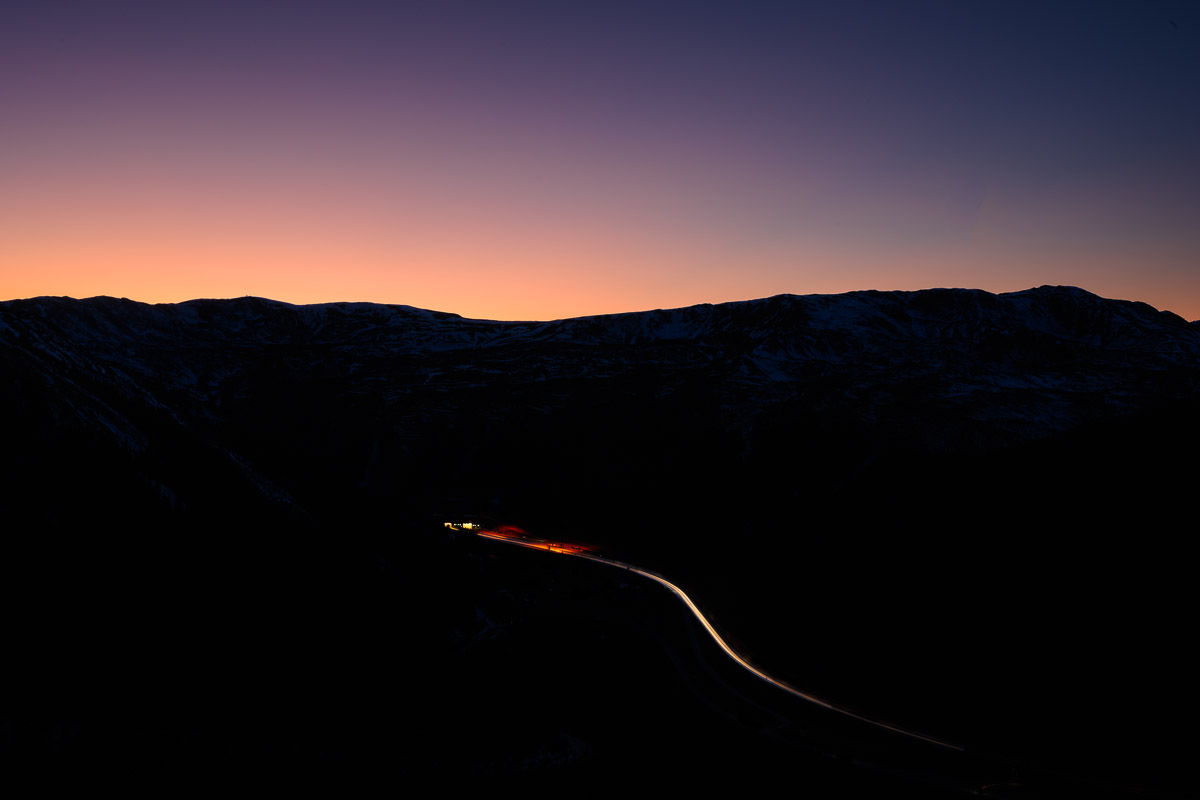
    Some anecdotal evidence for this is what I see of my scene recognition behavior while I’m driving. It is not unusual for that flash bulb to go off alerting me of something that is probably worthwhile to photograph – about a quarter of a mile after I drive by it. Like this image with this post.

    It is hard, mentally, to turn around on the highway and go back to check something out. It is especially hard when my wife is along. She rightly says “why didn’t you stop when you first saw it instead of having to go back?” I can’t get her to understand that when I am driving my mind is primarily occupied with that. The image recognition process is running in the background. This causes it to be delayed a few seconds. But when it gets a hit, it is like a highlight replay. It is clear and obvious, despite my having passed it by.

    I’m usually glad when I bite the bullet and go back for the image. Whatever triggered the response is usually worth checking out. I admit, though, I sometimes take a picture even when I don’t like the scene, just so I don’t have to admit to my wife that it wasn’t worth going back for.

    Learned library

    This library, if it really exists, must be learned. We don’t come prewired with it. Although it could be said that some things, like sunsets, are universal. How do we create the library? Well, we all see images all the time. When we see something that appeals to us perhaps we somehow add it to the library.

    A better way is to very consciously go through our catalog of images we have saved. Sort them into 2 piles, the ones we really like and want to build on, and the ones we are cool to and don’t really care about. Study the keepers. Decide what attracts us about them. Thinking about them will help build the library of images that match our vision.

    Conclusion

    The mind is incredibly powerful at recognizing patterns and matching images. Allow it to help sift through the clutter all around us. Pay attention when the flash bulb goes off. That is our pattern recognizer trying to tell us something important.

    Let me know what you think!

    To see the kinds of things I respond to, check out my galleries at photos.schlotzcreate.com

    Next week I will give an alternative viewpoint to this.

  • Something out of Nothing

    Something out of Nothing

    A great image is more than a subject. Sometimes the obvious subject itself fades to the back and the overall effect of the art becomes dominant. I would call this making something out of nothing.

    Geoffrey James, a Canadian photographer, has said “A photograph is more than its subject. The real challenge is to make something out of nothing.” He goes on to say “it used to be everything had to be beautiful, picturesque”, but he was now making images where the subject (something beautiful) was not the notable part of the picture.

    I don’t exactly subscribe to his vision, but the phrase captured me.

    I find myself frequently making something out of nothing. It’s subtle and difficult to explain. It is not normally about the beauty of a subject. And it is not “it didn’t work in color, try black & white“.

    Liberated from reality

    I am a fine art photographer. (the term is actually distasteful to me; I consider myself an artist who uses digital media, but that’s a subject for another article.) This is extremely liberating.

    One of the things this means to me is that the pixels I capture with the camera are just raw material. I am free to transform them any way I wish to create art. The resulting image may be “about” something entirely different than the original capture. Occasionally I see an opportunity to composite 2 or more images to make something different. I love doing this and I am sometimes surprised at the result.

    Back in my early learning curve, I was active in my local photography club. It was great experience and a good organization, except for certain aspects of the competitions. They were narrowly focused on the “purity” of the image. It could have some minor spotting and color correction and cropping, but that was about it. In other words, about what you could do in a chemical darkroom. I’m afraid I generated quite a controversy when I submitted (and won a blue ribbon for) a digitally manipulated image what had some serious warping applied. That was the beginning of my break from any assumption that an image should be “as shot”.

    The joy of Photoshop

    What a time to be an image maker! Photoshop is a marvelous tool for working with images. There are other tools, but I do not use them so I will not try to act like I know anything about them.

    Photoshop brings us almost infinite control over our pixels. It is far better control than the best darkroom masters ever had. We can adjust tone precisely and in totally localized regions. We can adjust color balance and tint in the most subtle or extreme degrees. It allows us to color grade, convert to black & white, remove distractions, selectively sharpen, warp and distort the pixels, and basically do anything possible with pixels. Pixels are raw material.

    So images are now completely malleable. There is no reason to stop processing an image until it is exactly what we see in our mind’s eye. When we get done, the image might have a completely different “meaning” or effect than the original. It has been fashioned into a different piece of art.

    What do pixels mean?

    This has been a difficult transition for me. Coming out of a background that valued a respect for the image “as shot”, it has been hard to give myself permission to push the original image into something completely different. But this is what art is really about. And I love it!

    In one sense, pixels are just pixels – a grid of little colored spots. They are a resource the artist has available to work with. Like paint on a canvas, they are there for whatever the artist wants to make of them. If the intent is to enhance the original image, that is great. If the artist wants to shape them into something completely different, that is their privilege and joy.

    We are no longer “stuck” with the image we captured. We can make it into something entirely different. In that sense, we make something out of nothing.

    If I have misused Mr. James’ quote, I apologize to him. I transformed the raw material through my own values and perspective and made something out of nothing.

    Note

    Please let me know what you think and what topics you would like me to address. I value your comments.

  • What is the Cost of Digital Imaging?

    What is the Cost of Digital Imaging?

    Digital photography is liberating. We are not limited to 36 frames on a roll. It doesn’t cost anything to shoot an image, so shoot anything you see. Wait, is that true? Is digital photography really free? What is the cost of digital imaging?

    The film days

    Ah, the good old days, right? Not really. Almost everything about digital imaging is better. For 35mm cameras, which is what I will discuss, film came in rolls containing up to 36 frames. Yes, I know there were some weird specials, but let’s ignore those. A roll cost several dollars and processing it cost about as many more dollars. It seems like my metric was that it cost $.50 per frame. And that was in the 1980’s. In todays dollars that might be $1-2 per frame. After you finished a roll it took several days before it was processed so you could see what you got. Horrible. Primitive. Intolerable by todays standards.

    Even a medium size memory card might hold hundreds of raw images and thousands of jpgs. The equivalent of that in the film days would be a large, heavy, expensive bag of film.

    And when you were traveling with the film, you had to take it out to be x-rayed at the airport. If you were shooting “high speed” film, say 800 ISO or more, you had to put them in lead lined bags or try to get the agents to hand inspect them to prevent fogging by the x-ray machines.

    Of course, when you go on a trip you have to carry all that bulky, heavy film back home. You usually did not want the expense of mailing them and the risk of them being lost in the mail.

    What a pain. And I won’t even mention the cost and problems of a darkroom.

    Digital solves the problems

    Along comes digital imaging. The cost of shooting comes rapidly down and the quality of the images comes rapidly up. Very soon digital is clearly better than film. On Amazon today professional grade 64GByte SDHC cards are $12. That is unbelievable! A card like that will hold hundreds, maybe a thousand raw images. Say 1000, that makes the cost per image $0.012. And then you load them into the computer and erase and reuse the card. So the actual cost per image in virtually zero.

    All is rainbows and unicorns. What can be bad about that?

    Does digital imaging really cost?

    Yes. A lot!

    For one thing, for professionals, sensors now generate huge files and we need large, fast memory to capture them in camera. My current camera uses XQD memory cards. They are very fast, but a 120 GByte card costs $200 – on sale. That is steep, but not the problem.

    Then there is the infrastructure problem on my computer. Loading all this data on the computer takes up a lot of disk space. My main storage is currently a fast 20TByte RAID disk. Since I am a fanatic about backup (seeYes, You Need to Backup“), the relevant data is backed up every day to another 12 TByte RAID disk. It is also backed up to yet another 12 TByte RAID disk. In addition, hourly Time Machine backups rotate to 2 other external disks. And then there is offsite backup… All of this gets expensive and requires a fair bit of maintenance. I’m drowning in data!

    But that is still not the biggest cost.

    Time is money

    The true cost of digital imaging is time. Time to load, file, tag, grade, and process. It is easy to get completely buried in a backlog of images to process.

    I’m mostly an outdoor photographer. Let’s say a productive day of shooting might bring back 400 images. That is about 20-30 GBytes of image data. Those have to be loaded in to the computer – I use Lightroom for all my image management. They have to be tagged by location and keywords added to assist in filing and locating. Then there is the difficult process of grading to filter out the best. My process involves at least 6 passes of review. Then there is processing of the best images. Since I am a fine art photographer, the images may be extensively processed, partly in Lightroom and partly in Photoshop.

    At this point, maybe I have selected 20 images from the day’s shoot as my “keepers”. Doesn’t seem bad, but the true cost of this is several days of difficult computer work, maybe even a week, to handle 1 day of shooting. And it is quite possible that 1 or more of the images may require an extra week of Photoshop processing to get to my standard. I have been over a year behind in processing at times.

    So, the main cost of digital imaging is the time to process them. If you are just culling through to find a few jpegs to post to Instagram, no big deal. But if you are doing fine art professionally, you can quickly get buried in computer work. It is a cost to count carefully.

    Note

    Let me know what you think and what topics you would like me to write about. I welcome your input.

  • Is Black & White a “Thing”?

    Is Black & White a “Thing”?

    Is Black & White photography an art form in its own or is it a way to salvage images that just didn’t work in color? Hear me out before you flame me. I love B&W and believe it is a special medium.

    History

    Black & White is where we started. It is our history and beginning. Looking only at commercial films, the early world was totally black & white. There were a variety of film designs, with tradeoffs of speed, contrast, fog level, etc. Because processing was done chemically, the entire roll had to be exposed at the same speed. Generally, a photographer became familiar with a handful of films. Lots of work was required to become familiar with the film’s exposure characteristics. Different films were selected for different uses and effects.

    In the black & white days lots of work was done in camera to adjust the tone values. Filters, usually red or orange, were used while shooting. Their selection was based on the artist’s subjective judgement of predicting the outcome.

    The system worked pretty well for decades.

    Color

    Then along came color. It really took off in the 1950’s with the introduction of Kodachrome.

    Finally ordinary consumers had what they thought they were missing – a color image. Color film sales dominated black & white.

    Digital

    In the early 2000’s digital cameras became practical and affordable. Now color film was eclipsed and it virtually disappeared from the market. Digital had better resolution, better dynamic range, it was cheaper, and we could print our own pictures on cheap inkjet printers.

    So why, with all these advances, does anyone care about black & white anymore?

    Digital saved black & white

    The technological benefits that made digital imaging take over mainstream photography also brought huge advances to black & white images. A modern sensor is amazing. It captures more information than black & white film and it captures and retains the color information. This can be used later to tailor the tonality of the b&w image. And it allows far more control than color filters and a chemical darkroom.

    The tools we have, like Lightroom and Photoshop, are very advanced and are able to exert a degree of control that would have been unthinkable in the film days. At the same time we have highly mature multichannel inkjet printers with sophisticated inks giving us archival prints. Added to that the development of many types of papers for printing and the options available to a black & white artist today makes this a golden age.

    Why black & white?

    But color is readily available and everyone can print it cheaply. Why would anyone still want black & white?

    This gets to the heart of the issue. A black & white print is perceived as an entirely different experience. Black & white sheds the distraction of color. What is left is tones, shades of gray. These emphasize the shapes and forms of things. Composition and graphic design comes more to the fore. It is an alternate view of reality. That causes us to look at the image differently.

    This difference is the beauty of it. It is a different interpretation of the world. The viewer immediately sees it is different and the artist can lead them through his composition more easily to see what he wants to emphasize.

    I have heard photographers say “this didn’t work in color, lets try black & white”. That is a very limited perspective. I would turn it around and say “this image really needed the color information to make it work, so we can’t do it in black & white”.

    Ansel Adams once said “the negative is the score, and the print is the performance”. This is still true, except the negative is a raw file and the print and processing are all done digitally. No dark room. No chemical mess.

    So is black & white a thing in its own right? Definitely! It is a great art form with a long and glorious history. Today is the best time ever to be doing or viewing black & white images!