An artists journey

Tag: creativity

  • Passion

    Passion

    I believe the best art is based on passion. We hear advice about “follow your passion” all the time from self help gurus, but what is it? What does that mean? Do you know how to find your passion?

    What you think you want

    In these times I think it is harder than ever to find our real passion. There are too many demands. Too many competing voices calling for our attention.

    My personal opinion is that we are seldom equipped to know our passion until we get more experience of life. True, some people have a clear “calling” for something. They may know from childhood what they want to do. I don’t meet many of those. Expecting to identify your passion when you are young seems as unfair as expecting a 17 year old high school junior to pick their major when applying for college. They don’t know. They haven’t experienced enough life to really know what they will be good at and want to do for the rest of their career. That’s why so many change majors. Sometimes several times. Nearly half of older millennials — 47% — wish they had chosen a different career, according to a CNBC Make It survey.

    So some people might say their passion is landscape photography. Next month it may be French literature. Another month later it may be organic cooking. But they are not being dishonest. They really don’t know. They are trying to figure it out.

    Maybe our friend likes a certain thing so we think that is our passion too. Often a celebrity feels strongly about something so we get caught up in it for a while. But those are someone else’s passion, not necessarily ours. We quickly get tired of following other people’s passions.

    What you’re willing to work for

    Passion demands work. I think a lot of times we discover our passion accidentally. We find our self putting a lot of time and work on something, and to our surprise, it doesn’t seem like work. It actually energizes us and makes us happy.

    That is a passion. They are usually not easy. If they are too easy they will not hold our interest. It takes a lot of time and effort to master something worthwhile and even more to practice it and keep learning and exercising our creativity. Our passions are those things where this work seems almost like play. We would rather be doing this than almost anything else we can think of.

    What are you working for and what can you effect? You may be “passionate” about homelessness, or the environment, or inequality, but what are you doing about it? If you are just saying “someone needs to work on that”, then it may be a value of yours, but probably not one of your passions.

    In A Beautiful Anarchy, David de Chemin makes the point that a lot of people tell him they envy his lifestyle. They would love to travel to exotic places and do interesting projects that benefit people. But, he says, the reality is they won’t make the sacrifices required to do it. They “wish” they could do it but won’t pay the price or go out on the limb to risk it.

    What price will you pay? And what is worth paying it? Those questions help you understand if something is really you passion.

    Learning is part of it

    Ramit Sethi promotes the idea that we should always be willing to invest in our self, to constantly learn. I completely agree with this. He goes on to offer actionable advice. He discounts the time honored “10,000 hour” rule as being what is required to be an elite expert in a field.

    Instead he says that for a great many things, if you put in 20 hours learning it, you would be better at it than most people and far enough along to know if you are interested in going deper. So he advises if something appeals to you even a little, get a book on it, take a class, spend a week focusing on it and trying it. If after a week it has run it’s course and you feel done, then you know. But if you are still interested, keep digging.

    This is great to build a base of experience to build on and it can be a great help to identify your passions.

    But whatever our passion turns out to be, we need to be a student of it. Be familiar with what has been done in the past. Stay somewhat aware of trends and directions in the present and who the thought leaders are. Learn the technology involved. Master the tools. These things are just a base to build on.

    Long term

    When we find our passion, our commitment to it is usually long term. While it is true that our passions can change over time as we mature and our experiences change our values, we usually hold on to a passion for quite a while. Years.

    It may take years to build sufficient expertise in our area of passion to achieve mastery. Then we can enjoy pursuing it at a high level of skill and satisfaction.

    But mastery is an illusion. We may become quite proficient in the technology and the practice of the subject. If we feel like we have learned it all and there is no more challenge, then our drive and our passion will evaporate. The reality is that for most art we learn that no matter how far and deep we go, we are a beginner. We can always look at it fresh and discover new paths to explore.

    This is the challenge that keeps it engaging and captivating for us.

    More than a feeling

    Your passions are not just a matter of feelings. Feelings are ephemeral. They come and go with our mood. Our passions are like love. Love is not a feeling, it is a commitment.

    Passions touch something deep inside of us. Something that is a need that seems to be fulfilled by pursuing the passion. I like the quote “What is it that you can’t not do? This is your art”. And your passion.

    We have many demands on us. Sometimes we just have to block things out and go spend time on something else for a while. Like, you know, a job. That is life. But our passion is what we daydream about when we have a few moments. It is what energizes us when we think about it. Subconsciously we are usually planning new projects or envisioning new creative things to do. We can’t not do it.

    Your value in the work

    We pursue our passions because they have value to us. It may not be monetary. It can just be a sense of fulfillment. Or just the joy it brings us.

    For those of us who are artists, our passion is often our art and much of the joy comes from creatively engaging in the practice. Speaking personally, my value derives from being able to do creative things, to grow and stretch my limits, and my love of the things I create. I get little pleasure in doing the same things over and over. Creatively discovering new ways to present my vision is what I need.

    It’s ours to make

    We are all unique and different. All were born into a situation we did not control. Each of us is given a certain set of talents and capabilities. It is up to each of us individually to decide what we do with what we have. Saying we are disadvantaged or not capable of doing what we want is just whining. We each will chose what to do with what we have and can do and the time we get.

    I could never have played NBA basketball and I can’t even draw well. OK. Those are some paths that are closed to me. I will do other things. It may turn out that the particular things we do may not be important in themselves. The important thing is our fulfillment of our needs and the benefits we may bring to other people.

    Today’s image

    I would not call it great art, but I appreciate this image. It shows an aspect of railroads we usually don’t notice. I wonder sometimes how trains are able to stay on their track.

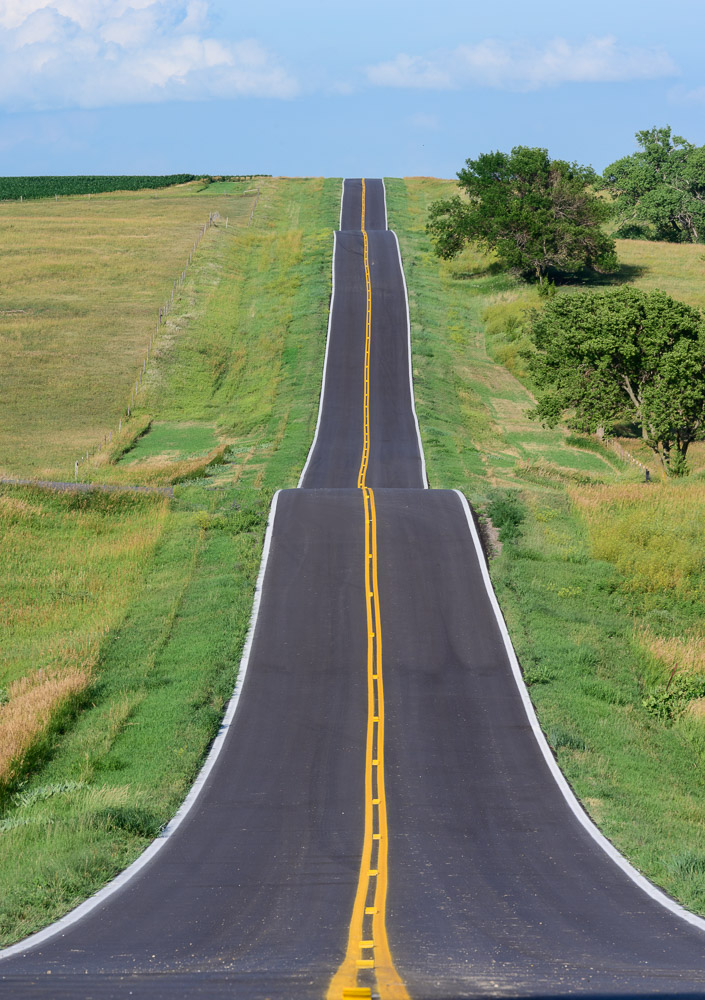
    Beyond that, it reminds me that our path is usually twisted and with many branches and turns. It is seldom clear at the start where we will end up. But the choices we make lead us somewhere. Following our passion involves making choices and tradeoffs. Do it consciously. Let’s choose the best outcome for our self that will help us become the best person we can be.

  • If You Can’t Beat ’em

    If You Can’t Beat ’em

    You have probably heard the old phrase “if you can’t beat ’em, join ’em”. It can actually be pretty good advice for some situations. Sometimes it is better to abandon your preconceived assumptions and respond to the actual conditions.

    Previsualization

    Many famous artists, from Ansel Adams onward, preach that we should previsualize the end result before we shoot. One accepted meaning of it is that the photographer can see the final print before the image has been captured. In other words, based on his experience, the photographer knows what end result he will be able to achieve before pressing the shutter release.

    Mr. Adams, ever the teacher, broke it down into 4 steps:

    1. Need or desire for the picture. Why are you taking it?
    2. Discovery. Recognize the essential composition that can be made.
    3. Visualization, the process of anticipating what the result will look like.
    4. Execution. Doing everything right to make it happen. This is image capture through post processing.

    I would not go on record as disagreeing with Ansel Adams, but I think there are a few assumptions wrapped up in this that we can look at. The advice may not be a universal truth.

    For one thing, if you are a commercial photographer contracted to get a certain image for a client, yes, planning and previsualization is important. Also, if it is a “one in a lifetime” situation where you know the opportunity will never repeat for you, be very diligent and make sure you get the shot you want when you have the chance.

    But another angle I don’t think I have heard talked about is personality. Some people are naturally planners. They work best when they are following a carefully thought out script. They need a high degree of structure in their environment. Other people don’t work that way.

    Generational changes

    And consider the differences in technology and capability of editing now compared to Mr. Adam’s day. You can see that we tend to favor a different style of capturing images.

    For Mr. Adams, making an image was slow and expensive and fairly difficult. A lot of heavy gear had to be set up. Looking at the upside down color image on the ground glass of his view camera and trying to visualize the resulting black & white print took a lot of skill and experience. And the 8×10 film sheets were expensive and he could only carry a limited number with him in the field. So yes, previsualization was necessary in that generation.

    Now, though, digital imaging is “free”. And we have great sensors and real-time histogram displays. Most of us can immediately see a fair representation of the captured image on our camera screen. We know what we captured.

    Since the images are basically free and quick to do, we can “work a scene”, shooting and looking at the captured images while we hone in on the result we want. We should seldom have any question of whether of not we captured the image correctly. The larger question is, did we get what what we want. It is not uncommon to shoot several or even dozens of images to finalize the result we want.

    Trying to force it

    Now I will readily admit that I am much more in the “no planning” side. I enjoy spontaneity.

    Something I see at times that makes me sad is photographers who go out with a rigid expectation of what they will accept. Many of them tend to battle against conditions they cannot overcome and go away disappointed. Maybe even feeling like a failure.

    In deference to the planners, I love this quote from a great planner:

    “In preparing for battle I have always found that plans are useless, but planning is indispensable.”

    Dwight D Eisenhower

    Thinking through the situation and trying to anticipate what may happen can give great insight on what we may decide to do. However, once the battle starts, e.g. we are in the field to make the image, nothing is likely to go as planned.

    Adapt

    When we discover that our plans are falling apart, we can double down and try to force it to work, or we can adapt and reevaluate what we can do.

    One aspect of creativity is to be flexible, to adapt to the situation and make the best of it. Make the best of the situation. Perhaps you got to the great scene and it is raining or snowing. Not what you planned. Use it. Get what you can. The result may be even better than what you planned.

    One of the principles of improvisation artists is that each step is “yes, and…”. That carries the momentum forward to the next step. Whenever you say “no”, it blocks the flow and makes it hard to go forward. So don’t block your flow. Respond to whatever situation you encounter and creatively figure out how to use it.

    Let it flow

    As artists, we are trying to creatively interpret the world around us. I find an ideal to enable this is to get into a flow state. This seems to be a peak of creativity and energy and concentration. This lets us work with the situation rather than fight it.

    Previsualization can give us an idea of what we want to achieve. We might even make the image as planned. But never overlook the opportunity to make a more compelling and engaging image.

    Maybe we do not get the image we anticipated. Often we get a better one. But even if it is a disappointment, as long as we did the best possible in the situation, we should be happy. I have said before that it is better to be lucky than good. But this is not luck. It is creatively adapting to circumstances.

    Today’s image

    This is a “bored at an airport” image. While waiting for a flight I wanted to capture scenes of airport operations. But I was frustrated by the reflections I could not eliminate. They were interfering with the image I had in mind to create.

    But on some thought, I discovered that maybe the reflections were integral to the scene. People waiting patient and trusting while a huge amount of complex logistics of running an airport went on just outside. Outside of their interest and curiosity. They just wait like cattle until their flight is called.

    This was definitely a “if you can’t beat ’em, join ’em” situation. I think the resulting image is better than what I originally set out to make. What do you think?

  • Bring Mystery

    Bring Mystery

    Some art lays everything out for you. What you see is what you get. Some art, though, seems to bring mystery to the image. You, the viewer, must become involved with it and imagine what you cannot see. I find I am being drawn more to the mystery side.

    Note: this article was inspired by an article "The Imaginary Shadows" in Better Photography Magazine #112.

    Reveal all

    I used to think full tonal range realism was the ideal for most art and photography in particular. I loved hyper realism. Honestly, I still do. Super detail throughout, Textures so crisp you think you can feel them. That is one reason I use a camera with good lenses and lot of pixels.

    You know the drill, especially if you are were in a camera club. Expose to the right, but no blown out highlights. Full histogram down to a few spots of rich blacks. The subject must be in the sharpest possible focus. Well sharpened overall, but with no halos. Printed using the best available paper and techniques so another photographer can come right up to the print as close as he can see and it all looks smooth and sharp to his critical eye.

    All these things are good ideas, but not a formula for making great art. I spent years honing my craft to be able to capture all those pixels in the best way. And more learning how to process the files to bring out all that detail. The technician in me loves the technical challenge. And the purist in me loves to see all that gorgeous detail and texture.

    Contrasts

    There is a problem I am starting to see, though. When you clearly show the viewer everything there is to see, it gets boring quickly. There is little holding power in the image. It is like a movie preview that gives away the whole plot. There is no mystery left. Viewers pass on fairly quickly.

    It is starting to sink in to me that in art and life, a lot is about contrasts. Contrasts put things in opposition. We are drawn to regions of sharp contrast. It is in our hard wiring.

    Contrasts are a way of comparing things by showing opposing qualities. The contrasts can be light vs dark, in focus vs out of focus, warm colors vs cool colors, moving vs still, hard vs soft, textured vs smooth – there are too many to enumerate.

    But we instinctively know that contrasts define a comparison that is important to the image. So we are drawn to the contrasted areas. We spend time looking and trying to figure out the meaning or importance of the contrast.

    It helps guide our understanding of the image and we become more involved in figuring out the artist’s intent.

    Use contrasts

    So, perhaps, viewers actually appreciate some need to think about and spend some time with an image. I call this introducing mystery. The viewer wants to get engaged and invest some energy in it. Contrasts are one primary way to do this.

    Unlike just a flat field of pixels, contrasts help the viewer understand the artist’s intent. It shows what relationships the artist wants to point out. What comparisons he wants to make. Contrasts help point out what the artist wanted us to notice.

    The mystery of black

    There is a special type of contrast often used in black & white images: areas of black. An article by Len Metcalf in a recent issue of Better Photography magazine brought this to my attention. It was kind of an “Aha” moment. You know how when you know something subconsciously, but then you see it written down and it is like a flash of insight?

    Len is an excellent photographer and teacher in Australia. He was describing a realization that came to him while teaching one of his master classes. They were surrounded by prints from great photographers, from Ansel Adams to contemporary artists. He says

    As I looked around the room, I became acutely aware of the intense blackness in each of the prints. As I stared, I realized that these were not little black speckles as we are cautioned about by judges in camera club competitions. … These were humongous areas of beautiful, deep rich velvety, black black, blacker than black blacks.

    He goes on to observe that some artists, like Ansel Adams and Bill Brandt for example, tended to make their prints darker and darker as they got older.

    Why? What were they seeing?

    Hold back

    One of his conclusions was that they realized that, in some cases, the less said, the better. That is, areas of blacks added a new quality to the images.

    He speculates that areas of highlight show all their information clearly. You see everything there is to see. The whole story is laid out clearly for us, so we do not have to work or use our imagination. But the dark areas, the spaces where we can’t see what is going on, hold interest for us. We wonder what is there. We make up our own story. it engages our imagination.

    Maybe this is why artists like Ansel Adams printed larger and larger areas of deep black as they evolved in their art. By holding back some information from the viewer the image actually becomes more interesting.

    Crush the blacks

    So I seem to be on a campaign to crush the blacks. What this means is intentionally pushing some of the darkest grays down to pure black. Yes, it eliminates information from the image. That is something we were always taught not to do.

    But it is an artistic choice. It brings the benefits I mentioned about introducing mystery and drama into an image.

    It is not for all images in all situations. But when you decide to use it, go for it. Be heavy handed. Overdo it to see how far you want to take it. When I overdo it and back off some, I find that I do not back off as far as I would have if I didn’t overdo it. In other words, after seeing the result, I often want to retain more of the effect that I would have thought

    It is surprising. Sometimes less is more. Experiment with making your blacks darker to see how it feels to you. I like what I am seeing so far. I used to consider dark images as somber and melancholy. Now I would more likely refer to them as mysterious. Try it and see if it feels better to you.

    Today’s image

    For fun and an experiment, I went back to an old image and re-processed it to crush the blacks even more. The result is more dark and mysterious than the original. I like it much better. Maybe it is approaching the “humongous areas of beautiful, deep rich velvety, black black, blacker than black blacks” that Len was talking about.

    One other reason for doing this is to investigate a point Len made that an advantage previous generations of photographers had was that, to re-print an image, they had to go through the whole darkroom process. This gave them a chance to think about the image anew and re-interpret it according to their current sensibility. We tend to just hit print to make a new print. No thought involved.

    I found, indeed, that I changed the image when I took a new fresh at it.

  • HDR

    HDR

    HDR, which stands for High Dynamic Range, is a bad word to some photographers. I think they have been overly influenced by some bad early use of it. It can be an excellent tool for certain kinds of images.

    Dynamic range

    First, though, what is dynamic range? Dynamic range is a measure of the span between the lowest level signal that can be used and the highest level. In most electronic systems the high end is limited by the point where the signal starts to clip or distort. The low end is limited by the point where an unacceptable amount of noise intrudes. For photography it is that range from the darkest value that is usable to the brightest value that doesn’t clip to pure featureless white.

    Modern digital sensors are far better than ones in early digital cameras. High end sensors now are rated at between 13 and 15 stops of dynamic range. That is incredible. Early sensors had maybe 5-6 stops.

    But like many things, the numbers are misleading. It is not that the camera makers lie, just that they do not quantify what they really mean. So my sensor may technically have 14 stops of range, but I cannot really use all of that with no cost.

    If you want to jump in to a little more technical depth, check out this article.

    Noise

    There is this problem called noise. It is worse at the dark range of exposure. We call what we do “digital photography”, but the reality is that a significant portion of it is based on analog signals. The information coming from the sensor is analog and it has to be amplified and digitized before it is actually digital data. Electronics, even the wonderful systems available now, have a certain level of noise in analog circuits. It is not a design fault, it is basic physics that cannot be entirely eliminated.

    So when we capture an image that has a wide range of brightness values, it needs to be processed a lot in order to make a good print or even a good image for social media. A lot of this processing involves boosting the dark values to a more usable level.

    But, the darkest values are close to the noise level of the electronics. So boosting them also boosts the noise. You have seen this when you brighten an image a lot and notice it looks very grainy and even blocky.

    HDR

    Enter HDR as a technique for mitigating the problem. HDR software takes several exposures, usually referred to as an exposure bracket, and combines them into a single image with a compressed dynamic range. Typically 3 exposures are used: one overexposed to make sure shadow data is good, one at the correct nominal exposure, and one underexposed to get all the highlight data.

    In combining this data, the software can select highest quality exposure value for each pixel. It uses sophisticated algorithms to “compress” the dynamic range. That is, it makes the brightest areas less bright and the darkest areas less dark. I could not explain the exact algorithms used.

    Abuse

    This sounds great. What is the problem?

    There is actually little problem with HDR as a concept. The problem is, when it first became popular, it was often abused by many practitioners who applied it in a heavy-handed way. Images with the dreaded “HDR look” were obvious and often scorned. The HDR look is an over compressed image with few real highlights and few real shadows. Everything has a bland sameness to the tonal range.

    The look rightly was looked down on by “serious” photographers. It tarnished the technique as a whole. That is unfortunate, because HDR is great for some things.

    When to use it

    HDR can create images that could not otherwise be made and it doesn’t have to be obvious. If a scene has extremely high contrast then HDR is often the only means to get the results we want.

    Way back in the olden days we had to use graduated neutral density filters in front of the lens to darken the brightest areas, usually the sky. This would pull the dynamic range down to a reasonable range to capture in one exposure. It was the “analog” equivalent of HDR. Of course, this involved adjusting the exposure to try to anticipate the final capture range. It was tricky, but it was the only way to do it.

    Now with HDR, no one I know uses split neutral density filters except the remaining film photographers. Except in one case.

    Movement

    HDR has one Achilles Heal – subject movement. An action scene is very difficult for the HDR software to build a good result.

    If only some small parts are moving, like grass or leaves shifting with the wind, the HDR software may use “ghosting” algorithms to try to work around the movement. If you are trying to photograph a high contrast action scene, like a car race, good luck. You probably will not be able to apply HDR because there is not enough correlation between the different exposures.

    Today’s image

    This is an HDR image. Trying to create an image with the direct sun in it and at the same time preserve the deep shadows in the mountains wasn’t going to work in one exposure. The HDR software was able to pull it all together.

    I don’t think this looks like the bad old “HDR look”. What do you think?

  • Come Alive

    Come Alive

    Does your art excite you? Does the joy or inspiration of your work make you come alive? If not, why do you think it will effect anybody else?

    Are you bringing anything?

    Your audience can pick up on how you feel about your work. Are you excited? Can you not wait to show this to people? Do you have so much fun doing what you do that you don’t want to do anything else? Why not?

    In my opinion, a lot of photographic art I see these days is pretty empty or depressing. Perhaps you are compelled to try to make a statement about environmentalism or social justice. That probably means you should consider yourself a photojournalist. Document your cause if that is what drives you, but can you also bring beauty and interest and hope? Can’t it be visually or emotionally appealing? Just because it is a serious subject doesn’t mean it has to feel like a news story on CNN.

    And the post-modernism that prevails leads to banal and emotionally void expressions. Just pointing your camera at 2 guys sitting in their back yard drinking a beer doesn’t necessarily make a picture I feel drawn to look at. And just because you used some forgotten wet plate process to print this image in a gritty, blurry way does not make it more valuable to me. Don’t you have anything to say?

    Does your work energize you?

    This is your art. What you see and feel. Surely you think it is worthwhile. If not, why are you wasting your time and energy?

    I have heard the definition that your art is “what you can’t not do”. This is pretty good. Most of us have to create art. We would go crazy if we couldn’t. There is a drive in us that needs this vehicle of expression.

    For me, when I fall into a nest of images I am excited and energized. I lose track of time. Even when I am seeing the images before me, I am planning what i am going to do with them and how I will bring them more to life. It enlivens me.

    This is one of the things I love about photography: of all the art forms, this is the one with the least barrier between inspiration and capture of an image. See it, shoot it. No real preparation or long time to produce a work. I am very visual and immediate. It suites my makeup very well.

    The great Jay Maisel is a wealth of quotes and wisdom about image making. A couple of favorites I continually remind myself of is “If the thing you’re shooting doesn’t excite you, why makes you think it will excite anyone else?” and “Photography is an act of love.”

    Why should people be motivated by your work?

    There are billions of photographs out there with billions more being added every day. How can I have anything new to say? What a bleak prospect!

    But I occasionally do have something new to bring to people. Those times where I am feeling alive and energized and excited can produce images that will stop people and compel them to look.

    I am motivated by this quote:

    “Don’t ask yourself what the world needs; ask yourself what makes you come alive. And then go and do that. Because what the world needs is people who have come alive.”

    Howard Thurman


    When we’re feeling most alive people can see it in our work. We have something to offer that people need. And it is more satisfying.

    So why should people be motivated by my work? I’m an artist. I have a unique and creative point of view and this image was motivated by me bring alive and in touch with what I was feeling. That is hard to find.

    Come alive and create exciting art.