An artists journey

Tag: Artist

  • Photography Isn’t Creative

    Photography Isn’t Creative

    Photography isn’t creative. I know, those are fighting words. Please put down the pitch forks for a few minutes and let me explain the distinction I see.

    A medium

    Photography is a medium, not something magic. Merriam Webster defines the aspect of “medium” I am referring to as “A means of effecting or conveying something; a mode of artistic expression or communication”.

    I know artists who express their art by taking pictures, some who put paint of a canvas, some who sculpt, others who make fabric creations, some who write or create music or make videos. I have known some who build art from scrap metal, even some who cut out bits of paper and create designs on a wall with them, and one or two who dance. These are just some I know personally.

    These artists all use a different medium for their creation. The medium sets parameters about what the resultant creation is: large, small, heavy, light, 2 dimensional, 3 dimensional, persistent or transient, etc. But the medium does not create the art. It is the mode through which the art is expressed

    Going around in circles©Ed Schlotzhauer

    Cameras don’t create

    A camera is a tool of the photographer. Some people think photography is not art because you just point a camera at something and press the button and capture it. When you do this, you usually get pictures that look like you just pointed the camera at something and pushed the button. No life. No excitement. Not that much interest. A record of something, not art.

    Luckily we have not gotten to the point that AI-equipped cameras try to make art all by themselves. It is still up to the photographer as artist to make the creative decisions.

    These decisions are what shape most of the outcome.

    Skill

    Photography is a medium and a technology. As such, it has limits on what it can do. Some things can be done very well and some things are difficult or impossible. For instance, it is difficult to create 3D images photographically. Not impossible, but difficult.

    Amazing things can be done by a craftsman wielding their tools expertly. As a photographic artist, we learn to think photographically, to internalize how to use the technology to create what we visualize. How to use our tools.

    But what I am describing is a process of an artist using tools to create art. The tool does not create the art. It helps express the artist’s will.

    A general flow for photography is establishing a concept, visualizing the intended result, capturing the image, and refining it on the computer. Which of those stages allow creativity?

    Trick question. All of them.

    Silhouetted tree against glass skyscraper©Ed Schlotzhauer

    People create

    A paintbrush does not create a great work of art. A chisel does not produce an amazing sculpture. And a camera does not produce an amazing, creative photograph.

    It is the artist using the tool that receives the credit, because it is his creative vision that applies the tools skillfully to achieve his intent. Every artist or craftsman I know appreciates excellent tools and likes to use the best he can afford. The quality and precision of great tools makes the creative process more of a joy when you know how to use them well.

    Same with photography. All the photographers I know love to talk about their tools. They long to have the highest quality cameras and lenses, the best computer and monitor. But they also recognize that these things are only tools. Good tools might make their work a little easier, but it doesn’t change their art.

    But the tool does not do the creative work. Photographic technology is a medium. If we are using a camera we must understand the strengths and weaknesses of the medium. As creatives, we must know how to use the medium to achieve our goals. That is very different from just taking a picture.

    Zig-zag shadow©Ed Schlotzhauer

    The medium isn’t the art

    So the medium is the channel we use to create or deliver our art. Nothing more. It is a “means of effecting or conveying something.” What we convey is our artistic vision. How we use the properties of the medium is part of the creative process.

    The way we express our vision may be different in a painting versus a photograph. We may have to choose the correct medium to achieve certain outcomes. You would have a challenge to express your music as a painting, for instance. Or maybe that would inspire you to push the medium of painting in new directions.

    Note: AI isn’t people

    An elephant in the room in conversations about art and creativity is AI. Let me go on record as saying, in my opinion, AI does not and cannot create art. It can make nice pictures that are very useful for advertising and utilitarian use. But it can never create, because computers can’t think, or feel, or appreciate art.

    AI models are trained using data from existing work. This is a major ethical question being debated, but not the issue here.

    Everything the model “knows” is work that has been done in the past. It will not be inspired to create something new. Inspiration requires a consciousness. Only humans are able to do that.

    AI can be useful as a helper, just not as a creator.

    Fall trees via intentional camera movement©Ed Schlotzhauer

    Photographic art

    Despite being maligned and excluded from the ‘inner circle” of fine art by established interests, photography continues to make inroads as a recognized art medium. Photographic artists continually push the limits of the medium and use those limits to inspire their creativity. Much of the creative discovery is at the limits of what can be done.

    Photography is just a medium. As that, it is not creative in itself. But artists can product creative works using it. The medium influences the art. The art uses the medium.

    Postscript

    As I write this, it is the day of the 50th anniversary of the release of the movie Jaws. The story behind it is fascinating. I would like to share a few highlights I have found that are relevant to today’s topic.

    Jaws was conceived as a low budget horror movie. It was given to an almost unknown director named Stephen Spielberg. But 2 unanticipated things happened that set it apart and allowed it to become one of the iconic movies of history.

    First, Spielberg collaborated successfully with a relatively unknown music writer, Jon Williams. Many say half the impact of the movie was the famous theme song.

    But of even more interest to me is that a huge factor in what the final product became was that the mechanical shark didn’t work. It was cheaply made. No one had thought to test it in salt water. Because it didn’t work reliably and he felt it looked pretty dumb, Spielberg showed it a lot less than they originally planned. Surprisingly, this resulted in greater drama and made the shark more menacing. Overall, the movie was a great success, partly because of a balky mechanical shark.

    A great artist, creatively adapting to the limitations of his medium and budget, unexpectedly created something wonderful. Something that is still recognized as great 50 years later. Creative problem solving. That is inspiring.

  • Its Been Done

    Its Been Done

    There’s nothing new left to photograph

    It’s been done! We all know it and feel it. The world is over-photographed. Why bother anymore? Nothing new is left. Should we pack up our gear and stow it in a closet?

    Too many photographs

    Trillions of photographs are taken every year. Think of that. As many as if every man, woman, and child on the planet takes over 100 pictures a year. Most of them seem to be uploaded to social media.

    Every person. you meet is carrying around a good camera – their phone. And they’re not afraid to use it.

    How many times have you been enjoying the view at a peaceful overlook, only to have a car skid up and unload a noisy group of parents and kids. The kids are herded in front of you and lined up and forced to smile so they can take a group selfie to show they were there. They may even ask you to take the picture. Then they rush back to their car to get back on their phones.

    Probably 99.9999% of this flood of photos are uninteresting selfies or food shots or other things like that that are just “look at me” pictures. Just think of the Exabytes of disk space they are taking up. Yes, this is judgmental on my part, but I am making a point. And I’m talking about uninteresting in an artistic sense.

    There is such a glut of pictures that it devalues photography as an art form. Why should I be interested in your photograph? I can take my own. I’ve seen that scene 1000 times. To the point that It’s a yawn.

    Fabric covered head©Ed Schlotzhauer

    Everything interesting is shot

    Every location on, above, or under the Earth that can be reached without the funding of a major expedition has been shot to death. Even the ones that are ridiculously hard and dangerous to get to have. So, should we give up?

    That depends on your goals. Since you are reading this, you probably consider yourself a “creative”. What does that mean to you? Do you define your creativity as photographing a location no one has ever shot before? If so, perhaps you should modify your definition. All the major sights have been photographed.

    There are other ways to be creative.

    Dancing in the Rust©Ed Schlotzhauer

    Do something bizarre?

    But for many, the perceived need to stand out and be different leads to strange ends. To try to create things no one has ever done sometimes leads to going for shock, or bizarre, or, at the other extreme, deliberate banality. Is this what you want for your art? If so, go for it. You do your art. But ask yourself if that is really you.

    Others may go back to film for its nostalgia. Maybe even to other non-traditional technology such as tin type or wet plates. People deliberately leak light onto film, use badly flawed lenses, or develop their film in unusual chemicals. Some use intentional camera motion or deliberate focus problems or other “errors”. Sometimes just for the goal of making something no one else has ever done.

    We are led to believe that creative means totally new that no one else has ever seen or done. Perhaps this is an overly strict definition of creativity.

    Surreal hamburgers©Ed Schlotzhauer

    Be you

    Artists have always done the same subjects over and over. There are only a limited number of subjects and not that many truly different ways to approach them.

    Are you not going to do ponds because Monet has “done” them? Are you not going to do a night sky because Van Gogh was the only one to be able to do that? Da Vinci did the definitive portrait, so no sense going there. Likewise, will you never photograph landscapes because there are no more to do after Ansel Adams finished? Must you forever avoid flowers because O’Keeffe did everything that could be done?

    Have all the songs been created? Have all the novels been written?

    Of course not. Humans always come up with creative new ways to present things. Therefore, “never been done” is not the strict test of creativity.

    Apply your style

    If artists do the same subjects over and over, where is the creativity? Isn’t it in the unique perspective of the artist? The new point of view or treatment or interpretation they can bring to it.

    If the famous ones can do it, then why can’t we? We are artists, too. Each of us can still do new, fresh, creative work.

    Sure, if you park at Tunnel View in Yosemite and put your tripod in the same spot that thousands of others have used and shoot the same wide-angle scene, like everyone else, it is going to be hard to stand out. But look around. There is a nice river there, and beautiful trees. Wildlife is around, flowers, and people doing weird or dumb things. We can direct our creativity in other directions.

    We each have our own unique point of view and way of expressing it. Use it. Be intentional. You are drawn to certain things. Recognize that and work it. You do not need to chase the crowd of popularity. It does not matter what “influencers” are promoting.

    Say what is in you, about what calls to you, in your own way. Unless you are on a commission, your art should be first for you. If everybody loves your work, but you don’t, isn’t that a failure? If you love your work but no one else seems to, isn’t that still satisfying your need to do art?

    By making art, we are trying to express something we feel or perceive. Maybe to other people, but sometimes just to ourselves. That brings a unique perspective to it. If we succeed, it is perceived as different, meaningful. That is creative. No one else has done that the way you do.

    Fence built of skis©Ed Schlotzhauer

    Creative, our way

    Creativity is not usually something radically new. Sometimes it is an incremental build on the past. It is the little twist that makes it uniquely our own. The little spin on the conventional way it has been done. Sometimes it is spotting what others overlook and treating it as art, not just something on the side of the road.

    Be curious. By going through life with a mindful attitude, we can see things other people look past. Our vision usually applies to the unique way we see the same thing other people see, but don’t really see. We will not often see something that no one else in history has ever seen before. The secret is what we bring to the common. Can we make something new out of things everyone else ignores?

    Everything has been photographed. But not everything has been seen.

    To be a photographer today requires us to see more clearly and think deeper and work harder to separate ourselves from the crowd, but we can do that. We are artists. We have the right to be obsessed and passionate. After all, this is our art.

    Follow your enthusiasm … The only quality common to all great artists and creative people is that they are obsessed with their work.

    Richard Avedon

    Today’s images

    Given what I am talking about, I decided to feature unexpected, hopefully creative images. All are things found in my explores. None are grand landscapes or iconic locations. These are the kind of treasures I like to collect. I hope they are all things you have never seen.

  • Ethics of Editing

    Ethics of Editing

    I thought this question was completely discussed and laid to rest. But just in the last week I have seen 3 posts questioning the ethics of editing images. Not really saying it is wrong, just questioning it in general.

    Let me give you my conclusion so you can stop reading if you disagree: the question is wrong. It is not an ethical issue for art.

    Are photographs special?

    Because of its nature of recording the scene in front of the camera, some people still assume that photography is some kind of “pure” imaging form. That is, that what you see is reality. It is not and never has been.

    You would never make that assumption of a painting. It is clear to everyone that it is a constructed image. Even if it was painted as “plein air”, the artist would leave out things that distract and freely put in things that “should” be there.

    Just because the sensor (or film) images everything in the field of view of the lens does not certify that the resulting image is “truth”. And speaking of the field of view, changing it is a valid and common way to change the story you are telling. Zooming in on a small part or moving to the side a little may completely alter the message of the image. Is that ethical?

    Giant flamingos, in Colorado.©Ed Schlotzhauer

    Modifying darkroom prints

    Prints were routinely modified even from the days of film and darkroom printing. Filters made serious modification to tonal renderings in the captured negatives. Negatives were spotted to remove dust (or distractions). Dodging and burning further altered the tonality of the original scene.

    If you are familiar with Photoshop, you know that one of the layer blend modes is Screen. Do you know where this name came from? A way of compositing film images was to project 2 images together onto a screen, then re-photograph the resulting combined image.

    Photographers are resourceful. They find a way to make the image they need or want to make. Even if the result departs from the original.

    Modifying digital images

    But it is so much easier to alter digital images. Does that somehow make it unethical to do it?

    We have wonderful technology in our computers and image processing software. But would we be better artists if we printed our images “straight” – unmodified in any way?

    No, we would not. Digital sensors are amazing, but the straight output of a RAW file is bland, low contrast, probably with a bad color cast, and it has dust spots and distractions. You could never sell an image like this, and it would be foolish to even show it to viewers in this state. Other than to make a point about how important correction is.

    Even black & white prints are an advanced modification of color images. It is no longer a throwback to simpler and more pure times.

    We are expected to correct the color and contrast, to remove spots and distractions, to alter the lighting and tonality to make it more pleasing. You could never win a contest or be admitted to a gallery without doing at least those steps.

    Beyond that, pixels can be processed and combined much more freely than film images ever could. To say that it is wrong to do that with digital images is like saying that writing should only use the grammar and vocabulary of 19th Century English, because it was more pure.

    Antique narrow gauge steam locomotive snowplow©Ed Schlotzhauer

    Why do it?

    Is it too simple to say, “because we can”? Simple but true. We can. Pixels are raw material. They can be modified or combined or stretched or colored at our will. The same way that a painter can use any colors or put any brush strokes down on his canvas.

    What we choose to do depends on the image. Sometimes we compose the “final” shot almost entirely in camera. We recognize what we want to do, and we can make it happen in the field. These images still need a lot of work to bring out the quality we want, but the result may be very close to the scene as shot.

    But sometimes I go out shooting what I call “raw material”. These images are deliberately not intended to be a finished image by itself. They become parts blended or composited together with other parts to form a final image concept. Is that valid? Is it ethical? To me, completely.

    Terra Incognita©Ed Schlotzhauer

    When not to do it

    There are times that images should be labeled as “truth”. If you are representing the work as photojournalism or documentary, it should relatively unmodified. Relatively in the sense that it may be cropped or spotted or exposure balanced. Things like that that do not seriously alter the result that is presented to the viewer.

    Even so, there are the issues of point of view and field of view. I discussed field of view. For journalism what the photographer chooses not to show may completely change the ‘truth” of an image. And anyone, even a seasoned journalist, has a point of view they bring to the shoot. That POV determines how they represent the scenes, what to feature, how to frame it, etc.

    So, we must accept that what we see is the truth from their point of view.

    Kentucky Coal Miner©Ed Schlotzhauer

    Ethics?

    One of the articles I read recently asks “how much we can ethically alter a photograph?” My response is that only photojournalists and documentary photographers should be expected to “tell the truth”. Other than that, there are no ethics involved. The concept does not even apply to art.

    All other photographers are creating something artificial. The resulting image is a creative work of fiction. Trying to say that there is some artificial ethical limit on what they do is like saying all writers must only tell the absolute factual truth. I hope not. I like reading fiction.

    There are many reasons for creating images. A few uses of them should maintain a semblance of truth. Most do not have any link to truth.

    My images are only truth in the sense that I created them (no AI involved), they are my product, and they represent what I felt or believed at the moment. Any ethical questions are within my mind and based solely on my values. If anyone else raises an ethical concern about my work, I thank them for being interested, I might want to find out their concerns, but I would tell them to apply their ethical anxieties to their own work.

    Of all the things there might be to worry about in the world, the ethics of altering my images is not one of them.

    The real ethical dilemma

    There is a serious ethical issue that needs a lot more discussion. That is AI generated work and creating images that deliberately lie about events. But I am out of room here.

  • Pull Out a Moment

    Pull Out a Moment

    Isn’t that what we do so well with photography, to pull out a moment of time to examine? Most art does this, but photography excels at it.

    Time

    Time flows continually. It so envelops and controls us that we often do not even consider it. But we cannot escape it. It carries us along with it whether we want it to or not.

    Some of us live for the future, planning for a “someday” when things will slow down or be better. Some live only for now, trying to experience life or just have fun with little regard for what may come in the future. Others are stuck in the past. Living in memories or regrets for past events.

    Regardless of our attitude about it, time keeps flowing relentlessly along. No one is rich enough to buy more time. No one is powerful enough to command it to slow down or speed up. We each have the same number of seconds in a day.

    But photographers seemingly have a power over time, to freeze it or stretch it and to pull moments out to keep forever. This is an amazing ability for mere mortals.

    Fast action at a County Fair©Ed Schlotzhauer

    Artists view

    To an artist, time can seem like a continuous series of pictures. We look at things happening and think that may have never been seen like that before and it may never happen like that again. We better capture it now before it is gone.

    Much of art is based on capturing moments. Paintings are usually of a moment in time. Sculptures often depict a moment of action or a grand pose.

    But photographs do it better. After all, a painting or a sculpture of a moment is probably based on photographs the artist took to record it. So the photograph is the prime material, the basis of the art.

    That is because photographs have a unique ability to record moments in time. We should be proud of that and use it to our advantage and to make our art more unique.

    Manipulate time

    Time flows constantly and at the same speed for everyone. But through photography we can look at time differently, depending on how we choose to see it.

    We can slice it very fine at 1/1000 of a second or even faster. This will freeze an instant so we can examine things happening too fast for. us to perceive in real time. Birds in flight, a waterfall, a galloping horse, even a bullet in flight are frozen into a clear moment. We can see the details of the action, the turbulence, the skill.

    At the other extreme, we can compress time. Any reasonable length of time can be imaged into a single frame. This allows us to visualize or see the effects of action happening over an extended amount of time. Car lights at night streaking into a long trail. A waterfall smoothing into a velvety flow. We might be able to capture multiple lightning flashes in one frame during a thunderstorm.

    All of these and more help us see action over time. It visualizes what we can only imagine without the aid of photography.

    An interpretation of my feelings for Trail Ridge Road©Ed Schlotzhauer

    Keep a time

    Whether short exposures or long exposures or a “normal” speed, this slice we capture is preserved for us to examine and contemplate at our leisure. We have plucked it out of the stream of time and kept it for ourselves.

    It is said that in a fire or flood, one of the first thing people try to save is the family pictures. These are our history, our memory. Moments that are important to us. (Many online sites tell us at length how to prepare a “go bag“; it’s a good idea; but the emotional reaction is to grab important memories in an emergency.)

    And they keep us together as humans. A friend told me recently about getting together for a rare visit with his brother and sister. One of them had digitized old pictures their parents took of them as children. They spent hours looking at them and sharing stories and memories. Most of these were originally shot 60-70 years ago. They still have power of moments.

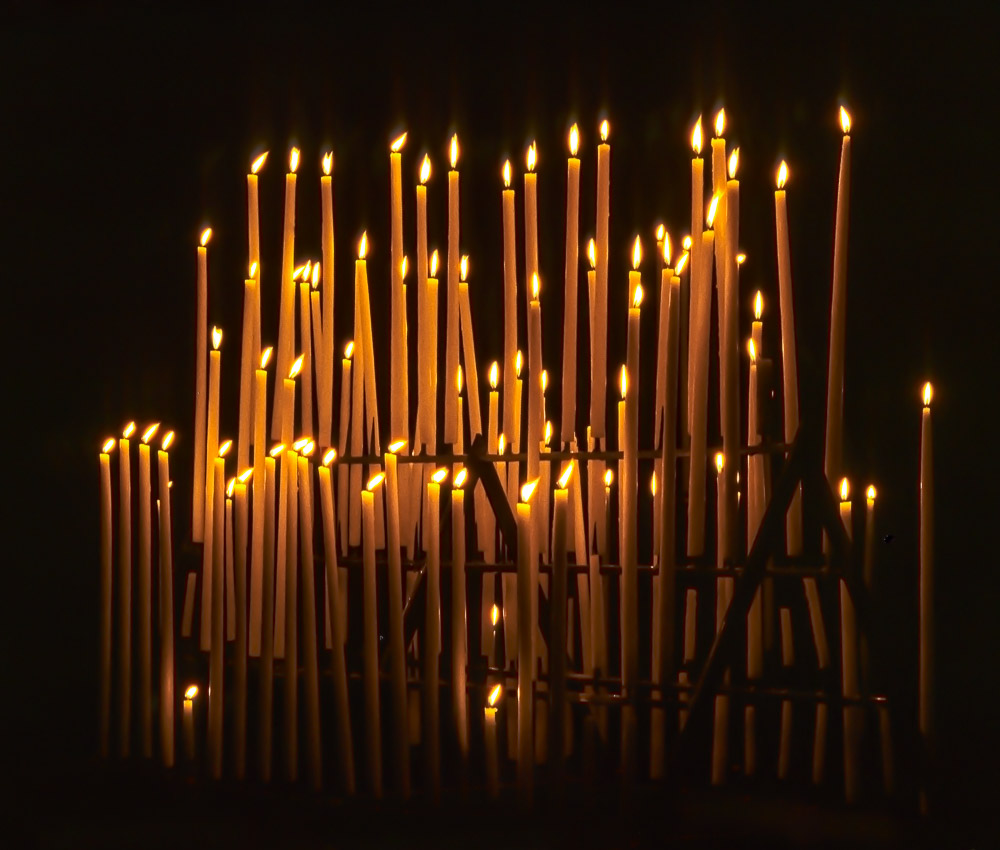
    Candles, Catholic Church, Regensburg Germany.©Ed Schlotzhauer

    View differently

    Obviously, family pictures have special memories for us. But how about art?

    As I mentioned before, most art involves the capture of moments that we can look at or think about whenever we want. Photography is uniquely suited for this.

    Street photography gives us insightful glimpses of people in their daily life. Landscape photography captures moments of beauty or awe in the natural world. Portraits give us a formal view of people. Whether abstract or realistic or black & white or an alternative process or any other rendering, they capture a moment.

    When we capture moments, we have the opportunity to study the moments at our leisure. Time ceases to flow for these images. Taking the moment out of the stream of time gives us a unique chance to spend all the time we want with the moment. We see and understand it differently.

    Years from now, that moment will still be there for us to bring out and examine again. Or our descendants may look at them and see a glimpse of what we saw, maybe even what we felt.

    Time is a key component in our photography. Photography is perhaps the best of the arts for capturing and manipulating time. Other forms of art rely on the artist seeing or imagining something, then representing it. Photography allows us to see things that could not otherwise be seen.

    Looking through clock, Musee Orsay©Ed Schlotzhauer

    Reflect

    We see a potential image and take it. What is it for? Who is it for? Does it matter how many people see it?

    It is quite possible it does not have more of a purpose than that we were compelled to make art. If we are making art, it may be sufficient that it fulfilled something in us.

    Most of us would love for great numbers of people to view our work and give us lots of compliments. Especially the compliment of buying it. But is that why we do it?

    Perhaps these moments in time are painting our history, marking our journey, filling our memory bank. Maybe their significance could not be apparent to anyone else.

    Or maybe something is compelling us to capture these moments so that someday we can begin to understand them ourselves.

    Regardless, we are compelled. We pluck these moments out of time and set them aside for reasons we may not understand. Or perhaps it is enough that they are beautiful, at least, to us.

    Every time we press the shutter release, we are capturing a moment. Be very aware of that. They are our moments. They have meaning to us. Sharing them with other people is an intimate act.

    “Life is a collection of moments; cherish them, embrace them, and create more of them.”

  • Go to a Forest, Again

    Go to a Forest, Again

    Go to a forest. It is good for you in many ways and it can benefit your photography. I say “again” because I wrote about this before, but it has been over 4 years and I decided to update my thoughts.

    Forest Bathing

    I am a believer in what is called forest bathing. This was my practice before I ever heard the term.

    Some research shows that just being in a forest, experiencing the sights, sounds, smells, and feel of nature will improve our physical and mental health.

    Forests are a magnet for me. Every place I travel to, I try to get out into the local forests. The different trees are special to me and are refreshing, each in their own way.

    My previous article talked a lot about forest bathing, but it is not just an idea. We can’t just put it on our to do list and try to fit it in somewhere, maybe as we listen to a podcast.

    Spreading oak branches.©Ed Schlotzhauer

    Silent Walk

    Just being in a forest is not magically going to make all our problems go away. Actually, nothing is going to magically make them go away. Things like forest bathing can help. Some people are proposing a parallel stress reducing plan called silent walking.

    We seem so totally controlled by our technology these days that it can even impact our forest experience. To get the most from the forest exposure, or any calming moment, we have to unplug.

    To get the benefits of being in the forest, we have to actually be there in the forest, physically and mentally. Leave the distractions behind. It is great that you love your music, but when you are in the forest, leave your headphones behind. Listen to the birds and the wind in the trees. Hear the sound of the river flowing by. And it is not a time for your run. That is great to do for exercise some other time, but try just taking it easy. Relax. Set a slow pace. This is a time to unwind.

    Promise yourself you will not pick up your phone while you are in the forest. Except maybe to take a picture. But them put it back away and don’t post the picture until later.

    Benefits

    Here are some benefits of being in nature as noted in an article quoting Allison Chase, PhD, CEDS-S, Regional Clinical Director at Pathlight Mood & Anxiety Center in Austin, Texas. She is more gentle and articulate than I am.

    “Spending time in nature, with more serene and slower paced stimuli, can be very calming to the nervous system, where stress and cortisol levels are impacted.”

    But to get this result, it requires being completely present. “The key is to slow down and take in the environment and its natural beauty,” which also helps the body calm down. “Without the input of screens and other modern or electronic stimuli, one’s brain [aka neurons] can calm down. This slows down the entire body to be more calm and relaxed.”

    Additionally, nature itself can be a great boost for your overall wellbeing. “Nature offers stimuli that can impact a number of senses, [such as] touch, sound and smell,” adds Chase. “Whenever our senses can be heightened in a healthy, positive, serene way, it is always good for the body and brain.” In fact, a study in Environmental health and preventive medicine found that forest bathing significantly lowered blood pressure and reduced negative moods.

    Stark, bare aspen tree. Chaos of branches.©Ed Schlotzhauer

    Mindfulness

    This sounds a lot like mindfulness to me. Imagine that.

    I’m not a formal practitioner of mindfulness, but I believe my secular practice of it has great value. It seems I recommend it a lot in my writings.

    And I will continue to recommend it. In our fast paced, high stress, over scheduled world it can help bring us back to a healthy state.

    Find your place

    I’m lucky. My house is about 10 miles from the edge of the Rocky mountains. In abut 20 minutes I can be in the mountains and forests. That is one of my happy places.

    But not living next to a National Forest does not exclude you. As a matter of fact, I do not go up into the National Forest nearly as much as the time I spend in the parks and natural areas in my town. You probably live near parks and open spaces, too. Use them. Don’t ignore the good even if we can’t have the best.

    I have come to believe it is our intent and our approach that makes the difference in what we get from our time. If we go out with the intent to slow down, calm our mind, and take in the environment with most of our senses, it will happen. If we just go for exercise, well, we will just get exercise.

    Leaning trees.©Ed Schlotzhuaer

    Get out there

    As I write this, spring is emerging in much of the country. Many of us are waking up, stretching, and resolving to get out and start taking pictures again.

    Do it.

    I hope there is nothing hindering you from picking up your camera, heading out to your local park, and getting back into nature. Or, optionally, leave the camera. Just experience the outdoors again. It is good for you

    A couple of days ago while wandering through a local natural area I saw 2 sights that made me feel good. A middle aged woman wearing a backpack was approaching me going the opposite direction. I wondered if she was another photographer, since I carry my camera in a backpack. As I got closer I saw that she was on oxygen. She had a tube under her nose going back to a tank, presumably, in the pack.

    In the other case, I came on a woman making her way along the trail using a walker. This was a gravel trail, not paved, so I assume it was work for her.

    Both of these ladies were quite a ways away from the closest parking lot. I thought they were awesome and encouraging. They were making a determined effort to get out in nature despite some hindrances.

    What is keeping you from doing it? Really.

    Get back out there.

    Forest bathing hack

    Everybody seems to want a quick way to hack the system. OK. Here is your hack for forest bathing, again from Allison Chase.

    1. Find your sanctuary

    Look for a local park, nature preserve or even your own backyard if it boasts a decent tree coverage. Find a place that feels calming and allows you to disconnect from everyday life. This also means silencing your phone and tucking it away.

    2. Slow down and savor

    Forest bathing isn’t a race. Meander along a path at a leisurely pace, allowing yourself to truly appreciate the sights and sounds around you. Take slow, deliberate breaths of the fresh air. You can even stop and sit under a shade tree for a while. Your session doesn’t have to be long — aim for 30 minutes to start.

    3. Engage your senses

    Don’t just look — touch, smell, listen and really see everything around you. Take note of the soft aroma of fresh blooms, how freshly-cut grass feels against your bare feet or the vibrant colors of a passing butterfly. If worries or negative thoughts start to creep into your mind, gently guide your thoughts back to the present and the beauty surrounding you.

    Layers and layers©Ed Schlotzhauer

    On photography

    Mostly I have talked about the general mental and physical benefits of being in nature. I believe there are benefits for photography also.

    Being in a forest refreshes us and awakens our senses. It is invigorating. If we are better physically we have more stamina and are more capable of getting out for photo shoots.

    And if we are calmer and less stressed we can better apply our creativity to our art. The more hindrances we can remove, the more we can focus on our art.

    Forest bathing leads to mindfulness. Mindfulness leads to more creativity.

    Note on the pictures selected

    I deliberately selected black & white images for my forest pictures today. There are 2 basic reasons. One, I really love b&w. Two, I want to make a subtle point that the benefits of being in a forest are not reserved just for what we think of as “peak” comfortable, colorful summer and fall times. The forests have benefits for me all year, in all of its moods and weather.