An artists journey

Tag: art

  • Reality is Overrated

    Reality is Overrated

    Is this controversial for a photographer to say? I hope so. 🙂 Photography used to be the land of total realism. Not so any more. Photography for me is purely artistic expression, with little concern for reality. That’s because reality is overrated.

    Reality – the good

    There is a long and honored tradition of highly realistic landscape and street photography. When you think of landscapes, you might think of John Fielder or Art Wolf or Ansel Adams. For street photography maybe it is Henri Cartier-Bresson or Jay Maisel or Elliott Erwitt.

    All of these artists were true to the reality of the scenes they found. Of course they looked for the best composition or the right light or the dramatic expression – that is why they are recognized artists. But the photographs they took were not modified at all, other than routine spotting or color corrections.

    Is their work good because they only shot reality? No, their work is good because they are great artists. I could walk outside and shoot a picture looking down my suburban street and publish it. It would be absolutely real and unmodified. Would it be good art because of that? Not to me.

    Reality – the bad

    Following up on the point about shooting down the street, a picture isn’t good just because it is reality. Reality can be boring. It can be depressing. It can be dreary and banal. While there may be a time and place for these things, they are not where I want to spend much time.

    I am not a critic or authority. I would never say such subjects do not constitute art. But don’t get caught up in the post-modernism depression where you don’t view art as worthwhile unless it is depressing or banal. That is just one passing movement led by some people with a very dark world view.

    Be yourself. Express your own values. Like, and buy, what you like.

    Assume no reality

    Photography has become much wider and more diverse than it was a few decades ago. It used to indeed be true that “a photograph didn’t lie”. You could believe what you saw. Not anymore. Photojournalism may be an exception, but in today’s climate, I wouldn’t rush to ascribe too much credence to any particular image you see on the news unless you know the circumstances. News has become just a business, not a guardian of truth.

    A lot of artists, including myself, no longer consider it necessary to represent reality. Now, some of my work is extremely detailed, with sharp, crunchy texture and edges. I actually like doing these sometimes. It is almost reveling in the detail that can be captured by my sensor and lenses. Quite the opposite of some of my blurred, low texture images.

    But if you see one of my images with super sharp detail, don’t necessarily assume it is reality. Even when I am going for crisp and detailed, I am not at the same time representing to you that it is reality. It could be manufactured. Even if I know that it is real, it could look so abstract to you that you could not describe exactly what it is.

    It is art, not a documentary

    My point being that I am making art. I think most “artists” are making art. Enjoy it as art. Don’t be disappointed if you find out it is not reality. I’m not sure there is much overlap between art and reality.

    Art may speak to universal truths and bring deep insights into our lives, but it does it through its metaphors and imagery. It does it by touching something within us. In the same way that Shakespear gives us a lot of insights about life, even though his stories are fiction.

    So don’t assume photography has to depict reality while painting does not. Both are art.

    It is art, not reality

    I will go out on a limb and state that art is not reality and it cannot be. Art might show a representation of reality. Even a very realistic representation. But the art is not the reality. Art is a 2 or 3 dimensional object you look at.

    To take an example that may be easier to comprehend, it is like a book. An excellent work of fiction may create a reality in our mind, but that reality is what we interpret from what the book describes. The places may seem real. The characters may seem real and alive to us. But they are feelings the author has communicated to us through the words. Not reality itself.

    I am drawn to joy

    On a personal note, I am drawn to joy and things that are uplifting. Even when my images are dark or showing bleak mid winter scenes, they are not depressing. At least, not to me. I try to find a hopeful angle on my art.

    For instance, I love finding certain types of old rusty trucks and cars. After surviving for 50 to 90 years, it seems these relics have something to tell me. They have resisted the elements far longer than most things. They may be beat up and rusty and out of service, but they are still there defiantly. That is the joy to me in old things like this. They are still standing and making a statement; they are not junk. There seems to be something significant about that generation. Some quality that makes people want to keep them. A 1952 truck is often still around in 60 years. I don’t expect that many 2022 trucks will still be in as good a shape after 60 years.

    The picture with this article is composited from shots of some old vehicles. It is detailed and sharp, but it is not “real”. No object I know of in the world actually looks exactly like this. That doesn’t keep me from creating it. I could even represent it as something that could be, even if it does not currently exist. But realism or potential realism is not an important consideration for me. I only care about if I like it. I do.

    What do you think?

  • Finding Inspiration

    Finding Inspiration

    Are you empty sometimes? Are there times when you don’t have any ideas or new projects? We tend to desperately put pressure on ourselves to find something creative and new, but this is often counter-productive. So how do we go about finding inspiration?

    Relax

    Ouch. This can be hard. Our art is important to us. We need to be proactive and driven to produce. But first. relax.

    If you are in a slump creatively, just go with it. You will come out of it. But the more pressure you put yourself under the harder it sometimes is. It is very hard to force ourselves out of a slump. Our subconscious will eventually get re-engaged and start pumping out the great ideas. Give it time to rest and rejuvenate.,

    Take a walk

    Really. “Waste” the time. Carry your camera or not, it’s up to you, but don’t require yourself to take any pictures.

    When you walk, go slow. This is not mainly for the exercise. It is for your head. Look around. Look at everything. See things as it for the first time. Play the game that you just teleported to [your favorite exotic destination] and you are looking around in wonder at everything. Try to see how many things around your neighborhood you never really “saw” before.

    None of these may be in your “style” or preferred subjects, but learning to see new things is good.

    Read a book

    I have heard it said that most adults never read another book after they graduate from school. Maybe that is just males. 🙂 Even so, I hope that is a false statement. Books are one of the most important inventions in history.

    Reading something new will expand your thinking. Studying something related to your art will give you a new appreciation of different styles and ideas. It may teach you something you can apply to improve your images and refresh your creativity.

    Even if not, you will still be better off mentally for exercising your brain. Books are a major repository of the collected wisdom of centuries.

    Watch an educational video

    I can say to watch videos because I do not produce any videos. I’m not selling anything.

    The good thing about the internet is that there is a wealth of information there, free or for relatively low cost. There is probably no aspect of our art that someone doesn’t have a video about.

    That being said, the “signal to noise ratio” (the percentage of useful information) is fairly low. Be careful of who and what you take in. Even so, it is not too hard to find good stuff.

    If you are up to it, it can even be healthy to watch bad videos. That sounds weird, but do you find, as you get more mature and confident in your craft that you can sift the good from the bad? If you watch a bad video, or one you disagree with, it can be empowering to be able to refute the presenter and know why you believe they are wrong, at least for you. It can help bolster your confidence.

    Read other artist’s blogs

    You are reading mine. Thank you! I would love to hear your thoughts.

    Probably thousands of blogs are written every week. Pick a few new ones to add to your list. They do not have to be leaders in your field. Look around and find artists in other fields whose work you admire, who influence you, whose style you admire. Follow them. This is another great source of wisdom and inspiration.

    I follow a few people. Not many. But I am constantly amazed at the wisdom they give away.

    Be open

    None of these suggestions will do much good unless you open yourself to receiving what they might give. Openness is an attitude. Our attitudes are under our control.

    Are you totally focused on one subject? Why? Widen your view. Have you become cynical? As you learn to look around more, re-awaken your wonder and joy. Find new things that excite you. Cast a wider net. Get enthused about something. Give yourself permission to try new things.

    Inspiration sneaks up on us when we aren’t expecting it. The more we can be open and receptive, the more often we will find it. I find that stimulating my mind with new thoughts and learning new things helps keep me open to inspiration. Try it!

    About the image here

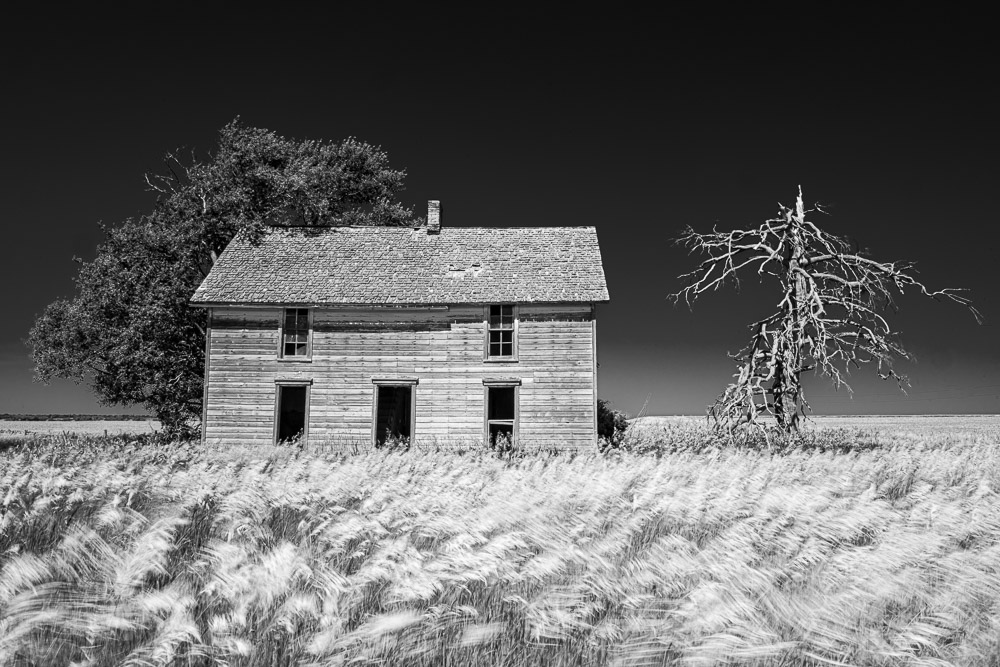
    I can’t claim this is super creative as such, but I am very happy I made this image. This is the epitome of depressing conditions: way out in the midwest, nothing around anywhere, temperature was 108F, winds blowing so hard I had to hold the tripod, totally clear blue sky – what to shoot? I decided the interest was the wind. How to capture the effect of it? I think, by being open to exploring new ideas, I made something good out of it. At least, I’m happy with it.

    This image is part of a series I am working on, tentatively called “Maria”. It is not published yet.

  • A Private Journey

    A Private Journey

    Being an artist is a private journey, but one the viewers are invited to participate in. I don’t collaborate or take votes to guide my journey. It is just me. It is intensely private.

    Private

    I have to make my own way in the world. As such, I am stuck in my own head. Creativity has to somehow spring up from within. Being an artist is lonely. LIke a writer, there are those terrifying times when you are facing a blank page (or empty frame) and you have to create something. No one else can do it for me.

    Not everyone agrees with this approach. Some people, especially if they are young and just learning, want to run in a crowd. They have to immediately post every image to social media to get feedback. To me this is a form of insecurity. My values and style is deeply ingrained and I do not seek immediate validation from the internet. But that is just me.

    What works for me is to explore, to be receptive to what I encounter. I seldom have a detailed plan for what I want to shoot. Rather, I turn myself loose and let myself be drawn to scenes that interest me. It doesn’t always work, but that is what inspires me. The word that keeps coming up is”me”. Not in an egotistical way, but in the sense that I am the only one who can take this journey. If it wasn’t me it would be someone else’s art.

    I also find, and this is just me, that when I put pressure on myself to “have” to come up with something creative the results may be good but they are seldom great. But when I let go and just react and experience then creativity can flow. Understanding this about myself has let me keep my art constantly being a joy.

    A journey

    Virtually all my subjects are collected outdoors. It is extremely rare for me to set up a controlled indoor shoot. So a shoot for me involves movement. I have to leave my studio and get out in the field where my subjects are.

    This is a joy for me. I am an explorer. It is hard to pass a road I haven’t seen the end of. As an example, just a couple of days ago I was exploring up along the border of Wyoming. I went down an obscure dirt road I knew was a dead end, but I had never been down it. It was great! I loved the sights, the remote wildness, the windswept barrenness, the newness. It was fresh. Something I had not seen before. It energized me. Even if none of the images make it into my portfolio, it was well worth it for me personally.

    But a journey doesn’t have to be far. I do a lot of shooting while walking around within a mile or 2 of my studio. Journeying is an attitude. A sense of exploring and investigating. It is sometimes difficult to feel a sense of discovery in an area I have been over and over so many times. But that is part of the game. It is a mental discipline. If I can find new and fresh sights in a familiar area then it is even easier to get inspired in an interesting new place.

    Viewers

    It is true that my art makes me happy. If I never showed it to anyone I would still have the joy of creation and discovery that would compel me to make it.

    But artists are also somewhat egotistical. We feel we have something worthwhile to share with other people. I hope those who see my work enjoy it and can share in the sense of wonder and amazement I felt while making it. I’ll be honest, I also hope you decide to buy some of my prints for your walls. The money is nice, but even more is the knowledge that this had an impact on you and that it will now continue to influence you. We all would like to leave a legacy.

    I know your time is valuable and increasingly scarce. I seek to make art that is captivating enough for you to give me some of your time to view it and think about it. I hope my art will awaken some new thoughts and feelings that will make your day better, to refresh and renew you. I like to feel that some of my pieces on your wall will have a long term benefit as you see them every day.

    Internal and external

    My art is a private creation of my own mind and energy. I do not collaborate with others or shoot assignments. What energizes me is exploring and finding wonder in the everyday sights around us. I may work a project or a theme at times, but mostly I let myself be drawn to whatever is exciting me at the moment. I am very much in the moment when I am creating, even when working at the computer.

    Even though my art and my process is intensely private and personal, I also have the viewer in mind. I am constantly reaching for something creative and fresh to share with my you. If you give me some of your time and attention I want to give back. I hope I can succeed with you. It is my private journey but I want to share it with you.

    Go to my web site at photos.schlotzcreate.com to view a little of my work and let me know if any of it resonates with you. Please join me in my private journey. I welcome your feedback.

  • The Histogram

    The Histogram

    Please permit me to rant briefly. I get incensed by the practice of most photo instructors to “dumb down” what we do. They assume people are incapable or afraid of anything technical. So they give a very short and often unintelligible description of something we, as photographers need to know, then go on. One example of this is the lowly histogram.

    I’m sorry to have to tell you, but all art has a technical component to it. Photography is one of the most technical.

    The histogram is like taking your temperature or looking at a graph of your portfolio performance. It is data that does not mean anything in itself but it is very useful to check. In this case, the histogram is just a measure of our image. It is valuable, but it is only one of many possible measures.

    What I hope to do here is do what your dad probably did (or should have done) in this situation – tell you to get over it. You need to know this, so get on with it. 🙂

    Not high tech

    The histogram is not a complex, fancy piece of technology. It is just counting and marking.

    Let’s say for simplicity that your image is black & white and is 8 bit depth. You know that this means the image is a grid of pixels, each having a value of 0-255. Now you decide to go through each pixel one at a time and keep track of a count of each pixel value you find. You come to a pixel that has the value 87. Go to your row of 87’s and increment it by one. You know, like

    Keep on going. If the next pixel is 127, go and increment the count for that bucket.

    After you count the values of all the pixels, you will have up to 256 groups of counts. Now, draw a graph (technically a column chart) or put the data in Excel and have it graph it. If you put the numbers 0-255 on the x axis (the horizontal line) and draw a point above each number corresponding to the count you made for that number, you will have a histogram.

    That’s all it is, just a count of the number of each pixel value. The actual number in each bin does not matter. What counts is the overall shape of the curve.

    An example

    Here is a fairly balanced black & white image and its histogram.

    People would call this a “good” histogram. It shows that the tones have counts from very close to 0 to almost 255, a full range from black to white The tones are spread fairly evenly. There is a bump in the distribution of the light tones – the right side- which is natural because there are big areas of snowfields and light gray clouds.

    There is no magic. You could manually follow the pattern I described and derive this yourself. It doesn’t “mean” anything of itself. It is just a way to get some information about your image.

    Descriptive, not prescriptive

    This is where people get confused, partly because they are misled by their instructors. The histogram does not tell you if you have a good or bad image. The histogram is descriptive, not prescriptive. That is, it is just information for you. It does not grade your image or tell you you exposed it wrong.

    IN GENERAL, if your histogram shows values bunched up far at the left or far at the right, that is a warning sign. It is telling you the image may be too underexposed or over exposed. Those values at the extremes show that you may be losing data that cannot be recovered.

    Whenever you see this situation it is a warning flag, not a stop sign. It may be necessary for the effect you want.

    Expose To The Right example

    You often hear the advice to “expose to the right“. This is good advice in general. It means bias your exposure higher – more histogram to the right – as long as there is no clipping of the highlights. This is because of some of that scary technical stuff you need to know. The dark areas of an image are more subject to noise. If you have to boost the dark areas that magnifies the noise. The best results are often obtained by overexposing a little and reducing the exposure of the whole image in post processing. Digital data retains more information when you are scaling it down than when you are scaling it up.

    Expose to the right is an example of a good way to use histograms. I always have the histogram view turned on in my viewfinder. As a matter of fact, possibly the single best reason to go to mirrorless cameras is to be able to get a real-time histogram. I always check it, before and after taking a frame.

    Let me emphasize again that this is information for you to use and make your own judgment. Do not let the histogram take your pictures. Keep artistic control.

    Yours can look anyway you want

    It is not unusual for me to shoot images that have a “bad” histogram. When I do this it is deliberate and I do not have to answer to the data police (yet).

    One class of very low key images is night photography. Often these are nearly all dark with only a few points of light. This is an example:

    It is hard to see at this size, but you can tell what is important from the histogram. Most data is clustered at the dark end. There is a spike at the brightest whites. These are the stars. Your instructor would tell you it is not a good histogram, but the image is exactly what I wanted. An image is properly exposed if it comes out the way you want.

    At the other extreme, a high key image is almost all white. This fence in a snowy field is almost all bright values:

    The distribution (the arrangement of the data values) is skewed way to the right, but not overexposed. But there is a spike at the left representing the black fence posts. Very high contrast. This is the result I wanted, so it is correct.

    These 2 examples of “wrong” exposures should broaden your understanding of what is allowed. Anything that matches your intent is a properly done image.

    A great tool, but just a tool.

    I hope I have given you a better feel of what a histogram represents. It is just an overall look at the data values in the image. It is there for information to help you make the images you want. A histogram is neither good or bad. It is just information. Other people have given their own interpretation of histograms and their importance. This is a good one.

    I am very thankful for the invention of histograms and their availability in modern cameras and post processing tools. It is an indispensable tool. I use them every day. But remember it is a tool. It is not there to tell you what you can do. You are the artist. Only you can decide the result you want.

  • Meaning

    Meaning

    Does art have “meaning”? Especially a deep meaning that leads to truth or changes the life of the viewer. This is a thorny subject that has been debated for centuries. I’m not going to settle the question. (Sorry) But I can give my POV.

    The Elitist view

    Some say that all art does, or should, have meaning. It should educate or enlighten. It should lead the viewer to a new state of understanding. To some all art should support a cause or attempt to change the world. One of the unfortunate extremes of this is the frustrated attitude that if you don’t “get it” you are not in the privileged elite. You are too lowly, unworthy to understand.

    This very high minded view is often presented by galleries and some artists in their artist statements. I can understand it, really. They are selling a product. The more elite and special it seems to be, the higher price it can command. The more collectable it is. I’m guilty of it at some level.

    And it probably is more typical of art that takes a long time to produce. If you worked for weeks or months on a painting or sculpture you naturally want to believe it has some reason to be worth a lot. Otherwise, why did you waste your time? It is natural.

    But I don’t want to discuss those more classical media. My art is based on photography.

    Does my photography have intrinsic meaning?

    Does a photograph, one of my photographs, have meaning or represent some great truth?

    Maybe.

    Sorry, that’s the best I can do, because I believe it is the right answer. Meaning, if any, is a communication process between the artist and the viewer.

    Take the image with this post. Does it have meaning to you? I could write a whole post on the symbols and relations I see in this. That does not mean you will or should.

    Communication

    When I produce an image, it is an instant of the world seen through my eyes. But is it also interpreted through your eyes. I may believe it has significance, but I may not communicate it effectively to you. Or I may capture something I think is interesting, but to you it represents an insight or truth I did not consciously see.

    That represents part of the problem. There are multiple parties involved. There is me, the author, on one side. I produce it. It is interpreted through my viewpoint, through my beliefs and vision and talent. I had a reason for creating the final image. On the other hand, each person viewing it sees something different. Some may see deep meaning. Some may only see a pleasing image. Others may be completely bored with it. Even if I believe there is meaning there I may fail to effectively convey it to you.

    My thought is to say it is my failing if I do not succeed in conveying the meaning, but that is too simple. We each have our own values and history and viewpoints. You may not be receptive to what I have to say. If that is the case it is not so much that I have failed, but that we just can’t get together on our viewpoints. Maybe that’s kind of like the current political mess we have.

    Do I have to bring meaning?

    Ah, but there is a subtle assumption in this argument. It assumes I really was trying to teach you something deep. Here’s a secret: I don’t usually. It is often sufficient that an image is pleasing to me.

    Life is multi-faceted. There are many layers and levels. Not everything has to be deeply significant and serious. Lighten up. Let some things exist just for pleasure. I am very happy with an image that I believe conveys beauty or joy or simply brings something interesting to your attention.

    It is a consistent theme with me, but I believe our high pressure, hurried lives are causing many of us a great deal of stress and actually reducing our pleasure in life. I want to produce art for your wall that will give you a moment of pleasure when you notice it. Hopefully you will slow down a minute, contemplate it, use it as a reminder to look around more for what is going by all the time. That’s enough meaning for me.

    So, meaning? It’s overrated. I hope my art beings you to a new place, but art should bring joy, not be a school exercise. I promise I will not score you down for not seeing all I believe there is in one of my images. Analyzing the meaning of my work doesn’t being me joy, I just want to create!

    But that’s just where I am. What are your thoughts?