An artists journey

Category: Photography

  • Does the Image Find You?

    Does the Image Find You?

    Does the Image Find You? It is often repeated. I don’t think I agree with this. Maybe it is just a matter of semantics.

    It finds you

    I have often heard it said that the image finds you more than you find it. I can’t find a print reference, but I know Kai Hornung said it in a very good recent Nook presentation on Inspiration.

    This sounds reasonable in a Zen sort of way. And sometimes I agree with it. I know it is sometimes frustrating to go out determined to “make an image.” They don’t seem to be there when that is our attitude. But then we give up and put our camera away and suddenly images seem to come out of hiding. They are everywhere. We frantically get our camera out again and snap away.

    Was this a case of the image finding us? Or was it us taking the mental barriers away and finally being able to see the images that were there?

    Freshly filled wine bottles©Ed Schlotzhauer

    It doesn’t care

    This leads to my quibble with the quote. The responsibility is with us, not the potential image.

    My cynical nature does not believe images come looking for us. I think they don’t care. They just are there. Images don’t look for us, they just go about their life on their own terms. They are doing their own thing with no particular interest in or need of us.

    Think of scene like a child playing out in the yard. They are in their own magic world. They may be acting out roles or playing an imaginary game or just moving and enjoying themselves. It could be them following their curiosity on a voyage of discovery.

    Beautiful, meaningful images are being generated constantly while they play. Not for us. Not because of us. But they are there for the taking if we let ourselves see them and react to them.

    In moments like that, the best we can do is be aware but be careful to not interfere. Don’t get in the way or interrupt the flow. It is not about us.

    Red barn, red truck©Ed Schlotzhauer

    Wisdom of Jay Maisel

    So, if images do not come looking for us, all the responsibility is on us to find them. We must stay receptive to what is happening around us.

    Jay Maisel is one of my favorite photographers to quote. He is a rich source of wisdom.

    Here are a few of his gems that I believe apply to this subject:

    It’s always around, you just don’t see it.

    It is important to realize that the pictures are everywhere, not just where you want or expect them to be.

    Don’t overthink things in front of you. If it moves you, shoot it. If it is fun, shoot it. If you’ve never seen it before, shoot it.

    If you’re out there shooting, things will happen for you. If you’re not out there, you’ll only hear about it.

    What you’re shooting at doesn’t matter. The real question is, does it give you joy?

    You can’t just turn on when something happens. You have to be turned on all the time. Then things happen.

    Had I not been told to look, I would have quit, ignorant of what was really there, because I had “made plans” and was wearing visual and emotional blinders that limited my perception and vision.

    Try to go out empty and let your images fill you up.

    Being receptive

    From these quotes and from my own experience and beliefs I think I can safely say good photography is not a passive experience. In most cases, we can’t just sit around and wait for images to come find us.

    Pictures are everywhere, but when we try to make them happen on our schedule and to our expectations, it often doesn’t work. What Jay called “visual and emotional blinders that limited my perception.”

    When we limit our perception, we are usually going to miss the exciting things that are happening instead. And as he says, the pictures are there, just probably not where and when we expect them. Sometimes you have to turn around. The interest may be happening somewhere else.

    One of Jay’s most famous themes is that we must “go out empty.” We must put our expectations aside and be open to see the images that are there, not trying to “make” them happen. And the images are going to happen where and when they happen. We must always be ready when we’re out shooting. After they happen is usually too late to react.

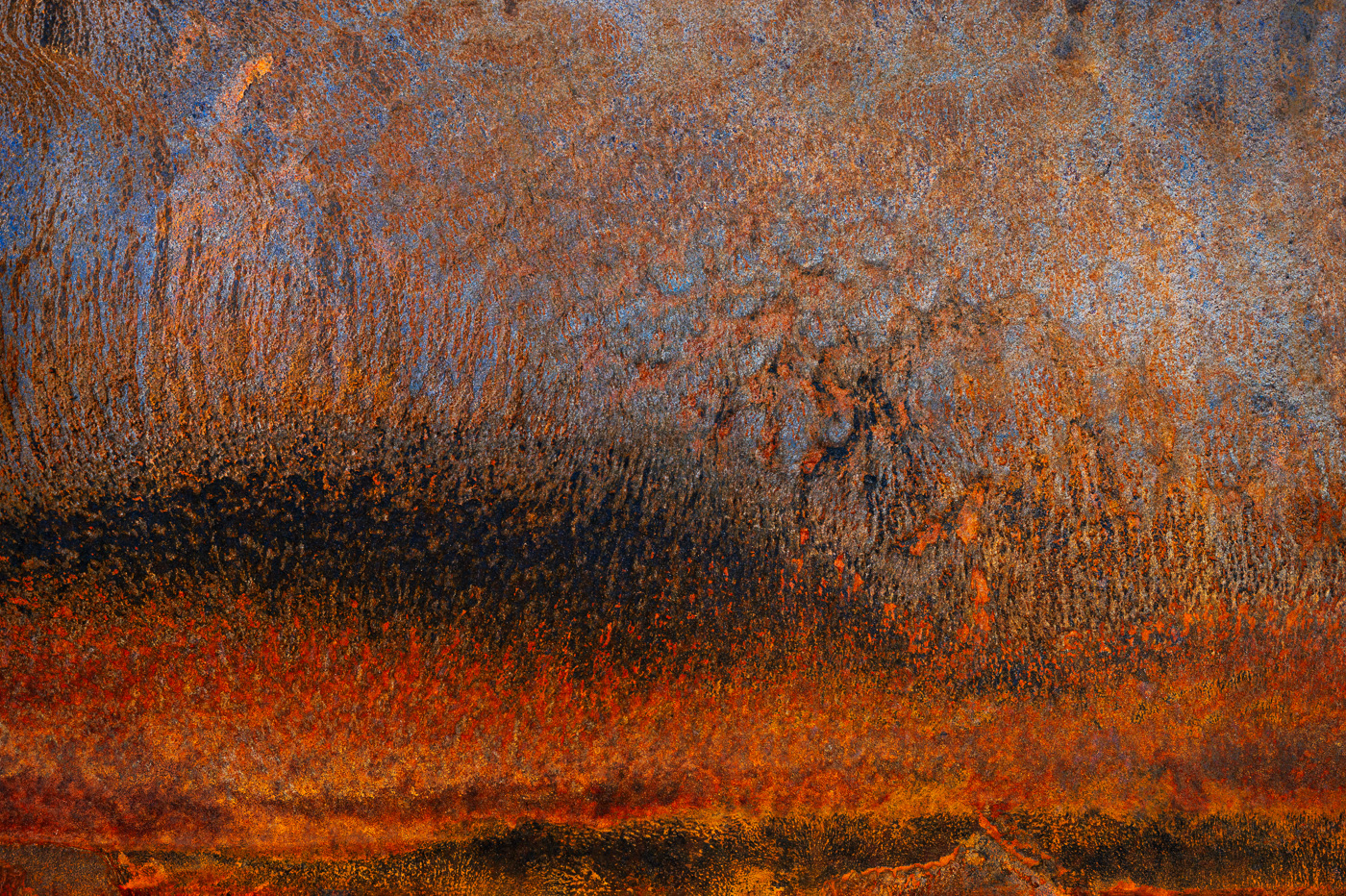
    Dancing in the Rust©Ed Schlotzhauer

    Whichever, take it

    So, whether you believe images come looking for us or you believe we must go looking for them, do it. Don’t let semantics get in the way.

    Not much advice is universal. I realize that commercial photographers always do planned and staged shots. That is not what I do so I don’t talk about it. I am just talking about what works for me.

    The rest of us who rely on everyday magic must be ready, mentally and with our equipment at hand. Be prepared to respond when we recognize that great image. Get out of your own way. See it – shoot it.

    Let your images fill you up. Collect them with gratitude.

  • Too Much Help

    Too Much Help

    Is it possible to have too much help in our photography? Are there long-term downsides to some of the technology we employ? What does it do to us as creatives?

    Photographic technology

    One of the characteristic things about photography is that it is closely tied to technology. Since the invention of photography, it has been technology based. The specialized emulsions and chemicals and techniques required training and a certain level of technical savvy.

    Today the technologies have changed drastically, but the tie between photography and technology has not changed. If anything, it is stronger than ever. Being a “serious” photographer just about requires a complex camera system, a capable computer system, and specialized training in the tools.

    The companies that make our technology try to ease some of the cognitive load by getting more helpful all the time. Usually, we welcome that. Who would not want our tasks to be easier? But we need to ask ourselves if there are hidden costs in taking the easy path.

    Leaning trees.©Ed Schlotzhuaer

    AI

    The antagonist I want to single out is what we generally call “AI”, or Artificial Intelligence. It is creeping into many aspects of our art with the promise of making our life easier or getting things done faster.

    I will be very open that I am against most uses of the things called AI, as embodied by large language models like ChatGPT. Not only in photography but most areas of life. I am not just a Luddite. I spent a long career in the tech industry, and I studied and practiced AI at some points of my career. So I have some familiarity with what it is and how it works, including a moderate knowledge of the technology within it and its limitations.

    Study of coding

    I am curious about lots of things. I enjoy looking at seemingly unrelated areas and trying to see parallels or applications.

    Many studies are starting to be done on the human impact of AI. One that intrigued me was a study of software developers in Italy and what happened when their access to AI was cut off.

    In 2023, the Italian Data Protection Authority suddenly banned ChatGPT based on privacy and security and non-compliance with European data protection laws. The effect on software developers was immediate and dramatic. Code check-in on GitHub – a proxy measure of output – dropped 50% in 2 days.

    But on further analysis, 2 very interesting things emerged: the output of inexperienced coders went up slightly while the output of experienced coders went way down, accounting for most of the drop in output.

    One of the suggested explanations is that novices were concentrating more on developing basic skills for themselves, therefore not relying on AI as much. Experienced developers, on the other hand, embraced AI to do a lot of the routine work. But the productivity booster had become a crutch. They lost a lot of the ability to do the work they used to do.

    Stark, bare aspen tree. Chaos of branches.©Ed Schlotzhauer

    Productivity tools

    I believe there are parallels for photography. At this point, I will ignore the novices just learning the craft, since I am not there and can’t think like them anymore. Let’s concentrate on experienced artists.

    Our tools constantly offer to take over more of the photographic process. Some of this is good, but not all of it all the time. I have bought into a lot of it. I don’t think my handheld light meter even works any more. And I have long forgotten how to use the manual calculators to determine exposure or desired depth of field. Now, my camera’s metering is so good that I usually trust it. And DOF, well, I can immediately see my image after shooting, so I can check it easily.

    I often use “AI” tools in limited ways. In Lightroom (Classic, the only “real” one ☺) I often use the Auto button to see it’s opinion of a good starting point. It does a pretty good job for the outdoor shots I usually take. I seldom leave its settings untouched, but it can be a time saver. Likewise, I use the manual Remove tool a lot for dust spots and distraction removal. I very occasionally use the generative remove, although it is about a 50/50 chance of it being better than doing it manually. Lightroom is getting much more capable of creating useful masks. I often use them as a starting point.

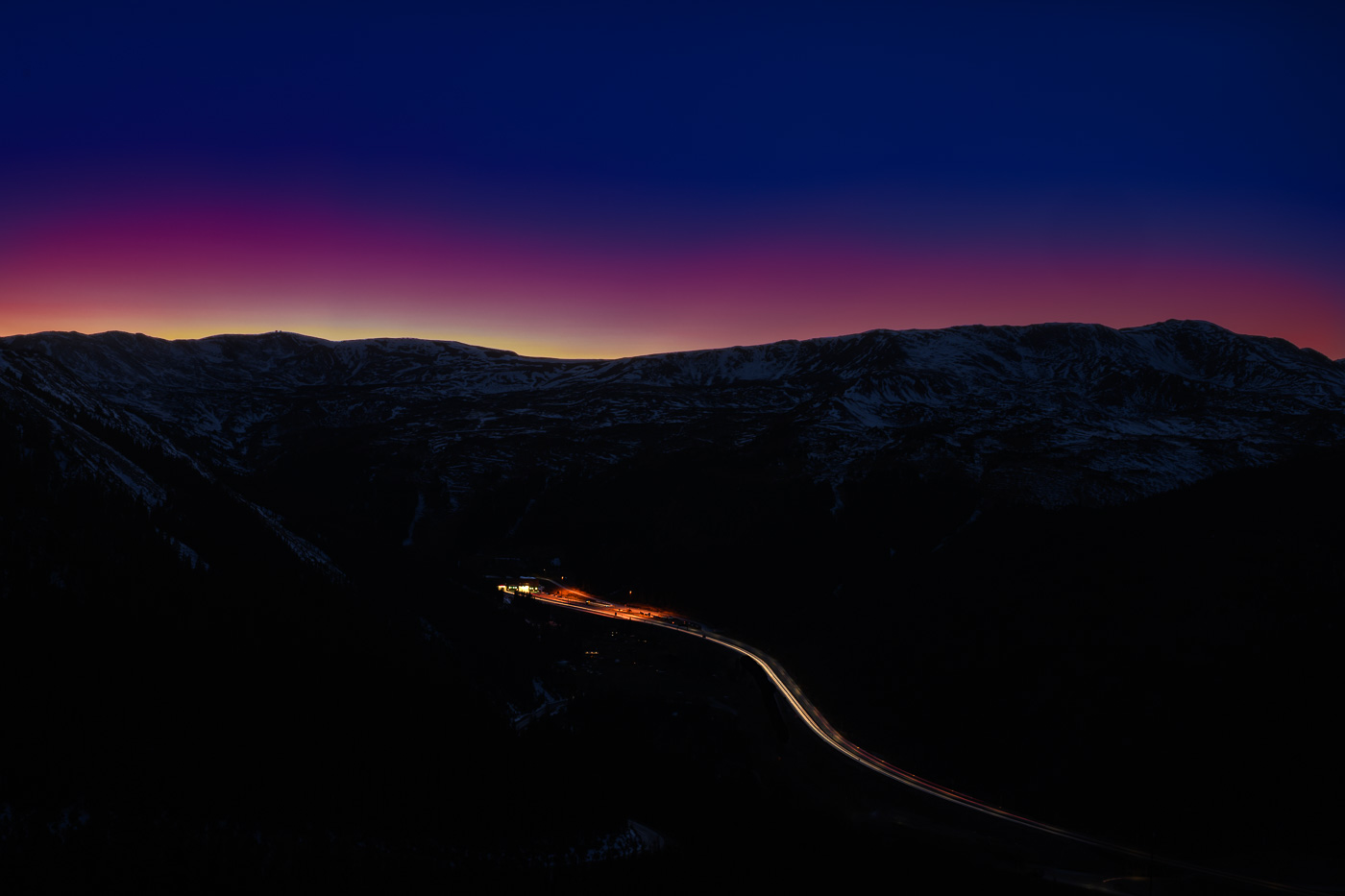
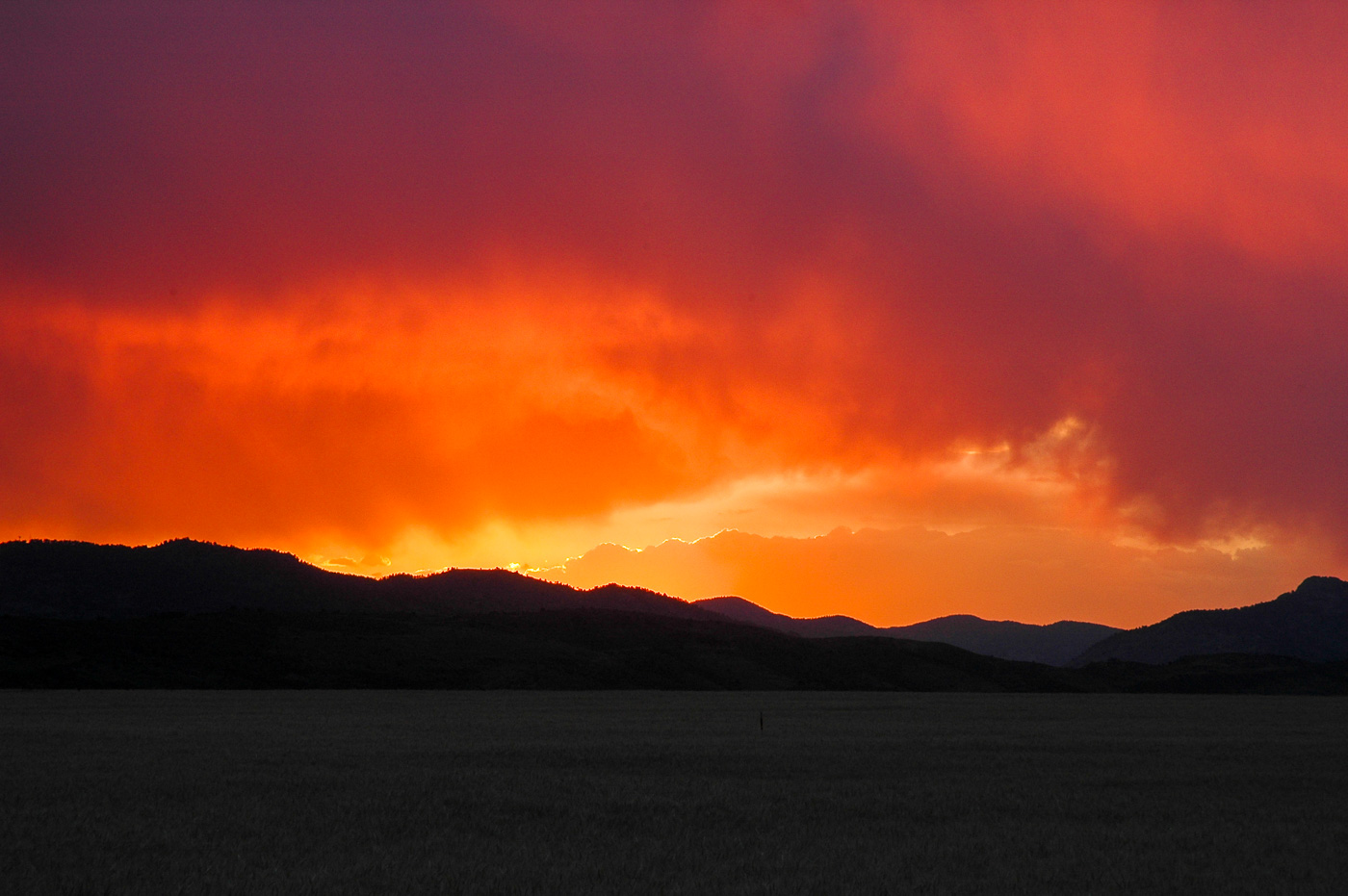
    Sunset sihlouette©Ed Schlotzhauer

    Creative rot

    But who says art should be effortless. Our tools want to take over increasing portions of our work, to “help” us and make it easy They offer to automatically remove dust spots, they provide great aid in removing distractions, they offer to distort our images to align verticals and horizontals, they offer to cull our photographs and assign keywords, etc. All these things can be helpful time savers, but at what cost?

    Like the experienced coders in the Italian study, at what point do we start losing the ability to do our own work?

    Editing, for example, is something I consider a necessary skill for photographers. I have noticed in my own work that I am now sometimes uneasy in manually removing complex distractions. My initial instinct is “that’s hard and will take a lot of time; maybe it would be better to just let the software do it”. That is a warning flag to me. I feel that I need to be skilled at doing this and confident that I can. If I cede these decisions to my tools, I believe I have abrogated part of my role as an artist. I am responsible for every pixel of my image. Software should not take over important creative decision making.

    Or take culling images as an example. I strongly believe culling is a critical part of the artistic process. Confronting our mistakes and selecting the best of a series is a necessary part of improving our work. I would rather not spend the time required to do it, but I feel I must. Without it, I am deluding myself about my actual work. I can’t afford to let the computer do it for me.

    There are too many examples to list. AI technology is trying to embed itself in most phases of our process.

    Dead tree in snow. Bent, broken, but still trying to stand.©Ed Schlotzhauer

    The other AI

    Let me pause for a moment and note that I am not discussing fully AI generated images. There are times and places to use them. They are not inherently bad. It is kind of like hiring an illustrator to create some graphics for a presentation or a graphic designer to make pictures for a marketing brochure. Those are business products, not art.

    I firmly believe that AI is incapable of coming up with creative new ideas or art. It cannot do more than it is trained on. Good art is a product of human creation. I admit that there is a lot of bad art that is no better than AI.

    Caution

    I am not going to abandon technology advances. Many of them make my life easier and more convenient. But I do intend to maintain a certain skepticism that will keep me from becoming dependent on convenience features.

    If the great automatic metering and auto focus in my camera went away, I still know how shoot fully manual. If most of the automatic aids in Lightroom and Photoshop disappeared, I still remember how to do things the hard way.

    I fear that younger photographers who have grown up with the tools do not have that fallback position. We could soon be in a position where photographers require AI tools to do their work, because they cannot do it themselves. If they have to rely on it to do their basic work, then why not allow it to do more and more. At some point, who (or what) is the artist?

    I do not believe my smarter tools have negatively effected my images or my creativity so far. I keep a watch for that.

    Or maybe I am wrong and completely out of touch. Maybe photographers are no longer required to be masters of our technology. It could be that the requirements for making an original and creative work are different from what I believe. In that case, I am just an old dinosaur holding on to a forgotten past. But I choose to believe my knowledge and experience is something AI cannot copy.

    Maybe this disquiet about too much help is one of the reasons there is a resurgence of interest in “old school” technology, like film and manual cameras. Many long for simpler days when we were more in control and closer to our end result. I am somewhere in the middle. I don’t want to give up most technology, but I refuse to be controlled by it.

  • Transmogrification

    Transmogrification

    Photography is a process of transmogrification – a transformation of one form to another. It’s a wonder an image ends up a recognizable representation of a scene. Some don’t.

    Transmogrification

    If “transmogrification” is unfamiliar to you, you are probably not a Calvin & Hobbs fan. I am a shameless fan. In my opinion, it was one of the most creative and humorous cartoon strips in history.

    Calvin (a little boy) and Hobbs (his imaginary friend who is a stuffed tiger) were always getting into typical little boy trouble. One of his “inventions” was a transmogrifier, a device (cardboard box) that could transform anyone into anything else.

    One of the reasons the comic is meaningful to me is that I had 2 active boys who always pushed the limits, and then some. Now, I have another newborn grandson, so I will be starting over in that world.

    I thought the author, Bill Watterson, invented the word, but it turns out to have been used as far back as 1671. It is a real word, not a made-up cartoon word.

    Not deep philosophy

    This discussion of the transformations that take place in making a photograph will be purely practical. I will not get into philosophical questions. We could do long analysis of indexicality or semiotics or formalism or the photo theories of John Szarkowski or any of dozens of other theories that attempt to explain why we see what we see.

    I don’t avoid this just because I am not capable of the deep thought. My nature is to be more of a pragmatist in my basic life philosophy. That’s why I went into Engineering rather than Science.

    A theory of why I made a particular image may be of a little bit interesting to me. It might help me to understand my process and vision. But I don’t think it benefits my viewers or really changes the final image.

    To someone viewing my image, it is what it is. It has to stand on its merits as they see them. I may have had deep theoretical intent behind what I did. but they don’t care. And despite any philosophical basis I may have used, if I don’t like the image either, it is useless. Don Giannatti recently said on Medium “A good photo is a good photo.” So true

    A series of transformations

    There are 3 main groups of transforms between a scene and a final print: in our head, in the camera, and in the computer. I include our head because it is probably the most important one. I will only describe a raw image processing path, since that is all I use. When I talk about a processing step, I mean a point where the result can be altered.

    Image processing transform in our head©Ed Schlotzhauer

    We see a scene and our brain goes through a lot of steps before we are even close to pressing the shutter release. We evaluate what we are seeing, determine what is significant, decide how we feel about it, what is our intent in taking this picture and if it is even worthwhile, and generally how we will compose and frame it.

    These steps may happen rapidly and instinctively, or they may be a slow deliberate process. That depends on the situation and our shooting style and our experience. But they probably happen.

    Camera transforms

    image transforms in the camera©Ed Schlotzhauer

    Assuming we decide to take the picture, now several processing steps take place within the camera. First, the light from the desired scene comes in through our lens. The lens determines the field of view, wide or narrow. It also “contributes” its own distortions – the MTF, barrel or pincushion distortion, chromatic aberration, vignetting, etc.

    After or within the lens is the aperture. This opens or closes to let in more or less light. As a side effect, the aperture size determines the depth of field – the amount of the image that is in sharp focus. Focus depth is one of the creative decisions unique to photography.

    Then the light is controlled by the shutter. The shutter opens for a precisely controlled amount of time when the photographer presses the shutter release. That opening time controls the amount of light that can pass through. The aperture and shutter work together to provide two of the key variables that determine exposure. The side effect is that shutter speed also determines the perceived motion blur of the scene. This is another creative decision.

    Next, the light hits the sensor where photons are converted to electrical signals. The total number of pixels is fixed here, as is much of the quality of the final image. The sensor also introduces some kinds of noise into our data.

    A deep, dark secret that many people do not internalize is that at the sensor, the information is “analog”. That is, it is varying levels of electrical signals. It goes through an Analog To Digital converter (ADC) to digitize it. Gain is also applied here as determined by the ISO setting. Higher ISO values apply more gain to boost the signal. There is a tradeoff the artist must make about the ISO setting, the amount of gain, since that determines a lot of the noise in our image data. Each pixel’s electrical value is digitized to create the matrix of digital values representing the image.

    Next the digital data flows through the digital signal processor (DSP) section. Each manufacturer applies its own proprietary “secret sauce” of processing to enhance the response of the sensor. This is why there is a Leica look and a Fuji look, etc. A jpg image is also processed from this to create a quick preview of the RAW data. The data is assembled into RAW data format for storage and then written to the memory card.

    The memory card receives the raw data that represents the image as processed by the camera.

    All these steps are just what is within the camera. I have not even mentioned our decisions of how to orient the camera or support it. Is it fixed or intentionally moving? Where is it positioned in relation to the scene? These decisions were probably made at the “head” stage.

    Computer transforms

    Image transforms in the computer©Ed Schlotzhauer

    We typically take that memory card and read its contents into our computer through a cataloging program such as Lightroom. Now the data is stored locally on our computer system for access.

    The type and amount of processing that can be done here is too vast to describe. We might use Lightroom or Photoshop or Topaz or any of several other software applications to operate on the pixels, bending and shaping and polishing them to our satisfaction. We may crop or delete large sections, combine images in various ways, change color drastically, even to black & white. There is little limit.

    Finally, to make a print, our print processing software uses profiles for the printer and paper we will be using to re-transform the image to a new color space. This is necessary to create a print that mostly matches what we see on our monitor. Raster Image Processing is used to do error diffusion and other complex calculations to create a new representation that creatively shapes the pixel values to patterns of microscopic ink dots that will produce the final image. The printer sprays the ink onto the paper substrate.

    We now have an image.

    Uniqueness of photography

    This series of transformations partially serves to define the basic difference between painting and photography. It should be clear that a photograph is a capture of all the light and forms that was seen by the lens. Everything gets recorded.

    The photographer has command of composition and viewpoint and lens selection and exposure to control what gets captured. But everything that was there is recorded. One of our jobs is to carefully select what to record, removing distractions.

    Distraction removal often continues to the post processing steps. And new elements may be added to the image. These happen long after the image is captured by the camera.

    A painter starts with a blank canvas and adds the elements he desires. Nothing can be there unless it was his intent to place it there. If he didn’t paint it in, it does not exist.

    Photography is a subtractive process while painting is an additive process.

    Over time we photographers learn how to control what ends up imaged on the sensor. We must be vigilant as we are looking through the viewfinder. Learning to actually see all the faults and distractions is a skill. Learning how to deal with them is part of our art, as is learning how to process the image to end up with the result we want.

    Looking through clock, Musee Orsay©Ed Schlotzhauer

    The chain

    As we can see, there is a complex chain of transforming steps that an image goes through between the “real” scene and the resulting depiction in a print. Most of these steps can seriously change the final result.

    I take 2 main points from this: all images are modified and as artists we exert the control over the intent of what we are creating.

    An image is not the object or scene. It is possibly a representation of the original. Or it can be completely different. I intentionally avoid any discussion of referent philosophy, other than to say a picture is not the original thing, it is an image that may or may not have something to say about the thing..

    How the image corresponds to the “real” scene is the artist’s choice in creating the image. As artists, we have an abundance of control points in the process. How we choose to use them is our decision. It is what we do as photographers. The result of all these transformation steps is an expression of our artistic vision.

    I called it transmogrification because the complexity of what is going on is almost science fiction or fantasy. But this is what we deal with every time we take a picture. As photographers, we must understand this chain. We do not have to understand all the technical details, but we must be able to use the steps available to us to create the image we want. As artists we must understand how to control all this technology to shape the final image to our vision.

    It’s a great thing, though. Taming all this technology and learning to use it well is part of the joy of being a photographer. It gives us tremendous creative freedom.

    Ultimately, though, our viewers do not care at all about our technology. They only look at the image and decide if it is worth looking at for more than an instant and if it has some relevance to them. Technology, like good magic, should be invisible.

  • Moments 2

    Moments 2

    Moments are frozen instants in the flow of time. Our life is about moments. Most art, but especially photography, is about capturing moments.

    Flow of time

    Time is like a stream flowing around us. It goes from infinity to infinity as far as we can perceive. But we can’t stop it or dam it up. We can’t even jump in the stream and ride a moment forever. Instead, we must watch it flow by and hear the clock ticking.

    Time itself may be virtually infinite, but our time is not. We have been alive a certain time, but we have no idea how long we have left. There may be many years left, or our time may be done tomorrow.

    Many of us live our lives as if we have infinite time left. That is simpler and less troubling than acknowledging the impermanence of our existence. So, we become numb to the passing of time. We bury our self in our job or other responsibilities or diversions. Days flow into weeks into months into years and we barely realize it. Someday we look back and wonder where the time went.

    Lobster shack, Maine coast©Ed Schlotzhauer

    Art is moments

    All we can clearly perceive is the current moment we are living in. The past is a sequence of moments that are gone. The future is a potential sequence of moments we cannot yet see.

    A characteristic of a lot of art, especially photography, is that it records moments. They may be beautiful moments, or touching ones, or poignant ones, or frightening ones. But the moment itself is the art.

    Art portrays these moments so we can look at them from outside the time stream. It gives us a new perspective on the moment. Whether the art captures the moment as a 2-dimensional image to hang on our wall, or a 3-dimensional form, or a poem or story we can visit whenever we want, they re-create for us a moment or a scene we want to save.

    One of the powerful aspects of our art is that it is concrete. That is, it is fixed, unchanging, staying as it was created. This plucks moments out of the stream of time and preserves them for us, beautiful and unchanging. A photograph is a frozen moment.

    What we remember

    Our memories are really a collection of remembered moments. Do you remember what you did at your job last month? Probably not, but you remember that time last month when your boss came to you and praised you on doing a great job on something.

    Do you remember college? Or is your memory based on some great times, some miserable times, a time when a professor said something that opened a whole new world of thought for you?

    In our lives and with our families we tend to remember events, certain happenings – in other words, moments. Everything else is just a blur.

    Sailboat, healed over in the wind.©Ed Schlotzhauer

    Moments we miss

    Astounding moments are flowing by us all the time. Mostly, we don’t notice. Those moments are lost and can never be regained.

    Mindfulness is a practice of being aware and “in the moment.” It attempts to let us forget the past and not worry about the future but instead be very aware of what is happening right now.

    Being mindful is a good thing, but when you look up “mindfulness” it often gets co-opted by types of eastern mysticism. Ignore that. The concept is simple, even if the practice may be hard.

    When I say we should be mindful I simply mean we should practice greater awareness of the world around us and the way we are responding to it. As artists this is especially important. There is beauty and interest almost everywhere. Fascinating moments are happening all the time wherever we are. Mindfulness is teaching our self to see them. We must notice moments.

    This usually involves unplugging from our technology and stepping away from the fast pace of our lives for a bit. A walk is a great tool for me. Being outdoors and getting exercise helps me see more of what is going on. Of course, this only works if we put the phone in our pocket and take off the headphones, freeing our self from our tether to the machine.

    But being there and seeing the moments are two different things. We must be open to the experience. Pause and marvel at small moments. At common, ordinary things around us that can become magical sometimes.

    The way we live our moments is the way we live our lives.

    Annie Dillard

    Sunset with power lines©Ed Schlotzhauer

    Photography is about moments

    By its nature, photography is about capturing moments. The shutter opens on a scene in the “real world” for a fixed slice of time. The sensor records what is happening during that time slice. What we get is not imagined or fake. We have captured a moment. If we are good, it is a worthwhile moment.

    Of course, I can create fantasy art that is impossible or surreal. I enjoy doing that. But most photography is a relatively straight capture of a real scene.

    The typical photograph is a portrait of a moment. It is not the moment itself, but an abstract image of it. We have plucked it out of the stream of time and set it aside for contemplation, to show other people what was there that they could have seen. Since there is such a rich flow of moments passing before us, one of the challenges is to develop the experience, the “eye”, to recognize a worthwhile moment as it is happening. In a sense, what Henri Cartier-Bresson called a “decisive moment”.

    Shoot it when you see it. Painters may be able to hold a moment in their memory well enough to be able to sketch and paint it back at their studio. But photographers must react immediately. Capture it or lose it. The famous Jay Maisel so rightly said “Always shoot it now. It won’t be the same when you go back.

    Pinocchio?©Ed Schlotzhauer

    Prints freeze moments

    Even in the realm of photography, there is the special case of the print. A print takes this fleeting moment and casts it in a permanent form onto a substrate like paper or canvas or metal.

    The moment becomes a real object. It has weight and form and texture. This is important because by being an object of substance, we have a different relationship with it. An ephemeral moment has been transported to a physical object we can see and touch and hold.

    Even more, it has permanence. Memories are unreliable things. They fade and change. A print holds the moment up for us to see for many years to come. We can come back to it and relive it at will. Maybe only to remind ourselves that great moments are happening all the time and we should be more mindful of them.

    In computer speak, a print is read-only-memory. That is a technology that, once written, can never be altered. Once the print is printed, it is an unchangeable record of the artist’s intent at that moment. The digital file can be altered and a new, modified print can be created, but the original print is fixed for its lifetime.

    A print celebrates a moment that is worth keeping among the continuous flow of time.

    Precisely by slicing out this moment and freezing it, all photographs testify to time’s relentless melt.

    Susan Sontag

    Fabric covered head©Ed Schlotzhauer

    Moments

    Be intensely aware of moments. They are our life. Each moment we have should be precious to us. Don’t let them drift away unnoticed.

    As photographers, we should be on the lookout for the moments we want to record. To do this we must be very aware of the world around us, mindful, in other words.

    We have the privilege of capturing moments and presenting them to people so they can marvel at the moments that have gone by. This is one of the things artists do. This is awesome.

  • No Learning Required

    No Learning Required

    Photography is a craft we traditionally spend years learning and practicing. What if we could shortcut all that and have some “hacks” that would let us make great images with little work or training?

    The click bait

    It seems like I am getting more and more click bait like this (actual names redacted to protect their anonymity, and to not support their sales offer):

    Most photographers spend years trying to figure it all out on their own—slow progress, scattered tutorials, lots of frustration.

    But what if you could skip that?

    What if this is the year you jump straight to clarity, consistency, and results?
    That’s exactly what the [program name] gives you: the proven system that pros actually use.

    If you’re at the bottom of the learning curve this seems attractive. Who wouldn’t want to be able to leapfrog to the top of your game with little effort? This would save years of hard work.

    For a little money, I could buy my way to success, fame, and fortune. I could become a respected artist quickly. What’s not to like?

    There are 2 things: there is no secret knowledge, and it still involves a lot of hard work and learning.

    Decrepit railroad tie, no track.©Ed Schlotzhauer

    Secret knowledge

    It is a popular and successful sales pitch to insinuate that there is secret knowledge known only by elite practitioners in a field. If someone shares this secret knowledge with you (for a fee), you, too, can be one of the elites.

    The problem with this is that photography does not rely on secret knowledge. Rather than being a closed league, like a guild, the field is very open. Most photographers readily and openly share their knowledge and insight.

    Why would they make all this knowledge available? I think it is for 2 reasons.

    First, many photographers rely on workshops and book and tutorial sales to supplement their income. It is just a reality. The number of people who live solely on image sales is relatively small.

    Second, they know their knowledge is not secret. It does not need to be closely guarded, because it is wisdom based on years of experience. Every photographer who has been in the game long enough basically knows the same things. Most of the ones I know are eager to share their experience and help others benefit.

    Learning required?

    Are there “hacks” you can use to get you where you want to go faster? Maybe. Depending on where you want to go.

    If you are the family photographer, there are simple things you can learn to make your images more enjoyable. Making yourself aware of the lighting and how to control it, framing the subject more deliberately, using shallow depth of field to isolate, and seeking a “decisive moment” are techniques to raise yourself above the norm.

    Or if you want to make your vacation pictures less boring to others, there are “hacks” that can be used. Learning to see and use the light, actively looking at what is going on all around your frame, use wide and close and high and low views. Culling out most of your shots will help a lot, too.

    If these are the kind of specific goals you have, then certainly learn the “tricks” and be satisfied. You will take better pictures but not be an artist.

    One tree leaning on another one©Ed Schlotzhauer

    Results or creativity?

    So, what is the goal? Many people, probably most people, only care about getting a decent shot to put on social media or in a memory album. I do not criticize this at all. That is where their values lie. Learn some simple techniques that will improve your photos.

    But if you aspire to be an artist, if your goal is to make creative and interesting images that express your point of view, that is an entirely different path. If you go to photography school, you will learn techniques like I described above. Probably in the first semester. Then you will be pushed onward to learn actual image making.

    Creativity is hard. You must know the basics of the craft very well, but then you must develop your own unique way of seeing and have something to say. It goes far beyond just being able to take a good picture.

    Are there shortcuts?

    The ad I quoted talks about “slow progress, scattered tutorials, lots of frustration” being involved in the way photography is usually learned. Maybe they have synthesized a program that guides a person through this messy time. Or maybe they just have a rigid program to follow to make a novice a clone of the instructor.

    I believe. that learning to be a creative photographer is hard work. Personally, I don’t think there is a reasonable shortcut. A good mentor can help immensely by pointing things out and giving good feedback. But you still must do the work. It is long and frustrating and sometimes you want to give up. We want to be progressing faster, but we don’t seem to be getting there yet.

    Henri Cartier-Bresson famously noted “Your first 10,000 photos are your worst.” That is true. It does not, however, mean your next 10,000 will be great. As someone who has shot many multiples of 10,000, I know that it is a long and difficult road.

    But we keep pushing, because something compels us to do it. Psychologists tell us we learn more from failures than from successes. As aspiring artists, we generate a lot of learning opportunities. And we do learn. Practice and ruthless evaluation eventually pays off.

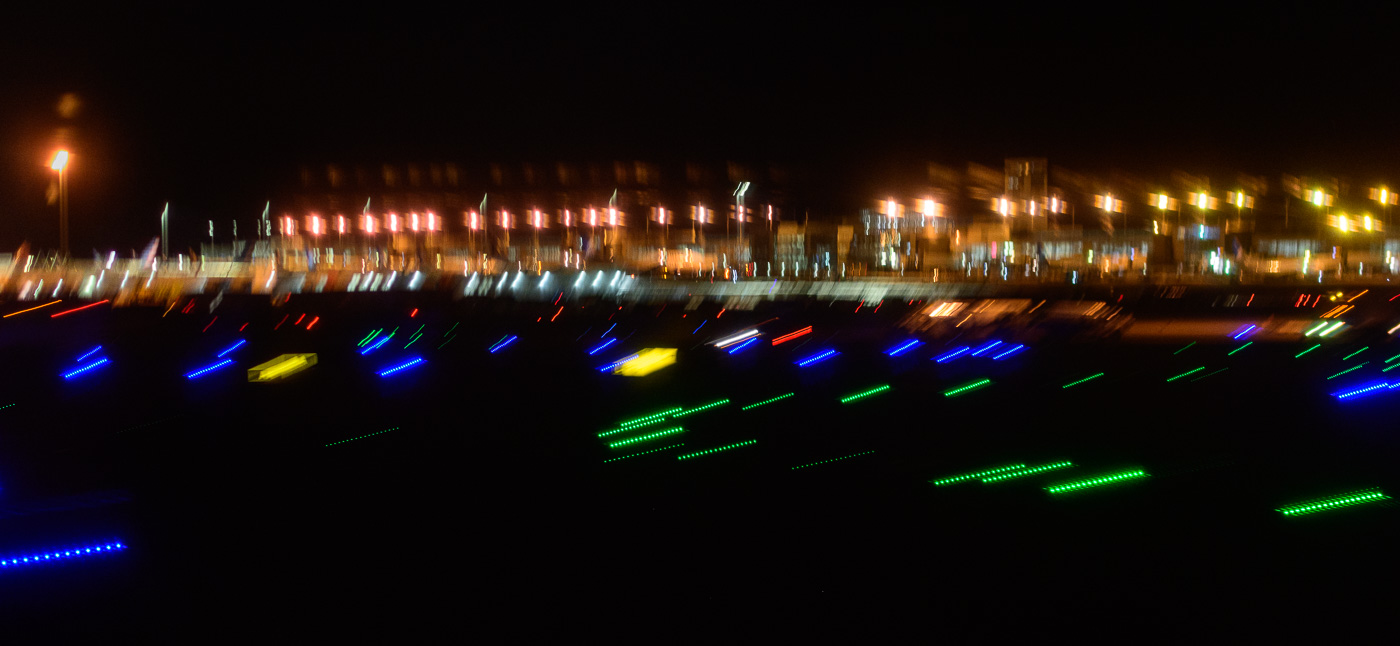
    Night landing at the airport©Ed Schlotzhauer

    Doesn’t AI do the work?

    An elephant in the room these days is AI. Won’t AI provide the shortcuts we want? Can’t we rely on it to make our images better?

    Yes, we can. It already happens every day with AI “enhancements” when we take a picture with our phone. And there are many AI “enhancements” that can automatically be applied to our images in Lightroom or Photoshop or whatever your tool of choice is. It will only get more powerful and more pervasive.

    If your goal is to make your image better, then yes, it will be glad to do it for you. But you didn’t do it. And by letting AI do it, you didn’t learn how to do it better next time. We become a tool of the machine rather than it being the other way around.

    If our goal is to become a creative artist, my opinion is that this is going the wrong direction. An artist is responsible for all the creative decisions in making an image. We delegate some simple things to our tools, like when I put my camera on Aperture mode and let it choose the shutter speed based on the aperture I selected. That is a simple technical calculation, it is not taking creative responsibility for the image.

    Maybe AI is one thing driving the resurgence of photographers shooting film and doing chemical darkroom work. They remain firmly in charge of all aspects of their image.

    Foggy night in the park©Ed Schlotzhauer

    Look back

    Sometimes looking back helps us look forward.

    In my blog I have given some glimpses of my culling and evaluation techniques. I will not describe them in detail, just to say that I do not use a basic 5-point ranking scheme. My images must go through several rounds of critique and editing to progress up to my top set. The ones I would be proud to show anyone.

    Recently I was going back through to catch up on my backlog of hundreds of images that are still “in progress”. It is a time to look realistically at each image and decide if it deserves to be promoted to the next level.

    An interesting thing occurred. Having to revisit these hundreds of images, I couldn’t help thinking that I have been making some pretty good and occasionally creative pictures. I shoot so much that I sometimes forget to look back and see the arc that is traced by the past. It was encouraging.

    Art is hard

    Becoming a better picture shooter is easy. Becoming an artist is hard. It involves lots of learning and practice and self-examination. And suffering. At least the mental suffering of falling short of your expectations. But even then, there is no certificate, no award ceremony, nothing to tell you that you have arrived. You keep pushing and reaching forward.

    It takes time and effort. I do not believe there are any magic shortcuts that will get you where you need to go. Put in the work. Put in the time. It is worth it.