An artists journey

Category: Mastery

  • Constraints

    Constraints

    I have written about this before, but I feel it is time to revisit it, maybe from a slightly different point of view. We have constraints on almost everything we do. Usually we try to find ways to avoid or relax the constraints. I am suggesting that they can actually be useful, Working within constraints can make us a better and more creative artist.

    Constraints

    Constraints are anything that bounds us, that limits what we can do. We all have them. You aren’t able to go on a 6 month art sabbatical because you have to work to earn a living. I would like to get the latest super mega pixel camera – no, I need it, really. But I can’t afford it. I feel limited because I don’t have a great wide angle zoom or super telephoto.

    Wherever we turn we bump up against constraints. Time and money are the overriding classics. And there are technology limitations and constraints imposed by our families, school, and job. Maybe the inability to travel to the locations you want. Everything seems to be conspiring against us.

    They seem to limit us as artists

    I was having a discussion recently with a friend I respect a lot. A very good professional photographer who you would know. He was observing that he has always taken multiple camera systems with him on shoots, along with all the associated lenses, batteries, etc. But he is getting older and all that slows him down and makes the experience less pleasant.

    Isn’t this common for photographers? We feel like we have to have LOTS of equipment. You may need that 600mm for a bird shot. You may need that tilt/shift lens to do architectural photography. The portable flash system would come in handy for portraits. Having a small mirrorless camera is good for travel photos, but you might want that medium format system for fine art scenes you find. We always need more gear.

    How can we capture the image we want unless we have that exact, perfect piece of equipment? Well, maybe we have to think. More on this later.

    How to work around our constraints

    We have freedoms of choice in our lives. Don’t have enough money? Earn more. Don’t have time? Get out of the working world and use your time for yourself. Can’t carry all your gear? Get a photo van and outfit it with storage for all your equipment. Drive it to your shoots. Can’t carry all you need to a location? Workout hard to get strong enough to carry a huge backpack. Family taking up too much time? Cut them loose.

    How’s this working for you so far? Yeah, I thought so. Doesn’t work for me, either. We have choices we can make, but I can’t snap my fingers and wish up a life of luxury to feed my art desires.

    I guess we had better resolve to accept most of our constraints. They are there. They are real. We don’t have a magic wand to wave to make them go away. Sure you can adjust your life goals to better accommodate your art. But we will probably not have unlimited money or time or equipment or travel opportunities. That’s life.

    So we have to deal with our constraints and work with them and still create our art.

    Turn it to your benefit

    In some types of self defense programs you are trained to use an attacker’s momentum against them. That is sort of what I am advocating. Our constraints seem to be working against us and limiting our freedom and ability. Use them for our good instead of fighting against them.

    Constraints can be a road block or a creativity enhancer. It is a matter of attitude. Don’t sit around moaning because there is a constraint in the way. Accept it as a challenge. Use it to rise to a new level.

    An example of constraints

    A story to illustrate. In 1974 a young upcoming director named Steven Spielberg was hired to direct a movie called Jaws. It was the first major motion picture to be actually filmed in the ocean. It turned out to be beset with problems. One of the producers later said if they had read the book twice, they would have not made the movie when they realized how difficult it would be.

    There are many interesting examples of constraints with this movie, but one in particular fascinates me. The mechanical sharks turned out to be a nightmare to make work. Even when they were working it took a team of 14 “puppeteers” to operate them. The sharks caused so many production problems that they had to be cut out of most of the first half of the movie. The result was that in the final product, the hidden presence of the shark, combined with John Williams brilliant music, built much more tension and drama than their original plan. The movie was a blockbuster hit and still viewed today.

    It was made better because of the constraints that had to be overcome. Spielberg later said of the difficulties that “The film went from a Japanese Saturday matinee horror flick to more of a Hitchcock, the less-you-see-the-more-you-get thriller.”

    Our constraints

    We may not be making a multi-million dollar movie, but we encounter constraints all the time in our every day lives. How we deal with them makes or breaks what we get.

    Maybe you can’t fit a photo safari to Iceland, Africa, New Zealand,… (fill in your blank) into your life or budget. Does that mean you should put up your camera and sulk and not take pictures? Of course not. Shoot where you are and what you find. The reality is you will have more insights on familiar areas than you do seeing a tourist spot for the first time. Learn to really see what is around you. Let your curiosity lead you to an attitude of awe about what you find.

    You’re a fine art photographer and you feel like you need to have a medium format system to shoot 100MPixels or more with great dynamic range. So you should sit and wait until you can afford to put $20,000 or more into a good medium format system? No. That is something you defined. Get out and work.

    Most fine art photographers I know do not shoot medium format, at least not exclusively. The fact that they do not shoot it exclusively means they recognize that it is not always required. They can do excellent and very salable work with their DSLR. It is more about vision and insight and technique than it is about technology.

    Do the best you can with what you have. Maybe someday you can upgrade, but that will not change your vision or your style. It will just make your images printable at a larger size.

    I could use many other examples of constraints. Many are common to most of us and some are unique to each of us individually. Whatever yours is, embrace it and work with it.

    Become a problem solver

    Embrace it? Yes. You have to live with it, so use it to your benefit.

    Working around constraints is a problem solving exercise. We have to think. We use our creativity to come up with an even better solution to what we wanted to do originally. Like Spielberg in Jaws.

    Looking to shoot a scene, but it would take a super telephoto that you don’t have? Re-evaluate your composition. Maybe there is a different POV that you can shoot with your 200mm. Or get up and move closer.

    Working on a composition that requires a super wide angle to bring in all the lines and shapes you envision? Re-think how to make the image using your 24mm. Maybe get closer. Maybe re-compose it to change the relationship of the elements.

    This is a significant part of creativity. Creativity is not just coming up with wild new ideas that no one else has ever thought of. A lot of it is solving problems to remove obstacles in order to realize your work. Your vision should transcend your constraints.

    So when an obstacle or constraint presents itself, don’t let it derail you. Put your creativity to work on it. It can be a good thing. It can stretch you and grow you as an artist. Find a creative workaround. Let it spur you to produce something better than you originally envisioned. If you react to it positively and exercise your creativity, you may end up being thankful for the constraint.
  • Out There

    Out There

    My previous article discussed being an explorer based on curiosity. I absolutely, intensely believe that. But I don’t want to leave the impression that most of the exploration can be done in books and videos and trips to museums and even on the computer. For what I do, I have to be out there. Out there in the outdoors. Thinking about images is great, but you haven’t created art until you actually make an image.

    Exploration can happen anywhere

    Exploration is partly a mental activity. Feeding your mind with new ideas and new images causes growth, new connections. This is a vital activity for artists – and for everyone if you care about growing. There is a limit to it, though.

    Creativity is a balance between thinking and doing. Thinking allows us to consider new possibilities and imagine what we would do. Actually getting out shooting lets us test the ideas, see unexpected things, apply the ideas and discover new ones.

    The craft of making something balances and perfects the ideas of what we might do. It is a feedback loop. They reinforce each other. Thinking new ideas helps us see more possibilities when we are out shooting. Capturing images helps refine what works and doesn’t. Then when we see what works we discover new possibilities to try another time. Putting theory to practice is necessary to perfect both.

    I shoot outdoor images

    At some point we have to stop just thinking about what we want to do and actually go do it. Get off the couch and out the door.

    Occasionally I set aside time to travel someplace specifically to shoot pictures. That is a joy. But i don’t get to do it as much as I would like. Some reasons are:

    1. It is expensive
    2. I have to be at my studio to process images and take care of all the things that need to be done.
    3. New places are enjoyable but I’m a visitor there. I feel the need to find fresh images where I live.

    So I force myself to get out frequently and explore in my own backyard, so to speak. I consider it great discipline to find new, interesting images in familiar areas. And I do find many that I consider good.

    I will confess that I am naturally something of a couch potato. Getting out in all kinds of weather is a significant act of will. Especially when you consider that where I live the temperatures can range from -10F to 110F. It can be easy to convince myself that is is just not fun. But it is a habit I force myself to do. When I am home, then 4 to 5 days a week I go our walking with my camera.

    Yesterday, for instance, it was 2F and snowing and we had about 4 inches of fresh snow on the ground. I walked over 4 miles. I’m not bragging. Probably many of you do much more. My point is that it is a conscious decision that I will go out with my camera and explore every chance I get. I am somewhat amazed at what I find.

    When I am looking at an image I like, I always remember what the conditions were when I shot it, but that is not a factor in my evaluation of the worth of the image itself. The image must stand on its own. But I sometimes find the best pictures in the worst weather.

    Practice makes perfect

    Exploration is largely a mental activity. Feed your mind. Take in new ideas and possibilities all the time and assimilate the learnings into your vision. But you have to do it, too. Make images. Express the creative ideas you formed. Realize the idea in a finished product for your viewers. It can be hard.

    In his e-book “10 Tips for Aspiring Photographers”, William Patino said

    One thing that I feel greatly helped my learning was the amount of time I was willing to invest in being outdoors, playing with my camera and observing light and the land.

    Invest the time. Be out looking and feeling. Getting good at anything takes time. Practice. Play.

    I find that creative ideas tend to be rather vague. They tend to come as an idea of something that would be interesting. But actually making it happen can sometimes be difficult. It may require planning or more research or travel or, typically, many attempts to capture the idea in a real image.

    When I was working on my Speeding Trains project I threw away hundreds of attempts before I learned how to capture the impression of motion and speed and power and presence that I envisioned. Even after I sort of figured it out, my “hit rate” was probably about 1 in 10. Practice makes perfect. Or at least better. 🙂

    Believe you are very lucky

    Being an artist is hard work. If anyone tells you different, they haven’t tried it. You have to create a huge body of work and continually refresh it. You have to deal with rejection. Gatekeepers are everywhere proclaiming themselves to be the arbiter of taste and style and you are not fit to be allowed in to their select club. You will want to give up. As an artist you have to believe in yourself and your work. Regardless of what others say or do. Push on.

    It seems a contradiction, but on the other hand, many people admire and look up to you. They dream of being able to step out of their drab world and create. To have the freedom to make art and tell the world they don’t care if no one else likes it, because it pleases them. We seem an independent rebel, living the creative artistic life. They are right.

    In a private correspondence my friend Les Picker said:

    It’s like a colleague of mine once said: There is no such thing as a bad day for a nature photographer. We’re out there. We’re walking the path. How fortunate we are!

    So when it’s 0F and I am feeling frostbite or it’s 100F and I’m about to pass out from heat exhaustion, I remind myself that I am out creating and following my vision. How can this be bad?

    My vision leads me to shoot outdoors. So this is where I have to go. I can’t cherry pick and just say “Oh, today is not totally perfect , so I will just stay in”. That would never get anything done. Get out in it. Get dirty or wet or hot. Look past the conditions and discover what is there to see.

    Being an artist is about seeing. I have to be out in the place I plan to shoot before I can see. I want to make art, not just think about art.

    Your mileage may vary

    It sounds like I am saying that you have to shoot landscape scenes to be an artist. Not at all. I think the principles apply to anything you do. If you do portraits, do them, a lot. Don’t just think about doing them. If your thing is commercial or food or street photography or abstract still life studio shots, it doesn’t matter. Do it. Practice. Get in the reps.

    My thing involves outdoor photography. I have to kick myself out the door to shoot. If you do your work in the studio then make yourself get up and go do the work there.

    You’re not an artist unless you are creating art.

    Don’t think about making art, just get it done. Let everyone else decide if it’s good or bad, whether they love it or hate it. While they are deciding, make even more art.

    Andy Warhol

    The image this week

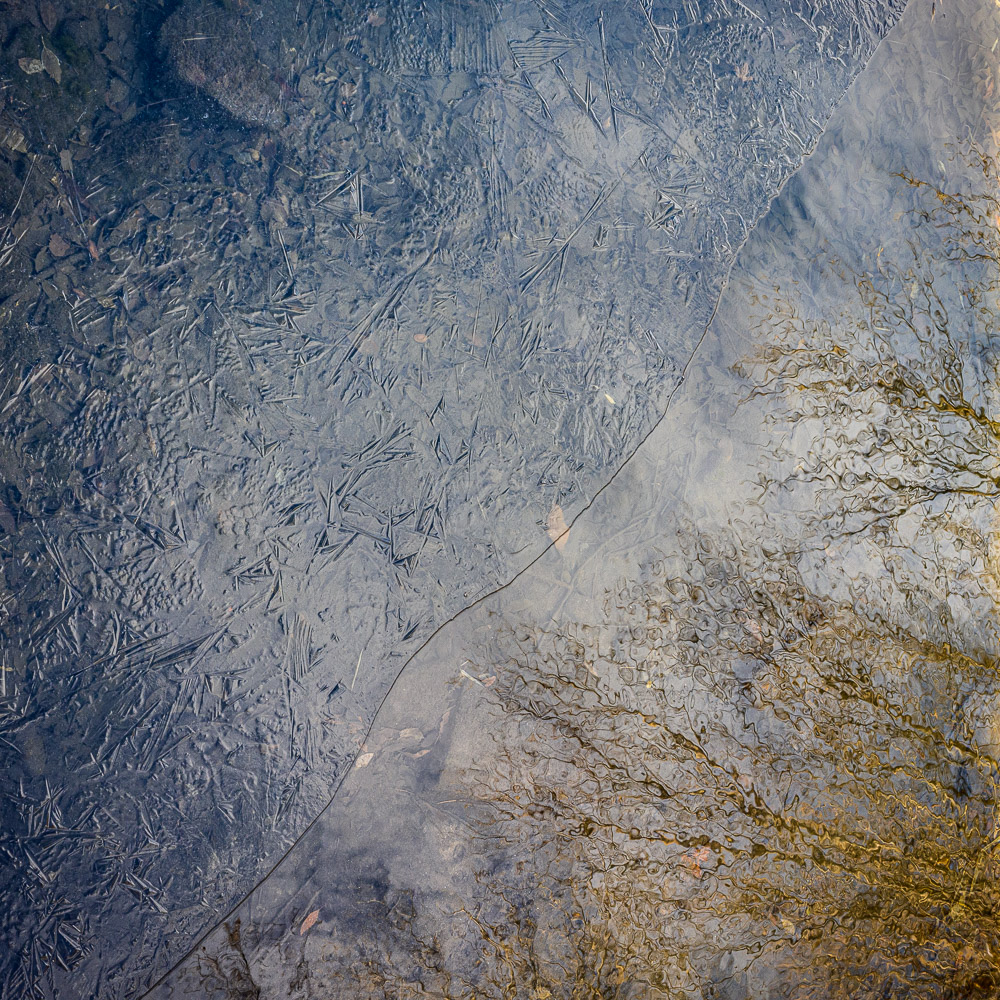
    I mentioned suffering in the cold. That is the time of year I’m in as I write this. What would be worth going out in that kind of weather? Well, things like this. I love patterns and reflections in ice. It is a very interesting subject to me. This kind of shot makes me forget the discomfort and think of the beauty in unlikely places. I hope you get out and find things like this, too.

  • Reflecting

    Reflecting

    At the beginning of a new year, I guess it is natural to reflect back on the one that just ended. To remember our successes and analyze our failures. Reflecting on the past puts us in touch with the flow of time.

    A calendar page

    Most of us have just “put up a new calendar” – does anyone (except my wife) still use paper calendars? Regardless, the metaphor holds. It is a new year, untracked, fresh with possibility.

    For some reason, the act of starting a new year causes us to spend a little time reflecting on the year that has just ended. This can be painful, because most of us did not accomplish all our goals or live up to our dreams. But it is also useful and necessary.

    The process of considering what we wanted to accomplish in the past year and making plans for the coming year is very useful. It helps focus our minds on our goals. Without it, we would tend to drift along year to year never going anywhere. Because the reality is, to accomplish our goals requires intense focus and detailed plans to get there.

    Limited resource

    Time is a reality none of us can escape. We travel along in the stream of time and have no choice but to flow with it. The amount of time we have is unknown, but is ultimately limited.

    Let’s put some hypothetical numbers to it. There are 8760 hours in a year (ignoring leap years and leap seconds 🙂 ). Sleeping 8 hours a day, as you should, takes away 2920 hours a year. I assume here you work a “normal” job to support your art habit. So that is 8 hours a day for 50 weeks a year, totalling 2000 hours.

    What’s left is 3840 hours, But wait. We can’t use all that. This is ALL the time left over. There is cooking and cleaning and home repair and mowing the yard and picking up the kids and family activities and being with friends and watching TV and … For most people, all of this is used up each year. Our lives are busy and we can’t figure out where the time goes.

    But let’s say you are very committed and disciplined and you save 1000 hours a year for creating, producing, and marketing your art. That doesn’t sound like much, but that is 1/2 of a full time job – basically 4 hours a day 5 days a week devoted to your art. Do you set that much aside for something so important to you?

    The point is that our time is a limited resource. Every moment we can set aside to spend on our art is precious. We should be disciplined and mindful of what we do. Isn’t this more important to you than following your favorite TV show?

    The dream life

    Are you living your dream life? Did you know that many people envy you?

    People in general look at artists through a romantic lens. It is a life that seems desirable to them, as they go though their day-to-day lives, all the same, no time to do what they think they want to do. The artist seems to have a life of creativity and independence.

    Now, you know that is a skewed view. You know that the artistic life is difficult. We deal with rejection all the time. Disappointment is routine. And yet we must push on and rely on our creativity driven by our will power to carry us through. We have to be tough and resilient.

    But use this year end time to step back and see it from a larger perspective. Maybe they’re right. Unlike most people, we get to use our creativity. We create things that other people appreciate and probably can’t do. Most people don’t think they are creative and they envy other people who are openly and consistently artistic. To them, what we do is almost magic and must be highly rewarding.

    They are right. It is rewarding. We love to exercise and display our creativity. While most people are too afraid or timid to do it, we proclaim our self as an artist. Isn’t that a dream life? Try to look at it the way non-artists do.

    New Year’s Resolutions

    So here we are now at the start of a new year and it is traditional to make New Year’s Resolutions. I would say, don’t bother. They are ineffective. A resolution is just a suggestion, really a wish. You are just telling yourself “I wish I would do this, but I don’t really hold myself responsible to do it”. Most are totally broken and discarded within a month.

    Either commit as a definite goal with plans and determination to make it happen, or don’t bother. Being an artist is hard. You won’t get there by just wishing it would happen. We have to believe in our self and push through the hard times.

    How are you going to direct your creativity this year?

    Looking back, what have you done well this past year that needs to be built on? What did not work and needs to be changed? Many dream of doing the things you do. Few follow through and actually believe in themselves enough to do it. There is an old saying “whether you think you can or you think you can’t, you are probably right.” What do you think?

    Those 1000 or so hours we have to devote to our art are precious and valuable. Do you hunger enough to do it? Do you believe you have a gift that needs to be used? Are you willing to put in the hard work? To deal with the rejection and criticism? Are you willing to persevere when people tell you you aren’t good enough?

    Don’t have a New Year’s Resolution. Instead be resolute. Nothing but yourself and your fears and doubts can keep you from using your talent and living the artistic life.

    Believe in the worth of your talent. Make a plan and believe in yourself. Don’t look back.

  • Time Builds Perspective

    Time Builds Perspective

    I find that a distance of time often builds a healthy perspective on my images. Sometimes, when the images are “fresh”, the experience of the capture clouds my judgment. Letting them age can build a clearer judgment of them. They can take on a new life.

    Let go

    I have written that we need to fall in love with our images and capture the emotions we were feeling at the time. That is true, but the experience of the moment is not sufficient to make it worthwhile. I could point to many images in my catalog that bring back great memories. Ones where I felt alive and on fire when I took them.

    They will always be meaningful to me, but that does not make them great images. I have to learn to let go of my emotional attachment to them and look at them with detachment. That is the only way to begin to see if they could bring satisfaction to other people.

    Be analytical

    I have said that we need to balance our emotional side with our analytical side. This is one of those times. Looking at one of my images may bring back a flood of joy or suffering or pain or other feelings. But I must coldly and analytically figure out if I have brought any of that to my viewers.

    Just because it was significant to me does not mean it should be to you. This may be the last picture I took of my father before he died, but that doesn’t make it meaningful to you unless it brings out something significant about the human condition.

    I may have a group of shots I took in 2 feet of snow in white-out conditions where hardly anyone was dumb enough to be out. The images may be beautiful to me and bring back the experience as a pleasant memory, but what can they convey to you?

    If I can’t bridge from personally important to an exciting image from your perspective, it is only a selfie.

    Distance

    One way to be able to see this is to use time as a distance mechanism. I have found myself instinctively doing this a lot, but it was interesting to see it discussed by Alister Benn, CaptureLandscape’s 2020 Photographer of the Year:

    When I turned professional, I suddenly found the time between shooting in the field and getting around to processing was extending from a matter of hours, to months, or even years. I have thousands of images I have never looked at since importing them (apart from rating and deleting any obvious weak ones.)

    Alister Benn – Luminosity & Contrast

    He goes on to describe how this separation helped him by allowing him to view images more objectively. They are distanced from their original meaning. How he perceives and reacts to the image right now is all that matters. Sometimes he looks through old images and “discovers” ones he was cool to at the time that he can now develop into a great image. Seen on its own without the baggage of the emotions of the shoot, it means something new. Distance builds perspective.

    See them for what they are

    Alister asks how, then, does he decide what images to work on? “Simply, I work the ones that speak to me.” Sitting in front of the computer days, or even months after the shoot, they look different. They have different meaning. A meaning may arise independent of the original context.

    He is in a different place – literally and figuratively. He has different feelings and emotions. The images are perceived different. Some become more important. Presumably some become less important. But he is processing them from the point of view of where his head is at the time.

    At the time

    Interestingly, this means that there could be a kind of ebb and flow to our perceptions. At any given time our feelings will be different. We may be happy, sad, melancholy, reflective, hopeful. How we feel at the time determines how we perceive our images and how we process them.

    In a recent article, I suggested an exercise to discover our natural themes: pick your “best” 100 images from your portfolio. Brainstorm descriptive terms. Group those into categories and name them. I also gave the opinion that this was not deterministic, because repeating the exercise at another time could be a little different, because you would pick different images as your “best”.

    I think I was discovering the idea that even our portfolio is not a fixed set. There is not necessarily 20 or 50 or 100 images that is fixed in time that represent me. The members can change, not only as we do new work, but as we change our perspective. Time brings new points of view. Distancing our self from the emotions of when we captured the image changes how we view it. We are always growing and learning.

    It’s actually exciting for me to look back through old images in my catalog. The excitement is when I have one jump out at me and I look at the way I processed it and say “what were you thinking?” Then I re-process it from a different point of view and create a new, different image.

    Example

    The image here is an example of this idea. Every time I come back to it, I see something different. Sometimes I love it, sometimes not as much. It is in or out of my portfolio on any given day. The longer I live with it, the more I like it. I am tending to see more layers and ideas swirling through it. Right now I would say it is a definite “in”. It speaks to me.

  • Apples or Oranges

    Apples or Oranges

    If you’ve taken a personality test, it probably showed you to be either rational or emotional. This may be true for most people, but you are an artist. This notion of your personality being a binary, either/or relationship probably presents a false dichotomy. It is based on built in assumptions that go back many years. People are not such a simple thing where you can label or classify them easily into rational or emotional, apples or oranges.

    Basis

    People have been trying to figure out human behavior, well, as long as there have been humans. There was a flurry of activity in the late Nineteenth and early Twentieth century time period. Two prominent psychoanalysts of the time were Carl Jung and Sigmund Freud.

    I won’t attempt to go into their beliefs. It is too deep and depressing and actually not that useful. One outgrowth of Jung’s theories, though, that has become ingrained in our culture is a model of personality theory.

    Jung postulated that there are patterns of personality common to most people. Many personality tests have been developed. You may have taken one or more of them. They can seem very insightful, but in the same way a horoscope can seem to predict events or behavior. We tend to believe what we are told from an “authority”. I do not recommend you bother with any of the tests.

    Anyway, one part of Jung’s theories is that people’s personality tends to be rational or emotional.

    Only choice?

    What I observe is that people are complex creatures. A simple model can predict some behavior of large populations of people, but is too simple to say much about an individual. Each individual has innate tendencies, but they are also modified by past experience, beliefs, education, circumstances, age, and a host of other factors.

    And we have this annoying habit of jumping around all over the map at different times as far as our behavior seems to go. Let me use myself as an example. I have a rational mind trained by decades of engineering experience. I fit that mold well at the time. But I also have become intuitive and emotional. I follow my feelings and intuition first. Rational thought is generally used to analyze my intuitive decision and justify or reject it.

    Also, in another completely different dimension, I am very introverted. If we were together at a networking event there is a very good chance you wouldn’t know I was there, because I probably wouldn’t come talk to you. I’m too shy. Yet I have little trouble speaking in front of a large audience. I actually enjoy it and feel relaxed and welcome spontaneous discussion and questions. Weird. Complicated. Contradictory. But that is what people are.

    Artist viewpoint

    This is about artists, though. Let’s focus down on this strange group.

    I believe artists have to be both rational and emotional. At least if you are a photographer.

    Rationally, we have to know our tools and processes. We have to understand what we can and can’t do and how to use the technology to accomplish what we want. Using the equipment, both camera and computer, need to be second nature. No matter the actual complexity. As effortless as a painter using a brush.

    The rational mind also gives us purpose and continuity. We decide where we are going, what our goals are, and how to market our self. Without a conscious focus on these things, we will drift. Our rational side helps us work out composition, framing, exposure considerations, and lighting.

    But on the “soft” side, we have to understand our feelings and intentions. Why are we doing what we do? What experience are we trying to bring to our viewer? If we do not have strong feelings for our work how can we expect our viewers to? For most work, if we are not conveying strong emotions, it will fall flat.

    Those of us who are naturally rational may have trouble with this. But it is possible to bend, to learn, to open up. We have to.

    It’s a balance

    The trick for artists is that we have to balance these two sides. Most non-artists can get away with not having to do that as much. Think of your stereotype of an accountant. Cold, objective, numbers person? Unemotional?

    An artist needs balance. The rational side will decide what we are trying to do and what path we will follow to get there. It keeps us focused. Yet if we are totally rational our work will be static and dry. Precisely composed and technically perfect, but empty.

    Our feelings will bring us passion and emotion, love of the image. Our viewers will sense this. They want to feel what we were feeling when we created it. But if we live totally in our feelings we will drift. We will follow every whim that tweaks our interest at the moment. We could even become one of those self-indulgent stereotyped artists whose personal life is a mess, who can’t keep focus on any goals and neglect their family and friends and even personal care.

    Talking about that tendency to go too deep into the emotional side, Sean Tucker said:

    Our rational minds are the foil that serves to balance those tendencies. They allow us to go deep but stay tethered to something truer and more stable than our shifting moods. They allow us to make our way far into the maze, knowing that we still have a thread to follow back into the light when we are done.

    Sean Tucker, The Meaning in the Making

    I love this image of the rational mind providing a safe path back when we have run off too deep into the wilderness of our feelings. We need to explore this maze, but we need to be able to get out, too.

    Don’t be put in a box

    Never allow yourself to be defined into a box by other people. Always surprise them, and yourself. Do the unexpected. If someone labels you as something, understand that that is just their opinion. It does not make you into anything. Other people’s expectations should not define us. You do not have to be either an apple or an orange.

    Likewise, do not put yourself into a box. It limits your thinking. It artificially places bounds on what you can and can’t do. What thoughts you will allow yourself to even think. How much freedom you have to experiment.

    Always do new things and try new ideas. This self-limitation is an even more serious problem, because we do not think there is anything we can do about it. Be aware of it and fight it.

    When we feel trapped in one of these boxes, rather than accepting it we should ask “who put the box there” and “so what?” That is someone else’s box. If someone comes up to you on the street and draws a chalk box around you on the sidewalk and tells you you are in this box, just step out of it and keep going. Let them have their box. You don’t have to be in it.

    Balance

    I believe, as artists, we have to be both rational and emotional. I’m not trying to give a new personality theory. Are we exhibiting both conflicting traits at the same time or are we bouncing back and forth between them? Don’t know and don’t care. The results are all that matter to me.

    It doesn’t have to be either apples or oranges. That is letting someone else define the problem. We are walking a tightrope. If we get overbalanced too far one way or the other, we will fall off into the pit. We won’t like that and won’t be doing much satisfying art there. But we have to walk the tightrope. It is part of the artist calling.

    Today’s image

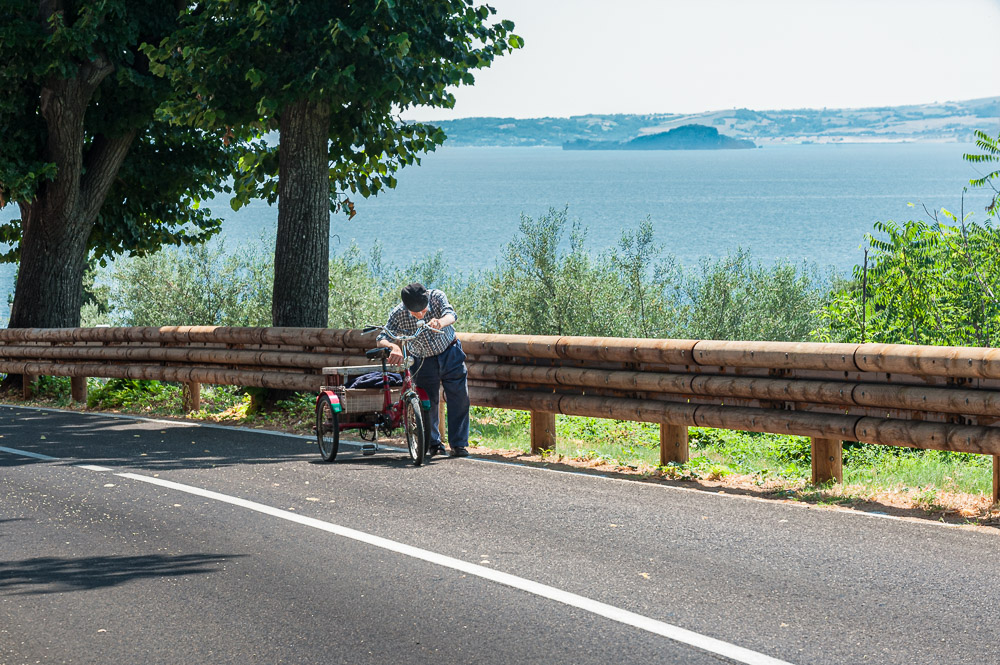
    The image above represents this tightrope. I took a brief time to get a reasonable composition, proper exposure, depth of field, balance of forms, etc. That was mostly instinctual. But mostly, I hope you get how I feel about the guy. And I hope it makes you feel something, too, and think about him. I have my story, influenced by the range of sights and emotions at the time. I’ll let you tell your own.