An artists journey

Category: Fear

  • What’s Right

    What’s Right

    Dewitt Jones often makes the point that the mantra of the National Geographic is “celebrate what’s right in the world”. He even has a TED talk about it. At this point in history focusing on what’s right seems like a great idea.

    National Geographic

    Ah, National Geographic. What a great institution with an excellent brand image. How many of us suspect our parent’s houses are held up mainly by the stacks of yellow magazines in the basement? If you are old enough you remember eagerly claiming your time to read each issue cover to cover when it arrived. The photography was amazing and the photographers were idols to us aspiring artists.

    I suspect Mr. Jones is right that one reason for it’s success is that it was positive, uplifting, showing the good side of places and issues. That seems so foreign in today’s world. It is expected now to show how bad everything is. To show the dark and depressing and gloomy side of every issue. Where are you when we need you, National Geographic?

    Some things are depressing

    It is absolutely true that there is disease, poverty, instability, pollution, economic uncertainty and political division all around. But does that need to be what we’re focused on? Is it really healthy and helpful? If we just moan about it without doing anything doesn’t that just make us more depressed?

    Dr. Martin Luther King said “Darkness cannot drive out darkness; only light can do that. Hate cannot drive out hate; only love can do that.” I believe this to be a very true statement.

    When we focus all our attention on how bad things are then everything seems bad. The attitude pervades our life, polluting all we see. That is a choice.

    Art, too?

    Doesn’t it seem that art, too, suffers from darkness and hate these days? There is a lot of dark, empty art. Like many artists seem caught up in depression and can only create brooding, depressing work. Does it have to be ugly now days to be art? Why?

    And we are told that everything has to support a social cause, otherwise it is not worthwhile. Who says? There are a lot of great causes, and a lot of bad ones. What you choose to support is your decision. But art should transcend the cause. Art should be art independent of the social or cultural context. If you are trying to produce art mainly in service to a cause, it might be propaganda. I am passionate about some causes, but they only indirectly influence my art.

    Can anything be done?

    Is the world too far gone to change? Does an individual have any power to effect things?

    I can’t change the world. I can only change me. The world is made up of individuals and each of us can make our own decisions about our values and behavior. Are you restricted to doing certain things or believing certain ways because your Facebook crowd says so? Break free. Are you going to hate everyone who doesn’t believe in your cause because a powerful influence leader says to? Run away.

    Be yourself. Make your own decisions.

    The sources of information we follow have a huge influence on our life. I won’t get into an argument about “fake news”, but a safe starting point is to believe that most everything you hear is wrong, or at least biased. So listen to many viewpoints and make your own decision. Be a grownup. That builds personal integrity.

    If the information you follow is talking about how terrible events or people are but not offering practical and positive solutions to improve things, they are just spreading fear and division. We have enough of that. Stand up for yourself. Go your own way. It doesn’t matter how famous or respected they are.

    And art?

    This blog is supposed to be about art. Being an artist exposes our beliefs and outlooks to the world. What has yours been looking like lately? What do you respond to? Writing about his WW2 years in Nazi Paris, Picasso said the artist “is a political being, constantly aware of the heart-breaking, passionate, or delightful things that happen in the world, shaping himself completely in their image.”

    I suggest we practice being positive and encouraging. Both in our art and our lives. Not just responding to what happens but consciously shaping our response. Being positive is not a Pollyanna, head-in-the-sand avoidance of the pain that is around. It is an effort to make what we touch better. To make people around us better and more able to cope with life. And to make ourself better.

    What do you love? What do you consider good and beautiful? Show it in your art. Help people see something uplifting. Bring joy, not sorrow.

    Maybe National Geographic had the right idea. Maybe focusing on what is right with the world would do a lot more good than harm.

    Be an individual. Be an artist. Don’t be afraid to follow your own values and beliefs. Try to be a positive influence on everyone who sees your work.

  • Being Timid

    Being Timid

    Aren’t most of us pretty timid with our art? We are intimidated to stray outside the safe boundaries of convention. We follow the trends or a favorite artist. At the root of it, we are too timid to be ourselves or go as far as our vision wants to take us.

    I hope this does not apply to you. It would be great if I am just preaching to myself. Probably not, though.

    Playing it safe

    Safe doesn’t get us in trouble. Safe doesn’t get us criticized for being weird or different. If our art is safe we will get nice comments on social media.

    At some point in our lives we will confront a dilemma, though. If our vision takes us in a direction that is no longer “conventional” we have to decide which path to follow. Do we play it safe and stick to what everybody likes or do we go where our vision is taking us?

    Going our own way is not safe. Just like starting a business is not safe. Or making investments is not safe. But if done well, these things usually lead to greater freedom and satisfaction than remaining in our safe boxes.

    If you keep denying your artistic values you will eventually either give up your art or lose your creativity. That seems a very high price to pay for safety.

    Who are you trying to please?

    Maybe I talk about this too much, but I keep making the point that the main audience I need to be concerned about is me. I would love for people to like my work and give me praise and buy my prints for their walls. But if they don’t and I still like my work, I’m successful. It is hard to remember sometimes, but I know it is true.

    Let me remind you that I am talking about what we call “fine art”. If you are a portrait or wedding or commercial photographer you do the work your clients want. They hired you to do that for them. You try to put your own creative spin on it, but when it comes down to it, the client calls the shots.

    In this fine art world I, as the artist, am called on to be creative, to boldly give my own interpretation. To make it my vision. If I am holding back because I’m timid then I am probably not pleasing myself or my clients.

    Don’t worry about making other people happy. If you intend to photograph as truthfully as you can, your days as a member of polite society are numbered, anyway. (Paraphrased from Stephen King)

    Are you willing to be an outcast if necessary to be pleased with your art?

    Be bold

    Timid is safe. Timid doesn’t discover new, creative things. We should, instead, take chances. Be bold. Go for it.

    I give you this advice, but I have recently discovered that I am still too timid. The epiphany startled me when I realized I am not fully following my vision where it wants to lead me. After giving the advice, I found out I was still timid. I apologize.

    I won’t go into detail, because my vision is mine and wouldn’t do you much good, but I realized I am still too conventional in my subject choices and post processing. I don’t make New Year’s Resolutions, but I have resolved to loosen up and take more risks.

    The realization that I have been stopping short of where I want to take my images was a blow to me, because I thought I was being pretty bold. It was a wake up call, but it had the feel of a discovery that was true and freeing. Long years of studying conventions of composition and post processing were deeply ingrained. I have to break through and let my imagination take me to new heights.

    How will I know if I have gone too far? It will be when I decide it’s too far. Then I may back off some.

    Only those who will risk going too far can possibly find out how far one can go.TS Elliott

    You don’t know you’ve gone far enough until you’ve gone too far. – John Paul Caponigro

    No fear

    I will try to keep this in mind as I start to experiment more. I know that there will be a lot of mistakes and failed experiments. But that is the only way to learn when you’re making a path where no one else has been.

    The magic is in you. I’m convinced that fear is at the root of most bad photography. Remember that the best photographers understand that YOU is more important than NEW. The magic is in you. – Jay Maisel

    I believe in looking reality straight in the eye and denying it. Garrison Keillor

    It’s time for me to seriously question reality. It is fearful but exciting.

    This will be an interesting journey. A growth period. A time of stress but joy. I’ve been there before and I trust my creativity and vision to take me through this to come to a new place. I hope you will come with me through the adventure.

    Let me know where you are in your journey and what you think!

  • Experimenting

    Experimenting

    I can’t speak for your goals or interests or learning style, but I know that my creativity is enhanced by actively experimenting some of the time. It is a conscious decision to try something completely different than what I normally do.

    Break the rules

    If you have read this blog much you have picked up on a love-hate relationship to photographic rules. Rules have a place but also a time when they should be abandoned.

    Learn, study, internalize the normal rules of composition. Get excellent at the techniques necessary to create well executed images. These things prevent you from embarrassing yourself by releasing well meaning garbage to your viewers.

    Sorry to be so blunt, but not bothering to learn the accepted conventions established over the years for good images is just arrogance and immaturity. Learn the conventions and follow them until they are deeply ingrained in your subconscious. Follow them until they become uncomfortable. and confining You will eventually understand when that is.

    Breakout

    At some point you will find yourself saying “yes, but…”. Then the rules are no longer enough for where you are creatively. They are restraining you to do the same kinds of images everyone else is doing. Something inside is compelling you to do it differently.

    It is very important then to realize you have permission to change your norm. You don’t have to ask anyone or apply to some authority for permission to do this. Just follow where your now trained instincts lead you.

    Now you will begin a period of experimentation and uncertainty. The old foundations you trusted are beginning to crumble. Will you trust your instincts to carry you to a new place?

    To be honest, you will probably start doing a lot of bad work. At least, work that is very different from your norm but far short of the vision you have for where you want to go. That’s OK. Push through it. Keep on trying and modifying until you get closer.

    At this point you probably better be content to get criticism. The people who enjoyed your old work will not be happy and you haven’t really gotten to a stage where you could develop a new audience to support you. Honestly, if you have to support yourself from your art you may have to continue doing the old style work and confine this experimentation to personal projects and off times alone. For a while.

    But you have to really ask yourself why you are changing and experimenting. Isn’t it because your vision is changing and you are no longer content with what you used to do? You will need to decide at some point if you want to be true to your vision or keep in the safe zone of doing what worked in the past.

    Do things that can’t possibly work

    Let me challenge you to regularly set aside time to experiment with wild ideas. Come up with crazy ideas that can’t possibly work – and try them. Can’t work might just mean no one has tried it like you are approaching it. Or it really can’t work. Either way you learn something.

    History is full of failed experiments that led to whole new ways of doing things or looking at problems. Did you know that Post-It Notes came from a failed adhesive experiment? What would anyone want with an adhesive that didn’t stick? Until somebody needed a bookmark that didn’t fall out of the book. They got together and things sparked.

    And those things you are trying that don’t seem useful? You are building a catalog of possibilities. A base of knowledge and ideas that will find surprising applications in the future. And you are accepting that not every image has to be “successful” in the conventional sense. Success in expanding your vision and your abilities may be more important long term.

    A special snowflake

    Please pardon the cynicism, but everybody is told they are unique snowflakes and many of us believe it. But do you act it? Or do you spend your energy trying to make the same pictures everyone else does.?

    Most photography tutorials are “how to create the same image I made”. Most workshops take students to locations where they can take the same iconic images everyone else does. Aren’t most online comments praise for safe, conventional images that are just like the norm?

    Everybody has the possibility of being truly unique, but you have to develop that uniqueness. You have to reach deep inside and bring a vision that is truly you. You have to be able to express that vision is a tangible way that others can see.

    Experimenting with ideas you have never seen before is one good exercise for that.

    And now for something completely different…

    All right, so I’m old enough to have been a Monty Python fan.

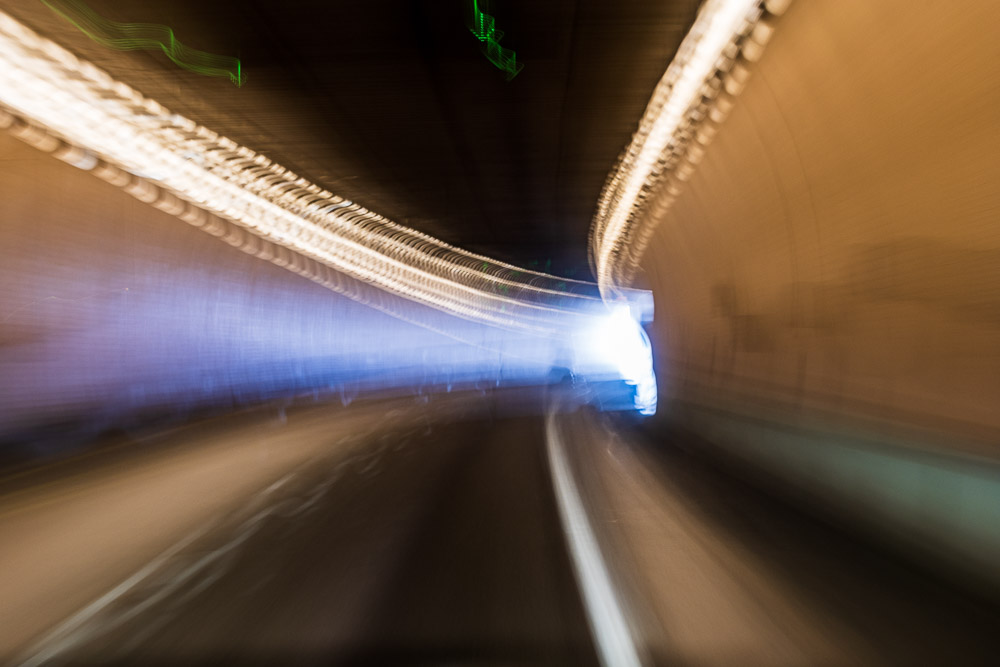
    I have preached the faith of experimenting but I haven’t shared any examples I have done. The image with this blog post is a deliberate experiment I did recently that violates virtually all rules I know of. It is long exposure, hand held, taken from a moving vehicle. There is nothing sharp in the entire image. It doesn’t fit normal composition rules. I certify that this is a single original frame with no double exposure or compositing.

    What has it got, in my opinion? Intrigue, interest, great flow, visual interest, ambiguity, questions, a staying power that makes me want to put is on the wall and look at it for a long time. Those things give me joy. And hope. I’m very glad I experimented.

    It keeps you fresh

    Training yourself to have a habit of experimentation will help keep you fresh. Always ask “what if?”. You lose the fear of trying something new and maybe failing. You gain the benefit of letting your vision expand and bloom in new ways.

    Do you look at your work and see the same subjects, the same treatment, the same composition over and over? Experimenting and taking on “strange” personal projects outside your norm and with no intent of commercial success will keep you from getting stagnant. You need it to keep your creative energy flowing.

    And when your experiments lead to results you are proud of, be confident to incorporate the technique into your mainstream work. You are a dynamic, living being who changes with time. Your work should reflect that. Don’t be afraid.

  • Pre-Visualization

    Pre-Visualization

    For many people, one of the fundamentals of the craft of photography has been pre-visualization. This simply means that before exposing the image you have worked out the exposure and what mood and effect you want to capture and how you plan to process it.

    I’m going to push back on this idea. My premise is that pre-visualization is no longer as important as it was in film days.

    Ansel did

    Yes, Ansel Adams was a big proponent of pre-visualization. He said “the term [pre]visualization refers to the entire emotional-mental process of creating a photograph, and as such, is one of the most important concepts in photography”.

    I think he got a little carried away here. He is veering into mystical/religious experience. The reality is that, because of the technology of the time, he had to pre-visualize carefully to get good results.

    Think about it, he was shooting film – no immediate preview. He was shooting black & white – he used strong filters to change the tonal arrangement, and he had to anticipate the result mostly based on experience. Negatives had to be developed and this introduced ranges of contrast choices that couldn’t be seen until after the fact. And then there was reciprocity failure that required compensation for long exposures – something those of us shooting digital don’t even know about. His negatives had to be fairly low contrast to try to capture as much information as possible so he could spend hours in the darkroom creating a final print. He generally exposed pretty conservatively to make sure he got something to work with.

    All this made it critical to him to plan out exposures and filter sets and contrast ranges as much as possible without actually being able to see the result. Everything had to be carefully done to capture a decent negative for processing back in the darkroom. Hence, a strong need for “pre-visualization”.

    Ansel and some of his associates even developed the famous “zone system” as part of pre-visualization. It divided the world into an 11 stop range from black to white. In normal practice, they pre-planned where the significant tones would end up after development and printing. This was part of the process of trying to make a useful negative at capture time.

    Fast forward

    We live is a very different world. Shooting digital, we can see a preview image and its histogram immediately. We know what we captured.

    And our modern digital sensors are incredible pieces of technology. Despite what Moose Peterson famously says in some of his videos, we can capture a dynamic range of about 14 stops, with a “useful” range of around 8 stops. That is a game changer. And if that is not enough it has never been easier to use high dynamic range (HDR) to capture about as much as you could want.

    For those of us still doing black & white – I love b&w and do it a lot – it is the best time in history to practice this. Very few people actually shoot in b&w, e.g. have their cameras physically modified to remove the Bayer color filter. Instead we capture full color images and use the fantastic post processing capabilities we have on our computers to do the conversion and tone mapping. But we don’t have to pre-visualize the tone effects we will get because we can non-destructively play with a wide range of effects to work out what we like. And we see in real time what we are getting. Ansel would have killed for this.

    Post pre-visualization

    John Paul Caponigro has said “Digital allows us to get away from pre-visualization and get back to visualization.” What does it mean? How can it be?

    My take on this is that we are much freer now to let our creativity run wild. Unlike previous generations of photographers we have immediate viewing of our images and non-destructive editing for post-processing. Every frame can be a different ISO speed. It doesn’t cost much or usually take much time to shoot a bracket of images to make sure we get a good original.

    And now, instead of huddling in the dark smelling strong chemicals, we can sit at our computer with a nice glass of wine and interpret an image however we want. The range of options is staggering. There are far fewer limits now. It’s a good time to be a photographer!

    This plays directly to the imaging style I love. In the field I can be in the moment. As long as I am making good captures I don’t have to have worked out in detail exactly what I am going to do with each image. I am free to treat the processing as an almost completely separate creative act. The raw image can be modified in ways Ansel never dreamed of.

    If you can get to the Luminous Landscape web site Alain Briot has a good discussion of this topic.

    Getting a good capture

    Pre-visualization is much less important now as long as we capture as much data as possible. Get a well formed histogram. Expose to the right where possible to avoid noise. Use appropriate technique for sharpness and detail.

    Capturing good images is still an art form. It is just my personal values, but pointing your camera at a scene and saying you will crop a good image out of it later and “Photoshop out” clutter is sloppy thinking and lazy. I believe I should decide what the subject is and create the best composition when I am taking the picture.

    Being an artist includes being a good craftsman.

    Wonders of post processing tools

    Pre-visualization is not as important because of the wonders that can be done now in post. I do not agree with the philosophy that “if it doesn’t work in color make it black & white”. But it is true that the decision does not have to be make up front. That is the point. I can make an artistic decision later when I determine the look I want for the image. I did not have to put a red filter on the lens or carefully place the tones on a zone scale. That can all be done in post processing. It’s great!

    Darkroom work was sort of the dirty little secret of photographers way back. They would labor for many hours to coerce a good print out of a negative. We might still spend hours post processing, but we are probably playing with alternate looks and having a lot of fun with the image.

    Free your spirit

    I am telling you my interpretation and what works for me. I believe we have been liberated from the detailed planning that was necessary in the film days. Now imaging is a more fluid and artistic medium. Pixels are data. Data can be processed many ways and to different degrees.

    It is not uncommon for me to see something completely different in an image at post than I felt in the field. This is one of the joys of being an artist today. I am free, creativity can flow, I am not tightly constrained by what I planned at capture time.

    I encourage you to not be burdened by a literal concept of pre-visualization. Do your best creative and technical work when you are capturing images and then feel free to decide how you really feel when you process them. Give yourself permission to follow your instincts and take each image where you want to go.

  • Whose Art?

    Whose Art?

    Who do you make your art for? No, really. It’s a serious question. A recent post discussed Finding Beauty. I think it is important to follow that by asking who determines the beauty and worth of our art. Whose art are we making? Who for?

    For the whole world

    If you are making your art for everyone, time to rethink your plan. Not everybody is going to like what you make. Sorry, that is the truth. And if your “style” is determined by what gets likes on Instagram or Facebook you are just chasing popularity.

    You have your own style and you should stick to it. You may not recognize your style or know how to express it yet, but you do have one if you are authentically trying to express your values.

    I don’t care much for a lot of images I see. I won’t say they are not art, just that they do not appeal to me. My style and values are different. The same with you. What you make will resonate with some people and not with others. Even if you become very popular I guarantee not everybody will love them. Accept that. Not everyone gets a ribbon for participating.

    Be honest and do the work that appeals to you. Be genuine. If you spend your time trying to make images that “everybody” likes, you are chasing a false and impossible goal. You are not doing your own work.

    It is better to be hated for what you are than to be loved for what you are not. – Andre Gide

    Why did you shoot that?

    Why will I/did I shoot it? That is a question we all should consider and answer every time we take a picture. If it has meaning for us on a personal level it is probably worth taking the time to capture it and process it. If it is to duplicate something that got a lot of Facebook likes, forget it.

    You have probably figured out I like to use quotes to reinforce ideas. And to let you know that greater minds than mine have expressed some of the same ideas before. Here are 2:

    If you shoot for the love of it, you know why you shot it. Jay Maisel

    There is no way to know what others want as well as we know what we want, so trying to please them instead of ourselves is a mistake.David Vestal

    As usual, I am only talking about the realm loosely called “fine art”. I wish we had a better term. In order to create our own art, we first and foremost have to please ourselves. If this image doesn’t blow us away, why waste time on it? Whose art is it? It has to be our own. If we get to where we can make images that make us very happy we will find a core of other people who share the same viewpoint.

    Your style

    Is it your style? Are you developing a style? Is your style acceptable to your peers? How do you know your style?

    These questions can cause a lot of angst for artists. I say stop worrying about it. Your style is a result of who you are, not a skill you develop or an affectation you present.

    Someone said to go through your portfolio and pick out your 20 best images. Lay them all out and examine them. This defines your style right now. This is what appeals to you and how you make your images. It will show the types of subjects you prefer, the lighting you like, the composition you tend to use, how you like to post process them, etc. This is you. You are not what someone else wants you to be.

    Can a style be consciously changed? Yes, some people are able to do it. I’m thinking of Picasso as he went through several distinct periods. Or Joel Grimes who has redefined his signature look at least a couple of times. This is unusual. But even for the rest of us, our style evolves with time. We change and adapt as we mature and get more knowledge and experience. I know that the images I make now are very different from the ones I made a few years ago.

    The point is, we each have a style and it comes from within. Don’t worry about what is in vogue today or what you see on social media. Be you.

    What critic do you listen to?

    But I posted an image I liked on Instagram and it didn’t get many likes. Or the judges in my camera club competition told me my treatment of the subject was not going to win any awards. Or a gallery I applied to rejected me because my images did not fit their needs.

    There are critics all around. That doesn’t mean they should dictate our values. To paraphrase the famous George Bernard Shaw quote “those who can, do; those who can’t, become critics”. It is a lot easier and safer to criticize from the sidelines than to be in the battle trying to do something no one else does.

    No critic can define your values, your vision, your art. If you have done your job well so that your image is technically correct as far as you want and composed the way you want and pleasing to you then it is nobody else’s business to tell you it should be different. They will try, but don’t listen to them. Maybe they are an artist, too, and have some good suggestions. Fine. Listen to them, but take it in and process it through your own values and style. Keep what feels right to you and discard the rest. No one is qualified to tell you what you have to do artistically. Notice in my description above what kept coming through was “the way you want”.

    Your inner critic

    If you’re not your own severest critic, you are your own worst enemy. – Jay Maisel

    The great Jay Maisel is right. You have to decide what is right for you. Only you can truly criticize your work. You owe it to yourself to be hard on yourself. Be brutally honest. Throw away most of what you do.

    You might feel that you need to get a lot of images to fill out a portfolio. No. You need some great images for your portfolio. If 5 is what you have then that is what is in your portfolio. Anything that is not a stand-on-its-own, awesome image you would be proud to show to anyone detracts from the collection. Weed out everything that does not show your best work

    Let me give an example. I recently went on a car trip. I allowed plenty of time for slow travel with side trips and stops for pictures whenever I wanted. This is how I like to travel. I shot over 300 images during the trip. My editing workflow is a multi-stage culling process for selecting images. Just in the first stage I eliminated all but about 45 to be further considered and processed. I am still in process, but I expect that maybe 4-6 will make it into my final select group.

    That seems fairly severe. Less than 2% of the images I shot will make it. But actually it is probably not severe enough. Realistically 2-3 of these would actually add value to my portfolio. I’m still in love with some that should be cut. That hurts. But I have really come to understand that a single weak image can bring down the level of an entire portfolio.

    The only critic

    So the only critic you should listen closely to is yourself. Only you are fully qualified to judge your work. Look at a lot of images from a variety of artists with different styles and interests. Get feedback from other people. Take what you can learn from everyone but stay true to your own vision.

    Whose art are you trying to make? I hope it is your own. Then you have earned the right to be very proud of your art.