An artists journey

Category: Craft

  • Is Digital Imaging Going to Stick Around?

    Is Digital Imaging Going to Stick Around?

    Got ‘ya. 🙂 Sorry to disappoint, but this is not a rant against digital imaging or a plea for a return to the “good old days” of film. Digital imaging is a technology. As such it should be a neutral consideration. It doesn’t matter if our art if it is created “digitally” or by some other means.

    It’s just a technology

    Art, by its nature, is created with a medium using specific technology. Digital imaging is the currently popular medium and technology used by most photographers. If I were writing this 30 years ago, the medium would be film and no one would give it a second thought.

    That is one reason I think it strange that people feel the need to qualify it most of the time. It is said to be digital photography using a digital camera and modified using digital post processing. To me that is putting undue emphasis on the technology.

    Pushing the limits

    Any medium or any technology has limits. Artists are inspired by pushing the limits of the medium. Whether it is painting or music or photography, a great craftsman knows the capabilities of the medium he is using. It becomes a game, a quest, to push the limits of the technology to create new art.

    But photography is fairly unique in that the technology is advancing rapidly. I don’t think people are inventing new cellos ( well, there are the electronic ones…). The quality and capability of oil paints is probably improving slowly, but not being revolutionized. Digital photography is a much less mature technology and it is based on the electronic and integrated circuit industry, which is huge and rapidly moving. Consequently we tend to think of getting a new shiny gadget that pushes out the boundaries rather than learning the limits and using them as part of our art. That is a problem for photographers.

    I love the quality of my equipment and the things I can express with it. But there is a tendency for most people to focus too much on the technology. The resolution, the dynamic range, the focusing, the low noise are easy to see as the important thing. I am glad these things are improving all the time. Too often, though, we get caught up in looking at what the technology can accomplish rather than focusing on what the artist is doing with it.

    Art is made by an artist, not a camera

    It is easy to get blinded by the brilliance of the technology and loose sight of the fact that ultimately, we should be talking about the art. Art is made by an artist, not a camera. An artist can make exciting art with a cell phone or a disposable film camera. Resolution and dynamic range do not make art.

    I am delighted to admit that my main camera is a mirrorless 46MPix wonder. The image quality is remarkable. I will confess that in one part of my work I like super detailed, crunchy sharp images. But I also, more and more, find myself making extreme abstracts that are unrecognizable from the original capture. The technology enables this, because the images have such depth and fidelity to begin with that they can survive serious processing. Pushing the limits. The technology lets me do these things. It does not do any of them for me.

    I love the technology and I make use of it, but it is not digital art, it is just art.

    It’s not perfect

    Saying that digital is just a technology also admits that is is not perfect. It is so good that it has displaced film, but it is not ultimate truth. Someday it too will be displaced by something else.

    A digital image is simply an array of pixels. That means there are artifacts that become obvious at extreme magnification. The sensors are getting better all the time, but that is a built-in limitation of the technology.

    A digital sensor can only capture about 14 bits of dynamic range (+/- 2). This is 16,384 brightness steps for each color. It is amazing how good this looks, but it is far short of the capability of the human eye. And the sensor is linear while the eye response is logarithmic. Again, the eye had a significant advantage.

    Technically, current digital imaging products are the best photographic devices that have ever been made. Technically. That does not mean they produce better art.

    Ephemeral

    Another important consideration for digital imaging is that it is and has promoted an ephemeral view of images. Digital images have fed the huge social media, entertainment industry, online viewing trend. People have become used to glancing at images for about 1 second or less and moving on. This has tended to devalue most images. Especially if they are on a screen.

    I don’t believe this short attention span culture is healthy for the viewers or artists.

    But there is a still more insidious problem with digital images: they have no physical presence. Did you at some time end up with a shoe box of family pictures that brought important memories back? Did you discover and enjoy a drawer full of negatives and old prints at your parents? Those do not exist any more.

    Digital images only exist on your computer or in “the cloud”. E.g. once the computer dies or you stop paying for the cloud, they are gone. Totally. No record of their existence. A career of art, a lifetime of family memories can disappear in an instant.

    This is a dark side of digital imaging.

    Prints are even more important

    Because digital images are so ephemeral, I believe it is even more important now to make prints of important images. Prints have substance, weight, physical presence. They seem much more real than an image on the screen. And they are.

    A print is “permanent” – well, maybe 100 years for a good quality pigment print on professional paper. When you handle it it has weight and the image seems important. It is something that can be displayed proudly on your wall to view often and for others to see. It can be handed down to others later. A print is a real material thing, not just a bunch of bits.

    Some photographers say an image isn’t finished until it is printed. More and more I’m coming to agree with that view.

    Will it stick?

    So, will digital imaging stick around? Sure. It already has. It is really hard to find film any more. Even harder to get it processed. Digital has become so clearly superior to the alternatives that it has displaced them all. That is not to say it does not have faults. Everything does.

    But digital is just a technology. It will dominate until something better comes along. A technology does not make art. What an artist does with the medium is art. A super high tech digital camera is not a requirement to make art.

    I would much rather be remembered as an artist than as someone who was very proficient with digital technology.

  • Vulnerable

    Vulnerable

    Being an artist is creative and rewarding. It is also a position that is vulnerable and lonely. I made my career in an objective, logical engineering world. In contrast, the artist’s world I live in now is based on opinion and perception. I have never felt so vulnerable and out of control.

    Lone-wolf

    A popular view is that the artist is a lone wolf. Fiercely independent, self-sufficient, going his own way regardless of what anyone thinks. To a certain extent, this is true. I think an artist has to have the fortitude to maintain his independence in the face of adversity and pressure to conform.

    Unfortunately, there is a cost to being this lone wolf. A lone wolf is, well, alone. He is isolated, vulnerable, having to go it alone. It’s a position where you don’t have a support infrastructure. You don’t really have people to build you up when you are knocked down. You don’t have people to take care of things and offload work from you – you have to do everything yourself. This can get debilitating at times.

    Some artists maintain a network of mentors, confidants, and collaborators. I envy them.

    Courage

    For me, one of the hardest things is to have the courage and determination to keep pressing on. I am not a natural marketer. It is hard to “put myself out there”. Making noise for myself is a very uncomfortable thing. Especially when I am continually getting knocked down emotionally and passed over.

    An artist has to believe in himself. To believe he has a vision and a message that people should pay attention to. This has to carry him through rough patches when things seem to be going against him. When you seem to be a lone voice in the world, this can be hard to maintain.

    Coming in in the morning with a fresh resolve can be trying. Sometimes it is difficult to say “I am an artist; I believe in myself and know I have something to bring the world”. And act on it.

    Rejection

    Rejection is a part of life, especially for an artist. We have to expect it, even seek it. If you are not being rejected, you’re not trying.

    But it takes a toll. I think even the strongest pay an emotional cost when we are rejected. It’s like being back in school and not being picked for the team or not receiving the scholarship or just not being asked to sit at the table with the “cool” kids. You know it is going to happen sometimes, but it still leaves a bruise.

    With rejection the world seems to be telling me I’m not good enough. That I don’t stack up to the competition. That I probably should just give up.

    But the world is a bitter and heartless place. I have to shrug it off and believe my own inner voice rather than a message some stranger is giving me. I have to believe in myself, even when others don’t.

    Indifference

    Possibly even worse than rejection is indifference. When my art seems to not matter at all to anybody. When everything seems to be futile.

    This is another tool the world uses to try to crush the aspirations of most artists. and it works a lot of the time.

    I sometimes think I would rather have someone write me and tell me they hate my work. At least they took a moment to acknowledge it. (No, it’s an exaggeration. I’m not really asking you to tell me how much you hate what I do.)

    Will power

    This has been much more negative than I usually am. Vulnerability can do that. Rejection and isolation can be cumulative.

    But I think the real point I am trying to make is that these things will come. They happen to everybody. The question is, what am I going to do about it?

    I said an artist has to believe in himself. That is kind of trite, but nevertheless true. Being vulnerable or discouraged or feeling isolated are part of what we have to accept if we call ourselves an artist. If we are feeling down are we going to pick ourselves up, metaphorically, and find the will to go on? Or are we going to pack it in and stop doing our art? It is our call. Nobody else can decide.

    I know of artists who claim to seek rejection and collect rejection letters. Good for them, if they are telling the truth. But good for them regardless, because the attitude is right.

    If I apply for something and get rejected, I have to understand that just means I was not right for that exhibit or the juror was looking for a different style or the gallery has a different culture. The rejection was not a legal certificate from a higher authority saying “you’re not an artist and you should give this up immediately.”

    I am an artist. I believe in what I do. That has to come from inside. If I listen to what other people say I will doubt myself. If I doubt myself, it will inhibit my creativity and my ability to express my vision and my will to apply for that next opportunity. I’m a lone wolf.

    Vulnerable

    Back full circle to the idea of vulnerability. Yes, I am vulnerable in the sense that I am out there, on the edge, exposed to the world, all alone. I have to take the hits and survive. I have to have a strong enough belief in my ability that it can carry me through the rejections and indifference.

    This can be one of the hardest parts of the art world. Many artists are introverts and somewhat shy and self doubting. We have to get over ourselves and put our work out there for the world to deal with. Rejection will come, but we have to go on if we believe we have something worthwhile.

    I will close with a favorite quote from Theodore Roosevelt, popularized recently by Brene Brown:

    It is not the critic who counts; not the man who points out how the strong man stumbles, or where the doer of deeds could have done them better. The credit belongs to the man who is actually in the arena, whose face is marred by dust and sweat and blood; who strives valiantly; who errs, who comes short again and again, because there is no effort without error and shortcoming; but who does actually strive to do the deeds; who knows great enthusiasms, the great devotions; who spends himself in a worthy cause; who at the best knows in the end the triumph of high achievement, and who at the worst, if he fails, at least fails while daring greatly, so that his place shall never be with those cold and timid souls who neither know victory nor defeat.

    To me, this is what it is about. I have to be in the arena to become what I want to be.

  • Terrible Images

    Terrible Images

    This is a follow up to my previous post “Kill Your Darlings“. It is too big a subject to let go that easily. There is a time and place for making terrible images. Even to seek to do it. Terrible images can be a springboard to new insight and growth.

    One of my heroes I quote often, Jay Maisel, said

    “I used to tell my classes when they raved about my work and compared it to theirs, ‘Believe me, I’ve taken more terrible images than all of you put together.’ The trick is not to show them to people.”

    Experiment

    I believe that experimentation is one of the most common and valid reasons for making terrible images. Many of us photographic artists spend a long time trying to discover our style. But once we have done that, I believe it is a mistake to settle down and only shoot to that style for the rest of our career. We need to push ourselves is different directions. View the works of other artists. Do things to make ourselves uncomfortable.

    I am always reading articles and looking at videos to get new ideas. Making myself get out and try some of these ideas I pick up is necessary to see if they work for me. Sometimes they do, but sometimes I just make terrible images.

    I have determined for my own values that if I am not growing in my concepts and techniques there is no reason to keep going. Keeping an uncomfortable edge to my work keeps me asking questions. It keeps me fresh. I do not want to keep shooting the same picture over and over.

    Shoot a lot

    As Jay Maisel hints in the quote at the start, shooting a lot of images is one of the keys to having good ones. The reality is that for even the best of us, the percentage is depressingly low.

    No, just walking around and pressing the shutter every few seconds will not lead to some gems. It might make a mildly interesting time-lapse video.

    Doing good work in any field takes practice. The infamous 10,000 hour rule is not a truth, but it is generally true. Any discipline takes uncounted hours of practice in addition to formal training. I believe it is certainly true for photography.

    It is important to get out every day and practice. Practice seeing, discovering subjects, planning shots, framing compositions, executing good images. Sometimes you should even use a camera. ☺. The point being that you don’t always need to be actually taking pictures. You can practice while walking to the coffee shop or driving down the street. It is a mental discipline.

    But it is a physical discipline, too. And it is very helpful to use your camera every day. Just having it in your hands helps sharpen your senses. Carry it everywhere. Actually using the tool builds muscle memory. And coming back and having to edit what you have done closes the loop. It makes me evaluate my work and really think about how I have done.

    Edit ruthlessly

    Ah, editing. The point of my previous post on killing our darlings. I believe this is probably the second hardest part of photography (the hardest being marketing).

    Shooting a lot of images means having a lot to edit. This can get to be a real time sink. And it can be depressing. I’m trying to look at it, not as making lots of terrible images, but as having lots of failed experiments.

    If you go out every day and make yourself shoot and try new things, most are going to fail. That is OK. A few will succeed. That is one of the things that keeps me going. A few succeed.

    The failures should be learned from and then trashed. There is little reason to keep a bad image, unless it helps you remember what your were going for and why it failed.

    Even if you are constantly experimenting and expecting large number of failures, there is no excuse for letting down your standards in the editing. Be ruthless. If I get even one “keeper” out of a day’s shoot, I am happy for it. Having no keepers is not a failure for a personal day.

    Another insight from Jay Maisel is “It’s my obligation to take out all the ‘wrong’ pictures.

    Be honest with yourself

    I like to experiment. I like to put myself in new situations and try out new ideas and techniques. But I have to be honest with myself and admit that most of them do not work well. Sometimes there is a glimmer of hope that might lead me to experiment further with an idea, but a glimmer of hope does not mean an image that should be shown to someone.

    I have to accept the fact that the vast majority of the images I make are bad. That is, bad by my standards, which is all I can go by.

    Most of them should be deleted. Even of the ones I keep, that may have some personal significance to me, very few should be shown to people. I am starting to understand and accept this.

    One of the lessons that has been hardest for me is that a tack sharp, well exposed and focused image may well be worthless. It probably is. If it does not have something useful to say it does not matter how technically perfect it is. I owe it to you, the viewer of my images to only show you one worth looking at and considering.

    Don’t fall in love with them

    So I know I am going to throw away the vast majority of the images I take. I know I will throw away piles of technically perfect images. I know I will throw away away most of the experiments I make.

    Because I know that, I have to keep from falling in love with them all. That’s hard. I made them. But the digital ecosystem is littered with useless bits. I have to do my part by cleaning up as much as I can.

    I said in the previous blog about this that I go through many rounds of edits and culls. I really try hard to delay falling in love with any of my images until they have survived several rounds and seem to be contenders. I am not always successful. There are times when I just love an image. I try to not let that bias the objectivity I need in my edits, but of course, love wins sometimes.

    Not falling in love with them is more a goal than a hard rule. But the hard reality in photography is that most of what I produce is not really good and is destined to be deleted or buried deep in my filing system never to be seen by anyone other than me.

    But if it hurts and they are going to be thrown away, why shoot lots of terrible images? I don’t know of any way to improve beyond where I am or to expand my vision without experimenting and then ruthlessly editing. Terrible images are necessary.

  • Making Sketches

    Making Sketches

    I am changing my perception of how I work. I used to view myself as going out and “making pictures”. Now I see myself more as going around making sketches.

    What is a sketch?

    I like words, and I like to know where they come from and what they really mean – their etymology. I know, I’m a geek. You don’t have to tell me. Here, let me prove it: “sketch” may be derived from several words from Dutch, German, Italian, or Latin, but the root seems to be Greek, σχέδιος – schedios. It means something temporary or done off hand. Wow, see. Geek but proud of it.

    One of the most understood meanings of “sketch” is a “rough drawing intended to serve as the basis for a finished picture“. This had been an established process of artists for centuries.

    Most painters begin their studies doing sketches and continue using sketch as an important tool the rest of their career. It is like a serious musician doing scales and simple practice every day. It continues to develop the eye/hand/muscle memory/mind. Plus, sketches are a tool for artists to capture a form or expression or gesture, to work out a plan for a piece, even to just record something they want to remember. Here is a sketch by Manet, 1878:

    Even when doing a final work, artists often sketch the composition on the canvas before starting. They then have a guide to follow as they overpaint the intended image. The final product may depart from the sketch, but it was shaped by it..

    Image capture as a sketch

    How does this apply to photography? I am starting to think of my original captured frames as sketches. But why? I spent a career learning how to set up and perfectly execute an image capture. Why change that?

    It is a concession to reality and a psychological tool. Sometimes (well, often to be honest) when I load my images into Lightroom, I am disappointed with them. They just did not capture the scene the way I saw it, or at least the way I wanted it to be.

    The limitations of photography are well known. It is a process of trying to map a vibrant, dynamic, 3 dimensional world with action happening everywhere to a static 2 dimensional representation. No matter how good a camera and lens is, it is a woefully limited process.

    Now I am reframing the problem. Rather than being disappointed and beating myself up for not having a portfolio image appear right out of the camera, I say “that is a good sketch of what I perceived. What do I have to do to develop the idea and complete it?”

    Starting point

    Giving myself permission to see my original image as a starting point rather than an end is a big deal. If I’m not happy with it, it wasn’t a failure, it was a sketch. The sketch probably captured some important aspects of the scene that attracted me. Now what do I have to do to proceed?

    Maybe everything I need is there in the RAW file and it just needs to be manipulated to bring it out. After seeing the reality of the sketch on screen, maybe I think about the scene differently now. Maybe only a part of the scene I photographed is really the picture.

    Sometimes the sketch can be developed into a picture. Maybe it helped me understand what I wanted and how to frame and capture it. Maybe it proved to be a dead end. In any case, it was worthwhile. I took a chance to explore an idea. If it didn’t work out, no big deal. I was not heavily invested in it. It was not a failure.

    But when it does work out, what a great feeling.

    Incomplete

    I now always view any unprocessed RAW image as a sketch. It is, at best, a starting point. No unprocessed RAW image could ever make one of my portfolios. It is incomplete out of the camera. And I have a really good camera.

    The camera is a piece of technology. It captures pixels. It does an incredible job of doing what it is designed to do, but it does not have my eye. The camera cannot know what is important to me. It does not know where the emphasis or interest is in the collection of pixels. I have to provide that.

    I have to provide the color correction to achieve the look I want, which may not be a completely accurate version of the live scene. I have to provide the tone mapping to achieve the relationships I want between the parts of the composition. I have to provide the level of sharpening (or un-sharpening) to get the effect I want.

    Even at the mechanical level of pixel-pushing there are a huge number of choices and corrections I must make. This is necessary to bring the sketch along toward becoming a picture.

    Turning into art

    The basic corrections and adjustments are great and fun and make a huge difference in the look of the file. But I have a problem here going forward and moving from a decently done image to art. Here, viewing it as a sketch helps me.

    A sketch is obviously rough and incomplete. No one would consider it the final image. Calling my images sketches helps emphasize to me that this is true in photography, too. Don’t stop with a “nice image”. It has to go further. It has to be special, different. It has to tell a story or make a difference.

    The raw material may be there, but it is probably not finished yet.

    By still viewing it as a sketch, it is easier to give my creativity permission to drastically modify what is there on screen. Does the intended mood require it to be darkened to an extreme? Do it. Are there distracting elements that take away from the focus of the image? Remove them or crop the picture. Is it a tone-oriented composition that would work better in black and white? Make it so.

    Sometimes the sketch can’t be developed into the intended final image. This is still good! The sketch proved valuable. It helped me discover what I wanted to do. It was not a failure. Maybe I need to go back with my vision clarified, and shoot it again. It is not always possible, but sometimes it can be done. If I can’t shoot it again I can file away the experience so I can look for similar situations in the future and do a better job of recognizing what I really want to do.

    In either case, I would not have gotten to the point I did without having a sketch to work with to clarify my vision of the subject.

    I shoot sketches now.

    Have you tried looking at your work like this? Did it help you get to better results? Share your experience with us by commenting here.

  • Don’t Shoot

    Don’t Shoot

    A hero of mine, Jay Maisel, says “If there’s nothing to shoot, don’t shoot.” This is generally very good advice. He also points out that, if you love your subject, there is almost always something interesting to shoot if you take the right attitude. Inconsistent and contradictory? No more than life in general.

    Don’t shoot if you don’t feel it, but try to learn to feel it. Any creative endeavor is part inspiration and part discipline and hard work. Many people say that hard work is the main determinant.

    Don’t force it

    Have you ever been to a great place but didn’t see anything? Did you feel the need to fire off frames anyway? Me too. But the shots I get are seldom outstanding.

    Forced shots like these seldom have passion. You know there is something there and you feel the need to record it, but it is not calling to you. Your shots may be technically good, but they do not convey life or interest. If it wasn’t interesting to you, why should it be to your viewer? If it won’t come, just put your camera away and sightsee. At least enjoy being out and being there. Or use the time to practice your technical craft, knowing you will probably throw away most or all of these images.

    But there is a strange and interesting corollary to this phenomenon , at least for me. Sometimes when I’m out for the purpose of taking pictures, I need the first shot as an ice breaker. Something magic happens when the shutter clicks. Now I am in image capture mode. Now I start to see. I suspend judgement and open up my emotions. Pictures start to emerge and form, even though they did not seem to be there before.

    I can’t explain it, but I have seen it happen to me enough times to trust it and accept it. It is not a 100% guarantee, but it is frequent.

    Flow

    Psychologists talk about the state of “flow“. This amazing place brings a real mental and physical change to you and your perception of the world around you. If you haven’t experienced it, I sincerely hope you are able to find it someday. It is a wonderful thing to experience. But you are not going to get there by reading about it.

    I used to go there frequently in my technical career. There would be days when I would realize it was 6 pm and I had not had lunch or even gotten up to go to the bathroom . Looking back on the day I was wonderfully productive and felt accomplished and energized.

    The same happens in my art too. I may lose track of the time and even where I am. I get in a mode where I see intriguing images everywhere. Where I get in a creative mode and ideas and possibilities are flowing faster than I can catch them. Being tired or hot or hungry don’t matter at the time. It is wonderful and fulfilling.

    It is not easy, and it takes getting yourself into a receptive position. This is about as far as you can get from my “don’t shoot” advice above.

    Exploring

    But how to get into a receptive state like this? For myself, getting into a flow state in my art often requires adopting an explorer attitude. I am naturally curious and am something of a polymath. An explorer attitude, to me, is turning off my preconceptions. I take the attitude that I am seeing these things for the first time. How do I perceive them? How will I capture this new thing to present to others who were not there?

    Have you ever traveled to a new location, a different culture? Even the little things you would never pay attention to are interesting. My friend taught me to go into places like grocery stores in a foreign country to see how common and familiar things can be so different.

    Capturing that attitude at home, in your everyday life can be a challenge for many of us. But it is necessary. It is one of the mental disciplines that keeps us fresh and lets us see the familiar as different and special.

    Train yourself to see fresh. To look at the ordinary things around you as if you were in a foreign country and you had never seen them before. Really look and see. Forget that you “know’ what they are and have walked by them a hundred times; see them as for the first time.

    Let me get painfully personal for a minute. Some people are so connected to their cell phones that it is usually in front of their face. Turn it off if that is what it takes to manage it. Your Facebook friends can live for a little while without your input. Work can wait a bit for an answer. You owe it to yourself to give yourself permission to unplug for a while. See the world for yourself.

    Beauty in the common

    This brings me around to one of my recurring themes, there is beauty in the common.

    We do not have to travel to grand, exotic locations to get interesting images. They are everywhere. Our limitation is our ability to see them. They are there, everyday, all around us, but we tend to walk right by them without noticing.

    I love grand locations, but even more, I love finding new and interesting sights in familiar haunts. Seeing new in the familiar is very rewarding. And humbling. When I see a great shot lurking in a worn out area I have been walking by it makes me wonder how many other great shots am I passing by. And somehow, it makes it more important to me. As Jay Maisel also says “It’s always around. You just don’t see it.

    At a grand location any klutz with a camera should be able to make a pretty picture. But when I discover beauty in the ordinary, beauty I didn’t think was there, it is meaningful. I feel like I have uncovered something special. And it encourages me to keep looking. To keep exploring, wherever I am.

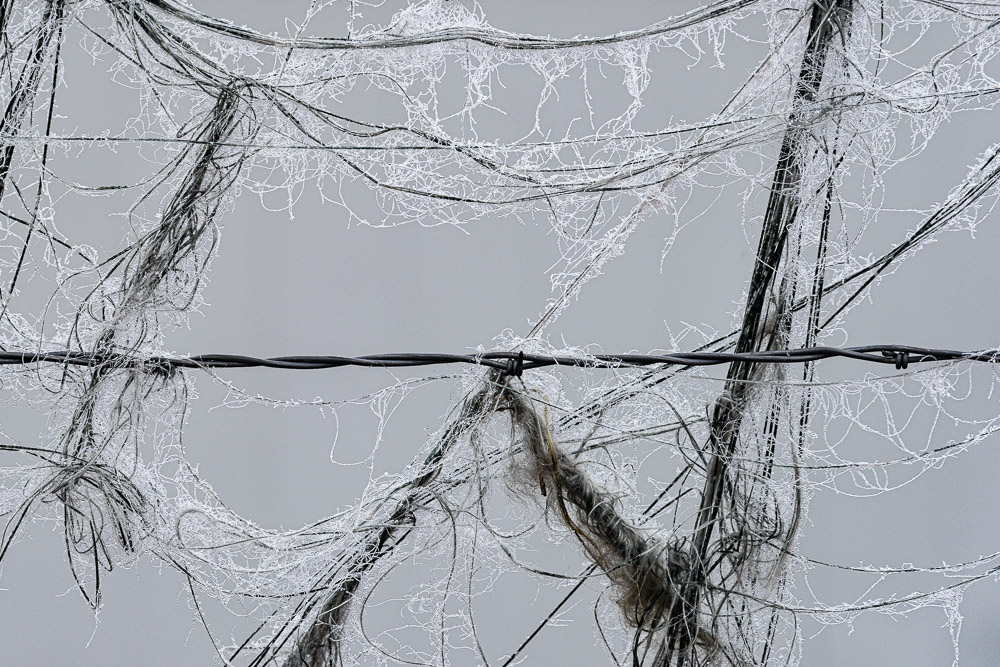
    The image at the top of this post is one of these. It was a very cold winter day, probably 0F. My hands were getting frostbit even with gloves on. There was a frost that morning. This fence with bits of construction cloth stuck in it was beautiful in the conditions. Most other times it would be very forgettable.

    If you really can’t get into it, don’t bother trying to shoot. But I hope you can condition yourself to be able to discover interesting images everywhere. I often find that when I can’t see good images, the problem is in me. I am distracted or preoccupied or in a bad mood. If I can change my attitude it makes a huge difference in my perception.

    I would love to hear about your experiences.