An artists journey

Category: Business

Ideas about the business side of art.

  • Invest in Yourself

    Invest in Yourself

    You are your best asset. As a matter of fact, you are your only asset. Invest in yourself to develop your skills and abilities.

    Professional

    I am primarily talking about our skills as an artist. We need to invest in our self to grow and get better professionally. It is a life-long process.

    Time

    Do you invest enough time in your art? Many of us have a “real” job to pay the bills. And we have families and other obligations. It stretches us pretty thin at times.

    But we cannot grow as an artist unless we put in the time to do the work. Practice, practice, practice. Repetition. Experiment. These things make us more skilled and more mature in our craft.

    I have heard of a gallery saying they are not interested in an artist until they have painted 10,000 pictures. Of course, that is a silly metric. There is no arbitrary number to reach your peak. I do believe, though, as Linus Pauling said, “The best way to have a good idea is to have lots of ideas and throw away the bad ones.” Same with our art. We get better with practice as we learn to recognize the bad stuff and throw it away.

    We have to put in the reps.

    Training

    I don’t know about you, but before becoming an artist, my professional life involved constant learning. I seldom did things I learned in college. One of the great benefits of my previous career was that I had to learn to learn. My life as an artist is the same.

    My friend Ramit Sethi makes a point of how much he spends on personal development, from courses to books to a personal trainer. He has a much larger budget to play with than I do. Even so, in proportion to where I’m at I may rival him. No personal trainer though. I have to be content with getting out almost every day and walking about 5 miles with my camera. His advice is good. I do like and generally follow his book buying rule: “If you see a book you like, just buy it”. As I write this I’m waiting for a new one to show up.

    It’s not the amount you spend on training that matters, it’s the results. I have occasionally spent hundreds of dollars on classes that were a marginal benefit, but gotten a lot of good from a free online class. It is a matter of what speaks to you at the time. And the fact that you’re doing it regularly. I probably watch 10-15 hours of videos a week on art, marketing, sales, general business, and selected other subjects of interest. No, no funny cat videos.

    The point, though, is that we must constantly invest in our self. When you say you already know everything you need, you start to stagnate. You can always learn something new and improve your artistic skills and yourself personally. You have to.

    Marketing

    Now it starts to hurt, at least for me. I don’t like marketing. I would rather just do art.

    But I have been told over and over and I now believe I have to invest at least 20% of my time marketing. The reality is probably more like 30-40%. I have a lot of catching up to do.

    Unless we are doing our art as a hobby, and are content to just show our work to friends, we have to market ourselves. “Build it and they will come” is a great line for a movie, but is not true in real life.

    Art is a very competitive world. Galleries don’t want to hear from you. They have too many artists already. Selling online? So is everyone else. So what can we do? We build a distinct brand and be very persistent and professional in our outreach.

    Several marketing gurus have made a point that we will never get anywhere if we do something a couple of times then get discouraged and move on to something else. Persistent, repetitive, sustained marketing is required to “break in” to the world we want. I don’t like it, but that is life.

    Personal

    As important as it is to grow and take care of our self professionally, I believe it is equally important to take care of our personal life. I hope your vision for your life is about more than just professional achievement. Do not neglect your health and fitness and your mental and spiritual development.

    The training I advocated above also helps you mentally. Keeping your brain active and learning new things has a lot of long term benefits. A substantial part of the training should be targeted at things that do not seem directly related to your art. Read biographies, history, science, psychology, and even fiction. It is amazing what seemingly unrelated things can spark a creative idea.

    A key word there is “read”. You are a professional. You cannot just watch videos. Reading has a greater benefit than watching a screen. Try it. It is good for your mind.

    Mindful

    A common thread to all of this is mindfulness. This is just a fancy psychological term for being deliberate and conscious in what we do and very aware of what is going on around us. I am studying this now and I am sure I will be writing more on it later. But for now, pay attention to what you do and be very aware of your choices.

    The picture

    I love this picture with the article. It is one of the greatest train tracks I have ever seen. Look closer if nothing jumped out at you when you first saw it.

    I can take it as metaphors for a lot of things. For this article, I will use it to make the point that there are many paths we can chose. But they do not all lead to the outcome we want. Choose wisely and deliberately. The path you want is usually not the easy one. You are your best asset. Take care of yourself. Work at it.

  • Creativity is a Process

    Creativity is a Process

    Is creativity something that just happens when the “muse” takes you over and directs you? I want to challenge that. I believe creativity is a process that we can follow almost anytime, not just when we are “inspired”. I hope this will seem inspiring, because it means we can create great work any time we decide to.

    The myth of the muse

    Ah, if only the inspiration would come! I guess I will sit and drink wine and read poetry while I wait for the muse to visit. That sounds like a pleasant way to spend a rainy day, but not a way to create art.

    The concept of muses comes from Greek and Roman mythology. They were 9 goddesses who controlled the arts and sciences and inspired artists. It is amazing how the concept has stuck. The idea of muses makes a good metaphor. We all know that our creativity seems to increase or decrease at unpredictable times. None of us understand the reasons why. But I will not believe my life and psyche is at the whim of Greek goddesses.

    I don’t feel like it

    If you believe some external influence controls you then it is easy to say “I’m not feeling it today, so I’m not going to do any art.” Maybe you can do that. I can only behave that way for very short periods of time.

    My art is something I have to do. Not doing it is worse than feeling like I am not inspired. I would make “bad” art rather than no art at all. I don’t have to show it to anybody.

    I find that when I assign myself a project to focus my creativity or just pick up my camera and get outside looking around I start to feel and see possibilities. Something magical happens to me when I hear the shutter click that first time. Now I am drawn into creative mode. My camera, like many new ones, has a fully silent mode. I don’t use it. I want to hear that shutter slap. It activates decades of muscle memory and discipline. I have made an image. Now I can go on.

    Hard work

    The bad news (for some of us) is that art is hard work. We cannot always sit around waiting for “inspiration”. We have to make our own inspiration.

    Inspiration is for amateurs. Us professionals just go to work in the morning.” – Chuck Close

    Hard work will outperform talent any day of the week.” – Joel Grimes

    Motivation exists, but it has to find you working.” – Pablo Picasso

    A professional is someone who can do his best work when he doesn’t feel like it.” – Alistair Cooke

    Sorry for the blizzard of quotes, but I find encouragement in the experience of others who have been there before. I could have found a lot more quotes on the subject.

    So, if you just dabble in art and it is not a driving passion, it is OK to wait for inspiration. But if you are serious about your art you have to just do it. Create your own inspiration. Work. Push on. Get moving to get the juices flowing.

    The process

    I said creativity is a process. What is the process? As Fast Company magazine said: “stop your whining and sit your ass in the chair.” Sorry to be crude, but it is true. They were referring to book authors, but the same principle applies to other creative efforts.

    It doesn’t do much good to complain about lack of inspiration. Do something. Taking positive action will lead to the work flowing. Eventually. It is hard at first, but it is a learned process. “Professional” creatives, like screen writers, copywriters, commercial artists, illustrators, wedding photographers – people who must deliver work to clients on a schedule – just have to get it done. Whether or not they feel like it. The rest of us can, too.

    Assign yourself a deadline. Define a project and a timetable. Go out and say you won’t come in until you have shot a certain number of images. Re-evaluate and re-organize your portfolio. Take some action to get some momentum going. It will overcome the barriers in your mind and get ideas flowing. The work you do right then may not be great, but it will get you going.

    Projects focus us

    I have said that projects are a good way to get ourselves going when we don’t feel like it. Actually, I am coming to believe it is one of the best tools we have. What is a project and why does it work?

    A project as I describe it is shooting and editing a collection of images that center on a theme or subject. I believe it helps focus us to write an artist statement before starting the project. This collects our thoughts on the purpose of the project, its scope, its meaning, and what your interest or motivation is.

    Write something? You’ve got to be kidding! No, I’ve come to believe writing is just another part of the creative process. It is organizing a linear series of words to communicate rather than communicating solely visually. Both are forms of expressing our thoughts. Both, I believe, are complimentary creative processes.

    The artist statement does not have to be long, maybe 200-300 words. It will serve as the guide to focus us and give unity to the project. So be clear to yourself.

    Maybe I’m just weird, but putting the blinders on and restricting my thoughts to a project gives me a huge boost of creativity. Rather than my thoughts being diffuse and wandering all over the place, they are focused on one thing. My creativity and energy have something to work on. Throwing myself into coming up with diverse ways to express a single subject is a challenge and, actually, fun.

    Get going

    Whether you challenge yourself with projects, go to museums, read books, write, finger paint, whatever, do something. Do not fall into the trap of feeling depressed and uninspired and, therefore, not doing art. Get moving to get your mind working. Doing creative things breeds creativity.

    Let me know what you do to get your creativity going,

  • Keywording

    Keywording

    Keywording is a pretty mundane subject. But I recommend not ignoring it. It is valuable to you and good discipline. I have tried to ignore keywords at times but I have always changed my mind.

    What

    The photo filing software you use probably has provisions for adding keywords to your images. It probably also has ways to add a lot of other meta data, like location or client or your copyright information. Use this other information, too. I use Lightroom Classic for my organization and keywording.

    Keywords are simply arbitrary tags that add words or phrases to help you locate or identify your image later. This is important, the keywords are completely chosen by you and for your use, unless you work for an organization that enforces standardized keywords. I will assume here that that does not apply to you.

    So they are only meant to be useful information for you. They may tag location or subject or color or mood or anything that seems relevant to you. You can add as many keywords to an image as you want. Perhaps there is an upper limit, but I have never found it or read about it. Again, let me emphasize that you decide what they are.

    Why

    Why go to this trouble? Because one of the problems with digital images is that we tend to collect a lot of them. And since they are “hidden” on your computer and not nice physical prints you can flip through, you need extra help finding things. Someday you will want to find a particular image or images of a certain subject or those pictures of a red cardinal in a winter snowstorm you took a few years ago. Keywords are one of the means of locating or grouping your pictures.

    One of the challenges of keywording is to Goldilocks it: not too much, not too little, but just right. How do you know what is just right? That’s the challenge. Partly it has to be sort of backward looking. That is, when you find you can use your keywords to locate the images you want and it did not seem too much trouble to have added them, it may be just right. Sorry, not a really helpful description. The trouble is, your mileage may vary.

    Strategy

    Most photographers eventually determine a strategy for keywording that works for them. I have seen people who do a lot of wildlife photography who tag images with the common and scientific name of their subjects. That is too much work for me. Since I don’t shoot much wildlife I may only tag the occasional one with “elk”, or “deer”, or “pronghorn”. Or a very generic thing like “bird”.

    Works for me. Would not work for some people I know. Choose an approach that is right for your needs.

    There are places on the internet where you can find lists of keywords. I have looked at some of them, but they tend to be too detailed for me. Plus, since I did not create them, I have trouble thinking of the words the author chose. So I make up my own keywords as needed. A quick export of my keywords shows that I have nearly 2200 unique keywords in my main catalog. I am completely sure many people have far more.

    For the most part, I use keywords to identify subjects, attributes of the image, and “housekeeping” information.

    Example

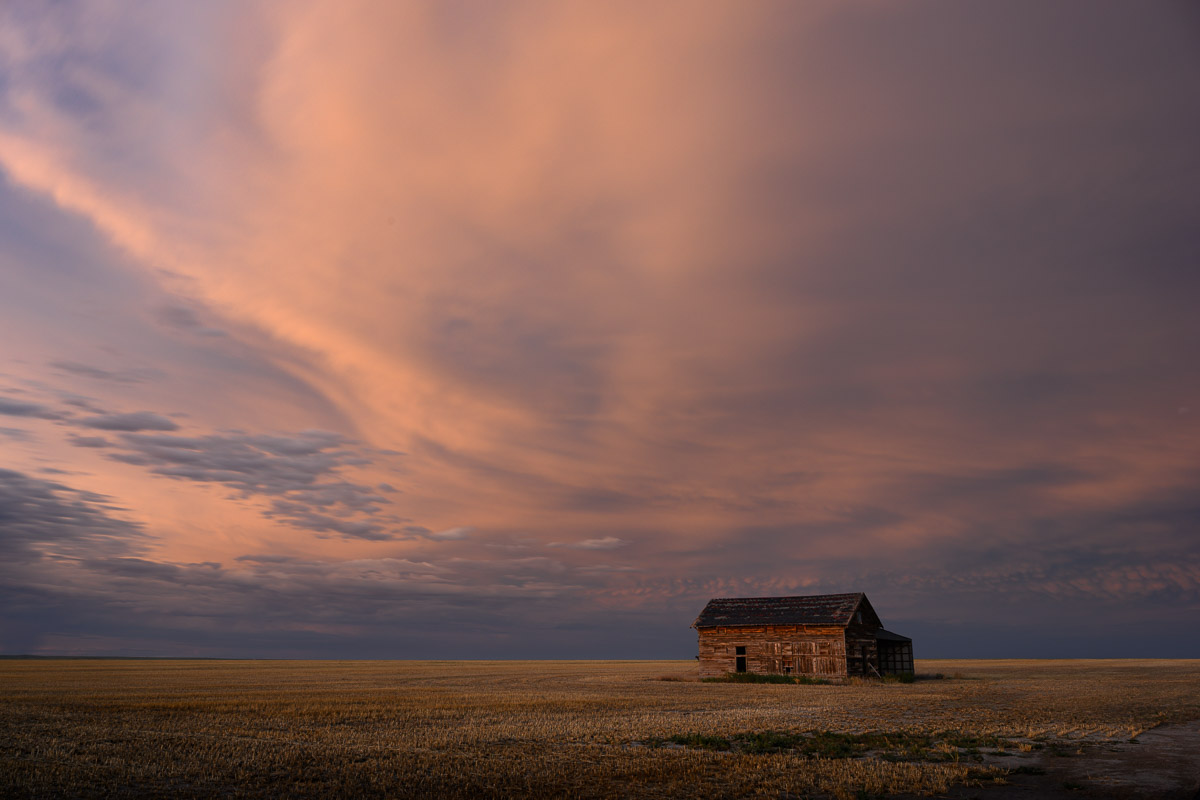
    Let me give a simple example. This is a somewhat randomly chosen image that seemed fairly typical of my keywording.

    Sunset, wide open spaces

    This image has 14 keywords currently. For the subject ones, it is identified as a cabin on the eastern plains of Colorado with interesting clouds. For the attributes that seemed important to me, it is a landscape, it is abandoned, it is made of wood, a sunset image, taken in summer, and showing an expanse of distance.

    The potentially most interesting are what I term housekeeping keywords. I use these to track important information that often has nothing directly to do with the image. An example for this one is that it is copyrighted. Yes, all of my images are copyrighted technically at the moment I take them, but this extra level signifies that the image has been filed and accepted for copyright by the United States Copyright Office. In addition it has keywords indicating the copyright registration number and date of grant. Other example housekeeping tags are that it is in my Select5 group, one of my highest ratings, and it is used in this blog.

    Why do it this way? Because I developed a system over time that works for me and is based on real needs that needed to be solved. I do not claim it is the only way to do things or that it is the best way. It is just the workflow I use. I encourage you to also adapt your tools and process to meet your needs rather than bending your needs to match the tools, or what someone has told you you should do – including me.

    Worth it?

    It is solely up to you to decide if it is worth it to you. It is to me. I often do searches to locate a particular image or a certain type of scene. The more identifying information I have, up to a point, the better. I also use smart collections sometimes to group together all images of a certain criteria. For example, I mentioned using a keyword for my selection level. I have smart collections that will show me, for instance, everything at select level 3 that has not yet been evaluated for possible promotion to level 4. This is a key part of my workflow.

    I always keep in mind what I termed the Goldilock effect. If my keywords are not adding value for me I will modify or abandon the process.

    These are your images and your process. Do what works best for you. But it is good discipline to enforce on yourself. I can say that if you go a long time ignoring something like keywording and decide later you should do it, it is a lot of boring work for a while.

    The tradeoff for me is that keywords are valuable for my work and useful for my processes. I will put in the effort to do it. Taking a little time to think about an image from several aspects like subject and attributes and housekeeping has benefits for me. It is one of the steps that ensures I am curating my valuable assets rather than just accumulating a big bag of pictures.

    Postscript

    A growing trend is software that attempts to analyze your images and automatically generate keywords. One new one I’ve seen is Excire. Another system I have seen described is fotoKeyword Harvester. I’m sure there are more. Lightroom itself agressively tries to get me to let it scan to identify people. It’s little brother, now named just “Lightroom” also automatically tries to keyword images. All this comes with the increasing penetration of so called AI technology.

    I don’t use these tools. As a matter of fact, I don’t trust them. All that I’ve seen will suck your images into “the cloud” for analysis. I have no sure way of knowing what will happen to them then. I am very protective of my rights and possession of my images.

    Yes, I may be a Luddite, but it is not entirely out of ignorance. I am a Software Architect who had done AI work and even developed practical applications based on some of its research. I have some idea of the downsides of using it.

    Besides, as I indicated above, my system is based on a network of keywords I have grown organically over a long time. I am not interested in some software system deciding to re-describe and re-interpret my image data.

    So for the foreseeable future, I will continue doing my keywording manually.

  • Themes

    Themes

    I have come to realize I am attracted to certain themes in my art. Before I fall off into art-speak, what I mean by a theme is just the simple dictionary definition: “a subject or topic of discourse or of artistic representation”. In other words, what subjects do we chose for our art. Themes tend to be bigger than a subject. A theme may tie several seemingly separate subjects together.

    Think about artists you admire. Do you also picture the typical types of works they do? Ansel Adams – grand black and white landscapes of the west. Georgia O’Keeffe – modernistic flowers. Monet – impressionistic rivers and ponds in northern France. John Paul Caponigro – abstract and ethereal seascapes and landscapes. They tend to go together in our minds because we know they very often do these subjects.

    Chicken or egg?

    Do artists pursue themes because that is what they like or do they pick something to get known for? Kind of a trick question. It doesn’t have to be just one or the other. Sometimes themes choose artists. Sometimes artists choose themes.

    What is available to us often has a huge impact on our themes. Ansel Adams lived in California. Yosemite and the Sierra Nevadas were his back yard. John Paul Caponigro lives in Maine. Seascapes are common to him. Monet lived along the Seine River. He painted what was around him. This is quite common. We tend to grow to love what we see most. I live in Colorado, right on the dividing line between the mountains and the arid plains. Both are beautiful to me. I see them every day. The more I see them the more I resonate with them.

    Some artists deliberately choose themes or subjects to become known for. They want a “signature”. Joel Grimes is well knows for his commercial work and stark, gritty treatment. Some people become famous portrait artists or wedding photographers. In general these are things they have consciously decided to build their career around.

    I won’t claim there is a right or wrong. If you pick a certain subject matter to build your career and reputation on, I hope you really love it. Otherwise you could be like these old rock bands still touring around whose audience only wants to hear their hits from 40 years ago. It would get very frustrating to me.

    I am a searcher and explorer. Themes are less conscious for me. Looking back through my portfolio I can detect a few. The ones I have detected make it less surprising now for me when I find myself drawn to them. I recognize it and have come to expect it. That doesn’t mean I am not open to new things, just that I can see larger patterns in my work.

    Very personal

    Themes or typical subjects tend to be personally meaningful in some way to the artist. It is hard to keep on doing art you don’t care for. That is probably one reason we have themes. The subjects we are drawn to are somehow meaningful to us so we keep coming back to them.

    I don’t want to go too deep on the need for meaning. Our themes do not have to align with deeply meaningful social or environmental causes for them to be meaningful. If they are meaningful for us, that is sufficient.

    I used Georgia O’Keeffe as an example earlier. Her mentor and, later, husband Alfred Stieglitz promoted the idea that her flower pictures had deep sexual significance. It helped build her reputation in the modern art world of the time. She later vigorously denied this was true. She maintained it was only the form and color that was important to her.

    Maybe meaning is a very nebulous and personal thing. What is meaningful to me may not be to you. And vice versa. Or you may see meaning I didn’t when I made the image. I have never thought that pictures have significant meaning in themselves. The themes I discover in my work have meaning to me, but I do not try to force it on you. Maybe on the rare times I try to express my feelings in words the viewer may occasionally get a glimpse of the meaning there is to me. But I do not expect you to get one of my images and hang it on your wall unless you like it as an image and maybe, there is something there that is meaningful to you.

    Consistent over long times

    Themes tend to be a persistent feature of an artist. We are drawn to certain subjects. Maybe we understand there is a theme there that we are pursuing. But regardless, we keep coming back to certain things.

    Our themes can fade with time and be replaced with new themes. We all grow and change our values and interests. This tends to be a slow process, but it happens for most of us. I hate to try to quantize it, but I would guess that when we find we are interested in a theme it will stick with us for a few years. Sometimes, for our whole life.

    Unifying themes

    Sometimes we find that several seemingly disparate subjects that interest us are really part of a unifying theme. This is a wonderful realization, because it unites large parts of our work and brings a new meaning, or realization to us to understand why we are drawn to it.

    Let me give a personal example. I am drawn to old things that are worn and aged, but only certain ones. Some old things excite me and many are of no interest. Old rusted cars, abandoned buildings, old machinery, these have always been interesting subjects to me. As I’ve gotten older I have discovered the Japanese term wabi-sabi. I realized I was embracing the philosophy before I ever heard it expressed. It has become a unifying theme for many of the subjects of interest to me.

    It is apparently impossible to succinctly and even correctly translate wabi-sabi to English. There are too many subtleties in the Japanese meanings. Some day I will attempt to write a better blog on it.

    Here is one very compact description of wabi-sabi: “‘Wabi’ expresses the part of simplicity, impermanence, flaws, and imperfection. On the contrary, ‘Sabi’ displays and expresses the effect that time has on a substance or any object. Together ‘wabi-sabi’ embraces the idea of aesthetic appreciation of aging, flaws, and the beauty of the effects of time and imperfections. The two separate parts when put together, complete each other.”

    I discovered that I am drawn to flaws and imperfections and the beauty of aging and the effects of time, especially of things that are bravely standing against time. This theme unites my collection of old rusty cars, broken down buildings, and broken flawed objects. I was happy to be able to wrap a higher vision around my old rusty things.

    It makes us different

    Our affinity for themes is one reason we can go out with a group of other photographers and still come back with our own unique images. We each have a different viewpoint. We are drawn to different aspects of a scene. Even if we shoot the “same” scene, we probably each have our unique viewpoint. This causes us to frame it differently, isolate a different part, emphasize different things.

    Or, for some of us, even turn away from the classic landmark and shoot a different direction entirely.

    Our themes help unify our images. They give a meaning and long term point of view to our portfolio. In another sense, our themes are an indication of our values and world view. What we are drawn to shoot are often things that are meaningful to us because of the themes we embrace. We still shoot other things, but something keeps drawing us in certain directions…

    This image

    The image with this blog was taken in Blaine Washington. It is on the seacoast right at the border with Canada. It is a lovely small town. I was across the harbor. There were good views all around of the harbor and the sea, but I was fixated on this great old boat. Rusty fittings, deteriorating paint, obviously it had seen better days. But it was still standing against the elements. That is encouraging. For me, a perfect wabi-sabi moment.

  • Vulnerable

    Vulnerable

    Being an artist is creative and rewarding. It is also a position that is vulnerable and lonely. I made my career in an objective, logical engineering world. In contrast, the artist’s world I live in now is based on opinion and perception. I have never felt so vulnerable and out of control.

    Lone-wolf

    A popular view is that the artist is a lone wolf. Fiercely independent, self-sufficient, going his own way regardless of what anyone thinks. To a certain extent, this is true. I think an artist has to have the fortitude to maintain his independence in the face of adversity and pressure to conform.

    Unfortunately, there is a cost to being this lone wolf. A lone wolf is, well, alone. He is isolated, vulnerable, having to go it alone. It’s a position where you don’t have a support infrastructure. You don’t really have people to build you up when you are knocked down. You don’t have people to take care of things and offload work from you – you have to do everything yourself. This can get debilitating at times.

    Some artists maintain a network of mentors, confidants, and collaborators. I envy them.

    Courage

    For me, one of the hardest things is to have the courage and determination to keep pressing on. I am not a natural marketer. It is hard to “put myself out there”. Making noise for myself is a very uncomfortable thing. Especially when I am continually getting knocked down emotionally and passed over.

    An artist has to believe in himself. To believe he has a vision and a message that people should pay attention to. This has to carry him through rough patches when things seem to be going against him. When you seem to be a lone voice in the world, this can be hard to maintain.

    Coming in in the morning with a fresh resolve can be trying. Sometimes it is difficult to say “I am an artist; I believe in myself and know I have something to bring the world”. And act on it.

    Rejection

    Rejection is a part of life, especially for an artist. We have to expect it, even seek it. If you are not being rejected, you’re not trying.

    But it takes a toll. I think even the strongest pay an emotional cost when we are rejected. It’s like being back in school and not being picked for the team or not receiving the scholarship or just not being asked to sit at the table with the “cool” kids. You know it is going to happen sometimes, but it still leaves a bruise.

    With rejection the world seems to be telling me I’m not good enough. That I don’t stack up to the competition. That I probably should just give up.

    But the world is a bitter and heartless place. I have to shrug it off and believe my own inner voice rather than a message some stranger is giving me. I have to believe in myself, even when others don’t.

    Indifference

    Possibly even worse than rejection is indifference. When my art seems to not matter at all to anybody. When everything seems to be futile.

    This is another tool the world uses to try to crush the aspirations of most artists. and it works a lot of the time.

    I sometimes think I would rather have someone write me and tell me they hate my work. At least they took a moment to acknowledge it. (No, it’s an exaggeration. I’m not really asking you to tell me how much you hate what I do.)

    Will power

    This has been much more negative than I usually am. Vulnerability can do that. Rejection and isolation can be cumulative.

    But I think the real point I am trying to make is that these things will come. They happen to everybody. The question is, what am I going to do about it?

    I said an artist has to believe in himself. That is kind of trite, but nevertheless true. Being vulnerable or discouraged or feeling isolated are part of what we have to accept if we call ourselves an artist. If we are feeling down are we going to pick ourselves up, metaphorically, and find the will to go on? Or are we going to pack it in and stop doing our art? It is our call. Nobody else can decide.

    I know of artists who claim to seek rejection and collect rejection letters. Good for them, if they are telling the truth. But good for them regardless, because the attitude is right.

    If I apply for something and get rejected, I have to understand that just means I was not right for that exhibit or the juror was looking for a different style or the gallery has a different culture. The rejection was not a legal certificate from a higher authority saying “you’re not an artist and you should give this up immediately.”

    I am an artist. I believe in what I do. That has to come from inside. If I listen to what other people say I will doubt myself. If I doubt myself, it will inhibit my creativity and my ability to express my vision and my will to apply for that next opportunity. I’m a lone wolf.

    Vulnerable

    Back full circle to the idea of vulnerability. Yes, I am vulnerable in the sense that I am out there, on the edge, exposed to the world, all alone. I have to take the hits and survive. I have to have a strong enough belief in my ability that it can carry me through the rejections and indifference.

    This can be one of the hardest parts of the art world. Many artists are introverts and somewhat shy and self doubting. We have to get over ourselves and put our work out there for the world to deal with. Rejection will come, but we have to go on if we believe we have something worthwhile.

    I will close with a favorite quote from Theodore Roosevelt, popularized recently by Brene Brown:

    It is not the critic who counts; not the man who points out how the strong man stumbles, or where the doer of deeds could have done them better. The credit belongs to the man who is actually in the arena, whose face is marred by dust and sweat and blood; who strives valiantly; who errs, who comes short again and again, because there is no effort without error and shortcoming; but who does actually strive to do the deeds; who knows great enthusiasms, the great devotions; who spends himself in a worthy cause; who at the best knows in the end the triumph of high achievement, and who at the worst, if he fails, at least fails while daring greatly, so that his place shall never be with those cold and timid souls who neither know victory nor defeat.

    To me, this is what it is about. I have to be in the arena to become what I want to be.