An artists journey

Category: Attitude

  • Consistency

    Consistency

    Consistency is good, right? Unless it’s not. There is a time and place for everything, including breaking expectations. Consistency should not be our main goal. What we are led to see and create is more important.

    Hobgoblin

    A quote we all know that is attributed to Ralph Waldo Emerson usually says: Consistency is the hobgoblin of little minds. That seems odd. Why would he disparage consistency?

    The reality is that this has been misquoted for so long that most people have forgotten the real statement. The quote, from his essay “Self Reliance“, actually is: A foolish consistency is the hobgoblin of little minds. Let’s explore that.

    But first, what is a “hobgoblin”? Even though I have heard this quote forever and acted like I understood it, I didn’t know what a hobgoblin was. Wikipedia says: A hobgoblin is a household spirit, typically appearing in folklore, … Like other fae folk, hobgoblins are easily annoyed. They can be mischievous, frightening, and even dangerous.

    So if we accept the concept, a hobgoblin is not a scary monster but something we tend to live with and accept that is kind of annoying, maybe occasionally dangerous. Playing that out, it makes it a spirit or tendency that can be dangerous or difficult to control. Something that can occasionally do more harm than good.

    Consistency is good

    We usually consider consistency a sign of intelligence, of good work habits, of reliability. You are respected when people know you can be relied on to keep your commitments. It is a sign of maturity.

    As adults this should be a quality we cultivate in much of our life. It makes us more predictable and helps us get along well in life. People around us need to know we are not schizophrenic. When they come to us for something, they need to know who they are dealing with, how we will behave.

    So what’s not to like?

    Consistency is bad

    But Emerson is saying that a certain type of consistency can be bad. Is that contradictory? One of the traits of an adult is the ability to keep contradictory concepts in our head and rationalize them. F. Scott Fitzgerald said: “The test of a first-rate intelligence is the ability to hold two opposed ideas in the mind at the same time, and still retain the ability to function.

    What is this, then, that Emerson calls “foolish” consistency? I believe he is referring to being a slave to consistency, even when it would make more sense to change. He says it is a trait of little minds – ouch.

    We all have ideas and opinions and habits we have developed over time. Key is: they have developed over time. This means they change with time. Do not be afraid to seem inconsistent with your past beliefs when you change and adopt new beliefs.

    As artists, we develop a style that is a signature of us. People recognize our work without being told. But is the style who and what we are, or is it merely a reflection of where we are right now? Don’t be trapped by your own success. We become reluctant to change it for fear of breaking our “brand”.

    We grow and change. Sometimes radically. Do you ever feel trapped by a style you no longer believe in? This may be what Emerson refers to as foolish consistency.

    As a couple of examples, I respect Joel Grimes for making a couple of right angle turns in his career. He became very successful for a certain look he brought to his work, mostly advertising. But he came to a point where he “used it up” and changed. He continued being successful.

    Another one that comes to mind is Cole Thompson. Cole is a great black & white photographer who lives near me in Colorado. He has usually done long exposure landscapes. But his new series Negative Intersections is a big departure from his old style. I respect him for taking the risk and breaking out of the rut..

    Go where the spirit leads you

    Artists should stay fresh, alive, seeking, learning. When we do this, we change. We grow and evolve. Practically, this means we will change our style at one or more points in our career. Isn’t your vision different now than 5 years ago?

    Let your feelings and instinct lead you in this journey as you develop as an artist. Consistency is good until it starts to limit you. Be willing to change, even if it means you now seem to be inconsistent with what you did before. You are not really inconsistent, because where you are now is authentically you.

    Change or you are trapped in a box of your own making. Set yourself free. Trust that you are growing to better levels all the time.

  • Secret Revealed: The Meaning of Art

    Secret Revealed: The Meaning of Art

    I may be expelled from the artist guild for revealing a closely guarded secret. I want to talk about the meaning of art. Maybe it is not actually a secret. Maybe I just don’t understand.

    Objective meaning

    Without getting pedantic, we have to talk a little about meaning. This is a deep study in itself that we can only shine a little light on here.

    Something has objective meaning if it creates the same idea in your head that it does in mine. A stop sign has meaning for most of us, but only because of training and convention. A user manual describing a feature of a product has meaning – or it should; many are poorly written.

    The famous psychoanalyst Carl Jung said:

    No individual symbolic image can be said to have a dogmatically fixed generalized meaning.”

    I think he was saying that we all see something different when we look at an image.

    Pictures consist of marks on a 2D surface, such as canvas. We see the marks as lines, shapes, forms, and colors. How we perceive these marks determine the meaning we get from it. Two people viewing the same image: one dismisses it as uninteresting, the other breaks down in tears because it invoked a deep symbolism or meaning or memory for them.

    Some things, like documentary photography or photo journalism, seem to have meaning. They at least motivate a certain response fairly consistently. Even so, the meaning is often not exactly what the creators meant, because everyone is in a different place. So I have to wonder if the work truly has meaning. Another question is whether it is really art. If the focus is meaning, is that at odds with art? Just asking.

    Feeling/emotion

    I spent most of my career as an engineer. Talking about and dealing with feelings is pretty alien to me. But I have discovered that art is all about feelings. I would go so far as to say that if art doesn’t invoke an emotional response in the viewer, it is probably a failure.

    For decades I took technically good, well composed pictures of the natural world. Mostly landscapes. When I look back at them now I see most of them as completely boring. There was little discernible emotion there. I just showed what it was, I did not attempt to give a glimpse of how I felt about it. I was making documentary images, not art. Today, in the same situation, I would strive to bring you my interpretation of the scene, with my feelings prominent. Or if I can’t figure out how to do that, I might take an image for a record of it, but I would never show it to you.

    The left brain/right brain model is useful for describing the logical vs. creative sides of our nature. I don’t want to imply that I have or believe we should switch totally to the right brain creativity. Life works best in balance. We have both natures for a reason. I strive to develop my creative side to an equal level with the logical, analytic side I have emphasized most of my life. But at times I also just let my right brain side run free to see what it creates.

    Where does meaning come from?

    Artists react to and bring out things we may not consciously be aware of. Creativity is a strange and murky process.

    John McGlade, an artist and free thinker from Australia, expressed it very well in a Quora answer to a question: Does art have a meaning that only the artist knows? Please pardon the long quote, but this is good stuff.

    NO! A piece of visual art may have meaning for the artist who made it or not. If you mean meaning statable in words then artists and the public may have no clue, of an artworks meaning. The visual arts are done precisely because words are insufficient to hold the concepts alluded to in the visual arts like painting, sculpture, photography, plays and film. The artist may say or discover or may have no idea of the meaning in their work just by doing it. (Some artists, contrary to popular belief, may have no idea of why they do their work or what it means, nor do they care!) But the moment other minds see the work, because of their individual and unique thinking and perceptual patterns, they will bring their own impression of what the work may mean to them. As an artist, at every stage of my creativity, I will try to put into some words that hunt around what my work may be about. That’s the exciting thing about doing art, I am groping around in the darkness of my mind and it’s ideas, to discover what my mind is trying to tell me. It’s the same for the public, the artist is highlighting some aspect of their experience, but there’s no guarantee that other people will see it the same way as the artist. Meaning, for our complex human minds, is more than just words, it’s a whole conglomeration of words, images, feelings, impressions, prejudices and perceptual biases into one gigantic scrambled omelette of being; and every omelette is unique. Artists may not be as smart as you or they think they are. They are just highlighting what they have noticed and we are free to take our perception on what they present.

    Do I know what it means?

    Like Mr. McGlade highlights, in the art I am currently doing I often have no idea when I am working on a piece where I am going with it or what it means. I just follow my feelings at the time and see where it leads. Even when I get done I may not know what it “means”.

    After I set it aside for a while and think about it I might be able to figure out why it moves me. Maybe even what it seems to be about. Sometimes I can state a meaning – for me.

    I have said before that for art, I am not much of a planner. I react and trust my intuition. So I often do not have a crisp understanding of what I have created.

    Why?

    But maybe that is not enough. Maybe I owe it to myself and my audience to ask “why”. If I am caught up in a creative mood and making something I really don’t understand, I wouldn’t interrupt the process. But maybe later.

    If a gallery requires an artist statement describing a work, I confess that I sometimes have to make up something. Because I honestly may not have words to describe what I meant. Sometimes, though, being forced to write it makes me examine myself and my work . It can be a good exercise to try to express our feelings and intent. Our meaning for a work may emerge over time. It is sometimes hard to force ourselves to go through the introspection required to dig it out.

    Questions?

    Perhaps one of the purposes of art is to make us ask questions. Could that be the meaning of some art? Maybe we should not look at an image and quickly say “I don’t like it”. A better response may be to ask our self why we feel like we do on viewing it.

    Great art, art that stays with us, leaves us feeling like we are on the brink of discovery. That if we keep pushing and examining ourselves we might reveal a great truth. It could be that the unanswered questions are one of the reasons for art. I like William Neill’s quote:

    I would rather make an image that asks a question than one that answers one.

    Make art

    We have enough people going around wringing their hands, promoting their own causes, and painting the world as bleak and depressing and hopeless. I believe art should generally be a positive force in the world. Art to bring us joy, to encourage us to reflect and be mindful, even to aspire to greater things.

    That is the direction I will take with my art. You can accuse me of having blinders on, of having my head in the sand. Maybe. But it is easy to point out suffering and ugliness. It is harder to bring joy and encouragement. That is my goal. So I would say my art has meaning, but it may only make sense to me. That is OK. I hope it has some meaning to you, but it will be a different meaning, because you are a different person with different values and experiences. If I can raise some interesting questions I will have achieved something.

    I apologize to the galleries that require artist statements full of deep thoughts and meaning behind my images: sometimes I just make something up. There is a meaning to me, but it might not seem significant to state it. It might not even be possible right now. But I will keep thinking. Some emotional or intuitive things can be destroyed by trying to precisely describe them.

    I like what E. B. White said about analyzing humor. Paraphrasing it:

    Analyzing art is like dissecting a frog. Few people are interested and the frog dies of it.

    Art is a conduit for feelings and emotions and understanding that cannot actually be expressed in words. So, does art have meaning? It is meaningful. It is powerful. Art moves us in different ways. Art can even change our lives. But it may mean one thing to me and something completely different to you. Perhaps it is better to say art creates meaning.

  • Making a Black & White Picture

    Making a Black & White Picture

    I seem to be following a couple of converging streams lately. Several times recently I have discussed whether art, specifically photography, should be “real” – e.g. faithful to the original. I have also been thinking a lot about black & white. Today I am merging these thoughts (don’t cross the streams!). I want to talk about making a black & white picture. That is explicitly chosen rather than saying “taking” a black & white picture.

    A unique art

    In my last post I mentioned some of the history of black & white imaging. This is important to keep in mind. This is not just general photography. It is a specific art form with a long tradition.

    We are not talking about just taking the color out of a picture. How many times have you heard someone say “that did not work in color, let’s try it is black & white”? As if to say that black & white processing is a last ditch effort to save an image. What a very limited view.

    When we step into the black & white world we are now following a different path. The way we look at the image, the way we work, the results we try to achieve are all very different from working a color image.

    It is art

    By its very nature, a black & white image is an abstraction. It is removed from reality. We use black & white to reinterpret scenes we see. This is art.

    As art, the results do not have to recreate the reality we originally started with. Did VanGogh actually see what he painted as Starry Night? If he did, he was on some serious drugs. Are Monet’s water lilies a faithful representation of the original scene? No, they are an interpretation. This is a characteristic of art.

    Likewise, black & white images are not meant to be a colorless picture of the original scene. It should capture a unique view or feeling about what it was.

    Recent videos

    This was brought home to me when watching a recent video by Serge Ramelli. The course was “Mastering Black and White Photography in Lightroom”, available on Kelby Training. (I get no compensation from Serge or Kelby One.)

    What hit me was not that Lightroom is a pretty good tool for doing black & white – I knew that. I came away with a new view of how Serge approaches modifying a picture to become a good black & white image. Not just the techniques, but the boldness.

    Serge has the ability to forget about the scene as shot and just look at the image on screen and ask what should be done to it to make it interesting. What it was originally is not even a consideration at this point.

    Realization – I haven’t let go

    The realization the hit me is that, despite all my talk about art not necessarily being representational, I have trouble making that transition in my black & white images. I get stuck too much in my memory of the scene as shot.

    All that matters is the image I am working with on the screen and the final print. That is the art. What I started with doesn’t matter.

    I have to get better at letting go and just working the image.

    No sales pitch

    I don’t want you going away thinking I am just promoting Serge. No, while he is unmistakably a very good artist, he is too commercialized for my taste. He has a neatly packaged set of products encompassing books and training videos and actions and tie-ins to other photographers and their training, etc. There is a strong a flavor of “follow my instructions and you can make pictures just like me”. Thank you, but I don’t want to copy you, Serge. I just want to improve my ability to realize my own vision.

    I have learned good things from Serge’s videos, and I recommend you checking them out on Kelby One or Creative Live. He presents a lot of excellent information, but I do not want to be a Serge Ramelli clone.

    My takeaway

    Serge opened my eyes some. I realize that the boldness I thought I had is only a shadow of how I ought to be behaving. What I saw Serge doing was just working with the image until it was the artistic piece he wanted. I need to completely let go of my “knowledge” of what it is and where and how it was made. Those things are not important at this stage. All that is important is how can I make this set of pixels an interesting black & white image?

    The image here is an attempt to follow this advice. This is where I live and this is a snapshot I took on a daily walk from my studio. This is basically the original image, no compositing or major editing. Creating this result was frustrating and a little painful until I really broke down my inhibitions and got in the spirit of the process. What you see here is very different in feeling and impression to the original. It works well in black & white, but it is not a faithful representation to the original. This picture was made, not just taken. I like the result.

    How about you? What do you think? How much liberty should artists take?

  • Fall in Love

    Fall in Love

    I advocate it, but I’m not talking about a romantic meeting. Making art should be an act of love. We should fall in love with our works, or else, why do them?

    Because it’s there

    I mostly wander and explore without a lot of planning or result in mind. Sometimes I shoot pictures just because something is kind of interesting and I’m there to see it. That can be good, but usually not.

    Being an explorer, I follow my curiosity. I tend to try a lot of experiments to see what happens. So if something tweaks my interest I often see what I can do with it. Occasionally I have a tingle and excitement when I press the shutter, knowing that I have captured something I love. Sometimes it doesn’t happen until I am reviewing the image large on my computer. Then I discover that it is far more interesting than I thought at the time I took it. Both are joyous occurrences.

    More often than not, I find I have well composed, well exposed pictures of – nothing much. I look at them later and say “yeah, it was an interesting scene and it’s an OK picture, but it doesn’t grab me.” Usually I think it is because I did not feel strongly about the subject or scene. I didn’t fall in love with it.

    If I don’t feel passion for the image, how can I expect you to when you view it? It is pretty obvious to me which ones really grab me. I think you can perceive it, too.

    Over-planning

    At the opposite end I see some photographers occasionally get trapped by over planning. Conventional wisdom from many renowned photographers is that any photo trip or outing should be planned out in great detail. They will research a location extensively, looking at pictures from other photographers to try to find the “best” places and positions and angles and times and seasons. In addition, they will use tools like The Photographer’s Ephemeris to select the exact time and day and location to get the exact sunrise/sunset/moonrise/ etc. shot they want. And they may book an outing with a workshop or guide to help with the logistics and transportation.

    Is there anything wrong with doing it this way? Absolutely not, if that is the way you work. Different personality types need to approach things in different ways. Do what works for you, but don’t get into a mental trap.

    One of the traps I see is that we tend to get so invested in the preparation for the shot that we have to take it. We spent a lot of time and money to get to that point. It becomes a quest. It has artificially become so important that we have to take the pictures to validate and justify the trip.

    But what happens when you get there and the weather is “bad”? Bad being not what you planned for. Maybe you don’t like the workshop leader or structure. Worst, what do you do when you get there after all the planning and expense, look at the scene, and feel “meh”?

    Of course you take the pictures. You have to. But if you’re honest, they may not make your portfolio set you are excited to show people. There was just no life there. You can check off that you got the iconic shot, but maybe it ends up not being very important.

    Having our expectations too high can lead to disappointment.

    Anti-planning?

    You can guess from what I’ve written that detailed planning is not for me. I am almost an anti-planner. I tend to come at things the opposite way. Going to iconic locations and fighting for a tripod location and taking the exact same image 10,000 other photographers have taken just in the last month is not a motivation for me.

    Yes, the scene is beautiful. Yes, it is probably salable because it is the type of image people like to have on their wall. Economically it is foolish to not get this image and pander to the crowd.

    But for me, even though I think the scene is beautiful, I probably will not feel great passion for it. How can I distinguish myself from the thousands of other photographers shooting the same things? How can I tell my story or share my feelings?

    In love

    Back to the original statement of this article, I believe I have to fall in love with my images. If I am going to show you something I have made, it has to be much more than good. It has to have a passion you can sense. How can I bring you art you want unless I feel strongly about it?

    Thoreau said “A man has not seen a thing who has not felt it.” The famous photographer John Sexton said “Too often we attempt to force a photograph out of a situation rather than allow the situation to speak to us.”

    I am guilty at times of trying to force images to be there when I’m not actually listening and feeling. I recognize it. It is painfully obvious when I am reviewing them in Lightroom that I have a bunch of well executed pictures that mean nothing to me. Trashing them is the best thing to do. And use it as a reminder to follow the passion more than the light. If I don’t have a sense of wonder and passion for the image that is a good sign that it probably didn’t work.

    “Follow your passion” is not always good advice in life – you have to do a lot of things you don’t like. But in art it is great advice. It may not be the clear path to fame and fortune, but you will feel good about what you create. And your viewers can tell. Love your work.

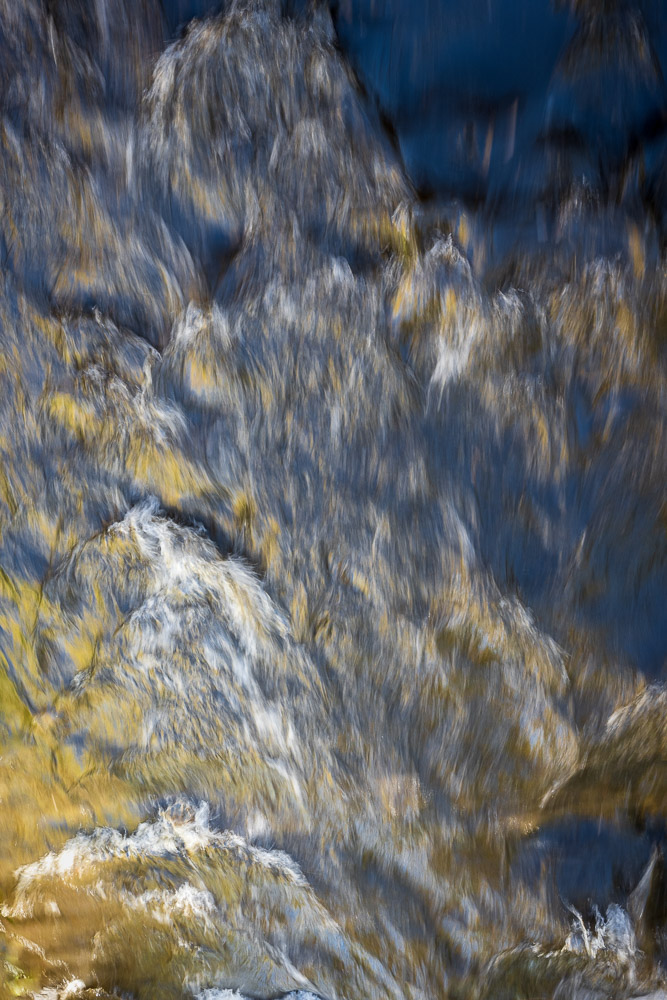
    This example

    I have used this image at the top before. It is a good illustration of my point here, though.

    I love this image. I could stare at it for a long time. It speaks to me at a level I can’t even describe. The rich color, the organic flow, the streaks of movement over time, the standing wave shapes, the minimalist simplicity all move me.

    This as shown here is almost straight out of the camera. It is what I shot. Yes, it has been cropped square and had some minor tone corrections, but this is what I discovered and jumped on. The color and the time effects of the flow are as shot. I liked it as seen through the viewfinder. I loved it after I saw it large on the computer.

    It is one of the few pictures I have hanging on my wall at home.

  • Competition

    Competition

    Why is it that we feel like we are in competition with other artists? Maybe, at its root, it is envy or insecurity. I don’t like to live in a competition. My desire is to make art and share my vision with other people. I believe that feeling we are in competition with other artists leads to problems for ourselves and can be a malignant stress eating away at us.

    Not competing until…

    Most people merrily go through their lives enjoying art without feeling any sense of competition. But for those of us who become artists, unfortunately, we tend to become critical and competitive.

    Once we are in the game we tend to look at other artist’s work more critically. It is hard to not think we could do better. Or think that our image that was similar was better composed and executed. Maybe we are right. Often, though, it is our ego or fear talking.

    Theodore Roosevelt (may have) once said “Comparison is the thief of joy”. Regardless of who said it, it is true that comparing ourselves to others is seldom beneficial and uplifting.

    Fear

    Why should we fear looking at someone else’s work? I think a lot of us are insecure. We aren’t secure in our conviction about the adequacy of our artistic skills. We have to boost our confidence by convincing our self that we are as good as them. Perhaps we fear failure and are unwilling to put our work out in the world publicly and face the potential criticism and rejection.

    It is not really a zero sum game – one winner and everybody else looses. When we see someone’s work that is good and excites us, we should be happy. It was a great achievement by them and it can inspire us to rise to greater levels in our own work.

    But doesn’t their achievement strike fear into us? Oh no, we aren’t any good, why am I calling myself an artist, how can I ever compete with them? This is our insecurity turned to fear. We try to compensate by criticizing the other artist’s work. Maybe it will make us feel better. If we believe our self.

    Jealousy

    Another negative feeling we may get is jealousy. We may not like to admit it, but think about it. Other people are getting praise and attention. They are selling well and making a lot of money. I should be in this gallery instead of them.

    We wish we were them. So we resent them. We look for ways to tear them down and to prove, even just to ourselves, that they are not so great. To believe that we are just as good.

    But don’t forget, you are jealous of them because you recognize their talent. That should be sobering.

    Become a critic

    Even if we don’t have full on, green-eyed jealousy, we may become a critic. To paraphrase George Bernard Shaw’s famous quote: “Those who can, do. Those who can’t become critics.”

    We can get to this point through festering fear or envy or jealousy. We try to put ourselves above the other artist. To give ourselves credentials to label them, to minimize their achievements, even to just nit-pick (the top left corner is not in perfect focus).

    Let me be very controversial and say I don’t think there are many critics who are worth listening to. Unless a critic has demonstrated history of creativity and success in similar art forms, they should be just another voice of someone entitled to their personal opinion.

    If George Lepp or John Paul Canponigro gave me a critique I would listen closely and thank them for their opinion. I would carefully consider it and may or may not act on it. If I decided to critique George Lepp, he probably wouldn’t listen to me at all. As he should. I have little experience in his genre and zero track record compared to him.

    Competitive market

    It is unavoidable a highly competitive market. We are always being compared to other artists. Fairly or unfairly, there will be winners and losers. The best don’t always win. “If you make it they will come” is ridiculous. There are biases and vested interests and politics at play everywhere.

    When we compete – and we always compete – we need to avoid the attitude that we are competing against “all those other artists”. That is turning our view out to worry about forces we cannot control. Instead, do your best and make work you are proud of.

    Sure, for a particular contest, we could research the judges and their styles and biases and research the audience and what usually sells and create work designed to score well here. It might work. But whose art are you creating? Is your work going to be dictated by other people’s attitudes?

    Relax

    Fear, jealousy, envy, and being critical are self-destructive attitudes. Look at other artist’s work and admire the ones you like. Go to them and sincerely congratulate them. It will have rewards for both of you. You will reclaim your self confidence and creativity. Getting over the competition and fear and jealousy will free up your emotional energy to create art.

    The reality is that we have our own unique vision, our own style and viewpoint. We are best off when we try to be the best version of our self we can be and create our own art. Even is nobody appreciates it. (cue a vanGogh discussion here 🙂 ) Unless you are starving and view your art as a job to earn money, it is better to follow your own vision. It would feel good to win that contest, but wouldn’t it be more rewarding to feel very proud of what we created?

    Art is an intensely personal internal journey. Hence the tag line for my blog: An artist’s journey.