Are you using all your artistic talent and showing the world what you really see? Or are you waiting for permission to be an artist? Guess what, no one is going to give you permission.
Priorities
You are an artist. As such, you have to be fiercely independent and confident. Yeah, I know. Few of us are really that confident, especially when we get criticism. But criticism comes with the job. We are an artist if we let it roll off and not distract us from what we feel we have to create. It hurts just as much, but it can’t derail us.
As an artist, we each have a unique viewpoint. This is what gives us our own style. Expressing our viewpoint has to be a priority for us. Even if it is not popular. Even if it seems to be going in a different direction to the mainstream.
Our priority has to be making the art we see and feel. If we are not following our own heart artistically, we are not authentic, we are an imitation of someone else. Sorry to be harsh, but if we are copying someone else’s art to be popular, we are a fake.
Agenda
The world has an agenda. Never believe otherwise. Galleries are not interested in the creativity or uniqueness of your art. They only want to include what their customers have historically bought. Curators have built a reputation for promoting a certain style or type of work. They are only going to select art that matches their program. Art consultants seek to maximize sales by choosing safe, known styles for their applications.
If you are creative and following your own path, you may well not be a match for their agendas. Anything even slightly outside the norm or expected will be rejected.
Does that mean your work is inferior? No, If it is your heartfelt creation, it is your art. Just because the gatekeepers do not embrace it does not mean they have the authority to deny you being an artist.
It may not be popular
There are people selling programs to “help” us sell our art to a wider audience. Usually they are based on some version of “look on Etsy or Artfinder and see what is selling, then do that.” These programs probably work, and if your only goal is to sell things, that is OK.
But I’m assuming you feel a burning need to create your own art, not a copy of someone else’s popular work. Now things get more difficult.
Of course, public reaction, either negative or positive, in not the point. The point is that the long history of creativity – in every imaginable field – takes us inevitably into places where we have to pour new wine into old wineskins, and that invites criticism, which in turn invites fear, and soon we’re back to hiding in the shadows, letting others take the risk while we abdicate the responsibility to do the one great thing we can do with our lives – be fully ourselves and make art of our lives.
As an artist we have to be able to stand up and say “This is what I see and feel; look at my view of the world.” We are out in the world seeing with fresh eyes. Capturing images to present to our viewers from a new perspective. No one should be able to take that away from you.
As Mr. duChemin puts it, we cannot shrink back in fear and hide in the shadows. If we do, we have robbed our self of creating our art and we have robbed the world of what we can give them.
Go your own way
One of the sayings I live by, to my wife’s alarm, is “ask for forgiveness, not permission”. Actually, I seldom ask forgiveness either.
Asking permission gives someone the opportunity to say no. Why give this person the authority to place rules or limits on your creation? They should not have the right to deny you your art. Do not be left waiting for permission.
An artist is driven by his vision and a need within to create. Do not let the world discourage you or quench your creative spirit. Do not accept labels or let the world pigeonhole you. Take responsibility for your own art. Avoid the trends and whims of the gatekeepers around you. Be what you feel is right for you. Create for the joy of creating.
I have written about this before, but I feel it is time to revisit it, maybe from a slightly different point of view. We have constraints on almost everything we do. Usually we try to find ways to avoid or relax the constraints. I am suggesting that they can actually be useful, Working within constraints can make us a better and more creative artist.
Constraints
Constraints are anything that bounds us, that limits what we can do. We all have them. You aren’t able to go on a 6 month art sabbatical because you have to work to earn a living. I would like to get the latest super mega pixel camera – no, I need it, really. But I can’t afford it. I feel limited because I don’t have a great wide angle zoom or super telephoto.
Wherever we turn we bump up against constraints. Time and money are the overriding classics. And there are technology limitations and constraints imposed by our families, school, and job. Maybe the inability to travel to the locations you want. Everything seems to be conspiring against us.
They seem to limit us as artists
I was having a discussion recently with a friend I respect a lot. A very good professional photographer who you would know. He was observing that he has always taken multiple camera systems with him on shoots, along with all the associated lenses, batteries, etc. But he is getting older and all that slows him down and makes the experience less pleasant.
Isn’t this common for photographers? We feel like we have to have LOTS of equipment. You may need that 600mm for a bird shot. You may need that tilt/shift lens to do architectural photography. The portable flash system would come in handy for portraits. Having a small mirrorless camera is good for travel photos, but you might want that medium format system for fine art scenes you find. We always need more gear.
How can we capture the image we want unless we have that exact, perfect piece of equipment? Well, maybe we have to think. More on this later.
How to work around our constraints
We have freedoms of choice in our lives. Don’t have enough money? Earn more. Don’t have time? Get out of the working world and use your time for yourself. Can’t carry all your gear? Get a photo van and outfit it with storage for all your equipment. Drive it to your shoots. Can’t carry all you need to a location? Workout hard to get strong enough to carry a huge backpack. Family taking up too much time? Cut them loose.
How’s this working for you so far? Yeah, I thought so. Doesn’t work for me, either. We have choices we can make, but I can’t snap my fingers and wish up a life of luxury to feed my art desires.
I guess we had better resolve to accept most of our constraints. They are there. They are real. We don’t have a magic wand to wave to make them go away. Sure you can adjust your life goals to better accommodate your art. But we will probably not have unlimited money or time or equipment or travel opportunities. That’s life.
So we have to deal with our constraints and work with them and still create our art.
Turn it to your benefit
In some types of self defense programs you are trained to use an attacker’s momentum against them. That is sort of what I am advocating. Our constraints seem to be working against us and limiting our freedom and ability. Use them for our good instead of fighting against them.
Constraints can be a road block or a creativity enhancer. It is a matter of attitude. Don’t sit around moaning because there is a constraint in the way. Accept it as a challenge. Use it to rise to a new level.
An example of constraints
A story to illustrate. In 1974 a young upcoming director named Steven Spielberg was hired to direct a movie called Jaws. It was the first major motion picture to be actually filmed in the ocean. It turned out to be beset with problems. One of the producers later said if they had read the book twice, they would have not made the movie when they realized how difficult it would be.
There are many interesting examples of constraints with this movie, but one in particular fascinates me. The mechanical sharks turned out to be a nightmare to make work. Even when they were working it took a team of 14 “puppeteers” to operate them. The sharks caused so many production problems that they had to be cut out of most of the first half of the movie. The result was that in the final product, the hidden presence of the shark, combined with John Williams brilliant music, built much more tension and drama than their original plan. The movie was a blockbuster hit and still viewed today.
It was made better because of the constraints that had to be overcome. Spielberg later said of the difficulties that “The film went from a Japanese Saturday matinee horror flick to more of a Hitchcock, the less-you-see-the-more-you-get thriller.”
Our constraints
We may not be making a multi-million dollar movie, but we encounter constraints all the time in our every day lives. How we deal with them makes or breaks what we get.
Maybe you can’t fit a photo safari to Iceland, Africa, New Zealand,… (fill in your blank) into your life or budget. Does that mean you should put up your camera and sulk and not take pictures? Of course not. Shoot where you are and what you find. The reality is you will have more insights on familiar areas than you do seeing a tourist spot for the first time. Learn to really see what is around you. Let your curiosity lead you to an attitude of awe about what you find.
You’re a fine art photographer and you feel like you need to have a medium format system to shoot 100MPixels or more with great dynamic range. So you should sit and wait until you can afford to put $20,000 or more into a good medium format system? No. That is something you defined. Get out and work.
Most fine art photographers I know do not shoot medium format, at least not exclusively. The fact that they do not shoot it exclusively means they recognize that it is not always required. They can do excellent and very salable work with their DSLR. It is more about vision and insight and technique than it is about technology.
Do the best you can with what you have. Maybe someday you can upgrade, but that will not change your vision or your style. It will just make your images printable at a larger size.
I could use many other examples of constraints. Many are common to most of us and some are unique to each of us individually. Whatever yours is, embrace it and work with it.
Become a problem solver
Embrace it? Yes. You have to live with it, so use it to your benefit.
Working around constraints is a problem solving exercise. We have to think. We use our creativity to come up with an even better solution to what we wanted to do originally. Like Spielberg in Jaws.
Looking to shoot a scene, but it would take a super telephoto that you don’t have? Re-evaluate your composition. Maybe there is a different POV that you can shoot with your 200mm. Or get up and move closer.
Working on a composition that requires a super wide angle to bring in all the lines and shapes you envision? Re-think how to make the image using your 24mm. Maybe get closer. Maybe re-compose it to change the relationship of the elements.
This is a significant part of creativity. Creativity is not just coming up with wild new ideas that no one else has ever thought of. A lot of it is solving problems to remove obstacles in order to realize your work. Your vision should transcend your constraints.
So when an obstacle or constraint presents itself, don’t let it derail you. Put your creativity to work on it. It can be a good thing. It can stretch you and grow you as an artist. Find a creative workaround. Let it spur you to produce something better than you originally envisioned. If you react to it positively and exercise your creativity, you may end up being thankful for the constraint.
My previous article discussed being an explorer based on curiosity. I absolutely, intensely believe that. But I don’t want to leave the impression that most of the exploration can be done in books and videos and trips to museums and even on the computer. For what I do, I have to be out there. Out there in the outdoors. Thinking about images is great, but you haven’t created art until you actually make an image.
Exploration can happen anywhere
Exploration is partly a mental activity. Feeding your mind with new ideas and new images causes growth, new connections. This is a vital activity for artists – and for everyone if you care about growing. There is a limit to it, though.
Creativity is a balance between thinking and doing. Thinking allows us to consider new possibilities and imagine what we would do. Actually getting out shooting lets us test the ideas, see unexpected things, apply the ideas and discover new ones.
The craft of making something balances and perfects the ideas of what we might do. It is a feedback loop. They reinforce each other. Thinking new ideas helps us see more possibilities when we are out shooting. Capturing images helps refine what works and doesn’t. Then when we see what works we discover new possibilities to try another time. Putting theory to practice is necessary to perfect both.
I shoot outdoor images
At some point we have to stop just thinking about what we want to do and actually go do it. Get off the couch and out the door.
Occasionally I set aside time to travel someplace specifically to shoot pictures. That is a joy. But i don’t get to do it as much as I would like. Some reasons are:
It is expensive
I have to be at my studio to process images and take care of all the things that need to be done.
New places are enjoyable but I’m a visitor there. I feel the need to find fresh images where I live.
So I force myself to get out frequently and explore in my own backyard, so to speak. I consider it great discipline to find new, interesting images in familiar areas. And I do find many that I consider good.
I will confess that I am naturally something of a couch potato. Getting out in all kinds of weather is a significant act of will. Especially when you consider that where I live the temperatures can range from -10F to 110F. It can be easy to convince myself that is is just not fun. But it is a habit I force myself to do. When I am home, then 4 to 5 days a week I go our walking with my camera.
Yesterday, for instance, it was 2F and snowing and we had about 4 inches of fresh snow on the ground. I walked over 4 miles. I’m not bragging. Probably many of you do much more. My point is that it is a conscious decision that I will go out with my camera and explore every chance I get. I am somewhat amazed at what I find.
When I am looking at an image I like, I always remember what the conditions were when I shot it, but that is not a factor in my evaluation of the worth of the image itself. The image must stand on its own. But I sometimes find the best pictures in the worst weather.
Practice makes perfect
Exploration is largely a mental activity. Feed your mind. Take in new ideas and possibilities all the time and assimilate the learnings into your vision. But you have to do it, too. Make images. Express the creative ideas you formed. Realize the idea in a finished product for your viewers. It can be hard.
In his e-book “10 Tips for Aspiring Photographers”, William Patino said
One thing that I feel greatly helped my learning was the amount of time I was willing to invest in being outdoors, playing with my camera and observing light and the land.
Invest the time. Be out looking and feeling. Getting good at anything takes time. Practice. Play.
I find that creative ideas tend to be rather vague. They tend to come as an idea of something that would be interesting. But actually making it happen can sometimes be difficult. It may require planning or more research or travel or, typically, many attempts to capture the idea in a real image.
When I was working on my Speeding Trains project I threw away hundreds of attempts before I learned how to capture the impression of motion and speed and power and presence that I envisioned. Even after I sort of figured it out, my “hit rate” was probably about 1 in 10. Practice makes perfect. Or at least better. 🙂
Believe you are very lucky
Being an artist is hard work. If anyone tells you different, they haven’t tried it. You have to create a huge body of work and continually refresh it. You have to deal with rejection. Gatekeepers are everywhere proclaiming themselves to be the arbiter of taste and style and you are not fit to be allowed in to their select club. You will want to give up. As an artist you have to believe in yourself and your work. Regardless of what others say or do. Push on.
It seems a contradiction, but on the other hand, many people admire and look up to you. They dream of being able to step out of their drab world and create. To have the freedom to make art and tell the world they don’t care if no one else likes it, because it pleases them. We seem an independent rebel, living the creative artistic life. They are right.
In a private correspondence my friend Les Picker said:
It’s like a colleague of mine once said: There is no such thing as a bad day for a nature photographer. We’re out there. We’re walking the path. How fortunate we are!
So when it’s 0F and I am feeling frostbite or it’s 100F and I’m about to pass out from heat exhaustion, I remind myself that I am out creating and following my vision. How can this be bad?
My vision leads me to shoot outdoors. So this is where I have to go. I can’t cherry pick and just say “Oh, today is not totally perfect , so I will just stay in”. That would never get anything done. Get out in it. Get dirty or wet or hot. Look past the conditions and discover what is there to see.
Being an artist is about seeing. I have to be out in the place I plan to shoot before I can see. I want to make art, not just think about art.
Your mileage may vary
It sounds like I am saying that you have to shoot landscape scenes to be an artist. Not at all. I think the principles apply to anything you do. If you do portraits, do them, a lot. Don’t just think about doing them. If your thing is commercial or food or street photography or abstract still life studio shots, it doesn’t matter. Do it. Practice. Get in the reps.
My thing involves outdoor photography. I have to kick myself out the door to shoot. If you do your work in the studio then make yourself get up and go do the work there.
You’re not an artist unless you are creating art.
Don’t think about making art, just get it done. Let everyone else decide if it’s good or bad, whether they love it or hate it. While they are deciding, make even more art.
Andy Warhol
The image this week
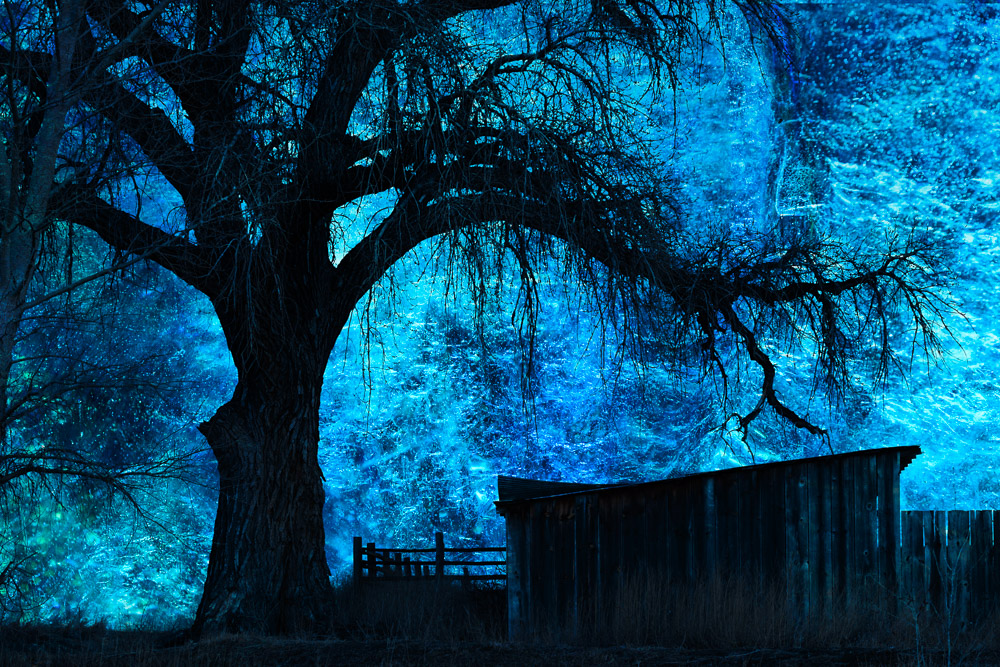
I mentioned suffering in the cold. That is the time of year I’m in as I write this. What would be worth going out in that kind of weather? Well, things like this. I love patterns and reflections in ice. It is a very interesting subject to me. This kind of shot makes me forget the discomfort and think of the beauty in unlikely places. I hope you get out and find things like this, too.
I firmly believe exploration is a foundation of art. Without it, we become stale and stagnant and eventually just start repeating the same things over and over. Exploration leads to growth and creativity.
Many ways to explore
I consider myself an explorer. It is a fundamental activity that I pursue. But I seldom go off to uncharted lands. There are countless ways to explore. Many without even leaving my studio.
Exploring often involves travel, but it also encompasses the ideas of searching and inquiry and discussion and evaluation. It is more a mental activity than physical. Just being in an exotic location does not automatically classify, for me, as exploring. That depends on what you bring from the experience.
When I read books by artists or view videos about artistic technique and thought, that is exploring. It is an inquiry process. I ask questions of myself and attempt to answer them. The process stretches us. Once stretched, we don’t come back to the same shape.
I sometimes spend hours at a time “exploring” on my computer. No, I don’t mean watching TikTok. Exploring editing possibilities and compositing possibilities. Reviewing images and trying to discover new things in them.
When I go out wandering in my local neighborhood, that is exploring. I do it with an open mind, seeking to see things in a new way. It is amazing that I can usually find new sights or see familiar ones in a different way. That is exploring.
Feed your creativity
At the heart of exploring is curiosity. Curiosity is the fountain that waters art. We need to have an active and healthy curiosity to sustain us.
Most people aren’t overly afflicted with curiosity. Is your curiosity a living and active part of you? We have various needs that have to be met, things like food and shelter and emotional satisfaction. I consider my curiosity almost on that level. I wouldn’t die physically if it died, but mentally and emotionally I would be very damaged.
Curiosity can be fed and nurtured to help it to thrive. There are many ways and I’m sure each of us responds in different degrees to each. Some that work for me are reading, learning new things, looking at good art, listening to intelligent people talk, a change of scenery, and play. All of them are consciously done activities that stimulate my brain. I believe this is very important for a healthy, creative life. The fact that you are reading this means you probably feel the same.
The one that probably seems out of place to most people is play. Are you too serious and grown up to play? I hope not. It is actually very important. In a newsletter, Srinivas Rao once said “When we play, we return to a childlike state of curiosity”. I believe this attitude is important for artists. Through play we discover opportunities to extend our artistic vision.
If you believe something is interesting, you are right. Go with it. Follow it to see where it leads. Considering something play lowers the barriers of expectation. No big deal if it is a failure – we were just playing. Brilliant!
Get out of a rut
Without experimentation that is driven by curiosity, we get stuck in ruts. We repeat the same old way of seeing and thinking all the time. Do you have any self imposed “I always do it this way” limitations? We need to view life fresh. Spend a certain part of your time just playing and trying random and ridiculous things. Do something silly. Have fun.
Brooke Shaden once said creativity is curiosity + experimentation. I think that is a good viewpoint. Experimentation helps us discover new things to encourage us to climb out of the rut. Curiosity drives the experimentation. I think most exploration begins with “what if…”.
Head in the clouds
Has someone told you you have your head in the clouds? They were probably not complimenting you. Most people are so focused and pragmatic that anything other than today’s goals seems useless. As artists, we can’t be that. We are on a lifelong quest to create and see the world differently. Sometimes that is best to do from the clouds.
If I can reframe “head in the clouds” to mean healthy exploration backed by wide-ranging curiosity, then I want to be called that.
Be an explorer
Become an explorer. That doesn’t necessarily mean we have to jump on a plane to a remote corner of the world. Your attitude determines it. It may just mean going outside with a fresh, new attitude. Let your curiosity guide you. Give yourself permission to play, to experiment, to do silly things. Shoot something new. Go extreme in post processing. Find new themes. No telling where that might lead.
I consider myself an explorer. It is the way I live my life. It has nothing to do with how many frequent flier miles I have. Wherever I am and whatever I’m doing I’m looking at interesting sights, examining compositions, thinking about themes or possible projects. Curiosity compels me to always be seeking.
Today’s Image
I love this image. It is built on some things most people would never stop to look at, much less photograph. It was put together in a playful way with some post-processing magic thrown in to flavor it. Complete play. It is a joy to me. I hope you enjoy it.
For an artist, I believe perfection is a false goal. It can lead us to spend our energy in the wrong places. This seems especially true for photographers. Our technology-based art can lead us to believe technical perfection makes good art. It doesn’t. At least, not by itself.
An absolute
I am a recovering Engineer. I know a lot about specs and technical details and I am naturally drawn to “perfection”, whatever that is. As photographers, we tend to be pulled this direction. Are there any overexposed highlights? Do the shadows contain some information and very low noise? Did the lens and sensor resolve every bit of detail that could be used? Was “proper” technique used to maintain total sharpness and low noise? Did it follow the “rules” of composition?
More and more I am convinced these things are relatively unimportant compared to the impact of the image on the viewer.
Normal people view and enjoy prints at a distance of about 1 1/2 times the diagonal measure. Photographers tend to press their nose right against the print to try to see any imperfections. Yes, I do too at times. But this is not realistic or very important for normal viewers.
One of the themes I enjoy at times is images that have super high detail. Images about complexity and texture and the details of the material. I have good equipment and I am OK at using it, so I can do that whenever I want. Some subjects seem to lend themselves to it. But I don’t think I have any images that I consider great solely because of their technical perfection.
A moving goal
And what is “perfection”? Who defines it? Is such a thing achievable?
Our technology is constantly improving and pushing the boundaries back. The camera I use now is vastly better than the one I used 10 years ago. It has higher resolution, lower noise, and wonderful new features like live histogram view. These things let us achieve ever better results with our craft.
Likewise with printers, drop sizes get smaller, allowing for sharper prints, inks get better permanence, and printers get larger. Along with that software technologies improve all the time. We can upscale and sharpen images with much less artifacts. New algorithms can reduce noise without materially damaging sharpness. It’s a great time to be a photographer.
Is this perfection? Sure, a photographer can put his nose up to a large print and see “perfect” detail, low noise, great edge sharpness, and smooth tonal gradation. Is that what perfection is?
So is perfection the absence of any artifacts and a hyper-realism that looks sharper than real life? That is nice, for some images, but I do not believe it is what perfection is.
Why perfection?
Before I attempt to get in over my head, I will ask why we need perfection? Does it make better art?
I have seen prints by Ansel Adams, Edward Weston, Stiglitz, and many others. Many are stunning and have amazing presence, but not all are technically perfect. At least, by today’s standards. I have also seen many paintings by Monet, da Vinci, Rembrandt, PIcasso, O’Keeffe, etc. Again, I would say that the great ones may not be because of perfection in the sense I have been discussing it.
Craft trumps perfection
Take Ansel Adams for example. He shot mostly 8×10 negatives and spent many hours producing a print. But, the film technology he had was arguably not as good as modern high-end medium format sensors. And his lenses were not particularly good compared to modern designs. Some of his prints are not as technically “perfect” as many artists at their studio today making a print on their Epson or Canon printers.
But there is something else that overrides the technical limits. There is a magic in what he brought out in the printing process. He was a marvelous craftsman. He knew how to work an image until it changed from an average original to a stunning final print. “Moonrise, Hernandez” is a classic example of that. He shot it quickly because he was losing the light. So quickly that he couldn’t find his exposure meter, so he had to guess. Because the negative was badly exposed, it was very difficult to print. It required many hours of work in the darkroom to create a rendition of it. But it became one of his masterpieces. The final print is far superior to the original capture.
As he himself said
A photograph is not an accident it is a concept. It exists at, or before, the moment of exposure of the negative. From that moment on to the final print, the process is chiefly one of craft; the previsualized photograph is rendered in terms of the final print by a series of processes peculiar to the medium.
Ansel Adams
Adams was very good at all the aspects of photography. But in my opinion, it was his craftsmanship that made him rise above most everyone else. He would work a print until it glowed and had a life in it. The tones and contrasts and lighting were amazing. The results he created went far beyond considerations of technical perfection.
Story trumps perfection
I include story here because I believe it is powerful. But in general I struggle some with the concept. In a sense, story happens automatically. If you pause to examine a print for more than a couple of seconds it is natural to build a story. Humans naturally seek meaning and story. Guiding the viewer into seeing a more interesting story is a plus, both for the viewer and artist.
I do prints. Generally single images, meant to hang on a wall. To me, it is difficult to tell an extensive story with one isolated image. Not that it can’t be done, but I don’t see it happen as much as critics and some artists want us to believe. Probably the Engineer in me is still too literal.
I think this is a great story captured at, what Cartier-Bresson called “the decisive moment”. As you look at it, you tell yourself a story about what is happening, why he is doing this, what he is thinking, what happens next. It is still a memorable image today, even though it is under exposed, the subject is slightly blurry, and, depending on your notion of proper composition, the guy being about to disappear out of the right frame can be a problem.
It is a great and famous and beloved image. Being technically perfect would not have improved it at all.
Emotion trumps perfection
Emotion is something I have struggled with for a long time. I now believe that if I can’t make you feel something about my print, it is cold and sterile. I believe it so much that I feel that emotion far outweighs technical perfection. This is one reason I have been doing more ICM (intentional camera motion) projects lately. It throws out all notions of sharpness and detail and focuses mainly on capturing a feeling or impression.
Emotion in art has been written about a lot lately, but let me repeat and reinforce it. If I can’t make you feel something of what I felt when I made the image, I have probably failed.
There are techniques for creating an emotional response, but I am not concerned with them here. The fact is, we have to do it. As an artist, I have to share my feelings in an image or there is not much interest for the viewer.
Sharing and being transparent is a challenge for some of us (me). I am learning. The results are apparent to me. An image with a depth of feeling has more impact and staying power. Sigh. I will just have to force myself.
But the point is that an image that touches you emotionally is more meaningful than one that is just technically perfect.
Table stakes
So perfection, mostly technical perfection. Where does it fit? Am I saying it is not important? No. A technically perfect image may be excellent, but not just because it was perfect. It also has to embody emotion and story and excellent craft. Perfection is a table stake. It has to be there in order to get in the game. It is not the game itself. Art has to go beyond technical measures.
Today’s image
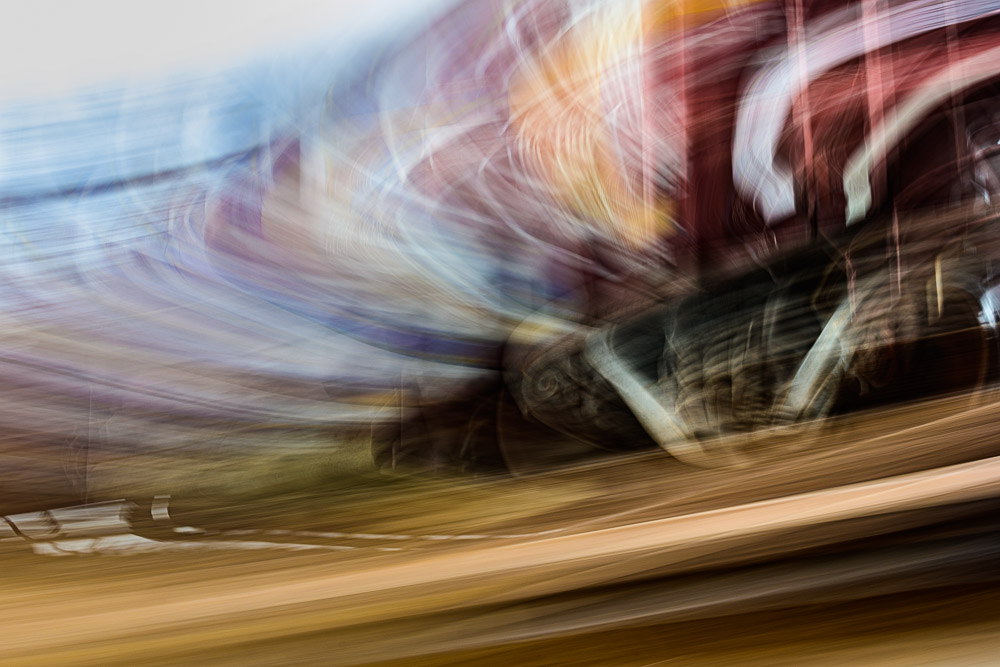
Earlier I mentioned ICM as a tactic I have been using occasionally to break away from the feeling I needed technical perfection. This image is an example of that. It is from a series I did called Speeding Trains. The intent is to capture the sight and feeling and power of a huge train speeding by. I hope you like it. Read the artist statement and see the rest on my web site.