Does your art excite you? Does the joy or inspiration of your work make you come alive? If not, why do you think it will effect anybody else?
Are you bringing anything?
Your audience can pick up on how you feel about your work. Are you excited? Can you not wait to show this to people? Do you have so much fun doing what you do that you don’t want to do anything else? Why not?
In my opinion, a lot of photographic art I see these days is pretty empty or depressing. Perhaps you are compelled to try to make a statement about environmentalism or social justice. That probably means you should consider yourself a photojournalist. Document your cause if that is what drives you, but can you also bring beauty and interest and hope? Can’t it be visually or emotionally appealing? Just because it is a serious subject doesn’t mean it has to feel like a news story on CNN.
And the post-modernism that prevails leads to banal and emotionally void expressions. Just pointing your camera at 2 guys sitting in their back yard drinking a beer doesn’t necessarily make a picture I feel drawn to look at. And just because you used some forgotten wet plate process to print this image in a gritty, blurry way does not make it more valuable to me. Don’t you have anything to say?
Does your work energize you?
This is your art. What you see and feel. Surely you think it is worthwhile. If not, why are you wasting your time and energy?
I have heard the definition that your art is “what you can’t not do”. This is pretty good. Most of us have to create art. We would go crazy if we couldn’t. There is a drive in us that needs this vehicle of expression.
For me, when I fall into a nest of images I am excited and energized. I lose track of time. Even when I am seeing the images before me, I am planning what i am going to do with them and how I will bring them more to life. It enlivens me.
This is one of the things I love about photography: of all the art forms, this is the one with the least barrier between inspiration and capture of an image. See it, shoot it. No real preparation or long time to produce a work. I am very visual and immediate. It suites my makeup very well.
The great Jay Maisel is a wealth of quotes and wisdom about image making. A couple of favorites I continually remind myself of is “If the thing you’re shooting doesn’t excite you, why makes you think it will excite anyone else?” and “Photography is an act of love.”
Why should people be motivated by your work?
There are billions of photographs out there with billions more being added every day. How can I have anything new to say? What a bleak prospect!
But I occasionally do have something new to bring to people. Those times where I am feeling alive and energized and excited can produce images that will stop people and compel them to look.
I am motivated by this quote:
“Don’t ask yourself what the world needs; ask yourself what makes you come alive. And then go and do that. Because what the world needs is people who have come alive.”
Howard Thurman
When we’re feeling most alive people can see it in our work. We have something to offer that people need. And it is more satisfying.
So why should people be motivated by my work? I’m an artist. I have a unique and creative point of view and this image was motivated by me bring alive and in touch with what I was feeling. That is hard to find.
Sometimes we forget that anything created has a creator. Which is greater, the creator or the thing created? Ask yourself this. Which is more important, the art or the artist who created it?
Creation
I’m mainly talking about art or artistic things here. The idea could apply to much larger contexts.
Anything that exists was created, or at least designed, by someone. By saying “someone” I am stating my belief that an AI is not a creator, because it cannot feel inspiration or passion.
Whether it is a picture or a sculpture or music or poetry or a book, it could not exist unless and until an artist created it. In the context I am talking about here, things do not spring into being out of nothing. There was nothing, then an idea formed in the mind of the creator and something was made real.
The creator can do it again
I guess one reason I felt compelled to write this is because I see people behave in ways I consider unthinking. We tend to be enraptured with some work of art as if it was the most wonderful thing in the world. Ignoring the fact that it was created by someone, and that should make them as the creator even more special than the creation.
Yes, if the creator is dead then the work that is left is a singular entity that cannot be duplicated. This would be true of works by Monet or Mozart or Michelangelo. No more will be created. Respect and admire them as unique works of art. and while you’re doing that, consider the genius of the creators who did them.
But the problem I have, even with dead artists, is our tendency to focus on the creation instead of the creator. If you took any work by a living artist and completely smashed it or wiped it out, the artist could create a new one, probably better. Not a replica, but an entirely new work of creation. That is the amazing thing we seem to lose sight of.
The artist created the amazing work we revere. But he can create a new one, maybe better. That puts the creator in the more important role. The created work may be excellent, but the ability of the artist to create it and others is more important.
Way marker
A great work by an artist represents an idea at one point in time. That is, this was what the artist felt and conceived and had the skill to do at the time. Artists grow. Later he might approach a similar work from a whole new point of view or with new materials or techniques he just developed.
So a work by an artist as a young person may be great, but later works show growth and development and change of attitude. The creation of a great piece of art is not a singular event for an artist. That work does not represent the pinnacle of his career or ability. It is just the pinnacle as of then.
The works are way markers along the journey of the artist. Looking back as a retrospective they may change and evolve over the years, along with the artist.
More coming
I think the proper attitude when discovering a piece of art you love is to say “Wow, that is great. I can’t wait to see what you do next!” The artist is the creative engine. The work is the byproduct.
Our attitude should be to encourage and support the artist. To let them continue to tap into their well of creativity and produce new things to amaze the world. If an artist created a great work, it could have been an accident, a one-off. Probably not, though. Greatness seldom comes out of a vacuum.
A great work is evidence that the artist can create great works and we should expect more to come.
I often write about carrying a camera all the time and even using it as a tool to get into a flow state for photography. I just did the opposite. I went off on a 3 day trip with no camera. Well, my phone, but I didn’t use it.
Why take a camera
I have said that having a camera with me gives me license to think photographically. It is true. This technique often helps be get off dead center and get moving.
Most of the time, the feel of a familiar camera in my hand and the click of the shutter propels me into a creative zone. I start seeing possibilities I was overlooking before. After the first frame or 2 things start to flow.
I wrote a couple of weeks ago about side trips and excursions. One example I used was taking my wife to the airport then wandering in the eastern Colorado plains. What i didn’t say was that I drove for a couple of hours without “seeing” anything to shoot. Finally I basically forced myself to get out the camera and shoot a couple of frames. After that I “found” over 300 images by the time I got back that evening. About 1 per mile that I drove. Some were quite good. Many more are ones I’m glad I shot, just for the experimental value if nothing else.
On the other hand, I sometimes, but rarely, deliberately leave the camera at home. I mentioned the trip I took last week where I did not take the camera.
There seemed to be a need to back off some. This is unusual for me, but I sometimes get so far behind in my processing that I feel like I am just shooting blindly and loosing touch with my work. And getting un-creative and un-inspired. So I decided to slow down producing images and work more on assimilating what I have already done.
I have slowed down shooting for a couple of weeks, but I haven’t completely stopped. Given that, though, when this short trip came up, I reluctantly talked myself into altogether abstaining by not even taking my camera. It is the first time I have done that for a long time.
OK, it was frustrating at times, but not as bad as I thought it would be. Granted, this was a fast family trip and I knew the weather would be bad. Those things helped. But before it would not have dissuaded me.
In a strange sense, it was kind of liberating to not feel any pressure to take pictures. It did not stop me from practicing composing images in my mind. But since it was impossible to shoot them, it as all just a fun creative exercise.
Recharge
I’m pretty good about having accurate intuition about what I need to do for my physical and mental health. I think I realized I was getting a little burnt out and needed to back off some. This exercising of depriving myself of the opportunity to shoot was actually kind of refreshing.. It was a recharge.
Just the 3 day event was healthy and useful but not enough. I plan to stay slowed down for a few more weeks. It will let me decompress and get back in touch with my current work and what directions I am going. Some of the time can be used to re-evaluate and do some soul searching. And to catch up with culling and filing and processing.
If you are doing intense physical training it is critical to plan in rest days. Otherwise your body breaks down and you do more harm than good. Likewise if you are doing intense mental activities like studying for finals, you have to take breaks to let your brain catch up and process information.
I think it is the same thing with art. We love doing our art. We want to do it. But we need to realize our body and mind need to rest sometimes.
Go off and do something unrelated. Take walks without a camera. Read a book. Write letters – remember paper and pens? Start a journal. These are good for your mind and your creativity. It recharges us and prepares us for the next intense push.
I consider my experiment of leaving my camera at home on that last trip to be a success. Sometimes it is more productive to not do anything.
The image
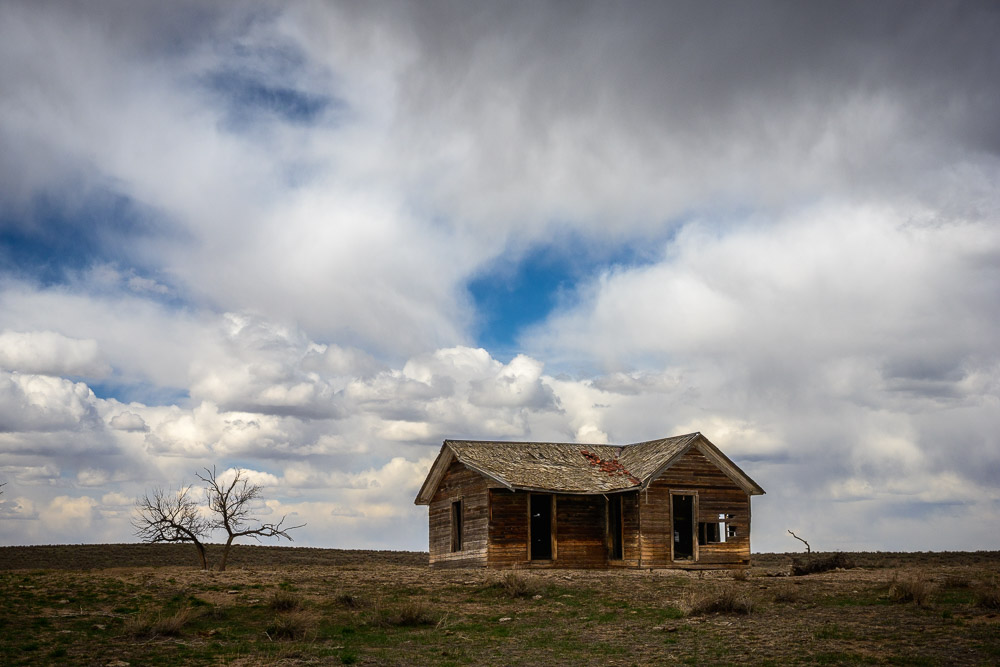
The image today is one of the ones I shot on that day I described when I took the excursion in eastern Colorado. I like doing portraits of weathered old houses like this. It was probably abandoned during the Dust Bowl days. Nothing but clouds to the horizon.
I didn’t show any pictures from the trip where I didn’t take a camera, because, well, I didn’t take any. 🙂
You saw something that excited you. All your experience and great camera gear was used to capture it. You poured your heart into representing what you felt. Now what? For fine art, no matter what we felt, now we have to make the best image we can. We have to let go of what we saw and figure out what can it be. Now it takes on a new life.
Capture time
When I am in the field with my camera, I have to use all my skill to compose and create the best image I can. I’m speaking for myself, because all my work is captured outside. The same idea would apply in a studio.
Something caught our eye. We were reasonably sure there was a subject there worth spending the time on. We completely fell in love with what we saw. That is great. If we can show that emotion and enthusiasm to our viewer, they should be drawn to the image just as we were.
So we work the scene. Design the composition. What is the best position to capture this? The right lens to use? Decide when and where the light is best, Does the background and foreground need work? What depth of field does this need? Work through the technical settings: aperture, shutter speed, ISO, focus, expose to the right but don’t burn out the highlights. It is on a tripod, of course.
In the field the process becomes a pleasant dance intertwining the technical details, the changing light, compositional tweaks, and the “decisive moment“. If we are new to it, there is a lot to try to think about in real time. If we are extremely experienced, we tend to get in the flow and let our subconscious take over. Either way, at capture time, we are intensely focused on getting the shot.
Associations
This (potentially) great image we just shot has a lot of personal baggage attached to it. We bring back all the associations we had in the field. This image has meaning for us in various ways. It may remind us of something significant from our past. We might be proud of a compositional trick we used that we have been wanting to try. It could be one of our favorite places we love to go back to. Or possibly our association is how cold or hot or wet or windy and uncomfortable it was.
Every image has associations from when and why we created it. We have memories, feelings, expectations.
But guess what? No one cares. Sorry. Well, the associations may make the image significant to me, but that is a don’t care to someone else unless I have a chance to tell them the story of why it is special. I seldom get the chance to describe my feelings, except in the image itself.
The reality is that my viewer is going to look at the print and decide what they feel or like, without having those associations I have. They see it fresh and in a completely different context. The image has to stand on its own and be accepted for what it is.
Letting go
So I’m back in my studio working on an image. At this point, I’m working on the image to be seen and appreciated by someone else, not myself. To get in the right mindset for this, I have to let go of the associations I feel for the image. The image has to stand on its own.
This is not saying I should forget the feelings and emotions I had. No, they are important. They form the base of why I responded to the picture. But what can I do to help my viewer see something of what it meant to me?
A technique that works for me is letting the image age. If I wait long enough before processing it, there is time for the raw emotions and the visceral experience to develop context in my mind. It helps me to see past the excitement of what I felt and look at it with more objectivity.
Let me give a not entirely made up example. Say I trekked in to a beautiful spot through deep snow. I’m standing on fairly slick rock at the precipice of a canyon. It is snowing lightly and very windy. I’m a little concerned about the wind and the slick rock sending me over the edge to a 100 ft fall. It is very cold. I’m tired and chilled, but the scene is beautiful. Worth the challenge and discomfort. I love it.
As I snap the picture, all these feelings are imprinted in my memory along with the image. The difficulty and stress and physical sensations impart more importance to the image than it may deserve.
It is all new in post
My point is that in post processing, our job as an artist is to finish the image into something our viewers will appreciate. We have to be free enough of our own associations that we can look at the picture and see what the viewer will see.
The feelings we felt and bring with us are still extremely important. This is the reason why why we made the image in the first place. But the viewer does not know what we felt unless we can convey some of that in the image itself.
What can we do now, sitting at our computer in a warm, comfortable studio, to bring those emotions to the viewer?
One thing I am learning is that I have to let go of a technician’s purist view of the reality of what the scene was. We have a wide array of tools available to us in post to make the image stand out without destroying the “truth” of the scene.
We’re expected to remove that offending tree or boulder that interferes with the sight line or takes attention away from the part we want the viewer to concentrate on. We can do color and brightness correction to get the overall tone to match what we felt. Dodging and burning will do wonders to change the perceived tonal values and let us emphasize or de-emphasize areas.
Crop it to a different aspect ratio? Of course. There is nothing sacred about the camera’s default crop ratio. Stretch things in one dimension? Sure, the wide angle lens made the mountain range seem less impactful than I remember. Stretch them some. That is not being false.
Pre-visualization
Many authorities say we should always pre-visualize our images. I take this to mean we should have worked out the details of what the final print should look like before we take the picture. That works for some people, not for me.
I’m more ADD. When I am in the field, I like to be in a flow state. I shoot instinctual, emotionally, drawn by what inspires me at the moment.
Of course I have a good idea of what I will end up with based on my experience and knowledge of the technology. I usually can predict how far I can push something. This is in the background, though. I try to not spend much conscious time thinking about the details while I am shooting.
Two images
So for me, every shot basically creates 2 images. The first is what i see and capture in the field. The second is how I interpret and morph the final print. They can be very different.
Both the images are dependent on my mood, perception, mindfulness, creative flow, health and intent at the time. All images are interpretations of a scene. If I went back to a scene another day, I would shoot a different picture. If I post processed an image I love a second time, I would probably end up with a different result. It is art. It is subjective. There is not right or wrong, only better or worse.
All of this is to try to convey our feelings and impressions to our audience. A straight, unprocessed image will never let my viewer see my intent. Like a movie, what matters in the end is the effect it has, the feelings it makes us feel. My image has to stand on its own and be accepted for what it is.
Who gets to judge art? What criteria do they have to use? Is it objective? This is a difficult subject and I will probably step on some toes. Judging art is something we all do. When we see art, we judge it. How should we do it?
This is actually a pretty good definition, but it leaves a lot of room for interpretation. Basically if the artist says it is art, it is. This includes the picture on your fridge your 6 year old drew
But 2 people can go out to the same location and paint the same scene and we will look at them and say one is valuable and the other is much less so. Why is this? Does it have to do with the skill of the artist, their creativity, their choice of color palette?
Even if we acknowledge them both as art, we will judge that one is “better” than the other.
Is Photography art?
Let me take a side track to address photography; a subject near and dear to me. I am a photographer, so I may be accused of bias.
I will hedge some and claim that photographs can easily be art, but not all photographs are art. Billions of photographs are taken every day (yes, Billions). The vast majority are selfies, friends, or food shots. These are taken as a record of something. Even the person snapping the picture does not consider it “Art” in the formal sense with a capital “A”.
But a few images are taken to be art. They are created by human skill and creativity. These images seek to show us something new or in a different way. The photographer is expressing something fresh and unique.
These rare images are art. Every bit as much as a symphony or a sculpture or a painting.. You may disagree that much skill is involved, but try it. Try creating photographs at this level. This isn’t getting to the top 10% of the photographs taken, but rather something like the the top 1 in 10,000,000. I consider creating a great photograph a life altering exception. If you can do that regularly, you are truly a top performer.
Twelve significant photographs in any one year is a good crop.
Ansel Adams
Is it good enough to just be “pretty”?
In Better Photography magazine* issue 111, Tom Putt describes the challenge of selecting images for his gallery in Australia. He laments that local customers want to see “pretty” pictures of the area, but he would prefer more abstract, edgy images that show off his artistry. He even clearly states that the prints that sell in galleries are not the ones that win awards in competitions.
I share the feeling. If I show what I consider a very creative, artistic image to most non-artists I get a polite “that’s nice”. But if I show a nice landscape to them I get a “Oh, wow; that’s very pretty!”. I can’t criticize them. The landscape is much more relatable to where they are. Mostly it is curators and avant-garde collectors and other artists who value the non-traditional work.
I used to get upset when someone said my work was pretty. Now I just say thank you. I’m glad to bring them something that meets their criteria for good art, even if I disagree with its true artistic value. I would be happy to sell them something they like.
Who gets to judge artistic merit?
So who’s call is it? Who judges the merit of art? Actually, we all do and nobody does.
Everyone is entitled to their opinion of art according to their criteria and values. Even if the intelligentsia with credentials and large followings disagree, what you like is good art to you. I will no longer try to educate people to show them how their opinion is immature or unsophisticated. Actually, it may not be. I have come to see how they may be educated and sophisticated enough to know what they like. I am happy for them.
And there will always be the self-appointed gate keepers who want to dictate style and judge competence.
It is impossible for art, or any of the higher creative activities, to flourish under any system which requires that the artist shall prove his competence to some body of authorities before he is allowed to follow his impulse.
The artistic police always tend toward building up their cause and rejecting new or differing work. As a matter of fact, their blinders usually make them incompetent to judge truly new and creative work.
What is the criteria for judging art?
When people are honestly trying to judge art, how are they to go about it? They must have some criteria to raise it above just “I like it”.
This is an area where I feel the gatekeepers are doing artists a disservice. When I apply to a show or a contest or a gallery, I get back a “sorry, you weren’t selected.” or a “congratulations, you were selected.” But in either case there is no criteria stated up front or feedback as to why my work was selected or not. I am getting very frustrated with this.
In most cases I have to pay to submit to a show. For that fee I don’t get back much value. There may be a theme stated for the show, but no actual criteria for judgment. I feel that we should get back some useful feedback. I am not seeking a full portfolio review, but this should be professional practice. Artists are the lifeblood of galleries and the galleries should be taking a long term view to help develop upcoming talent.
But even if they are not going to take an enlightened long view like that, I feel that we deserve to know the criteria for judging and how we were scored. Even in my local camera club competitions way back, every photographer heard a discussion by the judges and knew how the evaluation of their entry was derived. When I was a new photographer that was extremely valuable. It should be taken to a higher level now for professional artists. Otherwise we are feeling blindly in the dark.
Why is some art good?
So 2 artists are creating art at the some time. Why is one significantly better than the other? It could simply be skill. One of them has studied and practiced far longer and better than the other. Or it could be natural talent.
I used to write software. Numerous studies showed that some people have a natural talent for performing at a higher level than the norm. In the case of software, even with the same education and experience, differences of 20 to 1 in productivity were seen. I suspect it is similar with artists.
Or is could be their vision and creativity. This can’t be measured or quantified, but it makes all the difference.
Where does creativity come in?
Imagine again the 2 artists standing on the bank of the Seine River in France painting a landscape scene before them. One is an acclaimed Realist painter of the era. He renders a very skillful, detailed representation of the scene. The other is Claude Monet. He sees the same scene totally different. The painting he creates looks nothing like the one done by the man standing next to him, even though the subject is the same.
Monet’s impressionistic style was initially rejected and unpopular, He was criticized and mocked by the learned critics of the day. But today a significant portion of the people on the planet know Monet and recognize his work. Even after 100 to 150 years we still line up for hours to see a collection of his paintings. On the other hand, I bet you can’t name even one of the popular and well regarded Realist painters of his day.
This is the edge that creativity brings.
How about feeling?
We constantly hear that an artist needs to convey what they felt about the subject. I usually agree with this, although it is hard for some subjects. Most of the time, when I make an image, I am asking myself what I am feeling and how I am showing that to a viewer.
How does a viewer judge feelings? Isn’t it totally subjective? One viewer can look at a picture and break down in tears because of the associations and meaning it invokes in them. The viewer beside them may say “yeah whatever…” Obviously one was touched and the other wasn’t.
Was the problem of not reaching the second viewer the artist’s or the viewer’s? Maybe neither. If the artists did what he could, that’s all he can do. We don’t all react to the same things. We all have different criteria of “goodness” in art. Let’s acknowledge that and make it more transparent.
So, judging
We all judge art when we see it. Most of us probably are not practiced in introspecting and analyzing our response. So all we can say is something like “I like it”.
The professional gatekeepers who judge shows and contests and gallery submissions should be held to higher standards. Artists should get better feedback on their submissions. Even if a juror told me “My training and curation experience is in post-modernism; your entry did not fit that style so I was unable to evaluate it well.”, that, at least, gives me some good data. It is an honest response. I know I will not be accepted in a show this juror is judging. Even better would be for the show publication to state clearly that the theme is Urban Decay and the juror will be giving special consideration to post-modernist work. Here is a link to see other shows she has curated.
If criteria were made clear, even at such a rudimentary level, we would have much better guidance. I would know not to not submit a lovely landscape sunset to a show that was only going to consider gritty post-modern images. Even better, if I got actual feedback from the juror on why my image was or was not rejected, I could learn. I could evaluate where I stand against their criteria and decide if I need to change or find a new venue.
What judging counts?
Judging happens everywhere and all the time. What is important?
As I see it, there are 3 primary audiences to consider. The first is me. I, the artist, must decide how I feel about this image I have created. I must be able to express why it was made and how I felt and what I was trying to say with it. If I can do this and I am happy with the image, that is of first importance.
The second consideration, I think, is the viewer. They are the intended audience for the image. If someone likes one of my images and purchases it to hang on their wall for their pleasure and to show other people, that is high praise and it does not matter what any gatekeeper may say about it.
Lastly and least are the myriad of gatekeepers. Those who give anonymous judgment of our images according to secret criteria. Since they are working behind the scenes in secret, they are basically a Star Chamber court.
I am disappointed when I am voted out by one of these secret courts, but I refuse to take it as a judgment against my work. Since I don’t know the criteria used, I assume my work did not fit the pattern they are “promoting” in their curation.
So, we are all going to be judged whenever our work is seen. Accept that. Art judgment is not objective. It cannot be. But when someone other than a potential purchaser “votes” us down, ask what criteria was used. Understand the criteria and we understand the judge. Know that these 3rd party judges generally have their own agenda they are following.
And remember, when we get bad feedback, the judgment is on the piece of art, not us personally.
Footnote
Better Photography magazine is a lovely publication edited by Peter Eastway. Peter is an amazing Australian photographer who justifiably has multiple Professional Photographer of the Year and similar awards. I get no compensation from them. I just want to point this out as a fresh and interesting publication run by extremely knowledgeable and talented artists.