An artists journey

Category: Artistic Process

  • Go Out Empty

    Go Out Empty

    I often advise us to go out empty. This, at least, fits my working style and my personality. I don’t always follow my own advice. And regret it.

    Go out empty

    Go out empty is famous advice from the great Jay Maisel. What he meant is to not have preconceived ideas of what you want to photograph. Instead, be mindful (I doubt if he used that expression) and react to what you find.

    That way you will get the maximum good from the situations you encounter instead of being disappointed with not finding exactly what you wanted to find. What’s there might make an interesting picture. What’s not there, well, that doesn’t make much of a picture.

    When he lived in downtown Manhattan, Jay was famous for going out on the streets every day just wandering and taking pictures. He would occasionally get great images. Sometimes nothing. But even with nothing, he was not disappointed in not finding what he was seeking, since he wasn’t seeking anything in particular.

    I have been to New York City and I will be quick to admit that the streets there are far more interesting than the streets of my small little town. But still, I believe the principle applies wherever we are.

    I believe the basic premise of what he is advocating is to find joy in what you are shooting. Really look at it, Discover the interest. Be receptive. Inspiration is overrated. Shoot interesting things.

    No planning?

    Does that mean we should never plan anything? No, there are times to plan. Even Jay would plan carefully when he was doing commercial shoots. For instance, he shot the first Sports Illustrated Swimsuit covers. He had a crew and models and scouted locations, etc.

    When someone is paying you for results, you have to deliver what they want. This will involve careful planning and preparation.

    What I am discussing, though, is what most of us “fine art” photographers do when we are shooting for our own satisfaction and creativity. Different people have different personalities, but I am in the group that does best when reacting to scenes rather than trying to set them up.

    Falling into the expectation trap

    I advocate going out empty and I usually do it. But on a recent trip I fell into the trap of setting expectations for what I wanted to photograph.

    I was in central Florida visiting family. One afternoon I was able to slip away for a few hours to visit a favorite nearby place, Lake Louisa State Park. It has lakes and beautiful trees and swamps and incredible red water.

    A few times before I have found and photographed some gorgeous trees. In my mind, that is what I wanted to revisit and explore. It didn’t work out well. This was summer, not winter, and the foliage was very different. Some trails had been re-routed and I could not find the trees I wanted. And it was miserably hot and raining. Not al all pleasant or condusive to what I wanted to do.

    I was very disappointed until I reminded myself to explore what is there, not get stuck on what wasn’t. It was actually beautiful when I let myself see it. With the storms, the sky was very different from what I had seen before. The rain give a different look to the tree trunks and foliage. After some false starts, I was able to get some interesting shots before the thunderstorms and pouring rain chased me out.

    Don’t do what I did

    Do not fall into the trap of letting preconceived ideas block your creativity. Be mindful of where you are and what is there. Get into the flow and work the scene. Make something out of what you find. Look at your surroundings fresh and discover the good that is there.

    Today’s image

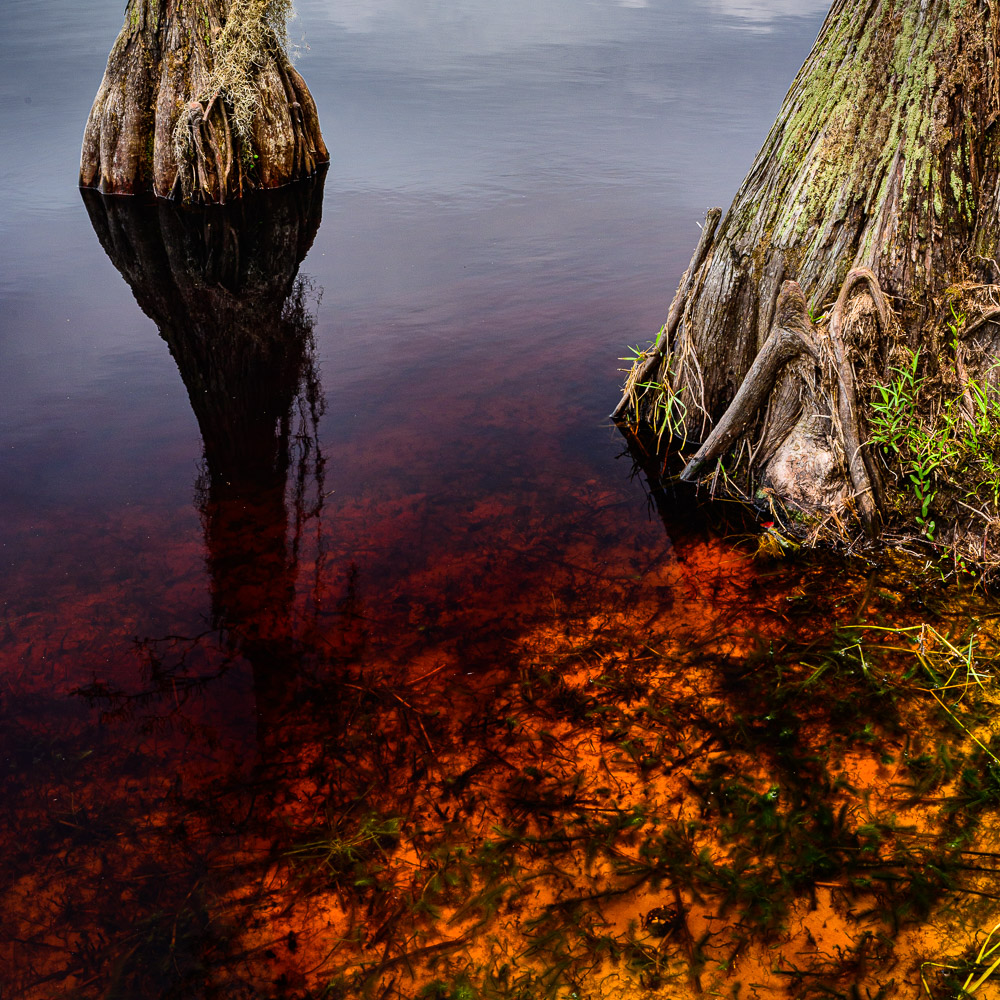
    The image today is from this aborted trip to Lake Louisa. It was during the calm before the storm. That really is the color of the water. It contains lots of decayed vegetation that has flowed slowly through the swamp and turned that color. Not what I expected to shoot, but beautiful and interesting.

  • If You Can’t Beat ’em

    If You Can’t Beat ’em

    You have probably heard the old phrase “if you can’t beat ’em, join ’em”. It can actually be pretty good advice for some situations. Sometimes it is better to abandon your preconceived assumptions and respond to the actual conditions.

    Previsualization

    Many famous artists, from Ansel Adams onward, preach that we should previsualize the end result before we shoot. One accepted meaning of it is that the photographer can see the final print before the image has been captured. In other words, based on his experience, the photographer knows what end result he will be able to achieve before pressing the shutter release.

    Mr. Adams, ever the teacher, broke it down into 4 steps:

    1. Need or desire for the picture. Why are you taking it?
    2. Discovery. Recognize the essential composition that can be made.
    3. Visualization, the process of anticipating what the result will look like.
    4. Execution. Doing everything right to make it happen. This is image capture through post processing.

    I would not go on record as disagreeing with Ansel Adams, but I think there are a few assumptions wrapped up in this that we can look at. The advice may not be a universal truth.

    For one thing, if you are a commercial photographer contracted to get a certain image for a client, yes, planning and previsualization is important. Also, if it is a “one in a lifetime” situation where you know the opportunity will never repeat for you, be very diligent and make sure you get the shot you want when you have the chance.

    But another angle I don’t think I have heard talked about is personality. Some people are naturally planners. They work best when they are following a carefully thought out script. They need a high degree of structure in their environment. Other people don’t work that way.

    Generational changes

    And consider the differences in technology and capability of editing now compared to Mr. Adam’s day. You can see that we tend to favor a different style of capturing images.

    For Mr. Adams, making an image was slow and expensive and fairly difficult. A lot of heavy gear had to be set up. Looking at the upside down color image on the ground glass of his view camera and trying to visualize the resulting black & white print took a lot of skill and experience. And the 8×10 film sheets were expensive and he could only carry a limited number with him in the field. So yes, previsualization was necessary in that generation.

    Now, though, digital imaging is “free”. And we have great sensors and real-time histogram displays. Most of us can immediately see a fair representation of the captured image on our camera screen. We know what we captured.

    Since the images are basically free and quick to do, we can “work a scene”, shooting and looking at the captured images while we hone in on the result we want. We should seldom have any question of whether of not we captured the image correctly. The larger question is, did we get what what we want. It is not uncommon to shoot several or even dozens of images to finalize the result we want.

    Trying to force it

    Now I will readily admit that I am much more in the “no planning” side. I enjoy spontaneity.

    Something I see at times that makes me sad is photographers who go out with a rigid expectation of what they will accept. Many of them tend to battle against conditions they cannot overcome and go away disappointed. Maybe even feeling like a failure.

    In deference to the planners, I love this quote from a great planner:

    “In preparing for battle I have always found that plans are useless, but planning is indispensable.”

    Dwight D Eisenhower

    Thinking through the situation and trying to anticipate what may happen can give great insight on what we may decide to do. However, once the battle starts, e.g. we are in the field to make the image, nothing is likely to go as planned.

    Adapt

    When we discover that our plans are falling apart, we can double down and try to force it to work, or we can adapt and reevaluate what we can do.

    One aspect of creativity is to be flexible, to adapt to the situation and make the best of it. Make the best of the situation. Perhaps you got to the great scene and it is raining or snowing. Not what you planned. Use it. Get what you can. The result may be even better than what you planned.

    One of the principles of improvisation artists is that each step is “yes, and…”. That carries the momentum forward to the next step. Whenever you say “no”, it blocks the flow and makes it hard to go forward. So don’t block your flow. Respond to whatever situation you encounter and creatively figure out how to use it.

    Let it flow

    As artists, we are trying to creatively interpret the world around us. I find an ideal to enable this is to get into a flow state. This seems to be a peak of creativity and energy and concentration. This lets us work with the situation rather than fight it.

    Previsualization can give us an idea of what we want to achieve. We might even make the image as planned. But never overlook the opportunity to make a more compelling and engaging image.

    Maybe we do not get the image we anticipated. Often we get a better one. But even if it is a disappointment, as long as we did the best possible in the situation, we should be happy. I have said before that it is better to be lucky than good. But this is not luck. It is creatively adapting to circumstances.

    Today’s image

    This is a “bored at an airport” image. While waiting for a flight I wanted to capture scenes of airport operations. But I was frustrated by the reflections I could not eliminate. They were interfering with the image I had in mind to create.

    But on some thought, I discovered that maybe the reflections were integral to the scene. People waiting patient and trusting while a huge amount of complex logistics of running an airport went on just outside. Outside of their interest and curiosity. They just wait like cattle until their flight is called.

    This was definitely a “if you can’t beat ’em, join ’em” situation. I think the resulting image is better than what I originally set out to make. What do you think?

  • Not HDR

    Not HDR

    My last article sang the praises of HDR processing. I don’t want to over sell it. Today I will try to balance it by showing we typically do not need to use HDR.

    The good

    My previous article attempted to show when and why to use HDR. There is a time and place for it. In general, if a histogram shows more than about 7 stops of needed information then I would consider HDR, if the subject and situation allows it.

    The example I used was a scene with the sun visible in the frame but where I also wanted to preserve the deepest shadows. Back in the film days we had to use a split neutral density filter over the lens to try to compress the dynamic range in these situations. Whenever you would have reached for the split ND filter is the time to consider if you can use HDR instead.

    The bad

    But HDR has some problems and limitations. There is the dreaded “HDR look” that most people want to avoid. In addition, there are problems with subject movement and extra processing steps to do.

    When HDR first became available, people tended to go crazy with it. It was almost a symbol of showing off the new technique. The HDR look was over compressed with flat tonality and lack of true whites or blacks. Sure, I could shoot that scene with a 20 stop range and make a print. Too bad it looks weird. It became almost a cliche. Many “serious” photographers shunned it as looking artificial. It got a bad reputation.

    But the problem was how people used it, not the technique itself. Almost any technique can be over used to create unappealing images.

    There is also the problem I mentioned with subject movement. To create a good HDR image there must be very high correlation between the pixels of each exposure bracket. That is, there can’t be significant movement.

    And there is the extra processing. This is not too big of a problem anymore. We can quickly do HDR processing from within Lightroom or Photoshop or your software of choice. It is probably easier now to do it than it was to adjust a split neutral density filter and figure out the exposure.

    Why we don’t usually need it

    Trust your sensor and the processing software on your computer. Modern high-end camera sensors are amazing. They record the greatest dynamic range of information that has ever been possible in photography. I’m sure it will only get better with new generations of equipment.

    My camera records a far greater range of information than it is possible to print. Prints are my gold standard. They are the expected outcome of my work. A surprising fact to many is that, although it is hard to compare because the physics are totally different, the effective dynamic range of print media is around 6 to 8 stops. So making any print has some aspects of dealing with HDR data, since the captured data is probably much greater than the final print.

    OK, so I am shooting a high contrast scene. I am careful to allow a little space on each end of the histogram, so say I am dealing with about 12 stops of range. The reality is that, for most needs, this can be used to make a great print.

    But that 12 stops of data has darks that are down dangerously close to an unacceptable level of noise. And the brights are dangerously close to clipping. Is that imperfection OK?

    How to process extreme ranges

    This is not a tutorial on photographic processing. You can find too many of them on the web. I will just give some suggestions. In Lightroom (Classic – the only version I think is worth using) just the 6 controls in the Tones section of the Basic panel can do wonders. And I seldom use Contrast, so there are really 5 most important ones.

    Use Whites and Blacks to set the overall white and black points as desired. Then I often use Exposure to balance the overall tonal range. Finally I use Highlights and Shadows to fine tune the tones.

    These simple adjustments, along with some tweaks in the Presence section, can do amazing things to “rescue” most images. These are probably an 80% fix for most situations.

    Of course, when I select an image to print, I will spend a lot more time working on it. A lot of work will be done with curves and masking and doing fine adjustments. Sometimes I will send it to Photoshop for very detailed tasks that cannot be done in Lightroom. Editing an image can take many hours. Most of us are pretty obsessive about our work.

    My point here, though, is that most single captures have enough data to make a great print or other final image. Sometimes we just have to work with it a little.

    Maybe you don’t want it

    The look of your final image is an artistic decision. It is not dictated by the “reality” of the original scene. You or I as the artist decide the look we want. What we decide is “right”, at least for us.

    So I may not want to create a perfectly balanced image that retains all the tones and data of the histogram. I may want to crush the blacks to make a moody, low key image. I may want to over brighten the image to make an ethereal scene. It is not written anywhere that the final print must look exactly and faithfully like the original scene.

    This is where artistic intent comes in.

    It is not numbers

    I want to end with the point that we are creating an image, not manipulating numbers. Well, we are manipulating numbers, but that is not what counts. What counts is the look and expressiveness and quality of the finished product.

    Photography is the most technical art, but do not be dictated to by the technology. Do not let someone say you can’t do something because the numbers are wrong. All that counts is the final art you create. Emotional response trumps technical excellence. How does it look to you?

    Example

    The image today is a full histogram spread. Single capture. I think this kind of thing comes out OK. What do you think?

  • Come Alive

    Come Alive

    Does your art excite you? Does the joy or inspiration of your work make you come alive? If not, why do you think it will effect anybody else?

    Are you bringing anything?

    Your audience can pick up on how you feel about your work. Are you excited? Can you not wait to show this to people? Do you have so much fun doing what you do that you don’t want to do anything else? Why not?

    In my opinion, a lot of photographic art I see these days is pretty empty or depressing. Perhaps you are compelled to try to make a statement about environmentalism or social justice. That probably means you should consider yourself a photojournalist. Document your cause if that is what drives you, but can you also bring beauty and interest and hope? Can’t it be visually or emotionally appealing? Just because it is a serious subject doesn’t mean it has to feel like a news story on CNN.

    And the post-modernism that prevails leads to banal and emotionally void expressions. Just pointing your camera at 2 guys sitting in their back yard drinking a beer doesn’t necessarily make a picture I feel drawn to look at. And just because you used some forgotten wet plate process to print this image in a gritty, blurry way does not make it more valuable to me. Don’t you have anything to say?

    Does your work energize you?

    This is your art. What you see and feel. Surely you think it is worthwhile. If not, why are you wasting your time and energy?

    I have heard the definition that your art is “what you can’t not do”. This is pretty good. Most of us have to create art. We would go crazy if we couldn’t. There is a drive in us that needs this vehicle of expression.

    For me, when I fall into a nest of images I am excited and energized. I lose track of time. Even when I am seeing the images before me, I am planning what i am going to do with them and how I will bring them more to life. It enlivens me.

    This is one of the things I love about photography: of all the art forms, this is the one with the least barrier between inspiration and capture of an image. See it, shoot it. No real preparation or long time to produce a work. I am very visual and immediate. It suites my makeup very well.

    The great Jay Maisel is a wealth of quotes and wisdom about image making. A couple of favorites I continually remind myself of is “If the thing you’re shooting doesn’t excite you, why makes you think it will excite anyone else?” and “Photography is an act of love.”

    Why should people be motivated by your work?

    There are billions of photographs out there with billions more being added every day. How can I have anything new to say? What a bleak prospect!

    But I occasionally do have something new to bring to people. Those times where I am feeling alive and energized and excited can produce images that will stop people and compel them to look.

    I am motivated by this quote:

    “Don’t ask yourself what the world needs; ask yourself what makes you come alive. And then go and do that. Because what the world needs is people who have come alive.”

    Howard Thurman


    When we’re feeling most alive people can see it in our work. We have something to offer that people need. And it is more satisfying.

    So why should people be motivated by my work? I’m an artist. I have a unique and creative point of view and this image was motivated by me bring alive and in touch with what I was feeling. That is hard to find.

    Come alive and create exciting art.

  • The Art or the Artist?

    The Art or the Artist?

    Sometimes we forget that anything created has a creator. Which is greater, the creator or the thing created? Ask yourself this. Which is more important, the art or the artist who created it?

    Creation

    I’m mainly talking about art or artistic things here. The idea could apply to much larger contexts.

    Anything that exists was created, or at least designed, by someone. By saying “someone” I am stating my belief that an AI is not a creator, because it cannot feel inspiration or passion.

    Whether it is a picture or a sculpture or music or poetry or a book, it could not exist unless and until an artist created it. In the context I am talking about here, things do not spring into being out of nothing. There was nothing, then an idea formed in the mind of the creator and something was made real.

    The creator can do it again

    I guess one reason I felt compelled to write this is because I see people behave in ways I consider unthinking. We tend to be enraptured with some work of art as if it was the most wonderful thing in the world. Ignoring the fact that it was created by someone, and that should make them as the creator even more special than the creation.

    Yes, if the creator is dead then the work that is left is a singular entity that cannot be duplicated. This would be true of works by Monet or Mozart or Michelangelo. No more will be created. Respect and admire them as unique works of art. and while you’re doing that, consider the genius of the creators who did them.

    But the problem I have, even with dead artists, is our tendency to focus on the creation instead of the creator. If you took any work by a living artist and completely smashed it or wiped it out, the artist could create a new one, probably better. Not a replica, but an entirely new work of creation. That is the amazing thing we seem to lose sight of.

    The artist created the amazing work we revere. But he can create a new one, maybe better. That puts the creator in the more important role. The created work may be excellent, but the ability of the artist to create it and others is more important.

    Way marker

    A great work by an artist represents an idea at one point in time. That is, this was what the artist felt and conceived and had the skill to do at the time. Artists grow. Later he might approach a similar work from a whole new point of view or with new materials or techniques he just developed.

    So a work by an artist as a young person may be great, but later works show growth and development and change of attitude. The creation of a great piece of art is not a singular event for an artist. That work does not represent the pinnacle of his career or ability. It is just the pinnacle as of then.

    The works are way markers along the journey of the artist. Looking back as a retrospective they may change and evolve over the years, along with the artist.

    More coming

    I think the proper attitude when discovering a piece of art you love is to say “Wow, that is great. I can’t wait to see what you do next!” The artist is the creative engine. The work is the byproduct.

    Our attitude should be to encourage and support the artist. To let them continue to tap into their well of creativity and produce new things to amaze the world. If an artist created a great work, it could have been an accident, a one-off. Probably not, though. Greatness seldom comes out of a vacuum.

    A great work is evidence that the artist can create great works and we should expect more to come.