An artists journey

Category: Art

  • Reality

    Reality

    As an artist, is reality our goal? Should we focus on depicting reality perfectly? Is art just a representation of reality, or is it something more?

    Reality leaves a lot to the imagination. – John Lennon

    Can a great image be “real”?

    To be honest, no. A 2 dimensional image expressed using pigments or pixels is not the same as a real scene. But you say, “yes, but the image ‘looks just like’ the original”. Actually, in most cases it looks either the way the artist remembered it or how they wanted it to look or how they wanted you to think of it looking.

    All photographs must be processed a lot to be presentable. Even Ansel Adam’s famous prints are based on many hours of darkroom work for each one. And for Ansel or any of us, the prints produced of an image change over time. So either reality changes with time or art is not reality. That is, as the artist’s vision and taste changes, the processing of an image changes to reflect it. This represents the artist’s interpretation, not reality.

    Is reality the goal?

    I don’t know of any genre of art where reality is the actual goal. Let’s say you are shooting images of birds for a birding book. Is reality the goal? I would say no, you want images that allow the reader to see the important characteristics of the bird. If that means distracting elements must be removed or colors enhanced or “corrected”, then these will be done for the sake of clear communication.

    The beautiful landscape print you bought to hang on your wall because it reminds you of a favorite place is not “reality”. Colors are enhanced, contrast is boosted to make it more dramatic, even mountains may be “stretched” some to make them more pronounced. None of this makes it a fake. It resonates with you as the way you remember it.

    This article will use a lot of quotes. I want to make the point that this idea is not just my ravings.

    “My goal as an artist is not to try and replicate reality , but to cross into the world of fantasy. This is a much easier sell because reality is what we see every day. The world of fantasy is a way of escape.” Joel Grimes

    “Fine art photography should be an escape from reality.”  Joel Grimes

    “A photograph is not reality, it is at best, a representation or illusion of reality.” Joel Grimes

    One reason Joel Grimes has credibility with me on this topic is because he is color blind. Yes, a color blind photographer. And he is famous and well respected. Rather than considering it a handicap he uses his color blindness to further his artistic vision. He is obviously not trying to duplicate reality when he does not even see the same reality most of us do.

    I’m not suggesting we all try to copy Joel Grimes’ work. I will not. It is very good, but it is not me. My hope is that you will see that reality can be a false goal.

    Did it really look like that?

    I get asked this a lot and I often struggle to answer. The obvious answer is “no, of course not”. But I have to try to read the questioner to try to determine what they mean by the question. Is the questioner just naive because they do not understand the process of art? Do they really believe that the picture should look like the reality? Are they wistfully hoping there is a place that really looks like that? Or are they trying to “trap” me into admitting that I “faked” the image?

    Usually I reply with a fairly generic answer like “that’s the way I saw it.” When the question is asked like this it is probably not the time to get into a long discussion of art vs. reality.

    But you probably understand that reality is not my goal and that all images are heavily processed. Never accept a picture as truth.

    Reality

    What, then, is the purpose of an image? In a way this is another way of asking what is real. I will go out on a limb and say that the artist helps bring reality to an image by their interpretation. The great Australian photographer Tony Hewitt says to “Look at the everyday ‘real’ in an entirely different way.” And he does this very successfully. His images are “of” real scenes, but they don’t look like what you would have seen standing there with him. They are more.

    A photograph is more than its subject. The real challenge is to make something out of nothing. Geoffrey James

    It is my responsibility as an artist to try to make you feel what I felt about the subject. If you see an image that is just a factual portrayal of a scene it will not hold your interest for long. But if I can give you an emotional connection it will have lasting power.

    Resonance

    Let me introduce the concept of resonance. In physics it is sound emitted from an object based on its vibration. That’s precise, but cold.

    Think of a bell. Strike it and it rings with a certain sound and it continues ringing for seconds. That is the bell’s response to the energy you gave it with the strike.

    In an artistic sense, I see resonance as the thought or feeling or memory invoked by a piece of art. Something about the work “resonates” with you – it, in effect, makes you vibrate or tingle. This resonance can happen when I am able to convey to you the emotion I felt when I discovered this scene and captured it.

    A resonance like this goes beyond the surface image. You feel a connection or it produces an emotion in you that makes you keep coming back to look at it. This is what I seek to do.

    This resonance is different than just “reality”. It is more important than the reality. What you feel is what you will remember. This is the significance of the image.

    Reality

    So, perhaps the “reality” of an image is the way it made you feel. This was your subjective reaction to what the artist gave you. It is your interpretation, your internal processing that lets you buy in to it and embrace it. It becomes reality through your personal response.

    Do not confuse what is visible with what is real: despite a degree of overlap, they are not the same thing. What’s real about an expressive image is never its objectivity, but how it is subjectively perceived.  – Guy Tal

    It may be a misconception to talk about art as “real” or not. Art cannot, of itself, be reality. The reality is what you create for yourself based on your emotional reaction to the work that the artist put his effort into.

    So, the “Real World”, what is it? Where is it? I believe that for art, the “real world” is our personal reaction to the piece. Was the artist successful in making you feel what he felt? Did you feel something completely different but meaningful to you? If you didn’t feel anything, you won’t remember it or have any attachment to it. We create our own artistic reality through our personal reaction.

    I believe it is my duty as an artist to help you feel my emotional connection to an image. If I can do that the image will become reality to you in a whole new way. If I cannot do that, I have failed and the image will be unimportant to you.

    So in a sense, reality is my goal. But it is not the reality of a faithful rendering of what was in front of the camera. It is the reality of trying to have you share my emotional reaction to the scene, and having you reawaken this feeling whenever you see the picture.
  • Inspiration

    Inspiration

    Inspiration, or lack of it, is a fear and concern for almost all artists. If we’re not feeling inspiration right now we fear we’ve dried up and our days as an artist are past. If we’re awash in inspiration we may feel overwhelmed.

    I’m mostly going to discuss the lack of inspiration, since that is what we typically fear.

    Be open

    If “the muse”, or whatever your view of inspiration is, doesn’t seem to be hanging out with you, what can you do? My experience is be patient and spend your time wisely while you’re waiting.

    Open yourself to stimulus. Take a walk. Read a book. Watch a training video. Look at another artist’s web site and/or blog. Visit museums or galleries. All these things can energize you and refresh your spirit. We are all different in our makeup, so what works for me might not work for you. That’s OK. Keep trying things until you find something that pumps you up.

    Creativity exercises

    When your “normal” work doesn’t seem to be going anywhere, it’s a great time to do some of those personal projects you have wanted to get to for a long time. Do something different. Something outside of your normal style or subject matter.

    It’s a complete no risk venture. If you decide it is a complete failure, fine. Now you know. Write that one off and try another. Jay Maisel once said “If it’s not working, go have a good glass of wine and then try something else.” But if you love the results maybe you have learned something new about yourself. Maybe it will stretch you and even take you in a new direction. Doing something is better than doing nothing.

    If you are a traditional landscape photographer, try something like street photography. It will be so different that it will make you reevaluate a lot of things. If nothing else it should be refreshing.

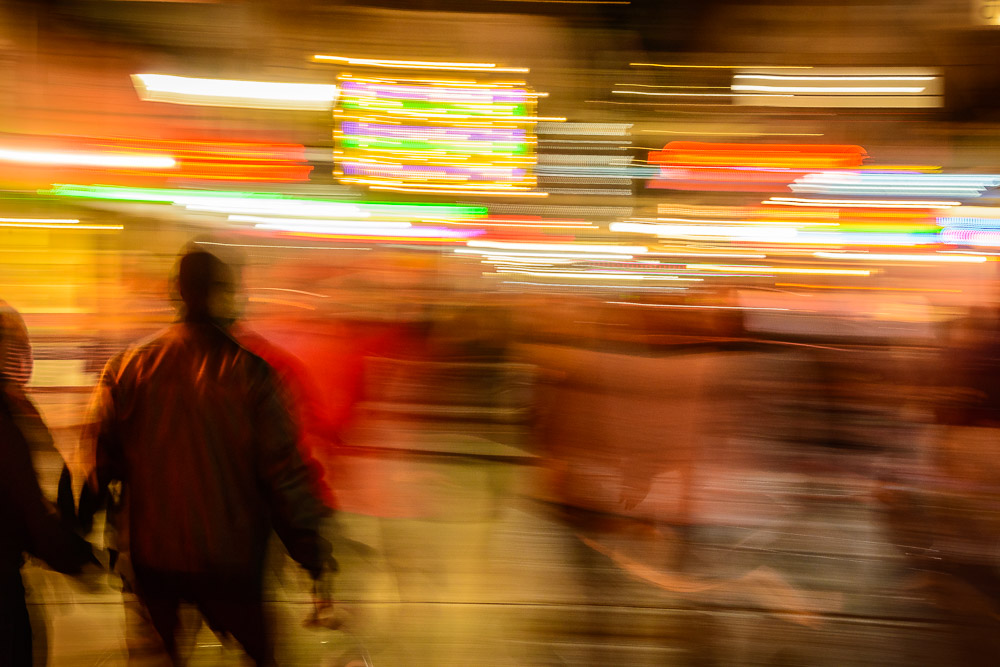
    Do you pride yourself in tack sharp, crunchy, high detail shots? Great. I love that, too. But spend some time doing blurred images. Do handhelds at slow shutter speeds, even introducing intentional camera motion. No, really. Try it. You may see whole new opportunities and new creative possibilities.

    I have talked before about exercises like going out with one lens. Give it a try. It forces a new thought process on your creativity. You will have to reevaluate some things about your composition and style. Some of them may influence changes. But even if not, it is something fresh and different that may energize you.

    A sense of wonder

    My work is strongly influenced by a sense of wonder towards the world around me. Honestly, sometimes I don’t feel it. The wonder and inspiration is gone. What can I do? I can’t make interesting images if I don’t feel excited about things.

    One thing is to give myself permission to acknowledge that I’m in a slump. I am very lucky to be what is called a “fine art” creator. As such, I don’t have to perform on schedule. Clients do not contract me to create something to their specification at a certain time.

    That is not accidental. I spent a long career working for other people and having to be driven by external demands. When the opportunity came, I re-molded my life to give myself freedom. I realize this may not be possible for you, but I’m being honest about my situation and the options I have.

    Giving myself permission to not have to create takes a lot of pressure off, but not all. I really don’t like not feeling wonder. It is frustrating and sometimes scary. I get impatient, wanting to move on NOW. Part of what I have realized is that patience has to be balanced with action.

    Confidence to wait

    Over many years of experience, I have learned that inspiration will return. It is important to develop the confidence that you are creative and that the feelings will return, probably even better than before.

    If you were creative in the past it did not just get used up. Creativity is not a fixed quantity that you exhaust. It is a skill and an attribute of our wondrous minds. But life is cyclic. You have ups and downs. sometimes you have to just “hunker down” and ride it out. That implies being content to wait, to be patient. You can do that if you believe it will come back.

    I believe there are things we can do to open us up to allow the creativity to flow again, but we cannot force it. If we try to force it we will get frustrated and disappointed and afraid. It will seem like the more we try to make it happen the further away it is from us.

    Giving yourself permission to not have to do the greatest work of your career today does not mean sit and not do anything. Action is important.

    Put in the reps

    As I said earlier, I believe there are useful things we can do to open ourselves to feeling the inspiration again. Things like going for walks or going to museums or looking at the work of other artists. And creativity exercises can help to stimulate our subconscious.

    But a simple and often overlooked thing is to “just do it”. Practice, practice, practice. Put in your reps. Don’t worry if you are not producing masterpieces. A great basketball player will spend hours a day in the gym just shooting baskets and practicing layups. That is not “game level” intensity. But it trains the muscles to do the right thing. That builds confidence and mastery over time.

    At this point, though, don’t overthink the problem. That will make you freeze up. Let it work itself out. I often quote Jay Maisel. One of his quips is “Don’t overthink things in front of you. If it moves you, shoot it. If it’s fun, shoot it. If you’ve never seen it before, shoot it.”

    Magic happens

    I find that when I make myself get out and do something, it is like the basketball player who can do well in the game because he did the practice. For me, the click of the camera shutter is a kind of magic. It is a sound I subconsciously associate with creativity and making images. Things often start to flow, even when I did not feel “in the mood” going out. Even if they don’t, it is good for me to be out practicing.

    So inspiration is not the end all. No inspiration does not necessarily mean just sitting in our room moping. Get up, get out, do something. If you are moving and taking action you are much more likely to start feeling inspiration. You don’t have to do your best work every day.

    To close with another Jay Maisel quote: “If you are out there shooting, things will happen for you. If you’re not out there, you’ll only hear about it.”

    How do you deal with slumps of no inspiration? Let’s talk!

  • What’s Right

    What’s Right

    Dewitt Jones often makes the point that the mantra of the National Geographic is “celebrate what’s right in the world”. He even has a TED talk about it. At this point in history focusing on what’s right seems like a great idea.

    National Geographic

    Ah, National Geographic. What a great institution with an excellent brand image. How many of us suspect our parent’s houses are held up mainly by the stacks of yellow magazines in the basement? If you are old enough you remember eagerly claiming your time to read each issue cover to cover when it arrived. The photography was amazing and the photographers were idols to us aspiring artists.

    I suspect Mr. Jones is right that one reason for it’s success is that it was positive, uplifting, showing the good side of places and issues. That seems so foreign in today’s world. It is expected now to show how bad everything is. To show the dark and depressing and gloomy side of every issue. Where are you when we need you, National Geographic?

    Some things are depressing

    It is absolutely true that there is disease, poverty, instability, pollution, economic uncertainty and political division all around. But does that need to be what we’re focused on? Is it really healthy and helpful? If we just moan about it without doing anything doesn’t that just make us more depressed?

    Dr. Martin Luther King said “Darkness cannot drive out darkness; only light can do that. Hate cannot drive out hate; only love can do that.” I believe this to be a very true statement.

    When we focus all our attention on how bad things are then everything seems bad. The attitude pervades our life, polluting all we see. That is a choice.

    Art, too?

    Doesn’t it seem that art, too, suffers from darkness and hate these days? There is a lot of dark, empty art. Like many artists seem caught up in depression and can only create brooding, depressing work. Does it have to be ugly now days to be art? Why?

    And we are told that everything has to support a social cause, otherwise it is not worthwhile. Who says? There are a lot of great causes, and a lot of bad ones. What you choose to support is your decision. But art should transcend the cause. Art should be art independent of the social or cultural context. If you are trying to produce art mainly in service to a cause, it might be propaganda. I am passionate about some causes, but they only indirectly influence my art.

    Can anything be done?

    Is the world too far gone to change? Does an individual have any power to effect things?

    I can’t change the world. I can only change me. The world is made up of individuals and each of us can make our own decisions about our values and behavior. Are you restricted to doing certain things or believing certain ways because your Facebook crowd says so? Break free. Are you going to hate everyone who doesn’t believe in your cause because a powerful influence leader says to? Run away.

    Be yourself. Make your own decisions.

    The sources of information we follow have a huge influence on our life. I won’t get into an argument about “fake news”, but a safe starting point is to believe that most everything you hear is wrong, or at least biased. So listen to many viewpoints and make your own decision. Be a grownup. That builds personal integrity.

    If the information you follow is talking about how terrible events or people are but not offering practical and positive solutions to improve things, they are just spreading fear and division. We have enough of that. Stand up for yourself. Go your own way. It doesn’t matter how famous or respected they are.

    And art?

    This blog is supposed to be about art. Being an artist exposes our beliefs and outlooks to the world. What has yours been looking like lately? What do you respond to? Writing about his WW2 years in Nazi Paris, Picasso said the artist “is a political being, constantly aware of the heart-breaking, passionate, or delightful things that happen in the world, shaping himself completely in their image.”

    I suggest we practice being positive and encouraging. Both in our art and our lives. Not just responding to what happens but consciously shaping our response. Being positive is not a Pollyanna, head-in-the-sand avoidance of the pain that is around. It is an effort to make what we touch better. To make people around us better and more able to cope with life. And to make ourself better.

    What do you love? What do you consider good and beautiful? Show it in your art. Help people see something uplifting. Bring joy, not sorrow.

    Maybe National Geographic had the right idea. Maybe focusing on what is right with the world would do a lot more good than harm.

    Be an individual. Be an artist. Don’t be afraid to follow your own values and beliefs. Try to be a positive influence on everyone who sees your work.

  • Obsessive Clicking Disorder*

    Obsessive Clicking Disorder*

    How many images do you click off of a scene? Why? Our wonderfully fast cameras have enabled this thing I have heard called “Obsessive Clicking Disorder”. When we see a scene that looks promising we can blast away at 5 or 10 or maybe 20 frames a second to “make sure” we get the shot.

    I claim that that is often self-defeating, even lazy.

    Machine gunning

    So we point our camera at the scene and machine gun it for 30 frames. We are afraid we might miss “the moment”. Machine gunning is a brute force technique.

    Think about the shooting metaphor. A rifle allows a skilled shooter to place a single clean hole right where he wants it. A machine gun sprays bullets all over the place in an uncontrolled way. The single rifle shot is elegant and controlled and disciplined. To me it is craftsmanship.

    Those of us shooting fairly static and predictable subjects can usually take the time to wait for the right moment and fire off just one or two or a few frames. And, of course, if you are taking long exposures you’re not going to be firing away at high speed. Less can be more.

    Bracketing

    Another time where lots of images are captured is bracketing. In certain situations this is completely appropriate. Our marvelous sensors have a great dynamic range, but sometimes scenes require more. Exposure bracketing might come to the rescue by allowing an HDR compression of the range.

    Do very many of your situations actually require this? I couldn’t put a percentage to my work. But I know it is only the occasional high contrast situation that forces me to use it. The extra work and the varied results of HDR processing make me try to avoid it where possible. And scenes with movement are often not good candidates.

    Be aware

    But what is the alternative to obsessive clicking? How can you get the shot of the fleeting moment?

    To me the answer is being aware and attuned to the action going on. If we train ourselves to anticipate the “decisive moment” and be ready for it, we can capture it and know we have it. A good DSLR is fast (10-20 mSec to trigger an image capture, maybe even faster if using electronic shutter). Compare that to machine gunning at 10 frames a second. That is one image every 100 mSec. But within the regular, unvarying 100 mSec ticks a person can move a few inches or blink. You are just hoping that the odds will work in your favor. And often they do.

    An alternative, though, is to focus on the moment, the gesture. You might be amazed at the ability you can learn to recognize and capture that peak time when the gesture and the eyes and everything is right. Triggering the shot then will usually get the scene you hoped for.

    Gesture

    The incredible Jay Maisel describes this as waiting for the gesture. That is his version of the decisive moment. When we get in the flow and are completely attuned to the subject we can usually anticipate when these great gestures will happen. Wait for it. If you are concentrating, you will have time to press the shutter and get it.

    “Such moments are fleeting, requiring more than fast autofocus and reflexes. It demands that the photographer be able to read a scene as it’s playing out. He or she had to understand that all moments evolve, having a beginning, middle, and end. With that understanding, the photographer can anticipate that peak moment where all the visual elements or light and shadow, line and shape, color and gesture culminate in a moment that can only be captured in a fraction of a second.” Ibarionex Perello

    I find this is a wonderful and rewarding skill to learn. It is precise and immersive. You become highly engaged in the scene and the action. You learn to grasp the whole gestalt while still triggering on that perfect instant. It is a great feeling.

    Have you experienced it? You know it’s coming. You are in the right place to view it. Almost, Wait for it. NOW! When you hit the shutter you know you have the shot. It’s a great feeling of accomplishment to know you captured exactly the gesture you were anticipating.

    There is a time

    Do I ever blast away at high speed? Well, actually no. I stopped doing that when I didn’t have any more family doing sports that I was shooting. I do use exposure bracketing at times. On occasion I even take exposure bracketed panoramas.

    I recognize that there are times when any of us will take lots of frames. I’m just trying to convince you that machine gunning is a sort of backup plan, not a primary strategy.

    As an example of where I would do it, I love taking images of reflections in water. This is a dynamic scene that never repeats. I may take a several frame sequence to capture variations of reflections so I can choose the one that works best for me. But by the argument I used before, this is not an attempt to capture a peak moment by brute force. I expect each frame to be an excellent image but hopefully one will speak to me as the best.

    Be disciplined

    At the root it is about being disciplined. Closing down our options and forcing ourselves to take one frame of the decisive moment is kind of like the exercise I recommended of going out with 1 lens. It requires us to practice and develop our skill and use our mental quickness rather than brute force.

    I believe mental discipline and the ability to make fast decisions is required for photography. Learning this skill will, I believe, help us make a higher percentages of images we are proud of.

    This is just my own value, but I have discovered that if I can help it, I really don’t want to spend the time editing through 500 shots only to throw 400 of them away. At some level it seems to me that I am shooting randomly and grasping at straws rather than being deliberate and disciplined about my work. Photography is an art and a craft. Training and experience and discipline will improve our art.

    Try it. Let me know who it goes after you practice a while.

    space

    *Yes, it is a pun on Obsessive Compulsive Disorder. I know that is a potentially debilitating disease that 1-3% of the population has. It is not something to make fun of and I am not doing that or denigrating anyone suffering from it. I am just using this well known phenomenon to make a point.

  • Being Timid

    Being Timid

    Aren’t most of us pretty timid with our art? We are intimidated to stray outside the safe boundaries of convention. We follow the trends or a favorite artist. At the root of it, we are too timid to be ourselves or go as far as our vision wants to take us.

    I hope this does not apply to you. It would be great if I am just preaching to myself. Probably not, though.

    Playing it safe

    Safe doesn’t get us in trouble. Safe doesn’t get us criticized for being weird or different. If our art is safe we will get nice comments on social media.

    At some point in our lives we will confront a dilemma, though. If our vision takes us in a direction that is no longer “conventional” we have to decide which path to follow. Do we play it safe and stick to what everybody likes or do we go where our vision is taking us?

    Going our own way is not safe. Just like starting a business is not safe. Or making investments is not safe. But if done well, these things usually lead to greater freedom and satisfaction than remaining in our safe boxes.

    If you keep denying your artistic values you will eventually either give up your art or lose your creativity. That seems a very high price to pay for safety.

    Who are you trying to please?

    Maybe I talk about this too much, but I keep making the point that the main audience I need to be concerned about is me. I would love for people to like my work and give me praise and buy my prints for their walls. But if they don’t and I still like my work, I’m successful. It is hard to remember sometimes, but I know it is true.

    Let me remind you that I am talking about what we call “fine art”. If you are a portrait or wedding or commercial photographer you do the work your clients want. They hired you to do that for them. You try to put your own creative spin on it, but when it comes down to it, the client calls the shots.

    In this fine art world I, as the artist, am called on to be creative, to boldly give my own interpretation. To make it my vision. If I am holding back because I’m timid then I am probably not pleasing myself or my clients.

    Don’t worry about making other people happy. If you intend to photograph as truthfully as you can, your days as a member of polite society are numbered, anyway. (Paraphrased from Stephen King)

    Are you willing to be an outcast if necessary to be pleased with your art?

    Be bold

    Timid is safe. Timid doesn’t discover new, creative things. We should, instead, take chances. Be bold. Go for it.

    I give you this advice, but I have recently discovered that I am still too timid. The epiphany startled me when I realized I am not fully following my vision where it wants to lead me. After giving the advice, I found out I was still timid. I apologize.

    I won’t go into detail, because my vision is mine and wouldn’t do you much good, but I realized I am still too conventional in my subject choices and post processing. I don’t make New Year’s Resolutions, but I have resolved to loosen up and take more risks.

    The realization that I have been stopping short of where I want to take my images was a blow to me, because I thought I was being pretty bold. It was a wake up call, but it had the feel of a discovery that was true and freeing. Long years of studying conventions of composition and post processing were deeply ingrained. I have to break through and let my imagination take me to new heights.

    How will I know if I have gone too far? It will be when I decide it’s too far. Then I may back off some.

    Only those who will risk going too far can possibly find out how far one can go.TS Elliott

    You don’t know you’ve gone far enough until you’ve gone too far. – John Paul Caponigro

    No fear

    I will try to keep this in mind as I start to experiment more. I know that there will be a lot of mistakes and failed experiments. But that is the only way to learn when you’re making a path where no one else has been.

    The magic is in you. I’m convinced that fear is at the root of most bad photography. Remember that the best photographers understand that YOU is more important than NEW. The magic is in you. – Jay Maisel

    I believe in looking reality straight in the eye and denying it. Garrison Keillor

    It’s time for me to seriously question reality. It is fearful but exciting.

    This will be an interesting journey. A growth period. A time of stress but joy. I’ve been there before and I trust my creativity and vision to take me through this to come to a new place. I hope you will come with me through the adventure.

    Let me know where you are in your journey and what you think!